
 |
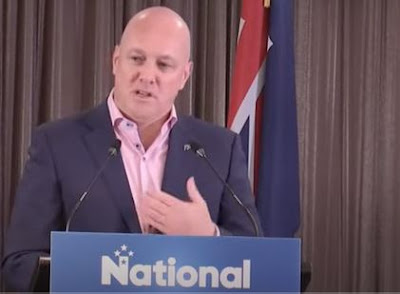
| Something Old, Nothing New: In a week when smoke billowed over Kyiv and Wellington, what did National’s Christopher Luxon offer? Tax cuts. |
IF EVER THERE WAS AN OPPORTUNITY for a conservative leader to seize the political initiative it was this past week. Seldom, in the post-war period, has there been such a confluence of disturbing and distressing events. War in Europe. Flames in Parliament Grounds. Covid-19 cases surging above 20,000 per day. Petrol prices topping $3.00 per litre.
A forceful demonstration of leadership by the Leader of the Opposition was required. A performance that not only addressed the hurt and confusion of New Zealanders, but also offered them reassurance and guidance.
On Sunday, 6 March 2022, the opportunity for a game-changing “State of the Nation” speech was right there in front of National’s Christopher Luxon.
Why didn’t he seize it? Why was his SOTN address such a limp and uninspiring effort? Political leaders worthy of the name possess an intuitive feel for what is on the voters’ minds. They don’t need a pollster to identify the main topics of conversation at the nation’s dinner-tables, office water-coolers, and public bars.
Given the week we have all lived through, Luxon’s speech should have been about security: what has happened to it, and how it might be restored. That is what the country wanted to hear, but that is not what the country got.
Luxon’s SOTN speech was straight out of National’s “Boiler Plate” file. Conventionally structured, rhetorically flat, and offering a policy package indistinguishable from all the other, equally undistinguished, SOTN speeches delivered over the past five years.
In a week when smoke billowed over Kyiv and Wellington: when New Zealanders had been frightened and angered by a series of shattering and bewildering events; what did National’s leader offer?
Tax cuts.
In a nation confronted with the enormous challenge of actually doing something meaningful about climate change – tax cuts. In a country where the restoration of social cohesion could hardly be more urgent – tax cuts. In a world where the red-lines of international conduct have been obliterated under the tracks of Russian tanks – tax cuts. (Although, to be fair, Luxon did address a few maudlin sentences to the people of Ukraine at the top of his address.)
This was not the speech of a serious – or even a very careful – politician. In his de rigueur castigation of Labour’s “socialism”, Luxon offered up the following anecdote:
“I remember sitting in a modest Moscow flat with a couple in their late 40s on a dark and snowy afternoon. It couldn’t have been clearer that socialism – in terms of Government control of everyday life and lack of rewards for hard work – had abjectly failed and actually created misery.”
Except that the Soviet Union blipped-off History’s screen in 1991 – when Luxon was still a university student. The earliest he is likely to have visited Moscow as an employee of Unilever was sometime after 1993. That would put his Moscow family squarely in the period of Neoliberal “Shock Therapy”. It was a time of accelerated social and economic collapse when millions of Russian workers lost their jobs, their homes, their pensions, and their hopes. The Yeltsin Years, when average Russian life expectancy actually fell.
If you’re going to sing the damnations of Soviet socialism, it helps to belong to a generation old enough to remember it!
The “Moscow Family” story is, however, illustrative of the “paint-by-numbers” approach of Luxon’s speechwriters. Clearly, the National Party possesses no one as talented as John F. Kennedy’s Ted Sorenson, or the US Republican Party’s Peggy Noonan and Pat Buchanan. Even more clearly, Luxon lacks the literary skills of a Barack Obama. The rhetorical genius of a Winston Churchill? … Sadly, no.
Does it matter?
Surely, the preponderance of recent poll data indicates that all Luxon has to do to win in 2023 is to sit still and not be Jacinda Ardern. If he can do that for the next 18 months, then all the smart money is on him becoming New Zealand’s next prime minister. Why draw attention to yourself with grandiose speeches about the state of your country and/or the state of the world? Surely, the offer of modest tax cuts is precisely the sort of small, but ideologically reassuring, gesture that will get National over the line?
Perhaps. If all the indicators pointed to New Zealand emerging from the worst of the Covid-19 Pandemic by the end of the third quarter of 2022, with life rapidly returning to normal by Christmas – well then, sitting still and saying as little as possible probably would be the best strategy. Especially if the fast-fading Covid Crisis throws into sharp relief all the unfinished and unstarted business of the Sixth Labour Government.
But is that any longer a particularly likely scenario? Is it not more probable that the Russo-Ukrainian War, internationally, and the ongoing breakdown of social cohesion, domestically, will foster a much starker, less forgiving, and more polarising kind of politics? A politics of daunting policy options and high-stakes gambles. A politics of fearless saviours and unforgiving avengers. Luxon might just pass muster as the hero of a fluffy Hollywood rom-com, but he hardly makes the cut as a Marvel super-hero.
Certainly, there is nothing in Luxon’s SOTN address to match the tone of Jacinda Ardern’s speech following the extraordinary events of 2 March 2022. This was not a “kind” speech. Indeed, it revealed the Prime Minister’s cold fury at what had transpired on Parliament Grounds. More importantly, it drew attention to the explosion of misinformation and disinformation that had fed the violence on Parliament’s front lawn, and which continues to eat away at the nation’s social cohesion. Something, she warned, that would have to be addressed.
Set forth in Ardern’s speech are the themes that will likely drive the political discourse of the next eighteen months. Perhaps the best way to encapsulate the Government’s new strategy is to cite the title of that greatest of trade union fighting songs: “Which Side Are You On?”
In its essence, it will ask the New Zealand electorate to choose between those who understand how radically the world has changed, and how much the country needs to change if it’s to keep up; and those who refuse to acknowledge that New Zealand is well beyond being restored to something approaching normality by a handful of modest tax cuts.
In the scathing words of Finance Minister Grant Robertson:
“National is still missing in action on a plan for the major issues that will define New Zealand’s future. The speech said nothing about how we will meet the challenge of climate change or seize the economic opportunities that come from a low carbon economy to provide higher wage jobs.”
Luxon will need to lift his game by a significant margin if he is not to find himself and his party positioned on the wrong side of history.
Recalling the first verse of “Which Side Are You On”:
They say in Harlan County
There are no neutrals there.
You’ll either be a union man
Or a thug for J. H. Blair.
If Luxon lets Labour manoeuvre him into the role of J.H. Blair, then he can kiss good-bye his chances of becoming Prime Minister.
To have a fighting chance, he’ll need a lot more than tax cuts.
This essay was originally posted on the Interest.co.nz website of Monday, 7 March 2022.

