Showing posts with label State Power. Show all posts

Thursday, 17 February 2022

Reality and the Left – A Bitter Divorce.

Things Fall Apart: The events of the past ten days offer ample evidence of just how seriously social decay has weakened New Zealand society. A more confident New Zealand Left, recognising the weakness of the system, and its acute vulnerability to those who would enlist the aid of “gangsters, racketeers, swindlers, petty criminals” would have no hesitation in identifying the so-called “Freedom Convoy” as the reactionary, quasi-fascist, enterprise it has always been.

WHERE IS REALITY HIDING amidst all these claims and counter-claims concerning the protest encampment in Parliament Grounds? In an excruciatingly post-modern political moment, reality seems to have gone AWOL, leaving behind only a noisy collection of competing narratives.

To make matters worse, the state itself, supposedly the supreme arbiter of what is and is not politically real, is refusing to do its job. Even though it is his sworn duty, the Commissioner of Police, Andrew Coster, has made it frighteningly clear to the public that he lacks both the will and the means to assert the state’s authority. The New Zealand Defence Force, meanwhile, holds itself aloof from the fray. Jacinda Ardern and Christopher Luxon, powerless to intervene, look on ineffectually. The crisis deepens.

Ask yourself: what does it mean when tow-truck drivers, asked to assist the Commissioner of Police, refuse? At what point during the last decade did citizens begin to tell themselves that they had no obligations to the society in which they live? That nobody had the right to tell them what to do – not even the Police? What business is it of theirs if the people of Wellington, their neighbours, need their help?

It has been reported that at least one towie openly declared his support for the protesters encamped on Parliament Grounds. Entirely understandable. The occupiers don’t accept that their government has the right to require their vaccination against Covid-19. Nor do they believe that they owe their fellow citizens even the slightest co-operation in the fight to limit the harm of the virus. That tow-truck driver recognised kindred spirits when he saw them. Andrew Coster and Wellingtonians could go fuck themselves.

Not all the towies were so bloody minded. According to media reports, some of them were just plain scared. They claimed to have been threatened with dire retribution if they allowed their trucks to be used by the Police. Considering those trucks carried the names and phone numbers of their owners, it’s not difficult to understand the impact of such threats. Were someone to burn down a towing company’s premises, torch its trucks, that would be multiple livelihoods lost and a business ruined. Who wouldn’t think twice?

Such tactics are, however, remarkably effective. I remember reading about Jimmy Hoffa and the Teamsters’ bitter battles with the trucking companies. The bosses could rely on local politicians, local judges, local editors and local cops to defend them against Hoffa’s strikers. The union was on a hiding-to-nothing, until Hoffa reached out to the Mafia. It only took a few dozen torched trucks for the bosses to get the message. The Teamsters won their improved contract. But the spoon Hoffa took to his dinner with the Devil wasn’t quite long enough. His beloved Teamsters’ Union now belonged to the Mob.

Now, you might think that people on the left of New Zealand politics would recognise the danger of holding up the occupation of Parliament Grounds as a praiseworthy assertion of working-class power. As if poverty and marginalisation, frustration and anger, ignorance and credulity are always and everywhere evidence of moral force and progressive intent.

Karl Marx himself recognised the acute political danger inherent in what he called the Lumpenproletariat. According to the Encyclopedia of Marxism, this social formation is composed of the “outcast, degenerated and submerged elements” of industrial society:

It includes beggars, prostitutes, gangsters, racketeers, swindlers, petty criminals, tramps, chronic unemployed or unemployables, persons who have been cast out by industry, and all sorts of declassed, degraded or degenerated elements. In times of prolonged crisis (depression), innumerable young people also, who cannot find an opportunity to enter into the social organism as producers, are pushed into this limbo of the outcast. Here demagogues and fascists of various stripes find some area of their mass base in time of struggle and social breakdown, when the ranks of the Lumpenproletariat are enormously swelled by ruined and declassed elements from all layers of a society in decay.

That our society is in decay can hardly be doubted. The events of the past ten days offer ample evidence of just how seriously that decay has weakened New Zealand society. A viable Left, recognising the weakness of the system, and its acute vulnerability to those who would enlist the aid of “gangsters, racketeers, swindlers, petty criminals” would have no hesitation in identifying the so-called “Freedom Convoy” as the reactionary, quasi-fascist, enterprise it has always been.

Alas, New Zealand no longer possesses a viable Left. Identity politics has schooled a whole generation to accept the self-definitions of “oppressed groups” at their face value. Drilling down into the actual character of such groups, and scrutinising their relationship to the ruling class, is not encouraged. Even among those leftists who still acknowledge the primacy of class politics there is a pronounced unwillingness to subject movements like the Freedom Convoy to any kind of rigorous class analysis.

For these leftists, it is enough that the occupiers of Parliament Grounds are, or were, members of the working-class. So desperate are these “revolutionaries” for the slightest hint of revolutionary consciousness that they are willing to overlook the absence of anything remotely resembling a concrete programme for the social and economic emancipation of the working class. The only programme in evidence among the occupiers is the one demanding the instant cessation of all measures aimed at minimising the hurt and suffering of Covid-19.

How self-proclaimed “socialists” could possibly mistake such a noxious potpourri of anti-social attitudes for anything remotely progressive is a mystery. Perhaps it is no more than the curious allure of the demi-monde, coupled with the magnetic eccentricities of the Bohemian temperament, that has led these desperate socialists to mistake reactionaries for revolutionaries. Clearly they have forgotten that Adolf Hitler himself was a Lumpenproletarian. A more “declassed, degraded and degenerated” specimen History has yet to supply!

It was the Italian socialist, Antonio Gramsci (1891-1937) who understood most completely the extraordinary fluidity of reality in periods of acute social stress and political disintegration. Moments in history when the hegemonic explanations of the ruling-class have lost, or are beginning to lose, their power to allay the fears and misgivings of subordinate classes. In such times – and we are living through them now – people are desperate for new and more persuasive narratives about the nature of reality.

Not all of those narratives are addressed to the best that is in human nature. Sorting out the lies of charlatans and demagogues from genuine revolutionary truths isn’t always easy – especially in this age of social-media algorithms. Leftists are often surprised to learn that Mussolini was a socialist before he became a fascist.

Gramsci put it best when he wrote: “The crisis consists precisely in the fact that the old is dying and the new cannot be born; in this interregnum a great variety of morbid symptoms appear.”

Or, more succinctly: “Now is the time of monsters.”


This essay was originally posted on The Daily Blog of Thursday, 17 February 2022.

Tuesday, 4 October 2016

Watching Without Love: The Ominous Implications Of "Hobson's Pledge".

Massive Resistance: The people behind Hobson's Pledge do not appear to have given any thought to what would happen to New Zealand if their programme was implemented in full. Can they really be so naïve as to believe that the nation's bicultural heritage could be legislatively dismantled without tipping the country into the most bitter civil strife since the land wars of the 1860s?
 
LET US SUPPOSE, purely for the sake of argument, that Hobson’s Pledge speaks for the majority of New Zealanders. That Captain Hobson’s famous response to the signing of the Treaty of Waitangi, “Now we are one people”, continues to reflect the bedrock of the Pakeha electorate’s understanding of New Zealand’s essential character.
 
Let’s further suppose that Hobson’s Pledge achieves all of its objectives. That, in an orgy of majoritarian recklessness, Parliament repeals every piece of “race-based” legislation. Affirmative action programmes are discontinued. All references to the Treaty of Waitangi and its “principles” are expunged from the statute books. Iwi representation on Crown entities is ended. Special Maori representation on local and regional councils disappears. And, finally, the Maori seats, a feature of New Zealand’s electoral landscape since 1867, are abolished.
 
Now let’s try to imagine what would be happening across New Zealand as this majoritarian assault on New Zealand’s bicultural heritage was taking place?
 
Because, rather surprisingly, no such imaginative exercise appears to have been part of Hobson’s Pledge’s deliberations. It’s as though its members believe that the implementation of its programme could be introduced without anyone, Maori or Pakeha, making any serious attempt to prevent it. Even though nearly all the people whose faces appear on the Hobson’s Pledge website look old enough to remember the 1981 Springbok Tour, how to handle the inevitable public opposition to their programme is not explained.
 
This is either a manifestation of Hobson’s Pledge’s political naivety, or evidence of a much darker purpose. If a general election delivers a majority committed to enacting Hobson Pledge’s programme, then public acceptance, and acquiescence, is simply taken for granted. It will be the law of the land, and the rule of law must be upheld. At any cost.
 
New Zealand has already been given a glimpse of how high that cost might be. On 5 May 2004, the streets of Wellington were filled with Maori protesting at the imminent passage of the foreshore and seabed legislation. Estimates of the demonstration’s size vary, but there were certainly enough angry activists on the streets that day to have trashed New Zealand’s capital – if the word had been given. That the word was not given is due, in no small part, to the existence of the Maori Seats, and to the opportunity they offered Tariana Turia and her confederates for lawful and peaceful redress.
 
Consider the response of the late Sir Paul Holmes to the images of that historic hikoi: “No New Zealander, frankly, could have watched proceedings today without a sense of pride, without being gripped by the heart, could have watched it without love.”
 
Would ‘pride’ and ‘love’ be the watchwords on the day a New Zealand parliamentary majority prepared to relegate the status of the Treaty of Waitangi to “a simple nullity”? To outlaw special Maori representation? To abolish the Maori seats? Or, would the streets of the nation’s capital, and every other city in the country, be filled with tens-of-thousands of angry citizens? Not all would be Maori, alongside the tangata whenua there would be an equal number of equally distraught young New Zealanders: all of them as determined as their Maori brothers and sisters to prevent the extinguishing of Aotearoa’s bicultural dream.
 
Those New Zealanders old enough to remember the clearing of Bastion Point in May 1978 will also recall just how far the operation stretched the coercive forces available to the Crown. Hundreds of Police and NZ Army personnel were required to ensure that the removal of just a handful of protesters was accomplished without serious injury or loss of life. This country simply does not possess the resources to enforce the passage of Hobson’s Pledge’s programme without resort to deadly force. To make it happen, the state would have to order police and soldiers to kill their fellow citizens.
 
Would they do it? Would police officers use deadly force on crowds that, in a nation this small, are bound to contain friends and relatives? Can the old kupapa tribes who still make up a large part of the NZ Defence Force, still be relied upon to kill their fellow Maori in large numbers – for the Crown? And, if they can, where would that leave us? Could we still call ourselves one people?
 
Hobson’s Pledge has forgotten that Captain’s Hobson’s words were uttered in the act of solemnising an agreement that bound together two peoples. Maori at Waitangi did not agree to hand over their lands, forests and fisheries and simply disappear. But that, in the end, is what Hobson’s Pledge is asking them to do – without a fight.
 
The Settler Government of the 1860s asked Maori to do the same. They refused then, and they refuse now. And, in this century, Pakeha can’t call on 12,000 imperial British troops to make it happen.
 
This essay was originally published in The Press of Tuesday, 4 October 2016.

Monday, 25 May 2009

Dangerous Winners

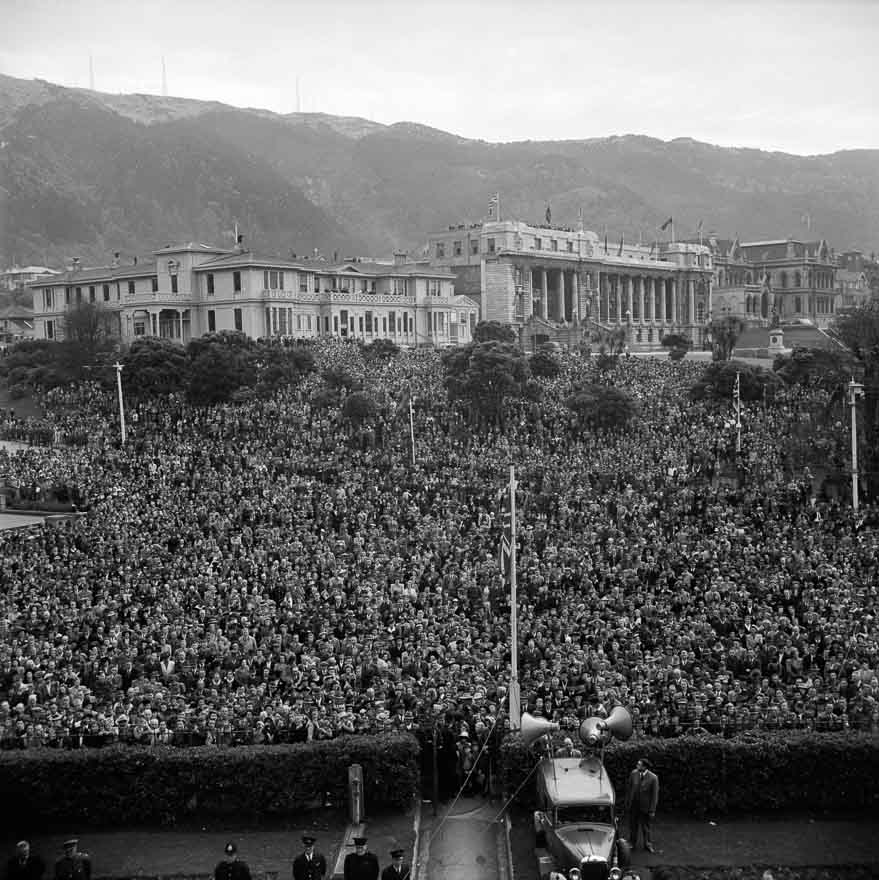
Tens of thousands of Wellingtonians celebrate the defeat of Nazi Germany in the streets below Parliament, 9 May 1945. But what would have happened to the Anglo-Saxon powers if they had failed what British military historian, Correlli Barnett, calls "the audit of war"?

THERE’S a price to be paid for always being on the winning side. States and peoples who have been found wanting by the twin audits of war and revolution are forced to learn from their mistakes. The victors are under no such obligation.

New Zealand has been on the winning side of practically every war it has ever fought. Alongside the other fingers of the Anglo-Saxon fist: the United States, the United Kingdom, Canada and Australia; New Zealand has never had to endure the ignominy of military occupation, nor the harrowing rigors of that other handmaiden of defeat – social revolution. On the contrary, our armed forces and our political institutions have emerged from the storm and stress of successive wars not only intact – but wreathed in the laurels of victory.

In the face of such incontrovertible evidence of success, even the most muted and respectful attempts at criticism tend to sound like crankiness – or worse.

But, just imagine that the First World War had been won by Germany, and that, in defeat, New Zealand, along with the other Anglo-Saxon powers, had undergone a series of debilitating economic and social upheavals, culminating in the establishment of a cruel and arbitrary dictatorship.

Upon finally emerging from this nightmare of repression, would we not, as a people, be extremely wary of the instruments of coercive state power: the Army, the Police, the Courts, and the Penal System? And wouldn’t we also place a much higher value on the traditional protections against such arbitrary and undemocratic regimes: the public administration of justice; the presumption of innocence; and the right to be tried by a jury of our peers?

I’d like to think so.

But, of course, the Anglo-Saxon fist has yet to meet its historical match. And that, I suspect, is why so many of us still put so much faith in the coercive instruments of the New Zealand State. They have, after all, never let us down. It would certainly explain why so many thousands of Kiwis flock to ANZAC Day parades, and why the funerals of slain policemen take on the character of state-funerals – replete with honour-guards, pipers and aerial salutes.

It might also explain why so many New Zealanders’ prefer retributive – as opposed to rehabilitative or restorative - justice. The outrage talk-back callers routinely express at the very idea that prison-cells might be constructed with under-floor heating, or that inmates might occasionally be permitted to watch a flat-screen television set, says a great deal about this darker side of the Kiwi character.

If they, or their loved ones, had ever spent time in a dank prison cell, reeking with the stink of their own excrement, I wonder if these talk-back callers would, like the Dutch, Danes and Norwegians (whose homelands were all occupied by the Nazis) begin to take a more humane view of crime and punishment?

It would certainly help them to understand why Maori, whose armies were defeated, whose society was forced to undergo a wrenching series of economic and social upheavals, and whose homeland has been occupied for more than one-and-a-half centuries, look upon the Police, the Courts and the Penal System of the New Zealand State through very different eyes.

Or, if that’s too big an empathetic ask, they could simply carry out this little thought experiment.

Imagine you’re living under a Government which has removed the right to elect trial by jury for offences punishable by less than three years imprisonment. Then imagine that, in spite of a referendum indicating the contrary, this same government has refused to repeal the law eliminating the defence of "reasonable force" for hitting one’s kids. Now imagine a Crimes Act which mandates a maximum of two years imprisonment for common assault (which includes smacking).

What does it all mean? It means that if you’re arrested by the Police, charged with assaulting your child, and you enter a plea of Not Guilty, you will no longer have the right to be judged by a jury of your peers. Instead, your case may end up being heard by a female District Court judge, with a law degree from Waikato University, who just happens to believe that Sue Bradford’s anti-smacking legislation is the bees-knees.

You see now how foolish it is to assume that the never-defeated, all-powerful, Anglo-Saxon state is always your protector?

This essay was originally published in The Timaru Herald, The Taranaki Daily News, The Otago Daily Times and The Greymouth Evening Star of Friday, 22 May 2009.