Showing posts with label New Zealand Left. Show all posts

Thursday, 18 January 2024

Hitting The Houthis.

Action Stations: The New Zealand Left has conflated the ten UN members condemning Houthi attacks on vessels transiting the Red Sea with the six states involved in the air and naval attacks on Houthi military targets. Veteran leftist Robert Reid, like most New Zealanders, knows full well that the RNZAF possesses no aircraft even remotely capable of participating in attacks of the sort launched by American and British forces. 

“SECOND NIGHT of NZ’s coalition bombing of Yemen!” This hair-raising statement, from veteran leftist Robert Reid, was followed by an even more jaw-dropping claim: “So NZ is at war without any debate, mandate, cabinet or parliamentary resolution and while its government is still on holiday!!”

While it is certainly the case that the New Zealand Left is currently in an excitable frame of mind, Reid’s posting on “X”, has taken that excitability to a whole new level.

To describe the countries involved in the air and naval strikes against the Houthi regime in Yemen as “New Zealand’s coalition” is merely the most egregious of the errors contained in Reid’s posting.

According to the statement released by the White House on 11 January, the strikes were launched at the initiative of the USA and the United Kingdom:

In response to continued illegal, dangerous, and destabilising Houthi attacks against vessels, including commercial shipping, transiting the Red Sea, the armed forces of the United States and United Kingdom, with support from the Netherlands, Canada, Bahrain, and Australia, conducted joint strikes in accordance with the inherent right of individual and collective self-defence, consistent with the UN Charter, against a number of targets in Houthi-controlled areas of Yemen.

Clearly, Reid has mistaken the ten UN members condemning Houthi attacks on vessels transiting the Red Sea with the six states involved in the air and naval attacks on Houthi military targets. Reid, like most New Zealanders, knows that the RNZAF possesses no aircraft even remotely capable of participating in attacks of the sort launched by American and British forces. Nor does New Zealand currently possess the necessary hardware and personnel to participate effectively in the US-led “Operation Prosperity Guardian”.

So, to be clear, New Zealand has not placed itself at the head of any military and/or diplomatic coalition. Nor has it participated in any military strikes against targets located in Houthi-controlled Yemini territory. The nation is not, therefore, at war with anyone. Hence the non-existence of any “cabinet or parliamentary resolution” authorising New Zealand’s participation in the escalating conflict.

Ever since he was a teenager, back in the 1970s, Reid has been involved in anti-militarism activism. A person of his vast experience knows full well that this country played no part in the US/UK airstrikes. Even assuming it wanted to, New Zealand couldn’t participate. Why? Because it is saddled with a defence force that is currently incapable of participating in anything more rigorous than disaster relief at home and, if it’s lucky, the South Pacific. Reid must also know that New Zealand’s adherence to the aims and objectives of Operation Prosperity Guardian is largely a symbolic gesture of support from the Coalition Government to its Five Eyes partners.

So, why the loud alarums and inflammatory claims from a man whose powers of political analysis were, for years, celebrated across the New Zealand Left? What is driving old lefties like Reid into the arms of an army of fanatical Shia fighters for whom the destruction of the “Great Satan”, America, and the utter elimination of the “Zionist Entity”, Israel, are goals for which they are only too willing to martyr themselves? Reid and his left-wing comrades used to be aggressively secular revolutionaries who dismissed religion as the “opium of the people”. What happened?

In a nutshell, the enemy of their Twentieth Century ideological mentors – some in Moscow, others in Beijing – became the Western Left’s enemy also. They may not have viewed the USA as the “Great Satan”, but they certainly saw it as the planet’s foremost imperialist power, as well as the world’s most aggressive promoter of globalised free-market capitalism. And, if the USA constituted the world’s greatest evil, then simple political logic dictated that the Soviet Union/Russian Federation, the Peoples Republic of China, North Korea, Cuba, and all the other dubious propositions of the “Third World” and “Global South” must be “lesser evils”. Anti-Americanism became a left-wing reflex – as strong today as it ever was.

Indisputably, the Americans made it easy for them. What was morally arguable in Korea swiftly became indefensible in Vietnam. And then there were the dictators Uncle Sam kept in power: the Shah of Iran, the Somoza family, Ferdinand Marcos, Augusto Pinochet, the list is as long as the historical record of those US-supported authoritarian regimes is bloody.

It never appeared to register with Western leftists, however, that they were able to condemn the USA’s actions because they could see them on their television screens and read about them in their newspapers. Moreover, those same left-wing activists could give vent to their moral outrage on the streets without being killed. Unlike the Peronist trade unionists, gunned-down by the Argentinian generals’ goons. Or the protesting students, slaughtered by the Peoples Liberation Army in Beijing’s Tienanmen Square. Hatred of US imperialism and the effects of global capitalism has blinded the Western Left to the much, much worse atrocities committed by the West’s alleged “victims”.

Nor was its moral clarity improved by the demise of the Soviet Union and the PRC’s embrace of capitalism with Chinese characteristics. With the great engines of proletarian liberation either shut down, or converted to less altruistic purposes, the Western Left was forced to cast about for an ideological substitute. In place of the now defunct doctrines of Marxism-Leninism and Maoism, Western leftists found themselves adopting the radically subjective nostrums of the so-called “New Social Movements” – better known today as “Identity Politics”.

Where Karl Marx had made the “proletarians of all lands” the heroes of his revolutionary drama, Identity Politics is driven by the horrendous depredations of its super-reactionary villain – the White Oppressor. All whites are complicit in the vast historical crimes – slavery, capitalism, imperialism – that have made the European peoples so rich and powerful, and the rest of humanity so weak and poor.

In this new ideological narrative, the pale, stale, former Marxists find themselves stripped of all positive agency. Immobilised by their “white guilt” and “white privilege”, Western leftists cannot hope to be the “good guys” of the ID-Pols’ emancipatory drama. Indeed, the only way they can avoid being lumped in with the “bad guys” is to back unreservedly the struggles of the non-white victims of Europe’s cultural cancer.

And so it is that we find Reid prophesying war with an almost reckless disregard for what is actually unfolding across the Middle East. A Left enthralled to the notion that the oppressed are always guiltless, and the oppressors guilty by definition, will not hesitate to stand shoulder-to-shoulder with the Houthis and Hamas.

As the British MP, Tom Tugendhat, lamented only yesterday on “X”: “It’s extraordinary to watch young men and women – who I’m sure would tell you they believe in freedom and equality – supporting groups like the Houthis who have reintroduced slavery, and systematically violate the rights of women and girls.”

Extraordinary, too, that the Palestinian poet, Mohammed El Kurd, can say “Our day will come. We must normalize massacres as the status quo”, and be cheered by his Western left-wing “allies” at a weekend pro-Palestinian rally in London.

It’s almost enough to make one wish that Robert Reid was right. That New Zealand was, indeed, unleashing war upon such reckless hate.


This essay was originally posted on the Interest.co.nz website on Monday, 15 January 2024.

Friday, 7 July 2023

Unstoppable And Explosive.

An Awesome Power: The metaphor of the erupting volcano is often pressed into service by journalists and historians. Understandably, since political upheavals, like volcanic eruptions, tend to take all but the most attentive observers by surprise. The existing political order, like a dormant volcano, seems stable right up until the moment it blows apart. 

IT’S VOLCANOLOGISTS who detect the first signs of the pending eruption. Barely discernible tremors, swarms of them, imperceptible to those not equipped with a seismograph, but indicative of something stirring beneath the seemingly solid earth. Magma, rising from the depths, disturbs an equilibrium that may have endured for centuries, causing the ground to shake. Inside the volcano things are heating up. Expanding gases create fissures in the volcano’s flanks, asphyxiating birds and other creatures caught in their invisible plumes. The quakes grow more violent. The air reverberates eerily – as if the mountain itself is groaning. In the final few hours before eruption, the volcano begins to deform, swelling ominously as the magma and the superheated gases expanding ahead of it approach the surface. Finally, with a roar like that of a stricken god, the volcano belches millions of tons of molten rock and ash into the upper atmosphere. For miles, across the landscape, Hell rises and walks around.

The metaphor of the erupting volcano is often pressed into service by journalists and historians. Understandably, since political upheavals, like volcanic eruptions, tend to take all but the most attentive observers by surprise. The existing political order, like a dormant volcano, seems stable right up until the moment it blows apart. Destroyed by forces which have been gathering strength for weeks and months right under the authorities’ noses – not so much unnoticed – as disregarded.

In this volcanic metaphor, the role of the seismograph is played by the polling agencies. It is the pollster who picks up the first tremors of political mobilisation. Barely noticed at first, generating results well inside the margin-of-error, but real nonetheless. Unmistakable evidence that beneath the familiar political topology magma is rising, gases are heating, hitherto solid rock is melting.

It was Act which provided the first indication that the fragile equilibrium established in the aftermath of the Covid Earthquake was coming apart.

As National began its belated rise towards electoral respectability (i.e. a Party Vote in the low-to-mid 40s) it soon became clear that getting there, and staying there, was more than it could accomplish. Meanwhile, the angry Right was refusing to cool down. New Zealand society was being changed radically, and without the permission of those who saw changing things as their prerogative. Moreover, National didn’t seem to be that bothered – as if they regarded the changes as tolerable.

Act’s take-off in the polls was the first sign of the roiling masses of magma churning away deep below the surface. More than willing to take the hard lines that National was eschewing, Act gave voice to the fears of those whose long-established privileges were being challenged by proudly insubordinate social movements pushing transformational ideas about ethnicity and gender.

Below the Me Too and Black Lives Matter agitation, however, and below the bewildering claims of the transgender activists, there was an upward thrusting force that at once empowered and overwhelmed the causes which Act and its fellow travellers dismissed as “Woke”. This was the magma of Māori nationalism, the expanding force of a people whose numbers and aspirations simply refused to stop growing.

The Māori Question was being put to Pakeha New Zealanders with an urgency born of too many wrong and/or misleading historical answers. It was heating the rhetorical gases of the Left, but it was not the Left. To the defenders of Pakeha privilege, however, the denizens of old New Zealand, two things were terrifyingly clear. That all this “Māori stuff” was huge – and that it was rising inexorably towards the surface of New Zealand politics.

Act placed itself athwart the Māori nationalists’ path. It promised to turn back the relentless advance of “Aotearoa” against “New Zealand”. The Treaty of Waitangi would be re-written, all traces of co-governance, would be swept away. A new, written constitution would entrench Pakeha privilege forever. But, these were horizontal solutions: as if the Māori cause was an army advancing towards a defensible border; a force that could be stopped and turned around.

Wrong metaphor.

The upward thrust of the Māori cause is magma – unstoppable and potentially explosive. It may flow down the slopes of New Zealand as lava, reshaping the state in dramatic and irreversible fashion. Or, blocked by the congealed rock of racist resistance in its throat, its pressure will grow and grow until New Zealand disappears in an explosion of fire and ash, leaving behind only Aotearoa.

Therefore, take note of the latest Roy Morgan poll. In that dramatic upward tick of Te Pāti Māori – to a system-busting 7 percent – perceive the first, tell-tale tremors of a political eruption in the making. It is the young people, the rangatahi, who are rising. Not simply in response to Act’s futile policies of obstruction and suppression, but because there is in them a passion for growth and expansion that must, by whatever means necessary, find its way to the sky.


This essay was originally posted on The Daily Blog of Friday, 7 July 2023.

Friday, 21 October 2022

Who Is Pulling Sharma’s Strings?

Plaything Of The Right? Just how decisively the Right is shaping our politics will become clear in the run-up to the Hamilton West by-election. Though National may consider the by-election outcome a foregone conclusion, it is likely to be disabused of any such notion relatively quickly.

GAURAV SHARMA’S DEATH-DIVE into the Labour mothership may strike many traditional leftists as fortuitous. Certainly, his decision to force a by-election in Hamilton West will inflict far more damage on Jacinda Ardern’s radically elitist government than any number of old-school leftists could possibly hope to achieve. This should not be permitted to obscure the fact, however, that, in 2022, it is the Right, not the Left, that is driving New Zealand politics.

Just how decisively the Right is shaping our politics will become clear in the run-up to the Hamilton West by-election. Though National may consider the by-election outcome a foregone conclusion, it is likely to be disabused of any such notion relatively quickly.

Between them, Act, NZ First, and the new parties of the Far-Right have the potential to siphon-off enough votes to place the contest’s outcome in serious doubt. The lazy assumption among political commentators that National’s strategists will be able to browbeat its right-wing rivals into giving it a clear run at Labour smacks more of wishful thinking than sound analysis.

If National wants a clear run, then it will have to give its rivals some pretty unequivocal assurances about what it will – and won’t – do in government. Even then, the arguments for delivering National a sharp lesson in the raw power of ideological conviction may prove hard for its right-wing competitors to resist.

A political novelist would look at this evolving situation and explore the question of exactly who informed Sharma that Ardern was planning to waka-jump him less than six months out from Election Day 2023. Sharma insists that it was a member of Labour’s New Zealand Council, but, honestly, that seems unlikely. The New Zealand Council of the Labour Party has been pretty effectively “scrubbed” ideologically. The notion that there is someone sitting around that table harbouring dark thoughts about Ardern and her colleagues, and spilling the beans to Sharma, is most unlikely. Easier to believe is that someone – a genuine enemy of the Labour Government – is pulling Sharma’s strings.

If such a person exists, then he or she is almost certain to be a right-winger. But, just how far is that person, and those s/he is working with, prepared to go? Is the idea of a Sharma-led “centrist” party his own, or was it planted and watered by his unnamed “friends”?

It’s an important question. A group of seasoned operatives who knew what they were doing might actually pull together something that looked enough like a genuine centrist party to draw-off a useful number of Labour votes. Then again, why would they invest so much energy and cash in a guy who’s never going to be more than a political footnote?

The only plausible explanation is that the political force best placed to draw off Labour votes – the Greens – have been so thoroughly battered and bullied by Labour, that they no longer possess the necessary political courage to demonstrate their indispensability to the “left-wing” cause.

A surging and ideologically rampant Green Party, slashing into Ardern’s record from the left, would make it next-to-impossible for Labour to retain Hamilton West. Not that a genuine Green Party would care. It’s only goal would be to show that if 2023 isn’t a Labour-Green victory, then it won’t be a victory at all.

Sadly, only the most unrealistic of optimists could foresee such a welcome recovery of electoral nerve. Most likely the Greens will meekly agree to sit-out the by-election. Meaning that, if there’s any vote-siphoning to be done, it will have to be done by the Right.

Viewed from the perspective of the non-National Right, the best possible outcome of the Hamilton West by-election would be a narrow (the narrower the better!) win for Luxon’s team.

A romper-stomper victory for the National candidate is the last thing the non-National Right wants. A win like that would reassure National that they have no need to make serious policy concessions to the parties on their right. It will convince Luxon and Willis that they can continue fudging on the Treaty and Three Waters, and double-down on John Key’s successful formula of doing whatever it takes to win and hold the suburbs. Knowing that, if National holds the suburbs, then the rest of the Right has no real option but to make do with half an ideological loaf.

Ensuring that National’s candidate only just makes it would put an end to all the party’s thoughts of an easy campaign in 2023. The idea that it will be enough to just shuffle along a few paces to Labour’s right, and muddle-through as usual, will be scotched. National will have no option but to respond to the gravitational pull of all those political forces unwilling to accept Labour’s radical elitism. The results are unlikely to be pretty.

But that’s what your country gets when it lacks a mass movement, grounded in the working-class, and dedicated to social equality – rather than radical elitism. The penny has yet to drop in Aotearoa-New Zealand that identity politics is not left-wing politics. Labour and the Greens are by far the slowest learners – dangerously slower than the Right.

This essay was originally posted on The Daily Blog of Thursday, 20 October 2022.

Thursday, 17 February 2022

Reality and the Left – A Bitter Divorce.

Things Fall Apart: The events of the past ten days offer ample evidence of just how seriously social decay has weakened New Zealand society. A more confident New Zealand Left, recognising the weakness of the system, and its acute vulnerability to those who would enlist the aid of “gangsters, racketeers, swindlers, petty criminals” would have no hesitation in identifying the so-called “Freedom Convoy” as the reactionary, quasi-fascist, enterprise it has always been.

WHERE IS REALITY HIDING amidst all these claims and counter-claims concerning the protest encampment in Parliament Grounds? In an excruciatingly post-modern political moment, reality seems to have gone AWOL, leaving behind only a noisy collection of competing narratives.

To make matters worse, the state itself, supposedly the supreme arbiter of what is and is not politically real, is refusing to do its job. Even though it is his sworn duty, the Commissioner of Police, Andrew Coster, has made it frighteningly clear to the public that he lacks both the will and the means to assert the state’s authority. The New Zealand Defence Force, meanwhile, holds itself aloof from the fray. Jacinda Ardern and Christopher Luxon, powerless to intervene, look on ineffectually. The crisis deepens.

Ask yourself: what does it mean when tow-truck drivers, asked to assist the Commissioner of Police, refuse? At what point during the last decade did citizens begin to tell themselves that they had no obligations to the society in which they live? That nobody had the right to tell them what to do – not even the Police? What business is it of theirs if the people of Wellington, their neighbours, need their help?

It has been reported that at least one towie openly declared his support for the protesters encamped on Parliament Grounds. Entirely understandable. The occupiers don’t accept that their government has the right to require their vaccination against Covid-19. Nor do they believe that they owe their fellow citizens even the slightest co-operation in the fight to limit the harm of the virus. That tow-truck driver recognised kindred spirits when he saw them. Andrew Coster and Wellingtonians could go fuck themselves.

Not all the towies were so bloody minded. According to media reports, some of them were just plain scared. They claimed to have been threatened with dire retribution if they allowed their trucks to be used by the Police. Considering those trucks carried the names and phone numbers of their owners, it’s not difficult to understand the impact of such threats. Were someone to burn down a towing company’s premises, torch its trucks, that would be multiple livelihoods lost and a business ruined. Who wouldn’t think twice?

Such tactics are, however, remarkably effective. I remember reading about Jimmy Hoffa and the Teamsters’ bitter battles with the trucking companies. The bosses could rely on local politicians, local judges, local editors and local cops to defend them against Hoffa’s strikers. The union was on a hiding-to-nothing, until Hoffa reached out to the Mafia. It only took a few dozen torched trucks for the bosses to get the message. The Teamsters won their improved contract. But the spoon Hoffa took to his dinner with the Devil wasn’t quite long enough. His beloved Teamsters’ Union now belonged to the Mob.

Now, you might think that people on the left of New Zealand politics would recognise the danger of holding up the occupation of Parliament Grounds as a praiseworthy assertion of working-class power. As if poverty and marginalisation, frustration and anger, ignorance and credulity are always and everywhere evidence of moral force and progressive intent.

Karl Marx himself recognised the acute political danger inherent in what he called the Lumpenproletariat. According to the Encyclopedia of Marxism, this social formation is composed of the “outcast, degenerated and submerged elements” of industrial society:

It includes beggars, prostitutes, gangsters, racketeers, swindlers, petty criminals, tramps, chronic unemployed or unemployables, persons who have been cast out by industry, and all sorts of declassed, degraded or degenerated elements. In times of prolonged crisis (depression), innumerable young people also, who cannot find an opportunity to enter into the social organism as producers, are pushed into this limbo of the outcast. Here demagogues and fascists of various stripes find some area of their mass base in time of struggle and social breakdown, when the ranks of the Lumpenproletariat are enormously swelled by ruined and declassed elements from all layers of a society in decay.

That our society is in decay can hardly be doubted. The events of the past ten days offer ample evidence of just how seriously that decay has weakened New Zealand society. A viable Left, recognising the weakness of the system, and its acute vulnerability to those who would enlist the aid of “gangsters, racketeers, swindlers, petty criminals” would have no hesitation in identifying the so-called “Freedom Convoy” as the reactionary, quasi-fascist, enterprise it has always been.

Alas, New Zealand no longer possesses a viable Left. Identity politics has schooled a whole generation to accept the self-definitions of “oppressed groups” at their face value. Drilling down into the actual character of such groups, and scrutinising their relationship to the ruling class, is not encouraged. Even among those leftists who still acknowledge the primacy of class politics there is a pronounced unwillingness to subject movements like the Freedom Convoy to any kind of rigorous class analysis.

For these leftists, it is enough that the occupiers of Parliament Grounds are, or were, members of the working-class. So desperate are these “revolutionaries” for the slightest hint of revolutionary consciousness that they are willing to overlook the absence of anything remotely resembling a concrete programme for the social and economic emancipation of the working class. The only programme in evidence among the occupiers is the one demanding the instant cessation of all measures aimed at minimising the hurt and suffering of Covid-19.

How self-proclaimed “socialists” could possibly mistake such a noxious potpourri of anti-social attitudes for anything remotely progressive is a mystery. Perhaps it is no more than the curious allure of the demi-monde, coupled with the magnetic eccentricities of the Bohemian temperament, that has led these desperate socialists to mistake reactionaries for revolutionaries. Clearly they have forgotten that Adolf Hitler himself was a Lumpenproletarian. A more “declassed, degraded and degenerated” specimen History has yet to supply!

It was the Italian socialist, Antonio Gramsci (1891-1937) who understood most completely the extraordinary fluidity of reality in periods of acute social stress and political disintegration. Moments in history when the hegemonic explanations of the ruling-class have lost, or are beginning to lose, their power to allay the fears and misgivings of subordinate classes. In such times – and we are living through them now – people are desperate for new and more persuasive narratives about the nature of reality.

Not all of those narratives are addressed to the best that is in human nature. Sorting out the lies of charlatans and demagogues from genuine revolutionary truths isn’t always easy – especially in this age of social-media algorithms. Leftists are often surprised to learn that Mussolini was a socialist before he became a fascist.

Gramsci put it best when he wrote: “The crisis consists precisely in the fact that the old is dying and the new cannot be born; in this interregnum a great variety of morbid symptoms appear.”

Or, more succinctly: “Now is the time of monsters.”


This essay was originally posted on The Daily Blog of Thursday, 17 February 2022.

Tuesday, 9 March 2021

Will The Much-Criticised SIS Have The Last Laugh?

Be Careful What You Wish For: At the very heart of the Left’s stupidity on national security matters is its lamentable unfamiliarity with the basic techniques of counter-intelligence. In their reckless, ideologically-driven haste to smash the infrastructure of white supremacism in New Zealand, the far-left critics of the SIS and the GCSB are openly embracing the maximum possible deployment of state surveillance and interception technology.

LEFT-WING NAIVETY is nothing new, but its power to astound and enrage has not diminished. The scorn heaped upon the Security Intelligence Service (SIS) for failing to intercept a recent threat to the Christchurch Muslim community is a case in point.

The official version of this event has the Police receiving a tip-off from a member of the public. Someone who just happened to be hanging-out in the digital neighbourhood of 4-Chan’s most dangerous white supremacists stumbled, quite accidentally, upon plans to car-bomb the two mosques attacked by Brenton Tarrant in 2019, and like any public-spirited citizen, he called the cops.

Hmmmm …

This may, of course, be a true story. The informant’s accidental discovery of a terrorist plot may, indeed, be just one of those amazing examples of pure dumb luck that sometimes happens in this funny old world. Then again, it might not.

Maybe, just maybe, the official version of events bears absolutely no resemblance to what actually happened.

Because, let’s face it, if the SIS is doing exactly what the Left has been urging it to do since 15 March 2019; if it has made the surveillance, interception, infiltration and disruption of white supremacist groups its top counter-intelligence priority; then what possible motive would it have for announcing the fact – and offering public proof of its effectiveness – to the individuals and organisations it is watching?

Let’s assume, for the sake of argument, that the SIS and its sister organisation, the Government Communications Security Bureau (GCSB) have not only been monitoring the “chatter” on 4-Chan, but that they have an agent, or agents, masquerading as hardline white supremacists participating energetically in any number of extremist chat-rooms. Let’s also assume that they are receiving a steady flow of HUMINT (human intelligence) from spies embedded in far-right and white supremacist groups. In these circumstances, only an imbecile would jeopardise these operations by waving their hands in the air and shouting “Lookit! Lookit! We’ve caught ourselves a terrorist!”

Surely, the SIS’s more likely response, in the event of it learning of a credible plan to car-bomb Al Noor Mosque and the Linwood Islamic Centre on the second anniversary of Tarrant’s attacks, would be to let the world believe that the plot’s discovery was due entirely to the initiative of a sharp-eyed and public-spirited citizen who saw something and said something … to the Police?

If this was indeed the SIS’s response, then the loud braying of the Left will, for once, be a welcome noise. Criticism of the SIS’s “failure” to take white supremacism seriously will be music to the Service’s ears. The longer the far-right can be persuaded that the national security apparatus remains blind to the threat posed to New Zealanders by their most extreme elements, the better chance the government’s secret agents will have of shutting these extremists down.

It is, however, unlikely that the SIS chiefs will be placing too much faith in the Left’s condemnation of their inadequacies. Merely by reading the public disclosures of experts on the far-right, like Professor Paul Spoonley, they will be aware that more and more of New Zealand’s right-wing extremists are learning the basic trade-craft of clandestine political organisation. Aware that unfriendly eyes are on them, these groups are encrypting their communications and vetting with great thoroughness every potential recruit to their cause. Such people and groups are unlikely to risk saying anything potentially incriminating on 4-Chan – not when there are many much safer places on the Internet in which to take refuge.

Given that one of the persons arrested by the Police was released without charge, and the individual in custody was charged under the Crimes Act – rather than the Terrorism Suppression Act – with Threatening To Kill, one might even speculate that there is more than a faint whiff of public relations about the whole incident.

Face it, rigging a car-bomb – especially one intended to be detonated remotely, rather than delivered directly to the target by a driver willing to sacrifice their own life for the cause – is not a game for amateurs. A former, or active duty, soldier, highly trained in the use of explosives and detonation devices, might be capable of such an attack. Alternatively, skilled and experienced operatives with similar backgrounds might be imported to perpetrate the outrage. With New Zealand’s borders closed by the Covid-19 Pandemic, however, this latter scenario can be confidently discounted. It is also inconceivable that the arrest of a suspect with such a military background would not have prompted a significantly higher security response on the part of the authorities.

How much more likely is it that a couple of idiots, talking big on what was effectively an “open line” were easily intercepted by the SIS and GCSB “watchers”; and that their identity was made known to the Police – not because they posed a serious threat to the Christchurch Muslim community, but because announcing the arrest of a couple of far-right, Islamophobic terrorist wannabes, just days away from the second anniversary of the Mosque Massacres, would constitute a major public relations coup?

Such an operation would achieve a number of objectives. First and foremost, it would reassure Muslim New Zealanders that their fellow citizens and, of course, the Police, still have their back – thereby reconfirming “They Are Us” in the most dramatic fashion. Secondly, it would serve as a reminder that there was still a great deal of hate out there – murderous hate. Precisely the sort of hate that the Labour Government is determined to keep in check with its proposed legislation outlawing “hate speech”. Thirdly, as intimated above, the circumstances of the alleged offender’s apprehension would set up the SIS and the GCSB for exactly the sort of left-wing bollocking that has, in fact, occurred. Criticism which, hopefully, will make the Service’s surveillance, interception, infiltration and disruption operations all the more effective. Assuming, of course, that the far-right is as predictable in its stupidity as the far-left!

At the very heart of the Left’s stupidity on national security matters is its lamentable unfamiliarity with the basic techniques of counter-intelligence. In their reckless, ideologically-driven haste to smash the infrastructure of white supremacism in New Zealand, the far-left critics of the SIS and the GCSB are openly embracing the maximum possible deployment of state surveillance and interception technology.

To root out Islamophobia and silence hate speech, they are happy to have the national security apparatus secure the demise of far-right extremists by any means necessary. That their own uncompromising demands are as predictable as they are extreme does not appear to have occurred to them. That their antipathy to the far-right might be used to the long-term advantage of the security services has, similarly, never crossed their minds.

Nor, apparently, has the realisation that, when they have rounded up the last ethno-nationalist extremist, those same security services will come after the Left with exactly the same surveillance technology and censorship powers. More tellingly, they will be able to do so citing precedents with which the Left itself has furnished them. The far-left critics of the national security apparatus will be hung by a rope which they, themselves, have twisted.


This essay was originally posted on The Daily Blog of Tuesday, 9 March 2021.

Wednesday, 7 February 2018

When ‘Maintaining The Rage’ Isn’t An Option.

"Just One Of Those Things You Say In Opposition": Had the rage so evident on the streets of Auckland on 4 February 2016 been maintained, Jacinda Ardern, Winston Peters, and Labour’s intrepid Trade Minister, David Parker, would not have found it such an easy matter to renege on the undertakings Labour and NZ First had given on that day when it seemed prudent for Mr Parker to stand outside the US Consulate, microphone in hand, and pledge Labour to the defence of New Zealand’s sovereignty against trans-national corporate predators.

THE HARD-LEFT of New Zealand politics enjoys nothing more than enumerating the shortcomings of the Labour Party. No matter that the hard-left itself represents only a tiny fraction of the electorate (a deficiency confirmed with crushing finality whenever it fields candidates in a general election). Not to worry. This past week [i.e. the week ending 27 January 2018] the Labour-NZF coalition government’s decision to sign-up to the Comprehensive and Progressive Transpacific Partnership (CPTPP) has afforded its hard-left critics multiple opportunities to, once again, rail against the manifold shortcomings of social-democracy.

Were they of a mind, however, the despised social-democrats could mount a telling critique of the hard-left’s own dereliction of political duty. The focus of such criticism would be the hard-left’s failure to “maintain the rage” against the Trans-Pacific Partnership which, in February 2016, had just been demonstrated with truly exceptional power on the streets of Auckland.

So effective had the campaign of the “It’s Our Future” organisation been in rousing public indignation at the TPP’s multiple assaults on New Zealand sovereignty, that the Andrew Little-led Labour Party felt obliged to step away from the long-standing bi-partisan consensus on free trade and come out openly against its ratification. It was joined in this radical oppositional stance by Winston Peters’ NZ First Party and the Greens. Foreshadowed in this ad-hoc anti-TPP multi-party alliance, was the Labour-NZF-Green government sworn into office in October 2017.

Was the hard-left quick to warn the still-fizzing anti-TPP demonstrators that this sudden display of radicalism on the part of Labour, NZ First and the Greens was not to be trusted? Did it urge the movement to shift its focus from the streets of Auckland to Parliament Grounds in Wellington? Was a concerted campaign proposed to pressure MPs directly by besieging the House of Representatives and impeding the Select Committee hearings into the legislation ratifying the TPP? Was the hard-left able, as its predecessors had been in the days of the Halt All Racist Tours organisation, to transform participation in a single day of rage into a permanent reserve army of protestors, capable of being mobilised at a moment’s notice?

No, it was not.

Had it been, Jacinda Ardern, Winston Peters, and Labour’s intrepid Trade Minister, David Parker, would not have found it such an easy matter to renege on the undertakings Labour and NZ First had given on the day when it seemed prudent for Mr Parker to stand outside the US Consulate, microphone in hand, and pledge Labour to the defence of New Zealand’s sovereignty against trans-national corporate predators.

So, what did the hard-left do?

Well, it did exactly what it so loudly condemns the centre-left for doing: it attempted to engage constructively with the many and varied processes of institutional power so as to get the firmest possible grip on the levers of political influence. Even now, the effective leader of the anti-TPP movement, Professor Jane Kelsey, is cautioning her followers against precipitate action:

“And yes, I know there are people who want to get out on the streets. We need to think about when and where that might have maximum effect. But we can’t go off half-cocked. People need to be confident that they know why the TPPA-11 is as bad as the original, and believe that their voices collectively can make a difference. And we can.”

The difference between hard-leftists and social-democrats, however, is that although they could mount a critique of the hard-left’s failure to maintain the momentum of the 2016 protests, the social-democrats haven’t. Why? Because they understand that, at some point, rage in the streets must give way to the demands of practical politics.

Once Labour, NZ First and the Greens had all publicly committed themselves to opposing the TPP – as currently configured – the hard-left’s ability to turn people out into the street evaporated almost immediately. Maintaining the rage for months on end was never an option.

Fighting TPP was quite unlike fighting Apartheid – which could be relied upon to keep the world horrified with its constant and ever-worsening acts of racial oppression. A year ago, when Donald Trump pulled the USA out of the TPP, most of its opponents – and even some of its supporters – believed it was dead. And yet – it lives!

The tenacity with which the proponents of the TPP have fought for their project should, perhaps, cause the hard-left to pause from their castigation of Labour and its allies. Is it really credible to suggest that so many countries have worked so hard, for so long, to secure their own economic and political subordination?

Perhaps, once they had made themselves familiar with their fellow CPTPP partners’ arguments, Ardern, Peters and Parker realised that ‘maintaining the rage’ wasn’t an option for them either. Perhaps, in the face of massive Australian and Japanese economic pressure they reluctantly settled for the best deal they could get.


This essay was originally published in The Press of Tuesday, 30 January 2018.

Friday, 3 March 2017

Rebooting The Red Menace.

Not So Much A "Cold" As A "Deep-Frozen" Warrior: New Zealand's most industrious anti-communist, Trevor Loudon, would have been much happier peddling his red-baiting wares back in the days of US Senator Joseph McCarthy and his local franchisee, National’s first prime minister, Sid Holland. At least back then there was a market for left-wing names, addresses and meticulously-recorded red rendezvous.
 
IT’S HARD NOT TO FEEL just a little bit proud of New Zealand-born businessman, Chris Liddell. To have a Kiwi in the West Wing of the White House – as Director of Strategic Initiatives, no less – is a pretty big deal.
 
Another Kiwi making waves in Donald Trump’s America is a lot harder to like.
 
In her coverage of the recent Conservative Political Action Conference (CPAC) held in Washington DC, Rolling Stone journalist, Sarah Posner, name-checked our very own Trevor Loudon.
 
Describing the Christchurch-born anti-communist as: “a conspiracy theorist who appeared on a panel moderated by Ginni Thomas, wife of Supreme Court Justice Clarence Thomas”, Posner offered Loudon’s outlandish conspiracism as proof of the Republican Party’s “willingness to look the other way as the movement mutates from 20th century conservatism to a Trump-Alt-Right-white-nationalism.”
 
What caught Posner’s attention were the startling claims contained in Loudon’s 23-minute video America Under Siege: Civil War 2017. Decrying the very idea that the Russians intervened in last year’s US Presidential Election on Trump’s behalf, Loudon advances the novel theory that Vladimir Putin is, in fact, the principal funder and director of Donald Trump’s enemies.
 
New Zealand Leftists of a certain age, especially those who belonged to the gaggle of tiny communist groups that once clung like limpets to the broader labour movement, will have little difficulty recalling Loudon. I certainly remember his NewZeal blog and its ferocious dedication to tracking down and monitoring the membership and minutiae of every Marxist-Leninist group that ever published a pamphlet or stood on a picket line. Verily, wherever three or more of them were gathered in Marx’s name, it seemed that Trevor was with them also.
 
To be honest, I felt sorry for him. Like so many others who found themselves swept up in revolutionary politics in the 1980s and 90s, Loudon was born too late. How much happier and more gainfully employed he would have been had he been able to peddle his anti-communist wares back in the days of US Senator Joseph McCarthy and his local franchisee, National’s first prime minister, Sid Holland. At least back then there was a market for left-wing names, addresses and meticulously-recorded red rendezvous.
 
But Loudon’s influence, both here and in his spiritual home, the United States, grew out of the Internet. There is considerable irony here, because by the time New Zealanders started connecting themselves to the Internet and starting up blogs, Loudon’s great fountainhead of subversion and sedition, the Soviet Union, had suddenly and irrevocably blipped-off History’s computer-screen.
 
Not that Loudon was about to let a little thing like the fall of the Berlin Wall and the demise of what used to be called “actually existing socialism” get in the way of his Manichean conviction that the future of the entire world turned upon the never-ending twilight struggle between the Children of Darkness and the Children of Light.
 
Nevertheless, the collapse of the Soviet Union in August 1991, did leave Loudon prey to the same deadening realisation that had demoralised its loyal disciples all over the world. Without so much as a bang, indeed, with barely a whimper, all the patiently collected literature and memorabilia of Soviet-style communism – along with all the bulging files detailing its collectors’ every move – were reduced to piles of worthless junk. Like those Russian warehouses filled with unwanted busts of Lenin and Stalin, Loudon’s vast archive of red subversion in Godzone no longer had any serious buyers.
 
Luckily for Loudon, the USA remains the one place where comically unserious people can still be taken very seriously indeed. While their more adaptable comrades made the necessary Manicheist transition from the evils of Soviet Communism to the evils of Radical Islam (assisted admirably by the terrorism of Osama Bin Laden) dyed-in-the-wool anti-communists like Loudon (now based in the United States) doggedly insisted that the Red Menace was still very much alive.
 
Putin and his “puppet masters”, says Loudon, have been “guiding the chaos unfolding on America’s streets”. Still inspired by the doctrines of Joseph Stalin and Mao Zedong, these shadowy string-pullers have been “organizing protests and riots in the United States from the Vietnam War to Ferguson, Missouri.”
 
The CPAC crowd lapped-up Loudon’s Cold War retro paranoia like gravy. Instead of being hailed as Trump’s best friend, Putin was, very helpfully, being recast as America’s old adversary.
 
As strategic initiatives go – it’s a beauty.
 
This essay was originally published in The Waikato Times, The Taranaki Daily News, The Timaru Herald, The Otago Daily Times and The Greymouth Star of Friday, 3 March 2017.

Thursday, 27 October 2016

“Old Lefties” – WTF! Simon Wilson hosts “Table Talk” at the Ika Seafood Bar and Grill.

Takes One To Know One, Simon: Simon Wilson's denigration of "old lefties" struck some as odd - coming as it did from a former member of the Workers Communist League! His present political orientation, however, is relatively clear. As he wrote for The Spinoff: “[O]ne way or another, everything benefits the agents of capitalism. If you’re a progressive, or a social democrat, or a socialist, you have to suck that up.”
 
“LABOUR – WTF?” The question said it all. And the packed-out restaurant confirmed its aptness. Laila Harré has good instincts for the mood of the Auckland Left, and “WTF?” sums up its assessment of the current state of the Labour Party with earthy directness.
 
Less adroit, perhaps, was her decision to allow The Spinoff to co-sponsor the event. It’s hard to reconcile the Ika Seafood Bar and Grill’s skilful courting of Auckland’s progressives with The Spinoff’s vicious attack on one of the Left’s most respected representatives – Mike Lee. That the attack on Lee could so easily have resulted in (and was quite probably intended to secure) Bill Ralston’s election to the Auckland Council merely confirmed The Spinoff’s political incorrectness.
 
That the choice of Simon Wilson as host of the evening’s panel discussion’s proved equally unsuitable was not something for which the Ika team could be blamed. Wilson made himself so by persuading The Spinoff to post his “Look, there goes the Labour Party – sliding towards oblivion” on the same day as the Table-Talk event.
 
It is a very curious piece of writing. Provocative title aside, Wilson’s posting is mostly an attempt to isolate and ridicule left-wing critics of his beloved Unitary Plan. Though no names are mentioned, it is clear that the sort of people Wilson has in mind when he castigates these “old lefties”, are people like Mike Lee.
 
“Their dispute wasn’t really defined by age,” writes Wilson, “but it was about modernising the progressive cause. The old argument is that when you relax the rules around building and allow more density, you create conditions for ugly apartment blocks and slums that ruin the quality of life for everyone who has to live in or near them. There might be more homes but the big winners are the developers who make a killing.
 
“That sounds grand, principled, insightful and historically sound. It’s been true in the past, even the quite recent past. In fact, in relation to the UP, it’s sentimental nonsense.”
 
But is it? Auckland’s history offers very little justification for believing that market-led intensification will produce anything other than “ugly apartment blocks” and “developers who make a killing.” More importantly, Wilson offers nothing in the way of evidence that the Unitary Plan, as approved, will ensure that Auckland’s future does not resemble its past.
 
What he does do, however, is set up a straw man. He implies that Mike Lee and his allies do not understand that “a compact city, with good quality affordable homes clustered densely around a comprehensive and efficient public transport system, is essential for any fast-growing city that wants to offer a decent quality of life to all its citizens.”
 
This is laughable. One of the reasons the tight little clique of lawyers, land-bankers, property developers, and roading contractors that has run Auckland for the past 150 years was so keen to get rid of Mike Lee was because, as Chairman of the Auckland Regional Council, he refused to extend Greater Auckland’s boundaries. Lee was arguing for a more compact city when Wilson was still collecting recipes for Cuisine magazine. His constant and highly successful advocacy for “a comprehensive and efficient public transportation system” – especially rail – also put Lee offside with Auckland’s powerful roading lobby.
 
Not so laughable is the fact that Wilson knows full well that Lee is but the latest in a long-line of left-wing politicians and planners who have fought for an Auckland capable of offering “a decent quality of life to all its citizens”.
 
In between his stints at Cuisine and Metro, Wilson was a jobbing editor for the Random House publishing group. One of the books he edited was my own No Left Turn, which included a chapter entitled “The Auckland That Never Was”. All of the elements making up what Wilson rather grandly calls “New Urbanism” feature in the plans for Auckland’s future development that were prepared for the First Labour Government by the Housing Division of the Ministry of Works back in the 1940s! That those extraordinarily progressive plans remained unfulfilled may be sheeted home to the same private sector interests who made their fortunes by turning Auckland into a cheap copy of Los Angeles, and who now propose to make themselves even richer by turning Auckland into a cheap copy of Singapore.
 
How someone in possession of this knowledge could, nevertheless, attempt to paint Mike Lee as someone guilty of failing “a bedrock test” for progressive urban planning, is utterly beyond me. But, then, I found it no less puzzling that the same man who could write: “one way or another, everything benefits the agents of capitalism. If you’re a progressive, or a social democrat, or a socialist, you have to suck that up”, was, somehow, able to begin last Wednesday’s (19/10/16) Table Talk discussion by quoting the late Helen Kelly’s emphatically anti-capitalist vision of the Labour Party.
 
Obviously, Wilson’s definition of “progressive”, “social democrat” and “socialist” is somewhat different from my own.
 
The rest of the evening was full of depressingly similar contradictions.
 
Only a very few minutes had expired before the Labour Party President, Nigel Haworth, took on the expression of a man who wished he'd stayed at home. Keeping out of the public eye has been something of a fetish for Haworth, whose principal motivation in taking on Labour’s presidency appears to have been quieting down the party’s frequently  restive rank-and-file. Having to admit that, had he been in Britain, he would not have voted for Jeremy Corbyn, was almost certainly something he would have preferred to keep under his hat.
 
Deborah Russell, Labour’s candidate for the Rangitikei electorate in 2014, told us she would have voted for Corbyn. That becoming a Corbynista would have put her offside with a fair swag of her putative caucus colleagues did not appear to have occurred to her. Which says a lot about her understanding of the party she defended with such enthusiasm throughout the night.
 
Chloe Swarbrick’s reputation for straight-talking was in no way diminished by her participation in the Table Talk panel. When asked what it would take to make her join the Labour Party, her quick-fire response, “an invitation”, raised eyebrows and hopes in almost equal measure.
 
Head-and-shoulders the most acute political thinker on the stage last Wednesday night was, however, Andrew Campbell. Formerly the Green Party leaders’ chief-of-staff, and now – impressively – communications director for the NZ Rugby Union, Campbell’s insights into the workings of contemporary New Zealand politics were refreshingly candid. That, in his estimation, “politics is a PR game” might be a bit depressing for “old lefties” like me, but only a fool would argue that, in New Zealand, in 2016, our politics is very much of anything else.
 
This essay was originally posted on The Daily Blog of Tuesday, 25 October 2016.

Sunday, 22 November 2015

What I Believe - A Social-Democrat's Credo


Challenged by the uncompromising content of my latest posting, “Capitalism Kills”, some readers of Bowalley Road have challenged me to state my own beliefs. Accordingly, I have hunted out part of a presentation I delivered to the Labour Party Summer School held near Thames in January 2007. For all those who have been asking me to spell out what I stand for – this is my answer.


I BELIEVE that human societies arise out of need. The need for food and shelter, the need for intimacy, the need for nurturing, and the need for protection – both from natural dangers and the aggression of our own species. To secure these needs human beings must work, individually or collectively, but always with the ultimate purpose of keeping strong those innumerable threads that bind our communities into a functioning wholeness.
 
The source of fulfilment of these human needs is the natural bounty of the planet on which our species dwells. Human beings are but one of the countless life-forms which inhabit the Earth’s surface and we share with them a fundamental dependency on the planet’s life-giving properties.
 
Alone among all the creatures of the Earth, humankind possesses the power to radically alter the fragile environment of its home. Such power bears with it an awesome responsibility. Our own future, and the future of all other living things, depends upon our willingness to accept that what is possible is not always desirable. To ensure its survival, the human species must recognise the limits of its power.
 
In New Zealand, two peoples co-exist in differing states of awareness of the essential collectivism and dependency of human communities. The indigenous people possess a clear and poignant vision of humanity’s place in these islands. But the colonising peoples would not rest until the ideas and institutions of their respective cultures had taken root in New Zealand. To the extent they succeeded, the conflicts and contradictions of their homelands were also transplanted here. Resolving these conflicts and contradictions, and discovering the best means of prospering together, is the historic task of the two peoples fated to share these islands – Maori and Pakeha.
 
As a social-democrat I am dedicated to furthering in all aspects of my country’s social, political and economic organisation the essential equality of human beings. Social-democracy defines equality in terms of the universality of human need. Old or young, male or female, Maori or Pakeha, we are all defined by the human and ecological relationships indispensable to our existence. None of us live but by the bounty of nature and the collective exertion of our fellow human beings.
 
That being so, we must reject all claims hostile to the reality of our interdependence. Individuals and groups who through inherited advantage or simple good fortune are endowed with disproportionate wealth and resources, enjoy their property on the sufferance of that vast majority whose daily labours make possible a functioning society. Only for as long as, in the judgement of the many, the accumulation of property by a fortunate few serves the interests of the community as a whole, will the private control of wealth be permitted to endure. Any attempt by a minority to transform this dispensation into a system of permanent and unchallengeable privilege cannot be deemed just.
 
As a social-democrat I look to the state, as the institutional expression of our interdependence, to secure for all citizens a healthy and abundant life. The provision of gainful employment, education, health, housing, and the guarantee of protection against the arbitrary curtailment of the citizens’ capacity, individually, to determine freely, within the constraints imposed by their interdependence, how best to pursue their own happiness, are rights due to all New Zealanders. Political institutions and the laws they create exist to secure these rights, drawing their authority from the freely given consent of all responsible citizens. Those charged with governing our country, hold in trust the resources – both natural and social – that are the common property of all our people.
 
Being a social-democrat, I cannot countenance the arbitrary dispersal of the New Zealand people’s resources, nor the slow fragmentation and dilution of their rights. Neither will I surrender the sovereignty of my nation to the interests of foreigners. Though the fundamental kinship of all human beings is indisputable, New Zealand’s destiny, finally, must be the enterprise of New Zealanders alone.
 
This essay was posted by The Daily Blog and Bowalley Road on Sunday, 22 November 2015.

Thursday, 2 July 2015

All That Glitters: James Shaw At The Ika Seafood Bar & Grill.

Is Not Gold: As a Green politician, Shaw is anything but staunch and conventional. His experience in the corporate world projects itself ahead of him like a force field. And, in a party chock full of small businessmen and women, it’s a force field they want him to use.
 
I WON’T SAY HE WAS BAD. That wouldn’t be fair at all. By any standards, James Shaw is an impressive politician. He’s just not as good as he seemed to be the day (30 May) he was elected the Greens’ Co-Leader. One of the reasons he looked so impressive that weekend was the quality of the keynote speech he delivered to the Greens AGM the day after his election. Writing for The Press, I characterised that address as containing: “some of the most impressive political rhetoric I have encountered in more than 30 years of writing about New Zealand politics.”
 
To say that I was disappointed to learn Shaw had not written the best lines of that speech would be an understatement. Foolishly, perhaps, I had allowed myself to believe that the Greens had voted themselves a leader of truly Churchillian virtuosity. Chatting to the man himself at the Ika Seafood Bar & Grill on Tuesday evening, however, it soon became clear that he belongs much more to the JFK than the Winston Churchill tradition. Kennedy had the remarkable Ted Sorensen as his speechwriter. Shaw is verbally equipped with the powerful prose of the scarcely less talented Danyl McLauchlan. It was McLauchlan who penned the following, truly memorable, lines of Shaw’s keynote speech:
 
“There is no name for this system. Nobody speaks for it. Nobody voted for it. It happens in the spaces between speeches and elections. It happens behind closed doors or over dinner with lobbyists. We have a political economy of friendly deals and whispers. Of overnight polling and focus groups.”
 
It is, of course, much to Shaw’s credit that he was able to recognise in the Wellington biologist, blogger and novelist a talent for political communication that was clearly guaranteed to enhance his career prospects. Shaw’s excellent maiden speech to Parliament had singled him out early as a person to watch. That McLauchlan had a major hand in drafting it, now strikes me as entirely unsurprising.
 
But if Shaw is savvy enough to have acquired one of the best political rhetoricians in the country, what about the rest of the political package? Does he come across as a leader who knows where the currents of twenty-first century culture are carrying political parties? And, is he ready to steer the Greens in that direction?
 
That he was elected by his fellow Greens on the first ballot, with 54 percent of the vote, strongly suggests that they think he does – and is. It has been clear (at least to me) that the Greens have, for some time, been growing increasingly irritated with their left-wing label. Since 2005, New Zealand’s overall political trajectory has been towards individualism, market-driven economic and social solutions, and an increasingly authoritarian state. Though many Greens have staunchly resisted these trends, a substantial number – probably a majority – have accommodated them. These rightward-floating Greens constitute Shaw’s political base: their expectations and his political future are inextricably linked.
 
What I found so curious about Shaw’s performance at Ika’s Tuesday “Salon” was his apparent reluctance to embrace these expectations. Now, it may simply have been a case of the wrong audience. The sort of people who turn up to Laila Harré’s restaurant are pretty much the left of the Left. That the Greens are about to embark on a journey to the Right is most emphatically NOT what they want to hear. If that is the explanation for his staunchly conventional presentation of the Rod Donald/Russel Norman version of Greenness, then I’m underwhelmed. As a Green politician, Shaw is anything but staunch and conventional. His experience in the corporate world projects itself ahead of him like a force field. And, in a party chock full of small businessmen and women, it’s a force field they want him to use. I would have been much more impressed if Shaw had used his hour upon the stage to challenge the assumptions of his largely “Old Left” audience.
 
Because the brutal political reality confronting the Greens is that the party’s residual collectivism is radically out of step with the young, tertiary-educated professionals who constitute the Greens’ electoral base. These voters do not want to be told that the market-driven system that employs them is fundamentally incompatible with planetary safety. They want to vote for Green Capitalism – not Red-Green Socialism. Even the trend towards increasingly authoritarian government and the National Security State may be turned to a Green purpose. After all, the sort of measures required to combat climate change will only be implemented with effect by a strong state that brooks no opposition.
 
Shaw shied away from my suggestion that he may soon find himself being courted by a John Key as eager to woo Green voters as he had once been to draw former Labour voters into National’s ranks. But if all goes well at Paris at the end of this year, and National finds itself obliged to take climate change seriously, then a new relationship with the Greens is inevitable. It is then that the people who voted for him will expect something much more radical than staunchness and conventionality from their champion.
 
Were I James Shaw, I would be asking Danyl McLauchlan to begin working on the speech immediately.
 
This essay was originally posted on The Daily Blog of Thursday, 2 July 2015.

Tuesday, 11 November 2014

Good News For The Left!

About Bloody Time! In a recent newspaper article, Stephen Mills, Executive Director of UMR Research, spells out just how well placed the Left is to reverse its current difficulties. All they need are the right policies and the right leader. Piece of cake!
 
EVER SINCE THE DEBACLE of 20 September 2014, the New Zealand Left has been hanging out for some good news. Today, thanks to Stephen Mills, the Executive Director of UMR Research, it has finally got some.
 
UMR Research has for many years been the Labour Party’s principal polling agency, so Mills’ article, The Future For Labour, based on the findings of the agency’s latest “Omnibus Survey” (posted Monday, 10 November 2014, on the Stuff website) may well have been commissioned by its principal client.
 
No matter. Good news is good news whoever pays for it – and the results of UMR’s telephone “Omnibus Survey” are very good news indeed.
 
According to Mills: “Asked to define themselves on a 1-10 left to right scale based on degree of support or opposition for Government provision of services, the need for Government to intervene in the economy and a progressive tax system, 30 percent of New Zealanders were clearly left (0-3) on the scale; 42 percent in the centre (4-6) and 25 percent clearly right (7-10). As is often observed the centre is the battleground in New Zealand politics.”
 
Thirty percent, Comrades! Thirty percent! Nearly a third of the electorate self-identifies with the precepts of New Zealand-style social-democracy. (Those seeking the “socialisation of the means of production, distribution and exchange” obviously constitute a much smaller subset of this larger group, although, if “socialisation” was ever properly explained to the voting public, who knows?)
 
But wait (as they say on the steak-knife commercials) there’s more! Mills and his fellow pollsters were not willing to stop at this broad-brush depiction of the electorate. They wanted to know a little more about these “Centre” voters. Suspecting that their respondents might be using the centrist designation as a safely neutral ideological haven, the pollsters pushed them just a little bit harder.
 
“If the 42 percent in the centre bloc are split up further”, notes Mills, “12 percent go left; 10 percent go right and 20 percent remain smack in the middle of the scale.”
 
That’s forty-two percent, Comrades! No wonder John Key, an inveterate poll-watcher, once conceded that most New Zealanders are socialists at heart. No wonder, too, that the National Party’s strategists are at such pains to abjure the notion that their policies cleave consistently to the Right. Without the support of that 20 percent in the middle of the scale, the National Party’s electoral prospects would be decidedly grim.
 
But, as Mills is quick to point out, there is currently no reason for National to be worried.
 
“The problem for Labour is that National is now both totally dominating the centre and winning more left votes than Labour and the Greens are winning right votes.”
 
John Key’s huge achievement as a conservative political leader has been to build out from the Right’s electorally weak position to encompass enough of what are, potentially, his political opponents to win three general elections on the trot. In the process he has driven the Left’s vote back towards its UMR-identified core of 30 percent.
 
Strategically-speaking, this tactical triumph is not without risk. As Mills notes: “Looked at another way National has moved further from its base than Labour.”
 
When Labour did this, back in the 1980s, the results were tactically spectacular but strategically disastrous. From a dizzying 47.96 percent of the popular vote in 1987 (the election in which Judith Tizard came within 407 votes of winning Remuera!) Labour would plummet, only three years later, to just 35.1 percent of the votes cast.
 
Looking back, the tactical successes racked-up by both parties over the past 30 years have depended hugely on two vital factors: a demonstrably superior party leader (Lange, Key) and the bold appropriation of some of their ideological opponent’s economic and social policies (Monetarism, Labour-Lite) which, for a short time at least, their governments gave every sign of understanding more thoroughly and implementing more effectively than their traditional sponsors. What is equally clear, however, is that such historically audacious forays into enemy territory cannot survive the loss of either the leader, or the economic and social conditions, which made such tactical audacity possible.
 
In other words, if something were to happen to Key, and/or the economic and social condition of the country was to suddenly deteriorate, National would find it very difficult to retain the support of the substantial plurality of centrist voters it currently enjoys, and would very soon be facing electoral defeat.
 
The precariousness of National’s electoral position is not the only good news contained in Mills’ article.
 
Both Labour and the Greens can also draw enormous reassurance from the clear evidence that New Zealanders ideological default position is still very solidly on the Left. Starting from a putative Centre-Left support-base of 42 percent, the two principal parties of the Left need only wrest back an additional 10 percentage points from National for electoral victory to be assured.
 
Labour, in particular, should be comforted by the fact that the UMR survey shows that a solid majority of Green Party supporters acknowledge Labour’s position as the dominant party on the left of New Zealand politics – at least for the foreseeable future.
 
Which leaves New Zealand’s oldest political party with just two vital tasks to accomplish.
 
The first is to find themselves a leader of the calibre, and who possesses the enormous cross-over appeal, of David Lange and John Key.
 
Is that person among the four candidates currently competing for the Labour Leadership? Personally, I’m doubtful. But, if Labour members were content to be guided by the logic of the UMR survey, then the choice would appear to lie between Grant Robertson and David Parker. Not because they best embody Labour’s core ideological values – they don’t – but because they undoubtedly represent Labour’s best shot at wooing and winning at least half of those crucial centrist votes.
 
As John key and Steven Joyce worked out long, long ago, this crucial fifth of the electorate contains neither the best nor the brightest of the New Zealand population. They are, for the most part, extremely lazy thinkers who draw practically all of their notions about domestic politics from the general tone of the news media’s coverage.
 
If the major media outlets’ (especially the television networks’) collective verdict vis-à-vis the Leader of the Opposition is consistently negative, then the chances of the Centre Vote going in that direction are slim.
 
It simply does not pay, therefore, to choose a leader whom the media finds it difficult, or, as happened with David Cunliffe, impossible, to accept.
 
The other crucial task is to make sure that Labour’s policy platform easily and obviously conforms with UMR’s brilliantly succinct description of what constitutes a Centre-Left, social-democratic, programme in New Zealand.
 
·         Support for Government provision of services.

·         The need for Government to intervene in the economy.

·         A progressive tax system.
 
If Labour, fed up with being scratched, opts to stroke the electoral feline from its head to its tail, nothing more is needed. Apart from a leader who’s not going to scare the bejeezus out of the cat!
 
This essay was posted simultaneously on The Daily Blog and Bowalley Road blogsites on Tuesday, 11 November 2014.

Sunday, 21 September 2014

ROUT!

Triumphant! John Key leads National to its greatest victory since 1951, routing the forces of the Left in the process.
 
 
Progressive New Zealanders,
we have some very serious
thinking to do.


This posting is exclusive to the Bowalley Road blogsite.

Tuesday, 29 July 2014

The Changing Priorities Of Protest

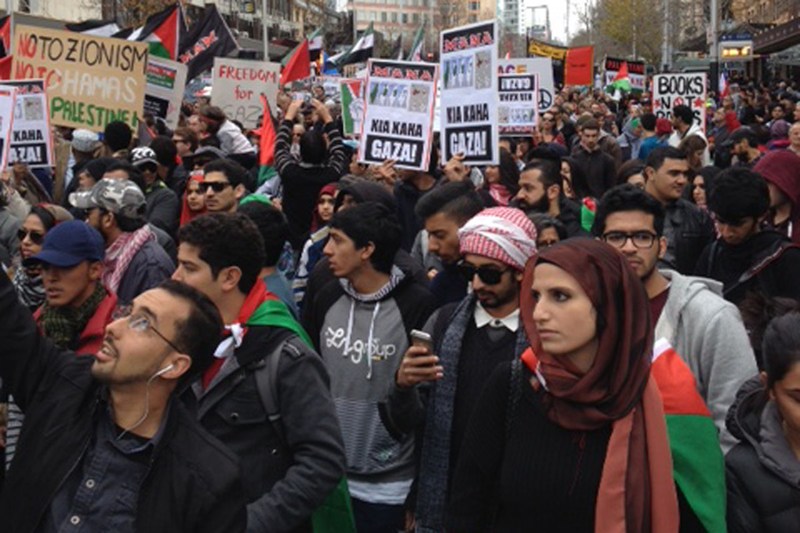
The Changing Face Of Protest: In marked contrast to the theologically- and ideologically-driven protest movements of the 1960s, 70s and 80s, contemporary protest, like this demonstration against the latest Israeli assault on Gaza, tends to be led by those whose stake in the identified violation of individual and/or collective identity is perceived to be the greatest. Photograph by GPJA.

PROTESTS against Israel’s latest invasion of Gaza are gathering momentum. In Auckland the rallies and marches of the last two Saturdays have drawn thousands to Aotea Square and Queen Street. Hundreds more have marched in Wellington. More action is planned. The protest organisers are now vowing to rally and march every Saturday until the Israeli Defence Force ceases its assault upon the beleaguered Palestinian enclave.
 
Viewed from an historical perspective these protests would appear, at least superficially, to conform to the templates laid down by the protest movements of the 1960s, 70s and 80s. Like the current movement in support of the Palestinian people, the movements against sporting contacts with Apartheid South Africa, nuclear weapons, and the war in Vietnam grew out of New Zealanders’ conscientious objection to conflicts flaring far beyond their country’s shores.
 
The prime movers of these earlier protests were drawn, overwhelmingly, from the churches, the trade unions and the universities. For the most part their motivation was straightforward moral revulsion. The Sharpeville Massacre of 1960; the nuclear war-gamers’ apocalyptic doctrine of Mutual Assured Destruction; the technology-driven carnage being visited upon the Vietnamese; all of these horrors stirred into action the muscular Christian ideals which, ever since the days of the Church Missionary Society, have played such an influential role in shaping New Zealand society.
 
Inevitably there was an element of smug condescension in these demonstrations of Christian charity. In the warm glow of the post-war boom many New Zealanders believed their little country came about as close to social perfection as it was possible to get in an imperfect world. With its “exemplary” race relations, its cradle-to-grave welfare state and its convenient amnesia concerning the nation’s disgraceful colonial conduct in Samoa, “progressive” New Zealand felt entirely justified in protesting against the rest of the world’s moral delinquency. How could “God’s Own Country” do less?
 
Playing the part of yeast in all this liberal Christian white-bread were the tiny communist parties. To the worthy moralism of the churches these Marxist missionaries added the sharp-edged arguments of socialist anti-imperialism. Though they were careful never to say so directly, implicit in their criticism of New Zealand’s diplomatic and military allegiances was the clear suggestion that we had taken up our position on the wrong side – not just of the Cold War but of History itself.
 
Wielding influence out of all proportion to their numbers, the communists would have been even more persuasive if their loyalties had not been divided between the gospels of Lenin, Mao and Leon Trotsky. The intensity of the struggles waged by the Communist Party of New Zealand (Beijing) against the Socialist Unity Party (Moscow) and by the Workers Communist League (Mao) against the Socialist Action League (Trotsky) rivalled that directed against the running-dogs of Capitalism themselves!
 
But regardless of whether the deities they worshipped were religious or secular, the leaders of New Zealand’s protest movements shared a common assumption that their respective doctrines were universally applicable. Black or White, Male or Female – everyone was welcome in God’s Kingdom/the Proletarian Paradise. What united human-beings was more important than what divided them.
 
It was only after the most convulsive protests in New Zealand history: the Springbok Tour Protests of 1981; that these universalist assumptions began to be challenged. Maori demanded to know what middle-class Pakehas could possibly know about racial and colonial oppression. Women wondered how men who preached racial equality could be so blind to inequality between the sexes. Gays struggled to make the straight world understand how oppressive a universal definition of sexuality could be.
 
The things that divided human-beings were important too. The new left-wing catechism now held that people define themselves less by the qualities they share with everybody else than by the attributes peculiar to themselves and those similarly identified: gender; ethnicity; sexuality; nationality; religion.
 
In this, the age of identity politics, protest activity operates according to a very different set of rules. The idea that New Zealanders per se might launch a series of nationwide protests inspired simply by Israel’s abrogation of universal moral values would quickly be challenged by persons and groups representative of the people most directly involved. In the case of Gaza and in descending order: by Palestinians; fellow Arabs and Muslims; people similarly victimised by imperialist oppression; and only then by “ordinary” New Zealanders – who must, of course, acknowledge the leadership and political objectives of those at the summit of the identity hierarchy.
 
And so the anti-Israeli protesters chant “Palestine will be free – from the river to the sea!” And no one who expects to be invited back dreams of asking: “Free in what way? Do you mean two free and independent states living side-by-side in peace? Or, do you mean that from the River Jordan to the Mediterranean, Palestine will be free of Jews?”
 
Because there’s a big difference.
 
This essay was originally published in The Press of Tuesday, 29 July 2014.