Showing posts with label Cameron Slater. Show all posts

Thursday, 20 February 2020

RNZ Must Have No Dogs In The September Fight.

Stand Clear! Winston Peters is encouraging voters to think of RNZ as belonging to “The Media Party”. He wants them to see it as a politically partisan institution with its own, vicious attack-dogs in the electoral fight. If he succeeds, it will be, and probably should be, the end of public radio in New Zealand.

RADIO NEW ZEALAND needs to reflect very carefully about the position in which it now finds itself. If it fails to alter its present course, there is a real possibility it will find itself accused of serious political bias. As a public broadcaster, RNZ simply cannot afford to be seen to have its own dog in the September 19 fight. Fair and balanced reporting is of huge importance when your radio network is funded by the taxpayer. In an election year, moreover, fairness and balance are absolutely critical to the maintenance of public confidence.  

For the moment, nearly all of the accusations of bias are coming from Winston Peters and the NZ First Party. This is only to be expected, given that RNZ’s reporting has inflicted serious damage on Peters and his colleagues. Lending credence to the latter’s accusations, however, is a photograph of Guyon Espiner, one of RNZ’s senior journalists, chatting amiably with Lester Gray, a former president of the NZ First Party. Looking at the photograph, it is very difficult not to identify Gray as the source of Espiner’s damaging revelations about the NZ First Foundation.

The release of this photograph – taken, according to Peters, by a member or supporter of NZ First – to The BFD (successor to the Whaleoil blog) has not only alarmed RNZ, it has put it on the defensive. The idea that a journalist and his source may themselves come under scrutiny is being widely interpreted as a thoroughly sinister development.

The mainstream news media has had much less to say about the failure of a supposedly experienced political journalist to protect his source. Tauranga is pretty much “ground zero” when it comes to NZ First’s historical support base. Why, then, would a former television journalist, with a very familiar face, choose to wander about in full public view with a former NZ First president and candidate? Why not meet privately, indoors, safe from prying eyes – and cellphones?

As for casting the whole episode as sinister, well, that particular charge is simply without merit. It is well-established in law that the taking of a person’s photograph in a public place, with or without their knowledge and/or consent, is not a criminal offence. If you are foolish enough to parade your connections in a Tauranga shopping centre’s carpark, then you should not act all hurt and surprised when that fact is recorded.

Nor should the mainstream news media be at all surprised that the photograph ended up on The BFD blog. Cameron Slater, of Dirty Politics fame, has publicly acknowledged his legal and personal connections with the lawyer Brian Henry. One of Winston Peters oldest and most trusted legal advisers, Henry also stood by Slater. Is this the explanation for what appears to be a decisive shift in the political allegiances of Slater and his colleagues from the National Party (which couldn’t distance itself fast enough from its favoured blogger following the publication of Nicky Hager’s book) to NZ First?

Such a shift would go a long way to explaining the rumours that NZ First is being assisted by one of Slater’s closest political allies from the Whaleoil years, Simon Lusk. A hard-bitten political operator, Lusk would have needed no instruction when it came to gathering intelligence on the two journalists responsible for revealing the closely-guarded secrets of the NZ First Foundation. The involvement of somebody like Lusk would certainly explain The BFD’s photograph of Stuff Reporter, Matt Shand. Recognising Espiner and Gray would not have been difficult. In that location, however, Shand was unlikely to be recognised by anyone not closely associated with the NZ First Foundation story.

That Tauranga shopping centre appears to have had more shooters in it than Dallas’s Dealey Plaza!

The demonisation of The BFD is yet another problematic aspect of RNZ’s coverage. Conservative blogs have every bit as much right to present their ideas to voters as liberal and left-wing blogs. In my time as a political commentator, I have contributed material to daily newspapers owned by Rupert Murdoch, and a weekly business publication edited by a devotee of Ayn Rand. So, when Cameron Slater invited me – along with a clutch of other non-right commentators – to contribute to a new pay-walled section of Whaleoil, I did not refuse. Similarly, when The BFD was launched, I agreed to contribute to its pay-walled “Insight” section. Nothing builds up one’s understanding of the Right like writing for their publications! And, although I have always been scrupulous to submit material I would happily see posted on The Daily Blog, or my own Bowalley Road, I’ve never once been censored.

In an environment where the idea that there might be two sides to every story, and that even those with whom you profoundly disagree have a story to tell, is dismissed as giving fascists a free-pass, it is not easy to make a stand for fairness and balance in journalism. It is vital, however, that RNZ tries.

On its “Mediawatch” programme, broadcast last Sunday morning (16/2/20) RNZ featured an interview with Ollie Wards from the Australian Broadcasting Corporation’s “Triple-J” youth-oriented radio station. Among many other observations, Wards ventured the opinion that “holding the government to account” was a vital aspect of the public broadcaster’s remit. There would appear to be a great many RNZ journalists who agree wholeheartedly with Wards’ characterisation of their role. That does not, however, make it right.

In a parliamentary democracy, it is not the news media which is entrusted with the role of holding the government to account, but the Opposition. They are the people elected to scrutinize the executive and ensure that government ministers are doing their jobs. They do this on behalf of the voters – the people charged, every three years, with the ultimate responsibility for holding governments to account. Nobody elected Guyon Espiner or Matt Shand to hold their government to account. Indeed, those gentlemen are not accountable in any meaningful political sense for the potentially decisive influence they are so well-positioned to exert on the electoral process.

The role of the news media (especially the publicly owned news media) is to assist the voters in the critical task of holding their representatives to account – not to do the job for them. That means doing everything within its power to give voters the truth, the whole truth, and nothing but the truth. It means unearthing the facts, as many as possible, and then contextualising them in a fair and balanced way. It does not mean extracting only those facts that serve an individual journalist’s purposes, and using them to manipulate the voters’ understanding of what a party has, or hasn’t, done.

Winston Peters is encouraging voters to think of RNZ as belonging to “The Media Party”. He wants them to see it as a politically partisan institution with its own, vicious attack-dogs in the electoral fight. If he succeeds, it will be, and probably should be, the end of public radio in New Zealand.

This essay was originally posted on The Daily Blog of Thursday, 20 February 2020.

Friday, 5 April 2019

Unwilling To Disclose.

Targeted: The great bundle of bearish energy that is my friend, Martyn “Bomber” Bradbury, could not understand why, suddenly, his usually supportive bank was refusing to rollover his website’s, “The Daily Blog’s”, overdraft. Bradbury was not to know that, a short time before, the Police had asked for and been given access to his bank accounts. Nor that the very fact the Police were asking had inscribed a large and very black mark against Bradbury’s name.

ONE OF THE DANGERS of keeping secrets is that the measures required to conceal them all-too-often end up revealing them. The unprecedented Police request to present secret evidence to the Human Rights Commission, for example, raises all sorts of questions about what, or who, they are trying to protect.

The great bundle of bearish energy that is my friend, Martyn “Bomber” Bradbury, could not understand why, suddenly, his usually supportive bank was refusing to rollover his website’s, “The Daily Blog’s”, overdraft. Bradbury was not to know that, a short time before, the Police had asked for and been given access to his bank accounts. Nor that the very fact the Police were asking had inscribed a large and very black mark against Bradbury’s name. Only later would he discover that his bank had not only failed to demand the production of a search warrant, but also neglected to inform Bradbury that the Police were in possession of his financial records.

If this story sounds familiar it’s because it is practically identical to the experience of another left-wing journalist, Nicky Hager. Like Bradbury, Hager was believed to have knowledge of the identity of the hacker calling him or herself “Rawshark”. It was Rawshark who, by his or her own admission, had hacked the computer of Cameron Slater, at that time the proprietor of the “Whale Oil Beef Hooked” blog. It was Rawshark’s purloined trove of Slater’s private e-mails that provided the controversial detail of Hager’s best-selling 2014 exposé, “Dirty Politics”.

In the course of their investigation of the theft of Slater’s e-mails, the Police not only sought and received (once again without the necessary authorisation) Hager’s bank records, but they also raided (this time brandishing a search warrant) his Wellington home and seized his computers.

Subsequent legal challenges by Hager’s lawyer, Felix Geiringer, established that the Police had obtained their search warrant improperly. The issuing judge had not been told that Hager enjoyed the legal protections of a journalist. Also exposed was the practice of Police investigators seeking and being supplied with individuals’ private financial information by an alarming number of the country’s biggest banks. The upshot was the return of Hager’s seized property, the communication of an official Police apology, and the payment of an undisclosed (but reportedly substantial) sum of money to New Zealand’s leading investigative journalist by way of compensation.

When Bradbury discovered that he had fallen victim to the same Police investigation as Hager, and that his reputation and privacy had been similarly violated, he laid a complaint with the Human Rights Commission. Over-worked and understaffed, the Commission took two years to get to Bradbury’s case. In the wake of the Hager settlement, however, Bradbury was confident of a favourable outcome.

His dismay upon discovering that the Police had applied to the Commission for permission to present evidence against him in private is easily imagined. Evidence, moreover, that Bradbury, the complainant, would not be permitted to view or challenge. Up until that moment, Bradbury, like most complainants to the HRC had been representing himself. Now he discovered that he was up against not only the serried ranks of the NZ Police, but also the be-wigged attorneys of Crown Law.

The question is, of course, Why? What, precisely, is the nature of the information which the Police are so determined to keep from public view?

Could it be that the information upon which the Police were persuaded to launch their extraordinary investigation had been supplied to them by one or both of New Zealand’s two national security organisations: the Security Intelligence Service and/or the Government Communications Security Bureau?

If so, then questions would have to be asked about the legal justification for placing journalists and bloggers under such surveillance. Had the requisite interception warrants been supplied – and on what grounds? That Hager and Bradbury were fierce critics of government policies? But, since when is political opposition grounds for spying on New Zealand citizens?

The suspicion arises that in 2014-2015, in some unspecified, possibly unlawful, and highly secretive way, the country’s national security apparatus was working hand-in-glove with senior elements within the police to silence and punish a couple of outspoken critics of the National-led 2008-2017 Coalition Government.

Such a pity that equivalent, over-zealous, investigative efforts were nowhere in evidence when the Christchurch Shooter was planning his homicidal attack.

Disclosure: The author is a personal friend of Martyn Bradbury, and a long-time paid contributor to The Daily Blog.

This essay was originally published in The Otago Daily Times and The Greymouth Star of Friday, 5 April 2019.

Tuesday, 28 July 2015

“Something Very, Very Different”: Why Rumours Of Labour’s Internal Poll Numbers Are Giving The Nats The Heebie-Jeebies.

Reasons To Smile: For some in Labour’s Caucus, the experience of taking fire (especially from people they considered friends and allies) has been a painful one. But the fact that they have remained at their posts, and returned fire, has not been lost on Labour’s traditional constituency. There have been no leaks, no private briefings, no wayward press releases. The Labour Caucus has – touch wood – rediscovered the power of collective commitment and responsibility. In the process, it has reclaimed a good measure of much-needed credibility.
 
CAMERON SLATER is appealing directly to members of Labour’s caucus on his Whaleoil blog. Why? Because he’s just got wind of Labour’s internal poll numbers. According to Cameron: “Their internal polls show something very, very different from the publicly available polls. Apparently the gap between Labour & National is about 6 or 7 percent when the public polls have it at 15%.”
 
This can only mean that, in the usually highly accurate UMR poll, Labour is positioned somewhere between 34-36 percent and the National Party somewhere between 40 and 42 percent. At that level of support, it’s ‘Game Over!’ for John Key’s government. No wonder Cameron is doing everything he can to sow doubt in the minds of Andrew Little’s colleagues.
 
Clearly, these results have brought on an attack of the heebie-jeebies in National’s ranks. How else to explain the usually very crafty Mr Slater’s tactical lapse? Calling people’s attention to what he’s heard about Labour’s internal polling – when it’s this good – has given a major boost to the Left’s morale. It’s also boosted the credibility of the other big rumour doing the rounds about UMR’s polling: the one that puts the combined Labour-Green vote at 49 percent.
 
Cameron’s post may also serve to confirm the rumours about National’s own internal polling. According to these, Labour’s much criticised ‘China Play’ almost immediately began shaking erstwhile Labour voters loose from National’s tree in large numbers.
 
That would certainly explain the way National suddenly went dark on the whole issue. As Matthew Hooton explained in his NBR column of 17/7/15: “Wedge politics are straightforward: You find a genuine problem, associate it with an unpopular minority, raise it with inflammatory language, or in a provocative context, and wait for your opponents to defend the minority. Then you stand with the majority against them.” With advisers as skilled in the dark arts of wedge politics as Mark Textor and Lynton Crosby, the Prime Minister was almost certainly warned against expressing too much solidarity with the targets of Labour’s campaign.
 
That job was left to TV3’s Patrick Gower, who has been waging a virtual one-man-war against what he insists are Labour’s “cooked-up” statistics. How disappointed poor Paddy must have been when his week-long assault upon Labour for “playing the race card” was rewarded with a marginal increase in Labour’s support (from 30.4 to 31.1 percent) in the TV3/Reid Research Poll. To rub salt in his wounds, the poll also showed the ‘Opposition Bloc’ of parties (Labour, Greens, NZ First) registering 50.9 percent to the ‘Government Bloc’s’ (National, Act, Maori Party, United Future) 48.2 percent. Completing Mr Gower’s discombobulation must have been Reid Research’s finding that 61 percent of New Zealanders support a ban on foreign investors buying-up residential property.
 
So, let us assume, purely for the sake of argument, that all the rumours are true and all the numbers are correct. It would mean that National has shed 6-7 percentage points directly to Labour. Interestingly, this is exactly what the Roy Morgan Poll of 17 July indicated. It had National down 6.5 points to 43 percent, Labour up 6 points to 32 percent, and the combined Labour-Green vote on 45 percent. Admittedly, the Roy Morgan survey only caught the first day of Labour’s China Play, but, by the same token, it escaped the effects of ‘Paddy’s Play’ entirely.
 
From the beginning of the year, Labour’s clear objective, and Andrew Little’s laser-like focus, has been to re-capture the roughly 10 percent of former Labour voters who have, ever since Helen Clark’s departure, taken to voting National with their Party Vote. Crucial to recovering that lost support are the two “Cs” – Connection and Credibility.
 
Labour's Caucus - Sticking To Their Guns.
 
Labour and Little must first connect with, and then remain at the side of, their electoral base. They must whistle their tune – and keep on whistling it – until their supporters start whistling it back to them. In lifting Labour’s vote towards that magical 40 percent mark, nothing is more important than saying what you mean, meaning what you say, and sticking to your guns.
 
For some in Labour’s Caucus, the experience of taking fire (especially from people they considered friends and allies) has been a painful one. But the fact that they have remained at their posts, and returned fire, has not been lost on Labour’s traditional constituency. There have been no leaks, no private briefings, no wayward press releases. The Labour Caucus has – touch wood – rediscovered the power of collective commitment and responsibility. In the process, it has reclaimed a good measure of much-needed credibility.
 
And if Cameron Slater’s right about the results of the latest UMR poll, they now have their reward.
 
This essay was originally posted on The Daily Blog of Monday, 27 July 2015.

Thursday, 21 August 2014

Simply Not Credible: Dr Tucker's "Clarifications" Are Only Making Things Worse For John Key.

Bullshit: The idea that the Director of the SIS, Dr Warren Tucker, would proceed with the release of highly sensitive political information to a right-wing blogger without his boss's, the Prime Minister John Key's, express approval is simply not credible.

THAT DR WARREN TUCKER, Director of the Security Intelligence Service in 2011, agreed to the release of politically sensitive material – thereby intervening in an on-going contretemps between the leaders of the National and Labour parties – without receiving the express permission of his boss, the Prime Minister, John Key, is simply not credible.
 
The release this morning of a letter written to Newstalk-ZB Chief Political Reporter, Felix Marwick, by Dr Tucker, states unequivocally, that:
 
“I notified the Prime Minister (in accordance with my usual practice to keep the Minister informed on a ‘no surprises’ basis) that I was going to release redacted documents in response to the request from Mr Slater. I advised the Prime Minister that I had received legal advice that there were no grounds for withholding the information given the public disclosures already made about the existence and some of the content of the briefing. I informed the Prime Minister that I had informed Mr Goff of my decision to release the information.” (My emphases.)
 
Shortly after 10 o’clock this morning, Radio New Zealand-National informed its listeners that the former Director, Dr Tucker, had issued a statement “clarifying” the information contained in his letter to Mr Marwick.
 
The crucial two sentences of Dr Tucker’s latest statement assert that:
 
“My practice under the ‘no surprises’ convention relating to Official Information Act requests was to brief the Prime Minister through his office. The reference to the PM in this context means the PM’s office.”
 
To which, I believe, the rest of the country is entitled to call – “Bullshit.”
 
The person under scrutiny here is a former Director of the SIS. In this role he would have been well aware (if he was doing his job!) of Cameron Slater’s identity; of the political complexion of his Whaleoil bog; and of the close relationship existing between not only Mr Slater and the PM’s Office but also with the senior Cabinet Minister, Judith Collins.
 
That he was about to expedite the release of sensitive political information to Mr Slater – a decision without precedent in the experience of the mainstream news media – was, of itself, extremely unusual and highly controversial. Especially so, considering the Director’s decision not to release the information to any other media outlets – in spite of a least one formal OIA request to do so. In other words, the Director of the SIS was planning to provide Mr Slater’s Whaleoil blog with a “scoop”.
 
All this, and we are being asked to accept that the Director was willing to rely on the people working in the Prime Minister’s office to just pass along the information, you know, when they had time!
 
I have spoken to two people who have worked in ministerial and prime-ministerial offices and both of them have told me that this is a preposterous suggestion. Ministerial and Departmental Chief Executives (not to mention SIS Directors!) do not mistake or conflate the Prime Minister’s Office with the Prime Minister him or herself. They do not put their jobs and reputations on the line – as Dr Tucker undoubtedly did when he organised the exclusive release of sensitive political information to a notorious right-wing blogger – without hearing the voice of their boss, or receiving a signed instruction, giving them the go-ahead.
 
Unless.
 
Unless the intention of the Director was to provide his boss with “plausible deniability” by deliberately not seeking express (i.e. spoken or written) prime ministerial approval. And if that is the case then it is difficult to avoid the conclusion that Dr Tucker was behaving in an entirely inappropriate and highly politicised fashion.
 
He must have known that what he was proposing to do was extremely unusual and open to serious question, and yet he is telling us now that he handled Mr Slater’s OIA request in a way that, should his own actions be subjected to official scrutiny at some point in the future, the Prime Minister would be protected from any and all ethical, political and legal repercussions.
 
But that would have entailed Dr Tucker abandoning his role as a neutral public servant and becoming the Prime Minister’s political accomplice.
 
And that, if true, would be an utter disgrace. Even worse, it would be subversive of New Zealand’s democratic system of government.
 
This essay was posted simultaneously on the Bowalley Road and The Daily Blog blogsites on Thursday 21 August 2014.

Tuesday, 19 August 2014

Dirty Politics - Is There Any Other Kind?

No Escape: If war is "the continuation of politics by other means", then the reverse may also be true: that politics is the continuation of war by other means. In practical terms, the accepted (if unacknowledged) principle of democratic politics has always been that so long as politicians and their followers eschew actual physical violence, then all other tactics are permitted.

IT IS NEARLY TWENTY YEARS since I first read Dirty Politics. Impossible? Given that Nicky Hager’s Dirty Politics: How attack politics is poisoning New Zealand’s political environment was only published a few days ago, how could I possibly have read it in the 1990s?
 
The answer, obviously, is that Mr Hager’s is not the only book bearing this arresting title. The American scholar, Kathleen Hall Jamieson’s, Dirty Politics: Deception, Distraction and Democracy, was first published by the Oxford University Press in 1992. As the subtitle of Professor Jamieson’s book suggests, her research covers much the same ground as Mr Hager’s Dirty Politics; the obvious difference being that her examples are drawn from American politics.
 
About the subject matter of her study Professor Jamieson writes: “Those who claim that politics is cleaner now than it was in the nineteenth century are usually marshalling evidence that compares toucans to tangerines, unsigned print ads to televised claims. But if one compares print to print one finds as much that is disreputable in today’s campaigns as in the past.”
 
Professor Jamieson’s claims for the historical continuity of attack politics are further reinforced by quoting American Founding Father, Benjamin Franklin.
 
To his friend, Robert Morris, Franklin observed that the public “is often niggardly, even with its thanks, while you are sure of being censured by malevolent Criticks and Bug-writers, who  will abuse you while you are serving them and wound your Character in nameless Pamphlets”. Franklin presses home his complaint in language which undoubtedly strikes a chord with today’s political leaders; accusing his critics of “resembling those little dirty stinking insects, that attack us only in the dark, disturb our Repose, molesting and wounding us while our Sweat and Blood are contributing to their substance.”
 
Nor does one have to look too hard to discover evidence of attack politics in New Zealand’s political history. Of the 1951 Snap Election, University of Otago Professor of History, Tom Brooking, writes: “The campaign was probably the dirtiest in New Zealand’s political history. National declared the election was a contest between the ‘The People versus the Wreckers’. Hackneyed old stories that [Labour Leader, Walter] Nash had once been a bankrupt were dredged up and his earlier visit to Russia was cited as proof of his communist leanings.”
 
Much worse, however, were the series of highly embarrassing and potentially criminal incidents which dealt death-blows to the political careers of Labour Party politicians Colin Moyle and Gerald O’Brien.
 
Nor is the dark anti-hero of Mr Hager’s Dirty Politics, Cameron Slater, without precedent when it comes to the New Zealand Right’s long history of doing damage to its political enemies. As Listener journalist (and now Bill English’s press secretary) Joanne Black wrote in her review of Redmer Yska’s study of the newspaper Truth (of which, ironically, Mr Slater was the last editor): “For nearly 40 years [James] Dunn, as Truth’s in-house censor, read almost every word of every edition before it was printed. But his influence was not only on what not to publish for fear of defamation suits. He also played a backroom editor-in-chief role and was himself the source of many stories, including those that satisfied his virulent anti-Communist beliefs, which were shared by editor Russell Gault.”
 
The great Prussian military theoretician, Carl von Clausewitz, famously described war as “the continuation of politics by other means.” I would argue strongly that the reverse of that famous formulation is equally true. That politics is the continuation of war by other means.
 
Democratic politics, in particular, requires both the political leadership of the state – and its citizens – to resolve the fundamental economic and social issues dividing their communities through institutions and processes that are of their essence both formal and peaceful. Legislatures and elections are thus charged with settling those issues which would, in previous centuries, have been resolved (to quote another Prussian) by “blood and iron”.
 
In practical terms, therefore, the accepted (if unacknowledged) principle of professional politics has always been that so long as politicians and their followers eschew actual physical violence, then all other tactics are permitted. Politics is not an occupation for the faint-hearted, nor is it one whose practitioners can remain both effective and unstained. Bluntly, “dirty politics” is the only kind there is.

Mr Hager argues that: “Exposing dirty politics is an essential step in allowing reasonable people to understand and to choose other approaches. There is no need to follow those who are least principled down into the pit.”
 
But the choice is not – with all due respect to Mr Hager’s ardent idealism – between decency and the pit. The choice is between accepting “dirty” politics, with all its “Criticks and Bug-writers”, and rejecting altogether the formal and peaceful processes of democracy.
 
The options are not fair means or foul: they are foul means or fouler.
 
This essay was originally published by The Press of Tuesday, 19 August 2014.

Saturday, 16 August 2014

Closing Our Eyes In The Sausage Factory: Some Thoughts On Nicky Hager's Book, "Dirty Politics"

Not A Pretty Sight: Everyone likes a good sausage, but if we knew exactly what went into the making of that sausage would it still taste so good? Democratic politics, too, is not always improved by too close an examination. It would, however, be a tragedy if Nicky Hager's book, Dirty Politics, caused people to abandon the political process altogether as irredeemably corrupt and to call down a plague upon the houses of both Left and Right.
 
IT WAS THE GERMAN CHANCELLOR, Otto von Bismarck, who warned his countrymen that “laws are like sausages, it is better not to see them being made.” The same could be said for democratic politics generally. That democracy, like a good sausage, is a wonderful thing, but you really do not want to know what goes into it.
 
With this in mind, it is tempting to take Nicky Hager to task for grabbing us all by the scruff of our necks and dragging us into the sausage factory. This is especially so when we consider the observations of right-wing political fixer, Simon Lusk, who Hager quotes in the first chapter of in his book Dirty Politics: How Attack Politics is Poisoning New Zealand’s Political Environment.
 
In an e-mail to Hager about negative campaigning Lusk writes: “The are a few basic propositions with negative campaigning that are worth knowing about. It lowers turnout, favours right more than left as the right continue to turn out, and drives away the independents. Voting then becomes more partisan.”
 
If Lusk is correct then the publication of Dirty Politics could have the perverse outcome of suppressing the vote of those disgusted and demoralised by Hager’s revelations while ensuring the maximum turnout possible by voters sympathetic to John Key and the National Party.
 
It is certainly possible to infer from the response-lines agreed upon by Key and his allies that this is precisely the outcome they are seeking. It is presumably the reason for their constant reiteration of the idea that Hager’s revelations are nothing new, or even very remarkable, given that it has always been thus in the deeply compromised world of politics and politicians. This idea of the ubiquity of political evil is reinforced by TeamKey’s insistence that Hager’s behaviour is morally indistinguishable from that of the dark anti-hero of Dirty Politics, the blogger Cameron Slater. The sub-text here is simple: No one in politics has clean hands – even Hager. After all, his book could not have been written had the very same sort of hacking and privacy breaches which he so roundly condemns when practiced by the Right not supplied him with an information treasure-trove that was simply too compelling not to use.
 
Key, himself, has no choice except to point-blank refuse to engage with Hager’s allegations in any way. Were he to do so, Hager would be able to claim victory. This is because, in the most brutal terms: an allegation responded to is an allegation taken seriously; and an allegation taken seriously is an allegation which could, quite possibly, be true.
 
The moment Key allows the Chief Prosecutor, Nicky Hager, to have the Prime Minister called as a witness before the Court of Public Opinion, then, regardless of the nature of the evidence provided, the impression of there being a case to answer will be indelibly stamped on the voter’s mind. And that is “Game Over” for Key and the National Party.
 
No matter how shrill and false he may sound in the ears of Hager’s supporters, the Prime Minister will continue to refuse to acknowledge the possibility that Hager might be onto something. From now until Election Day, the author of Dirty Politics can only be “a screaming left-wing conspiracy theorist” who is “making it up”.
 
And there is method to this seeming madness. Key understands that his followers have been rattled by the appearance of yet another pre-election book by Nicky Hager. Their hero must, therefore, stand strong in the face of his persecutor.
 
The Prime Minister will make the same claims over and over again: Dirty Politics is without foundation; part of a vast left-wing conspiracy to bring him and his government crashing down; just one more vicious assault to set alongside obscenity-shouting students, anti-Semitic boguns, and a feral underclass of John Key effigy-burners. The slightest concession to even the most trivial of his persecutor’s accusations will be interpreted by his followers as weakness – tantamount to a full confession of guilt.
 
This is why the prime Minister is standing rock-solid behind his former staffer, Jason Ede. Why he will take no action whatsoever against his Minister of Justice, Judith Collins. Why he accepts the denials of Cameron Slater without demur. And why he will not deign to read even so much as a single word of Dirty Politics – not while he is so clearly the victim of dirty politics.
 
The Prime Minister can adopt this strategy because he knows that TeamKey is sufficiently powerful to block any serious attempt by the mainstream news media to take up the cudgels on behalf of Hager’s allegations. The public broadcasters will not dare to do it and the commercial networks and newspapers will not want to do it.
 
This failure will only intensify the feelings of disgust among those who feel there is something very rotten at the heart of New Zealand’s political system. In a grotesquely ironic abdication of the very civil responsibilities Hager’s book is intended to strengthen and mobilise, thousands of New Zealanders may yet abandon the political field altogether, calling down a plague on the houses of both the Right and the Left as they depart.
 
If that happens then the cynical political analyses of Otto von Bismarck and Simon Lusk will be vindicated. Hager will have demonstrated that although he is able to lead voters into the interior of the sausage factory, he cannot make them open their eyes.
 
What is it that John Lennon sings in his marvellous A Day In The Life?
 
A crowd of people turned away
But I just had to look
Having read the book.
 
This essay was originally posted on The Daily Blog of Friday, 15 August 2014.

Wednesday, 13 August 2014

Thank God For Nicky Hager!

Man Of The Hour: Nicky Hager with a copy of his just released book, Dirty Politics. Photo by Mark Mitchell.

IF NICKY HAGER did not exist it would be necessary, for the survival of our democracy, to invent him.

A full review of Nicky's book will follow just as soon as I have read and digested its contents.

In the meantime, as the news media responds to Nicky's revelations, we should ask ourselves this very simple question: "Does this journalist's response to Dirty Politics suggest that he or she is part of the solution - or part of the problem?"

Oh, and thanks again, Nicky. Thanks heaps.

This posting is exclusive to the Bowalley Road blogsite.

Thursday, 1 November 2012

Anything Cam Can Do ...

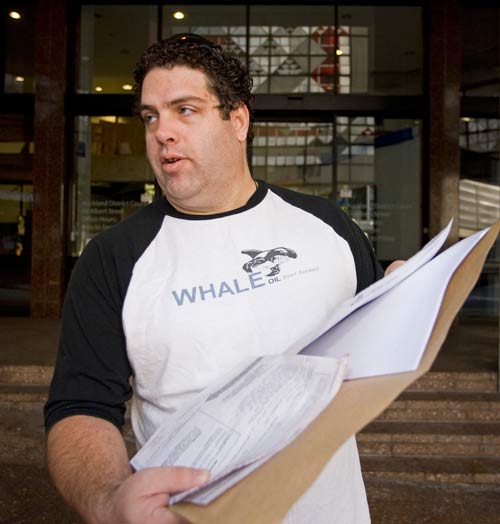
Can He Handle The Truth? Cameron Slater has leveraged his extraordinary success as the author of the Whaleoil blog into the editorship of the once-mighty Truth newspaper. Now that they know what's possible, the Left's bloggers should aim for similar communications success.
 
“ALL I WANT is the truth!” It’s a measure of Cameron Slater’s propagandistic flair that he should celebrate his appointment as Truth’s new editor by posting a video-clip featuring John Lennon. Recruiting one of the Left’s pop icons to celebrate his new job as right-wing press baron – that’s our Cam!
 
Though you wouldn’t think it to read the response of the left-wing bloggers, who have, almost unanimously, greeted Mr Slater’s success with the level of enthusiasm usually reserved for the Black Death, his appointment is a very good reason to celebrate.
 
The extraordinary effort Mr Slater has put into his Whaleoil blog - propelling the single-man operation to the Number One slot on Open Parachute’s New Zealand blog-rankings - is almost certainly the reason he was asked to do the job. Mr Slater may not be a trained journalist, but 600,000 page-views per month more than entitles Whaleoil to be compared favourably with most of this country’s provincial dailies.
 
Certainly Whaleoil reaches more people than Truth has been able to attract over the past few years. And that, presumably, is the point. As newspaper circulation figures continue to decline and publishers tear their hair out trying to arrest the slide in both readers and advertisers, the proprietors of Truth have taken a punt on a guy who has proved that right-wing political blogging has mass appeal.
 
Okay, okay – so it’s not the sort of political blogging that appeals to me, but in assessing the effectiveness of any sort of blog the number of page-views it registers cannot be ignored. And by that measure Mr Slater is a highly effective communicator.
 
A crucial part of Whaleoil’s appeal lies in its direct and simple prose-style. That, and its author’s unerring eye for the political jugular. These are the qualities upon which Truth’s owners, Messrs Horton and Crow, have staked their reputations – and their fortunes. They are betting that Mr Slater can restore Truth to its former status as one of the most influential newspapers in the country.
 
From its current circulation of 10,000 to 16,000 copies, they will be hoping that Truth – both as a newspaper and as an Internet presence – will once again become powerful enough to make or break any citizen fortunate or unfortunate enough to attract its interest.
 
At present, the paper’s readership is made up, to the tune of around 80 percent, of the social group I have elsewhere dubbed “Waitakere Man”. Mr Slater will be doing everything he can to keep these blokes attached to the National Party and, if possible, recruit their friends and workmates to the right-wing cause.
 
If ever there was a time to throw one’s hat into the ring as a potential Truth columnist, it was the day Mr Slater’s editorial appointment was announced and his left-wing nemesis, Martyn “Bomber” Bradbury, resigned. Getting on board what could become one of the great publishing adventures of recent years (and hopefully seeding whatever left-wing ideas one could squeeze past the Fox News-style of journalism Mr Slater so clearly favours) was certainly worth a try.
 
I did my best, but the ubiquitous Josie Pagani beat me to it.
 
Well done that woman, I say, and congratulations to Mr Slater. The challenge before the Left is now to build their own version of the sort of extraordinary communications vehicle that Whaleoil has become, and which the proprietors of the Truth newspaper are clearly expecting its new editor to replicate on their behalf.
 
After all, anything Cam can do, the Left should be able to do better.
 
The last thing we need to see is Mr Slater, contemptuously twitting his left-wing opponents by posting a YouTube clip of Jack Nicolson snarling:
 
“You can’t handle the Truth!”
 
This posting is exclusive to the Bowalley Road blogsite.