Showing posts with label SIS. Show all posts

Tuesday, 9 March 2021

Will The Much-Criticised SIS Have The Last Laugh?

Be Careful What You Wish For: At the very heart of the Left’s stupidity on national security matters is its lamentable unfamiliarity with the basic techniques of counter-intelligence. In their reckless, ideologically-driven haste to smash the infrastructure of white supremacism in New Zealand, the far-left critics of the SIS and the GCSB are openly embracing the maximum possible deployment of state surveillance and interception technology.

LEFT-WING NAIVETY is nothing new, but its power to astound and enrage has not diminished. The scorn heaped upon the Security Intelligence Service (SIS) for failing to intercept a recent threat to the Christchurch Muslim community is a case in point.

The official version of this event has the Police receiving a tip-off from a member of the public. Someone who just happened to be hanging-out in the digital neighbourhood of 4-Chan’s most dangerous white supremacists stumbled, quite accidentally, upon plans to car-bomb the two mosques attacked by Brenton Tarrant in 2019, and like any public-spirited citizen, he called the cops.

Hmmmm …

This may, of course, be a true story. The informant’s accidental discovery of a terrorist plot may, indeed, be just one of those amazing examples of pure dumb luck that sometimes happens in this funny old world. Then again, it might not.

Maybe, just maybe, the official version of events bears absolutely no resemblance to what actually happened.

Because, let’s face it, if the SIS is doing exactly what the Left has been urging it to do since 15 March 2019; if it has made the surveillance, interception, infiltration and disruption of white supremacist groups its top counter-intelligence priority; then what possible motive would it have for announcing the fact – and offering public proof of its effectiveness – to the individuals and organisations it is watching?

Let’s assume, for the sake of argument, that the SIS and its sister organisation, the Government Communications Security Bureau (GCSB) have not only been monitoring the “chatter” on 4-Chan, but that they have an agent, or agents, masquerading as hardline white supremacists participating energetically in any number of extremist chat-rooms. Let’s also assume that they are receiving a steady flow of HUMINT (human intelligence) from spies embedded in far-right and white supremacist groups. In these circumstances, only an imbecile would jeopardise these operations by waving their hands in the air and shouting “Lookit! Lookit! We’ve caught ourselves a terrorist!”

Surely, the SIS’s more likely response, in the event of it learning of a credible plan to car-bomb Al Noor Mosque and the Linwood Islamic Centre on the second anniversary of Tarrant’s attacks, would be to let the world believe that the plot’s discovery was due entirely to the initiative of a sharp-eyed and public-spirited citizen who saw something and said something … to the Police?

If this was indeed the SIS’s response, then the loud braying of the Left will, for once, be a welcome noise. Criticism of the SIS’s “failure” to take white supremacism seriously will be music to the Service’s ears. The longer the far-right can be persuaded that the national security apparatus remains blind to the threat posed to New Zealanders by their most extreme elements, the better chance the government’s secret agents will have of shutting these extremists down.

It is, however, unlikely that the SIS chiefs will be placing too much faith in the Left’s condemnation of their inadequacies. Merely by reading the public disclosures of experts on the far-right, like Professor Paul Spoonley, they will be aware that more and more of New Zealand’s right-wing extremists are learning the basic trade-craft of clandestine political organisation. Aware that unfriendly eyes are on them, these groups are encrypting their communications and vetting with great thoroughness every potential recruit to their cause. Such people and groups are unlikely to risk saying anything potentially incriminating on 4-Chan – not when there are many much safer places on the Internet in which to take refuge.

Given that one of the persons arrested by the Police was released without charge, and the individual in custody was charged under the Crimes Act – rather than the Terrorism Suppression Act – with Threatening To Kill, one might even speculate that there is more than a faint whiff of public relations about the whole incident.

Face it, rigging a car-bomb – especially one intended to be detonated remotely, rather than delivered directly to the target by a driver willing to sacrifice their own life for the cause – is not a game for amateurs. A former, or active duty, soldier, highly trained in the use of explosives and detonation devices, might be capable of such an attack. Alternatively, skilled and experienced operatives with similar backgrounds might be imported to perpetrate the outrage. With New Zealand’s borders closed by the Covid-19 Pandemic, however, this latter scenario can be confidently discounted. It is also inconceivable that the arrest of a suspect with such a military background would not have prompted a significantly higher security response on the part of the authorities.

How much more likely is it that a couple of idiots, talking big on what was effectively an “open line” were easily intercepted by the SIS and GCSB “watchers”; and that their identity was made known to the Police – not because they posed a serious threat to the Christchurch Muslim community, but because announcing the arrest of a couple of far-right, Islamophobic terrorist wannabes, just days away from the second anniversary of the Mosque Massacres, would constitute a major public relations coup?

Such an operation would achieve a number of objectives. First and foremost, it would reassure Muslim New Zealanders that their fellow citizens and, of course, the Police, still have their back – thereby reconfirming “They Are Us” in the most dramatic fashion. Secondly, it would serve as a reminder that there was still a great deal of hate out there – murderous hate. Precisely the sort of hate that the Labour Government is determined to keep in check with its proposed legislation outlawing “hate speech”. Thirdly, as intimated above, the circumstances of the alleged offender’s apprehension would set up the SIS and the GCSB for exactly the sort of left-wing bollocking that has, in fact, occurred. Criticism which, hopefully, will make the Service’s surveillance, interception, infiltration and disruption operations all the more effective. Assuming, of course, that the far-right is as predictable in its stupidity as the far-left!

At the very heart of the Left’s stupidity on national security matters is its lamentable unfamiliarity with the basic techniques of counter-intelligence. In their reckless, ideologically-driven haste to smash the infrastructure of white supremacism in New Zealand, the far-left critics of the SIS and the GCSB are openly embracing the maximum possible deployment of state surveillance and interception technology.

To root out Islamophobia and silence hate speech, they are happy to have the national security apparatus secure the demise of far-right extremists by any means necessary. That their own uncompromising demands are as predictable as they are extreme does not appear to have occurred to them. That their antipathy to the far-right might be used to the long-term advantage of the security services has, similarly, never crossed their minds.

Nor, apparently, has the realisation that, when they have rounded up the last ethno-nationalist extremist, those same security services will come after the Left with exactly the same surveillance technology and censorship powers. More tellingly, they will be able to do so citing precedents with which the Left itself has furnished them. The far-left critics of the national security apparatus will be hung by a rope which they, themselves, have twisted.


This essay was originally posted on The Daily Blog of Tuesday, 9 March 2021.

Friday, 14 August 2015

Trading With The Enemy?

Ukraine Doesn't Even Come Close: Soviet troops roll over the Afghan border in late-December 1979. The presence of T-54 tanks on the streets of Kabul was not enough, however, to halt New Zealand's burgeoning trade relationship with the Soviet Union. So keen was the Muldoon Government to keep selling butter to the Reds that the relationship even survived  the SIS catching the Soviet Ambassador passing $10,000 to the Socialist Unity Party!
 
NEW ZEALANDERS like to make fun of their Security Intelligence Service. That an SIS agent’s abandoned briefcase was found to contain a cold meat pie and a hot copy of Penthouse magazine has provided endless fodder for the nation’s satirists. The service’s critics also like to reiterate its agents’ failure to secure a conviction for espionage against William B. Sutch – one of New Zealand’s most distinguished public servants. More latterly, we’ve been encouraged to shake our heads in wonderment at the sort of Cold War madness that could persuade the SIS to keep a file on the mild-mannered Keith Locke – from the age of ten!
 
Largely forgotten amongst all this guffawing and tut-tutting is the occasion when the SIS got it right. When all the weeks of surveillance and electronic eavesdropping actually paid off, and New Zealand’s spooks were able to parade the scalp, not of some lowly Eastern Bloc attaché, but of the Soviet ambassador himself.
 
The so-called “Sofinsky Affair” took place just before Christmas in 1979 and featured the Soviet Ambassador, Vesevelod Sofinksy, caught in the act of handing over $10,000 of “Moscow Gold” to a representative of the Socialist Unity Party. The latter, a Soviet-aligned communist organisation, though small in numbers, wielded considerable influence in the then powerful trade union movement. Sofinsky was the SIS’s biggest “gotcha” by far – a Christmas present wrapped up in the reddest of red ribbons.
 
And yet, the Prime Minister of the day, Rob Muldoon, was troubled. His most obvious course of action was to expel the ambassador for what everybody agreed was an egregious breach of diplomatic protocol. The problem was that, on Christmas Eve 1979, just days after the wildly successful Sofinsky “sting”, Soviet armoured divisions began rolling across the Afghan border.
 
Amidst the outraged protests of the Muslim states, and the teeth-grinding rage of the “Free World”, Prime Minister Muldoon was desperately worried that New Zealand’s expulsion of its Ambassador would be construed by the Soviet Government as an act of exaggerated Cold War fealty. How would the Soviets respond? What would happen to the burgeoning trade relationship between the two countries? What was a delinquent ambassador worth? Hopefully not that much!
 
Muldoon dispatched one of his most trusted advisers, Gerald Hensely, to consult New Zealand’s principal allies on the likely consequences. The [Jimmy] Carter Administration in Washington urged caution, but the British were confident that the most New Zealand had to fear by withdrawing Sofinsky’s diplomatic credentials was that the Soviets would do the same to New Zealand’s ambassador in Moscow.
 
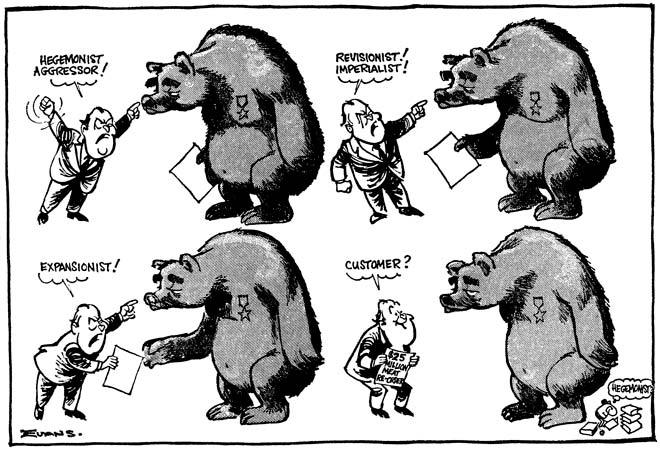
And so it proved. The two states expelled each other’s ambassadors, but took no further action. The shipments of butter and mutton to Russian ports continued uninterrupted – as did the unloading of Russian-made Lada cars at the Auckland docks. Not even the Soviets’ reckless intervention in the internal politics of New Zealand, or the presence of T-54 Russian tanks on the streets of Kabul, was enough to keep the Dairy and Meat Boards’ exports out of the Russian market. Back in 1980, foreign trade was important to New Zealand’s prime minister.
 
Customer? Cartoonist, Malcolm Evans, exposes the hypocrisy of the Muldoon Government's anti-Soviet rhetoric.
 
Is it still? As dairy prices tumble, and the Aussie banks start sharpening their pencils, you might think that New Zealand’s current prime minister, John Key, would be doing everything within his power to move this country’s major exports over the border of any country willing to let them through. Russia is one such country. Her people are hungry for butter, cheese and milk powder, and their government is anxious to supply them. Who, or what, could possibly prevent New Zealand and Russia from taking advantage of this mutually beneficial situation?

The answer, apparently, is exactly the same combination of “allies” who, back in 1980, had no problems at all with New Zealand trading with the Soviet Union. Today, however, the Russian Federation is a “no-go area” for New Zealand exports. Russia could invade Afghanistan in 1979, and not be subjected to trade sanctions. But, in 2014, her defensive annexation of Crimea (which had, up until the mid-1950s, been an integral part of the Russian state) has prompted her Nato enemies to declare Russia’s markets off-limits.
 
Why isn’t our government challenging the EU’s/Nato’s/USA’s right to impose such trade barriers? Time, perhaps, for the SIS to place the American ambassador and the National Party under surveillance?
 
This essay was originally published in The Waikato Times, The Taranaki Daily News, The Timaru Herald, The Otago Daily Times and The Greymouth Star of Friday, 14 August 2015.

Friday, 10 October 2014

Daggers In The Dark: Why John Key Should Remain Minister-in-Charge Of The SIS and GCSB.

John Key's New Spymaster? Chris Finlayson has proved to be a politician of icy rectitude: an austere and unbending executor of his official responsibilities as Attorney-General. All well and good, it is an office well-suited to austerity. But John Key should think again before entrusting a person so confident in the unassailability of his own judgements with the awesome weaponry of the secret state.
 
JOHN KEY’S DECISION to hand off day-to-day responsibility for the national security apparatus to Chris Finlayson is deeply troubling. The tradition of making the Prime Minister the Minister-in-Charge of the NZ Security Intelligence Service (SIS) and, more latterly, the Government Communications Security Bureau (GCSB), reflected the public’s expectation that foreign and domestic intelligence gathering must never be permitted to overstep the democratic boundaries. As the nation’s most powerful elected official, the Prime Minister is supposed to keep the spooks in line.
 
But now the Attorney-General – the country’s most important legal officer – is being asked by the Prime Minister to double as New Zealand’s Spymaster. Ominously, the responsibility for administering the law and supervising New Zealand’s national security apparatus is to be vested in a single individual. Inevitably, the biblical question arises: can Mr Finlayson serve two masters?
 
Historically, those charged with preserving the safety of the State have demonstrated little patience for formal legal protocols. In the words of the Roman jurist, Cicero: salus populi suprema lex – the safety of the people shall be the highest law. And when that safety is perceived to be under imminent threat, the first impulse of those in possession of the State’s defensive weaponry has almost always been to strike first and ask the judges later.
 
And if the Spymaster’s swift action results in the threat to the State being removed, then why should the courts be troubled with it at all? A spymaster is, of course, expected to declare absolute fealty to the Rule of Law and express nothing but horror at the thought of the Crown’s servants taking the law into their own hands. All quite right and proper. And yet, the State will have its reasons, as compelling as they are unacknowledged. What spymasters profess to believe, and what they actually do, have long been very distant cousins.
 
It is also worth bearing in mind just how difficult it is for those with the power to execute their judgements secretly to then have those same judgements subjected to wider  (even public!) scrutiny. Surely the expectation of any leader who sees fit to devolve such extensive authority upon a subordinate is that his servant will use that power to both protect and advance their master’s cause? And, surely, one of the best ways to protect one’s master is to ensure that he or she retains what the American’s call “plausible deniability”. To work from the assumption that there are some decisions best made and executed without the leader’s knowledge – or approval?
 
And therein lies the greatest threat to the liberties of the citizen. That an individual, having been given immense power within the State begins to use that power in ways that are accountable to no one – save the conscience of he or she who wields it. From Elizabeth I’s Walsingham to Joseph Stalin’s Beria to the FBI’s almost wholly unaccountable J. Edgar Hoover, spymasters have, practically without exception, regarded themselves as the system’s secret dagger: a weapon to be driven home in dark places, far from prying eyes, but always in defence of its most profound values. Often unacknowledged and frequently unthanked (at least in public) the Spymaster seeks no greater reward than the knowledge that he or she has kept the Crown/the Revolution/the Constitution safe from its enemies.
 

Sir Francis Walsingham: Queen Elizabeth I's spymaster.
 
And it is precisely for this reason that, hitherto, our prime ministers, by making themselves, alone, accountable for the exercise of the State’s secret power, have protected us from the rise of such individuals. Theoretically, it is an arrangement that denies our leaders all hope of “plausible deniability”. They know what has been done because they were the ones who gave the orders to do it. If the State’s secret dagger must be wielded, then better the blood be upon our leaders’ hands. That way, only the public, in full democratic array, has the power to absolve them.
 
Chris Finlayson has proved to be a politician of icy rectitude: an austere and unbending executor of his official responsibilities as Attorney-General. All well and good, it is an office well-suited to austerity. But John Key should think again before entrusting a person so confident in the unassailability of his own judgements with the awesome weaponry of the secret state. Let the Spymaster’s dagger remain in the Prime Minister’s hands – where we can all see it.
 
This essay was originally posted on The Daily Blog of Thursday, 9 October 2014.

Thursday, 21 August 2014

Simply Not Credible: Dr Tucker's "Clarifications" Are Only Making Things Worse For John Key.

Bullshit: The idea that the Director of the SIS, Dr Warren Tucker, would proceed with the release of highly sensitive political information to a right-wing blogger without his boss's, the Prime Minister John Key's, express approval is simply not credible.

THAT DR WARREN TUCKER, Director of the Security Intelligence Service in 2011, agreed to the release of politically sensitive material – thereby intervening in an on-going contretemps between the leaders of the National and Labour parties – without receiving the express permission of his boss, the Prime Minister, John Key, is simply not credible.
 
The release this morning of a letter written to Newstalk-ZB Chief Political Reporter, Felix Marwick, by Dr Tucker, states unequivocally, that:
 
“I notified the Prime Minister (in accordance with my usual practice to keep the Minister informed on a ‘no surprises’ basis) that I was going to release redacted documents in response to the request from Mr Slater. I advised the Prime Minister that I had received legal advice that there were no grounds for withholding the information given the public disclosures already made about the existence and some of the content of the briefing. I informed the Prime Minister that I had informed Mr Goff of my decision to release the information.” (My emphases.)
 
Shortly after 10 o’clock this morning, Radio New Zealand-National informed its listeners that the former Director, Dr Tucker, had issued a statement “clarifying” the information contained in his letter to Mr Marwick.
 
The crucial two sentences of Dr Tucker’s latest statement assert that:
 
“My practice under the ‘no surprises’ convention relating to Official Information Act requests was to brief the Prime Minister through his office. The reference to the PM in this context means the PM’s office.”
 
To which, I believe, the rest of the country is entitled to call – “Bullshit.”
 
The person under scrutiny here is a former Director of the SIS. In this role he would have been well aware (if he was doing his job!) of Cameron Slater’s identity; of the political complexion of his Whaleoil bog; and of the close relationship existing between not only Mr Slater and the PM’s Office but also with the senior Cabinet Minister, Judith Collins.
 
That he was about to expedite the release of sensitive political information to Mr Slater – a decision without precedent in the experience of the mainstream news media – was, of itself, extremely unusual and highly controversial. Especially so, considering the Director’s decision not to release the information to any other media outlets – in spite of a least one formal OIA request to do so. In other words, the Director of the SIS was planning to provide Mr Slater’s Whaleoil blog with a “scoop”.
 
All this, and we are being asked to accept that the Director was willing to rely on the people working in the Prime Minister’s office to just pass along the information, you know, when they had time!
 
I have spoken to two people who have worked in ministerial and prime-ministerial offices and both of them have told me that this is a preposterous suggestion. Ministerial and Departmental Chief Executives (not to mention SIS Directors!) do not mistake or conflate the Prime Minister’s Office with the Prime Minister him or herself. They do not put their jobs and reputations on the line – as Dr Tucker undoubtedly did when he organised the exclusive release of sensitive political information to a notorious right-wing blogger – without hearing the voice of their boss, or receiving a signed instruction, giving them the go-ahead.
 
Unless.
 
Unless the intention of the Director was to provide his boss with “plausible deniability” by deliberately not seeking express (i.e. spoken or written) prime ministerial approval. And if that is the case then it is difficult to avoid the conclusion that Dr Tucker was behaving in an entirely inappropriate and highly politicised fashion.
 
He must have known that what he was proposing to do was extremely unusual and open to serious question, and yet he is telling us now that he handled Mr Slater’s OIA request in a way that, should his own actions be subjected to official scrutiny at some point in the future, the Prime Minister would be protected from any and all ethical, political and legal repercussions.
 
But that would have entailed Dr Tucker abandoning his role as a neutral public servant and becoming the Prime Minister’s political accomplice.
 
And that, if true, would be an utter disgrace. Even worse, it would be subversive of New Zealand’s democratic system of government.
 
This essay was posted simultaneously on the Bowalley Road and The Daily Blog blogsites on Thursday 21 August 2014.

Tuesday, 15 July 2014

Springing The Trap: Did The FBI Turn New Zealand Into Dotcom's Holding Cell?

Right Where They Want Him: It is now clear that New Zealand Government agencies connived with the FBI and other US agencies to trap Kim Dotcom in New Zealand. While the US Department of Justice struggles to get all its legal ducks in a row, his Coatesville mansion has become a luxurious holding-cell.

IT WAS THE EVENING of 25 July 2013, at the anti-GCSB Bill meeting held in the Mt Albert War Memorial Hall, when Kim Dotcom released his information about the SIS. Although the news media was well represented in the hall, his revelations received scant journalistic attention. With intense controversy once again swirling around Dotcom, putting an end to that journalistic neglect seems timely.
 
Because what Mr Dotcom told New Zealanders on 25 July was profoundly disturbing.
 
In the course of legal discovery, Dotcom alleges that his defence team discovered that the New Zealand Security Intelligence Service had suddenly and inexplicably reversed its position on whether or not he should be granted permanent residence status in New Zealand. The question that hung in the air as he laid out the sequence of events was: “Why?”
 
In the months leading up to November 2010, when Dotcom was finally granted permanent residence status, the SIS had consistently advised against it. According to the SIS’s vetting team, the German IT entrepreneur’s past crimes and misdemeanours made him an unsuitable candidate for permanent residence in New Zealand. Then, quite suddenly and without explanation everything changed. The SIS reversed its position, informing Immigration NZ that they no longer had any objections to Dotcom being admitted to the country.
 
Officially, Dotcom was granted permanent residence under the “Investor Plus” scheme whereby high-net-worth individuals willing to invest more than $10 million in New Zealand’s domestic economy were fast-tracked through the system. In the light of subsequent events, however, the sudden removal of all SIS objections to Dotcom’s entry may have been inspired by considerations that had nothing to do with his investment plans.
 
Dotcom’s spectacular arrest by the New Zealand Police took place at his Coatesville mansion on 10 January 2012 – just five days after the FBI filed copyright-violation, money laundering and racketeering charges against him in a Virginia court. It is, however, very clear that the operation to secure his apprehension and extradition to the United States had been planned for many months. Equally clear is the more-or-less continuous role the spy agencies of both the United States and New Zealand played in monitoring and gathering evidence against Dotcom, his partners, and their Megaupload business.
 
Dotcom’s revelations to the public meeting on 25 July 2013 point very clearly to the possibility that the FBI may have advised the New Zealand authorities, including the SIS, that they would be doing the US Government a very big favour if they allowed Dotcom into the country. New Zealand, as part of the now notorious “Five Eyes” intelligence-sharing agreement, was the perfect holding-cell for Dotcom while the months of evidence-gathering (i.e. covert surveillance) required to secure his extradition was organised and executed.
 
Why would the FBI ask such a favour of a supposedly sovereign state? What reason did they have to suppose that the government of New Zealand would be prepared to connive in an American-driven exercise designed to eliminate an enterprise that was fast becoming a significant threat to the profitability of US media corporations?
 
Most probably because, in the weeks immediately preceding Dotcom’s permanent residence being granted, the FBI, along with the Hollywood moguls on whose behalf Dotcom was being hunted, had witnessed the New Zealand Government ride to the rescue of Warner Bros.’ production of The Hobbit. In the space of a day the New Zealand Parliament passed legislation which made the unionisation of New Zealand’s film industry a near impossibility. A government that was willing to strip away the employment rights of its own citizens to keep Hollywood happy was unlikely to lose too much sleep over the fate of a German IT entrepreneur who had somehow incurred its wrath. Indeed, it’s entirely possible that Hollywood may have pointed the FBI in John Key’s direction!
 
If such a request was received, then all the evidence subsequently extracted from the individuals and institutions involved in Dotcom’s surveillance, arrest and extradition suggests that it was granted. Certainly, the ease with which the FBI enlisted the “fraternal” assistance of the NZ Police and the GCSB indicates strongly that ever since the signing of the UKUSA Agreement in 1946 any and every request for assistance from the national security apparatus of the United States has been granted. Why else would Key respond to the New Zealand courts’ determination that the GCSB acted outside the law with legislation making its hitherto illegal activities legal?
 
In assessing all of this information it is important to bear in mind that the key motivation for Hollywood’s appeal to the Obama Administration for legal intervention against Dotcom was his alleged violation of the studios’ intellectual property rights – i.e. for breaches of copyright.
 
The studios’ problem is that in just about every civilised country (and that includes New Zealand) breach of copyright is a civil – not a criminal – matter. That makes securing an alleged copyright violator’s extradition next to impossible. It is, therefore, difficult to avoid the conclusion that the charges of racketeering and money laundering were only added to Dotcom’s ticket to ensure that an extradition hearing could take place. One can only speculate about how long such serious felony charges will remain on the ticket should the FBI be successful in getting Dotcom on to American soil.
 
The law relating to extradition in New Zealand is based on the understanding that since it is a matter involving two or more sovereign states its ultimate resolution will always be political. A Judge may find that the state seeking extradition has presented her with a plausible case, but the final decision is left to a representative of the Government. The Judge’s opinion should be taken into account but it is not determinative. Under Section 30 (3) (d) & (e) of the Extradition Act 1999:
 
The Minister may determine that the person is not to be surrendered if ...
 
it appears to the Minister that compelling or extraordinary circumstances of the person including, without limitation, those relating to the age or health of the person, exist that would make it unjust or oppressive to surrender the person; or
 
for any other reason the Minister considers that the person should not be surrendered.
 
Among those “other reasons” could be incontrovertible evidence that the applicant state was guilty of entering into a conspiracy to apprehend “the person” on behalf of private commercial interests seeking to nullify the effects of rapid technological change on their enterprises’ ability to protect their intellectual property; and that in seeking to give effect to this conspiracy the applicant state was guilty of inciting illegal acts by agents of the host country’s police and security forces.
 
In those circumstances, it would be entirely proper for a Justice Minister to refuse to grant an order for extradition. Nor would it be improper for Opposition politicians to indicate that while the facts continue to point to the obvious conclusion that if Dotcom is guilty of anything at all, it is of offences for which no citizen or permanent resident of this country should be extradited.
 
Hollywood wanted to make an example of Megaupload and the FBI agreed to help. If part of that assistance involved persuading the New Zealand Government to first lure Dotcom within its borders and to then engage in illegal acts of surveillance and evidence-gathering until it was ready to spring the trap, then Dotcom has every right to use whatever legal means necessary to defend his liberty, and New Zealand has every right to tell Hollywood, the FBI and the American Government to go to hell.
 
This essay was originally posted on The Daily Blog on Friday, 14 February 2014.
 
[Author’s Note: Unbeknownst to me at the time of writing this posting, the investigative journalist, David Fisher, in a NZ Herald article dated Monday, 25 March 2013, had already exposed the connivance of the New Zealand authorities in allowing Kim Dotcom to settle in New Zealand . The full credit for the uncovering and breaking of this story belongs to him.]

Saturday, 14 February 2009

A Badge of Honour

Keith Locke and the guilty agents of state repression

THERE are times when the antics of Green MP Keith Locke make me want to scream.

"Radio Keith" – the unreconstructed voice of Sixties radicalism – is as predictable as those dreadful evangelical Christian radio stations. No matter what time of the day or night you tune in, the message is always the same: personal salvation through right-wing bigotry.

Now, it would be most unfair to label Keith a left-wing bigot, but it is fair to say that there is precious little acknowledgement of the complexities (let alone the ambiguities) of human motivation in his political pronouncements.

If a policeman guns down a citizen, Keith is always on the side of the citizen. Is this because, through revolutionary eyes, all police officers look like "pigs"? Brutal, unthinking animals in the pay of the capitalist "Establishment"?

If so, what, to Keith eyes, do their invariably black and/or poor victims look like? To hear him tell it, they’re the helpless by-products of poverty and discrimination – innocent by definition.

Guilty-as-charged, however, are the economic criminals: the political and business leaders who allow social dysfunction to flourish rather than reduce the rate of return on shareholders’ funds. If anyone should be left to the tender mercies of the Taser and the Glock, say the revolutionaries, it should be them.

Where this revolutionary "logic" falls down, of course, is in the attribution of individual agency (and hence responsibility) to the servants of the system – but not to its victims. If the unemployed Maori teenager, high on "P", who guns down the proprietor of a liquor store is the guiltless by-product of poverty and discrimination, then the police marksman who shoots him dead is equally innocent of mendacity – being no more than the brainwashed by-product of a society in which the citizen’s right to be secure in both person and property is sacrosanct.

But, a world in which individuals are generally acknowledged to be helpless puppets, whose volitionless limbs are moved by forces over which they exercise no control, would also be a world in which "politics", as we know it, could not exist. And this would be especially true of revolutionary politics. Because, at its heart, the revolutionary credo holds out the promise that human-beings, by an act of collective will, can reconfigure fundamentally the social and economic structures in which they are enmeshed.

And this is what puzzles me about Keith’s outrage at the contents of his recently acquired SIS file. All his adult life he has advocated the revolutionary transformation of New Zealand society: initially as a Trotskyite Marxist; and, more latterly, as a libertarian eco-socialist. Both these ideologies offer a direct, revolutionary challenge to the sanctity of private property – and hence to the current configurations of power in New Zealand’s capitalist society.

Now, Keith has made much of the fact that his file contains no evidence of any criminal activity (with the exception of minor civil disobedience during the Springbok Tour). But, does this mean that Keith’s revolutionary activity has been entirely harmless? Only if he is willing to argue that the radical ideas he’s espoused – and continues to espouse – possess no power to impel his fellow citizens to action. (And if that is the case one wonders why he bothers!)

But, if he concedes that his ideas are, indeed, motivational, can he then legitimately suggest that the State, confronted with a revolutionary challenge to its core institutions, should, nevertheless, deny itself the right to monitor the actions of the challenger?

Surely not.

Arousing Keith’s genuine ire, however, is the revelation that the SIS continued to monitor his actions even after he was elected a Green Member of Parliament in 1999. For some reason Keith believes that a "libertarian eco-socialist", located at the very heart of democratic power, should be considered less of a risk to the security of the capitalist State than some poor mug struggling ineffectually in an isolated Trotskyite sect. Not even an MP’s decision to involve himself with the Tamil Tigers – inventors of the suicide bomber – would prompt Keith to authorise SIS surveillance of that politician’s contacts.

Just this once, I wish Keith had done something unpredictable – like accepting his SIS file as a badge of honour. After all, for more than fifty years the New Zealand State has paid him the ultimate tribute of taking his revolutionary rhetoric seriously.

This essay was originally published in The Timaru Herald, The Taranaki Daily News, The Otago Daily Times, and The Greymouth Evening Star of Friday, 13th February 2009.