Showing posts with label Dairy Industry. Show all posts

Friday, 25 August 2017

The National Party In Gumboots.

Smile For The Camera: Call me a cynic, but the carefully staged photograph of Federated Farmers’ new president, Katie Milne (the first woman ever to hold the post) resplendent in boots and Swandri, kneeling at the side of the Ngaruroro River, while a grinning line of gumbooted corporate cockies look on admiringly, strikes me as too good to be true.
 
IT WAS MAUDE ROYDEN, the English suffragette, who admonished the Anglican Church to “go forward along the path of progress and be no longer satisfied only to represent the Conservative Party at prayer.” Royden’s oft-quoted quip was irresistible to a wit of Sir Michael Cullen’s acerbity. His wicked paraphrase: that Federated Farmers represented “the National Party in gumboots” has always struck me as at least as memorable as the original. The Labour Party would, therefore, be wise to keep Sir Michael’s witticism at the front of their minds as they congratulate Federated Farmers and other “farming leaders” for their pledge to make all New Zealand’s rivers swimmable.
 
And before said “farming leaders” admonish me for failing to do the same, I will concede that, on the face of it, their better-late-than-never embrace of Labour/Green policy just might constitute evidence of a hitherto unnoticed willingness to “go forward along the path of progress”.
 
The operative phrase in this case is, of course, “on the face of it”. Call me a cynic, but the carefully staged photograph of Federated Farmers’ new president, Katie Milne (the first woman ever to hold the post) resplendent in boots and Swandri, kneeling at the side of the Ngaruroro River, while a grinning line of gumbooted corporate cockies look on admiringly, strikes me as just a wee bit too good to be true.
 
First of all, there’s the timing. Surely it is no coincidence that this happy little announcement and artfully composed photo-opportunity have been arranged just four weeks out from a general election? And not just any old general election, either, but one in which the “Water Issue” has featured prominently. When New Zealanders go to the polling stations of 23 September, the appalling state of this country’s lakes, rivers and streams will have persuaded more than a few of them to vote for those parties pledged to do something about it.
 
If Sir Michael Cullen is right about Federated Farmers and the National Party, it is quite impossible to avoid the conclusion that these gumbooted farming leaders’ last-minute conversion to the religion of Gaia – as elucidated in the Gospel of Dr Mike Joy – has been undertaken purely in the interests of protecting the Government’s exposed flank.
 
Presumably, the argument in favour of hauling all these characters out to the banks of the Ngaruroro runs something like this. “If we appear to be conceding the Greens’ and the Labour Party’s points on water quality, and if Nick Smith joins in the inevitable chorus of congratulation, then an issue currently causing the Government a lot of grief will be taken off the table.”
 
And, who knows, it just might work. If the voters fail to notice that there is precious little in the farming leaders’ announcement relating to HOW they, and their respective organisations, intend to go about making our lakes, streams and rivers swimmable; and even less about WHEN this happy state will be achieved.
 
Personally, I’m betting they will notice those rather large holes in Federated Farmers’ cunning plan. Why? Because Greenpeace, Forest & Bird, Fish & Game and every other NGO fighting for swimmable rivers will tell them. I’m especially confident that Russel Norman, the guy who, when he was the Greens’ co-leader, introduced the expression “dirty dairying” into everyday Kiwi conversation, and who is currently the boss of Greenpeace in New Zealand, will find these cockies-come-lately to the clean water party as bogus as I do.
 
Because talk is cheap – especially in the run-up to general elections. And because what I’m being shown in this latest photo-opportunity is just one more image in the lengthy sequence of images presented to New Zealanders as part of a concerted PR campaign to undo the damage caused by the success of the Dirty Dairying project.
 
Cast your mind back over the past 18 months and recall the expensive advertising campaign on behalf of New Zealand’s hard-working, dairy-farming families (along with the big corporations who actually dominate today’s dairy industry, but whose agribusiness systems curiously do not feature in the ad campaign’s soft-focus vision of the Kiwi heartland) and ask yourself this question:
 
“How can Federated Farmers and their allies possibly guarantee to make our rivers swimmable once again, without drastically reducing the size of New Zealand’s dairy herd?”
 
Then ask yourself: “Am I really that gullible?”
 
This essay was originally published in The Waikato Times, The Taranaki Daily News, The Timaru Herald, The Otago Daily Times and The Greymouth Star of Friday, 25 August 2017.

Thursday, 16 March 2017

New Zealand’s “Non-Negotiable” Mythology: Deconstructing The Dairy Industry’s Latest Propaganda Campaign.

The Myth Of Clean, Green, Dairying: The primary production sector’s stance that what is good for New Zealand’s farmers must also be good for the country as a whole has become non-negotiable. Preserving the Kiwi way of life is now synonymous with preserving the economic well-being of the New Zealand farmer. Specifically, the New Zealand dairy farmer.
 
NEW ZEALAND’S DAIRY INDUSTRY was recently compared to the NRA. A better comparison would be the United States oil industry. Like the National Rifle Association the US oil industry’s lobbying power is legendary. To set one’s face against either group is generally considered to be career suicide – especially if you’re a career politician.
 
The US oil industry is the better comparison because, like our own dairy industry, it plays a central role in its national economy. Both industries are strategically positioned to bend governments to their will.
 
Shortly after assuming the office of Vice-President in 2001, Dick Cheney convened a secret conclave of US oil interests. The proceedings of that gathering remain inaccessible to ordinary Americans. By 2008, however, the effects of the decisions taken at Cheney’s Energy Summit were measurable across the entire planet. The Vice-President was unrepentant, reaffirming to Fox News in the dying days of the Bush Administration the message that his boss’s father, President George H W Bush had delivered to the Rio Earth Summit way back in 1992: “The American way of life is non-negotiable.”
 
Equally “non-negotiable” is our own primary production sector’s stance that what is good for New Zealand’s farmers must also be good for the country as a whole. Preserving the Kiwi way of life has thus become synonymous with preserving the economic well-being of the New Zealand farmer. Specifically, the New Zealand dairy farmer.
 
As anyone who watches television will attest, a colossal amount of money is currently being spent to convince New Zealanders that farming – especially dairy farming – is, in some mysterious way, integral to preserving the New Zealand way of life.
 
Dairy farmers are depicted as dedicated protectors of the land. Striding across their paddocks in the early light, breathing in the scent of their lush natural pastures, these quintessential Kiwis are presented as the uncomplicated stewards of modest family farms passed down from generation to generation over many decades.
 
That most dairy farms are now rigorously commercial ventures, owned by private companies or listed corporations, and monitored constantly by the foreign-owned banks to which they are so deeply indebted, are facts which the makers of these advertisements prefer to keep out of their stirring pastoral narratives. Also missing are any visual references to the complex irrigation machinery so essential to meeting their business’s ambitious milk production targets.
 
Nor, in the dawn’s early light, are we vouchsafed a glimpse of the depleted streams and polluted rivers that the doubling and tripling of dairy herd sizes has rendered inevitable. Indeed, the dairy farmers depicted in these ads appear to be throw-backs to the time when dairy farmers drove only 100 or 150 cows towards the milking shed – not the 400-600 cows found on today’s average dairy unit.
 
Such information would, of course, make it much harder to sell the notion that the farmers depicted in these ads are the ones who make it possible for New Zealanders living in cities to remain psychically linked to the clean, green countryside which underwrites their urban lifestyles. By the power of the ad-man’s dubious magic, these entirely fictional representatives of New Zealand agriculture have been enlisted to reinvigorate the nation’s foundation myth.
 
At the heart of that myth lies the “countryside good/cities bad” dichotomy. It is the dichotomy that fuels the sacred ideological fires of the National Party and which informs the ingrained assumptions that sets provincial New Zealanders against their metropolitan cousins. It also the dichotomy behind the suggestion of urban dereliction which constitutes the unspoken message of the latest batch of Fonterra ads.
 
The rural beneficence being celebrated here is Fonterra’s (and, by extension, the New Zealand dairy farmers’) donation of packaged milk to the nation’s school-children. By which, of course, is meant the nation’s “needy” schoolchildren. These little packages of rural generosity are intended for the unfortunate offspring of the indigent (and probably immoral) inhabitants of the wicked cities’ treeless suburbs.
 
Extolling the virtues of Fonterra’s milk-in-schools philanthropy is no less an icon of provincial virtue than the all-conquering All-Black hero, Ritchie McCaw. Seldom has one complex bundle of national myths been enlisted to the cause of another which such seamless effectiveness.
 
It is worth paying close attention to these ads the next time they appear on your television screen. As you take in the sophisticated messages embedded in the text and imagery, ask yourself why they are being broadcast now, with such relentless regularity, to their overwhelmingly urban audience.
 
Think about the success of Greenpeace’s “Dirty Dairying” campaign; about the shocking images of shit-filled streams, dried-up riverbeds and toxic lakes. Think about the dairy industry’s point-blank refusal to accept that it is more-or-less singlehandedly destroying New Zealand’s clean, green image. Recall its role in the destruction of regional democracy in Canterbury: its determination to overcome all opposition to its plans for vast, government-subsidised irrigation schemes. Think about the fact that nitrogen levels across the country are rapidly approaching danger levels – even in the deep, formerly pristine aquifers beneath our feet. Think of the way the Ministry of Primary Industry and the National Party stand guard over the dairy industry in exactly the same way as Dick Cheney and Scott Pruitt stood and stand guard over the US fossil fuels industry.
 
The dairy industry’s way of life is every bit as “non-negotiable” as the American people’s – and just as big a threat to our environment.
 
This essay was originally posted on The Daily Blog of Wednesday, 15 March 2017.

Tuesday, 11 August 2015

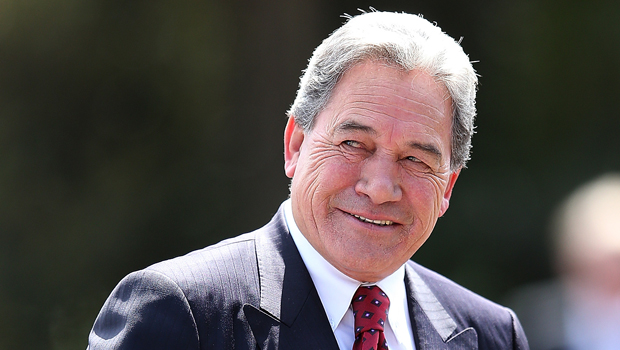
Winston Peters Seizes The Moment.

Eyes On The Prize: Success in the 2017 General Election will go to the politician best equipped to recognize - and exploit - the impending populist moment. There can be little doubt that the politician currently best placed to do both is the NZ First leader, Winston Peters.
 
THOSE SUFFICIENTLY CAPTIVATED by politics to spend their weekend mornings watching current affairs television were more than repaid for their dedication by Sunday’s Q+A. On display were the talents of Labour’s Andrew Little and NZ First’s Winston Peters. At the end of a week of unrelenting bad news for John Key’s National Government, both politicians were given an opportunity to shine. Only one of them took it.
 
Peters is on a roll that may yet see NZ First overtake the Greens as this country’s third-largest party. His performance on Q+A showed us how he might do it.
 
With New Zealand’s dairy farmers reeling from the grim news of “Black Friday” – when the numeral preceding Fonterra’s proposed pay-out per kilogram of milk solids changed from a 5 to a 3 – Peters presented himself as the agricultural sector’s saviour. Blessed with the perfect foil: Federated Farmers President, Dr William Rolleston; the NZ First leader did what he does best. He condemned Dr Rolleston as a Government apologist – hinting darkly that Kiwi farmers’ official representatives were failing in their duty.
 
For people under acute economic and social stress, the whiff of conspiracy is all-but-irresistible. It is much easier to believe that sudden and catastrophic events are the result of deliberate human agency than it is to accept them as the product of vast and impersonal forces, far beyond the conscious control of any single individual. But, on those not uncommon occasions when both explanations contain a portion of the truth, the scope for political mobilisation is huge. Watching Peters’ performance on Q+A there can be little doubt that New Zealand’s pre-eminent populist politician has seen it, understands it, and intends rousing rural and provincial New Zealand on the strength of it.
 
He saw it first in Northland: the loss of confidence in the future; the closing of the business person’s chequebook; the pervasive sense of drift – as if there’s no one on the bridge of New Zealand’s ship of state. As if this wasn’t alarming enough, he also picked up something else. It was just a feeling, but, for governments in their third terms, such feelings often prove fatal.
 
Across the whole of Northland, even among the well-heeled residents of Russell and Kerikeri, there was a feeling that the Government had lost interest in them; that the politicians who had ridden to power on their votes no longer cared about the fate of their farms, orchards or businesses. That, because they lacked the clout of Hollywood movie moguls, Aussie casino owners, huge transnational corporations, or the Prime Minister’s Hawaiian golfing-buddy, their voices were getting lost in the din.
 
NZ First’s campaign song for the Northland by-election was “Help Is On Its Way” by the Little River Band, and it struck precisely the right note. Chosen months before “Black Friday” dealt its body-blow to the nation’s dairy farmers, the prescient pertinence of the song’s refrain can only grow as the seasons pass and the quantum of farm debt becomes insupportable.
 
Rolleston accused Peters of panicking, but the tone of urgency in the NZ First leader’s voice was not only entirely appropriate, it was also, astonishingly, unmatched. Neither Rolleston, himself, nor the Prime Minister, nor the Labour leader, Andrew Little, sound even remotely like someone who grasps the seriousness of what is unfolding in rural and provincial New Zealand.
 
Under attack for being “Angry Andy”, Little has clearly been told to present as calm a façade as possible to the electorate. In a political environment less fraught with dangers, this would be good advice. Little’s problem, however, is that over the past month there has been a coming together of issues far too serious for the sort of phlegmatic responses he has been offering. With the economy teetering on the brink of recession, and the nation’s sovereignty under threat from the Trans-Pacific Partnership, the return of “Angry Andy” would be welcomed.
 
A debut appearance by “Decisive Andy” wouldn’t hurt either. Why Labour is so unwilling to rule out support for the TPP – at least in its present leaked and hinted-at colours – is a tactical mystery. Certainly, Little’s reticence on the subject offers a poor contrast to Peters’ long-standing and unequivocal rejection of TPP’s alleged contents. It’s all of a piece with his party’s foundational promise to put New Zealand first.
 
At his party’s recent conference in Rotorua, Peters urged delegates to drive up the membership of NZ First with an additional 10,000 new recruits, and to give him a war-chest of at least a million dollars. As New Zealand succumbs to the same political paranoia that has overtaken the democracies of Europe and North America, Peters expects his party to be match fit.
 
Angry and unequivocal: revelling in the role of prophetic outsiders; Peters and NZ First will meet 2017’s electoral questions with provocatively populist answers.
 
This essay was originally published in The Press of Tuesday, 11 August 2015.

Friday, 18 July 2014

Opening Our Eyes

Threatened Birthright: If our children are to enjoy the rights their parents enjoyed in New Zealand's rivers and streams we must open our eyes to the damage already done and the damage threatened by the commercial exploitation of this country's waterways.\
 
IT MIGHT HAVE BEEN YESTERDAY, so vivid is the memory. The river was called the Waianakarua. Fresh and clean it tumbled out of the Kakanui Mountains, flowing powerfully through the narrow defile which the district’s Scottish settlers called Glencoe. As it curled and twisted around the great boulders that clogged and blocked the valley, the river collected itself into deep pools. It was into one of these that I leaped as a boy and for the first time in my life opened my eyes underwater. So pure and clean were the waters of the Waianakarua that I could see every pebble. The wonder of it has never left me.
 
Until a few years ago it never occurred to me that the magic of such moments was anything other than the birthright of all New Zealanders. These islands were so large and we Kiwis so few that the possibility that New Zealand’s rivers and streams could ever be anything other than pure and clean seemed fanciful. The marketing expert who came up with “100% Pure New Zealand” clearly felt the same.
 
Humanity’s response to the idea that somewhere, far away at the bottom of the world, there is a place where rivers and streams still tumble pure and clean out of snow-capped mountains has been dramatic. The tourist dollar is now a crucial contributor to New Zealand’s economic well-being. The purity and cleanliness of our waterways now possess much, much more than mere aesthetic value.
 
Indeed, the world’s impression of New Zealand as “clean and green” offers us a perceptual springboard from which we could construct a new and very exciting “green” economy. The world hungers for reassurance that the havoc human-beings have wrought upon the natural environment can be repaired and that it is possible to tread so lightly upon the planet that the wonders they experienced as children will still be there for their grandchildren.
 
The exports from such a green economy would command a huge premium in world markets. The sheer prestige value of products bearing the Made in New Zealand “brand” (think “Swiss watches”, “French wines”) could make this one of the richest countries on Earth.
 
None of this is new. Since the late-1950s, when Bill Sutch offered the Second Labour Government his vision of a richly diverse, highly-skilled, value-added and self-sustaining New Zealand economy, it has been obvious to all patriotic Kiwis what needs to be done.
 
That it hasn’t been done is attributable almost entirely to that wealthy minority of New Zealanders who control our primary production sector, and around whom have gathered a parasitic coterie of importers, retailers and real-estate speculators. These people have always set our nation’s course. The original colonisers. Harvesters of forests. Diggers of mines. Farmers of sheep and cattle. Rip-in, rip-out and rip-off has always been their creed and New Zealand is merely the last in a long line of ravaged and ruined lands they have fallen upon. They remain among us only because there is still some ruin to work here. When the pillaging is complete they will move on.
 
We have reached the point, however, where the nitrate and phosphate pollution these pillaging cockies are pumping into their farmland is overwhelming the environment’s capacity to neutralise it. Milk powder, the latest example of their extractive mania, has given rise to dairy herds whose weight upon the land is now so great that our rivers and streams are rapidly becoming toxic ditches in which no responsible parent would allow a little boy to swim.
 
If you doubt this, just consider the new management policy the polluters’ political representatives have set for our waterways. The quality of the water must be such that merely by wading in it New Zealanders can be confident of avoiding illness. But rivers and streams that they can swim in? No, no! That’s too much to expect. Too much to ask for.
 
It is time all New Zealanders opened their eyes. But, please, not underwater!
 
This essay was originally published in The Dominion Post, The Waikato Times, The Taranaki Daily News, The Timaru Herald, The Otago Daily Times and The Greymouth Star of Friday, 18 July 2014.

Thursday, 8 July 2010

Stemming the Flow

Trotters Creek, North Otago.

WHEN IT COMES to Trotters Creek, I have to admit, I’m biased. My family has farmed that part of North Otago since the 1840s. So, if the arc of rolling hill country between Aorere Point and Shag Point isn’t "home" – then I guess I don’t have one.

The Trotters are not alone in feeling a powerful attachment to the little river that tumbles down out of the Horse Range, through the spectacular limestone gorge that also bears the family’s name, and finally empties into the Pacific Ocean in the shadow of the Moeraki Peninsula at Katiki Beach. Fly-fishermen like the poet, Brian Turner, also know and love Trotters Creek. Hardly surprising when, in the remarkably poetic language of the Otago Regional Council’s own pamphlet: "The river runs with large slow, deep pools combined with shallow riffles." In the words of one local, the creek’s "a little gem at our back door".

But the world around Trotters Creek is changing. When I was growing up the hills and paddocks of North Otago were the colour of a lion’s hide. The constant easterly blowing inland off the sea kept them dry and brown through most of the year. It was mixed farming country: wheat and barely on the flats; sheep on the hills.

Not any more.

The last time I travelled along the coast road between Oamaru and Waianakarua I was astounded to see the countryside had changed colour. Its once tawny coat was now a vivid green. The sheep were gone and everywhere I looked I saw cows, cows, cows.

More shocks were in store. Before settling into the converted flour-mill where we planned to spend the night, I led my family down through the lodge’s garden to splash our feet in the sun-dappled waters of the Waianakarua. But where was the rushing river I had dived into as a boy? Could this flat and shallow trickle really be the Waianakarua of old?

What had happened to the water?

Now I understood the dramatic change in North Otago’s colour. Dairying, like a verdant blush, has swept over the landscape’s hills and valleys. The "White Gold Rush" it’s been called, and just like the real thing this new wealth cannot be extracted from the earth without using water – lots and lots of water.

Not even Trotters Creek has escaped the irrigator’s insatiable thirst. It was around this time a year ago that the Otago Regional Council proposed increasing the amount of water "abstracted" for irrigation by reducing the river’s minimum summertime flow-rate to just 10 litres per second – the Trotters, unsuccessfully, bid for 20 litres per second. An appeal was lodged with the Environment Commissioner back in March – but I’m not holding my breath.

Rumours are rife in the community that the Otago Regional Council is running scared of the law-suits that suddenly materialise whenever an extended water-right is denied. Not all the dairy farmers participating in the White Gold Rush are individuals, or even families of dairy farmers. More and more of them are "persons" only in the legal sense that a body corporate can be a person – and they do not lack for money.

That Coastal River Communities and the Waianakarua River Community Users group threw themselves on the mercy of the Parliamentary Commissioner for the Environment, Dr Jan Wright, rather than try the Environment Court, is because they lacked the funds necessary to present an effective case. That, and the risk of being required to pay the defendant’s legal costs if they lost.

There’s an uneasy feeling abroad in rural New Zealand these days that a coalition of wealthy, publicity-shy, but very well-connected "developers" are hell-bent on constructing a new kind of countryside – and they’re not the sort of people you want to cross.

This climate of fear is something new. Time was, when the local community got together and presented a solid case to their district and/or regional councillors, there was every chance of the community’s wishes being respected. Now it’s different. Now things aren’t so much changing as being changed – and there’s precious little the locals can do about it.

Just one generation ago the cry would have been "Vote the rascals out!" But it’s not that simple anymore. If there’s any real prospect of old-fashioned democratic controls being imposed on these "developers", then, as the people of Canterbury have discovered, democracy itself can be left to lie fallow for a few years.

In 1889 The Temuka Leader denounced an arrogant rural oligarchy: "Born in the lap of luxury, brought up in exclusive social circles, educated to regard themselves as superior beings". Are grasping landowners with bulging bank balances and big-city law-firms about to reclaim their lost ascendancy?

Is the family farm destined to become an endangered species – along with all those little rivers bearing family names?

This essay was originally published in The Press on Tuesday, 6 July 2010.