Showing posts with label Dr Michael Cullen. Show all posts

Saturday, 7 October 2017

Adults In The Room?

Meet The Old New Boss: Sir Michael Cullen's snow-white head of hair is clearly visible as Labour's negotiating team prepare to meet waiting journalists after their preliminary meeting with the negotiators for NZ First. The presence of so many former members of and advisers to the government of Helen Clark in Jacinda's entourage raises some troubling questions. When Labour's new leader talked about ushering in “generational change”, most New Zealanders fondly assumed that she was committed to taking their country forward – not back.

WHAT’S GOING ON, JACINDA? Why has the former Labour Finance Minister, Sir Michael Cullen, and Helen Clark’s former Press Secretary, Mike Munro, been invited on to your team of negotiators with NZ First? And, while we’re on the subject of Labour’s Rogernomics Generation, why was Annette King sent to ride shotgun alongside you for the duration of the election campaign?

These are important questions, because when Jacinda talked about ushering in “generational change”, most New Zealanders fondly assumed that she was committed to taking their country forward – not back.

The other assumption New Zealand made, as the baton of leadership passed from Andrew to Jacinda, was that she was completely up to the job of carrying it without assistance. We made precisely the same assumption about her senior team’s readiness to govern the country without “adult supervision”.

The September newsletter from “Positive Money” (a group dedicated to creating “a money and banking system that serves a fair, democratic, and sustainable economy”) may, however, give many Labour supporters cause to wonder whether any of those assumptions were justified.

In the newsletter, two of Positive Money’s stalwarts, Don Richards and Sue Hamill, describe a “surprising and somewhat disappointing” exchange of views with Sir Michael Cullen at an election meeting in Whakatane on Friday, 15 September:

“Sir Michael, the former Labour Finance Minister during the Helen Clark-led government was with Grant Robertson, the Labour Party’s current Finance spokesperson and Kiri Allan, our local Labour Party candidate.

I asked Grant Robertson if he was aware of what was happening in Japan with the Central Bank buying up a significant portion of their national debt. Inflation in Japan was close to zero and the real economy was thriving. Had he considered instructing the Reserve Bank to do the same, thereby saving taxpayers money for social and infrastructure projects?

Grant asked Sir Michael to answer the question and he said that Japan had been experiencing negative growth for some time and so the two economies were not similar. I reminded Sir Michael that the Japanese economy was now thriving and the Central Bank was still buying up their national debt. I was told that a Labour government would not be doing that.

Sue then asked Grant Robertson if he had thought about doing what the first Labour Government did in the 1930s, using the Reserve Bank’s balance sheet to fund the building of housing and infrastructure? The question received a few claps from the audience.

Sir Michael once again fielded the question. He said that we had to be fiscally responsible otherwise we could end up with an economy like Germany after World War One, Venezuela or Zimbabwe. Sue carried on with a second question stating that as private banks create most of the money in the economy, why not let the Reserve Bank do it as well. Sir Michael responded by saying the banks do not create money.

The meeting finished with an invitation to meet at a local café for a chat. We went home and printed off the Bank of England’s article and the IMF’s discussion paper that stated categorically that banks create money in the act of lending. Sue went back to the café and had a further conversation with Sir Michael. He dismissed the Bank of England paper as not relevant and that it did not mean that banks created money. He also dismissed the IMF paper saying that banks lend out people’s savings.

It was a frustrating experience and if Sir Michael has the ear of Grant Robertson, as he appears to have, then no difference will be made to the way our money is created, should the Labour Party come to power.”

When Richard’s and Sue’s report of this encounter was drawn to my attention, I responded with the following comment:

“That is the most alarming piece of intelligence I have received in the entire course of the 2017 election campaign. It is hard to distinguish which is the most dispiriting aspect of [the] report: that Grant Robertson cannot answer basic questions on political economy without reference to his mentor, Sir Michael Cullen; or, that Sir Michael’s grasp of these issues is as woeful as Don Brash’s (who also refuses to accept that banks create money). If this truly is the level of understanding in Labour's senior ranks, then we are all - to use a technical political science term - fucked.”


This essay was originally posted on The Daily Blog of Saturday, 7 October 2017.

Friday, 3 August 2012

What If The Boss Went On Strike?

Armageddon Outa Here! Confronted with the brute economic power of a recalcitrant business community, Dr Michael Cullen, Minister of Finance in the Labour-Alliance Government of 1999-2002 was forced to repudiate the radical implications of his infamous "We won. You lost. Eat that!" quip to the National Party Opposition.

THE IRREPRESSIBLE Martyn “Bomber” Bradbury, displaying an entrepreneurial spirit not generally associated with the Left, has persuaded some of New Zealand’s largest trade unions to back The Union Report, a half-hour television show about unions and unionism which he hosts every Monday evening on Auckland’s Triangle TV and, via web-casts, across the country. Occasionally, Bomber invites me to participate.

This week’s show featured James Ritchie, former head of the Dairy Workers Union, who’s just taken up a prestigious post with the International Foodworkers in Geneva. The discussion ranged over many matters, but the topic that provoked the liveliest discussion was how constrained both unions and union-friendly governments have become under the present, globalised, variant of capitalism.

With an extension of Paid Parental Leave (PPL) once again on the parliamentary agenda, we recalled the infamous “Winter of  [Employer] Discontent” that gripped the country in the first year of the Labour-Alliance Government of 1999-2002. The left-wing Alliance MP and Associate Minister of Labour, Laila Harré, was proposing an employer-funded PPL scheme, and New Zealand’s bosses were not happy. It seemed to them that Helen Clark had a socialist tiger by the tail and its claws were threatening their bottom lines. In debating the new Employment Relations Bill, hadn’t the new Finance Minister, Dr Michael Cullen, taunted his National foes with: “We won. You Lost. Eat That!”

The degree of employer disaffection could be read in the sudden and sustained fall in the value of the New Zealand dollar, which bottomed-out at an alarming US$0.32. As the opinion polls turned against the government, and business confidence plummeted, Dr Cullen warned that the Right’s propensity for “Armageddon economic analysis” could become self-fulfilling.

By late May 2000, with economic Armageddon getting closer – the Government caved. At a series of breakfast meetings, Dr Cullen set about reassuring business leaders that his government was not composed of sharp-clawed socialists: “We want to be a government that moves forward with business,” he told a Wanganui business audience, “not one that watches indifferently from the sidelines.” For good measure, the Prime Minister declared that employer-funded PPL would be enacted “over my dead body”.

It was a U-turn executed under duress. In early June, at the funeral of Jock Barnes, the militant leader of the watersiders in 1951, CTU President, Ross Wilson, quietly informed me that, only days before, the Prime Minister had warned him the country was facing an “investment strike”.

Shortly after Monday’s screening of The Union Report a viewer contacted me with a question. What would have happened, he asked, if Helen Clark had gone on television and told the country what the bosses were doing? If she had challenged the business community, both at home and abroad, to let New Zealand’s democratically elected government carry out its mandate, and called her supporters out into the streets. Would the Prime Minister have prevailed?

Possibly. But in doing so she would have raised the political stakes to a such a dangerous degree that 99.9 percent of politicians (even social-democratic ones) would simply have run the other way. To openly pit “the people” against “the bosses” is to place the option of full-scale revolution – or repression – on the table. Having done so, Ms Clark would very quickly have discovered that breaking an “investment strike” is in no way comparable to breaking an ordinary strike. In the latter case, only the future of a single company and its employees is on the line. With the former, you’re hazarding the future of an entire social class. Most political parties, even left-wing ones, would rather keep control of the losing side than lose control of the winning side.

Perhaps this explains why the Labour Party remains so reluctant to promise the opponents of partial privatisation that it will renationalise the assets if re-elected. Global markets take a dim view of such uncompromisingly anti-capitalist behaviour. The world would simply stop lending us money.

And even revolutions (some might say especially revolutions) need credit.

This essay was originally published in The Dominion Post, The Waikato Times, The Taranaki Daily News, The Timaru Herald, The Otago Daily Times and The Greymouth Star of Friday, 3 August 2012.

Monday, 4 June 2012

Long Live The Republic!

Sixty Glorious Years: But Elizabeth Windsor was not born to be Queen. Indeed had her wicked uncle, Edward VIII, been just a little cleverer (and a lot wickeder) England may well have been burdened with a royal fascist dictator. Such are the fatal vagaries of the hereditary principle. Heads-of-state should be chosen by more rational - and democratic - means.

A LOATHING OF MONARCHY is one of the many benefits of living with an avid student of Tudor history. You learn about the huge political, economic and social costs of hereditary rule. How utterly dependent society becomes upon the health and fecundity of royal fathers and mothers. Of the dangers posed to political and social order by physically and mentally deficient monarchs. And, most especially, of the horrors and injustices to which royal personages and their families are exposed on account of the constitutional principle of hereditary succession.

To which all you monarchists out there will smugly reply: “Just as well, then, that our Queen is a constitutional monarch.” Well, if you want to comfort yourself with that notion, feel free. But if you believe the “conventions” of constitutional monarchy offer us the slightest political protection, then you are quite mistaken.

Take our present sovereign, Queen Elizabeth II. When she was born very few people believed she would inherit the throne. Her uncle, Edward, Prince of Wales, was heir apparent and was duly proclaimed King-Emperor upon the death of his father, King George V, in 1936. We are all extremely lucky that Edward VIII was nowhere near as clever as he was selfish, vain and irresponsible. Had he been as smart as his youngest brother, George, the Duke of Kent, he could well have turned the constitutional crisis arising out of his determination to marry Mrs Wallis Simpson into an opportunity to establish a fascist monarchical dictatorship. He would certainly have been able to count on a great deal of public support, not to mention the solemn oaths of loyalty sworn to his person by the armed forces and the police.

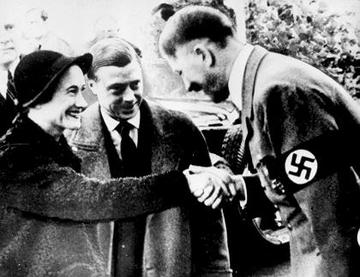
Democracy’s stocks were not very high in 1936, and the Windsor’s connections with Hitler’s Nazis were much stronger than they now care to admit. The Duke of Kent, in particular, moved freely in the highest Nazi circles. He was convinced that the British Empire could not survive another war with Germany. had he ever been in a position to do so, he would have guarded Germany’s back while she demolished the Soviet Union, and thereafter remained confident of her support against the economic ambitions of the USA. It is not difficult to understand why the German Ambassador to Great Britain, Joachim von Ribbentrop, kept in such close touch with both the Duke of Kent and Mrs Simpson.

Dangerous Liaisons: Wallis Simpson and the former King Edward VIII are welcomed to Germany by Adolf Hitler.

Had King George VI named Lord Halifax, and not Winston Churchill, prime minister in 1940, exactly the same calculations that made life for the surviving members of the Plantagenet dynasty so precarious during the reign of Henry Tudor would have been made about both himself and the little princesses, Elizabeth and Margaret. For there is no disputing the fact that, in the first six months of the war, a substantial “fifth column”, committed to making peace with the Nazis, florished in Britain – especially among the aristocracy. A negotiated peace with Germany could very easily have seen Edward VIII restored to the throne – leaving the erstwhile King George and his family to the tender mercies of a triumphant Adolf Hitler.

So, we are, indeed, extremely fortunate that Edward VIII was not equal to the many political opportunities that came his way. And, by “we” I certainly refer to New Zealand. Because you may be absolutely sure that if Great Britain had signed a peace treaty with Germany in mid-1940, our own government, and the governments of Canada, Australia, and South Africa, would have ceased hostilities immediately. And if, in a fit of madness, Peter Fraser had attempted to carry on the fight (counting, perhaps, on help from the United States) then it is certain that the new King-Emperor’s representative in New Zealand, the Governor-General, Viscount Galway GCMG DSO OBE PC, would have dismissed the Labour Government from office and invited the National Party leader, Adam Hamilton, to form a new ministry.

This is, of course, a very long way from the version of constitutional monarchy peddled by Dr Sean Palmer, Chair of Monarchy New Zealand, who shills for the hereditary principle on the grounds that it offers a much more stable foundation than popular election when determining a nation’s head-of-state.

His argument boils down to a recitation of those mostly European countries whose heads of state are kings and queens. Do you see how stable and non-threatening Norway, Sweden, Denmark and the Netherlands are? asks Dr Palmer. That has nothing to do with the democratic character of their politics, the homogeneity of their populations, or the pluralistic nature of their societies. No, no, no! It’s because their heads-of-state were raised to that office not by virtue of their talent, their courage, their generosity or their contribution to their fellow human-beings, but because they were clever enough to choose royal parents.

This is the same Dr Palmer who told Radio New Zealand’s Queen’s Birthday host, Richard Langston, that his homeland, Canada, and New Zealand had very similar constitutional arrangements. I suppose you could make out a case for that proposition – providing, of course, you set aside the fact that Canada has a written constitution, a bi-cameral parliament and a federal system of provincial governments. Apart from these small and inconsequential constitutional differences, Canada and New Zealand are practically identical!

We are, however, alike in being ruled over by a Governor-General (when Her Majesty isn’t going walkabout) and so I would have expected a constitutional expert, like Dr Palmer, to have had something intelligent to say about the Canadian Governor-General, Michaelle Jean’s, egregious failure to uphold the principle of parliamentary sovereignty.

Egregious Failure: Canada's unparliamentary sovereign, Governor General, Michaelle Jean.

Her 2009 decision to prorogue the Canadian House of Commons, thereby preventing it from debating a No Confidence motion in the Conservative Government of Stephen Harper, was made in defiance of the near unanimous opinion of Canada’s leading constitutional experts. Like the Australian Governor-General, John Kerr’s, decision to dismiss the Whitlam Labour Government in 1975, Jean’s abrogation of democratic norms lays bare not the stability, but the capriciousness, of “constitutional” monarchies, and demonstrates how extremely vulnerable their “subjects” are to the anti-democratic proclivities of these unelected heads-of-state.

All constitutional questions turn on the direction in which one believes power ought to flow: from the top to the bottom; or from the bottom to the top? It is quite impossible to cast monarchical institutions as anything other than top-down and, hence, profoundly undemocratic.

The “honours” announced to mark the sixtieth anniversary of Elizabeth Windsor’s coronation, provide stark proof of just how corrupting service to such monarchical institutions can be. In addition to a union-buster and a neoliberal hatchet-woman, Prime Minister Key has announced that the Duke of Edinburgh, Phillip Mountbatten, the man the late Chris Hitchens memorably described as “a dingy fascist”, has been made a member of the Order of New Zealand. Worse than this, however, was the news that Dr Michael Cullen, the man who taught me about the Levellers and the Diggers, Oliver Cromwell and the Putney Debates, has accepted a knighthood.

I felt a great wave of shame wash over me on his behalf. Could this be the same man whose university office once boasted a full-size poster depicting humanity’s putative parents above the revolutionary slogan of the English Peasants Revolt of 1381?

 
May my vanity and pride never play me so false, Dr Cullen. Rather, let me invoke on this, Queen's Birthday holiday weekend, the spirit of Oliver Cromwell’s plain, russet-coated troopers; whose contribution to human liberty a younger Michael Cullen once kept fresh; and cry out again, with a great voice:

“Long live the Republic!”

This posting is exclusive to the Bowalley Road blogsite.