Showing posts with label Laila Harre. Show all posts

Thursday, 5 January 2017

Some Rhymes For The Silly Season


Said Bronagh: “From where I am sitting,
It’s tremendous to know John is quitting.
His surprise Christmas gift
Gave so many a lift,
Which, given the season, was fitting.”


With the family back home on the farm …
Bill English was seized with alarm.
Was this two-oh-oh-two?
Or just more déjà vu?
… With the family back home on the farm.
 

With Mt Albert again up for grabs
Be prepared for some pretty sharp jabs
As to whom we should turn
Harré? Genter? Ardern?
(Just don’t call it a battle of babes!)


So it’s Trump – and what’s not to like?
All you losers can go take a hike.
Just how good can it get?
You ain’t seen nothing yet.
So much more’s coming straight down the pike!
 
These rhymes were originally posted on The Daily Blog of 23 December 2016.

Thursday, 27 October 2016

“Old Lefties” – WTF! Simon Wilson hosts “Table Talk” at the Ika Seafood Bar and Grill.

Takes One To Know One, Simon: Simon Wilson's denigration of "old lefties" struck some as odd - coming as it did from a former member of the Workers Communist League! His present political orientation, however, is relatively clear. As he wrote for The Spinoff: “[O]ne way or another, everything benefits the agents of capitalism. If you’re a progressive, or a social democrat, or a socialist, you have to suck that up.”
 
“LABOUR – WTF?” The question said it all. And the packed-out restaurant confirmed its aptness. Laila Harré has good instincts for the mood of the Auckland Left, and “WTF?” sums up its assessment of the current state of the Labour Party with earthy directness.
 
Less adroit, perhaps, was her decision to allow The Spinoff to co-sponsor the event. It’s hard to reconcile the Ika Seafood Bar and Grill’s skilful courting of Auckland’s progressives with The Spinoff’s vicious attack on one of the Left’s most respected representatives – Mike Lee. That the attack on Lee could so easily have resulted in (and was quite probably intended to secure) Bill Ralston’s election to the Auckland Council merely confirmed The Spinoff’s political incorrectness.
 
That the choice of Simon Wilson as host of the evening’s panel discussion’s proved equally unsuitable was not something for which the Ika team could be blamed. Wilson made himself so by persuading The Spinoff to post his “Look, there goes the Labour Party – sliding towards oblivion” on the same day as the Table-Talk event.
 
It is a very curious piece of writing. Provocative title aside, Wilson’s posting is mostly an attempt to isolate and ridicule left-wing critics of his beloved Unitary Plan. Though no names are mentioned, it is clear that the sort of people Wilson has in mind when he castigates these “old lefties”, are people like Mike Lee.
 
“Their dispute wasn’t really defined by age,” writes Wilson, “but it was about modernising the progressive cause. The old argument is that when you relax the rules around building and allow more density, you create conditions for ugly apartment blocks and slums that ruin the quality of life for everyone who has to live in or near them. There might be more homes but the big winners are the developers who make a killing.
 
“That sounds grand, principled, insightful and historically sound. It’s been true in the past, even the quite recent past. In fact, in relation to the UP, it’s sentimental nonsense.”
 
But is it? Auckland’s history offers very little justification for believing that market-led intensification will produce anything other than “ugly apartment blocks” and “developers who make a killing.” More importantly, Wilson offers nothing in the way of evidence that the Unitary Plan, as approved, will ensure that Auckland’s future does not resemble its past.
 
What he does do, however, is set up a straw man. He implies that Mike Lee and his allies do not understand that “a compact city, with good quality affordable homes clustered densely around a comprehensive and efficient public transport system, is essential for any fast-growing city that wants to offer a decent quality of life to all its citizens.”
 
This is laughable. One of the reasons the tight little clique of lawyers, land-bankers, property developers, and roading contractors that has run Auckland for the past 150 years was so keen to get rid of Mike Lee was because, as Chairman of the Auckland Regional Council, he refused to extend Greater Auckland’s boundaries. Lee was arguing for a more compact city when Wilson was still collecting recipes for Cuisine magazine. His constant and highly successful advocacy for “a comprehensive and efficient public transportation system” – especially rail – also put Lee offside with Auckland’s powerful roading lobby.
 
Not so laughable is the fact that Wilson knows full well that Lee is but the latest in a long-line of left-wing politicians and planners who have fought for an Auckland capable of offering “a decent quality of life to all its citizens”.
 
In between his stints at Cuisine and Metro, Wilson was a jobbing editor for the Random House publishing group. One of the books he edited was my own No Left Turn, which included a chapter entitled “The Auckland That Never Was”. All of the elements making up what Wilson rather grandly calls “New Urbanism” feature in the plans for Auckland’s future development that were prepared for the First Labour Government by the Housing Division of the Ministry of Works back in the 1940s! That those extraordinarily progressive plans remained unfulfilled may be sheeted home to the same private sector interests who made their fortunes by turning Auckland into a cheap copy of Los Angeles, and who now propose to make themselves even richer by turning Auckland into a cheap copy of Singapore.
 
How someone in possession of this knowledge could, nevertheless, attempt to paint Mike Lee as someone guilty of failing “a bedrock test” for progressive urban planning, is utterly beyond me. But, then, I found it no less puzzling that the same man who could write: “one way or another, everything benefits the agents of capitalism. If you’re a progressive, or a social democrat, or a socialist, you have to suck that up”, was, somehow, able to begin last Wednesday’s (19/10/16) Table Talk discussion by quoting the late Helen Kelly’s emphatically anti-capitalist vision of the Labour Party.
 
Obviously, Wilson’s definition of “progressive”, “social democrat” and “socialist” is somewhat different from my own.
 
The rest of the evening was full of depressingly similar contradictions.
 
Only a very few minutes had expired before the Labour Party President, Nigel Haworth, took on the expression of a man who wished he'd stayed at home. Keeping out of the public eye has been something of a fetish for Haworth, whose principal motivation in taking on Labour’s presidency appears to have been quieting down the party’s frequently  restive rank-and-file. Having to admit that, had he been in Britain, he would not have voted for Jeremy Corbyn, was almost certainly something he would have preferred to keep under his hat.
 
Deborah Russell, Labour’s candidate for the Rangitikei electorate in 2014, told us she would have voted for Corbyn. That becoming a Corbynista would have put her offside with a fair swag of her putative caucus colleagues did not appear to have occurred to her. Which says a lot about her understanding of the party she defended with such enthusiasm throughout the night.
 
Chloe Swarbrick’s reputation for straight-talking was in no way diminished by her participation in the Table Talk panel. When asked what it would take to make her join the Labour Party, her quick-fire response, “an invitation”, raised eyebrows and hopes in almost equal measure.
 
Head-and-shoulders the most acute political thinker on the stage last Wednesday night was, however, Andrew Campbell. Formerly the Green Party leaders’ chief-of-staff, and now – impressively – communications director for the NZ Rugby Union, Campbell’s insights into the workings of contemporary New Zealand politics were refreshingly candid. That, in his estimation, “politics is a PR game” might be a bit depressing for “old lefties” like me, but only a fool would argue that, in New Zealand, in 2016, our politics is very much of anything else.
 
This essay was originally posted on The Daily Blog of Tuesday, 25 October 2016.

Thursday, 11 February 2016

Here Be Dragons: The Ika Seafood Bar & Grill’s First “Table Talk” Looks At The Year Ahead - Through Right-Wing Eyes.

"Have a care when fighting dragons, lest ye become a dragon yourself." Nietzsche's famous aphorism remains as confronting as ever. To beat the likes of the Right's Matthew Hooton, should the Left attempt to match their Machiavellian amorality? Or, should it simply decide not to invite them onto "Table Talk" panels?
 
I LEFT the first Ika “Table Talk” for 2016 feeling very down – and I know I wasn’t the only one. The panel discussion, on “The Year Ahead”, could have been an enlivening rehearsal of the challenges facing the New Zealand Left in 2016 – but it wasn’t. Instead Ika’s patrons endured an hour-long demonstration of the Right’s remarkable skill at kicking the Left’s ass.
 
Moderated by broadcaster Lisa Owen (of TV3’s The Nation) the panel was made up of the ubiquitous far-right political commentator, Matthew Hooton (proprietor of Exeltium Public Relations) arbiter of all-things-Auckland, Simon Wilson (Editor at Large of Metro Magazine) and Maori educationalist, Dr Ella Henry (AUT Faculty of Maori Development).
 
Dr Henry adopted a position of wry detachment from her “bourgeois” audience of mostly inner-city leftists. Her comments throughout the evening suggested that she regards "Table Talk" as little more than an additional course which Laila Harré has tacked on to Ika’s menu. A heaped ideological platter in which, this time, the sour easily overpowered the sweet.
 
Only once did she cut through the relentless conservative discourse of her fellow panellists and that was in relation to the forthcoming local government elections. Her uncompromising description of the world inhabited by West and South Aucklanders: Maori, Pasifika and immigrant; was as compelling as it was unsparing. Intruding, as it did, a jarring note of brutal social reality to the proceedings, Dr Henry’s intervention was easily the most uplifting of the night.
 
There was a period in Simon Wilson’s life when he mixed almost exclusively with the sort of people who attend the Ika Seafood Bar & Grill’s events. As the Editor of the Victoria University Students Association’s newspaper, Salient, and later, as the Maoist President of NZUSA, Wilson’s youth was an emphatically left-wing affair. The journey he has undertaken since then, from the Left to the Right, has been a slow one. The Maoism he ditched early in favour of the well-mannered leftism of the Wellington liberal intelligentsia. It was only when he bade farewell to Wellington, and Consumer magazine, to take up the editorship of the yuppie gourmand’s glossy guidebook, Cuisine, that the shift to the Right began in earnest.
 
Wilson has a newshound’s nose for a shift in the political winds. As a Metro writer, he’d correctly predicted John Key’s comprehensive electoral victory in 2008, and two years later used his new position as Metro’s Editor to deftly reposition the magazine as the voice of the socially liberal, economically conservative and aggressively acquisitive Auckland middle-class. Nowhere was this repositioning more in evidence than in his choice for Metro’s political columnist. Where the magazine’s founder, Warwick Roger, had turned to New Zealand’s best left-wing journalist, Bruce Jesson, for political commentary, Wilson’s choice was the National Party’s leading ideological skirmisher, Matthew Hooton.
 
Those skirmishing skills were displayed to considerable effect from the get-go on Tuesday night (9/2/16) when Hooton accused the writer of seeing the 4 February anti-TPPA demonstrations as “the beginning of a revolution”. It is precisely this acidic mixture of smile and sneer that makes Hooton such a formidable opponent. That, and his ability to master a complex political brief very quickly and then fashion it into a political argument that is at once simple and subtle. Hooton, when he’s in control of himself, is both a superb manipulator of the truth and a master at identifying his opponents’ weak spots.
 
Out of control, Hooton can be rabid. One of the reasons the numbers were down for Ika’s first Table Talk for 2016 was that many people simply refused to be in the same room as the man who has constantly and viciously impugned the integrity of Professor Jane Kelsey. This penchant for abusing progressive New Zealanders publicly has turned Hooton into something of a hate figure, and it seriously undermines his political credibility. If he ever learns to control it, he will instantly become an even more deadly opponent of the Left.
 
As it was, the Good Cop/Bad Cop routine of Wilson and Hooton was deflating enough. Between them they succeeded in making their left-wing audience wince, sigh, squirm and shake their heads in disbelief. A different set of panellists may have blunted some of the worst thrusts from Hooton, but the one we “bourgeois” leftists had to endure on Tuesday night left Lockwood Smith’s political adviser; the man who makes RNZ’s Kathryn Ryan sound like a moderate; in undisputed possession of the field.
 
Now the more hard-headed leftists amongst us would no doubt say that Tuesday’s Table Talk was an important wake-up call for the Left. Unused to the punishing performance that Hooton excels at delivering, an hour-long pistol-whipping at his hands might be exactly what the Left needed if it is to muscle-up and become politically competitive.
 
But if the only way to defeat a dragon is to become a dragon oneself, then what’s the point? What distinguishes the Left from the Right is its belief that the world should be – and can be made – a better place. Against all the contrary evidence that the cynics and trimmers delight in throwing in their path, the world’s progressives must somehow continue to muster the faith, hope and love to continue fighting. That’s why Laila Harré’s gatherings at the Ika Seafood Bar & Grill are so valuable. They provide an opportunity for the beleaguered Auckland Left to recommit itself to a more just and equal future. The cause that Simon Wilson long ago abandoned, and Matthew Hooton openly despises.
 
So, Laila, please. No more dragons!
 
This essay was posted on The Daily Blog and Bowalley Road on Thursday, 11 February 2016.

Wednesday, 29 April 2015

From Foreign Correspondent To Folk Singer: Cameron Bennett Plays The Ika Seafood Bar And Grill

"I'm Cameron Bennett": Singing songs that blend the intensely personal with the robustly political.
 
FOR YEARS he filled our television screens with the images of a troubled world. "I'm Cameron Bennett", he'd say, by way of introducing himself, and then whisk us off to wherever people were bleeding. This was back in the days when the term "public service broadcasting" still meant something to the state-owned broadcaster. A time when, if the crisis was serious enough, Bennett's bosses would fly him to where it was happening. And there he'd stand, his lanky frame clad in the dusty, desert-toned safari jacket that became his trademark, and remind us all how lucky we were to live in New Zealand.
 
That Cameron Bennett might be a pretty solid left-winger never once occurred to me. Fairness and balance were the professional watchwords of TVNZ, even in the 1980s and 90s, and Bennett was careful to keep his personal opinions behind the camera. Only friends and workmates got to know the man who sang and played the guitar so engagingly; the folksinger who said in song all the things he could not say on screen.
 
It was, therefore, a delightful surprise to encounter Cameron Bennett, folksinger, at the Ika Seafood Bar & Grill on Tuesday night (28 April). Yes, the very same Ika Seafood Bar & Grill that, just a fortnight ago, hosted a "Table Talk" discussion about the fate of Campbell Live. Laila Harre (Ika's owner and manager) had organised that event in collaboration with the Campaign For Better Broadcasting and The Daily Blog, but Tuesday night's entertainment fell under the heading of "Ika Salon" - Harre's own monthly offering of intellectual (as opposed to purely culinary) sustenance.
 
And what a fine repast it was! Bennett's hour-long set was a mixture of the intensely personal and the robustly political.
 
Certainly, tackling the two great tragedies of the last six years, Pike River and the Christchurch Earthquakes, struck me as a brave thing to do. Such grim events, so close to the surface of our collective memory, often elude the songwriter's craft. But in Pike 29 and Jerusalem Road, Bennett offers a more than adequate response to these landmark events. The former is the more traditional of the two, harking back to the bleak mine disaster ballads of Appalachia. Jerusalem Road, however, takes a very different route. Working into his spare lyrics the imagery and religious references of Colin McCahon's paintings, Bennett has crafted a sombre but very powerful song.
 
Bennett's repertoire encompassed everything from the exploits of the West Coast mass-murderer, Stanley Graham, to the experiences of a grandfather wounded in the Great War and the closure of Dunedin's Hillside Workshops. For a Dunedin man, this latter song was especially moving.
 
We're flesh and blood, flesh and blood,
Standing shoulder-to-shoulder in the Carisbrook mud.
But who will stand for us?
 
The two songs that really struck home, however, were Bennett's very personal recollections of the community in which he grew up. If anyone had asked me whether it was possible to write a great song about the Auckland suburb of Howick, I would have laughed them out of the room. But in his bitter-sweet The Place That I Come From, Bennett captures the enforced innocence of New Zealand suburbia in the 1970s. The references to Picton Street and Stockade Hill pins the location down geographically, but the jagged recollections of disruption and distance are universal.
 
Then there was True Believers - the song that, even as I made my way out onto Mt Eden Road, I was still humming softly. A hymn to the sense of infinite possibility that was the special possession of the Baby Boom generation, True Believers tells the story of all those young men who responded to the challenge of being masculine in a new way in the uptight New Zealand of the 1960s and 70s:
 
Letting our hair grow curled
Believing we could change the world
 
In a grown-up country, the song-writing and musical talents of a man like Cameron Bennett would find a much wider audience than a café-full of Laila's friends and comrades. If New Zealand had been able to keep its public service broadcasting intact - as the citizens of Australia and Europe have done - there would be space in the schedule for showcasing this little country's extraordinary artistry. Not in the amped-up fashion of The X-Factor, but gently, sensitively, intelligently.  
 
In the manner of Cameron Bennett.
 
This review was posted simultaneously on The Daily Blog and Bowalley Road of Wednesday, 29 April 2015.

Thursday, 16 April 2015

Willkommen Im Cabaret: "Table Talk" At Ika Restaurant, Tuesday, 14 April 2015.

 
Welcome To Cabaret! Glücklich zu sehen, Je suis enchanté, Happy to see you, Bleibe, reste, stay.
 
RIDICULOUS I KNOW, but I just couldn’t help it. As I looked around Laila Harré’s Ika restaurant on Tuesday night, I kept thinking: Weimar Germany, 1932.
 
Perhaps it was the cause. In collaboration with the Coalition for Better Broadcasting, The Daily Blog, and her own (and husband Barry Gribben’s) latest venture, Harré had called together a panel discussion on the future of Campbell Live. Looking around the restaurant I momentarily entertained the gruesome thought that one well-placed bomb would wipe out the cream of the Auckland Left (plus Bill Ralston and Fran O’Sullivan!)
 
Not that it’s come to bombs – not yet. Not like the poor doomed Weimar Republic. Even so, there’s the same worrying feeling that the forces of the Right are openly manoeuvring; striking ever more provocative poses; showing less and less regard for appearances. To wit, the impending demise of Campbell Live.
 
The thing about a good puppet show is that you either can’t see, or are artfully distracted from noticing, the strings. It’s only when the strings themselves become more interesting than the puppets they’re attached to that the audience should start to worry.
 
And that time has come.
 
Which is why, as I sat there in Ika (formerly the Neapolitan eatery Sarracino, formerly the chapel of Tongue’s the undertakers!) watching present and former MPs, trade unionists and entrepreneurs, left-wing and right-wing journalists shake hands and exchange gossip, my gloomy thoughts led me to the Kit-Kat Club and Bob Fosse’s classic movie, Cabaret.
 
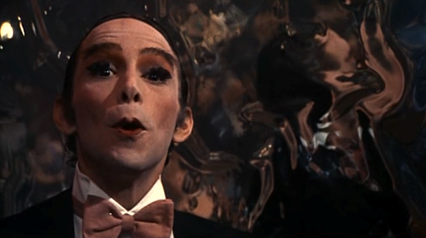
Up on the stage, playing the role made famous by Joel Grey was our Emcee, Wallace Chapman. And the floor-show, Ika’s Cabaret Band, if you will, were (from neoliberal right to post-modern left) Fran O’Sullivan, Bill Ralston, Simon Wilson and Phoebe Fletcher.

"I am your host!" - Wallace Chapman plays Emcee at Ika's "Table-Talk" about the future of Campbell Live.
Together, they discussed and dissected the decision to dangle the sword of Damocles above the marvellous Mr Campbell’s current-affairs half-hour. All good stuff, and the punters lapped it up. (Along with their whole gurnards and snappers, expertly seasoned, and laid out on a bed of the most fashionable vegetables.)
 
But outside in the dark, where the unseasonable weather was turning Mt Eden Road into an icy wind-tunnel, a very different New Zealand was settling in for a very different bill of fare. The languid musings of TVNZ’s Mike Hoskings, perhaps? Or TV3’s X-Factor? Maybe The Bachelor, or NCIS, or How To Get Away With Murder, or any of a host of other shows beamed into their living rooms by Sky TV’s bounteous satellite. Their thoughts and feelings so far from the worries of these left-wing luvvies that they might as well be living on another planet.
 
Hence the ominous analogy with the tragic Weimar Republic. In the nite-clubs of Berlin’s demi-monde the clever and artistic lamented what was happening in the streets outside. The running battles between Left and Right. The strategic re-positioning of big business as the economy tanked and politics turned sour. And, most of all, the looming presence of a man who seemed almost umbilically joined to all the little people living in all the little rooms where democracy was fast becoming a dirty word.
 
Willkommen, Bienvenue, Welcome. Im Cabaret, au Cabaret, to Cabaret!”
 
A version of this essay was first posted on The Daily Blog of Wednesday, 15 April 2015.

Monday, 21 July 2014

15/9/14

T Minus Five ... And Counting: Kim Dotcom has promised to prove the Prime Minister a liar at a meeting in the Auckland Town Hall on 15/9/14 - just five days before the General Election. It promises to be a night to remember.

IT IS THE EVENING of Monday, 15 September 2014. The General Election is just five days away and the Auckland Town Hall is full-to-bursting. The Internet Party has made certain that every one of the 1,250 seats is occupied by making free tickets available to people online on a first-come, first-served basis. Many hundreds more are packing the rooms adjoining the chamber and, outside, Aotea Square is rapidly filling with people eager to follow proceedings on the giant video screen supplied by the man of the hour – Kim Dotcom.
 
The unprecedented public interest has been carefully nourished by the Internet Party’s constant drip-feeding of information to the news media. Week-after-week Laila Harre and her team have told the story of a small but proud Pacific nation transformed into the willing lap-dog of an overbearing super-power. At the centre of the narrative stands the Prime Minister of that nation: a man accused of turning over to that super-power not only his country’s national security apparatus but its police force as well. Not simply to curry favour with the super-power, the United States, but to expedite the commercial agenda of the giant media corporations making up the Motion Picture Association of America (MPAA).
 
As the story has unfolded, other individuals and organisations have been drawn into the action. In the light of everything that happened afterwards, New Zealanders have been invited to examine afresh the events of late October 2010. The anti-union hysteria whipped up by Sir Peter Jackson and his movie industry allies over alleged “threats” to The Hobbit, and the way in which this was used to justify Government legislation (rushed through under urgency) effectively de-unionising the entire Kiwi movie industry, has come under particular scrutiny.
 
There are representatives of Actors’ Equity in the Town Hall tonight. They will be demanding to know whether Prime Minister John Key’s willingness to oblige Hollywood in the matter of The Hobbit is in any way linked to his willingness to oblige the MPAA in the matter of Kim Dotcom.
 
Fair Trade spokespeople and representatives from the New Zealand Council for Civil Liberties are also in the Hall. They will draw the linkages between John Key’s willingness to let the core institutions of his country be used to the advantage of foreign corporations and the dramatic erosion of New Zealanders’ civil rights. They mean to show how transforming New Zealand into a desirable destination for foreign direct investment necessarily entails the elimination of every civil institution and law capable of challenging investor priorities.
 
But it is Kim Dotcom himself that thousands of Auckland voters have come to hear (and that many more thousands are following on the Internet).
 
The Internet Party leader, Laila Harre, pulls no punches in her introduction. She does not ignore Dotcom’s past convictions and pokes gentle fun at his childlike delight in spending money. But then, having acknowledged his faults, Harré turns to his unlooked for and unwanted role as the symbol of what can happen to an individual when all the malignant powers of big business and the state are ranged against him. What he proposes to tell New Zealanders, she warns, may sound like a grudge-match between two men, but it is much more than that.
 
If the Prime Minister of New Zealand regards telling his people the Truth as a mere option, as just one more weapon in the arsenal of political spin, to be used whenever it serves his purposes and which possesses no greater or lesser moral weight than a more politically convenient lie, then New Zealand’s democracy is at profound risk. And what does “National Security” really mean if it can only be defended by such duplicity and falsehood? What could possibly require such ethical surrender to keep safe? If Kim Dotcom is able to convince this gathering that John Key has lied to the New Zealand people, Harré concludes, then in five days’ time the New Zealand people must use the Ballot Box to inform John Key that his services as Prime Minister are no longer required.
 
The Town Hall and the now overflowing Square outside erupt in thunderous applause.
 
Kim Dotcom rises from his seat and walks towards the microphone …
 
This essay was originally posted on The Daily Blog of Wednesday, 16 July 2014.
 
AFTERWORD: Since the original posting of this essay, Kim Dotcom has announced that Glenn Greenwald, the journalist who brought the CIA whistle-blower, Edward Snowden’s, revelations to the world, will be in attendance in the Auckland Town Hall on Monday, 15 September. And he may not be the only “special guest”. All-in-all, the evening of 15/9/14 is shaping up as an event not to be missed.
 

Friday, 3 August 2012

What If The Boss Went On Strike?

Armageddon Outa Here! Confronted with the brute economic power of a recalcitrant business community, Dr Michael Cullen, Minister of Finance in the Labour-Alliance Government of 1999-2002 was forced to repudiate the radical implications of his infamous "We won. You lost. Eat that!" quip to the National Party Opposition.

THE IRREPRESSIBLE Martyn “Bomber” Bradbury, displaying an entrepreneurial spirit not generally associated with the Left, has persuaded some of New Zealand’s largest trade unions to back The Union Report, a half-hour television show about unions and unionism which he hosts every Monday evening on Auckland’s Triangle TV and, via web-casts, across the country. Occasionally, Bomber invites me to participate.

This week’s show featured James Ritchie, former head of the Dairy Workers Union, who’s just taken up a prestigious post with the International Foodworkers in Geneva. The discussion ranged over many matters, but the topic that provoked the liveliest discussion was how constrained both unions and union-friendly governments have become under the present, globalised, variant of capitalism.

With an extension of Paid Parental Leave (PPL) once again on the parliamentary agenda, we recalled the infamous “Winter of  [Employer] Discontent” that gripped the country in the first year of the Labour-Alliance Government of 1999-2002. The left-wing Alliance MP and Associate Minister of Labour, Laila Harré, was proposing an employer-funded PPL scheme, and New Zealand’s bosses were not happy. It seemed to them that Helen Clark had a socialist tiger by the tail and its claws were threatening their bottom lines. In debating the new Employment Relations Bill, hadn’t the new Finance Minister, Dr Michael Cullen, taunted his National foes with: “We won. You Lost. Eat That!”

The degree of employer disaffection could be read in the sudden and sustained fall in the value of the New Zealand dollar, which bottomed-out at an alarming US$0.32. As the opinion polls turned against the government, and business confidence plummeted, Dr Cullen warned that the Right’s propensity for “Armageddon economic analysis” could become self-fulfilling.

By late May 2000, with economic Armageddon getting closer – the Government caved. At a series of breakfast meetings, Dr Cullen set about reassuring business leaders that his government was not composed of sharp-clawed socialists: “We want to be a government that moves forward with business,” he told a Wanganui business audience, “not one that watches indifferently from the sidelines.” For good measure, the Prime Minister declared that employer-funded PPL would be enacted “over my dead body”.

It was a U-turn executed under duress. In early June, at the funeral of Jock Barnes, the militant leader of the watersiders in 1951, CTU President, Ross Wilson, quietly informed me that, only days before, the Prime Minister had warned him the country was facing an “investment strike”.

Shortly after Monday’s screening of The Union Report a viewer contacted me with a question. What would have happened, he asked, if Helen Clark had gone on television and told the country what the bosses were doing? If she had challenged the business community, both at home and abroad, to let New Zealand’s democratically elected government carry out its mandate, and called her supporters out into the streets. Would the Prime Minister have prevailed?

Possibly. But in doing so she would have raised the political stakes to a such a dangerous degree that 99.9 percent of politicians (even social-democratic ones) would simply have run the other way. To openly pit “the people” against “the bosses” is to place the option of full-scale revolution – or repression – on the table. Having done so, Ms Clark would very quickly have discovered that breaking an “investment strike” is in no way comparable to breaking an ordinary strike. In the latter case, only the future of a single company and its employees is on the line. With the former, you’re hazarding the future of an entire social class. Most political parties, even left-wing ones, would rather keep control of the losing side than lose control of the winning side.

Perhaps this explains why the Labour Party remains so reluctant to promise the opponents of partial privatisation that it will renationalise the assets if re-elected. Global markets take a dim view of such uncompromisingly anti-capitalist behaviour. The world would simply stop lending us money.

And even revolutions (some might say especially revolutions) need credit.

This essay was originally published in The Dominion Post, The Waikato Times, The Taranaki Daily News, The Timaru Herald, The Otago Daily Times and The Greymouth Star of Friday, 3 August 2012.

Tuesday, 10 April 2012

To Play The Queen

A Bold Move: The Green's appointment of Laila Harre as its Auckland-based Issues Director signals its intention to resist the tidal drag of Labour's rightward drift. It's an ideological flanking manoeuvre David Shearer will ignore at his peril.

THE APPOINTMENT OF LAILA HARRÉ as the Green Party’s Auckland-based Issues Director should be sending shivers down David Shearer’s spine. Henceforth, hundreds-of-thousands of former Alliance Party voters will no longer have to hum-and-haw about which left-wing party to support. Ms Harré, a former Alliance leader, is one of the Left’s most intelligent and articulate spokespeople. The clarity and radicalism of her thinking has been evident since her maiden speech to Parliament in 1996:

A government cannot both embrace the full force of globalisation and retain sovereignty over key economic decisions. A government cannot deliver a first class health and education service accessible to all regardless of wealth without a substantially more progressive income tax system. A government cannot deal with fundamental issues of biosecurity and ecological diversity by adopting a market model which will by definition subsume these needs to the perceived interests of foreign investors ….. These fundamental issues of difference between the Alliance and Labour must be resolved, and not simply disguised by clever packaging.

That the issues identified by Ms Harré sixteen years ago remain at the heart of contemporary political debate on the Left is proof of her analytical perspicacity. They certainly constitute the “fundamental issues of difference” that Labour and the Greens have yet to resolve.

Which brings us back to the shivers that should be running up Mr Shearer’s spine. Because, in just about every particular of Ms Harré’s 1996 challenge, the gap between Labour’s position and the Greens’ isn’t narrowing, it’s growing wider. Rather than increasing the progressivity of our income tax system, Mr Shearer intends to decrease it. And, far from attempting to free himself from the “embrace” of globalisation, Mr Shearer remains as committed as his predecessors to “free-trade” and “productive foreign investment”.

Mr Shearer’s principal policy advisers: His chief-of-staff, Stuart Nash; his policy consultant, John Pagani; and the Labour Right’s faction-leader, Trevor Mallard; would appear to have no intention of permitting either the Caucus, or the wider Labour Party organisation, to address these fundamental policy differences. Which can only mean that they intend to mask the ideological gulf separating Labour and the Greens with “clever packaging”.

The Greens are having none of it. Ms Harré’s appointment makes that clear. If Mr Shearer and his minions are signalling their intention to take Labour to the right; the Greens, by appointing a radical social-democrat as their Issues Director, have communicated their party’s strong disinclination to follow suit. More than this, the Greens are warning Labour that if it is no longer interested in the votes of the Auckland working-class, then they will gladly take them off their hands.

Ms Harré is not only a former Alliance leader and MP, but also a highly successful trade-union organiser. She masterminded the “Nurses Are Worth More” campaign of 2003-04, and was for four years the General Secretary of the National Distribution Union. In Auckland, where Labour’s organisation is weak (and where Mr Shearer and his allies have thrown their support behind organisational “reforms” which threaten to keep it that way) the Greens have installed a woman of proven organisational and motivational talent.

What we are witnessing is a fascinating historical reversal. Labour conquered power by first organising the working-class vote, and only then extending its reach into the educated middle-class and small proprietors. The Greens are expanding in the opposite direction: from their core base of support among the educated middle-class; to the small proprietor; to the working-class; and potentially to the much-despised “underclass” of beneficiaries and alienated youth.

Mr Shearer and his allies are, therefore, pursuing a potentially fatal strategy. By leading the party to the right they risk losing their working-class base, which, following the last election, is all that remains to them. The Labour leadership do not seem to appreciate that the Greens have already made off with the educated middle-class vote, and have won over a significant number of small proprietors. To leave their Auckland working-class flank exposed to Ms Harré’s organisational flair risks replicating here what has already occurred in Germany: the Greens supplanting Labour as the dominant left-wing party.

Labour members who would rather not see their party pushed into second place need to act swiftly and decisively. Not simply on the question of: “Who should be leading the party?” But on the more important question of: “How should the party be led?”

A crucial aspect of the Greens’ success as a political movement has been the open and transparent nature of its decision-making processes. In short, it’s commitment to democracy. If Labour’s membership wishes to make progress on those “fundamental issues of difference” between their party and the Greens, they must demonstrate an equally vigorous commitment to democratic values.

This essay was originally published in The Press of Tuesday, 10 April 2012.

Friday, 17 July 2009

The Face in the Mirror

The Face in the Mirror: The culture of the new Auckland "supercity" is being formed right now - by the people in charge of the transition process. Those on the Left who decry Laila Harre's appointment to the Auckland Transition Authority need to ask themselves: "Who would you rather have in charge?"

IN her 2007 Bruce Jesson Memorial Lecture, Laila Harré quoted the former boss of the British Transport and General Workers Union, Moss Evans, who famously quipped: "When I look in the mirror when I am shaving I don’t see the face of the man who will bring down capitalism."

With her characteristic drier-than-dry humour, Harré joked that: "Of course like your typical union member today, I don’t get to first base on this one. I’m female."

At the time, Harré had only recently been elected National Secretary of the National Distribution Union (NDU). The election had been a hard-fought affair, but she’d run with the posthumous blessing of veteran union boss, Bill Andersen, who’d long admired her industrial and political skills. These were evident not only during her time as a Cabinet Minister in the Labour-Alliance coalition government of 1999-2002, but also in the "Nurses are worth more" campaign she masterminded for the Nurses’ Organisation between 2003-05.

While it’s been common knowledge for some time that Harré wouldn’t be seeking a second four-year term as National Secretary of the NDU, her latest appointment, to a senior human resources role in the new Auckland Transition Agency (ATA) has come as a major surprise.

Or, perhaps, that should be "shock". Because, if the reaction from some of the Left’s heavyweight commentators to Harré’s new job is anything to go by, she should not only forget about ever getting to Moss Evan’s first base, but consider herself disqualified from playing the trade-union/anti-capitalist game altogether.

Writing in his "Frontline" blog on Fairfax’s Business Day, the veteran leftist, John Minto, declared darkly that: "It was an inspired move to approach her and those involved will be overjoyed she accepted. Not because she will do a good job for them, which she will, but because she will provide the type of broad political cover for the agency which money can’t buy. The agency gets the added bonus that she will be the public face of the mass redundancies which will follow."

The killer-line in Minto’s posting makes very clear just how seriously he judges his former comrade’s apostasy: "Harré’s decision to join the process of corporatising and de-democratising Auckland governance will help ease Aucklander’s fears."

That statement is almost certainly true, but should we join Minto in judging Harré’s ability to allay not only Aucklanders, but Auckland local authority employees’ fears – a bad thing?

For revolutionary socialists, the pithy historical truth packed into Moss Evans "face in the mirror" quip has always been anathema. Far from seeing the trade unions as bargaining instruments, operating on their members behalf, whilst remaining firmly embedded within, and governed by the logic of, the capitalist economy, (Evan’s and Harré’s view) the revolutionary sees them as battering-rams; weapons of mass-membership destruction to be wielded against the entire capitalist system. In this all-or-nothing mindset, if you’re not part of a "fighting union", you’re not part of a union at all.

All well and good, of course, if you enjoy revolutionary rhetoric and the intoning of long-forgotten union anthems, but it butters no parsnips in the grim business of amalgamating the workforces of seven local authorities in a way that preserves the wages and conditions of those who get to stay, while ensuring adequate compensation for those who have to go.

That is a job that has to be done: a job that will be done. So the only thing to decide, really, is the sort of person you want to do it.

Are you looking for someone who has demonstrated over and over again her commitment to the rights of working people? Someone who understands and believes in the trade unions’ role of looking after employees’ interests? Someone with the education and vision to grasp the rich opportunities for creating and defining the new Super-City’s human resources "culture"?

Or, are you seeking a ruthless, union-busting, hatchet-man to set the tone for the new Auckland’s industrial relations environment? An ice-cold neo-liberal ideologue instead of a passionate social-democrat?

The Chief Executive of the ATA, Mark Ford, may see Harré as nothing more than "cover" for his dark designs to "corporatise and de-democratise Auckland governance", but I don’t think so. On the contrary, I believe the decision to appoint Harré is evidence of bold and imaginative thinking on the part of – and at the heart of - the ATA.

Certainly, the Key Government’s acquiescence in the appointment of such a prominent left-winger may simply reflect its urgent need to undo the damage done to National’s re-election chances by Rodney Hide and the shadowy right-wing forces urging him forward, but I think there is more at work here than mere party manoeuvring.

Those of us with long memories will recall that Mark Ford was one of the business experts recruited by the left-wing writer and politician, the late Bruce Jesson, during his 1992-95 term as Chair of the Auckland Regional Services Trust (ARST) – a body whose membership included Laila Harré. And I know, from many conversations with Bruce, just how much he admired Ford’s professional skills. The two became close allies in what turned out to be the ARST’s phenomenal (and unlooked-for) success in retaining Auckland’s publicly-owned assets, and in retiring its massive debt. Ford still sits on the Bruce Jesson Foundation.

Is it really beyond the comprehension of critics like Minto, that just as Jesson was able to admire the positive qualities of Ford the right-wing businessman; Ford, himself, may have found an equal amount to admire in the intellectual strength and political creativity of left-wingers like Jesson and Harré?

Inevitably, the proof of the pudding Ford and Harré have cooked-up will be in the eating. Neither protagonist is a fool, so we must assume that, fully aware of the consequences of failure, both have comprehensive exit-strategies prepared.

Harré, in particular, is well-positioned to profit from any demonstration of bad-faith on the ATA’s part. Having proved her commitment to the Super-City plan, and undertaken to give it as progressive a character as possible, who could blame her – should Minto’s dire predictions prove correct – for stepping away from the ATA, and ranging herself alongside other representatives of the intelligent and moderate Left, in the Super-City elections of 2010?

The face in Harré’s mirror my not be destined to bring down capitalism, but it could very easily play a role in bringing down John Banks.

This essay was originally published in The Independent of Thursday, 16 July 2009. 

Saturday, 22 November 2008

Comrades, Quo Vadis?


He who would sup with the Devil must needs have a long spoon. – Old Proverb

IN the penultimate issue of the NZ Political Review, published in the spring of 2004, I published an article by Dr Elizabeth Rata entitled "Trading on the Treaty" in which she wrote prophetically of the way in which the Maori nationalist slogan tino rangatiratanga was being remorselessly co-opted by ethnic elites espousing the "neotraditionalist" ideology of "neotribal capitalism" and practising what she called "brokerage politics". (Unfortunately I cannot provide a link to the NZPR article, but this link should take you to a very similar piece of writing by Dr Rata from 2005.)

Summing up her case in the NZPR, Dr Rata wrote:

It is likely that governance will be promoted as a relationship between two complex political systems based upon an idealised politics that bypasses the material realities of how people actually work, live and interact …

… Neotribal capitalism, however, [operates] in the real world, a world where ownership and control over economic resources acquired through the Treaty settlements leads to real material advantages that enable some people to take up opportunities, to overcome limitations and to live without the real hardships of poverty, while others remain excluded.

The motivating force of the bicultural project which led to the Treaty settlements was to improve the material conditions of real people struggling to overcome marginalisation and the social and economic consequences of New Zealand’s colonial past.

The issue remains today what it was three decades ago. The specific socio-economic realities of affordable housing, educational opportunities of a standard enjoyed by the rest of society, and the chance to earn a reasonable livelihood, are the essence of politics in New Zealand society today, as [they are in] any society.

It is the political regulation of this reality that provides the opportunities for improved life chances or for permanent inequalities.

Regulation by brokerage politics leads away from the more just society promised by pluralist politics, and, in the New Zealand example, the society promised by biculturalism. By institutionalising the influence of the neotraditionalist ideology, it leads towards the permanent capture of economic resources and political power by a privileged ethnic elite.

It isn’t often that reality confirms a writer’s theoretical speculations quite so fulsomely, but the deal stitched together between the National Party and the Maori Party provides more than ample proof of Dr Rata’s thesis.

Nowhere was this better illustrated than at a gathering to which my old friend and comrade Matt McCarten was invited earlier this week.

According to Matt, it was a function that brought together the Business Roundtable and the Maori "Brown Table". Here, amidst the self-congratulation and barely concealed political triumphalism, Dr Rata’s worst fears were made flesh. The leaders of Maori businesses, Maori tribal authorities, and the providers of Maori welfare services shook hands with the leading players and ideological commissars of New Zealand capitalism. The unstated cause of the celebration was, of course, that the power-brokers of the new regime were men and women who accepted and embraced the tenets and institutions of the settler-capitalist state. The capitalists’ worst fear, that the "political regulation" of "improved life chances" for the majority of Maori would take place under the auspices of parties and individuals hostile to capitalist ideology, had – thanks to the Maori Party leadership’s decision to throw in their lot with National, ACT and United Future – been dispelled.

Quite what Matt was doing there I cannot say: perhaps he had been summoned to witness to the final defeat of one of the Left’s fondest political dreams.

There were other witnesses to that defeat.

A young comrade of mine told me of her feelings of utter dismay upon hearing the leader of the National Distribution Union, and former Alliance cabinet minister, Laila Harré, addressing a group of workers protesting the Farmers department stores owners’ risible pay offer. Laila urged these workers to throw their support behind the Maori Party, United Future (?!) and (almost as an afterthought) the Greens. Only by supporting these parties (especially the ones in league with National) she said, could they hope to see the Minimum Wage raised to $15.00 per hour.

Some hope!

There is an apocryphal tale, hailing from the early days of the Christian Church, in which St Peter, warned that the authorities propose to unleash yet another wave of persecution against his co-religionists, flees the city of Rome. Alone on the road, not far from the city walls, Peter encounters his master, Jesus. "Lord," asks Peter,"quo vadis?" (Whither goest thou?) And, Jesus answers him: "To Rome, to be crucified." Instantly, Peter realises that he must return to the city; understanding, at last, that the road to salvation leads towards pain and persecution – not away from it.

Hearing about the recent deeds of Matt and Laila, I feel like asking them the question Peter put to Jesus: "Comrades, quo vadis?"

"Where are you going?"

Four years ago, in my penultimate editorial for the NZPR, I wrote:

"My own view, after reading Dr Rata’s research, is that the Maori Party will become the new face of brokerage politics. Post-Orewa, the cosy back-room relationships between Maori power-brokers and the Crown have become less and less sustainable. Neotribal capitalism, in need of a new brokerage strategy, appears to have decided to test the viability of the electoral option. [Tariana] Turia’s flat refusal to rule out forming a parliamentary coalition with the National and ACT parties certainly points in that direction.

Whatever the Maori Party leadership’s ultimate intentions, by its very existence it has brought the New Zealand Left to a fork in the road. Some, out of historical guilt or a misplaced sense of solidarity, will take the path of the tangata whenua – hoping like mad that by doing so they can exert a progressive influence on the content of the Maori Party’s election manifesto. Others, all too aware of the fearsome historical consequences of ethnic chauvinism and religious obscurantism, will stick with the values of the European Enlightenment, and keep to the narrow path of old-fashioned social-democracy.

If I may paraphrase the early 20th Century German social-democrat, August Bebel’s, memorable judgement upon the anti-Semitic illusions of the European working-class:

Neotraditionalism is the socialism of fools.

There is, however, one bright aspect to all these dismal events. At least, I now know what to buy Matt and Laila for Christmas.

A pair of very, very, very long spoons.