
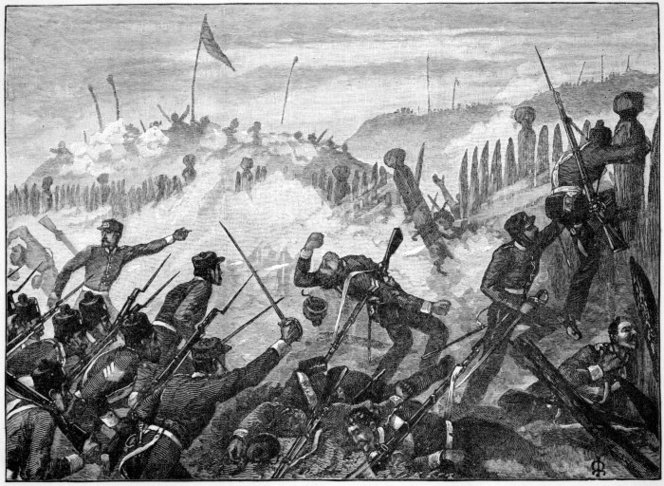
Fighting For A Principle? At the Battle of Rangiriri, 1863, General Duncan Cameron's invasion force overcame the Maori King's defences at Rangiriri. It marked the beginning of the end of Maori sovereignty in New Zealand. In proposing to commemorate the New Zealand Wars, what does the Government hope Maori and Pakeha will remember? The "principles" their ancestors died for? We must hope not - lest the war begins again.
IT HAD TO COME, this official recognition of the dead of the
New Zealand Wars. After four decades of constant revision, our nation’s story
has reached the point where even those who fell in the battles that made it are
summoned forth from the shadows. In recognising these ghosts, however, we must
not deceive ourselves that the causes for which they fought and died will
somehow remain unrecognised.
In announcing the Government’s intention to set aside a day
to commemorate those who fell in the battles of one-and-a-half centuries ago,
The Deputy-Prime Minister, Bill English declared that the time had come “to
recognise our own conflict, our own war, our own fallen, because there is no
doubt at Rangiriri ordinary people lost their lives fighting for principle in
just the same way as New Zealand soldiers who lost their lives fighting on
battlefields on the other side of the world”.
And what principle would that be, Mr English? The principle
of dual sovereignty? – because that was what the Kingitanga represented. The
principle of tino rangatiratanga? – in recognition of which the sovereign
rights of Maori chiefs had been deemed inviolate under the Treaty of Waitangi?
Or, was it the more general principle, recognised then, as it is now, that the
military invasion and seizure of territory occupied by people who have not
struck a blow against you is an international crime?
When teachers are asked to explain why 12,000 Imperial
troops invaded the Waikato and the Bay of Plenty in 1863-64, how would Mr
English have them reply? Should they tell their pupils that the Maori fighting
force, against which this massive army advanced, struggled to maintain a muster
of four-figures? And what should they say about the million Maori acres confiscated
by the Settler Parliament? How should that be justified?
Perhaps these questions should be left for the Minister of
Arts Culture and Heritage, Maggie Barry, to answer. She was, after all, the
person who described the invasion of the Waikato, and the Battle of Rangiriri,
as: “a deeply regrettable time in our history”. Speaking to those gathered to
witness the repatriation of the Rangiriri battle-site to the Kingitanga on
Friday, 19 August, she emphasised the significance of commemorating the New Zealand
Wars: “It is important to us as a nation. At least as important as our World
War I commemorations, if not more so.”
Much more so, Ms Barry. The formation of the New Zealand
State was predicated on the full and final subjection of its indigenous people.
In the two decades separating the signing of the Treaty, in 1840, and the
invasion of the Waikato, in 1863, tens of thousands of mostly British
immigrants had poured into New Zealand. In 1852, the British Foreign and
Colonial Office responded to this influx by granting a large measure of
self-government to the burgeoning settler population. The Maori tribes of the
North Island interior countered by establishing the Kingitanga. While the Maori
King’s writ ran, no more land would be sold to the Pakeha. To the London
investors and Auckland land speculators who were chafing at the bit to turn
this British “possession” into a paying proposition, such defiance was
intolerable. New Zealand’s restless natives needed to be taught a lesson.
General Duncan Cameron and his 12,000-strong army would be the teachers.
So what, exactly does Ms Barry find “regrettable” about the
New Zealand Wars? That the Pakeha won them? That the confiscated lands of the
Waikato, Bay of Plenty and Taranaki tribes went on to form the foundation of
New Zealand’s economic prosperity? That the victory of the colonial forces, by
removing the risk of further warfare, prepared the way for the breakneck
development of the colony in the half-century that followed? Are these the
consequences of the New Zealand Wars that the Minister of Arts Culture and
Heritage regrets? Probably not.
So what, exactly, will Maori and Pakeha talk about on this
yet-to-be-announced day of commemoration? Will the victors tell the vanquished
how damned decent it was of their ancestors to let their ancestors kill so many
warriors and steal so much land? Will the vanquished shrug their shoulders and
say, “No worries, Bro, it was a long time ago”? And will the victors smile
indulgently, slap the vanquished on the back, and say: “Quite right, Mate, it
was, and we’re all New Zealanders now.”
We shall see. Of one thing we can be certain, however: the
dead who have slept for one-and-a-half centuries beneath the disputed soil of
Aotearoa will have a very different story to tell.
There is a reason why so many of the signposts to old battle
sites are weathered and overgrown; why lichen has been allowed to obliterate
the names of those who fell.
Sleeping ghosts, like sleeping dogs, should never be
needlessly awakened.
This essay was
originally published in The Press of Tuesday,
23 August 2016.
