Showing posts with label NZ Security Intelligence Service SIS. Show all posts

Tuesday, 15 November 2022

The “Us versus Them” Worldview.

Behind Closed Doors: What were the organisers of He Whenua Taurikura, the second hui called into existence by the recommendations of the Royal Commission of Inquiry into the Christchurch mosque shootings, afraid of? Were they worried that journalists not 100 percent sympathetic to the ideals animating the hui might report something untoward? Like the truth?

THE SIGN said it all: “No Media Access”. Whatever was going on behind these closed doors, it was not open to the scrutiny of a free and independent media. Given the meeting’s/hui’s ostensible purpose – Countering Terrorism and Violent Extremism – this was rather odd. The sheer volume of government and quasi-government noise being generated on the subject of extremism surely suggests that the proceedings of He Whenua Taurikura deserved the widest possible audience.

What were the organisers of this, the second hui called into existence by the recommendations of the Royal Commission of Inquiry into the Christchurch mosque shootings, afraid of? Were they worried that journalists not 100 percent sympathetic to the ideals animating the hui might report something untoward? Like the truth?

Something like the Director of the NZ Security Intelligence Service, Rebecca Kitteridge, announcing her concern that there were New Zealanders out there at risk of developing an “Us versus Them” worldview.

What could she mean? Who could she be talking about?

Is it possible that she was thinking about the 120 members of the NZ House of Representatives? Certainly, our Members of Parliament are irretrievably enmeshed in the “Us versus Them” worldview about which the SIS Director is so concerned. One can only imagine her horror upon discovering that the House, itself, is quite deliberately divided into “The Government” (Us) and “The Opposition” (Them). The radicalising effect of the Chamber’s architecture, which forces these antagonists to confront each other from a distance traditionally expressed as the length of two drawn swords, can only be imagined.

When it comes to officially sanctioned polarisation, however, Parliament does not stand alone. Our legal system openly describes itself as “adversarial” – with the “Prosecution” (Us) doing all it can to discredit and undermine the “Defence” (Them) – and vice versa. And what about labour relations? The radicalisation of exploited workers confronted by rapacious bosses is as old as capitalism itself.

Clearly, Director Kitteridge is on to something: the “Us versus Them” worldview is everywhere!

It would certainly explain why the SIS has devoted considerable resources to producing a helpful handbook encouraging New Zealanders to “Know the Signs” of somebody at risk of succumbing to “violent extremism”.

There are no fewer than 50 of these signs, apparently, a cluster of which involve the afflicted individual deliberately seeking out opportunities for camaraderie and self-sacrifice, learning how to handle firearms and explosives, and surrounding themselves with martial and nationalistic symbols.

We must assume that Director Kitteridge has already been alerted, via the SIS’s special contact number – 0800STASI – to the existence in Aotearoa of a force of more than 5,000 such individuals, and that this violent organisation, “The NZ Army”, has been placed under round-the-clock surveillance.

Ms Kitteridge has become an easy target for this sort of satire for the very simple reason that hers was one of the few contributions to He Whenua Taurikura that received extensive coverage by the mainstream news media.

What the country didn’t hear very much – if anything – about were the contributions of other hui attendees. A cynic might suggest that the suppression of this material was deemed necessary by the hui organisers because if the average citizen was made aware of its existence there would be an outcry. Most New Zealanders do not see it as a role of their government to “guide” the thinking of the nation towards the radical, ideologically-driven goals of a tiny, unelected, elite of bureaucrats, academics and activists.

To be fair to these elite reformers, the presence of the Prime Minister, Jacinda Ardern, at the hui, could be construed as a sign that she and her government had cast the mantle of their protection over He Whenua Taurikura’s deliberations.

Indeed, since the horrific events of 15 March 2019, the Prime Minister has evinced an uncompromising determination to strengthen the country against the violent extremists of word and deed. One could almost say that she has been “radicalised” by her experiences, and that her views on matters like “hate speech” have become deeply polarising.

Ms Ardern’s and her government’s radicalisation is fast becoming electorally problematic. Precisely because radical ideas, practically by definition, are polarising, they tend to make those who espouse them politically defensive and hostile to criticism. Those citizens who oppose state-sponsored radicalism, mark themselves as “enemies of the people”.

“No Media Access” is only the beginning.


This essay was originally published in The Otago Daily Times and The Greymouth Star of Friday, 11 November 2022.

Friday, 4 November 2022

0-800-STASI

The Lidless Eye: New Zealand’s Security Intelligence Service has scoured its own files, and drawn on the relevant files of its Five Eyes partners, to produce a handbook identifying all the tell-tale signs that a citizen has undergone radicalisation, and is on the verge of organising and/or engaging in an act of deadly violence. But, that’s not all. The SIS has also set up a special number for people to call if they believe their next-door-neighbour has become a violent extremist.

“WHAT THE HELL IS THIS!” Gerald stared at the words on the screen as if, somehow, he could make them blink first.

“What’s up?” Gerald’s co-worker, Elise, swivelled towards him, eyebrows raised interrogatively. Gerald was usually such a quiet and studious worker, she found his angry outburst just a little bit shocking.

“See for yourself”, Gerald replied, turning his screen towards Elise.

“Hmmmm.” Elise settled back in her chair with a thoughtful expression. “That is certainly an unusual brief. Not the Boss’s style at all. What do you suppose has led her to issue such an odd assignment?

“I don’t have to suppose anything, Elise, I know what inspired this. It’s the second of those national anti-terrorism seminars. The first one was a complete waste of time, and the second has been a complete waste of time multiplied by ten. Why doesn’t the Boss just tell the Prime Minister to leave national security to the professionals?”

“Because Directors don’t get to tell Prime Ministers what to do, Gerald – as you well know. The PM has immersed herself in this misinformation, disinformation, bad actors stuff, to the point where she can no longer think rationally about national security matters.”

“No, she can’t. What Prime Minister in her right mind would ask her security chief to prepare a ‘How To Tell If Your Neighbour’s A Violent Extremist’ handbook? Dear God! Putting to one side the utterly appalling anti-democratic ramifications of the idea, why would a national security agency provide an actual or potential violent extremist with a helpful list of all the behavioural tells to avoid? How wise is it, do you think, to warn these characters what to keep hidden from their friends and family? Surely the PM can be made to see that putting out something like this only makes the bad guys’ work easier?”

“The problem, Gerald, is that she’s been persuaded that we, and all the other national security agencies, are either incompetent, or racist, or both. She probably thinks that, with the right sort of surveillance, violent extremism can be stopped in its tracks.”

“Nuts.”

“Yep. And the animosities stirred up by the Pandemic have only made things worse.”

“True, but whose fault is that? Who went from being the Good Fairy, trusted protector of the people; to full-on Maleficent, imposing vaccination mandates with a cackle? Who allowed the Speaker to go on whacking that Hornets’ Nest in Parliament Grounds until its occupants erupted in fury and started stinging all-and-sundry? Who made it clear how pleased she was with the sort of journalism that portrayed the country as brimming over with white supremacists and fascists?”

“I know, I know, Gerald. Nor does she appear to understand that the moment a political leader indicates an explanatory preference, that is the only explanation she will receive.”

“Hence, the Boss’s instruction to write this bloody handbook. I’m supposed to go through all our own files, along with the relevant files of our allies, and identify all the tell-tale signs that someone’s undergone radicalisation, and is on the verge of organising and/or engaging in an act of deadly violence. But, that’s not all. I’m also supposed to set up a special number for people to call if they suspect their next-door-neighbours are preparing to ram-raid their Petunias. I’m going to suggest 0-800-STASI.”

“If you’re thinking Stasi, you should talk to Dieter – he used to be a Colonel in the Ministerium für Staatssicherheit, the Ministry of State Security, back in the days of the German Democratic Republic.”

“East Germany?”

“Yep. He moved here to be with his children and grandchildren after the fall of the Berlin Wall. He works for us from time to time. On contract, presumably. Come to think of it, Dieter’s been around the building quite a bit lately.”

“Do you think the Boss would contract him to give me a hand with this assignment? I mean, who is better qualified to write a handbook on identifying real and/or potential enemies of the state than a former Stasi colonel?”

“I don’t see why not. Gosh, Gerald, this is actually getting quite exciting. Have you been watching Kleo – that Netflix series about a GDR assassin?”

“I keep meaning to, but I haven’t yet, no.”

“Oh, but you must, it’s a hoot. Kleo worked for the HVA, the Main Directorate for Reconnaissance – the external arm of the Stasi responsible for espionage, propaganda, sabotage, and assassination. Believe me, Gerald, that girl is dangerous!”

“Hey, do you think, Dieter might have been in the HVA? I mean, espionage, propaganda, sabotage, and assassination – he’d know all about that stuff!”

“Jeez, Gerald, we’re not at that point – surely? All we’re being asked to do is alert people to the tell-tale signs of violent extremism. That hardly makes us the Stasi.”

“Actually, Elise, that’s exactly what it makes us. In the early years of the GDR there really were thousands of former Nazis to identify and punish for the crimes of 1933-45. By the 1980s, though, the Stasi were keeping tabs on just about everybody. Neighbours were asked to spy upon neighbours – and they dared not refuse. A word in the right ear, and your worst enemy could lose her job, or you could be thrown into prison. When thoughts become crimes, Elise, everybody is a potential criminal.”

“And what better incentive could there be for committing an act of violent extremism than being punished for thinking about one?”

“Exactly.”


This short story was originally posted on The Daily Blog of Friday, 4 November 2022.

Thursday, 2 June 2022

Intriguing Last Words: Remembering Stan Rodger (1940-2022)

Stan's Our Man: A decent, moderate Labour Party stalwart, Stan Rodger navigated the treacherous waters of the Rogernomics era to such effect that he was able to state, with complete honesty, that he belonged to none of the factions that were tearing the Fourth Labour Government apart. Unfortunately, as Aneurin Bevan so rightly observed: "If you spend all your time in the middle of the road, then eventually you will get run over." In a time of extremism, moderation is a kind of betrayal.

STAN RODGER, Minister of Labour, and Minister of State Services in the Fourth Labour Government, died on Sunday, 29 May 2022, aged 82. Between 1978 and 1986, Stan was my Member of Parliament. In 1984, that crucial year which saw the fall of Robert Muldoon and his right-wing populist National Government, I found myself on Stan’s campaign team for the Dunedin North Labour Electorate Committee.

The Labour Party of 1984 was a monstrous creature. It’s branch membership, alone, was close to 100,000, with another quarter-of-a-million trade union members affiliated to the party. It also possessed a large and highly vocal left-wing: people who took the Party’s pledge to promote the cause of “democratic socialism” seriously.

One morning, early in 1984, three old comrades from the student protest movements of the 1970s chanced to run into one another in the student union cafeteria at the University of Otago. To our considerable consternation, we discovered that all three of us were working on the campaign committees of Labour MPs and candidates. Radical leftists who had laughed at the pretentions of Labour claimants to that title, now found themselves designing pamphlets, organising photo-shoots, and analysing canvassing returns. “Has it truly come to this?” We asked ourselves. “Have we all become fucking social-democrats!”

Within days of that embarrassing reunion, I had put a new set of words to the tune of Cliff Richard’s 1963 hit “We’re All Going On A Summer Holiday”.

We’re all working for a Labour victory
No more Trotsky, no more Lenin or Mao.
We’re all working for a Labour victory,
I’m glad the comrades cannot see us now!

Stan Rodger had a pretty good feel for the political leanings of the people he worked with. Certainly, he could recognise the many and various shades of red radicalism with relative ease. I was not the only “democratic socialist” on his campaign committee, although it is fair to say that we were easily outnumbered by the Labour moderates among whom Stan felt most comfortable. What distinguished him from practically every other member of the Labour caucus at that time, however, was his conviction that, to retain its political “soul”, the party needed to encompass the full range of democratic left-wing opinion. In the hierarchy of Labour’s “broad church”, that made Stan an Archbishop – at the very least!

Before his death, Stan Rodger allowed himself to be interviewed by the veteran political journalist, Richard Harman. In the course of that interview, Stan revealed something very few people outside the upper echelons of the trade union movement of the 1960s – and the Security Intelligence Service – knew anything about. Stan only learned the secret because he was a rising star in the Public Service Association (of which he would eventually become president) as well as being a senior bureaucrat in the Ministry of Works.

According to Harman, as Stan started moving up the ranks of the PSA he encountered a highly organised underground movement within the Association dedicated to advancing the ideology and clout of the far-left.

“Stan might have been a member of a political party that was still nominally socialist,” writes Harman on his Politik website of Tuesday, 31 May 2022, “but like most Labour Party members, he subscribed to Michael Joseph Savage’s argument that the party’s philosophy was actually ‘applied Christianity’. Stan, said Harman, “had no time for pure socialism or Marxism.”

But, Marxists there were in the public service: “a new cohort of university graduates with far-left views was making itself felt in Wellington.” According to Stan, the wartime Labour Government of Peter Fraser had placed many of these young firebrands in the Department of Industries and Commerce (DIC).

Now, as any good Kiwi leftist knows, the Department of Trade and Industry (as the DIC was later renamed) came to be headed-up by New Zealand’s most effective left-wing intellectual, William (Bill) Sutch – the man who, in 1974, was charged with espionage on behalf of the Soviet Union – and acquitted.

Stan’s principal antagonist, however, wasn’t Sutch, but John P Lewin. Lewin, a former President of the PSA, senior official at Industries and Commerce and, ultimately, Government Statistician, was the man who, according to Stan, became the unofficial leader of a far-left group within the PSA, calling itself the Korero Group.

“It had many key activists in the PSA within it,” Stan told Harman, “with Lewin driving it out of the Trade and Industry department. And Jim Turner, the last member that I knew that was in it, told me it always ran with huge discipline and would even expel people out of the Korero. It essentially ran the PSA at arm’s length through the executive.”

What Stan Rodger has held back until he was safely beyond the reach of controversy are the bones of an explanation for one of the most devastating hit-jobs in the history of New Zealand political journalism. The exposé was published in the right-wing weekly newspaper, Truth, in July 1975, and it purported to expose a “plot” to socialise much of the New Zealand economy which had been hatched on behalf of Labour Prime Minister, Norman Kirk, by Labour MP, Gerald O’Brien, Bill Sutch and Jack Lewin.

Dismissed by Labour supporters at the time as just one more example of an increasingly sinister series of leaks and rumours (what we would, today, call “fake news”) intended to disorient and dismay the electorate in the run-up to the 1975 general election, Truth’s “Plot” may have been something else altogether.

If Stan Rodger knew about the Korero Group, so, almost certainly, did the SIS. Unable to prevent the likes of Sutch and Lewin rising high in the government department at the cutting edge of economic policy, the Security Services likely became increasingly fixated on the extent to which the “far-left” bureaucrats at Trade and Industry were influencing the direction of New Zealand economic development.

It is possible, therefore, that right through the 1960s, and into the 1970s, there was a race between the Left and the Right to find a group of politicians with the courage to undertake a drastic reform of the New Zealand economy. The persecution of Sutch, and the “fake news” about a plot to socialise the New Zealand economy (almost certainly leaked to Truth by the SIS) both bear testimony to the “Deep State’s” fear that the “hugely disciplined” left-wing “cell” in Trade and Industry had already found, or was about to find, the group of politicians it was looking for.

As the man who made certain that David Lange entered Parliament, Stan Rodger, set in motion the political sequence of events that culminated, ironically, in an equally disciplined group of ideologically-driven bureaucrats – this time concentrated in the Treasury – finding the group of politicians it had been looking for. The politicians who were to give us “Rogernomics”.

With Stan Rodger’s passing it is no longer possible to ask him if he saw the rise and rise of the neoliberal “cell” at Treasury as clearly as he saw the defusing and dispersal of the Trade and Industry Marxists and the Korero Group. I wonder if he would have agreed that there was a moment, at some point during those extraordinary post-war years, when New Zealand could have gone in an entirely different direction.


This essay was originally posted on The Daily Blog of Thursday, 2 June 2022.

Saturday, 5 June 2021

Who Poses the Bigger Threat: The Far Right, Or the Far Left?

Anyone Heard Of The 'Horseshoe Theory'? The notion that the political spectrum isn't really a straight line, but actually more of a horseshoe shape, is making something of a comeback in the 2020s. Its great appeal lies in the fact that it places those at the very ends of the Left-Right spectrum much closer to each other than to those at the centre. Listening to the diagnoses and proposed cures of those purporting to be opponents of the Far-Right, one is tempted to say: "If the horseshoe fits ..."

EVEN THE HEADLINE is misleading: “How the SIS Missed the Threat of the Far Right”. Marc Dalder’s latest posting on the Newsroom site purports to offer evidence of the Service’s failure to adequately assess the danger posed to New Zealand society by Far Right and White Supremacist groups. In fact, from the documents Dalder relies upon, it is clear that the SIS assessed the threat potential of New Zealand’s right-wing extremists with considerable accuracy.

That the SIS failed to prevent the “lone wolf” attack perpetrated by Australian extremist Brenton Tarrant is undeniable. But, once again, the official documents cited by Dalder make it very clear that without the assistance of the most extraordinary dumb luck the detection and prevention of such attacks is next-to-impossible. Curiously enough, this is also precisely what the Royal Commission of Inquiry Into the Christchurch Mosque Attacks concluded.

Dalder’s post highlights a paper produced by the National Assessments Committee of the Department of Prime Minister and Cabinet (not, you’ll note, the SIS) entitled “The Right Wing in New Zealand: Myth versus Reality”.

According to Dalder:

The bulk of this paper examined the threat of far-right groups, even though previous right-wing terrorists like Anders Breivik were not affiliated with a specific organisation. It determined that ‘established, overt groups’ like Right Wing Resistance and the New Zealand National Front ‘posed no threat to domestic security’ and ‘there is no information to suggest either group has the intent or capability to impose their ideology through illegitimate means’.

Greater threats could be found in ‘small [extreme right wing] groups or individuals acting outside the sanction of established organisations’ who ‘are the key vector for harm associated with the far-right ... Extremist racist acts are rare and have not routinely featured the use of firearms, but the relative ease of access to semi-automatic firearms means that a ‘lone wolf’ attack scenario remains a possibility.


Reassuringly, the SIS agreed. Dalder quotes the relevant findings from the Service’s January 2018 Combined Threat Assessment Group report – the last issued before the Christchurch attacks:

This document briefly notes that publicly available information ‘indicates the popularity of far-right ideology has risen in the West since the early 2000s’ but that New Zealand's far-right groups don’t have ‘the intent or capability to promote their ideology by an act of terrorism’.

Yet again, this focus on groups appears to have slipped up the agency. What about a lone wolf attack?

As has been evidenced in similar jurisdictions to New Zealand, an extreme right-wing lone actor attack remains a possibility, albeit a remote one.


Dalder’s judgement of the New Zealand Intelligence Community – revealed in sentences like: “Yet again, this focus on groups appears to have slipped up the agency”, relies entirely on ex post facto reasoning. He knows that Tarrant’s terrorist attack occurred, and therefore feels entitled to say that the SIS “slipped up”.

Except that it didn’t slip up. The SIS and its sister agencies looked at New Zealand’s tiny – and, frankly, rather ridiculous – Far Right community and quite correctly assessed its miniscule groups as possessing neither the intent nor the capability of carrying out a terrorist act. Far from slipping up, the SIS made the right call. It advised the Government that New Zealand’s Far Right groups were nothing to worry about – and they weren’t.

The ideologies of overt white supremacism and/or National Socialism simply do not attract New Zealanders in anything like the numbers required to merit the serious attention of the SIS. Every time these wannabe stormtroopers attempt to strut their stuff on the streets, they are monstered by a far superior force of genuinely aggressive anti-fascists – so much so that they usually require Police protection! Terrorists should be (and are) made of sterner stuff.

Certainly, the Christchurch Shooter was made of homicidally sterner stuff. Stuff which, as New Zealand’s national security analysts rightly warned, is almost impossible to detect or prevent. Yet, even here, their predictions proved accurate. They had rated the chances of a “lone wolf” New Zealander emerging to wreak the sort of havoc unleashed by Anders Breivik in Norway as “remote”, and, once again, they were proved correct. Brenton Tarrant was an Australian, radicalised online and overseas, who chose to carry out his “mission” in New Zealand precisely because it was just about the last place on earth where anyone would expect such a dreadful tragedy to happen.

So, what, exactly, is Dalder hoping to achieve by constantly berating the SIS and the rest of New Zealand’s national security apparatus for missing a “lone wolf” Australian terrorist? Especially when our spooks had repeatedly warned their political masters that “lone wolf” terrorists were almost impossible to intercept? Is he hoping that by repeating these charges over and over again he and his supporters will establish a political climate in which truly draconian levels of state surveillance are accepted as both urgent and necessary?

Assessing the response of the “anti-fascists” to the clearly illegal communication of genocidal ideas via a YouTube posting (quickly taken down) from a person later confirmed by the Police as suffering from a mental illness, one is left wondering. Our current laws prohibit the sort of violent, racially-charged speech posted by this individual – who may yet find himself charged with inciting racial hatred.

A small measure of comfort should, however, be taken from the fact that his anti-Maori threats were broadcast on YouTube, and were, consequently, detected almost immediately. Would that Brenton Tarrant had stated his murderous intentions so publicly: because, had he done so, the Christchurch Massacres would never have happened.

Sadly, this is not the way the “anti-fascists” think. The call has gone out from the Maori Party for a special “joint taskforce”, comprised of the Police and the SIS (and, perhaps, Race Relations Commissioner, Meng Foon, from the Human Rights Commission, who has gallantly volunteered his assistance) and mandated to step up the surveillance (and harassment?) of Far-Right and/or White Supremacist groups targeting Maori.

Even without such a taskforce, New Zealand’s own version of Antifa has succeeded in getting one such purveyor of Far-Right (but not illegal) online content sacked from his job.

What would a national security profiler say, presented with an individual, already dangerously radicalised, who loses his employment amidst a shrill chorus of public condemnation? Would the profiler be concerned that the subject’s anti-social inclinations might be even further inflamed? That his imagination would soon be seething with bloodthirsty revenge fantasies. Scorned and shunned, could he see such a person descending into the criminal underworld and letting it be known that he’s in the market for a military-style semi-automatic rifle?

One suspects a national security profiler, presented with such a case, would recommend that the subject be declared a “person of interest”. It is to be hoped that law enforcement would have the resources to keep an eye on him 24/7. Although, strictly speaking, until he actually acquired an illegal firearm, he would have committed no offence. So, round-the-clock surveillance might not be possible. What about the SIS? Well, no, the SIS is not permitted to engage in law enforcement – that’s the Police’s job.

Perhaps that’s what the Maori Party has in mind: the spooks and the cops working together, side-by-side – ably assisted by Meng Foon and an unofficial collection of civilian spies and YouTube monitors. Once the accusation of Far Right, White Supremacist and/or anti-Maori proclivities was made, these folk could swing into action. Maybe take the suspect into protective custody? Maybe interrogate him?

After all, interventions of this kind, targeting communists, socialists, gays and Jews, worked really well for the Nazis.


This essay was originally posted on The Daily Blog of Friday, 4 June 2021.

Thursday, 3 November 2016

Cause For Celebration: An Entirely Fictional Exchange.

"Shhh, Sir! Walls have ears. Even Here." "No, Rachel, not here. The GCSB sweeps this place every week. We can speak freely here."
 
A PRIVATE DINING-ROOM in an exclusive Wellington restaurant. Seated at a window table and reading a newspaper is JULIAN, a well-dressed senior officer in the NZ Security Intelligence Service. The door opens and a waiter ushers in RACHEL, a much younger officer.
 
RACHEL: That’s not The Guardian I see you reading, is it Sir? Tsk, tsk! What would the Minister say?
 
JULIAN: Well, yes, I’m afraid it is, Rachel. I’m keen to discover exactly how much they actually know about our SAS deployment in Iraq.
 
RACHEL: Shhhh, Sir! Walls have ears! Even here.
 
JULIAN: No, Rachel, not here. The GCSB sweeps this place every week. We can speak freely here.
 
RACHEL: Well, that’s good to know because I’ve just received some very interesting intelligence from one of our more reliable sources in the Labour caucus.
 
JULIAN: Hah! I’m relieved to hear that at least one of them is reliable! What have you been told?
 
RACHEL: It’s your old friend, Mr Cunliffe. He’s leaving Parliament.
 
JULIAN: About bloody time!
 
RACHEL: I thought you’d be pleased.
 
JULIAN: More relieved than pleased, Rachel. Cunliffe was a real problem.
 
RACHEL: For a while.
 
JULIAN: Oh, for more than a while, I think. From the moment he began to grasp the implications and ramifications of the Global Financial Crisis the man’s been a bloody great thorn in our side. Vaunting ambition armed with a convincing explanation. Nothing is more dangerous to the status quo than a man in a hurry with a story that makes sense.
 
RACHEL: Not that very many people ever got to hear it.
 
JULIAN: No, that’s true. But we were forced to rely on the media to an extent that made me distinctly uncomfortable.
 
RACHEL: But it worked, didn’t it? Our journalistic assets made sure that Cunliffe’s message never got taken seriously.
 
JULIAN: Oh yes, it worked. But the media is an unreliable ally. All it takes is for someone like Cunliffe to say something on live television or radio that resonates with the electorate. Something that can’t be edited out. Something that sets people on fire. When that happens the bloody journos just can’t help themselves. A story – is a story – is a story.
 
RACHEL: But Cunliffe did just the opposite, didn’t he? I mean, if we had worked night-and-day for a month we couldn’t have come up with anything half as good as “I’m sorry I’m a man.”
 
JULIAN: Heh-heh! No. That was way beyond even our most sanguine expectations!
 
RACHEL: And even if Cunliffe had said something … inconvenient … we were still covered. Didn’t you tell me that there was plenty up the Service’s sleeve if the campaign looked about to tip Cunliffe’s way? Something about a woman? Or was it two women?
 
JULIAN: Oh yes, there was plenty in reserve if something was needed to “shift the narrative” – as our academic friends might say.
 
RACHEL: Like a $100,000 bottle of wine?
 
JULIAN: Like a $100,000 bottle of wine.
 
RACHEL: And then there were the ABCs – although they never needed much in the way of encouragement from us!
 
JULIAN: No, they didn’t. But it was good to know they were there. Nothing turns the voters off faster than the spectacle of public disunity – let alone open revolt.
 
RACHEL: They would really have gone that far?
 
JULIAN: Rachel, my dear, they would have gone as far as tearing the Labour Party into bloody little chunks on the six o’clock news if that was what it took to prevent Cunliffe becoming Prime Minister. These are seriously unpleasant people – even by our rather loose standards.
 
RACHEL: Well, I suppose we only have to look at what’s happening in the UK to get some idea of what Labour MPs are prepared to do to ensure that a socialist never becomes prime minister. I had no idea MI5 had so many of them in its pocket.
 
JULIAN: No, neither did I. It has really been quite an impressive demonstration.
 
RACHEL: Corbyn’s still there, though.
 
JULIAN: For now. We, on the other hand, have something a little closer to home to celebrate. Some Champagne, I think.
 
RACHEL: Excellent idea, Sir! But, before we celebrate, I’d like to know why you think it took Cunliffe so long to take the hint – or should that be hints?
 
JULIAN: Do you know, I think it can be put down to his misplaced faith in Andrew Little. He really did believe that the man he helped to install as leader was a politician after his own, rather soft, Anglican heart. That although Little had to pretend to the ABCs that he shared their loathing of him, Cunliffe was convinced that, deep down, what Little really shared was his ideas. That, when victory came, there would be a prime, if not a prime-ministerial, job for him in the new Labour-Green cabinet. It’s taken him two years to realise that, in the highly unlikely event that Labour does win the 2017 election, there will be nothing for David Cunliffe. Nothing at all.
 
RACHEL: Good to know that Little can be relied upon to do the right thing.
 
JULIAN: Yes, it is, isn’t it? Cause for celebration. See if you can find that waiter, will you.
 
This sketch was originally posted on The Daily Blog of Wednesday, 2 November 2016.

Saturday, 9 April 2016

Call The Vet! Protecting The State From The Virus Of Dissent.

Vetter-in-Chief: Rebecca Kitteridge has a legitimate role in identifying potentially dangerous vulnerabilities, such as drug and alcohol addiction, in candidates for senior roles in the civil service. Where the SIS veers away from legitimate "vetting", however, is in its role as the state's ideological gatekeeper. When it comes to senior civil service positions, it is still very much a case of "anti-capitalists need not apply".
 
THAT THE SECURITY INTELLIGENCE SERVICE (SIS) has failed to protect the privacy of the people it has “vetted” is no surprise. Information is power, and what is the SIS if not the official gatherer of the information needed to keep the core institutions of the state secure? It will take more than criticism from the Inspector-General of Intelligence to persuade the SIS to give up its role of keeping potential security threats as far away from the Government’s doors as possible.
 
Ideally, the whole notion of security vetting would be insupportable in a nation whose laws prohibit discrimination on the grounds of political belief. The persistence of the practice offers proof that Capitalism is still ready, willing and able to defend itself.
 
If you’re one of those who find it difficult to accept that our civil service is dedicated to the preservation of the capitalist status quo, then try this thought experiment.
 
A left-wing coalition government is elected on a platform of enacting root-and-branch reform of New Zealand’s economic system. The new government’s overall goal is the eradication of social inequality through radical changes to the prevailing fiscal and workplace regimes. The government announces that a major purge of the civil service will be necessary for its reforms to succeed. Accordingly, all present and prospective members of the senior echelons of the civil service are required to submit themselves to a comprehensive vetting process.
 
Senior bureaucrats found to have strong neoliberal sympathies are dismissed from their positions immediately. Neoliberals seeking employment in the reformed civil service are weeded out as real, or potential, threats to New Zealand’s national security. By the end of the purge, scores of civil servants have been advised that, having failed the SIS’s vetting procedure, their services are no longer required.
 
Now imagine the outrage that such an exercise would precipitate. Newspaper editors would thunder their disapproval. Leading law firms would announce their intention of challenging the purge in court. Civil rights advocates would prepare to stage protest demonstrations against the Government’s “Blue Scare” tactics. All of the defence mechanisms of capitalist society would be mobilised to ensure that the system’s ideological guardians remained in place.
 
Clearly, it would be next to impossible to purge a capitalist society like ours of its official defenders without being accused of abandoning democracy itself. And yet, we tell ourselves that democracy remains unimpaired in a country which actively discriminates against those who threaten to bring anti-capitalist ideas into the upper-echelons of the state bureaucracy. Why do so many of us simply accept that the SIS, having subjected such individuals to the most rigorous vetting, is justified in recommending they not be appointed to senior civil service posts?
 
That question was much easier to answer during the Cold War. (1946-1991) Back then it was entirely possible that state servants harbouring strong sympathies for the cause of International Communism and/or the Soviet Union might feel moved to pass on sensitive political and economic information to their ideological soul-mates. The national security implications of appointing such persons to sensitive positions could not (and were not) ignored.
 
National security concerns were also raised in regard to civil servants’ sexual orientation. While homosexuality remained legally, morally and socially unacceptable, gay civil servants were acutely vulnerable to blackmail.
 
In the twenty-first century, addictions to prohibited substances and/or alcohol can make state employees similarly biddable. It is, therefore, difficult to argue against some effort being made to uncover such vulnerabilities prior to appointing someone to a position where nationally important and highly confidential information is regularly circulated and discussed.
 
The collapse of the Soviet Union and the decriminalisation of homosexuality has, however, removed the most obvious justifications for SIS vetting. The background checks undertaken by today’s security personnel should, accordingly, be restricted to identifying drug and alcohol abuse. Discrimination based upon a civil service job candidate’s political beliefs is, surely, be a thing of the past?
 
Don’t you believe it.
 
Today’s civil service, and most of our society generally, functions in an environment of aggressively enforced ideological orthodoxy. Neoliberalism is, without doubt, the most pervasive and effectively defended ideology in human history. Not to be a neoliberal in the early twenty-first century, especially in the upper echelons of the dominant public and private bureaucracies, is to risk career death. To openly espouse ideas hostile to neoliberalism is to make that career death certain.
 
The SIS stands as the last line of defence against the occasional incompetence of those specialist recruiting agencies entrusted with delivering short-lists of acceptable candidates for senior positions in the civil service. Personality tests, CV checks and exhaustive interviews with referees can usually be relied upon to filter out all the ideologically inappropriate applicants. Should the commercial gate-keepers prove derelict in their duties, however, Rebecca Kitteridge and her team of “vets” stand ready to protect the key institutions of the capitalist state from the deadly virus of dissent.
 
This essay was originally posted on The Daily Blog of Saturday, 9 April 2016.

Friday, 21 August 2015

When The Nation’s Permanent Interests Override Its Impermanent Politicians

Pushback: Rob Muldoon's NZSIS Amendment Bill 1977 inspired huge protest demonstrations up and down the country. The Bill passed, but only at the price of massive and enduring public mistrust of the SIS itself. Were a left-wing government ever to give legislative expression to that mistrust, however, the true purposes of our national security apparatus would very quickly be revealed.
 
SUBMISSIONS TO the Independent Review of Intelligence and Security closed last Friday. No doubt the “Independent Reviewers”, Sir Michael Cullen and Dame Patsy Reddy, are already up to their elbows in the earnest recommendations of their fellow citizens. By March of next year we will learn what they have made of them.
 
In all probability, neither Sir Michael, nor Dame Patsy, will end up recommending much more than a little tweaking here and there to New Zealand’s national security apparatus. The terms of reference of their inquiry were extremely narrowly set – always an indication that nothing too dramatic is expected by the politicians who set the process in motion.
 
A few judicious redefinitions of the scope and powers of the Security Intelligence Service (SIS) and the Government Communications Security Bureau (GCSB) is the most we should anticipate. (Especially after the Prime Minister has strongly and publicly hinted that this is what his government is expecting!)
 
Indeed, any government attempting to make more than minor changes to either institution is asking for trouble. In 1977, the National Prime Minister, Robert Muldoon, ignited a firestorm of nationwide protests when he announced his intention to legislate a substantial increase in the powers of the SIS. The New Zealand Security Intelligence Service Amendment Bill, which dramatically expanded the Service’s capacity to intercept private communications, and forbade the public identification of its agents, was passed by Parliament, but only at the cost of a significant portion of the citizenry’s trust and goodwill.
 
That New Zealand’s so-called “intelligence community” is anxious to retain and build public trust and goodwill has been evident over the past fortnight in the substantive public relations campaign it has waged in advance of the Independent Review. SIS Director, Rebecca Kitteridge, knows how difficult her job will become if her fellow citizens are unwilling to concede the legitimacy of the SIS’s role.
 
But, if losing the trust and goodwill of New Zealand’s citizens is a bad thing, losing the trust and confidence of New Zealand’s allies would be much, much worse. This would, however, be the most likely outcome if the recommendations of those who made submissions to the Independent Review from the left were ever to be taken up and implemented by a future left-leaning government.
 
The submission from the Anti-Bases Campaign, for example (whose spokesperson is the redoubtable left-wing activist, Murray Horton) has recommended to Sir Michael and Dame Patsy that: “New Zealand immediately exits the Five Eyes regime.”
 
The reviewers will, of course, ignore this demand – if only because it falls outside the scope of their inquiry. But, what if a future Labour-Green Government was persuaded to withdraw from the UK-USA Agreement, to which New Zealand has been party for more than 60 years?
 
It is precisely in circumstances such as these that the true function of our national security apparatus would be demonstrated.
 
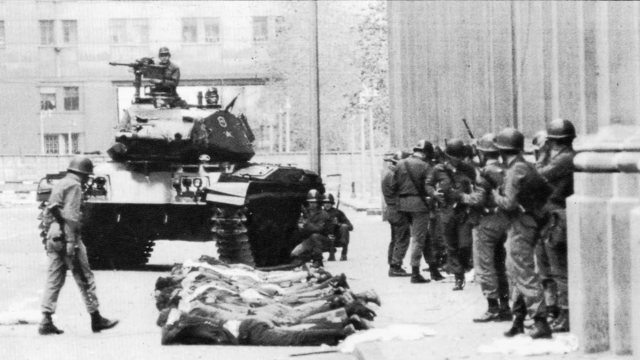
It was the United States Secretary of State, Henry Kissinger, who infamously remarked of the democratically elected socialist government of Chile: “I don’t see why we need to stand by and watch a country go communist due to the irresponsibility of its own people. The issues are much too important for the Chilean voters to be left to decide for themselves.” On 11 September 1973, that government was overthrown by the Chilean armed forces.
 
"The issues are much too important for the Chilean voters to be left to decide for themselves."
- US Secretary of State, Henry Kissinger, justifies the overthrow of Chile's socialist government.
 
On 10 November 1975, outraged that his government was under CIA surveillance, the Australian Labour Prime Minister, Gough Whitlam, let it be known that he would be closing down the joint CIA/National Security Agency’s satellite tracking station at Pine Gap near Alice Springs in the Northern Territory. The following day, Whitlam’s government was dismissed by Sir John Kerr, the Australian Governor-General. (The Pine Gap station was critical to the effectiveness of the “Five Eyes regime”.)
 
In the eyes of both the Chilean armed forces, and Australia’s national security apparatus, the permanent national interests of their respective states had been placed at serious risk by political figures who either did not understand, or were hostile to, those interests. In arriving at these conclusions, both institutions relied upon the intelligence and advice of their nation’s principal military and economic ally, the United States.
 
Although neither Sir Michael, nor Dame Patsy, will admit it, “national security” is all about identifying which permanent national interests are best kept beyond the reach of Democracy’s impermanent practitioners.
 
This essay was originally published in The Waikato Times, The Taranaki Daily News, The Timaru Herald, The Otago Daily Times and The Greymouth Star of Friday, 21 August 2015.

Saturday, 8 August 2015

Revolution In Pipitea Street: The Listener Celebrates The Baby-Boomer Takeover Of The SIS And The GCSB.

Spook Central: Both the SIS and the GCSB are headquartered at "Pipitea Plaza", a 2011 building located just a few hundred metres from Parliament Buildings in Central Wellington.
 
WOW! The SIS Director marched against the Springbok Tour! And the Acting-Director of the GCSB is a lesbian. But, wait, there’s more: the Inspector General of Intelligence used to be a member of the Socialist Action League, and worked in a freezing works for six years! And they’re all women! Surely, with people like these in charge of New Zealand’s “intelligence community”, no reasonable, fair-minded citizen could have the slightest cause for complaint? Clearly, this is a new order in the making. No more Penthouses, no more pies. No more grim, trench-coated spies. The bad old days are as dead as Rob Muldoon. Gone, like the Cold War.
 
Or, at least, that’s what we are supposed to think. “We” being the readers of the Listener. (Issue Dated: August 15, 2015) Baby Boomers mostly. Well-educated and well-heeled. A great many of whom marched against the Springbok Tour, flirted with revolutionary politics in our student days, and then went on to bigger and better things. Some of our best friends are lesbians. Yep, “we” can rest easy now that our generation has taken over everything – even the SIS and GCSB. Baby-Boomers Rule – OK!
 
Was it Listener editor, Pamela Stirling, who came up with the idea? Or, did free-lance journalist, Rod Vaughan, pitch it to her? And was the deal clinched by the promise of access to all three chiefs? And whose idea was that? At some point, someone in the “intelligence community”, decided that a front page story about a “revolution” sweeping the corridors of Pipitea House would be just what the Director ordered. The question is: was that decision made in response to Rod Vaughan’s request for access? Or did someone make Rod an offer that he – and Pamela – couldn’t refuse?
 
Because a front-page story in the Listener, reassuring the Baby-Boomers that the SIS and GCSB are now being run by people just like themselves, was bound to prove very helpful - especially now. That’s because a Government-commissioned review of both agencies, led by Sir Michael Cullen and Dame Patsy Reddy, is about to start asking questions. A cynic might observe that Rod Vaughan’s article has very helpfully suggested most of the answers.
 
What is there to fear, after all, from an SIS staffed by scores of bright-eyed young university graduates determined to keep New Zealand safe from “extremist behaviours”? Or, a GCSB run by someone who understands the importance of reminding “the troops” to “remain focused on the job at hand and to remember their responsibilities to all New Zealanders.”
 
Not that Sir Michael is likely to deliver a report recommending the upsetting of too many apple carts. As Helen Clark’s finance supremo, he always appeared to be doing his best to deliver what the state expected of its ministers. Yes, in the House he could summon up a rhetorical storm fit to set the Tories a-trembling. But, in the Joint Intelligence Committee, sweet reason seems to have prevailed. If Michael Cullen has ever been guilty of troubling the sleep of the “Deep State”, there is scant evidence for it.
 
On the off-chance that there might be New Zealanders less willing to let the Deep State escape all serious scrutiny, however, why not engage in a little pre-emptive PR? A story in the Listener, in which all the “news media, politicians, bloggers and activists” guilty of poking their noses into “the labyrinthine world of the New Zealand intelligence community” were shown to be “completely oblivious to [the] revolution that [is] well under way” within its walls, would undermine any future attempts to “pillory and hold accountable” those responsible for keeping the nation’s secrets.
 
That this could well be the case is confirmed by the Listener’s choice of headlines for Rod Vaughan’s article. The story about SIS Director, Rebecca Kitteridge is called “Secrets & Spies” – a clear reference to Nicky Hager’s exposé of the malign influence of PR on New Zealand politics entitled Secrets and Lies. The story about Una Jagose, Acting-Director of the GCSB, boasts an even more in-your-face thrust at the critics of the SIS and GCSB. It is headlined “Moment of Truth” – which is, of course, the name of the Kim Dotcom-sponsored event featuring Glen Greenwald and Edward Snowden that was held in the Auckland Town Hall just days before the 2014 General Election.
 
The triumphalism of the Listener could hardly be more explicit. In the words Sir Michael Cullen is said to have used to taunt his Tory opponents following the 1999 Labour-Alliance victory:
 
“We won. You lost. Eat that!”
 
This essay was originally posted on The Daily Blog of Saturday, 8 August 2015.