Showing posts with label Rebecca Kitteridge. Show all posts

Tuesday, 15 November 2022

The “Us versus Them” Worldview.

Behind Closed Doors: What were the organisers of He Whenua Taurikura, the second hui called into existence by the recommendations of the Royal Commission of Inquiry into the Christchurch mosque shootings, afraid of? Were they worried that journalists not 100 percent sympathetic to the ideals animating the hui might report something untoward? Like the truth?

THE SIGN said it all: “No Media Access”. Whatever was going on behind these closed doors, it was not open to the scrutiny of a free and independent media. Given the meeting’s/hui’s ostensible purpose – Countering Terrorism and Violent Extremism – this was rather odd. The sheer volume of government and quasi-government noise being generated on the subject of extremism surely suggests that the proceedings of He Whenua Taurikura deserved the widest possible audience.

What were the organisers of this, the second hui called into existence by the recommendations of the Royal Commission of Inquiry into the Christchurch mosque shootings, afraid of? Were they worried that journalists not 100 percent sympathetic to the ideals animating the hui might report something untoward? Like the truth?

Something like the Director of the NZ Security Intelligence Service, Rebecca Kitteridge, announcing her concern that there were New Zealanders out there at risk of developing an “Us versus Them” worldview.

What could she mean? Who could she be talking about?

Is it possible that she was thinking about the 120 members of the NZ House of Representatives? Certainly, our Members of Parliament are irretrievably enmeshed in the “Us versus Them” worldview about which the SIS Director is so concerned. One can only imagine her horror upon discovering that the House, itself, is quite deliberately divided into “The Government” (Us) and “The Opposition” (Them). The radicalising effect of the Chamber’s architecture, which forces these antagonists to confront each other from a distance traditionally expressed as the length of two drawn swords, can only be imagined.

When it comes to officially sanctioned polarisation, however, Parliament does not stand alone. Our legal system openly describes itself as “adversarial” – with the “Prosecution” (Us) doing all it can to discredit and undermine the “Defence” (Them) – and vice versa. And what about labour relations? The radicalisation of exploited workers confronted by rapacious bosses is as old as capitalism itself.

Clearly, Director Kitteridge is on to something: the “Us versus Them” worldview is everywhere!

It would certainly explain why the SIS has devoted considerable resources to producing a helpful handbook encouraging New Zealanders to “Know the Signs” of somebody at risk of succumbing to “violent extremism”.

There are no fewer than 50 of these signs, apparently, a cluster of which involve the afflicted individual deliberately seeking out opportunities for camaraderie and self-sacrifice, learning how to handle firearms and explosives, and surrounding themselves with martial and nationalistic symbols.

We must assume that Director Kitteridge has already been alerted, via the SIS’s special contact number – 0800STASI – to the existence in Aotearoa of a force of more than 5,000 such individuals, and that this violent organisation, “The NZ Army”, has been placed under round-the-clock surveillance.

Ms Kitteridge has become an easy target for this sort of satire for the very simple reason that hers was one of the few contributions to He Whenua Taurikura that received extensive coverage by the mainstream news media.

What the country didn’t hear very much – if anything – about were the contributions of other hui attendees. A cynic might suggest that the suppression of this material was deemed necessary by the hui organisers because if the average citizen was made aware of its existence there would be an outcry. Most New Zealanders do not see it as a role of their government to “guide” the thinking of the nation towards the radical, ideologically-driven goals of a tiny, unelected, elite of bureaucrats, academics and activists.

To be fair to these elite reformers, the presence of the Prime Minister, Jacinda Ardern, at the hui, could be construed as a sign that she and her government had cast the mantle of their protection over He Whenua Taurikura’s deliberations.

Indeed, since the horrific events of 15 March 2019, the Prime Minister has evinced an uncompromising determination to strengthen the country against the violent extremists of word and deed. One could almost say that she has been “radicalised” by her experiences, and that her views on matters like “hate speech” have become deeply polarising.

Ms Ardern’s and her government’s radicalisation is fast becoming electorally problematic. Precisely because radical ideas, practically by definition, are polarising, they tend to make those who espouse them politically defensive and hostile to criticism. Those citizens who oppose state-sponsored radicalism, mark themselves as “enemies of the people”.

“No Media Access” is only the beginning.


This essay was originally published in The Otago Daily Times and The Greymouth Star of Friday, 11 November 2022.

Saturday, 9 April 2016

Call The Vet! Protecting The State From The Virus Of Dissent.

Vetter-in-Chief: Rebecca Kitteridge has a legitimate role in identifying potentially dangerous vulnerabilities, such as drug and alcohol addiction, in candidates for senior roles in the civil service. Where the SIS veers away from legitimate "vetting", however, is in its role as the state's ideological gatekeeper. When it comes to senior civil service positions, it is still very much a case of "anti-capitalists need not apply".
 
THAT THE SECURITY INTELLIGENCE SERVICE (SIS) has failed to protect the privacy of the people it has “vetted” is no surprise. Information is power, and what is the SIS if not the official gatherer of the information needed to keep the core institutions of the state secure? It will take more than criticism from the Inspector-General of Intelligence to persuade the SIS to give up its role of keeping potential security threats as far away from the Government’s doors as possible.
 
Ideally, the whole notion of security vetting would be insupportable in a nation whose laws prohibit discrimination on the grounds of political belief. The persistence of the practice offers proof that Capitalism is still ready, willing and able to defend itself.
 
If you’re one of those who find it difficult to accept that our civil service is dedicated to the preservation of the capitalist status quo, then try this thought experiment.
 
A left-wing coalition government is elected on a platform of enacting root-and-branch reform of New Zealand’s economic system. The new government’s overall goal is the eradication of social inequality through radical changes to the prevailing fiscal and workplace regimes. The government announces that a major purge of the civil service will be necessary for its reforms to succeed. Accordingly, all present and prospective members of the senior echelons of the civil service are required to submit themselves to a comprehensive vetting process.
 
Senior bureaucrats found to have strong neoliberal sympathies are dismissed from their positions immediately. Neoliberals seeking employment in the reformed civil service are weeded out as real, or potential, threats to New Zealand’s national security. By the end of the purge, scores of civil servants have been advised that, having failed the SIS’s vetting procedure, their services are no longer required.
 
Now imagine the outrage that such an exercise would precipitate. Newspaper editors would thunder their disapproval. Leading law firms would announce their intention of challenging the purge in court. Civil rights advocates would prepare to stage protest demonstrations against the Government’s “Blue Scare” tactics. All of the defence mechanisms of capitalist society would be mobilised to ensure that the system’s ideological guardians remained in place.
 
Clearly, it would be next to impossible to purge a capitalist society like ours of its official defenders without being accused of abandoning democracy itself. And yet, we tell ourselves that democracy remains unimpaired in a country which actively discriminates against those who threaten to bring anti-capitalist ideas into the upper-echelons of the state bureaucracy. Why do so many of us simply accept that the SIS, having subjected such individuals to the most rigorous vetting, is justified in recommending they not be appointed to senior civil service posts?
 
That question was much easier to answer during the Cold War. (1946-1991) Back then it was entirely possible that state servants harbouring strong sympathies for the cause of International Communism and/or the Soviet Union might feel moved to pass on sensitive political and economic information to their ideological soul-mates. The national security implications of appointing such persons to sensitive positions could not (and were not) ignored.
 
National security concerns were also raised in regard to civil servants’ sexual orientation. While homosexuality remained legally, morally and socially unacceptable, gay civil servants were acutely vulnerable to blackmail.
 
In the twenty-first century, addictions to prohibited substances and/or alcohol can make state employees similarly biddable. It is, therefore, difficult to argue against some effort being made to uncover such vulnerabilities prior to appointing someone to a position where nationally important and highly confidential information is regularly circulated and discussed.
 
The collapse of the Soviet Union and the decriminalisation of homosexuality has, however, removed the most obvious justifications for SIS vetting. The background checks undertaken by today’s security personnel should, accordingly, be restricted to identifying drug and alcohol abuse. Discrimination based upon a civil service job candidate’s political beliefs is, surely, be a thing of the past?
 
Don’t you believe it.
 
Today’s civil service, and most of our society generally, functions in an environment of aggressively enforced ideological orthodoxy. Neoliberalism is, without doubt, the most pervasive and effectively defended ideology in human history. Not to be a neoliberal in the early twenty-first century, especially in the upper echelons of the dominant public and private bureaucracies, is to risk career death. To openly espouse ideas hostile to neoliberalism is to make that career death certain.
 
The SIS stands as the last line of defence against the occasional incompetence of those specialist recruiting agencies entrusted with delivering short-lists of acceptable candidates for senior positions in the civil service. Personality tests, CV checks and exhaustive interviews with referees can usually be relied upon to filter out all the ideologically inappropriate applicants. Should the commercial gate-keepers prove derelict in their duties, however, Rebecca Kitteridge and her team of “vets” stand ready to protect the key institutions of the capitalist state from the deadly virus of dissent.
 
This essay was originally posted on The Daily Blog of Saturday, 9 April 2016.

Friday, 21 August 2015

When The Nation’s Permanent Interests Override Its Impermanent Politicians

Pushback: Rob Muldoon's NZSIS Amendment Bill 1977 inspired huge protest demonstrations up and down the country. The Bill passed, but only at the price of massive and enduring public mistrust of the SIS itself. Were a left-wing government ever to give legislative expression to that mistrust, however, the true purposes of our national security apparatus would very quickly be revealed.
 
SUBMISSIONS TO the Independent Review of Intelligence and Security closed last Friday. No doubt the “Independent Reviewers”, Sir Michael Cullen and Dame Patsy Reddy, are already up to their elbows in the earnest recommendations of their fellow citizens. By March of next year we will learn what they have made of them.
 
In all probability, neither Sir Michael, nor Dame Patsy, will end up recommending much more than a little tweaking here and there to New Zealand’s national security apparatus. The terms of reference of their inquiry were extremely narrowly set – always an indication that nothing too dramatic is expected by the politicians who set the process in motion.
 
A few judicious redefinitions of the scope and powers of the Security Intelligence Service (SIS) and the Government Communications Security Bureau (GCSB) is the most we should anticipate. (Especially after the Prime Minister has strongly and publicly hinted that this is what his government is expecting!)
 
Indeed, any government attempting to make more than minor changes to either institution is asking for trouble. In 1977, the National Prime Minister, Robert Muldoon, ignited a firestorm of nationwide protests when he announced his intention to legislate a substantial increase in the powers of the SIS. The New Zealand Security Intelligence Service Amendment Bill, which dramatically expanded the Service’s capacity to intercept private communications, and forbade the public identification of its agents, was passed by Parliament, but only at the cost of a significant portion of the citizenry’s trust and goodwill.
 
That New Zealand’s so-called “intelligence community” is anxious to retain and build public trust and goodwill has been evident over the past fortnight in the substantive public relations campaign it has waged in advance of the Independent Review. SIS Director, Rebecca Kitteridge, knows how difficult her job will become if her fellow citizens are unwilling to concede the legitimacy of the SIS’s role.
 
But, if losing the trust and goodwill of New Zealand’s citizens is a bad thing, losing the trust and confidence of New Zealand’s allies would be much, much worse. This would, however, be the most likely outcome if the recommendations of those who made submissions to the Independent Review from the left were ever to be taken up and implemented by a future left-leaning government.
 
The submission from the Anti-Bases Campaign, for example (whose spokesperson is the redoubtable left-wing activist, Murray Horton) has recommended to Sir Michael and Dame Patsy that: “New Zealand immediately exits the Five Eyes regime.”
 
The reviewers will, of course, ignore this demand – if only because it falls outside the scope of their inquiry. But, what if a future Labour-Green Government was persuaded to withdraw from the UK-USA Agreement, to which New Zealand has been party for more than 60 years?
 
It is precisely in circumstances such as these that the true function of our national security apparatus would be demonstrated.
 
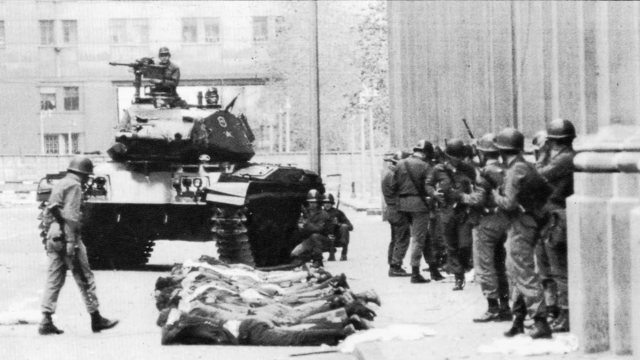
It was the United States Secretary of State, Henry Kissinger, who infamously remarked of the democratically elected socialist government of Chile: “I don’t see why we need to stand by and watch a country go communist due to the irresponsibility of its own people. The issues are much too important for the Chilean voters to be left to decide for themselves.” On 11 September 1973, that government was overthrown by the Chilean armed forces.
 
"The issues are much too important for the Chilean voters to be left to decide for themselves."
- US Secretary of State, Henry Kissinger, justifies the overthrow of Chile's socialist government.
 
On 10 November 1975, outraged that his government was under CIA surveillance, the Australian Labour Prime Minister, Gough Whitlam, let it be known that he would be closing down the joint CIA/National Security Agency’s satellite tracking station at Pine Gap near Alice Springs in the Northern Territory. The following day, Whitlam’s government was dismissed by Sir John Kerr, the Australian Governor-General. (The Pine Gap station was critical to the effectiveness of the “Five Eyes regime”.)
 
In the eyes of both the Chilean armed forces, and Australia’s national security apparatus, the permanent national interests of their respective states had been placed at serious risk by political figures who either did not understand, or were hostile to, those interests. In arriving at these conclusions, both institutions relied upon the intelligence and advice of their nation’s principal military and economic ally, the United States.
 
Although neither Sir Michael, nor Dame Patsy, will admit it, “national security” is all about identifying which permanent national interests are best kept beyond the reach of Democracy’s impermanent practitioners.
 
This essay was originally published in The Waikato Times, The Taranaki Daily News, The Timaru Herald, The Otago Daily Times and The Greymouth Star of Friday, 21 August 2015.

Saturday, 8 August 2015

Revolution In Pipitea Street: The Listener Celebrates The Baby-Boomer Takeover Of The SIS And The GCSB.

Spook Central: Both the SIS and the GCSB are headquartered at "Pipitea Plaza", a 2011 building located just a few hundred metres from Parliament Buildings in Central Wellington.
 
WOW! The SIS Director marched against the Springbok Tour! And the Acting-Director of the GCSB is a lesbian. But, wait, there’s more: the Inspector General of Intelligence used to be a member of the Socialist Action League, and worked in a freezing works for six years! And they’re all women! Surely, with people like these in charge of New Zealand’s “intelligence community”, no reasonable, fair-minded citizen could have the slightest cause for complaint? Clearly, this is a new order in the making. No more Penthouses, no more pies. No more grim, trench-coated spies. The bad old days are as dead as Rob Muldoon. Gone, like the Cold War.
 
Or, at least, that’s what we are supposed to think. “We” being the readers of the Listener. (Issue Dated: August 15, 2015) Baby Boomers mostly. Well-educated and well-heeled. A great many of whom marched against the Springbok Tour, flirted with revolutionary politics in our student days, and then went on to bigger and better things. Some of our best friends are lesbians. Yep, “we” can rest easy now that our generation has taken over everything – even the SIS and GCSB. Baby-Boomers Rule – OK!
 
Was it Listener editor, Pamela Stirling, who came up with the idea? Or, did free-lance journalist, Rod Vaughan, pitch it to her? And was the deal clinched by the promise of access to all three chiefs? And whose idea was that? At some point, someone in the “intelligence community”, decided that a front page story about a “revolution” sweeping the corridors of Pipitea House would be just what the Director ordered. The question is: was that decision made in response to Rod Vaughan’s request for access? Or did someone make Rod an offer that he – and Pamela – couldn’t refuse?
 
Because a front-page story in the Listener, reassuring the Baby-Boomers that the SIS and GCSB are now being run by people just like themselves, was bound to prove very helpful - especially now. That’s because a Government-commissioned review of both agencies, led by Sir Michael Cullen and Dame Patsy Reddy, is about to start asking questions. A cynic might observe that Rod Vaughan’s article has very helpfully suggested most of the answers.
 
What is there to fear, after all, from an SIS staffed by scores of bright-eyed young university graduates determined to keep New Zealand safe from “extremist behaviours”? Or, a GCSB run by someone who understands the importance of reminding “the troops” to “remain focused on the job at hand and to remember their responsibilities to all New Zealanders.”
 
Not that Sir Michael is likely to deliver a report recommending the upsetting of too many apple carts. As Helen Clark’s finance supremo, he always appeared to be doing his best to deliver what the state expected of its ministers. Yes, in the House he could summon up a rhetorical storm fit to set the Tories a-trembling. But, in the Joint Intelligence Committee, sweet reason seems to have prevailed. If Michael Cullen has ever been guilty of troubling the sleep of the “Deep State”, there is scant evidence for it.
 
On the off-chance that there might be New Zealanders less willing to let the Deep State escape all serious scrutiny, however, why not engage in a little pre-emptive PR? A story in the Listener, in which all the “news media, politicians, bloggers and activists” guilty of poking their noses into “the labyrinthine world of the New Zealand intelligence community” were shown to be “completely oblivious to [the] revolution that [is] well under way” within its walls, would undermine any future attempts to “pillory and hold accountable” those responsible for keeping the nation’s secrets.
 
That this could well be the case is confirmed by the Listener’s choice of headlines for Rod Vaughan’s article. The story about SIS Director, Rebecca Kitteridge is called “Secrets & Spies” – a clear reference to Nicky Hager’s exposé of the malign influence of PR on New Zealand politics entitled Secrets and Lies. The story about Una Jagose, Acting-Director of the GCSB, boasts an even more in-your-face thrust at the critics of the SIS and GCSB. It is headlined “Moment of Truth” – which is, of course, the name of the Kim Dotcom-sponsored event featuring Glen Greenwald and Edward Snowden that was held in the Auckland Town Hall just days before the 2014 General Election.
 
The triumphalism of the Listener could hardly be more explicit. In the words Sir Michael Cullen is said to have used to taunt his Tory opponents following the 1999 Labour-Alliance victory:
 
“We won. You lost. Eat that!”
 
This essay was originally posted on The Daily Blog of Saturday, 8 August 2015.

Saturday, 23 May 2015

If The SIS Director Wants To Tell Us The Truth, She Should Commission Fiction.

Memorable Presentation: Rebecca Kitteridge, the first woman Director of the SIS, laments the fact that the necessarily secret work of her agents cannot become the subject of a reality TV series - as it has for Police and Custom Officers. For shame, Ms Kitteridge! If you would tell the truth - write fiction! Just think Spooks.

REBECCA KITTERIDGE is like no Director of the Security Intelligence Service (SIS) New Zealand has ever seen. There was a time when the identities of such national security bureaucrats were, if not secret, then, at the very least, invisible to the general public. In recent decades, an SIS Director’s name might have been slid into the public record, but he (and before Ms Kitteridge they were all “he”) was seldom heard and almost never seen.
 
How things have changed. Like her British equivalent, Dame Stella Rimington, Ms Kitteridge has, as the Service’s first female Director, allowed a Force 10 gale to blow through the stuffy corridors of her publicity-shy corner of the secret state. What Dame Stella did for MI5, Ms Kitteridge hopes to do for the SIS.
 
Her latest foray into the public sphere occurred earlier this week at the 2015 Privacy and Identity Conference in Wellington. Having heard Ms Kitteridge’s frank address, New Zealand’s Privacy Commissioner, John Edwards, vouchsafed to his audience that he “could not remember such a presentation from an intelligence director”.
 
Perhaps the most intriguing offering from Ms Kitteridge concerned the Service’s limited options for improving its public image. The sort of PR opportunities that were open to other state agencies – most notably the Police and Customs Officers – were simply not available to the SIS. It would be difficult, she suggested to make a reality show out of a state agency that was required to “do everything behind locked doors.”
 
For shame, Ms Kitteridge! Reality shows are not the only vehicles for showcasing the day-to-day activities of state operatives. Indeed, there’s an old saying among those who have made it their business to report the activities of the secret state: “If you want to tell the truth – write fiction.”
 
If Ms Kitteridge wants to improve the public’s image and understanding of the SIS, she has only to persuade NZ on Air to fund a television drama series about its activities.
 
Was it no more than coincidence that in the years immediately following Dame Stella’s stint at MI5 the BBC began airing the hit series Spooks? The show’s creator, Jane Featherstone, told The Daily Mail that: “At first the intelligence services were resistant, and they let that be known through former members who acted as technical advisers on Spooks.” But, eventually, says Featherstone, the real spooks came around. “They even used the first series to help with their [recruitment] campaign.”
 
Prime Recruiter? The British television series Spooks boosted the numbers of people seeking to join MI5.
 
And it’s not as if there isn’t plenty of experienced writing talent close at hand. The British-born television writer, Neil Cross, who wrote multiple episodes of Spooks, as well as the memorable detective thriller, Luther, has lived in Wellington for many years.
 
The story-lines for such a series (working title “The Service”) would no doubt include many of the issues raised in Ms Kitteridge’s speech. Imagine the possibilities of a story-line based upon Islamic State’s use of social media. Or about tracking-down the member of the public who tipped the SIS off about a plot to contaminate New Zealand’s dairy exports. More controversially, there could be an episode about a terrorist cell undergoing military training in the bush.
 
If Ms Kitteridge is really serious about letting the public know just how difficult her job can be, she could advise the series writers on how an SIS Director might respond to an attempt to use the SIS for political purposes. What does the Director do when someone from the Prime Minister’s Office approaches her with a request to blacken the name of a political opponent? Or when one of her agents discovers that the Israeli Embassy has recruited a prominent blogger to blacken the reputations of pro-Palestinian activists?
 
And, just imagine the dramatic possibilities of a “Black Hat” hacker, recruited to turn the tables on Chinese cyber-criminals who have succeeded in penetrating the defences of one of New Zealand’s most innovative companies. Should the Director use her hacker’s talents independently, or share him with the Government Communications Security Bureau’s own team of “Computer Network Operations Specialists”? And how should she fend off the furious intervention of a Foreign Minister desperate to keep New Zealand’s relationship with the Chinese Government on an even keel?
 
If Ms Kitteridge cannot give us the facts about the SIS, she could at least try to tell us the truth – by commissioning fiction.
 
This essay was originally published in The Waikato Times, The Taranaki Daily News, The Timaru Herald, The Otago Daily Times and The Greymouth Star of Friday, 22 May 2015.

Sunday, 30 November 2014

The Deep State Surfaces

Forced To The Surface: One of the most significant effects of the Neoliberal revolution has been the radical shortening of the distance between the surface of the State and its hitherto "deep" foundations.
 
IT IS EIGHTEEN YEARS since education lecturer, Denis Small, surprised two Security Intelligence Service (SIS) agents attempting to break into the home of the anti-free trade activist, Aziz Choudry. The SIS was to pay dearly (quite literally as it turned out) for that spectacular cock-up. Legislative change was required to settle the feathers of liberal opinion which, as always, professed outrage at the very idea of a state that was willing to break into the homes of its citizens. The bitter truth, of course, is that the agents and agencies of the “Deep State” have never hesitated to do whatever the hell they liked in citizens’ homes and workplaces.
 
Before the responsibility for defending “national security” was handed over to stand-alone agencies like the SIS it had been divided between the Police (Special Branch) and the Armed Forces (Military and Naval Intelligence).
 
Sometimes, as in the Waihi Miners’ Strike of 1912, the Police worked hand-in-glove with the government of the day to bring agitators and subversives under control. On other occasions – as in the  early years of the First Labour Government – the Police kept tabs on their political masters without their knowledge. (What other choice did they have when the agitators and subversives had become the Government!)
 
This is, of course, the defining characteristic of that nexus of defence, control and administrative institutions we call the Deep State: that it feels perfectly comfortable determining what is and isn’t in the “national interest”; and that it carries out this function without paying too much attention to the democratic niceties. The people’s elected representatives might be consulted if they are the right sort of representatives (with the emphasis on “right”). “Left” representatives, on the other hand, don’t “need to know” and should not be told too much about the Deep State’s activities.
 
In Margaret Hayward’s Diary of the Kirk Years she makes it plain that Norman Kirk was not only the subject of more-or-less constant SIS surveillance from the moment he became Leader of the Opposition, but that even as Prime Minister he could not count on his spooks keeping him in the loop of their surveillance activities.
 
As a young, fairly radical back-bench Labour MP, Helen Clark made no secret of her belief that her phone-calls were being monitored by the SIS. Given Clark’s long association with such dangerous beasts as the Nicaraguan Sandinistas and East Timor’s FRETILIN freedom-fighters, the SIS was probably the least of Helen’s worries. The Americans cannot have been happy with her appointment to the Chair of Parliament’s Peace and Disarmament Select Committee – especially when it became clear that David Lange (his solemn promises to US Secretary of State, George Shultz, notwithstanding) was about to take his party’s anti-nuclear policies seriously.
 
Had the Fourth Labour Government not been equally keen on implementing a radical series of neoliberal reforms, the Deep State would almost certainly have set in motion the same kinds of “defensive” measures that led to the dismissal of Gough Whitlam’s errant Labour Government back in 1975.
 
In 1984, however, a major power-shift was underway within our Deep State apparatus. From being just one of a number of important government institutions, the Treasury was moving to assert a decisive role in the governance of New Zealand.
 
All over the capitalist world power was migrating from the military to the economic sphere. The money men were beginning to count for more than the men in uniform. With the fall of the Berlin Wall this shift became complete. The Soviet Union did not fall to generals driving tanks, it was broken up by economists wielding lap-tops.
 
Francis Fukuyama called it the “end of history” and in a way he was right. If history is understood to mean the steady pressure of the masses to throw open the closed institutions of the elites, then the collapse of the Soviet Union and the dismantling of the social-democratic institutions that made possible the post-war boom did, indeed, mark the terminus of the “progressive” historical experiment.
 
The most significant effect of this massive disempowerment of the Western working-classes is the radical reduction in the distance between the surface of the State and its foundations. For the neoliberal victors of the ideological struggle, only the institutions of the Deep State are deemed worthy of preservation. The Courts, the Police, the Prisons, the Armed Forces, the Security Services: all are needed to manage the consequences of the free-market revolution. In Fukuyama’s “liberal capitalist democracies” the only remaining legitimate role for elected politicians is to keep the agencies of repression and social control adequately funded and fit for purpose.
 
To justify this “night-watchman” role, the modern politician is required to manufacture a menagerie of enemies frightening enough to keep a majority of the voting public clamouring for safety and security. Democratic politics is thus reduced to a combination of cheap vaudeville routines and spectacular conjuring tricks. The electoral “audience” is first persuaded to identify and bond with their political impresarios, and then impelled to seek protection from the succession of scary monsters which their masters periodically summon to the stage.
 
This sort of politics cannot succeed without the active participation of the news media. Even more than the traditional agencies of social control and repression, the media has become integral to the Deep State’s protection of the neoliberal revolution. For the “Politics of the Spectacle” to work its magic of misdirection and distraction, the media must be fully engaged in the process. This not only requires the transformation of politicians into media “talent”, but also the Deep State’s active collaboration in fuelling and maintaining the media’s evolving political narratives.
 
Back in 1996 David Small’s surprising of two SIS agents at Aziz Choudry’s residence spelled political disaster for the Service. Eighteen years later, the Director of the SIS, Rebecca Kitteridge, fronts-up to the television cameras and openly argues for a “temporary” curtailment of civil liberties. Her predecessor in the job, Warren Tucker, is shown to have willingly inserted himself into the machinery of a media smear operation run out of the Prime Minister’s Office.
 
The Deep State has surfaced.
 
This essay was originally posted on The Daily Blog of Saturday, 20 November 2014.