Showing posts with label Political Blogs. Show all posts

Tuesday, 11 December 2012

Mistaken Assumptions: Labour's Anti-Democratic Culture

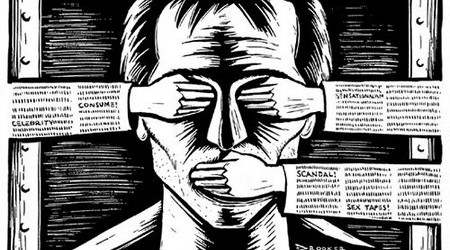
Vulnerable Medium: The young editors of the Otago Labour Regional Council's newspaper, Caucus, could only reach their readership through the expensive processes of the printing press. This gave their publisher, by virtue of its control of the purse-strings, the ability to shut the paper down if it strayed too far in the direction of controversy. That was in the early 1980s. Today's political bloggers cannot be silenced so easily - or so they thought.
 
THE FIRST ISSUE of Caucus appeared in September 1982 and the last in April 1983. The third (and final) issue featured a highly critical opinion-piece entitled: “Yes – I’m the Great Pretender: A Socialist Critique of David Lange.” Since Lange had only been Labour’s Leader since February 1983, the editors’ decision to publish the critique in a Labour Party newspaper was either exceptionally brave or extremely foolish.
 
The newspaper’s publisher, the Otago Regional Council of the Labour Party, did not have to wait long for Lange’s reaction. At its next meeting the Labour Leader turned up unannounced, asked the man on the door to point out the author of the offending article, took a seat beside him, removed a copy of Caucus No. 3 from his briefcase and tore it into little pieces.
 
The Port Chalmers Branch of the Labour Party went one better than their leader. After passing a motion of censure in the newspaper’s editors, all 200 of their branch’s copies of Caucus were burned.
 
A few days later, Caucus’s two young editors were asked to drive Labour’s then Transport spokesperson, Richard Prebble, to Oamaru for a “Save Rail” rally. Mr Prebble took advantage of his captive audience to deliver a stern homily on party discipline.
 
“Your first mistake”, he told the hapless twenty-somethings, “was to assume that the Labour Party is a democracy.”
 
Thirty years later, supporters of internal Labour Party democracy are facing many important differences from the early 1980s, but also some startling continuities.
 
The most obvious difference between 1982 and 2012 is the size of the party. Labour’s current membership is reportedly at an historic low, but thirty years ago it was at an all-time high. Putting to one side the trade unions’ affiliated membership, Labour’s branch membership in the early 1980s numbered more than 80,000. The very fact that a regional council possessed sufficient funds to publish its own newspaper points not only to the sheer scale, but also the organisational vitality, of what was indisputably a mass political movement.
 
It was also a time before the invention of the World Wide Web. To reach a mass audience in the early 1980s required the assistance of a printing-press – and that cost money. Having strayed beyond the paths of acceptable opinion, Caucus very quickly discovered that he who pays the piper calls the tune. Not that the Otago Regional Council would ever censor its own newspaper – perish the thought! It was simply a matter of budget priorities, which were deemed, in the weeks following the notorious Caucus No. 3, to NOT include a regional party newspaper.
 
The Offending Article: Said Richard Prebble to the editors of Caucus: "Your first mistake was to assume that the Labour Party is a democracy."
 
In 2012 no party subsidy is required for Labour members and supporters to speak to one another. The World Wide Web and the “blogs” it has spawned have relocated the no-holds-barred political debate which the young editors of Caucus had so courageously attempted to encourage in 1982-83 to “cyberspace” – a realm well beyond the financial veto of the Labour Party’s regional and national hierarchies.
 
Foremost among New Zealand’s Labour-focused blogs is The Standard (its name inspired by Labour’s nationwide newspaper of the 1940s and 50s) with a readership in the hundreds-of-thousands. Like Caucus, The Standard has earned the wrath of the party hierarchy (and especially Labour’s parliamentary caucus) for its outspoken criticism of Labour’s leader – criticism that’s only grown louder following the demotion of Mr Shearer’s purported challenger, David Cunliffe.
 
It is at this point that we encounter some powerful continuities with the Labour Party of thirty years ago. For it would seem that those participating in The Standard have made the same “mistake” as the editors of Caucus: that of assuming the Labour Party to be a democracy.
 
Stung by The Standard’s continued criticism of Mr Shearer, a “senior Labour MP” is reportedly seeking to limit the ability of Labour members to post articles and/or offer commentary on any blog operating outside the effective editorial control of the party organisation. Even more damning, from the perspective of a generation raised on the ethical protocols of the Web, information supplied in confidence to the Labour Caucus controlled blogsite, Red Alert, is allegedly being used to identify Labour members participating either anonymously or pseudonymously on The Standard and other blogs critical of Labour’s performance.
 
It is too soon to predict the outcome of this latest attempt to curb democratic debate within the Labour Party. It is, however, possible to draw some lessons from the fate of Caucus.
 
Prophetically, the author of “Yes – I’m the Great Pretender” wrote: “It is ironic that Lange leading the fourth Labour government will probably succeed in the reconstruction of capitalist relations where National has failed.” How very different Labour – and New Zealand – might have been had such prophetic insights been debated instead of suppressed.
 
Only a democratic Labour Party can re-construct a democratic New Zealand.
 
This essay was originally published in The Press of Tuesday, 11 December 2012.

Thursday, 29 November 2012

Islands In The Mainstream

Keeping The Story Straight: But if a conflict arose between the mainstream media's version of events and the version presented by the citizen journalists of the blogosphere - what then? Even more alarming - what if the bloggers' version proved to be the more believable?

SOMEWHERE THERE’S GOT TO BE a focus-group report. Nothing else adequately explains the current behaviour of the “mainstream media” (MSM). Somewhere, somehow, someone has been incautious enough to ask a representative sample of MSM readers, listeners and viewers how often they visit, and what sort of credence they give to, the blogs. Their answers appear to have shocked some journalists into full-scale retaliation.
 
My guess is that the consumers of news and opinion are not abandoning the MSM altogether – not yet. Most probably it’s still just a case of people turning to the blogosphere for a second opinion. The big problems will only arise when the stories people read on the blogs begin to sharply contradict stories being printed in the newspapers and broadcast over radio and television. That’s when the MSM should really begin to worry.
 
But if the note of alarm that has crept into the MSM’s coverage of blogs – especially political blogs – over the past few weeks is anything to go by, some of that worrying has already begun. The final edition of The Nation, broadcast on TV3 last weekend, warned ominously of the potentially destabilising political influence of the left-leaning blog The Standard. Senior Parliamentary Press Gallery journalists have launched repeated attacks against “anonymous bloggers” with many eagerly accusing their blogs of playing a sinister role in David Cunliffe’s alleged “attempted leadership coup” at the Labour Party’s Annual Conference.
 
The tone of these attacks leaves little doubt that not only do these political journalists consider bloggers to be unwelcome and illegitimate contributors to the nation’s political discourse, but that nothing would make them happier than to see them tightly regulated and controlled. It’s an attitude that should send a shiver down every New Zealander’s spine. A genuine “Fourth Estate” would welcome the democratisation of the gathering and distribution of news which the Internet has made possible. That so many MSM journalists have greeted the competitive spur of the blogosphere with a mixture of self-serving patch-protection and outright authoritarianism is cause for considerable concern.
 
It also casts much of their recent reporting of political news in a new and worrying light. If the truth is indeed out there, then presumably it’s as readily accessible to bloggers as it is to members of the Parliamentary Press Gallery? If both are present at the same event, then their reports should be (making obvious allowance for nuance and emphasis) at least broadly similar? But what if they are not similar? What if the MSM’s coverage of Event X is radically at odds with both the experience of participants and the reportage of bloggers? Wouldn’t that raise some extremely disturbing questions about the credibility and trustworthiness of MSM journalism?
 
The recent Labour Party conference demonstrated in the most dramatic fashion the MSM’s capacity to misrepresent and mislead the NZ public. The political journalists covering the conference were either collaborators with, or the dupes of, a faction of the Labour Party Caucus which, fearing the consequences of radical changes to the party’s constitution, manufactured a leadership challenge to Opposition Leader, David Shearer, by his front-bench colleague, David Cunliffe.
 
That the rule changes endorsed by the rank-and-file offered Mr Cunliffe a route to the leadership of the party which allowed him to by-pass his Caucus enemies was obvious to anyone familiar with the agreed reforms. Quite legitimately (if somewhat maladroitly) the MP for New Lynn declined to rule-out taking advantage of these new constitutional opportunities at some point in the future. To translate this sequence of events into a full-scale leadership challenge, as TV3’s Patrick Gower did, lacked even the slightest evidential foundation. It did not prevent him, however, from telling Mr Shearer that Mr Cunliffe was “coming for you” and demanding to know what he was going to do about it.
 
The peculiar political-economy of news reporting from the Parliamentary Press Gallery ensured that Mr Gower’s conspiracy theory became the core of the MSM’s reporting. Effective Gallery reporting is based on easy access to the principal political newsmakers of both the Government and the Opposition. Once it becomes clear that those principals have agreed upon an interpretation of events it is extremely hazardous for any political journalist to offer an alternative view. It would risk not only an immediate denial of access to the principal players, but also the wrath of one’s editor. Any narrative at odds with the main media outlets’ agreed version of events has the potential to make the perpetrator appear both eccentric and/or ill-informed. These are not epithets with which most MSM editors feel comfortable. Multiple interpretations of the same event might also encourage the public to question the competence of the MSM’s journalistic staff. Much safer all round if the coverage remains consistent across all media.
 
But consistent is not the same as accurate. What happened at the Labour Party Conference, far from being an attempted leadership coup, bore all the signs of a pre-emptive strike against the man most likely to front a successful leadership challenge under the new rules. Political journalists who rejected the principal players version of events, could have spoken to conference delegates who witnessed incidents strongly suggestive of the attacks on Mr Cunliffe being carefully orchestrated well in advance of the actions which ostensibly provoked them. Persistent questioning would also have uncovered evidence that it was supporters of Grant Robertson, not Mr Cunliffe, who had been gauging the level of support for a leadership spill in the weeks leading up to the Conference. No hint of these alternative narratives appeared anywhere in the MSM.
 
They have, however, been appearing in both the postings and commentary threads of the political blogs. Is this the real explanation for the sudden spate of attacks on the anonymity of these citizen-journalists? Has a focus group warned the MSM that the stories it declines to tell – and which are now turning up in blogs – are being believed? Are more and more of the MSM’s readers, listeners and viewers coming to the conclusion that the Fourth Estate, far from speaking truth to power, has become its willing stenographer?
 
If this is true, then the decision by so many active participants in the blogosphere to remain anonymous or write under a pseudonym becomes entirely reasonable. Any system powerful and mendacious enough to suborn the one institution specifically charged with exposing its malfeasance is probably not the sort of system to be openly challenged or taunted by vulnerable individuals using their real names.
 
The day focus groups and their deliberations cease to be confidential is the day bloggers will gladly abandon their pseudonyms and the current “pandemic of anonymity” will be ended.
 
This posting is exclusive to the Bowalley Road blogsite.