

Here Comes The Sun: Andrew Little's political career has prospered in no small way by the care he has taken to mask both his ambition and his talent until the most propitious moment. Like Shakespeare's Prince Hal he has imitated the sun; hiding his brilliance behind "base contagious clouds" until the moment "when he please again to be himself" so that "being wanted, he may be more wondered at".
HAS THERE EVER BEEN a leader who commanded absolute loyalty?
A king, a party boss, a prime minister so blessed with the attributes of
leadership that not even one of his barons, ward-heelers or cabinet ministers
ever felt moved to ask the question: “Why not me?”
Even in the court of King Arthur, Mordred plotted murder and
ruin. The “one brief shining moment” that was the Kennedy White House shivered
in the shadow of Lyndon Johnson’s unappeasable ambition. On the plane-ride back
from Norman Kirk’s Waimate funeral his colleagues lobbied furiously for the numbers
to succeed him.
The acid of political power dissolves all friendships, all
pacts, all solemn pledges of loyalty. All leaders knows this and conduct themselves
accordingly. On the battlefield, they bring victory. At the ballot box, more
votes than their opponents. On the Government Benches, favourable polls and
reliable majorities.
The moment a leader fails to furnish the victories, votes
and validation promised to his followers, challenges – and challengers – are
inevitable.
Power belongs to those with courage to take it – and the
skill to wield it.
Which is why the initial conclusions of Labour’s election review
panel made me chuckle. One of the reasons the party performed so poorly, reported
the four wise heads appointed to identify where Labour went wrong in 2014, is
that its parliamentary caucus failed to unite around the leadership of David
Cunliffe.
Well, duh!
David Cunliffe knew that he faced a caucus full of enemies
when he put his name forward for the Labour leadership. What he did not appear
to understand was how urgently he needed to neutralise that enmity.
In this respect, the behaviour of Mr Cunliffe’s successor is
instructive.
To begin at the beginning: Andrew Little’s whole
parliamentary career appears to have been inspired by Prince Hal’s soliloquy
from Shakespeare’s Henry IV, Part One:
Yet herein will I
imitate the sun,
Who doth permit the base contagious clouds
To smother up his beauty from the world,
That, when he please again to be himself,
Being wanted, he may be more wonder’d at,
By breaking through the foul and ugly mists
Of vapours that did seem to strangle him.
Who doth permit the base contagious clouds
To smother up his beauty from the world,
That, when he please again to be himself,
Being wanted, he may be more wonder’d at,
By breaking through the foul and ugly mists
Of vapours that did seem to strangle him.
There are times when one’s leadership ambitions are better
served by keeping them hidden than by openly parading them before one’s
colleagues and the world. Like Prince Hal, Mr Little was at pains to smother up
his leadership qualities until such time as his party had most need of them.
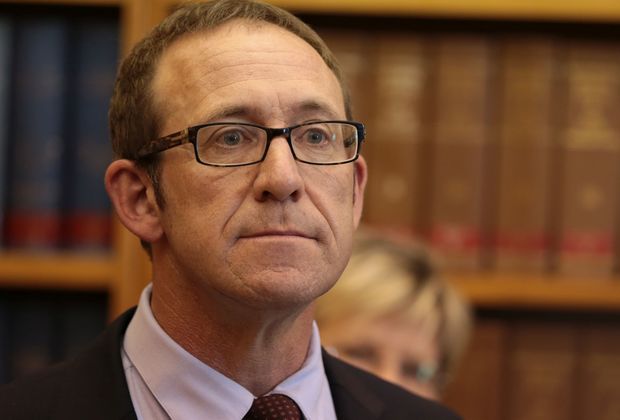
Prince Hal In Glasses? Labour's Andrew Little.
And what a masterful job he made of it! As far as most of
the political class was concerned there was very little to be hoped for from Mr
Little’s wafer-thin victory over Grant Robertson. Commentators almost gloated
that Labour’s new leader was everybody’s second choice; had never won a seat; carried
neither his caucus nor the party membership; and almost didn’t make it into
Parliament at all! Needless to say, the wider electorate’s expectations were similarly
modest.
But Mr Little, like Prince Hal, understood that:
By how much better
than my word I am,
By so much shall I falsify men’s hopes.
By so much shall I falsify men’s hopes.
Far from being “a modest little man, with much to be modest
about” – as Winston Churchill famously described his nemesis, Clement Atlee –
Mr Little burst out of Labour’s corner with his dander well-and-truly up,
landing punches on a Prime Minister whose reaction to this new leader’s wholly
unexpected onslaught was almost as disbelieving as the Press Gallery’s.
For the first time in a long time the whole of the Labour
Party experienced that surge of energy and hope that comes from seeing one’s
champion lay low the enemy’s best fighter. MPs, party grandees, union bosses
and ordinary members alike heard Mr Little tell the Prime Minister to “cut the
crap” and knew that Labour had, at long last, a leader worthy of the name.
Mr Cunliffe failed dismally to unite his caucus for the very
simple reason that nothing he did gave his enemies cause to cease questioning
his right to lead them. Like a medieval king defeated on the field of battle, Mr
Cunliffe was forced to endure, through the whole duration of his long retreat,
the contemptuous scorn and open hostility of his embarrassed barons.
Mr Little, by contrast, having demonstrated the requisite
courage and skill, can now present that surest proof of leadership.
Followers.
This essay was
originally published in The Waikato Times, The Taranaki Daily News, The
Timaru Herald, The Otago Daily Times and The Greymouth Star of Friday, 12 December 2014.

