
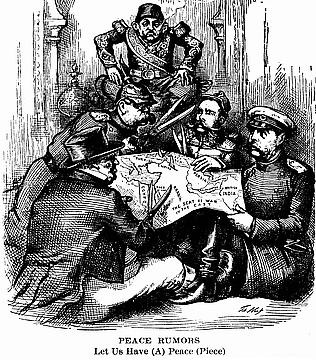
The Lion's Share: As the hapless Ottoman Sultan looks on, the major imperial powers openly bid for huge chunks of his empire. New Zealanders died in their thousands so that John Bull (him with the scissors) could keep the Royal Navy supplied from its Middle-Eastern oil-wells. The very same oil-wells that the German Kaiser (him with the shears) was so keen to get his hands on.
DIPLOMACY AND WAR have always been uneasy bedfellows. Uneasy
because, when diplomacy fails it is usually war that triumphs. Sometimes,
however, the baton is passed on quite deliberately. In those cases: when
diplomacy is allowed to fail; the uneasiness arises out of war’s wild
contingency. It is upon the bodies of warring states that the Law of Unintended
Consequences inflicts its most dreadful wounds.
On 25 April, Australians and New Zealanders will mark the
hundredth anniversary of a catastrophic military defeat. Close to 3,000 young
New Zealanders died in the Gallipoli campaign and many thousands more were
wounded. These shattering losses (New Zealand’s population in 1915 was barely 1
million) provided but a foretaste of the bitter repast that awaited New
Zealanders in Flanders and Picardy. From a very little country, diplomacy and
war were about to extract a very high price.
This would have been tragic enough if the diplomatic and
military decisions that sent so many young New Zealand men to their deaths had
been made by New Zealanders themselves. That they died as a result of the
deliberate failure of British diplomacy, in a war intended to enrich and
enlarge the British Empire, renders their sacrifices even more absurd and
obscene.
Such, however, are the hard, cold facts of the matter. The
Dominions of Australia and New Zealand entered the First World War at precisely
the same moment as Great Britain (11:00am 4 August 1914) because
constitutionally, diplomatically and militarily they were appendages of the
British Crown. Where Britain stood, we stood. Her enemies were our enemies.
Where she led – we followed.
That we ended up following Great Britain on to the territory
of the Ottoman Empire was only partially accidental. One of the most important
reasons British diplomacy did so little to prevent the outbreak of hostilities
in 1914 was the British Empire’s rising concern at the Germans’ lengthening
strategic reach. British policy makers were especially wary of Germany’s rapidly
expanding diplomatic, military and economic ties with the Ottoman Empire. The
British had observed the dramatic benefits of French investment in the Russian
Empire and were fearful that Germany’s administration of a similar tonic to the
tottering Ottomans could compromise Britain’s strategic future.
It was Winston Churchill who, as First Lord of the
Admiralty, made the decision (just one year out from the First World War) to power
the Royal Navy with oil rather than coal. With Churchill’s primary source of
oil being the Anglo-Persian Oil Company (whose wells were perilously close to
the Ottoman border) Germany’s “peaceful” expansion into the oil-fields of the
Middle-East loomed instantly as a major strategic threat.
The decision to invade the Ottoman Empire, which swept the
hapless ANZAC’s into the doomed assault on Gallipoli, was first and foremost
Churchill’s. Ostensibly an attempt to come at the Central Powers from a new direction,
its true purpose was to secure for the British Empire and its French allies the
strategic oil reserves located in Ottoman territory. Britain’s other ally,
Tsarist Russia, would receive Constantinople (modern-day Istanbul) and control
of the crucial straits linking the Black and Mediterranean Seas.

The Sykes-Picot Agreement: In complete secrecy, the British and French negotiators (Sir Mark Sykes and Francois George-Picot) carved up the Ottoman Empire to their respective governments' satisfaction. The peoples who actually lived there were never consulted. Had the Bolsheviks not published its contents (Britain and France had thoughtfully provided their Tsarist Russian ally with a copy) the Arabs would never have known what they were fighting for - and neither would we! Modern-day borders are overlaid.
The first of these strategic objectives were confirmed in
the notorious Sykes-Picot Agreement of 1916, in which the Ottoman provinces of
Syria, Palestine and Mesopotamia (modern-day Iraq) were divvied up between the
British and French Empires. The top-secret deal was to be delivered militarily
not only by British arms, but also by the Ottoman Empire’s Arab subjects
(inspired to revolt by T.E. Lawrence “of Arabia”) with additional assistance
from the New Zealand Mounted Rifles and the Australian Light Horse.

The New Zealand Mounted Rifles
The second objective – Russian control of Constantinople and
the Bosphorus – was thwarted only by the intervention of the Russian people,
who overthrew the Romanov dynasty in 1917.
Undaunted, the British simply revised their plans. Just how inimical
these would have proved to the people of modern-day Turkey was revealed in the
extraordinary Treaty of Sèvres. Had the latter been allowed to stand, virtually
the entire empire of the Ottomans would have been parcelled out between the
British, French, Italians and Greeks.
That this did not happen was due to the efforts of a man not
unknown to the ANZAC’s – one Mustapha Kemal. The man who had held the heights at
Gallipoli rallied the Turkish people behind him, drove out the Greek invaders,
forced the Allied occupiers of Istanbul to withdraw, and established the
Turkish Republic – where Saturday’s ANZAC centennial commemorations will unfold.
On TVNZ’s Q+A
programme (19/4/15) Chief of Defence Force, Lieutenant General Tim Keating,
declared that New Zealand entered World War I to fight “a great evil”.
Presumably, he was referring to Kaiser Wilhelm’s Germany. History refutes him. The
First World War was a war between rival empires. The “great evil” was Imperialism.
And New Zealand’s sons were fighting for it – not against it.
This essay was
originally published in The Press of
Tuesday, 21 April 2015.


