
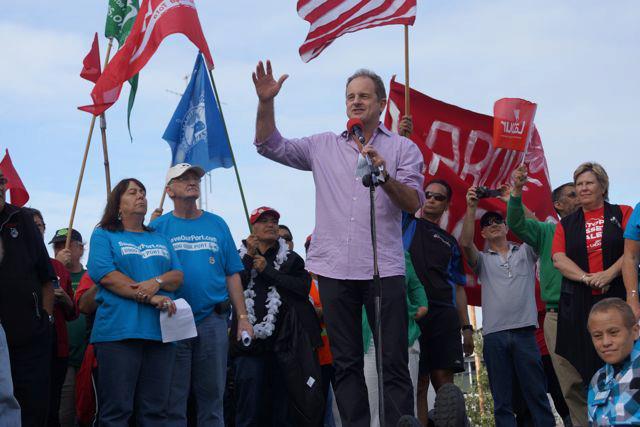
Mr Shearer Makes His Stand: Mauveine, the world's first aniline dye, allowed Nineteenth Century textile manufacturers to produce the same washed-out combination of red and blue on an industrial scale and without noticeable variation. A cynic might say it is the perfect colour choice for a modern Labour Party leader.
IN 1856 WILLIAM PERKIN invented mauve. He didn’t invent it on purpose, the world’s first aniline dye was the accidental by-product of a failed chemical experiment involving coal-tar. In fact, young Mr Perkin was on the point of throwing the gloopy substance away, when he became fascinated by its “strangely beautiful” colour.
He wasn’t the only one. Mr Perkin’s new colour – a soft, mellowed-out shade of purple, reminiscent of lavender and lilac – turned out to be a huge hit with the ladies. Queen Victoria chose a mauve outfit for her daughter’s wedding and the fashion-setting French Empress, Eugenie, reckoned the colour matched her eyes.
Soon mauve was everywhere. More importantly, mauve was everywhere the same. Unlike the highly variable and often unreliable “natural” dyes made out of plants, rocks, and even insects, aniline dyes offered the fashion industry consistency on an industrial scale. One person’s mauve was exactly the same as the next person’s.
Within thirty years, Mr Perkin’s patented “Mauveine” dye had become so pervasive that the 1890s became known as the “Mauve Decade”. Mr Perkin’s “applied science” had made him a very wealthy man.
The colour purple (of which mauve is but a pale cousin) is itself a combination of the two primary colours red and blue. So rare and expensive was purple-producing dye that from classical times its use was restricted to royalty and rulers. Being “reared in the purple” meant being born to rule.
In contemporary political terms, purple could be thought of as the ultimate ideological compromise: a regal blending of revolutionary red and conservative blue. In the United States such a politician would be the hybrid offspring of Republican Party red and Democratic Party blue – Bill Clinton, perhaps?
Clinton’s Democratic Leadership Council can certainly lay claim to making globally respectable the long tradition of centre-left and social-democratic parties seeking to smooth-off the jagged edges of socialist politics.
Working from the assumption that it is a lot easier to change a political party’s policies than the public’s prejudices, Clinton re-branded Franklin Roosevelt’s New Deal Democrats into a “Republican-Lite” party, pandering to the fads and foibles of suburban “Soccer Moms” and their white-collar professional spouses. Out went social-justice and in came “the era of Big Government is over”.

"Hey, Tony, have you ever thought about mixing Labour Red and Tory Blue and then adding a whole lot of water? Worked for me." "Crikey, Bill, what an excellent idea!"
The British Labour Party leader, Tony Blair, was absolutely besotted with Clinton’s makeover of the Democratic Party and immediately began blending Labour Red and Tory Blue into what became “New Labour”. The reviews of Blair’s purpling exercise were equally mixed. While the Blues hailed him as a statesman, the Reds denounced him as “the bastard son of Maggie Thatcher”.
Long before either Clinton or Blair mounted the podium, the New Zealand Labour Party had recognised the potential electoral advantages of mixing National blue and Labour red. As far back as the early 1960s, when Arnold Nordmeyer was Labour’s leader, there had been calls for the party’s “modernisation”.
The extraordinary success of the First Labour Government’s economic and social reforms had given birth to what the British political scientist, Austin Mitchell, called “the half-gallon, quarter-acre, pavlova paradise”. Kiwis kidded themselves that this was about as good as it got. Post-war electoral contests boiled-down to a handful of “marginal” electorates – most of which encompassed vast tracts of “ticky-tacky” suburban housing chock-full of young families. These middle-class mums and dads held great expectations: both for themselves and their children.
The very proletarian intrusion of Norman Kirk in 1965 was all that prevented Nordmeyer’s modernisation programme from purpling Labour in the late-1960s and 70s. “Big Norm’s” great skill as a left-wing politician lay in convincing New Zealanders they were all entitled to great expectations, and that Labour was capable of fulfilling them. Kirk’s was a manifesto grounded in the abundance of the post-war boom, and when, in 1973, the First Oil Crisis brought that boom to an end, he and his government were doomed.
It was David Lange who finally blended Kiwi reds and blues into the ominous shades of the Rogernomics era. In terms of applied political science, his efforts far outshone those of William Perkin. Looking at New Zealand’s anti-nuclear policy, the world saw only red. While the spectacle of a Labour Government privatising state assets was rendered entirely in the deepest shades of blue. Bill Clinton and Tony Blair were never so bold.
Nor were Helen Clark and Michael Cullen. Under these two political colourists New Zealand saw a whole lot of water added to Labour’s ideological palette. Kirk’s vivid reds were puddled into pale pinks, and the Roger Douglas blues reduced to something much weaker. Under Ms Clark and Dr Cullen New Zealand experienced its own “Lavender Decade”.
On Saturday, speaking to the big union rally for Auckland’s beleaguered watersiders, Labour’s new leader, David Shearer, spoke reassuringly about “flexibility and fairness”.
He was wearing a mauve shirt.
This essay was originally published in The Press of Tuesday, 13 March 2012.


