Friday, 27 July 2012

Thinking Our Way Out

It's Okay To Be Smart: Professor Peter Gluckman has urged New Zealanders to embrace intellectualism, science and the life of the mind. But in a country where intelligence and creativity are viewed with suspicion, what are his chances?

THE PRIME MINISTER’S scientific advisor, Professor Peter Gluckman, recently asked New Zealanders to show more respect for intellectualism. He was right to do so, although I hold little hope that New Zealanders will heed him. Kiwis don’t put a lot of stock in intellectualism and even less in intellectuals. Supposedly, our nation was built by “practical men” in circumstances that left little time for extravagant flights of fancy. Besides, to most New Zealanders intellectualism smacks of elitism: of people who misconstrue their intelligence and specialised knowledge as a badge of superiority. It offends our egalitarian principles.

Though this faux egalitarianism obliges our sporting heroes to demonstrate huge difficulty in stringing together a coherent sentence, we don’t object. An articulate Rugby player would only arouse suspicion. Was he making fun of us? His team-mates? Or – God forbid! – the holy game of Rugby itself? It’s why our sportsmen and women would never dream of waxing lyrical about their codes. Kiwis don’t appreciate “show-offs”. The media would be unsparing. Careers would suffer.

The Prime Minister, John Key, understands this imperative to do “normal Kiwi” very well. It’s why he has never attempted to modify his excruciating pronunciation of “Nu Zild” English. Remaining so dismally unquotable undoubtedly requires considerable self-discipline in a man as ebullient and intelligent as John Key. But, he’s up for it. To be the sort of bloke most New Zealanders can see themselves having a drink with, not only must the Prime Minister have nothing to say, but he must not say it often, with complete conviction, and in an accent broad enough to send elocutionists running screaming from the room.

In a peculiar way, this practice of political leaders deliberately dumbing themselves down is a tribute to the democratic temper of the New Zealand electorate – and must not be neglected. David Cunliffe’s great mistake, as an aspiring leader of the Labour Party was to be, in the words of Matt McCarten, “the better performer”. Intelligent, accomplished, articulate, even a little poetic, the man simply didn’t stand a chance against the patriotically inarticulate David Shearer.

But our democratic temper – or perhaps that should be “distemper” – comes at a cost. Professor Gluckman made his appeal for more intellectualism at a function honouring the late scientist, author and entrepreneur, Sir Paul Callaghan. In a country that valued men of ideas more (and ignoramuses less) Sir Paul would have been better known and more highly regarded. He wanted a New Zealand that put smarts ahead of sports, and was the untiring advocate of a nimble, export-oriented economy based on scientific entrepreneurism and innovative manufacturing – not on ever increasing volumes of milk and muck.

But, such an economy will only come into being in a New Zealand that has freed itself from the tutelage of “practical men”. A New Zealand whose airwaves are mercifully free of Maori haters, beneficiary bashers and climate change deniers. A New Zealand from which the malign spell of neoliberal economics has been lifted, and whose boardrooms have been populated with business leaders prepared to believe in the extraordinary abilities of ordinary Kiwis. A New Zealand that has, once again, become the place where exciting new ideas go to be born – instead of remaining the place where exhausted old ideas go to die.

Because the real story of New Zealand is not the story of sporting heroes and “practical men”, but of clever, creative, caring and innovative risk-takers. Men and women like William Pember-Reeves and Kate Shepherd, Bill Sutch and Clarence Beeby, Sonja Davies and Sir Owen Woodhouse. Sorely missed citizens like Sir Paul Callaghan and Margaret Mahy.

The social anthropologist, Peter J. Wilson, was another distinguished New Zealander. His celebrated book, Crab Antics, takes its name from the behaviour of crabs in a crab-pot. Should a more intelligent and enterprising crustacean discover a way out of their prison, his companions, rather than follow him to life and freedom, will reach up with their claws and haul him back. Wilson’s study of impoverished rural communities in the Caribbean revealed a culture in which human-beings behaved towards one another much like those incarcerated crabs.

The egalitarianism of Crab Antics is impressive, but it is also fatal. To have an equal chance of escaping their present confinement, New Zealanders must learn to stop hauling down those who have thought our way out.

This essay was originally published in The Waikato Times, The Taranaki Daily News, The Timaru Herald, The Otago Daily Times and The Greymouth Star of Friday, July 27, 2012.

Thursday, 26 July 2012

Doing The Right Thing For The Wrong Reasons. Labours "Unprincipled" Opposition To Asset Sales.

Are You Serious, David? Labour's reasons for opposing the partial sale of state energy generators have been as inadequate as they have been changeable. It's position would be improved dramatically if the party's leaders allowed themselves to be guided by the "democratic socialist" principles set forth in Labour's constitution.

“THE NATURAL RESOURCES of New Zealand belong to all the people and these resources, and in particular non-renewable resources, should be managed for the benefit of all, including future generations.” In any debate over the merits of public versus private ownership in New Zealand one might assume that these words, taken from the second, “Principles”, section of the Labour Party Constitution, would constitute the bedrock of the Labour Caucus’s argument.

For, surely, if any resources belonging to the people are alienated from the people, then they should be restored to the people. Indeed, such restoration should be mandatory given Labour’s “principle” that: “All people, either individually or in groups, may own wealth or property for their own use, but in any conflict of interest people are always more important than property and the state must ensure a just distribution of wealth.”

If ever there was a “conflict of interest” between the right of the people to benefit from the resources they own, and the right of wealthy individuals to convert public resources to private profit, it lies in the struggle over the partial sale of state-owned energy generators. On the basis of its founding principles, Labour’s position on these asset sales should be very simple and very clear. First: The assets belong to every New Zealander and should not, under any circumstances, be sold. Second: If the assets are sold they will be repurchased by the state at the earliest practical opportunity.

On this issue, Labour’s principles do not permit very much in the way of wiggle-room. If it is the obligation of the state to ensure a just distribution of wealth, then it is vital that the citizens’ access to something as important as energy not be restricted or rationed according to their ability to pay. The right of commoners to gather firewood on the lord’s estate was recognised as far back as the middle ages. To deny people the means of lighting and heating their homes, and cooking their food, was simply unthinkable. In the social-democratic New Zealand of 1935-1975, the successors of those medieval barons were required to pay their workers “a living wage” which incorporated the cost of energy. Massive state investment in hydro-electric power schemes from the 1940s to the 1980s made this possible by ensuring all New Zealanders had access to cheap and abundant electrical power. A Labour Party committed to its constitutional principles would make energy security a cornerstone of its appeal to Twenty-First Century voters.

Why then did the Phil Goff-led Labour Caucus shy away from basing its opposition to asset sales on the Labour Party’s constitutional principles mandating the public ownership of natural resources and a just distribution of wealth? And why hasn’t its successor, the David Shearer-led Labour Caucus, made a point of re-stating the party’s “democratic socialist” commitments? Could it be that Mr Shearer and his colleagues no longer subscribe to those beliefs?

From the very beginning of this latest privatisation drive Labour’s parliamentary leadership has offered a bewildering combination of explanations as to why the state-owned electricity generators should not be sold. Initially we were told that the energy assets were too profitable to justify privatisation. That the dividends they paid to the Treasury were so substantial that it made more commercial sense to simply borrow the sum any asset sales were likely to realise from international lenders. Then we were told that the sale of the state’s energy generators would see the shares in these strategic infrastructural assets being flicked on from domestic to foreign investors. Now we are told that the National-led Government’s efforts to ensure that most of the shares remain in Kiwi hands can only be achieved by ordinary taxpayers subsidising the Government’s “Loyalty Scheme”. Most importantly, however, from the point of view of first principles, New Zealanders have been told repeatedly that the Labour Party can give no guarantee that a future Labour Government will buy back the private sector’s shareholding in the state’s energy generators.

This refusal to commit to renationalisation is explained, in part, by Labour’s 2010 decision to exclude energy generation from the “closed list” of strategic infrastructural assets that the party’s economic policy-makers had recommended be run “in the New Zealand interest” and which foreign investors should be debarred from purchasing either in whole or in part (see here and here).

A more honest explanation for Labour’s refusal to endorse renationalisation, however, is simple embarrassment. Most Labour MPs would feel “naïve and stupid” advocating such a policy. Business leaders, civil servants and academics would ridicule their “1930s thinking” and they would be branded dinosaurs by their right-wing opponents in Parliament and the media. Labour’s Constitution may still declare that New Zealand’s natural resources “belong to all the people” and avow the state’s duty to “ensure a just distribution of wealth”, but the sort of people who make up Labour's current caucus are no longer prepared to pay even lip service to such “principles”.

That is why the Labour Caucus’s opposition to asset sales rings so hollow, and why the justifications for its position on this issue have been so inadequate and so changeable. Ideologically-speaking, the views of the party’s current MPs are little changed from those of the men and women who introduced and supported Rogernomics (and initiated the policy of full-scale privatisation in New Zealand). They no longer believe that the opportunities for private individuals to profit from the existential needs of their fellow human-beings should be progressively diminished and, ultimately, extinguished. The duty of twenty-first century policy-makers, as they see it, is to inform and expand the choices of free individuals operating in free markets. The only real difference between Labour’s spokesperson, David Parker, and National’s Finance Minister, Bill English, is that the former sees the state playing a much greater role in informing and expanding those choices than the latter.

Labour Party members should be on their guard. The weird peregrinations of their parliamentarians when it comes to explaining their opposition to asset sales is proof that their hearts are not truly in the fight. Eventually (and it may be sooner rather than later) the Caucus and its advisers will realise that the policy preferences of “modern social democracy” are incompatible with Section Two of Labour’s existing Constitution. Like Tony Blair, they will insist that the old commitments to wealth redistribution, public ownership and the “principles of democratic socialism” generally, be jettisoned in favour of a “new” Labour Party.

One that even Tories can vote for with a clear conscience.

This posting is exclusive to the Bowalley Road blogsite.

Tuesday, 24 July 2012

Here's To You Mrs Robinson

Under Scrutiny: Imagine if the same expectations of "responsibility" underpinning Paula Bennet's new "social obligations" policy were applied to members of the upper-middle-class as well as Domestic Purposes Beneficiaries.

THE OFFICERS of the Social Obligations and Responsibilities Unit knocked on Charlotte’s front door as she was preparing breakfast. She always tried to send her children off to school with something hot and nutritious – not always successfully. Justin and Katherine were both teenagers and did not appear to believe in eating anything at all. Most mornings they simply opened the refrigerator, grabbed the orange juice, took a swig, and then, offering their mother a desultory wave, disappeared for the rest of the day. Charlotte would be left with more French toast, pancakes and scrambled eggs than she could possibly eat. Usually she ended up scraping most of it into the re-cycling bin.

In fact, she was just on the point of throwing out her offspring’s untouched breakfasts when the SORU came a-knocking.

“Mrs Robinson?” The young woman who spoke was thin and angular with a set of teeth that appeared to have been borrowed from a horse. Her colleague, as round as she was straight, wore rimless glasses and resembled an extremely well-fed and intelligent domestic cat.

“That’s me!” Charlotte replied brightly. “Can I help you?”

“By authority of the Social Obligations and Responsibilities Act (2015)”, droned the young woman, reading from a small card, “I am empowered to conduct a mandatory interview and inspection of the domicile of you, Mrs Charlotte Elizabeth Robinson. Failure to fully co-operate with officers performing their duties under the Act is a criminal offense punishable by a $25,000 fine or six months imprisonment, or both. Do you understand?”

The young woman pushed past Charlotte and began inspecting the large, well-appointed property room by room, making notes on a digital clipboard.

“What’s this all about?” Charlotte asked the young woman’s rotund sidekick.

“Complaints have been laid about your excessive energy consumption, your failure to conserve and recycle, your unsound childrearing practices, alcohol consumption and sexual promiscuity – we’re here to help.”

“Now just a minute!” Charlotte snapped. “I don’t know who you’ve been talking to, but these accusations are outrageous. Who the hell told you all this?”

“I’m afraid I cannot tell you that”, the young man said primly, “the identity of complainants is privileged.”

The young woman strode into the kitchen and spotted the duo of as yet unscraped breakfast plates.

“Are we to understand that you were about to throw this food away, Mrs Robinson?”

“I was, yes.” Charlotte murmured, carefully examining the toes of her slippers.

“And are we to further understand that you have allowed your children to depart for their classes without an adequate breakfast?”

Charlotte nodded as the young woman tapped away furiously on her digital clipboard.

The young woman flicked the screen with her fingers and reviewed her notes.

“In this private dwelling I have detected five flat-screen televisions and four personal computers – a number well above the recommended maximum quantity of domestic electronic devices. In your bedside table, Mrs Robinson, there are a large number of prescription drugs – prima facie evidence of an unhealthy dependence on mood-altering medication. In your recycling bin there are a ridiculously large number of wine and gin bottles – prima facie evidence of a serious alcohol addiction. And, as my colleague noted upon entering the property, there is a large sports utility vehicle parked, in blatant contravention of the new regulations on automotive maximums, in your excessively large garage.”

“We’re selling the SUV”, Charlotte protested.

The young woman shot her a disbelieving glance.

“Our complainants also report that your children have been seen imbibing alcopops illegally in the local park, and that your daughter, though under the age of consent, has been engaging in lascivious behaviour with the 18 year old son of one of your neighbours.”

“For God’s sake!” wailed Charlotte, “They’re teenagers!”

“Under the Social Obligations and Responsibilities Act (2015) Mrs Robinson, you have a duty to raise your children according to the generally accepted social norms. Simply because you are a member of the upper-middle-class you are not exempted from those responsibilities and obligations.”

“In fact,” purred the corpulent young man, “it could be argued that the enjoyment of such obvious privileges carries with it an even greater obligation to behave responsibly. People like yourself should take care to offer the less fortunate members of society – beneficiaries for example – a positive role model.”

“Which brings us to the affair you’re currently conducting with Mr Benjamin Braddock.” The young woman touched her keypad and an extremely embarrassing image flashed up on the screen. “Does this sort of behaviour reflect a proper understanding of a wife and mother’s social obligations and responsibilities, Mrs Robinson?”

Charlotte blushed bright red.

“I will be recommending to my superiors that your husband’s taxes be doubled, Mrs Robinson. You’ll be attending drug rehabilitation and parenting classes. Your children will receive counselling. The SUV will, of course, be confiscated.”

This short-story was originally published in The Press of Tuesday, 24 July 2012.

Friday, 20 July 2012

New Rules - Old Transgressions: Some Thoughts On Labour's Proposed Constitutional Changes

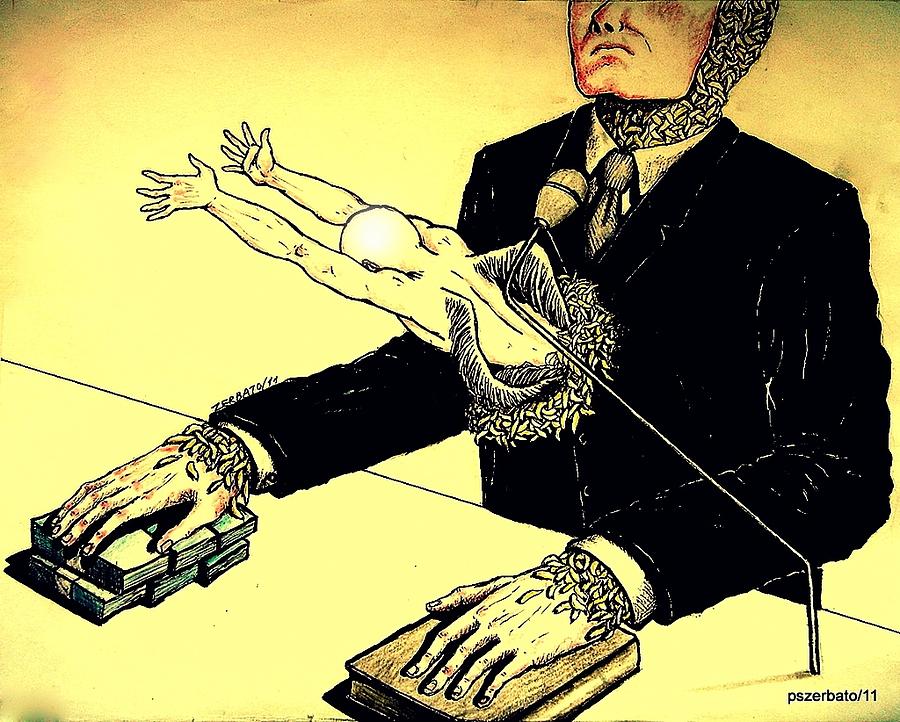
Let The Party Speak: Only by striking down the blatantly self-protective rules with which the parliamentary wing of the Labour Party has surrounded itself, can the rank-and-file and affiliate members recover their autonomy and rebuild their organisation into a political force capable of rescuing the nation. (Painting by Paulo Zerbato)

LAST WEEKEND, Labour’s governing body, the New Zealand Council, endorsed a comprehensive overhaul of the party’s constitution. These new rules have the potential to revolutionise left-wing politics in New Zealand – but only if Labour’s rank-and-file membership and its trade union affiliates summon all their courage and imagination to the party’s annual conference in November. That is the moment to reclaim the Labour Party from an ideologically suspect, intellectually moribund and morbidly self-protective Labour Caucus. If the moment is allowed to pass, then the Review Committee will be remembered only for giving Labour MPs new rules for committing old trangressions.

The rule changes on affiliation to the party, for example, could see a host of advocacy groups bringing political commitment, membership and, most importantly, bold, evidence-based policies, to the process of constructing Labour’s new election “platform”. Imagine Mike Smith and his Fabians as fully-fledged affiliates, with votes to cast, debating economic policy. But, why stop at the Fabians? If left-wing activists with interests ranging from the arts and public broadcasting, to urban planning and industrial democracy, decide to get their act together they’ll incorporate a society or institute, affiliate it to Labour, and feed their ideas directly into the party's deliberations.

A party offering potential members vibrant regional forums where new and radical ideas are debated and refined for presentation to the electorate, and where opportunities for effective, street-level political activism abound, is likely to grow by leaps and bounds. The party’s national leadership would be able to identify in potential parliamentary candidates qualities more substantive than assiduous personal networking, ruthless back-room vote-trading or three years as a parliamentary researcher or communications manager. Men and women entering Cabinet with practical plans for social and economic reform would offer a welcome contrast to past Labour cabinet ministers who were content to let civil servants tell them what was and wasn’t possible.

What Ms Coatsworth and her team of reformers have done is devise a set of Twenty-First Century mechanisms for resurrecting the Labour Party of the 1970s and 80s.

Labour had expanded rapidly in the late-1970s as New Zealanders, horrified by the authoritarian instincts and philistine excesses of the Muldoon-led National Government, flocked to the Opposition’s banner. Though there was no formal opportunity for affiliation, members of the extra-parliamentary anti-apartheid, anti-nuclear and feminist movements joined up in their hundreds and swiftly applied their expertise to the task of turning activist aspiration into party policy. There was of course considerable overlap with the trade union affiliates, whose organisers provided important logistical and voting support at annual conferences. By 1984 this proudly independent and fiercely democratic Labour Party had more than 85,000 branch members and close to quarter-of-a-million affiliated trade union members. There was an active party presence from Kaitaia to Bluff.

A party this strong took a lot of breaking, but break it Rogernomics did. The Parliamentary Party has always presented the organisational wing of Labour with problems. Labour MPs are more than mere party “delegates” in the House of Representatives, they are also the nation’s legislators and, when Labour is in office, Cabinet Ministers with all the responsibilities of Government. But these perennial structural tensions look trivial when compared to the open enmity that divided the rank-and-file and affiliate membership from the Caucus, and ultimately split the party.

It was a scoundrel time, when loyalty and treachery traded uniforms on an almost daily basis. A time when a Cabinet Minister, Richard Prebble, could injunct the governing body of his own party to prevent his political enemies from taking over his electorate committee. A visit to the current Labour Party website, however, discloses only a single bland reference to this awful period (which saw Labour’s membership plummet from 85,000 to 15,000 in less than six years):

The Fourth Labour Government (1984-1990), led successively by David Lange, Geoffrey Palmer and Mike Moore took difficult and long overdue decisions necessary for the modernisation of the New Zealand Economy.

The constitutional changes proposed by Moira Coatsworth and her team will, hopefully, bring into being a Labour Party capable of seeing that sentence for what it truly is. Not simply a deliberate elision of all the brutalities and betrayals of Rogernomics, but a refusal by all subsequent Labour leaders and presidents to acknowledge (let alone mourn) the loss of the mass social-democratic political movement the Fourth Labour Government destroyed. A party unable, or unwilling, to tell the truth about the 1984-1990 period is a party in the deepest denial.

Helen Clark was the perfect person to lead such a party. She was so unquestioningly of the Labour Party that the membership felt unable to challenge her all-too-obvious unwillingness to repudiate the Roger Douglas legacy (many of whose champions remained in her caucus). Traumatised by the Rogernomics experience and the bitter split with Jim Anderton’s followers, the bewildered rump of members who remained were happy to see their policy-making role diminished and the power of the Caucus strengthened in return for the cessation of factional strife and a semblance of party unity.

Helen Clark as Miss Havisham: That which is prevented from growing, decays.

It was a bad bargain. Like Dickens’ Miss Havisham, Helen Clark refused to clear away the detritus of her party’s ill-fated nuptials with the New Right, allowing it, instead, to rot and fester throughout the party. Meanwhile the splendid social-democratic wedding-gown she had worn to her never-consummated “Third Way” marriage, faded slowly to rags on her back. In departing New Zealand for New York the best she could offer by way of a successor was one of Roger Douglas's earliest converts.

The painstaking reconstruction of a (nearly) independent Labour Party organisation has been the work of a small but determined group of activists. It was they who drove a reluctant Phil Goff steadily to the Left and compiled the most progressive Labour election manifesto in fifteen years. Their latest gift to the party is a draft set of constitutional reforms – the scope and potential of which are marred by just one, Caucus-driven, defect.

The democratisation of the procedure for electing the Party Leader has been effectively sabotaged by the suggestion that the deposition of a clearly unpopular and/or ineffective leader may be vetoed by just 34 percent of the membership of the Labour Caucus. A minority of MPs is, thereby, invested with the capacity to thwart the will of a clear majority of their colleagues – and the entire party organisation.

In the words of a Guest Commentator on the Labour-supportive blogsite The Standard:

At base the reforms presume there is a beautiful pyramid of power, with the Leader in Wellington at the top. The constitutional proposals entrench the Leader so that even if they only have the support of 33% of caucus, no challenge to the leadership is possible.

Only the most naïve Labour Party member could construe this provision as anything other than the Caucus Right’s SAAC (Shearer At All Costs) strategy elevated to the dignity of constitutional principle. All Labour MPs know that if the Shearer/Cunliffe choice was put to the party under the new rules, the proposed Electoral College (40 percent Caucus, 40 percent Members, 20 percent Affiliates) would deliver the leadership to David Cunliffe.

Rather than see that happen the unholy alliance of the talentless, the jealous and the ambitious that makes up the ABC (Anybody But Cunliffe) clique are only too willing to repeat the “crab antics” described in the New Zealand anthropologist, Professor Peter Wilson’s, famous study of the same name. According to reviewer David Vital, Professor Wilson’s book “tells us much about the harsh traditional method by which small peasant societies of the Caribbean maintain a primitive form of equality within themselves. In effect this is achieved by holding others back by attacking their reputation and claiming a false respectability to which all must conform. As a result few people dare to break out or think outside the box and so the status quo remains in force and everyone remains the same. It is a kind of forced equality where people do not want anyone to succeed, ‘all ah we is one’, but the society gets nowhere.”

If Labour is to get somewhere its members must use the upcoming November conference to strike down the blatantly self-protective measures with which the parliamentary wing of the party is attempting to surround itself, and afford its leader no more in the way of armour than his predecessors were content to wear. Both the Caucus and the Party must be empowered to test the legitimacy of an incumbent by formally petitioning for a Vote of Confidence. And if 51 percent was good enough for Mickey Savage, Norman Kirk and Helen Clark, then it should be more than good enough for David Shearer.

This posting is exclusive to the Bowalley Road blogsite.

Heading Backwards?

Missionary Zeal: Labour's finance spokesperson, David Parker, seems to be on a mission to reassure the New Zealand business community that a Labour Government will not deviate in any alarming way from the prevailing economic orthodoxy.

“I’M BECOMING INCREASINGLY CONCERNED at the Labour Caucus (and Leader) moving Labour to the Right,” observed a former Labour MP recently in an e-mail to a Labour friend and trade union stalwart of many decades standing. “As a long-time Labour Party member/activist, I find it disturbing to think the Labour Caucus is heading backwards to the Rogernomics era that was so damaging to NZ communities. Comments made by various MPs at the latest Labour Caucus Dinner at Waitangi last week did not reassure me.”

Alas, I have yet to learn what those “various MPs’” were talking about. What I do know, however, is that those who share this former MP’s concern at their party’s political direction don’t need to eavesdrop on the dinner conversations of Labour’s caucus to discover where it’s going. Labour leader, David Shearer, and his finance spokesperson, David Parker, have been telling New Zealand loud and clear, and in public, for weeks.

Speaking to a group of corporate head-hunters on 11 July, Mr Parker spelled out the details of Labour’s policy on foreign investment. Concerned to prevent “infrastructure assets with monopoly characteristics” from being sold to offshore buyers, Labour, in the run-up to last year’s election, drew up a “closed list” – to keep a “bright line” between “what is to be sold and what is not.” Among the infrastructure that was not to be sold was any: electricity line, water storage or irrigation networks; no seaports or airports; and no public hospitals, schools, railway lines or roads.

Not included in Labour’s “closed list” were telecommunications networks and – amazingly – “electricity generators”.

According to Labour’s policy:  “While the electricity market is on the cusp of becoming uncompetitive and exhibits monopoly-like characteristics, generation assets are diverse in nature, location and ownership.”

What this means is that although Labour went into the last general election on a policy of “No Asset Sales”; and in spite of the fact that its campaign advertising showed a vast banner, displaying that very message, being draped over a hydro-electricity generating dam; the party was unwilling to include electricity generators on the list of state-owned infrastructure that “ought to be run in the New Zealand interest” – and never be sold to foreigners.

Am I alone in thinking that Labour’s foreign investment policy fatally compromises its current campaign against asset sales? If the generation of electricity is an activity which properly belongs to the market, and if New Zealand’s electricity generation assets are “diverse in nature, location and ownership” and, therefore, able to be purchased by foreign interests, then I’m at a loss to know why the Labour Party is opposed to their partial privatisation.

Perhaps opposing the sale of state assets is just (if I may quote the former Labour cabinet minister, Steve Maharey) “One of those things you say in Opposition, but forget about in Government”. Certainly, the decision to keep state-owned energy generators off Labour’s “closed list” would explain why Mr Shearer keeps telling New Zealanders that: “Once they’re gone, they’re gone for good.”

I like David Shearer, he’s a good, down-to-earth Kiwi bloke. But, I also fear him. Why? Because he’s been so easily persuaded that what’s wrong with New Zealand can only be fixed by inflicting radical and wrenching change on ordinary working people. (As if ordinary working people have spent the last twenty-five years living with anything else!) He scares me because he and the people he listens to lack the courage to devise a manifesto that imposes the radical and wrenching change where it belongs – on the rich and powerful. And, like the former Labour MP quoted at the top of this column, I’m concerned that those voters too young to remember the devastation wrought by the ideas of Roger Douglas are about to let Labour’s present leader give them another go.

Mr Shearer’s convinced we’ve a “good chance” of becoming “a twenty-first century peasant economy” if he doesn’t. I’m concerned that’s exactly what we’ll become if he does.

This essay was originally published in The Dominion Post, The Otago Daily Times, The Waikato Times, The Taranaki Daily News, The Timaru Herald and The Greymouth Star of Friday, 20 July 2012.

Tuesday, 17 July 2012

Power To The People?

People Power: Radical photographer, John Miller, took this photograph of people gathering for an anti-Vietnam War protest march down Queen Street on Bastille Day 1972. Forty years later another, much smaller, crowd gathered to protest against the partial sale of state assets. One of the saddest themes of the politics of the past four decades has been the steady demobilisation of the citizenry. In 2012, the demonstrators' cries of "Power to the People!" have taken on an increasingly hollow ring.

JOHN MILLER has been taking photographs of demonstrations for more than forty years. On Saturday, as the numbers slowly built for Auckland’s “Aotearoa is NOT for Sale” protest march up Queen Street, we ran into each other in Queen Elizabeth Square. With a wry grin, John handed me a photograph he’d taken of demonstrators at the same assembly point, on the same date, exactly forty years ago – 14 July 1972.

The cause that day was, as so many causes were in the 1960s and 70s, someone else’s. Though American troops were being pulled out of Vietnam as fast as President Nixon dared, the war in Indo-China rumbled on, with New Zealand, at least nominally, a part of it. The thousands of young faces in John’s photograph reflected their generation’s willingness to stand up and be counted as opponents of the morally insupportable contest between a nation of rice farmers and the most destructive military machine the world had ever seen.

“That one was clearly a lot bigger than this one’s going to be”, I commented, looking around the little square and registering how empty it was. Others seemed to share my sense of embarrassment at the low turnout, self-consciously lining the sides of the square. The only people willing to occupy its empty space were a brave band of young Chinese Christians. They held placards saying “Jesus Loves You” and sang hymns to the demonstrators.

“We could certainly use a little divine support!” I thought to myself as John hurried off to share his historical treasure with the other grizzled veterans of protests-gone-by. The first of the “Aotearoa is NOT for Sale” protests, on 28 April, had attracted up to 8,000 people, but it was already clear that this one wasn’t going to be even half that size.

I had feared it would be so. The law enabling the partial sale of the state-owned energy generators has been passed (albeit by a single vote) and the Government’s $120 million promotional effort is about to begin. Many New Zealanders, though deeply opposed to the sale of Mighty River Power, must’ve heard about Saturday’s protests and asked themselves: “What’s the point?”

On the other hand, the country’s attention had been focused for a whole week on the Maori Council’s bid to convince the Waitangi Tribunal that the sale of the hydro-electricity SOEs should be postponed until the vexing question of who does, and who does not, hold a proprietary interest in the water that spins their humming turbines is resolved. It was just possible that people might reconsider their decision that partial asset sales are now a “done deal” – and re-join the protest movement.

It was a false hope. While Maori are obviously concerned to secure a seat at the table when it comes to dividing up the spoils of the partial privatisation process, it is by no means clear that Maoridom as a whole is opposed to the sale of state assets per se. There was encouraging testimony at the Waitangi Tribunal hearings from individual Maori hapu who promised to act as the kaitiaki – guardians – of New Zealand’s lakes, rivers and streams. But, representatives of the much more powerful Iwi Leaders Group spoke elsewhere (and approvingly) of “market mechanisms”, “reserved share-holdings” and “royalties”.

There are times when your enemy’s enemy is not your friend.

And so the drums started beating, the marchers chanted “Power to the People!”, and the ragged column of 2,500 to 3,000 souls began it’s slow trudge up Queen Street. I looked around me and saw the multi-coloured union and political party flags fluttering, and the hand-painted banners bobbing up and down. (The best I saw read: “New Zealand: 51 percent pure – 49 percent for sale.”). “Who’s got the power?” Someone bellowed. “We’ve got the power!” the marchers bellowed back.

I lifted up my eyes and the gleaming towers of the banks and finance houses seemed to lunge towards me: BNZ, AXA, Deloittes, ANZ, National Bank: giants of glass and steel standing like sentinels along the length of Queen Street. I wondered how impressive we looked from those top floors. Did the financiers, looking down, see a torrent of angry humanity pouring through that narrow canyon like a river in flood? Or did they see a line of scurrying ants: too tiny and remote to merit more than a dismissive sneer?

A Question Of Perspective: A raging human torrent - or scurrying ants?

At the end, as always, there were speeches and resolutions. Representatives from the Opposition parties spoke: Phil Twyford for Labour (last time it was David Shearer) Julie Anne Genter and Russel Norman for the Greens. I listened carefully, but only John Minto, speaking for the Mana Party, was willing to make the one political commitment capable of worrying the watchers in those glass towers:

“If elected,” said Mr Minto, “we will renationalise any asset that has been sold, and deduct any dividends paid from the purchasers’ compensation.”

This essay was originally published in The Press of Tuesday, 17 July 2012.

Friday, 13 July 2012

Business As Usual: Labour Disowns "Uncompromising Dogma"

Politics Without Idealism: Paulo Zerbato's grim painting offers an acerbic commentary on the notion that political action can somehow be divorced from the ideals ("uncompromising dogma") which inspired it. In the face of inescapable moral challenges, it is "business as usual" (or as close to "usual" as you can make it) that paves the road to perdition.

“WE CAN’T AFFORD the luxury of uncompromising dogma.” The Green Party should write that down. It’s a direct quote from Labour’s deputy-leader and environment spokesperson, Grant Robertson.

He was speaking alongside (and keeping an eye on, a cynic might suggest) David Cunliffe at a “Labour and the Environment” forum held at the Titirangi Public Library on Saturday, 23 June. I took down Mr Robertson’s words because they were so obviously intended to alert all left-leaning political activists (including Mr Cunliffe) that Labour will be offering no hostages to fortune when it comes to formulating environmental policies for the 2014 election.

It’s worth spending a little time unpicking Mr Robertson’s statement. Obviously, his “uncompromising dogma” barb was directed at the environmental policies of other parties – but which ones?

Was he alluding to the National Party? Certainly, Mr Key’s government has a reputation for dogmatism when it comes to deep-sea drilling, the evils of trade unionism and the virtues of educational standards, but “uncompromising”? Mr Key’s many critics on the Right would strongly disagree. Indeed, it is precisely Mr Key’s willingness to back-track and compromise that so infuriates his detractors.

No, I do not think Mr Robertson’s rhetorical harpoon was intended for the National Party. His target wasn’t a blue whale, it was green.

Labour’s attitude to the Greens gyrates wildly between aggrieved toleration and rank hostility. Fundamentally, they regard the Greens as poachers: impudent trespassers on the Left’s ancestral lands and wilful perpetrators of electoral larceny. It’s what the hapless Clare Curran, Labour MP for Dunedin South, meant when she blogged, in August of 2011, about “attempts by the Greens to encroach on Labour territory”.

Labour looks at the polls: sees its own numbers rising; National’s falling; and the Greens’ tracking up. Clearly, some of National’s soft right-wing vote is drifting back to Labour, but, equally clearly, Labour’s left-wing support is shifting to the Greens. The policy implications of this right-wingers-in-the-front-door, left-wingers-out-the-back, political movement presents the Labour leadership with all kinds of headaches.

Reading the full text of his speech to the Titirangi meeting, it is clear that rather than see Labour go fly-fishing in the rivers of the Right, Mr Cunliffe would prefer the party to lower a net into the ocean of the 800,000 electors who declined to participate in the 2011 General Election.

In his speech, TheDolphin and the Dole Queue, Mr Cunliffe declares:

Getting the best long term outcomes will not always mean maximising short term profits. It can’t. Anyone who tells you it can is either stupid or lying … Do people … understand the costs of not adjusting and not planning for a better future? Do they understand that business as usual simply cannot continue?

The strategic thinking here is bold: align Labour’s policies closely with the Greens’ and let the two parties go fishing together for the disillusioned, the disengaged and, most especially, for the young.

Grant Robertson: Cautious political instincts.

Unfortunately, Mr Robertson’s more cautious political instincts adjudge this sort of thinking to be not bold but reckless. Mr Cunliffe’s recitation of the well-documented global hazards threatening the human species’ long-term survival, and his radical conclusion that “business as usual simply cannot continue”, all of it rings in Mr Robertson’s ears as “uncompromising dogma”. Such policies are all very well for minor parties like the Greens, but they simply will not do for parties that aspire to the status of New Zealand’s “alternative government”.

Such parties “cannot afford the luxury” of a radicalism that just might energise this country’s increasingly inert electorate. An alternative government committed to the notion that “business as usual simply cannot continue” would instantly attract the enmity of every entrenched industrial, commercial and financial interest in the land. It’s leaders would be pilloried, denounced, demonised. And, honestly, Mr Robertson has never struck me as a politician who would, voluntarily, risk any of those experiences.

That’s the message he’s conveying to his rival for the Labour leadership and, more importantly, it’s what he’s saying to the Greens’ co-leaders, Russel Norman and Metiria Turei. It’s a simple, and very brutal warning:

There’s a cabinet seat for you in the next Labour-led government, but only if you’re willing to leave your radical ideals [“uncompromising dogma”] at the door. Only if you accept that it will be ‘business’ as close to ‘usual’ as Labour can make it.

This essay was originally published by The Otago Daily Times, The Waikato Times, The Taranaki Daily News, The Timaru Herald and The Greymouth Star of Friday, 13 July 2012.