Wednesday, 9 July 2014

Something In The Air: Examining The Precursors Of Past Labour Victories

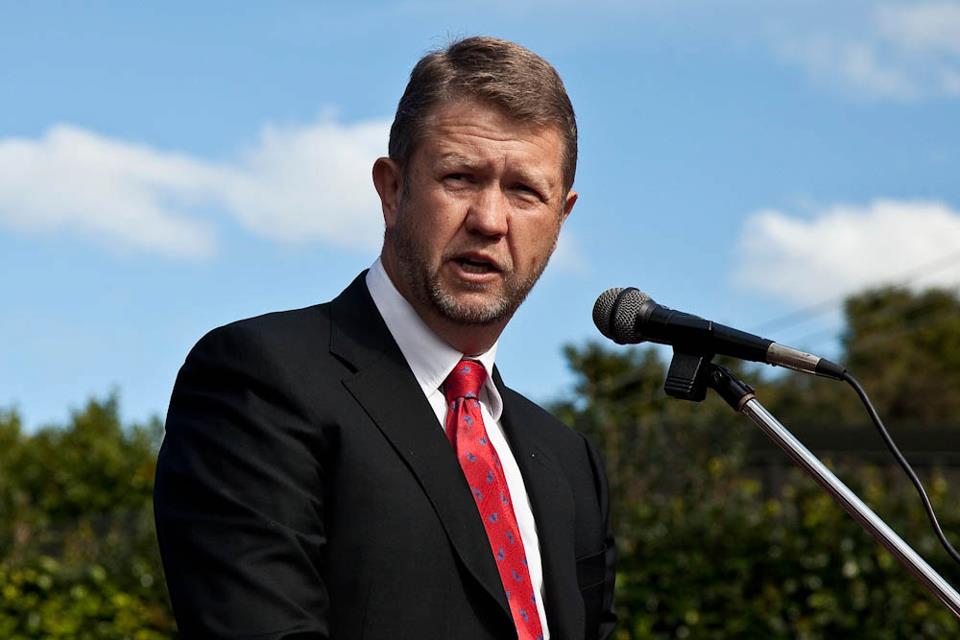
There's Something Happening Here: The Labour victories of 1972 and 1984 were preceded by massive upsurges in extra-parliamentary civil engagement. By 1999, however, the neoliberal counter-revolution had reduced politics to a contest between political parties - the two largest of which were steadily becoming ideologically indistinguishable. (Photo by JOHN MILLER)
 
A DECISIVE FACTOR in New Zealand’s left-wing electoral victories has been the upsurge in progressive civil engagement which preceded them. In its turn, this increased politicisation has lifted the level of electoral participation. In circumstances of heightened civil engagement the ordinary citizen experiences a growing feeling of politics being “in the air” and the act of casting a vote is more easily presented as “making a difference”. At length, even the politically disengaged begin to take an interest, and since political disengagement is disproportionately associated with the young, the poor and the socially marginalised, it is hardly surprising that an up-tick in participation from these groups can make a crucial difference to the electoral efficacy of the overall “Left Vote”.


Let’s flesh out this proposition by examining the three periods immediately preceding the decisive Labour victories of 1972, 1984 and 1999.

1972
 
Having only narrowly lost the 1969 General Election (National: 605,960 votes or 45.2 percent, Labour: 592,055 votes or 44.2 percent) Labour was confident that the very small swing required to change the government in 1972 could be achieved.
 
This confidence was boosted by the widespread public perception that “the times they were a-changing”. Young people – especially the tens-of-thousands who were yearly taking advantage of New Zealand’s “free” tertiary education system – were making their political presence felt on the nation’s streets in protest demonstrations of unprecedented size and impact.
 
The 1971 “mobilisations” against the Vietnam War featured simultaneous demonstrations in the university cities of Auckland, Wellington, Christchurch, Dunedin, Hamilton and Palmerston North. The combined turnout of these protest marches represented roughly 1 in 4 of the country’s university students. They were joined by thousands more progressive New Zealanders from the churches and the trade unions. On Friday, 30 April 1971, more than 30,000 citizens participated in anti-war protests across New Zealand.
 
The trade unions themselves were increasingly by-passing the now discredited Arbitration Court and deploying the strike weapon against their employers. Acute labour shortages left employers with little option but to settle and wages rose accordingly. Working-class New Zealanders’ political confidence grew by leaps and bounds. The Federation of Labour’s conservative National Executive struggled to keep pace with the jaunty aspirations of the unions’ rank-and-file.
 
In 1970, 264,907 people (10 percent of the country’s population!) signed the “Save Manapouri” petition – imprinting the issue of environmentalism on to the nation’s political consciousness for the first time. This potent example of “post scarcity politics” was followed by the creation of the Values Party. In 1972 this plucky political arriviste, chock-full of visionary inspiration, so spooked the Labour Party that their full-page election advertisements featured a graphic of the New Zealand environment (including a forest-destroying deer) safely bottled up in, of all things, an Agee preserving jar!
 
By the time the election rolled around, politics wasn’t just “in the air” – it was filling the air. The 1969 turnout had been a very respectable 88.94 percent and crucially for Labour that number – three percentage points higher than the turnout in 1966 – held firm in 1972. This time, however, the Norman Kirk led Opposition won 677,669 votes or 48.4 percent, and National 581,422 votes or 41.5 percent. The massive upsurge in civil engagement described above had challenged the complacency of the old and politicised the young. Labour’s winning slogan: “It’s time for a change” was resoundingly endorsed.

1984
 
The three years separating 1981 from 1984 saw the huge outpouring of progressive energy occasioned by the Springbok Tour channelled into a series of long-term hegemonic projects that have yet to end.
 
Labour’s easy victory in 1984 provided belated confirmation of its plurality of the popular vote in 1981. Only the exigencies of the First-Past-the-Post electoral system allowed Rob Muldoon’s National Party to cling onto power in that tumultuous year. In 1981 the final count gave “Rob’s Mob” 698,508 or 38.77 percent of the popular vote compared to Labour’s 702,630 votes or 39.01 percent.  (Social Credit, which claimed an extraordinary 20.6 percent of the popular vote, was “rewarded” with just 2 seats!)
 
The turnout in 1981, at 91.4 percent, was even higher than 1969 and 1972. The near record number reflected the extraordinary politicisation of the country which the Tour had effected. That it failed to secure Muldoon’s defeat saw progressive politics bifurcate into the largely extra-parliamentary “New Social Movements” (Feminism, Anti-Racism, Gay Rights, Pacifism and Environmentalism) and the more traditional, class-based movements (trade unionism and the working-class political parties). There was, of course, a lively intercourse between the two which saw the Federation of Labour endorse the Working Women’s Charter and the Labour Party establish its enormously influential Women’s Council.
 
The 1981-84 period also marked the high point of the “New Cold War” and its answering response – the movement for a Nuclear-Free New Zealand. The extent to which this movement permeated the New Zealand population is extraordinary – as evidenced by the succession of county, borough and city councils (representing two-thirds of the population) which declared themselves nuclear-free between 1980 and 1984.
 
Finally, there was the creation of the unemployed workers’ rights movement. Astonishingly, at least to younger politicos, this movement was state-subsidised. Unemployed Rights Centres received grants not only from the trade unions but also from government agencies, and their full-time staff were paid courtesy of government work schemes. For the first time since the 1930s, the poorest and most marginalised citizens had a voice. (Interestingly, the Fourth Labour Government moved very quickly to eliminate this kind of state support for advocacy groups.)
 
The Left's mobilisation of New Zealand’s most marginalised citizens almost certainly explains the truly extraordinary turnout for the 1984 General Election. At 93.7 percent it holds the record for the greatest percentage of registered voters ever to have participated in a general election. Labour was swept to power in what should have been an undiluted triumph for the Left. The full explanation for why it very quickly turned into something else must wait for another occasion.

1999
 
The Neoliberal Counter-Revolution which remade New Zealand in the years that followed 1984 reached its zenith in 1991 with Bill Birch’s long-prepared Employment Contracts Act and Ruth Richardson’s savage “Mother of All Budgets”. Had both been answered as they should have been, with a General Strike from the unions and mass demonstrations by the unemployed and beneficiaries, the following decade could have been one of unprecedented and radical politicisation culminating in the eventual election of a government committed to rolling back neoliberalism in toto. Tragically, the 1990s turned out to be anything but.
 
On 18 April 1991, state-sector union bosses (actively encouraged by the officers of the Council of Trade Unions) voted down the General Strike motion advanced by the private sector unions – thereby condemning hundreds of thousands of wage workers to the steady erosion of their workplace rights and the relentless deunionisation of their industries.
 
And because the unions did not rise, the sympathetic effect of a general strike upon the other groups under attack from Jim Bolger’s National Government never eventuated. The natural alliance of wage workers and beneficiaries which had already begun to take shape as tens-of-thousands took to the streets in late-March and early-April 1991 was brutally aborted by the CTU’s failure to effectively resist the Employment Contracts Bill.
 
The inevitable and entirely predictable result of this strategic failure on the part of the New Zealand labour movement was a steady decline in the turnout of registered voters at general elections. Twenty-seven years after that record 93.7 percent turnout in 1984, the number of registered voters participating had slumped to just 74.2 percent – the lowest turnout recorded since the advent of universal suffrage in 1893.
 
There were, of course, a succession of bold and extremely sincere opponents of the neoliberal counter-revolution – the most effective being those heroic champions of the MMP cause who, by securing a narrow victory for proportional representation in the referendum of 1993, successfully resisted the corporate sector’s well-funded campaign to preserve the manifestly unfair FPP system.
 
But not even MMP could undo the terrific damage inflicted upon New Zealand’s political system by the Fourth Labour Government’s abandonment of social democracy in favour of neoliberalism in the 1980s. This fundamental political derangement not only split the Labour Party but, by driving National sharply to the right, inspired its more moderate elements to form NZ First. Subsequent to Labour’s ideological apostasy, all politics in New Zealand has been about how best to navigate around the black hole where the centre-left used to be.
 
The NewLabour Party, which soon became the Alliance, was the best effort to rebuild an electorally viable alternative on the Left. By 1996, however, its relentless struggle against what remained of the Labour Party had severely shaken the electorate’s faith in the entire Left’s ability to govern. It is for this reason that the first MMP coalition government was the one formed between National and NZ First.
 
Turnout for that first MMP election, at 88.3 percent, was the highest since 1984, and between them National and NZ First secured 47.2 percent – more than enough with the votes of the avowedly neoliberal ACT Party to form a government.
 
Racked by internal strife and the insuperable contradictions inherent in any attempt to merge the neoliberal and conservative ideologies into a single project, the National-NZ First Coalition Government was soon reduced to an incoherent collection of rabid ideologues and disreputable turncoats. Seizing the moment Labour and the Alliance announced their intention to govern together in a loose coalition and the scene was set for a “left-wing” victory in 1999.
 
But the Labour-Alliance victory (augmented by the electoral success of the Green Party which had left the Alliance in 1997) bore almost no resemblance to the victories of 1972 and 1984. Yes, there had been some protest activity – mostly centred around tertiary student fees and, to a lesser extent, environmental issues – but it paled in comparison to the mass actions of 1971 and 1981. Overwhelmingly, politics had become a matter for organised parties. The extra-parliamentary impetus which an effective trade union movement, peace and environmental activism, and the struggle against Apartheid had given to Left politics as a whole in the 1970s and 80s was absent.
 
The 1999 turnout, at 84.1 percent, represented not a rise but a falling away in political enthusiasm. Bluntly, Helen Clark became Prime Minister because she was not Jenny Shipley. And when Big Business complained about the radicalism of her Alliance partner she was quick to reassure the bosses that socialist measures would pass only over her dead body.
 
2014
 
As the General Election of 2014 approaches, the signs of any sort of upsurge in civil engagement are few and far between. Certainly, the kinds of mass protest and the forcing on to the agenda of wholly new political issues and priorities which were the precursors of the great electoral transitions of the 70s and 80s are almost entirely absent. A dreadful inertia pervades the body politic: an unwillingness to be moved by any cause or even any outrage. It is hard to believe, looking back at the conscience-driven civil eruptions of our recent history, that we are the same people.
 
The National Prime Minister, John Key, recently told Radio New Zealand’s Morning Report that when Labour was last in power, National voted for two-thirds of its legislative programme, and that since he’s been Prime Minister, Labour has voted for two-thirds of his. It was an extremely shrewd statement, because the only New Zealanders who could possibly object to such a cosy arrangement are those who desperately need politics to be about difference. And the only way to secure the success of transformative politics is for the young, the poor and the socially marginalised to, once again, become engaged in the processes of change.
 
The very thing that, currently, they are either unable, or unwilling, to do.
 
This essay was originally posted on The Daily Blog of Tuesday, 8 July 2014.

Tuesday, 8 July 2014

Kindred Lizards

Bleak Evangelism: Last weekend David Parker's Presbyterian hymn to egalitarianism brought Labour's election-year congress to its feet. But there is little in his Alternative Budget to justify the standing ovation he received. Philip Snowden's messianic Methodism, similarly, could make grown men weep, but his utter failure to deal with the Great Depression made his name a by-word for laissez-faire retrenchment and ideological betrayal.

THERE ARE NAMES in every culture which – for good or ill – summarise a person’s character. In our own, branding someone a “Judas” vilifies him as irretrievably as calling someone else “Mother Teresa” extols her.
 
In the dwindling sub-culture of the English-speaking labour movement, the mention of just one name, Philip Snowden, continues to conjure-up the spectres of all those Labour finance ministers whose limited imaginations, excessive caution and unreflective orthodoxy condemned their parties to electoral disaster and their working-class supporters to years of undeserved and unmitigated hardship.
 
Snowden, himself, was a peculiar mixture of fiery Methodist evangelism and deeply orthodox Gladstonian liberalism. His personal vision of “socialism” (if that is what it was) consisted almost entirely of a redeemed Utopia brought into being by unrelenting moral struggle:
 
“But the only way to regain the earthly paradise is by the old, hard road to Calvary – through persecution, through poverty, through temptation … And then the resurrection to the New Humanity – purified by suffering, triumphant through Sacrifice.”
 
Sounds lovely!
 
Snowden’s blackened reputation dates from his second stint as Chancellor of the Exchequer under the Labour Party Prime Minister, Ramsay MacDonald; the period encompassing those three fateful years between 1929 and 1931.
 
As the Capitalist world spiralled into the most profound economic crisis of its history, Snowden clung to the orthodoxies of the vanished Victorian era. In the words of Keith Laybourn, his biographer: “He was raised in an atmosphere which regarded borrowing as an evil and free trade as an essential ingredient of prosperity.” Along with his advisers at the Treasury, Snowden dismissed out of hand the stimulatory formulae of the rising economist, John Maynard Keynes. This prompted Winston Churchill’s withering judgement: “The Treasury mind and the Snowden mind embraced each other with the fervour of two long-separated kindred lizards.”
 
To balance his Budget, Snowden insisted that the benefit paid to the rapidly swelling ranks of the unemployed be cut. His Cabinet colleagues jibbed at condemning so many of their party’s supporters to abject poverty. The Government split. MacDonald and Snowden invited the Tories (and what remained of the Liberals) to form a “National” administration. A general election ensued which reduced Labour’s seats in the House of Commons from 228 to 46.
 
For decades afterwards, whenever British Labour Party members came to the line in The Red Flag about cowards flinching and traitors sneering – it was the betrayals of MacDonald and Snowden that they recalled.
 
In New Zealand Labour Party circles it is, of course, the name of Roger Douglas that produces the most visceral reaction. And, when it comes to betrayals, “Rogernomics” holds pride of place. What Kiwi Labourites are less willing to concede, however, is that the neoliberal ideology introduced by Roger Douglas in the late-1980s continues to constitute (the rank-and-file’s antipathy notwithstanding) the orthodox economic ideas of the Labour Party.
 
Philip Snowden: The coward who flinched, the traitor who sneered.
It is in this regard that the party’s current finance spokesperson, David Parker, most closely resembles Philip Snowden. Like Snowden, Parker has made himself the guardian of neoliberal economic orthodoxy.
 
“Under our alternative budget”, Parker told last weekend’s party congress, “everything is paid for, plus we are in surplus. Let me repeat that. Everything is paid for, plus we are in surplus.”
 
As the historian A.J.P. Taylor remarked of Snowden’s first Budget: “it would have delighted the heart of Gladstone.”
 
But, as the economic commentator, Rod Oram, pointed out last Sunday, Labour’s tight spending cap – $1.5 billion over three years – and its ‘ring-fencing’ of health and education expenditure “means it will have to cut funding in some other areas. It needs to say where in the election campaign to prevent a voter backlash later.”
 
The other thing Parker needs to explain is how his economic programme contributes to his cherished dream of a more equal New Zealand.
 
“My political heart lies in something that has become a quaint notion these days, the notion of an egalitarian society.”
 
But lifting the top tax rate by 3 cents will not restore a New Zealand that is “not just about equality of opportunity. It’s about decent outcomes as well.” To house the working poor will require more than Kiwibuild. Just as the elimination of child poverty will require massive increases in welfare spending. Are these included in Parker’s boast that “everything is paid for”? Or, when Parker talks about making “tough choices” and expresses his regret that “not all the policies we would like can be funded”, are these the sort of policies he’s talking about?
 
They say that, on the stump, Snowden’s messianic Methodist rhetoric could make grown men weep. And last weekend, Parker’s Presbyterian hymn to egalitarianism brought Labour’s congress to its feet. Even so, when you’ve absorbed the detail of Parker’s Alternative Budget, it is Churchill’s image that lingers: Of Parker’s mind and Douglas’s mind embracing like “kindred lizards”.
 
This essay was originally published in The Press of Tuesday, 8 July 2014.

Friday, 4 July 2014

Gotcha Politics: A Cautionary Tale

Know Your Enemy: John Key and his National Party colleagues want New Zealanders to believe that Labour under David Cunliffe, the Greens and the Internet-Mana Party represent the "Hard Left". Those truly deserving of the title would probably say, paraphrasing Crocodile Dundee: "That's not a Hard Left. THAT'S a Hard Left!"
 
THE DOORS TO THE LIFT closed behind the Special Commissioner for State Security with a barely audible sigh. Before him lay the spacious reception area of the Minister of the Interior. A young man, dressed in the muted grey uniform of the Senior Public Service, glanced up at him briefly and then returned his gaze to his computer screen.
 
“Good evening Comrade Commissioner, the Comrade Minister is expecting you – please go in.”
 
The Special Commissioner nodded curtly at the Receptionist and pushed open the heavy Rimu doors.
 
“Bruce! Good of you to come at such short notice. Sit down, sit down. Can I get you something? Tea, Coffee, something a little stronger?”
 
“Perhaps some water, Comrade Minister.”
 
“Call me Harry, Bruce. After all these years, I think the Party will forgive us dropping the revolutionary formalities.”
 
The Minister pushed a button and summoned up a bottle of sparkling water and a generous measure of McCallan’s.
 
“So, Bruce, you finally got him!”
 
“That we did, Harry. That we did.”
 
“And he’s safely interred with the rest of his party?”
 
“Suffice to say, Harry, that there is a little plot of the Central Plateau that will be forever John Key.”
 
“Heh! So it’s done.”
 
“It is. But I must say, Harry, I was somewhat surprised that the Central Committee decided against putting him on trial. There are still plenty of Aotearoans who remember him.”
 
“Precisely, Bruce, precisely! That’s why we thought better of it. He was, after all, an extraordinarily popular Prime Minister – served more terms than Keith Holyoake! Taking everything into account, the Central Committee thought it best not to remind people – let alone permit him to demonstrate – why that was. So, snatch him from Hawaii, bring him home, shut him down. That was the plan, and Bruce, you carried it out to perfection.”
 
“The Americans won’t be happy.”
 
“The Americans still don’t know what happened, Bruce. Oh sure, they suspect – but they don’t know. It could just as easily have been the neo-Maoists in Beijing – they have even longer memories than we do!”
 
“True enough.”
 
‘So, what did he have to say during his interrogation?”
 
“Not a lot. Confirmed a lot of what we knew already. There was nothing of any real significance. We got the impression he went through his time as Prime Minister trying very hard not to know what was going on.”
 
“Any famous last words?”
 
“Well, he did say that he wished the SIS and the GCSB had briefed him more accurately on who was – and who was not – a part of the ‘Hard Left’. Apparently his National Security team had no idea that people like us, or our party, even existed. You’ll find this difficult to believe, Harry, but he actually asked me what happened to people like David Cunliffe, Russel Norman, Metiria Turei, Hone Harawira, Annette Sykes, Laila Harre and John Minto!”
 
“Oh, Bruce, the naiveté of the man! Did he really have no idea that they were the very first people to be shot?”
 
“Not a clue, Harry. Not a clue.”
 
“What did you tell him?”
 
“Well, since he was so fond of American presidents, I quoted JFK.”
 
“Go on.”
 
“I said, John, you’re right, it is a pity that your security advisers didn’t tell you that those who make peaceful revolution impossible make violent revolution inevitable. He gave me a sad smile, and then we loaded him onto the truck.”
 
This short story was originally posted on The Daily Blog of Monday, 30 June 2014.

Thursday, 3 July 2014

A Factoid Is Born

Honestly, John's Victory Was This Big! The ease with which false information can be transformed into an ostensible statement of fact is unnerving. Simply by appearing in print, Steven Joyce's boast to National's annual conference about the scale of its electoral success made the transition from falsehood to factoid.

HAVE YOU EVER witnessed the birth of a political “factoid”?  A fact-what? A factoid, which is defined by the Free Merriam Dictionary as “an invented fact believed to be true because it appears in print.” In this instance, the “invented fact” made its first appearance last Saturday in Steven Joyce’s speech to his party’s annual conference in Wellington.
 
As National’s key campaign strategist, it was Mr Joyce’s job to drum home to conference delegates the extreme political danger of complacency. National must maximise its Party Vote, he warned them, because all of its potential coalition partners are so very, very small.
 
“We have got to look at matching the number we got last time which just happens to be the highest ever under MMP and I think the highest single vote for a party since the Waterfront Strike in 1951.”
 
And there it is – the factoid: National’s 2011 Party Vote was the highest ever under MMP and the highest vote achieved by any single party since 1951.
 
Now a factoid wouldn’t be a factoid if it didn’t bear some resemblance to the truth – and this example is no exception. At 47.31 percent, National’s 2011 Party Vote (and let’s remind ourselves here that the “Party Vote” is a measure specific to the MMP system) was indeed the highest ever recorded. It was also an astonishing achievement. Proportional voting systems hardly ever deliver so decisive a result.
 
Had he been of a mind, Mr Joyce might have expanded upon National’s 2011 performance by pointing out that it was 2.38 percentage points higher than its record 2008 result. After all, how often is it that a party, seeking re-election, actually registers an increase in its popular support? Rubbing salt into the floundering Opposition’s polling wounds, Mr Joyce might also have drawn delegates’ attention to Labour’s best performance under MMP: the modest 41.26 percent of the Party Vote it attracted in 2002.
 
So, National’s record Party Vote of 47.31 percent really is worth bragging about – and that’s a fact. But the second part of Mr Joyce’s boast – about it being the highest vote any party has achieved since the snap election of 1951 – well, that isn’t true at all.
 
Now, to be fair to Mr Joyce, he did only say that he thought National’s was the highest single vote for a party since the Waterfront Strike in 1951. He did not state it as a fact.
 
What he did do, however, and very cleverly, was associate John Key’s remarkable electoral achievements of 2008 and 2011 with the event that stands in National’s institutional memory as the party’s greatest ever victory over the forces of the Left.
 
Held in the bitter aftermath of the tumultuous Waterfront Dispute – New Zealand’s worst ever industrial confrontation – the snap election of 1951 marked the beginning of the National Party’s long ascendancy in post-war New Zealand politics. In the 33 years which separate 1951 from 1984, Labour held office for just 6 years.
 
National’s share of the popular vote in 1951? A decisive 54 percent. Ominously for the Labour Party, that election also took place in September.
 
Perhaps it was the latest Faifax-Ipsos poll showing National on 56.5 percent that reminded Mr Joyce of the 1951 election – the last in which a political party would take over half the popular vote.
 
Which is not to say that Labour and National haven’t in the intervening years come pretty close. In 1972, for example, the Norman Kirk-led Labour Party secured 48.4 percent of the popular vote. National’s Rob Muldoon romped home in 1975 with 47.6 percent. In 1987 David Lange lifted Labour’s 1984 total of 42.9 percent to 47.9 percent. Jim Bolger swept into office in 1990 with 47.82 percent of the popular vote – National’s best effort since 1951.
 
Mr Key’s 47.31 percent was an excellent effort (especially considering it was achieved under an electoral system designed to prevent a single party getting anything like half the votes cast) but it was NOT the highest single vote for a party since the Waterfront Strike in 1951.
 
Except that, by the following day, it was. Overnight, Mr Joyce’s thought had become a factoid, with Tracy Watkins writing in the Sunday Star-Times:
 
“He does not need to remind them either that at 47.3 percent support on election night 2011, National got the highest vote ever under MMP – and the highest vote achieved by any single party since the 1951 Waterfront Strike.”
 
It was that simple – and that quick. And you may be sure this new political factoid will be deployed by National supporters throughout the forthcoming campaign. Let the voters beware, because it won’t be the only one!
 
Oh, and in case you’re wondering, the highest vote ever received by a New Zealand political party was Labour’s triumphant 55.8 percent – way back in 1938.
 
This essay was originally published in The Press of Tuesday, 1 July 2014.

Thursday, 26 June 2014

Cramped And Conventional: Labour's Alternative Budget Fails To Impress.

Labour Apologist? David Parker's Fiscal Plan is cautious in conception, orthodox in construction and singularly lacking in political inspiration. It's as if Parker felt the need to apologise for being a member of the Labour Party by constantly reassuring his readers that when it comes to controlling expenditure his plan is as fiscally responsible as the Finance Minister’s.

CONGRATULATIONS to the Labour Party for releasing an Alternative Budget well ahead of the General Election. Allowing the voters to quite literally get the measure of Labour’s economic ambitions is an entirely praiseworthy gesture which will, hopefully, be emulated by all the other parliamentary parties.
 
The document itself is less deserving of praise. What David Parker has produced is a Fiscal Plan that is cautious in conception, orthodox in construction and singularly lacking in political inspiration. If the document can be said to reveal any sort of vision at all it is of the most cramped and conventional kind – as if Parker felt the need to apologise for being a member of the Labour Party by constantly reassuring his readers that when it comes to controlling expenditure his plan is as fiscally responsible as the Finance Minister’s.
 
Responding to Labour’s Alternative Budget, BusinessNZ Chief Executive, Phil O’Reilly, noted that its costings and commitment to frugal spending would likely be welcomed by the business community. But Parker’s centrepiece – an increase in the top personal tax rate and trust rate to 36 percent – was unlikely to aid competitiveness and would penalise those who tended to invest most.
 
“Higher income and trust tax along with a new capital gains tax are not good signals for anyone wanting to invest in New Zealand’s growth.” Said O’Reilly.
 
But this rote rejection of higher taxes on the wealthy is of much less importance that the generally positive noises that preceded it. Clearly, Parker’s Budget is one that offers very little with which New Zealand capitalism could take serious issue. Indeed, the risible addition of 3 cents to the top tax-rate almost certainly occasioned a massive sigh of relief on the part of New Zealand’s top 2 percent of income earners.
 
On the afternoon he announced his candidacy for Labour’s leadership, David Cunliffe’s response to the inevitable question: ‘Do you believe in higher taxes?’ had been an unequivocal “You betcha!” Ever since, New Zealand’s wealthiest citizens have almost certainly been anticipating an aggressively redistributive fiscal strategy from the Cunliffe-led Labour Party. The announced top rate of 36 percent – 9 percentage points lower than Australia’s – must have them shaking their heads in disbelief. Their party was not so sparing of New Zealand’s poorest citizens.
 
Parker’s refusal to give effect to the confiscatory fiscal impulses of Labour’s membership is emblematic of everything that has gone awry with Cunliffe’s leadership. Elected on the promise of restoring the Labour Party to its core, democratic socialist, values (and being rewarded with a 37 percent poll rating by an electorate hungry for political substance) Cunliffe has failed utterly to build on the ideological momentum of his historic victory.
 
It is now clear than in the months following his win Cunliffe spent most of his time attempting to pacify his caucus colleagues. Rather than using the inevitability of constructing a left-wing coalition government to bring obstructive Cabinet aspirants to heel, the new leader attempted to construct some form of policy consensus. Parker’s Alternative Budget is proof of just how successful his caucus colleagues have been in forcing Cunliffe to abandon his democratic socialist promises.
 
The brutal fact of the matter is that Labour will go into the 2014 election with an economic policy package considerably to the right of its 2011 manifesto. In trying to unite his caucus “team”, Cunliffe has abandoned the very principles that had caused the Labour Left to embrace him as their champion. If Parker’s warmed-over “Third Way” social-democracy (with neoliberal characteristics) fails to inspire the voters, and Cunliffe leads Labour to defeat, it is likely the membership will punish their erstwhile champion’s apostasy with much more severity than the ABC faction’s admirable consistency.
 
Parker is at pains to paint his deeply conservative economic policies as a progressive “Economic Upgrade”. It is, he tells us in his introduction, “an ambitious set of goals” which, sadly, have required some “tough choices”. Among these, presumably, is the tough choice to compulsorily acquire a portion of a worker’s meagre wages and place it at the disposal of private investment companies until that worker turns 65. Or should that be 67? Tough, too, must have been the choice to build the 100,000 highly subsidised private dwellings the middle-class wants, rather than the 100,000 affordable state houses the working-class so desperately needs.
 
In the dreary tone of a latter-day version of the British Labour Party’s infamous Depression-era  Chancellor of the Exchequer, Phillip Snowden, Parker informs us that “not all the policies we would like to do can be funded”. The priority, as always, must be “getting the government’s books in order” and “getting the economy growing” after six years of National Party rule. Hardly the sort of message to get the masses flocking to the polling booths!
 
Cramped and Conventional: Philip Snowden (1864-1937) was Britain's Chancellor of the Exchequer at the onset of the Great Depression. Unable to think outside the box of laissez-faire capitalist orthodoxy, this Labour politician oversaw a programme of retrenchment and austerity which succeeded only in making the economic crisis worse.
 
What’s missing from this Alternative Budget is any hint of a political movement determined to change the overall direction of national policy. There is no plan to bring the ideas and aspirations of working-class people back to the centre of the political stage. No pledge to repair the damage inflicted upon the poorest and most marginalised New Zealanders by successive governments (including the last Labour Government).
 
There is not even an attempt to make good on the promise at the heart of Labour’s 2011 election campaign: the pledge to “Save Our Assets”. For Labour’s parsimonious finance spokesperson, the notion of “buying back the farm” clearly comes a poor second to “getting the government’s books in order”.
 
And yet there exist vast capital reserves that a bold and radical Labour-led Government could devote to housing the people and putting the unemployed to work. ACC does not need to be a fully-funded scheme. Were it to return to the pay-as-you-go scheme it was originally intended to be, then the $20 billion taken from levy-payers to transform ACC into an insurance company fit for privatisation would steadily become available for the improvement of New Zealand society.
 
It is the manifest lack of imagination, the stunted ambition, the absence of excitement and inspiration that makes Labour’s Alternative Budget so disappointing. The wealthy and the powerful will praise it – remarking on Labour’s surprisingly responsible approach to economic management. But for those who look to Labour for the opportunities that helped their parents and grandparents enjoy a more abundant life, Mr Parker’s Fiscal Plan risks being seen as just another reason to stay at home on 20 September.
 
This essay was originally posted on The Daily Blog of Thursday, 26 June 2014.

Tuesday, 24 June 2014

"Give Them Hell, David!"

Trust The People: Labour Leader, David Cunliffe, needs to grasp the difficult truth that the news media has written him off and is refusing to carry his messages fairly. He must now find the courage to go around them, addressing himself directly to that one incorruptible source of democratic power – the people themselves.

HARRY WAS A GONER. Nothing could save him. All the polls said so – the pundits too. He may have risen to the job by accident, they opined, but his dismissal would be deliberate. Harry was going to lose. You could bet on it. Everybody agreed.
 
Except Harry S. Truman, the thirty-third President of the United States. At the 1948 Democratic Party Convention Truman rounded on what he called the “do-nothing [Republican Party controlled] Congress”. Not only would he defeat his opponents, avowed the plucky little Missourian, but he’d “make these Republicans like it”.
 
Truman decided to take the Democratic Party’s progressive platform to the American voters directly – by train – on what would become his famous, 35,000 kilometre, “Whistle-Stop Tour”. The train would roll into a small American town, Truman would deliver a rousing speech, and then, after a few words with local reporters, the train would move on to its next stop.
 
During one of these tub-thumping speeches a man in the crowd cried out: “Give ‘em hell, Harry!” To which Truman replied. “I don’t give them hell, I just tell them the truth – and they think it’s hell!”
 
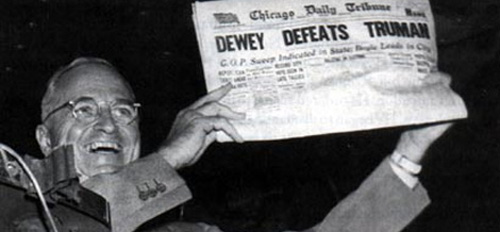
The 1948 presidential election was notable not simply for the vigour of Truman’s campaigning but for the fact that practically all the opinion polls pointed to a decisive Republican victory. So convinced were the “experts”, that one newspaper, The Chicago Daily Tribune, actually called the election for Truman’s rival, Thomas Dewey, on its front page.
 
In one of the most famous photographs of American political history, the real victor, Truman, triumphantly holds the Tribune aloft. It’s “Dewey Defeats Truman” headline reversed by the only poll that ever truly matters.
 

Bad Call: The Chicago Daily Tribune speaks too soon. President Harry S Truman celebrates winning the only poll that matters. 
 
Only after the election did the pollsters realise that their sampling methodology was connecting them exclusively to Americans wealthy enough to own a telephone. Overwhelmingly, they had been questioning Republican voters.
 
Harry Truman’s come-from-behind 1948 victory offers an important strategic lesson to the beleaguered leader of the New Zealand Labour Party. At the heart of the lesson is one very simple precept: trust the people.
 
And how is trust established? By meeting the people face-to-face. By letting the magic of the stump – the raw energy that arcs between speaker and audience – do its work. By grasping the difficult truth that if the news media has written you off and is refusing to carry your messages fairly, then you must find the courage to go around them, addressing yourself directly to that one incorruptible source of democratic power – the voters themselves.
 
Of course the “experts” will sigh and tell David Cunliffe that this is 2014 – not 1948 – and that times have changed. And, of course, ‘times’ have. But the fundamentals of politics have not.
 
Strategically, Mr Cunliffe has locked himself into a political process which, at the end of every week, is leaving him weaker, not stronger. Political journalists have already stamped the word “Loser” on his forehead and are treating him accordingly. As a communications strategy, relying on the news media to transmit Labour’s policy ideas to the voters has failed. It’s time for a new one.
 
If Mr Cunliffe was to take a leaf out of Harry Truman’s playbook he would organise and publicise a nationwide “whistle-stop” tour. Starting out softly in the halls of small-town New Zealand and building slowly to a resounding crescendo in the major centres’ town halls.
 
And, because this is 2014, every meeting, small and large, should be broadcast live on the Internet (brickbats, bouquets and hecklers included) and uploaded to YouTube the following day.
 
Can’t be done? Actually, it can. In July last year I watched young Martyn Bradbury and his anti-GCSB team fill the Mt Albert War Memorial Hall with 500 people. And then, three weeks later, pack the Auckland Town Hall with more than three times that number. On both occasions the meetings were broadcast live, to thousands more, on the Internet.
  
It Can be Done: Anti-GCSB Amendment Bill organisers fill the Auckland Town Hall, 19 August 2013.
 
Mr Cunliffe boasts that his Labour Party has doubled its membership in the space of a year. Let him prove it by making sure every one of the “whistle-stops” on his nationwide tour is Standing Room Only.
 
And what message should Mr Cunliffe deliver to these audiences? The same message he delivered to the audiences that elected him Labour Leader last year. The message that lifted Labour to 37 percent in the polls.
 
Or, as business columnist, Fran O’Sullivan, advised Cunliffe:
 
“Put aside the ‘Gotcha’ politics that both you and John Key have been indulging in. Instead, get out and sell Labour's defining policies – something which you are exceptionally skilled at when you take a disciplined approach.”
 
Stand and deliver Mr Cunliffe. Take Labour’s “defining policies” directly to the people who need them most. Tell the truth, David – and make National like it. Give 'em hell!
 
A version of this essay was originally published in The Press of Tuesday, 24 June 2014.

Saturday, 21 June 2014

Progressive Politics Is Not A Game: Chris Trotter Responds To Rob Salmond

The Prize: The Labour Party of Savage, Fraser and Nash, Nordmeyer, Kirk and Rowling did not need to master the dark arts of smearing their opponents. They did battle with the National Party on the sunlit field of policy.

“ALL THE WORLD’S A STAGE” says Shakespeare in As You Like It, “and all the men and women merely players”. Life as a play: as the mischievous scribblings of some amoral dramaturgical deity; is a metaphor as old as the theatre itself.
 
Closely related, and just as old, is the metaphor of life as a game. Taken as a whole, or broken up into its most vivid elements, the human experience is reduced to something as artificial and essentially meaningless as the turn of a card, the muscular efficiency of a horse or the physics of a rolling pair of dice.
 
What lies behind both of these metaphors is the desperate need of those who make use of them to empty their personal conduct of all moral agency. Actors do not write the lines they are obliged to read, nor do they control the way their scenes unfold. The shape of the plot is somebody else’s responsibility – not theirs. It’s much the same for game players. They didn’t make the rules, but having opted to play the game they’re obliged to follow them. “Love ‘em or hate ‘em,” say the players, “the rules are the rules.” Or, in the words of a recent blog posting: “The game is the game.”
 
The “game” referred to in that posting is the “game” of politics and its author, Rob Salmond, is commenting on the skill (or lack of it) displayed by the National Party in its attempted smearing of David Cunliffe.
 
“National certainly knew about it well before anyone else, and were gloating about it on online forums over the past weekend. I’m betting National also had a hand in cajoling reporters to ask very particular questions of Cunliffe just hours before the incriminating OIA would be released.
 
“And, to be blunt, there’s nothing really wrong with that.”
 
And right there – in Salmond’s bland sentence – lies the source of all Labour’s woe.
 
Implicit in Salmond’s exoneration of National is the notion that politics is a game in which deception, entrapment and public humiliation are all well within the rules. A game for players without scruple or regret. Players to be judged not according to any moral code, but simply according to how adroitly they wield the officially sanctioned weapons of the game.
 
Salmond admits as much when he upbraids National for bungling the job:
 
“If you are going to orchestrate a smear against your opponent, but hope to fade into the background while the smear unfolds, it really pays to have your cover-up stories straight.”
 
He then goes on to gloat about how much better Labour is at smearing its opponents:
 
“Did you ever hear about Labour’s role in forcing [redacted] of the [redacted] party to resign back in [redacted]? No, I bet you didn’t.”
 
Presumably Salmond expects his readers to offer up a professional chuckle at this little gem. In much the same way that a Mafia hit-man would acknowledge a fellow assassin’s description of how he dispatched his latest victim. After all, when “the game is the game” there’s simply no room for the squeamish. Indeed, Salmond and his fellow professionals have a name for those who feel nauseated by such behaviour. They call them ‘losers’.
 
The real loser, of course, is the noble calling of progressive politics. The sort of politics that Labour’s Mickey Savage, eighty years ago, was quite unembarrassed to describe as “applied Christianity”. Unembarrassed, because Savage wasn’t a “professional” politician in any sense that Salmond might recognise. Born into poverty, largely self-educated, quietly spoken and diminutive of stature, Savage did not conceive of politics as a “game”. For him it was the only means by which ordinary, decent working people could secure the prerequisites of an abundant life for themselves and their children.
 
The Labour Party of Savage, Fraser and Nash, Nordmeyer, Kirk and Rowling did not need to master the dark arts of smearing their opponents. They did battle with the National Party on the sunlit field of policy. The only thing their conservative opponents were “forced” to do was to tell the voters why Labour’s policies of social uplift and collective progress could not possibly be implemented. The basements and back alleys of deception and entrapment remained the natural environment of blackmailers and pimps: the immoral milieu into which such criminal elements have always faded.
 
But that all changed in the 1980s when Labour’s caucus embraced the politics of “professional” neoliberal governance and abandoned the New Zealand working-class to its fate. It was then that the practice of progressive democratic politics ceased to be the open-ended process of collective emancipation that it had been from the 30s to the 70s. With both Labour and National now irreversibly committed to upholding the rules of neoliberalism, politics ceased to be about turning progressive and emancipatory ideas into reality, and became instead a contest designed to identify which team of politicians was most adept at playing the neoliberal game.
 
And what else but the skills of deception, entrapment and public humiliation would such politicians seek to master? When “the game is the game” what can politics be apart from an unceasing effort to beset and belittle the men and women of the opposing teams? An endless conspiracy to make your opponents look like losers.
 
This essay was originally posted on The Daily Blog of Friday, 20 June 2014.