Thursday, 17 February 2022

Reality and the Left – A Bitter Divorce.

Things Fall Apart: The events of the past ten days offer ample evidence of just how seriously social decay has weakened New Zealand society. A more confident New Zealand Left, recognising the weakness of the system, and its acute vulnerability to those who would enlist the aid of “gangsters, racketeers, swindlers, petty criminals” would have no hesitation in identifying the so-called “Freedom Convoy” as the reactionary, quasi-fascist, enterprise it has always been.

WHERE IS REALITY HIDING amidst all these claims and counter-claims concerning the protest encampment in Parliament Grounds? In an excruciatingly post-modern political moment, reality seems to have gone AWOL, leaving behind only a noisy collection of competing narratives.

To make matters worse, the state itself, supposedly the supreme arbiter of what is and is not politically real, is refusing to do its job. Even though it is his sworn duty, the Commissioner of Police, Andrew Coster, has made it frighteningly clear to the public that he lacks both the will and the means to assert the state’s authority. The New Zealand Defence Force, meanwhile, holds itself aloof from the fray. Jacinda Ardern and Christopher Luxon, powerless to intervene, look on ineffectually. The crisis deepens.

Ask yourself: what does it mean when tow-truck drivers, asked to assist the Commissioner of Police, refuse? At what point during the last decade did citizens begin to tell themselves that they had no obligations to the society in which they live? That nobody had the right to tell them what to do – not even the Police? What business is it of theirs if the people of Wellington, their neighbours, need their help?

It has been reported that at least one towie openly declared his support for the protesters encamped on Parliament Grounds. Entirely understandable. The occupiers don’t accept that their government has the right to require their vaccination against Covid-19. Nor do they believe that they owe their fellow citizens even the slightest co-operation in the fight to limit the harm of the virus. That tow-truck driver recognised kindred spirits when he saw them. Andrew Coster and Wellingtonians could go fuck themselves.

Not all the towies were so bloody minded. According to media reports, some of them were just plain scared. They claimed to have been threatened with dire retribution if they allowed their trucks to be used by the Police. Considering those trucks carried the names and phone numbers of their owners, it’s not difficult to understand the impact of such threats. Were someone to burn down a towing company’s premises, torch its trucks, that would be multiple livelihoods lost and a business ruined. Who wouldn’t think twice?

Such tactics are, however, remarkably effective. I remember reading about Jimmy Hoffa and the Teamsters’ bitter battles with the trucking companies. The bosses could rely on local politicians, local judges, local editors and local cops to defend them against Hoffa’s strikers. The union was on a hiding-to-nothing, until Hoffa reached out to the Mafia. It only took a few dozen torched trucks for the bosses to get the message. The Teamsters won their improved contract. But the spoon Hoffa took to his dinner with the Devil wasn’t quite long enough. His beloved Teamsters’ Union now belonged to the Mob.

Now, you might think that people on the left of New Zealand politics would recognise the danger of holding up the occupation of Parliament Grounds as a praiseworthy assertion of working-class power. As if poverty and marginalisation, frustration and anger, ignorance and credulity are always and everywhere evidence of moral force and progressive intent.

Karl Marx himself recognised the acute political danger inherent in what he called the Lumpenproletariat. According to the Encyclopedia of Marxism, this social formation is composed of the “outcast, degenerated and submerged elements” of industrial society:

It includes beggars, prostitutes, gangsters, racketeers, swindlers, petty criminals, tramps, chronic unemployed or unemployables, persons who have been cast out by industry, and all sorts of declassed, degraded or degenerated elements. In times of prolonged crisis (depression), innumerable young people also, who cannot find an opportunity to enter into the social organism as producers, are pushed into this limbo of the outcast. Here demagogues and fascists of various stripes find some area of their mass base in time of struggle and social breakdown, when the ranks of the Lumpenproletariat are enormously swelled by ruined and declassed elements from all layers of a society in decay.

That our society is in decay can hardly be doubted. The events of the past ten days offer ample evidence of just how seriously that decay has weakened New Zealand society. A viable Left, recognising the weakness of the system, and its acute vulnerability to those who would enlist the aid of “gangsters, racketeers, swindlers, petty criminals” would have no hesitation in identifying the so-called “Freedom Convoy” as the reactionary, quasi-fascist, enterprise it has always been.

Alas, New Zealand no longer possesses a viable Left. Identity politics has schooled a whole generation to accept the self-definitions of “oppressed groups” at their face value. Drilling down into the actual character of such groups, and scrutinising their relationship to the ruling class, is not encouraged. Even among those leftists who still acknowledge the primacy of class politics there is a pronounced unwillingness to subject movements like the Freedom Convoy to any kind of rigorous class analysis.

For these leftists, it is enough that the occupiers of Parliament Grounds are, or were, members of the working-class. So desperate are these “revolutionaries” for the slightest hint of revolutionary consciousness that they are willing to overlook the absence of anything remotely resembling a concrete programme for the social and economic emancipation of the working class. The only programme in evidence among the occupiers is the one demanding the instant cessation of all measures aimed at minimising the hurt and suffering of Covid-19.

How self-proclaimed “socialists” could possibly mistake such a noxious potpourri of anti-social attitudes for anything remotely progressive is a mystery. Perhaps it is no more than the curious allure of the demi-monde, coupled with the magnetic eccentricities of the Bohemian temperament, that has led these desperate socialists to mistake reactionaries for revolutionaries. Clearly they have forgotten that Adolf Hitler himself was a Lumpenproletarian. A more “declassed, degraded and degenerated” specimen History has yet to supply!

It was the Italian socialist, Antonio Gramsci (1891-1937) who understood most completely the extraordinary fluidity of reality in periods of acute social stress and political disintegration. Moments in history when the hegemonic explanations of the ruling-class have lost, or are beginning to lose, their power to allay the fears and misgivings of subordinate classes. In such times – and we are living through them now – people are desperate for new and more persuasive narratives about the nature of reality.

Not all of those narratives are addressed to the best that is in human nature. Sorting out the lies of charlatans and demagogues from genuine revolutionary truths isn’t always easy – especially in this age of social-media algorithms. Leftists are often surprised to learn that Mussolini was a socialist before he became a fascist.

Gramsci put it best when he wrote: “The crisis consists precisely in the fact that the old is dying and the new cannot be born; in this interregnum a great variety of morbid symptoms appear.”

Or, more succinctly: “Now is the time of monsters.”


This essay was originally posted on The Daily Blog of Thursday, 17 February 2022.

Monday, 14 February 2022

Changing Their Story.

Situation Normal All Fucked Up: Already weakened by its poor handling of Delta and Omicron, this Government’s botched response to the Freedom Convoy has changed dramatically its political narrative.

IT IS DOUBTFUL whether Jacinda Ardern’s Labour Government understands just how completely it has lost control of the political narrative. Most likely, it is operating on the assumption that because most New Zealanders, like most MPs, are appalled at the behaviour of those occupying Parliament Grounds, all is well. It is a false assumption. Like the first victim of the “Freedom Convoy” weapon, Justin Trudeau, the Ardern Government’s refusal to “go hard and go early” against the protesters has created the worst of all political narratives: that it has become weak and ineffectual.

Not only has the occupation of Parliament Grounds made this government look weak, but it has also emboldened and, in the eyes of some, at least, ennobled the occupiers. Swift and decisive action to evict the occupiers was crucial, if only to forestall the creation of a David versus Goliath narrative in which every successful defiance of the forces of law and order only serves to make their movement stronger.

Those who share the occupiers frustration with the Government’s management of the Covid-19 pandemic, but who have, hitherto, not believed that successful resistance to its policies is possible, have been given cause to think again. They may represent fewer than one-in-ten New Zealanders, but one-in-ten of 5 million is 500,000. If only a tenth of that half-million citizens decided to join the Wellington protest camp, then this Government will very quickly find itself confronting a national security crisis of immense proportions.

It is a genuine mystery why neither the Government, nor the senior Police commanders, were able to grasp the nature of the challenge they were facing. It was clear to every thinking New Zealander that the protest action represented by the “Freedom Convoy” was of a new and potentially extremely dangerous kind. One didn’t have to be a master strategist to understand that once 200-300 motor vehicles converged on the centre of the capital city, the owners of those motor vehicles would, more or less immediately, control the centre of the capital city. New Zealanders knew that they had nothing to fear from protesters who gathered for a couple of hours to deliver their message and then dispersed. But, protesters who came to stay until their demands were met – this was a very different kettle of fish.

New Zealand’s senior police commanders cannot say that they weren’t warned. The Ottawa example was there before them. By failing to break the Canadian truckers’ blockade immediately, the Canadian authorities allowed the protest’s relatively limited set of demands to escalate wildly. Fatally, Prime Minister Trudeau opted to talk tough, but then refused to act tough. The latest poll out of Canada shows only 16 percent of Canadians are satisfied with his handling of the crisis. Trudeau’s failure to deal with the truckers’ protest swiftly and effectively may spell the end of his political career.

While the Policing Act 2008 makes it clear that in operational matters Ministers of the Crown are required to butt right out, there are other ways for the State to assert its duty to protect the rights of the citizenry and the rule of law. It would be interesting to know whether the Officials Committee for Domestic and External Security Coordination – commonly referred to as ODESC – was convened to address the national security implications of the Freedom Convoy. Chaired by the CEO of the Department of Prime Minister and Cabinet, ODESC can bring together all the instruments of the state apparatus required to coordinate an effective response – including the Police and the NZDF.

From the perspective of the ordinary person in the street, however, neither the Prime Minister nor the Police Commissioner, Andrew Coster, appeared to be taking the matter very seriously. Indeed, by constantly invoking people’s right to protest, they gave the impression that they were reluctant to do anything more than politely request the protesters to behave themselves and then “move on”. Only the Deputy Prime Minister, Grant Robertson, who, as a former student leader, was familiar with the unwritten rules of the demonstration game, appeared to grasp the qualitative difference between the Freedom Convoy and the protests he had helped to organise.

And then the Speaker of the House, Trevor Mallard, stuck his oar in.

The care and protection of the Parliamentary Precinct is, indisputably, the Speaker’s responsibility. The dignity of the office, and the need to at all times conduct himself professionally, should, however, have persuaded Mallard to limit his involvement to simply declaring the occupiers to be trespassers. The strategy and tactics required for their eviction should then have been left entirely to the Police.

To describe the extraordinary decision of the Speaker’s Office to, first, order the parliamentary ground’s lawn-sprinklers turned on, and then, the following night, to blast loud music across the grounds (presumably in an effort to either dislodge or disturb the occupiers in their tents) as “unfortunate” would be a gross understatement. Indeed, it is difficult to conceive of actions more likely to convince the occupiers that they are not dealing with serious people. Mallard’s actions may have hardened the occupiers’ determination to resist. Worse, by responding so childishly, he risks convincing them they can win.

For the long-suffering citizens of Wellington, and the rest of New Zealand looking on, the manifestly inadequate policing tactics employed to move the occupiers from Parliament Grounds, coupled with the Speaker’s ludicrous interventions, have combined to produce a political narrative of weakness, incompetence and pettiness that will be very hard to dispel. The spectacle of unhelmeted constables in their summer shirts, wearing flimsy surgical masks, being sent to stand eyeball-to-eyeball with shrieking, unvaccinated occupiers, was extremely hard to watch. So, too, was the sight of those same constables wading into the flailing, spitting crowd to effect arrests. Where was the Police Association, their union, when these egregious failures of health & safety were unfolding?

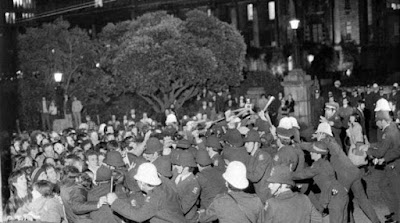
More to the point, where were the force multipliers essential to any operation in which hundreds of police officers are pitted against thousands of aggressively resisting protesters? How many games would have gone ahead during the Springbok Tour of 1981 if the then Police Commissioner, Bob Walton, had confronted HART’s protesters with unhelmeted constables in their shirtsleeves? The late Tom Newnham didn’t call his photographic history of the Tour “By Batons and Barbed Wire” for nothing!

The sheer carelessness with which Ardern and her colleagues have relinquished their winning political narrative is astonishing. Already weakened by its poor handling of Delta and Omicron, this Government’s botched response to the Freedom Convoy has changed their story dramatically. Labour no longer seems willing – as it was throughout 2020 – to go in hard and early for the Team of Five Million. In fact, it seems unwilling to go in hard at all. Small wonder, then, that the enemies of reason and science are feeling vindicated and emboldened. Or that the Team of Five Million is feeling a lot let down – and not a little fearful of what happens next.


This essay was originally posted on the Interest.co.nz website on Monday, 14 February 2022.

Friday, 11 February 2022

Policing Protests: Then, And Now.

Then: Forty years ago the Police resorted to more direct methods of bringing protests, if not to an end, then to a sudden halt. I had friends who were bloodied by Police truncheons on Molesworth Street, right outside Parliament grounds, on the night of 29 July 1981. 

THE ONE AND ONLY TIME I’ve been arrested was for the offence of obstructing a carriageway. The arrest took place at the intersection of Rattray Street and Princes Street in Dunedin during the 1981 Springbok Tour. In attempting to assist a fellow protester, whose arm was pinned against a metal post, and who was obviously in considerable pain, I somehow ended up sprawled on the street. Deemed to be obstructing this important carriageway, I was bundled into the back of a windowless van and deposited in the holding cells of the Dunedin Police Station, where I spent the next few hours singing every protest song I knew. Small wonder that my involuntary constabulary audience tossed me back onto the streets!

I was thinking about that incident earlier this week as hundreds of motor vehicles made their way to Parliament grounds to protest the Labour Government’s handling of the Covid-19 Pandemic. It prompted me to wonder if that quaint old charge (of which, many months later, I was acquitted) is still on the statute books.

Well, it is. Under the Summary Offences Act 1981:

Every person is liable to a fine not exceeding $1,000 who, without reasonable excuse, obstructs any public way and, having been warned by a constable to desist,—

(a) continues with that obstruction; or

(b) does desist from that obstruction but subsequently obstructs that public way again, or some other public way in the same vicinity, in circumstances in which it is reasonable to deem the warning to have applied to the new obstruction as well as the original one.


That the anti-vaxxer convoy did not set out on their protest without apprehending that, at some point, their actions were bound to impede the normal, lawful, passage of other users of the public ways, strikes me as highly implausible.

Certainly, the protesters who blocked motorways, ran onto airport runways, attempted to blockade rugby fixtures, and even interrupted the television broadcast of the final test match between the All Blacks and the Springboks, were all-too-aware that their actions were unlawful. They fully expected to be, and usually were, confronted, apprehended and charged by the Police.

The protest organisers understood the political impact of otherwise law-abiding citizens courting arrest and risking conviction in the name of combatting the racist system of Apartheid. They were also aware of the sheer practical difficulty of the Police, the Courts, and Corrections processing and accommodating hundreds (or even thousands) of arrestees in secure facilities.

It was to overcome these difficulties that the police relied upon the minor offence of “Breach of the Peace” to arrest, briefly detain, and then release (without the need for formal charges) so many of the more “disruptive” anti-tour protesters.

On occasion, however, the Police resorted to more direct methods of bringing protests, if not to an end, then to a sudden halt. I had friends who were bloodied by Police truncheons on Molesworth Street, right outside Parliament grounds, on the night of 29 July 1981. I was there in Wilson’s Road, outside the First Test at Lancaster Park, when the “Blue” riot squad smashed into the front row of protesters with their notorious PR-24 long batons.

In one sense, it is mighty puzzling to witness a protest movement publicly announce its intention to engage in actions which appear to be – at least to the ordinary person in the street – a flagrant breach of the law, without incurring the stern intervention of both the Government and the Police that characterised the 1981 Springbok Tour protests.

In another sense, however, the behaviour of the authorities is perfectly understandable. The prospect of having to effect mass arrests of anti-vaxxers is, very clearly, one which the Police Commissioner and his fellow senior officers are loath to contemplate. His forces are overstretched as it is. Certainly, they have a great deal more to contend with than the cops responsible for policing the more innocent New Zealand of forty years ago.

Halting the anti-vaxxers in their tracks would require a level of force unseen in this country for decades. Some of the anti-vaxxer crowd would need more than a PR-24 to subdue them. The wholesale use of tasers, tear-gas and pepper-spray would be required. Even, ultimately, the use of deadly force.

In 1981, students like me went quietly. Will the anti-vaxxers do likewise in 2022?


This essay was originally published in The Otago Daily Times and The Greymouth Star of Friday, 11 February 2022.

Thursday, 10 February 2022

Proceeding Without The People: Labour’s Gift To The Right.

Colonial Relic: The te Tiriti-driven constitutional transformation proposed by the parties of the Left makes no provision for popular ratification. The radical changes proposed – like Three Waters – will either be imposed by statute, or achieved by judicial fiat. No heed will be given to the venerable notion that it is unacceptable for a government in possession of a temporary parliamentary majority to fundamentally change the rules of the political game. 

BY THE SECOND HALF of 2022 the right-wing assault on the Treaty policies of the Left will be raging.

At the level of local government, candidates known to support the Government’s Three Waters scheme will be targeted for electoral destruction. The local government elections will be repurposed as a national referendum on the Three Waters legislation. If its supporters are voted out, then the Government will face increasingly angry demands for the scheme’s abandonment.

On the broader political front, NZ First, finally free of the Serious Fraud Office’s investigation, will be terrifying rural and provincial audiences with tales of rampant, government-supported Māori separatism hellbent on destroying New Zealand democracy.

With contrapuntal precision, Act’s David Seymour will be reassuring the people Winston Peters has been terrifying that the price of Act’s participation in any coalition government of the Right will be the effective nullification of the Treaty of Waitangi.

National, with less venom and vitriol than its potential allies, will, nevertheless, have re-positioned itself on Treaty issues. Christopher Luxon will argue that what “normal” New Zealanders want more than anything in 2023 is a restoration of “social cohesion”. National’s position will be that social cohesion is impossible while three of New Zealand’s parliamentary parties are promoting racially-charged and undemocratic policies calculated to drive New Zealanders apart.

Labour’s, the Greens’ and the Māori Party’s ability to successfully counter the Right’s attack will be fatally undermined by their deafening silence on the key issue of whether or not they intend to seek formal popular authorisation for their radical (some would say revolutionary) proposals.

To date, however, the te Tiriti-driven policies and plans of all three left-wing parties offer no opportunity for the people of New Zealand to have their say on the profound constitutional changes being promoted.

The Left’s refusal to abide by the long-established conventions for validating and effecting significant constitutional change in New Zealand will leave them wide open to the charge that they are conspiring to brush aside their country’s democratic traditions.

The most damaging aspect of the Right’s charge will be that it is true.

The te Tiriti-driven constitutional transformation proposed by the parties of the Left makes no provision for popular ratification. The radical changes proposed – like Three Waters – will either be imposed by statute, or achieved by judicial fiat. No heed will be given to the venerable notion that it is unacceptable for a government in possession of a temporary parliamentary majority to fundamentally change the rules of the political game. The convention that significant constitutional reform – like altering the way parliamentarians are elected – must be put to a referendum, will be over-ridden.

Labour and the Greens have “form” in this regard.

The Labour-led government of Helen Clark established the New Zealand Supreme Court and abolished the right of New Zealanders to appeal to the Privy Council in London, simply by passing a law to that effect. In spite of the radical reformation of the New Zealand judiciary proposed by the law’s supporters, New Zealanders were given no opportunity to vote the reforms up or down.

Labour’s parliamentary caucus has not grown any more supportive of New Zealand’s democratic political culture in the years since the Supreme Court Bill was passed in 2003. Indeed, the venomous scorn poured upon the defenders of freedom of expression by some Labour and Green MPs strongly suggests that the rights and freedoms granted to all New Zealanders by the Bill of Rights Act (and, for that matter, the Treaty of Waitangi) are regarded as irritating obstacles to the imposition of a new te Tiriti-based political order.

The process adopted by the Clark Government in relation to the Supreme Court Act is, however, instructive.

According to the Department of Courts own historical summary:

The issue re-emerged in early 2000, when the Labour/Alliance Government agreed to review the role of the Privy Council. In December 2000 Cabinet approved the release of a discussion paper entitled Reshaping New Zealand’s Appeal Structure. It invited public comment on three options to replace the Privy Council. Submissions were evenly divided on whether appeals to the Privy Council should be abolished or retained. There was a clear consensus however that if appeals to the Privy Council ended, a replacement stand-alone court sitting above the Court of Appeal should be established.

Further public consultation culminated in the report of a Ministerial Advisory Group. This formed the basis of a Supreme Court Bill. The bill was introduced in 2002, and passed by Parliament on 14 October 2003. The Act came into force on 1 January 2004, officially establishing the Supreme Court, and at the same time ending appeals to the Privy Council in relation to all decisions of New Zealand courts made after 31 December 2003.

Remember that sequence: A “discussion paper” is released. Public “comment” is invited. In spite of expert opinion being “evenly divided”, “further public consultation” takes place. Eventually, a “Ministerial Advisory Group” presents a report. This report becomes a government bill. Public submissions on the bill are invited by a Select Committee of the House. The shape of the bill remains essentially unchanged. Despite strong representations from four of the seven parties represented in Parliament, the call for a referendum is rejected. The bill passes, 63 votes (Labour, Greens, Progressives) in favour, 57 votes (National, NZ First, Act, United Future) against.

That is how easily our constitution can be changed – if a government is sufficiently motivated to do so.


This essay was originally posted on The Daily Blog of Thursday, 10 February 2022.

Monday, 7 February 2022

Thoughts On Waitangi Day, 2022.

Disputed Sovereignty: Politics as usual is no longer capable of delivering an Aotearoa worth living in. It is time for a new net to go fishing.


PERHAPS IT WAS just as well Omicron’s Red Light put paid to this year’s Waitangi celebrations. Too much is moving at speed on the front we used to call “race relations”. An embittered series of polemical exchanges on the Treaty Grounds would not have facilitated the clear and calm thinking so urgently needed on the nature and ultimate purpose of the “Treaty partnership”.

Such decisions as have been made: the new history curriculum, Māori representation in local government, the Māori Health Authority, Three Waters; have only whetted the appetite of an increasingly impatient younger generation of Māori nationalists. Those older activists who see the bi-centenary of the Treaty’s signing in 2040 as the best finishing post for a te Tiriti-based constitutional transformation will likely be disappointed.

Driven by the 15-strong Labour Māori Caucus, which must, itself, keep an eye on the even more unabashed radicalism of the Māori Party. Aided by a mainstream news media determined to make good the historical harms inflicted upon Māori by its deeply prejudicial coverage of New Zealand race relations. The drive towards constitutional transformation has acquired an momentum that cannot now be easily, or painlessly, slowed.

Interviewed by leading Māori journalist Julian Wilcox for the first broadcast of RNZ-National’s new programme, Māpuna, on Saturday (5/2/22) newly appointed Māori Land Court judge, Aidan Warren, warned of the growing impatience evident among rangatahi. It is becoming increasingly difficult for older Māori, Warren observed, to counsel patience successfully. Simply pointing to the rapidly increasing numbers of strategically located Māori professionals is no longer enough. Māori society is experiencing that most frightening of social phenomena, a “revolution of rising expectations”.

Armed with the well-honed arguments of Māori lawyers, historians and political activists, and marching to the beat of their own musicians, young Māori activists are unlikely to wait another 18 years for the construction of a new, te Tiriti-based, Aotearoa to be completed. After 182 years of Pakeha domination, the emerging consensus among young Māori activists seems to be that the time for waiting is over.

What, then, are they likely to make of David Seymour’s “State of the Nation” address of last Friday? (4/2/22) In what some commentators have already described as an updated version of Don Brash’s in/famous “Nationhood” speech to the Orewa Rotary Club, Seymour offers those New Zealanders yet to be persuaded of the need for a te Tiriti-based constitution the following, potentially inflammatory, propositions:

The next Government will not be able to simply stop doing new things that divide New Zealand. We will have to actively push back against the divisive idea that there are two kinds of New Zealanders.

We will need to remove the constant references to the Treaty from the law and replace it with a commitment to liberal democracy. One person, one vote, and equality for all in a multi-ethnic nation state.

It means removing co-governance structures from healthcare, from resource management, infrastructure, and education. It means going through the statute books and removing the distinctions in law that hold my Māori ancestors as legally different from my European ones.


The election of a National-Act government in which the balance of right-wing parliamentary forces made the implementation of these highly contentious policies a non-negotiable element of any coalition agreement would be potentially calamitous. The immovable object of right-wing Pakeha resistance to te Tiriti-based constitutional change would meet the irresistible force of youthful Māori nationalism (with plenty of Pakeha allies in tow). Something, or someone, would have to give up – or in.

It probably wouldn’t be Māori. As AUT’s Ella Henry told Moana Maniapoto in the course of Māori Television’s excellent Waitangi Day programming: when set against an historical backdrop extending back 3,000 years across the Pacific, the 200 years of Aotearoa’s European colonisation is just “one bad day”.

There was a time when those same European colonists spoke piteously about “smoothing the pillow” of the dying Māori race. And yet, the tangata whenua are still here.

Would voters really be willing to test the practicality of Act’s programme to effectively roll back the judicial, institutional, political and (most importantly) the economic and social progress made by Māori over the last 50 years? More to the point, would National? How many New Zealanders, when push came to shove, would be willing to embrace the repressive measures necessary to nullify the inevitable Māori resistance? Is it not more likely that a majority would opt to avert such a potentially tragic course by voting for a less combustible coalition?

But, even if they did, the challenge of te Tiriti-based constitutional transformation remains. Would it not be better for Labour, the Greens, and even National, to grasp the nettle and simply hand over the whole question to a constitutional convention?

Using the recent Chilean constitutional convention as a model, the first stage of the process would be the nationwide election of delegates. Not only would this require the four-fifths of the population who are non-Māori to decide what sort of future they favoured, but it would also require the Māori promoters of a te Tiriti-based constitutional transformation to come out from behind the closed doors where, to date, so much of the detailed discussion of what their new Aotearoa might look like has taken place.

Māori have, quite understandably, been reluctant to state too openly, or with too much detail, exactly what their preferred future would look like. Their preference has been to let their revolution unfold from the top down in a series of fait accomplis impervious to popular challenge from below. To spend the next 18 years very slowly boiling the Pakeha frog.

The consequences of this strategy are already ominously clear in Act’s reactionary propositions. If “co-governance” is perceived in terms of 15 percent of the electorate imposing its will on the other 85 percent, then it’s a non-starter. Which is why, as many of the participants in Moana Maniapoto’s Waitangi Day discussion were at considerable pains to explain, co-governance should be viewed not simply as a means of restoring Māori mana, but also of radically expanding the horizons of all the human-beings who have made Aotearoa their home.

Do Labour and the Greens have the courage to demand that all New Zealanders either put up, or shut up, by voting for or against the constitution eventually presented to the electorate by the Convention? Does National?

The colonial state of our fathers is slowly but surely breaking up. If we are to avoid Antonio Gramsci’s “morbid symptoms” – the product of an old system that is dying while its successor struggles to be born – then all of us will have to find the courage to dream dreams and see visions of an Aotearoa in which both tangata whenua and tauiwi can grow and flourish.

Politics as usual is no longer capable of delivering an Aotearoa worth living in. It is time for a new net to go fishing.


This essay was originally posted on the Interest.co.nz website on Monday, 7 February 2022.

Friday, 4 February 2022

The Bellis Embarrassment.

The Right To Return? Where is the “kindness” in the treatment of Charlotte Bellis, and scores of other pregnant New Zealand women aching to get home? If this desperate, pregnant, Kiwi journalist, stranded in starving Afghanistan, did not deserve kindness – then who does?

CHARLOTTE BELLIS knows the news business. Over the last week the pregnant and stranded Kiwi journalist has delivered a master-class in how to apply pressure to a government via the news media. Sadly, the same cannot not be said of the Covid-19 Response Minister, Chris Hipkins.

Confronted with a story like Bellis’, there is only one sensible strategy: shut it down by giving the aggrieved party exactly what she wants. Instantly, a very bad news story becomes a passably good news story.

Had the Minister announced that, thanks to his decisive intervention, Bellis would be arriving home on the first convenient flight; following that up with the terse observation that those responsible for this debacle had let both Bellis and the Government down very badly; then a passably good news story could have become an excellent news story.

But, he didn’t. Instead, he just kept right on digging himself into a deeper hole. The National Opposition, and their Act ally, were not slow to take advantage of the Labour Government’s folly. Unsurprising, since, when it came to ammunition, they were spoiled for choice.

Should they fire the shot reminding voters that the Taliban regime had shown this young woman more empathy, and offered her more practical assistance, than her own government? Or, should they begin their barrage with a devastating salvo of statistics? Blasting the Government with the numbers proving that Bellis is very far from the only pregnant New Zealander languishing in the tortuous limbo of MIQ?

Decisions, decisions.

The utter madness of the Government’s response may be judged by the way it instantly devalued any and all decision-making related to MIQ policy. Whatever the Cabinet decided to do: no matter how far it went towards meeting the public’s expectations and/or criticisms; it could not now avoid being read by the electorate as a policy concession forced upon Labour by the Bellis Embarrassment.

The madness of Minister Hipkins also provided the National Opposition Leader, Chris Luxon, with an opportunity to, in effect, piggy-back on the public interest generated by the Bellis Embarrassment. His own Party’s “solution” to the MIQ disaster could now gazump the announcement of the Cabinet’s policy decisions.

In the highly-charged atmosphere generated by Bellis’ difficulties, National’s MIQ position statement was, naturally, given fulsome and positive coverage by the media.

Luxon and his advisers, undoubtedly buoyed by the results of the latest Roy Morgan poll (showing National/Act backed by 50 percent of the voting public) could hardly be blamed for marking the past seven days as the week Fortune’s tide re-floated the Centre-Right’s boats.

Perhaps the most difficult aspect of the Bellis Embarrassment to understand is what on earth possessed those writing the rules to erect even the smallest obstacles to pregnant New Zealand women returning to their homeland to give birth. For most older New Zealanders, the rule has always been: “Women and children first – and pregnant women before everyone!” We were raised on the tragic example of the doomed “Titanic” – where men gave up their places in the lifeboats for the bearers of the next generation.

What does it say about the current crop of public servants that they were able to create a labyrinth of rules and regulations that made it possible for a British deejay to be welcomed into this country, while denying re-entry to a stranded Kiwi woman and her unborn child?

More to the point, what does it say about the current crop of Labour ministers – Chris Hipkins in particular – that they did not intervene, with righteous wrath, to put an end to this unconscionable rejection of that most basic human instinct: the urge to protect, at any cost, mothers and their children?

The Bellis Embarrassment is, in Talleyrand’s famous quip: “worse than a crime, it’s a blunder.”

Prime Minister Jacinda Ardern has made “kindness” the watchword of her ministry. In doing so, she gave birth to a new kind of politics. Just how appreciated, especially by New Zealand women, “Jacinda’s” efforts were to soften and humanise the exercise of power, was confirmed by her stunning victory in the 2020 General Election.

But where is the “kindness” in the treatment of Charlotte Bellis, and scores of other pregnant New Zealander women aching to get home? If this desperate, pregnant, Kiwi journalist, stranded in starving Afghanistan, does not deserve kindness – then who does?


POSTSCRIPT: Even as this column was being written, Deputy Prime Minister Grant Robertson was doing what his colleague, Chris Hipkins, should have done at the very beginning – giving Charlotte Bellis everything she asked for. Too late to repair the considerable damage done to Labour’s reputation by the Bellis Embarrassment, but at least it’s off the front page.


This essay was originally published in The Otago Daily Times and The Greymouth Star of Friday, 4 February 2022.

Thursday, 3 February 2022

Kitset Solutions: Imagine Housing The Homeless For $15,000 Per Unit.

Commie Kitsets: By negotiating a deal with the Chinese, whereby cheap kitset homes are shipped to New Zealand at a fraction of the cost of building a similar house here, the social and economic problems attributable to the lack of low-cost housing could be tackled head-on.

A MATE OF MINE sent me an e-mail. “I guess no one told Phil Twyford about Ali Baba.” I followed the link to an advertisement for kitset homes manufactured in China. You could have one of these: completely broken down and shipped to your nearest port in a container; for approximately $NZ15,000.

The quality of the home I cannot vouch for, but that really isn’t the point, is it? If this Government had possessed the courage to, just once, think outside the square, then by now the housing crisis would be over. By negotiating a deal with the Chinese, whereby cheap kitset homes were shipped to New Zealand at a fraction of the cost of building a similar house here, the social and economic problems attributable to the lack of low-cost housing could have been tackled head-on.

The potential problems associated with the quality of these kitset homes could easily have been addressed at a government-to-government level. Given the enormous pay-off for Beijing, the durability and weatherproofness of such dwellings could be guaranteed. With the state supplying the land and installing the necessary infrastructure, whole towns could have sprung up out of the ground with astonishing speed – as they once did in the days when New Zealand still possessed a Ministry of Works.

Just think of the economic and social impact of being able to supply a warm, dry, and healthy home for every family in need of one. The satisfaction of this need would, obviously, have reduced property speculation dramatically and kept private-sector rents low. In response, investment would have been re-directed away from real estate and into more productive areas of the economy.

Welcome as these effects might be, they would pale into insignificance when compared to the improvement universal housing would bring to New Zealand’s rapidly declining social indicators.

The educational performance of New Zealand’s poorest children would improve rapidly once their parents were safely and securely housed. Nothing retards a child’s educational attainment like being forced to move frequently from house to house and school to school. The elimination of serious overcrowding would also eliminate a broad range of the physical and mental health problems generated by too many people living in too little space. Domestic violence, too, would reduce dramatically.

Solving the housing crisis would reveal to every New Zealander just how many of the country’s other problems are the direct result of widespread homelessness and unrelenting housing insecurity.

The problem, of course, is that even if this government’s first housing minister, Phil Twyford, had been made aware of the capacity of the Chinese construction industry to meet the demand for cheap public housing, he would have been confronted immediately with a whole host of obstacles.

Obviously, New Zealand’s domestic construction industry would have screamed blue-bloody-murder at the price-depressing effects of such formidable foreign competition. The seriously disrupted relationship between local government, land-bankers and builders would, similarly, have provoked loud protests. The most ear-splitting shrieks, however, would have come from landlords. Overnight, their business model would have collapsed – along with their ability to ruthlessly immiserate their tenants by constantly ratcheting-up rents.

Owning multiple properties would no longer make commercial sense. Thousands of former rental properties would thus be put up for sale in what would very soon become a buyers’ market. What had been a crippling shortage of affordable housing would suddenly become a glut. Prices would tumble, and the dream of home-ownership for middle-class thirty-somethings would be realised.

As this cascade of consequences descended upon the New Zealand economy, homeowners would watch with mounting horror as the putative value of their houses declined precipitously. The powerful sense of well-being engendered by the seemingly unstoppable rise of house prices, sweetened by the prospect of pocketing hundreds-of-thousands of dollars in tax-free capital gains when they eventually sold-up and moved to the provinces, would evaporate in a red mist of anger and resentment.

Exposed, in all its ugly reality, would be the naked class interests bound up in the maintenance of the housing crisis. By freeing the working-poor and beneficiaries from the misery of housing insecurity and homelessness, the Deus ex machina of cheap Chinese kitset homes, purchased with cheap Chinese credit, would have produced a profound re-ordering of class relations. The 60 percent of New Zealanders who had been on the winning side of the housing crisis would not have been best pleased.

To strategic onlookers located in Washington, London and Canberra, such a sudden reversal of class fortunes, especially one made possible by the shrewd intervention of Beijing, would’ve been utterly unacceptable. As disturbing to our “allies” as it was to those on the deal’s domestic downside.

The very idea of the New Zealand working-class clasping with relief and gratitude the helping hand offered to them by a courageous Labour Government, and its Chinese Communist partners, would give New Zealand’s Five Eyes partners the screaming heebie-jeebies. In the time it takes to “make the economy scream”, Jacinda Ardern would’ve found herself walking the same path as Salvador Allende.

The problem is not that New Zealand’s housing crisis cannot be fixed, but that it is not in the unequivocal material interest of enough New Zealanders to allow it to be fixed – not even at Ali Baba’s knock-down price of $15,000 per unit.


This essay was originally posted on The Daily Blog of Thursday, 3 February 2022.