Monday, 13 June 2022

Macho chest-beating won’t tame the gangs, but Poto Williams’ “softly, softly” approach just might.

Misdirection: New Zealanders see burly gang members, decked out in their patches, sitting astride their deafening motorcycles, cruising six abreast down the motorway as frightened civilians scramble to get out of their way, and they think these guys are the problem. Fact is, these guys represent little more than the misdirection of the criminal magicians no one ever gets to see.

THE GROWING CHORUS calling for Poto Williams to be sacked as Police Minister bespeaks a fundamental misreading of her performance. We are so used to bumptious males like Stuart Nash and Mark Mitchell holding (or seeking) this portfolio that we read Williams’ “softly, softly” approach as a sure-fire indication of failure. But, since when did inflated male chests, bombastic claims and political humbug ever bring about anything more useful than inflated poll-ratings? Since we have seen this noisy “Laura Norder” pantomime repeated over and over again, we can say with some confidence that it makes next to no impact on crime.

My impression of Williams is that she has spent the last 18 months searching desperately through all the available research/data for something that just might help her make a real difference. But, seeking to base government policy on something more substantial than rabid right-wing reckons is the very last thing an ambitious Police Minister should be doing. The tried and true methodology is to get the voters’ blood up with rhetoric red in tooth and claw. Then, while you’re doing that, task your officials with finding out what rabid right-wing police ministers overseas have settled upon as their solution to rising crime – and steal it.

Chances are that the real-world effects of these “solutions” will be pretty close to zero. But, since the research/data only proves their ineffectuality after a two-to-five year time-lag, this is of no political consequence. The voters have already watched the launch of the Government’s getting tough on crime initiatives on the six o’clock news, dutifully bumped the ruling party’s poll-ratings up a couple of percentage points, and then forgotten all about it – until the next crime wave. In response to which the entire pantomime will be re-staged. Same script, different actors.

What most people simply don’t understand is how sophisticated criminal offending has become. They see the burly gang members, decked out in their patches, sitting astride their deafening motorcycles, cruising six abreast down the motorway as frightened civilians scramble to get out of their way, and they think these guys are the problem. Fact is, these guys represent little more than the misdirection of the criminal magicians no one ever gets to see. While rival gangs are shooting up each other’s neighbourhoods, draining-off Police resources and thoroughly terrifying the public, core criminal business continues to be conducted largely unmolested.

The Guardian of 7 June reports the existence, in Australia, of “thousands” of members of the Italian Mafia, or, more specifically, the ‘Ndrangheta of Calabria. (That’s the “toe” of the boot-shaped Italian peninsula.) Hiding in plain sight in ordinary suburban communities, looking like any other Aussie, upwards of 5,000 of these criminals have been quietly plying their illegal trade for decades. According to the Australian Associated Press: “The Calabrian mafia work with other organised crime groups including bikie gangs and Asian or Middle Eastern crime groups to cooperate on drug importation, money laundering and violence.”

“It’s entirely possible that people will be living next door to members of the ‘Ndrangheta without knowing,” the Assistant Commissioner of the Australian Federal Police, Nigel Ryan, informed the media. “They’ve been able to stay under the radar while living modest lives in modest homes. They funnelled the illegitimate wealth into their legitimate construction, agricultural and catering businesses. In many ways, I would say that the ‘Ndrangheta are actually the ones pulling the strings of other organised crime groups, particularly the more violent groups, such as outlaw motorcycle gangs.”

As The Daily Blog’s Editor, Martyn Bradbury, has been telling his readers for many years, Australia’s harsh immigration regime is sending hundreds of New Zealand-born members or associates of these same violent outlaw motorcycle gangs across the Tasman as deportees. These “501s” have fundamentally changed the way New Zealand gangs do business, introducing a level of violence that had not hitherto been a feature of indigenous gang culture. It would be naïve in the extreme to assume that at least some of the ‘Ndrangheta’s string-pullers have not crossed the Tasman with them.

The Aussies run our largest banks, so why not our largest criminal enterprises? (If you’ll pardon the tautology!)

The same Guardian article also makes reference to the extraordinary law enforcement coup that saw organised criminals around the world avail themselves of a supposedly unbreakable encryption app called “ANoM”. Little did the crooks know that their every conversation, every text, every e-mail, every JPEG was being copied to the international law-enforcement inventors of ANoM.

“Officers gathered intelligence from the ANoM app to understand how transnational serious organised crime syndicates – including the ‘Ndrangheta – operate and communicate.”

Just how serious is the ‘Ndrangheta? According to Assistant Commissioner Ryan, Calabria’s organised criminals are “responsible for 70 to 80% of the world’s cocaine and they are flooding Australia with illicit drugs ….. They are pulling the strings of Australian outlaw motorcycle gangs who are behind some of the most significant violence in our communities.”

Ultimately, it is the sort of intelligence gathering exemplified by ANoM that will provide the Police with the information they need to push back against the criminal organisations already well-ensconced in New Zealand. If New Zealand’s Police Commissioner, Andrew Coster, is not working closely with Police Minister Poto Williams on this method of bringing not only the local outlaw motorcycle gangs, but also, their Calabrian, Columbian, Mexican, Chinese and Australian string-pullers into New Zealand courtrooms, then he bloody well should be! Undercover operatives and state-of-the-art electronic surveillance have been the key to the apprehension of organised criminals since the 1980s. “Eyes of Mordor” they might have been, but they brought down the Five Families.

Christopher Luxon and Mark Mitchell would do well to ponder the possibility that the recent spate of drive-by shootings may actually be intended to divert Police resources away from the string-pullers. In calling for Poto Williams’ head, they may be doing the very thing that would most assist the real criminal masterminds. If this is the case, then a sudden reduction in drive-by shootings will not be a sign of Police success, but proof that the wise-guys are once again conducting their criminal enterprises in the preferred manner.

Quietly, without being noticed.


This essay was originally posted on The Daily Blog of Thursday, 9 June 2022.

Friday, 10 June 2022

Our Least Worse Option.

We Can Be Heroes: Ukrainian newly-weds pose for the cameras before heading-off to the front-lines. The Russo-Ukrainian War has presented young people with the inescapable reality of heroism. They see Volodymyr Zelensky in his olive-drab T-shirts; they see men and women their own age stepping-up to do their bit. They have learned that there are some things worth fighting for – worth dying for. They have also learned how to say: Sláva Ukrayíni! – Glory to Ukraine! 

THERE ARE MOMENTS in history when the essential powerlessness of our leaders stands exposed for all their people to see. Moments when they are struck forcefully by the brutal realisation that they have no good options – only the least worse ones. The manner in which they respond to these moments is critical.

Volodymyr Zelensky, for example, presented with the reality of Russian forces rolling across Ukraine’s borders at multiple points, had to accept the reality that his worst nightmare was now upon him. The man who had campaigned on promises of peace, now faced war with an enemy the whole world expected to be rumbling through his capital city within three days.

The Americans famously offered Zelensky a ride out of harm’s way. He refused. Faced with no good options, he chose what was, morally, the least worse: he stayed where he was. Outnumbered and outgunned, he nevertheless vowed to defend his homeland and his people.

And the hearts of the peoples of the West beat a little faster. After the shame of the cowardly flight from Afghanistan, the spirits of Westerners were lifted. Everywhere, from the battlements of Edinburgh Castle, to the rooftops of Dunedin, Ukraine’s blue and yellow banners suddenly blossomed, like bright flowers of freedom.

To the immense relief of their elders, young people were presented with the inescapable reality of heroism. They saw Zelensky in his olive-drab T-shirts; they saw men and women their own age stepping away from their university studies; saying farewell to their workmates; and presenting themselves to be trained in the operation of deadly weapons. They learned that there are some things worth fighting for – worth dying for. They also learned how to say: Sláva Ukrayíni! – Glory to Ukraine!

How much easier it would have been: not only for Vladimir Putin and the Russian Federation, but also for the West itself, if Zelensky had taken that ride. If Kyiv had fallen in three days and a puppet government subservient to Moscow had been installed. Diplomatically, the world would have been confronted with a convenient fait accompli. Western leaders, most particularly, President Joe Biden, would have huffed and puffed. Sanctions of a largely cosmetic nature would have been imposed. And that would have been that.

The waters of the world, briefly disturbed, would have returned to their former placidity. And the children of the West would have received yet more lessons from their leaders. That might makes right. That nothing is worth fighting for. That heroism is dead.

It has taken the example of Zelensky to make us understand, fully, the true political magic of Winston Churchill’s example in 1940. France had fallen, and those who purported to speak the language of realism argued that Great Britain was “irredeemably lost”. The world expected to learn, any day, of Britain’s surrender, confirming the irreversible advance of fascism across the entire globe. But, Churchill said “No!” Refusing to bow to the “inevitable”, he vowed that Britain would “never surrender”.

The flame of freedom, guttering, grew suddenly stronger and brighter. The darkness hesitated and drew back. Hope sang – like a nightingale in Berkeley Square.

So, what do we do now? Now that Ukraine is fighting for us all? Now that we can no longer afford to let her lose? What is the least worse option being offered to our own leader, Jacinda Ardern?

She may already have taken it.

Diplomatically and militarily the game is changing. Russia and China are already allies – and only likely to grow closer together. Against the fluttering complexities of liberty and democracy, they will offer the straight lines and sharp edges of authoritarianism. In place of the heady wines of freedom, they will offer the opium of security.

It would be most unwise to believe that this new Eurasian behemoth will not find friends. The wounds inflicted by the West still bleed in many countries. Among the victims of imperialism, the virtues of democracy and freedom are often obscured by tears.

But, if we would not shed tears of our own, then we must look to our own safety. At the end of this month, Prime Minister Ardern will attend the Nato Summit. Alongside Australia’s Anthony Albanese, she will hear plans for a great Western alliance extending the protections of collective security well beyond the North Atlantic.

Our least worse option.


This essay was originally published in The Otago Daily Times and The Greymouth Star of Friday, 10 June 2022.

Tuesday, 7 June 2022

The Affable Snake: Tony Simpson Remembers Stan Rodger (1940-2022)

A Man May Smile And Smile: Stan Rodger was an affable almost avuncular figure although it’s important to recall that no-one gets to the top of the then largest union in the country without exercising the skills commonly found in any political snake pit; ostensible bands of brothers and sisters are no exception.


THE DEATH of erstwhile Dunedin Labour politician and Cabinet Minister Stan Rodger on 29 May and the obituary note by Chris Trotter that followed a few days after raised a number of ghosts which I thought I had long buried; but ghosts have a habit of coming back to haunt and Stan’s role in the Lange government of the eighties is no exception. That government may be ancient history to many reading this but it represents a significant phase shift in our political past which needs to be regularly examined and analysed. As someone once said: those who ignore history are doomed to repeat it; someone else added “the first time as tragedy, the second time as farce.” [1]


I knew Stan quite well when I was a senior advocate for the PSA in the early seventies and he was the union president. He was an affable almost avuncular figure although it’s important to recall that no-one gets to the top of the then largest union in the country without exercising the skills commonly found in any political snake pit; ostensible bands of brothers and sisters are no exception. Stan went on to parlay his union background into a safe Labour seat in Parliament. There was nothing exceptional about that. The trade union movement invented the Labour Party in 1916 to unify its parliamentary initiatives on behalf of working people and moving from union office to MP was quite common in past decades. As an experienced worker representative Stan was an obvious candidate for Cabinet when the Lange government came to power in 1984 and he became Minister of Labour and of State Services. And that’s where the fun begins.

It is now commonplace to recognise that that government repudiated the social democratic tradition which was central to its previous philosophies and replaced it with a thoroughgoing economic and social neo-liberalism which included an attack on some of the longstanding rights of workers in their trade unions. There was widespread outrage at this within the union movement; I myself abandoned my role with the PSA, at root because they refused to call out the Lange government for its anti-union policies, but immediately because the debate became so heated that there were fisticuffs in the office and I had to go, although I was subsequently to return as president to try and repair some of the damage.

The angry debates that government occasioned affected its Members of Parliament along with everyone else. Some, such as Jim Anderton walked away and set up an alternative party true to what they perceived to be the previous Labour traditions. Others, along with much of the previous mass party membership, disappointed and disillusioned, turned their backs and slipped away. But some stayed on in Parliament and saw the crashing defeat of Labour at the 1990 election. Stan’s erstwhile membership at the PSA showed their displeasure by revoking his honorary status at a subsequent Conference against the advice of the then platform leadership. It was subsequently restored but it is indicative of the fury among many committed unionists that it happened at all.

All of this created a dilemma for Stan. No-one likes to be labelled a traitor to a cause i.e. in this case the workplace rights of working people, whether such a characterisation is justified or not. Others who were confronted with the same problem took the obvious course and published a memoir in justification. [2] Stan didn’t publish a memoir as far as I am aware. But he did it seems invent a narrative of his motives which he vouchsafed to those around him such as the veteran journalist Richard Harman; it is one that finds its way into Chris Trotter’s obituary notice.

According to this story there was a left wing Marxist conspiracy against the PSA led by another of its erstwhile presidents, Jack Lewin, who by the deployment of a sinister body called The Korero sought to take over the union and turn it by stealth to its own left wing purposes. This group it is alleged, playing some master game of which the puppet master had been Bill Sutch, were trying to use their position within the PSA to turn our polity in an extreme left direction, and had already attracted the attention of not only the scurrilous right wing newspaper Truth but the SIS. Stan, by playing a major instrumental role in getting David Lange into Parliament, his story goes, and then into the leadership of Labour saved the nation from this Marxist conspiracy. His role in the Lange government was an on-going part of that brave enterprise. Its problem as a narrative is that it bears little or no resemblance to the facts of the matter.

That there was a group referred to informally and partly in jest as ‘the korero’ is true, and Jack Lewin who was also well known to me not only existed but was considerably more colourful and larger than life. I also knew personally quite a number of the other activists involved including Jim Turner and Jack Batt, both subsequently union presidents. But to understand what this was all about you must go back to the creation of the PSA in 1913 in the wake of the passage of the first serious attempt to create a professional and non-political civil service in this country, the Public Service Act of 1912. This Act was predicated on the assumption that some organisation would be in place representing the interests of the newly created professional public service workers, and so one was accordingly created – the PSA. But if you called it a union you would probably give its founders a heart attack. Even its name eschewed the word ‘union’; it was an association, and its rules to this day contain a clause forbidding it to affiliate to any political party. It sternly rejected the suggestion that it should register under the then Industrial Conciliation and Arbitration Act because it had a paranoid fear of anything resembling compulsory membership and was from its inception to this day a wholly voluntary body.

But times change. By the late nineteen fifties New Zealand had gone through a cruel Depression, the first Labour government, and the trauma of the Second World War. This had created a generation of committed unionists to whom the PSA as originally constituted was no longer fit for purpose. But neither were they Marxists or Leninists or any other of the communist sectarians who are always with us but who have also had little or no influence on the direction of the trade union movement in this country, except perhaps in the fevered imaginings of the SIS or populist politicians in search of a bogeyman such as Robert Muldoon, and sometimes only in their own minds.

What Jack Lewin and the so-called ‘korero’ were all about was ending the cosy relationship between the senior public service of the day and the leadership of the PSA and replacing it with a leadership transparent and accountable to its rank and file members. In this they succeeded admirably. I would venture to say, from my own observation, and as someone with a highly sensitive nose for bull shit and subterfuge that during my period working at a senior level for the PSA it was genuinely responsive to the views and requirements of its members and probably more so than any other union in the country. Those were its agendas and nothing else despite efforts from time to time by various groups to take it over or assert influence on it – including at various points a strange right wing philosophical group calling itself Moral Rearmament, the ubiquitous sectarians of the communist left, and some of the more socially conscious groups within the Catholic Church. None of them came within a bull’s roar of gaining their objectives or even enjoying other than minor influence.

Ironically, it was only when the Lange government repealed the State Services Act – not on Stan’s watch but that of Geoffrey Palmer - and replaced it with legislation which effectively shut out the PSA from any influence on the direction of government workplace policy, that there was serious damage done to the professional and politically neutral ethos of our public service. In a very real way we have returned at least partially to the situation which pertained prior to the passing of the 1912 Act when the New Zealand civil service was subject to gross political patronage and inappropriate interference by politicians.

I last saw Stan and chatted briefly to him at the centenary function of the PSA in 2013. He remained at a personal level what I had always known him to be – an affable and avuncular figure who came over as someone who wouldn’t harm a fly. In that regard I would simply remind you reading this that appearances, particularly when power is involved, can be very deceptive, and that Stan survived and flourished in one of the most unforgiving of all social environments - the trade union movement.

Tony Simpson.


[1] There are many claimants to have invented this dictum, including Winston Churchill and a Spanish philosopher George Santayana but the most likely candidate is Edmund Burke (1729-1797) with the coda added by Karl Marx.

[2] The prime instance of this is Reform by Geoffrey Palmer (2013). There were others I will not mention, some so egregious as to beggar belief. In its subsequently published centenary history the Labour Party also glossed over the whole matter.


This essay is exclusive to Bowalley Road.

Monday, 6 June 2022

The Year Of Jubilee.

Apres moi ...? Queen Elizabeth II, photographed nearly 70 years ago at her coronation. A remarkable monarch, but she is faltering. Unable to attend so many of the Jubilee’s dazzling spectacles, the Queen’s frailty attests to the unalterable fact of human mortality. Unlike palaces and castles, human-beings cannot be strengthened and renovated. Time, remorseless and unforgiving, exacts its toll.

ON TUESDAY, 22 JUNE 1897, my Grandfather, William Marshall, rode through the streets of London to honour Queen Victoria. As a trooper in the North Otago Mounted Rifles he was part of the New Zealand military contingent sent to celebrate Her Majesty’s Diamond Jubilee. For sixty glorious years Victoria had reigned over the United Kingdom of Great Britain and Ireland, and an empire of unsurpassed extent and power.

One hundred and twenty-five years later, the streets of London are again filled with cheering crowds. Queen Elizabeth II has easily exceeded Victoria’s record, reigning for an astonishing 70 years. Her Platinum Jubilee has given the British people what is almost certainly their last opportunity to mark a milestone in the reign of the only monarch most of them have ever known.

To have a clear memory of King George VI, one would need to have been born in, or before, the late-1940s. And yet, when I was growing up in the 1960s, the late King’s image was everywhere. On ha’pennies, pennies, threepences, sixpences, shillings and florins. George wasn’t merely a “Rex”, he was an “Imp”: the King-Emperor from whom my father received his commission during the Second World War.

George’s daughter, Elizabeth’s, coins were never stamped with the “Imp”. India was gone by the time she became Elizabeth R in 1952. Her seventy years as queen have been distinguished not by the Imperial might to which my grandfather contributed (by helping Victoria’s ministers seize the Boer republics) but by imperial decline.

The British Empire is no more, and the United Kingdom itself is becoming an increasingly dubious proposition. The unification of Ireland has moved from an utter impossibility to a distinct likelihood. Scotland, too, is moving away from the “Great Britain” forged by the accession of James I in 1603. Even Wales is teetering.

Who else but Elizabeth II could have held this strange heraldic menagerie in check? Her great age encompasses so much of the UK’s recent history. She was there when Hitler’s bombers filled England’s skies. She donned a scratchy khaki uniform to “do her bit” for the “war effort”, saluting bravely alongside millions of her father’s subjects, caught up, like her, in the most terrible event of human history.

As the handful of still airworthy Spitfires and Hurricanes roared over the balcony of Buckingham Palace on Friday, Queen Elizabeth’s participation in the Second World War was acknowledged. It brought to mind my father’s own experiences as a Pilot Officer in the RNZAF, and my mother’s vivid high-school memories of “the War”. Both of them are gone now, but somehow, miraculously, Elizabeth endures.

But she is faltering. Unable to attend so many of the Jubilee’s dazzling spectacles, the Queen’s frailty attests to the unalterable fact of human mortality. Unlike palaces and castles, human-beings cannot be strengthened and renovated. Time, remorseless and unforgiving exacts its toll. New Zealand’s banknotes have told the story. From the young and radiant Elizabeth; to the mature mother of a fractious royal brood; to the Old Queen of today. The planet’s seventy journey’s around the Sun are etched upon her face for all to see.

There are some who say that she has carried her royal burden for far too long. At 73, Charles, Prince of Wales, appears to many as a man wronged and ruined by a surfeit of waiting. Had his mother abdicated in his favour at the age of 75, King Charles III would now be in the twenty-first year of his reign. Moreover, with the precedent of a retiring age of 75 firmly set, Charles would now be readying his own son, Prince William, to ascend to the throne in 2024.

Why, then, is the above counter-factual, rather than actual, history? Blame it on Elizabeth’s wicked uncle, Edward VIII. Thanks to him, abdication became a dirty word. A king or queen of England does not shrug off the solemn duties owed to the Realm like a soiled overcoat. Duties, no matter how burdensome, are to be borne to the bitter end – to the last breath.

And then, sadly, there is Charles himself. The poor man would have been so much better suited to the role of an eccentric aristocrat, only distantly related to the reigning monarch, whose peculiar interests, even more peculiar opinions, and “difficult” relationships with women, could inflict no lasting damage on the Royal Family. In the Heir Apparent to the Throne, however, these eccentricities were always going to give his royal mother and her ministers serious cause for concern.

Indeed, with the possible exception of her youngest son, Edward, all of the Queen’s children have allowed themselves to provide unfavourable contrasts with the unblemished track-record of their mother. It isn’t difficult to grasp why the disadvantages of stepping down from the Throne have always struck Elizabeth as being vastly greater than the advantages. Schooled by her grandmother, Queen Mary, in the sacredness of duty; and by her father, the King, in the obligations of service, Her Majesty has chosen to stiffen her shoulders, set her chin, keep calm – and carry on.

And so, as the years have passed, the sprawling ramshackle family pile that is the British Monarchy, has shown increasing signs of wear and tear. There’s a fragility about the whole edifice now that poses, to all who still care about it, an uncomfortable question: “Can it survive the present Queen’s demise?” Will the old “Dominions” – Canada, Australia, New Zealand – embrace King Charles III? Will the peoples of England, Scotland, Wales and Northern Ireland?

Perhaps, if Charles set a limit upon his reign of five years, or, with more prospect of saving “The Firm”, abdicated in favour of his 40-something son and his glamorous wife. That just might work. Indeed, skipping an entire generation, and crowning Princess Diana’s son King William IV, strikes many royalists as the only viable strategy for preventing the British people, and their far-flung progeny, from rather quickly falling out of love with the whole anachronistic notion of a head-of-state who is born – not chosen.

And yet, and yet … My grandfather Marshall (now a captain) was back in England for the Coronation of the King Emperor, Edward VII. As a little boy, I would, from time to time, be allowed to draw his dress sword from its scabbard. With shining eyes, I would trace Edward’s royal initials woven into the hilt. King’s man. That was my grandfather. And Marshall is my middle name. Passed down. Inherited.

King's Man: Captain William Marshall. The author's grandfather.
The continuity of family in a chaotic world.

Vivat Regina!


This essay was originally posted on the Interest.co.nz website on Monday, 6 June 2022.

Summer Is Coming.

A Sun-Hardened Road To Victory: The point of maximum danger will come if/when a day arrives when the Russian forces in Ukraine lose all offensive capability and begin to fall back under Ukrainian pressure. That moment is likely to come when the state-of-the-art weaponry currently being dispatched from the United States is effectively deployed on the battlefields of Ukraine. Weapons with the power to shut down the massive artillery barrages Russian military commanders rely upon to take their objectives.

THE AMERICANS are doubling down on their commitment to keep the Ukrainian armed forces in the field against the Russians. The Biden Administration’s decision to dispatch another billion-dollars-worth of state-of-the-art artillery to Kiev has been met with fury in Moscow. The rage of Putin and his mouthpieces is understandable. Washington is giving the Ukrainians the weapons they need to keep the devastating Russian self-propelled guns out of range of the Donbass cities Moscow must take to secure anything remotely resembling victory.

What do the Americans know about Russia’s present military situation that makes them willing to incur Putin’s wrath in this way? The Russian President has warned the United States and its Nato allies repeatedly that the supply of weapons capable of fundamentally altering the strategic balance of its “Special Military Operation” in Ukraine will produce unimaginable consequences. By this, Putin is clearly alluding to the Russian Federation’s nuclear capability. “Give Ukraine too much help,” he is saying, “and I’ll use my nukes.”

That’s a big bluff to call.

To find out why Biden and his Defence and National Security advisors may be willing to call Putin’s bluff, we have to go all the way back to January and February of this year. From the wealth of detail relating to Russia’s offensive plans for Ukraine – subsequently borne out by the facts of the Russian invasion – it is clear that there had been a massive breach of Russian military security. Somehow, the Americans were reading Russia’s political and military leaders’ mail.

Obviously Putin, himself a counter-intelligence specialist, took steps to close up the breach. Senior figures in the political and military hierarchy started blipping off Russian screens.

Job done?

Apparently not.

It is highly doubtful that the Americans would feel confident enough to call Putin’s nuclear bluff if they did not have it on very good authority, from those in a position to do so, that any move toward the tactical or strategic use of nuclear weapons by the Russian President will result in his immediate deposition.

This could mean something thoroughly cinematic – like a patriotic bodyguard drawing his pistol, shooting Putin and his advisers dead, crying “Long Live Russia!” and then turning the weapon on himself. Alternatively, it could involve the commanders of Russia’s Strategic Rocket Forces sending an H-Bomb tipped missile hurtling into Putin’s supposedly blast-proof nuclear bunker. (Spoiler Alert: There’s no such thing.) Or, it could amount to senior officers in the know quietly communicating Putin’s location to the Americans in sufficient time for them to carry out the deposition themselves.

Certainly, there can be little doubt in the minds of senior Russian commanders that the Americans know pretty much exactly where they are at any given moment of the day or night. The sheer number of Russian commanders killed by sniper-fire or drone-strikes since 24 February makes that terrifyingly clear. They will also know that if Putin is insane enough to actually order a tactical nuclear strike, the American response will be a massive, decapitating, counter-strike that will leave Russia leaderless and rudderless. Precisely because Russian nuclear-war-fighting doctrine devolves launch authority, in extremis, to battlefield commanders, the Americans will make damn sure that there are no battlefield commanders left alive.

In the context of this discussion it is important to remember that when the world was literally on the brink of Nuclear Armageddon in October 1962, it was the good sense and humanitarian instincts of the political commissar aboard a Soviet nuclear-armed submarine under attack from US Navy-launched depth-charges, off Cuba, who persuaded the vessel’s commanders not to respond with its nuclear torpedoes. By refusing to put his key in the unlocking mechanism, he saved himself, the crew, and the whole world from nuclear annihilation.

There is absolutely no reason to suppose that Russian patriots have become so extreme that, rather than depose a delusional and potentially genocidal president, they would see the whole of Mother Russia – along with the rest of the planet – reduced to a radioactive ash-heap. Nor is it fanciful to suppose that Russia’s most intelligent and capable citizens have not long since realised that their country has no viable future as an independent nation if it persists in the folly of attempting to “Make Russia Great Again” by force of arms. The only questions that matter now are: How many of those intelligent and capable citizens are there in the upper echelons of the Russian armed forces? And: How many of them have a working back-channel to the US Joint Chiefs of Staff?

The point of maximum danger will come if/when a day arrives when the Russian forces in Ukraine lose all offensive capability and begin to fall back under Ukrainian pressure. That moment is likely to come when the state-of-the-art weaponry currently being dispatched from the United States is effectively deployed on the battlefields of Ukraine. Weapons with the power to shut down the massive artillery barrages Russian military commanders rely upon to take their objectives.

In the hugely popular television series, Game of Thrones, the stark warning that “Winter is coming” struck fear into the hearts of all the peoples of Westeros. Along the bitterly contested battle-lines of the Russo-Ukrainian War, the warning that should strike fear into the Russians’ hearts is the seasonal opposite of the Game of Thrones. Not the bitter snows of winter, but the sun-hardened fields of the Ukrainian plains, across which the Blue and Yellow Walkers can move with deadly speed.

What stark warning should Putin fear?

“Summer is coming.”


This essay was originally posted on The Daily Blog of Friday, 3 June 2022.

Saturday, 4 June 2022

Centering The Right.

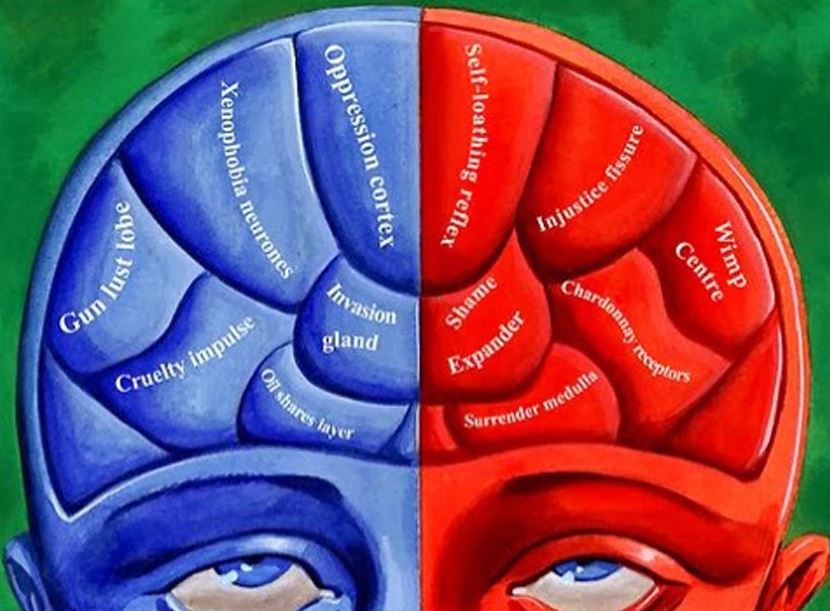
It's All In Our Heads: Prefixing right and left with the word “centre” was once a gesture of moderation, intended to reassure voters that the people being put up for election by these “mainstream” parties weren’t crazies. Today, however, the use of the word in relation to parties like America’s Republican Party, Britain’s Conservatives and Australia’s Liberals is, simply, inappropriate. These are no longer centrist parties, they’re unabashed promoters of the policies of the far-right.

IF PETER DUTTON is the answer, then the question should never have been put! The predicament of the Australian Liberal Party, left with no choice but to go from bad to worse, encapsulates the dilemma confronting all of the world’s centre-right parties.

Prefixing right and left with the word “centre” was once a gesture of moderation, intended to reassure voters that the people being put up for election by these “mainstream” parties weren’t crazies. Today, however, the use of the word in relation to parties like America’s Republican Party, Britain’s Conservatives and Australia’s Liberals is, simply, inappropriate. These are no longer centrist parties, they’re unabashed promoters of the policies of the far-right.

As such they have nothing positive to offer an electorate slowly becoming aware of just how much the planet will have to face – and overcome – in the years ahead. If they do not already, these voters will soon comprise a clear majority of their respective populations. In order to rip-up this emerging majority’s preferred policy track, it will be necessary for the parties of the far-right to rip-up democracy as well.

America’s Republican Party is leading the way in this regard: passing voter suppression legislation and shamelessly gerrymandering congressional districts in its favour. Britain’s Conservatives are more dependent on the fundamentally undemocratic first-past-the-post electoral system than ever. Boris Johnson’s 80-seat majority in the House of Commons was won with just 43.6 percent of the popular vote!

The fate of Australia’s Liberals was sealed by many factors, but their country’s complicated (and rort-resistant) preferential voting system must be counted among the most important!

Now, it may be that a comprehensive rorting of the democratic system is the far-right’s preferred option. Being the sworn enemy of moderation and compromise, extremism may simply be unwilling to countenance either. Assuming, however, that the far-right’s objective is not the “illiberal democracy” currently on display in Hungary, Brazil, and the Russian Federation, what must these errant movements do to earn the reapplication of the trusted centre-right label?

The answer provided by the Australian general election is unequivocal. No party of the centre-right can any longer afford to do anything other than affirm its unqualified belief in the science of Climate Change.

The social and economic consequences that follow logically from that crucial affirmation explains why far-rightists are so unwilling to make it. To meet the challenges of Climate Change it will be necessary to rebuild the machinery of collectivism. The state will have to become much, much larger, and the taxes of the super-wealthy will have to be set much, much higher. Since a small state and low taxes have constituted the sine qua non of centre-right parties since (at least) the late-1970s, what does that leave for them to champion?

The answer, surely, lies in what liberal democracy has always demanded, and will continue to demand, of the party system. At least one major party that is devoted to the protection of the rights of the small against the depredations of the large.

Individual liberty, with all its trappings – most particularly the freedoms of speech, communication, and association – would seem like the logical place to start. Building from there, a centre-right party should champion entrepreneurial enterprise and the creation of small businesses. It should also argue for what the Europeans call “subsidiarity” – the idea that decision-making bodies should remain as close as possible to those most directly affected by their decisions.

The new rule-of-thumb for the parties of the centre-right should be: big is oppressive, small is beautiful.

The political-economy of fighting Climate Change will ensure that this contention between bigness and smallness remains a constant theme of political debates for the foreseeable future. Accordingly, left-wing parties will also find themselves struggling to retain their centrist credentials. The temptation to simply crush any opposition to their radical measures will be very strong. Already, right across the planet, citizens of democracies have experienced how forcefully the state feels entitled to respond to a system-threatening emergency. The global Covid-19 Pandemic has revealed just how difficult defending the rights of the few can become when governments are confronted with the urgent demands of the many.

In the new political configuration that is fast approaching, individuals and communities will have need of centre-right champions. If only to remind us that a planet without freedom isn’t worth saving.


This essay was originally published in The Otago Daily Times and The Greymouth Star of Friday, 3 June 2022.

Thursday, 2 June 2022

Intriguing Last Words: Remembering Stan Rodger (1940-2022)

Stan's Our Man: A decent, moderate Labour Party stalwart, Stan Rodger navigated the treacherous waters of the Rogernomics era to such effect that he was able to state, with complete honesty, that he belonged to none of the factions that were tearing the Fourth Labour Government apart. Unfortunately, as Aneurin Bevan so rightly observed: "If you spend all your time in the middle of the road, then eventually you will get run over." In a time of extremism, moderation is a kind of betrayal.

STAN RODGER, Minister of Labour, and Minister of State Services in the Fourth Labour Government, died on Sunday, 29 May 2022, aged 82. Between 1978 and 1986, Stan was my Member of Parliament. In 1984, that crucial year which saw the fall of Robert Muldoon and his right-wing populist National Government, I found myself on Stan’s campaign team for the Dunedin North Labour Electorate Committee.

The Labour Party of 1984 was a monstrous creature. It’s branch membership, alone, was close to 100,000, with another quarter-of-a-million trade union members affiliated to the party. It also possessed a large and highly vocal left-wing: people who took the Party’s pledge to promote the cause of “democratic socialism” seriously.

One morning, early in 1984, three old comrades from the student protest movements of the 1970s chanced to run into one another in the student union cafeteria at the University of Otago. To our considerable consternation, we discovered that all three of us were working on the campaign committees of Labour MPs and candidates. Radical leftists who had laughed at the pretentions of Labour claimants to that title, now found themselves designing pamphlets, organising photo-shoots, and analysing canvassing returns. “Has it truly come to this?” We asked ourselves. “Have we all become fucking social-democrats!”

Within days of that embarrassing reunion, I had put a new set of words to the tune of Cliff Richard’s 1963 hit “We’re All Going On A Summer Holiday”.

We’re all working for a Labour victory
No more Trotsky, no more Lenin or Mao.
We’re all working for a Labour victory,
I’m glad the comrades cannot see us now!

Stan Rodger had a pretty good feel for the political leanings of the people he worked with. Certainly, he could recognise the many and various shades of red radicalism with relative ease. I was not the only “democratic socialist” on his campaign committee, although it is fair to say that we were easily outnumbered by the Labour moderates among whom Stan felt most comfortable. What distinguished him from practically every other member of the Labour caucus at that time, however, was his conviction that, to retain its political “soul”, the party needed to encompass the full range of democratic left-wing opinion. In the hierarchy of Labour’s “broad church”, that made Stan an Archbishop – at the very least!

Before his death, Stan Rodger allowed himself to be interviewed by the veteran political journalist, Richard Harman. In the course of that interview, Stan revealed something very few people outside the upper echelons of the trade union movement of the 1960s – and the Security Intelligence Service – knew anything about. Stan only learned the secret because he was a rising star in the Public Service Association (of which he would eventually become president) as well as being a senior bureaucrat in the Ministry of Works.

According to Harman, as Stan started moving up the ranks of the PSA he encountered a highly organised underground movement within the Association dedicated to advancing the ideology and clout of the far-left.

“Stan might have been a member of a political party that was still nominally socialist,” writes Harman on his Politik website of Tuesday, 31 May 2022, “but like most Labour Party members, he subscribed to Michael Joseph Savage’s argument that the party’s philosophy was actually ‘applied Christianity’. Stan, said Harman, “had no time for pure socialism or Marxism.”

But, Marxists there were in the public service: “a new cohort of university graduates with far-left views was making itself felt in Wellington.” According to Stan, the wartime Labour Government of Peter Fraser had placed many of these young firebrands in the Department of Industries and Commerce (DIC).

Now, as any good Kiwi leftist knows, the Department of Trade and Industry (as the DIC was later renamed) came to be headed-up by New Zealand’s most effective left-wing intellectual, William (Bill) Sutch – the man who, in 1974, was charged with espionage on behalf of the Soviet Union – and acquitted.

Stan’s principal antagonist, however, wasn’t Sutch, but John P Lewin. Lewin, a former President of the PSA, senior official at Industries and Commerce and, ultimately, Government Statistician, was the man who, according to Stan, became the unofficial leader of a far-left group within the PSA, calling itself the Korero Group.

“It had many key activists in the PSA within it,” Stan told Harman, “with Lewin driving it out of the Trade and Industry department. And Jim Turner, the last member that I knew that was in it, told me it always ran with huge discipline and would even expel people out of the Korero. It essentially ran the PSA at arm’s length through the executive.”

What Stan Rodger has held back until he was safely beyond the reach of controversy are the bones of an explanation for one of the most devastating hit-jobs in the history of New Zealand political journalism. The exposé was published in the right-wing weekly newspaper, Truth, in July 1975, and it purported to expose a “plot” to socialise much of the New Zealand economy which had been hatched on behalf of Labour Prime Minister, Norman Kirk, by Labour MP, Gerald O’Brien, Bill Sutch and Jack Lewin.

Dismissed by Labour supporters at the time as just one more example of an increasingly sinister series of leaks and rumours (what we would, today, call “fake news”) intended to disorient and dismay the electorate in the run-up to the 1975 general election, Truth’s “Plot” may have been something else altogether.

If Stan Rodger knew about the Korero Group, so, almost certainly, did the SIS. Unable to prevent the likes of Sutch and Lewin rising high in the government department at the cutting edge of economic policy, the Security Services likely became increasingly fixated on the extent to which the “far-left” bureaucrats at Trade and Industry were influencing the direction of New Zealand economic development.

It is possible, therefore, that right through the 1960s, and into the 1970s, there was a race between the Left and the Right to find a group of politicians with the courage to undertake a drastic reform of the New Zealand economy. The persecution of Sutch, and the “fake news” about a plot to socialise the New Zealand economy (almost certainly leaked to Truth by the SIS) both bear testimony to the “Deep State’s” fear that the “hugely disciplined” left-wing “cell” in Trade and Industry had already found, or was about to find, the group of politicians it was looking for.

As the man who made certain that David Lange entered Parliament, Stan Rodger, set in motion the political sequence of events that culminated, ironically, in an equally disciplined group of ideologically-driven bureaucrats – this time concentrated in the Treasury – finding the group of politicians it had been looking for. The politicians who were to give us “Rogernomics”.

With Stan Rodger’s passing it is no longer possible to ask him if he saw the rise and rise of the neoliberal “cell” at Treasury as clearly as he saw the defusing and dispersal of the Trade and Industry Marxists and the Korero Group. I wonder if he would have agreed that there was a moment, at some point during those extraordinary post-war years, when New Zealand could have gone in an entirely different direction.


This essay was originally posted on The Daily Blog of Thursday, 2 June 2022.