Thursday, 21 October 2010

Misdirection (How "The Hobbit" Buried "Fairness at Work")

Misdirection: The furore reignited by Sir Peter Jackson and his minions over the production of "The Hobbit" occurred on the same day as 22,000 workers protested the National Government's plans to curtail workers rights. This fortunate "coincidence" (along with a vicious anti-union outburst from the country's DHBs) drove the issues relating to "Fairness at Work" clean off the nation's front pages.

THEY CAME HOWLING through the streets of Wellington like an army of bloodthirsty orcs. And striding at the head of this rabble of hysterical computer geeks, dull-witted gaffers and troll-like grips was the wizard of Weta Workshops, Sir Richard Taylor, energetically playing the role of Saruman to Sir Peter Jackson’s Sauron.

Meanwhile, the Black Gates of Mordor (a.k.a The Wairarapa) opened – spewing forth those two spiteful Nazgul, Fran Walsh and Phillipa Boyens. Raising high their Dark Lord’s banner, they made a beeline for the White City (a.k.a the studios of Radio New Zealand).

Barring the way, their bright red banners glowing in the morning sunlight, stood a tiny army of elves and men (a.k.a. NZ Actors Equity and the CTU). At its head, awaiting the onset of Mordor and Isengard with drawn swords, were Robyn Malcolm and Helen Kelly.

And over all, untouched by the media lights in its multi-million-dollar fortress, the Eye of Jackson cast its baleful glare. Safe behind his impenetrable walls, Sir Peter will only ride forth when the final battle has been won and the last contract signed – the wheels of his midnight SUV rolling heedlessly over the corpses of slain actors and eviscerated unions.

* * * * *

AND WHAT A COINCIDENCE (if coincidence it was) that Jackson’s vicious display of anti-union fury should occur within 24 hours of 22,000 workers turning out to demonstrate their opposition to the National Government’s Employment Relations Amendment Bill.

And, of course, Jackson wasn’t alone. The DHB’s also chose 20 October to launch a full-scale assault upon the unions representing medical radiographers and laboratory technicians.

How convenient, because, who knows, without the scurrilous, unsubstantiated and completely self-defeating claims scattered around by the DHBs; without Taylor’s mob and Jackson’s scaremongering letter; the New Zealand public might have been able to concentrate their minds on the issues being raised at the CTU’s "Fairness at Work" rallies.

Without these spectacular employer provocations inflaming their passions and diverting their attention, decent New Zealanders might even have felt a twinge of sympathy – even empathy – for the plight of the invisible hundreds-of-thousands of working-class people who, day-after-day, keep this society functioning.

And don’t tell me that there is no such thing as "the working-class" any more. Don’t pretend that we are all, in John Lennon’s words: "so clever and classless and free". Because, if you had been sitting where I was sitting yesterday afternoon you would know what a dangerous and self-serving lie that is.

Seated in the Telstra Clear Event Centre in Manukau yesterday, watching the thousands of union members as they slowly filled up the vast space in front of me, it was as though I had been transported to a wholly different New Zealand.

This wasn’t the bright, white world of the television ads: the world where everyone is beautiful and everything is new. Nor was it the world of Ken and Barbie news presenters, breathlessly relating the details of the latest celebrity scandal. The faces of the men and women in front of me were lined by care and etched with hardship. Many of them were wearing the livery of their masters – like the servants of 18th Century aristocrats. Others came straight from the factory floor in boots and overalls.

And, overwhelmingly, the working people in front of me were brown-skinned. Maori and Pasifika, Asian, Middle Eastern and African. Represented on that rapidly filling floor were scores of languages and dozens of cultures. It was another New Zealand altogether, and upon its collective back, every day, the New Zealand of the rich and the comfortable does its business.

Whether the rich and the comfortable allow themselves to be carried in wilful ignorance, or callous indifference, matters much less than the fact that the people upon whose backs they ride have become invisible to them.

The hopes and fears, struggles and triumphs of working people simply don’t matter to this rich and comfortable New Zealand. It never drives through their neighbourhoods, it doesn’t drink in their pubs, it knows nothing of the great rows of factories, warehouses and shops where they work. The people who drive the trucks, who unload the ships, who keep the water flowing through the taps and the electricity flowing down the wires are seen as mere appendages to the machines they operate. They are not people – they are services, servants, things.

And things are not supposed to talk back, complain, ask for more, demand a say: things are supposed to work when they’re switched on, and to shut-down when they’re switched off.

I wish the rich and the comfortable – the New Zealand that switches human-beings on and off – had been in that hall yesterday. I wish they could have heard the great shout that went up when Robert Reid, Secretary of the National Distribution Union, cried out:

We will defeat this bill, nothing is surer! If not today, we will defeat it tomorrow; if not tomorrow, we will defeat it on the streets, we will defeat it in the workplaces, we will defeat it next year when we throw this anti-union Government out! We defeated John Banks and got Len Brown in ... We can win, we will win, we will throw this bill and this Government into the dustbin of history!

That’s what rich and comfortable New Zealand has forgotten, you see: that these "things" they switch on and off have votes – and are learning how to use them.

The sword that was broken is being reforged.

The Dark Lord hasn’t won yet.

Tuesday, 19 October 2010

A Change Gonna Come (Labour Abandons Neoliberalism)

A New Day Dawns: At it's Annual Conference in Auckland last weekend (15-17 October) the NZ Labour Party finally and decisively abandoned its 26-year experiment with Neoliberalism.

IT BEGAN, as so many things do, with words on a page. Seated in the sprawling foyer of Auckland’s Aotea Centre, I was flicking through the pages of the Labour Party’s "Policy Framework" document, when suddenly it struck me. These weren’t words of continuity – these were words of change.

As a former trade unionist, the first section I always turn to in any Labour policy document is the section dealing with industrial relations.

Now, about the best one can say of the employment reforms enacted by Helen Clark’s government was that they were a cautious improvement on the infamously harsh Employment Contracts Act. But the policy I was reading in the foyer of the Aotea Centre last Friday evening was anything but cautious. Dammit – this stuff was radical.

What Labour is proposing is nothing less than restoring to the many thousands of workers currently lacking an active voice in their workplace the right to engage in collective bargaining. Across entire industries minimum pay-rates and conditions will again apply. State-facilitated and binding arbitration will again be made available to both employers and employees. For nearly quarter-of-a-century, New Zealanders rights in the workplace have been unconscionably abridged, Labour is promising to restore them.

My fellow journalists hadn’t missed these proposed changes. Eyebrows were raised. Clearly, this Labour Conference was going to be different.

They weren’t wrong. In the bars and cafes of the Auckland CBD, where many of the 600 registered delegates gathered that night to catch up and compare notes since last year’s conference in Rotorua, there was a palpable sense of excitement. Those who had been most closely involved in the drafting of the new policy framework all wore the same expression of quiet satisfaction. I half expected them to break into Sam Cooke’s haunting anthem: "It’s been a long, a long time coming, but I know a change gonna come."

By Saturday lunchtime it was becoming clear just how dramatically things were changing. Policies which had once been the preserve of a handful of persistent dissidents were now being forcefully promoted from the top-table.

In one session, I witnessed what I thought I’d never see: left-wing unionists and staunch Labour members enthusiastically applauding businessmen and economists. The combined message of Selwyn Pellett, John Walley and Ganesh Nana: that the neoliberal experiment had failed, and that it was time to reclaim New Zealand’s economic sovereignty by helping the export sector repay New Zealand’s mountainous debt; was fast becoming the theme of the conference.

The raw emotion of business journalist and commentator, Bernard Hickey’s, address to conference delegates brought tears to more than one hardened observer’s eyes. His potent mixture of dire economic prophecy and unashamed patriotism moved even Labour’s usually irrepressible finance spokesman, David Cunliffe, to tell Hickey’s audience, in choked tones: "You will remember this day."

Perhaps it was simply the fact that this was the conference of a party in opposition that contributed so forcefully to the impression of an organisation vigorously exercising its limbs – and mind – after a dangerously long period of enforced restraint. Personally, I think there was more to it than that. Personally, I think what I witnessed over the weekend was the long-awaited lifting of Helen Clark’s shadow from the New Zealand Labour Party.

No one has ever dominated Labour so thoroughly or for so long as Helen Clark. Her great historical achievement was to keep it together after the bitter divisions of the Rogernomics Era and the defection of its left and right wings. But, like all great achievements, hers came at a high cost: the surrender of the Party’s freedom to the leadership.

This was the conference where the Party won it back.

But it did not win it back at the expense of its current leadership – it won it back with the leadership's active and eloquent support.

In the course of just 22 months Andrew Little has transformed himself from dour union boss into a party president capable of both passion and (who knew?) humour. In contrast to last year’s rather wooden presidential address, Mr Little this year gave voice to genuine political oratory.

But, it was left to Phil Goff to set the capstone on the edifice of change which, by Sunday morning, Labour’s 2010 conference had become – and he did not disappoint. In what was undoubtedly the best Labour speech in thirty years the Leader of the Opposition finally and with considerable eloquence announced the end of Labour’s 26-year long neoliberal experiment.

Recalling the New Zealand of his youth where "the rungs of the ladder reached down to where everybody grew up" Labour’s leader pledged to make "a place at the table" for every New Zealander.

"I believe this", he said, as his party rose to its feet. "We can do this!"

It was a long time coming, but change had come at last.

This essay was originally published in The Press of Tuesday, 19 October 2010.

Sunday, 17 October 2010

"All Politics Is Local"

Winning hearts and minds doorstep by doorstep: Phil Goff must reconnect with Labour's base if he is to have any chance of winning next year's election.

WHAT’S GOING ON? At the local government level voters execute a sudden lurch to the Left, while nationwide opinion polls show them simultaneously clinging to the Right. As the Lost in Space robot used to say: "That does not compute."

Let’s try to make it add up.

The former Speaker of the US House of Representatives, Phillip ‘Tip’ O’Neill, said that "All politics is local."

In other words, unless there is a real connection between politicians and voters: in the places where they live, and at the level of their day-to-day lives; electoral success will likely prove elusive.

It’s not enough to simply offer the public what they want, they’ve got to be convinced you can deliver it. Nor is it sufficient to simply reflect the voters’ concerns, you have to make them believe that you share them. That you, in the words of the ‘great empathiser’, President Bill Clinton, "feel their pain".

As Labour Party members gather together in Auckland for their annual conference, it is sobering to reflect that while the city’s newly-elected Mayor, Len Brown, ticks all of Tip O’Neill’s boxes, Labour’s leader, Phil Goff, does not.

What’s lies behind Phil’s lack of connection with the voters?

His working-class background and his obvious political competence should both argue strongly in his favour. And yet there are doubts – and an obvious reticence on the electorate’s part to invest emotionally in the Labour leader’s quest for the top job.

As an historian, my instinct is to explain the present by looking into the past.

Phil’s past is very instructive.

He’s one of a whole generation of young Labour politicians (including Mike Moore, Richard Prebble and Roger Douglas) who took away from Labour’s disastrous 1975 election defeat some very painful lessons about the acute political vulnerability of radical governments.

One of the most important of those lessons was the need for economic credibility. The fate of both Bill Rowling and Gough Whitlam convinced Labour’s ‘Young Turks’ that if the leading elements of the business community, the civil service and the news media remain unconvinced by your government’s economic policies they have the power to undermine and, ultimately, destroy it.

The faction to which Phil Goff attached himself in the early 1980s was absolutely determined that the very same forces which had stood in front of the Third Labour Government would be standing behind the Fourth. Nothing which he has said and done so far as Leader of the Opposition suggests to me that Phil has abandoned this objective.

He has had no "Greenspan Moment". No dramatic public admission (as there was by the former Chairman of the US Federal Reserve) that the economic policies he and his colleagues adopted to secure the backing of big business, Treasury and the nation’s editors have now been tested to destruction.

On the contrary, Phil still believes that: "a well-functioning market system is the most effective and efficient way of organising an economy".

For those on the left of New Zealand politics, indeed for all those who’ve voted Alliance, NZ First or The Greens because they simply could not bring themselves to vote for the party of Rogernomics, this is profoundly disappointing.

More importantly, it’s disconnecting.

On Saturday afternoon, the CTU president, Helen Kelly, will come to Labour’s Conference bearing the trade union movement’s Alternative Economic Strategy – a document based on the principles of Fairness, Security and Participation.

Assuming Phil comprehends the importance of atoning for the sins of his neoliberal past, he could use his own keynote speech to Labour’s Annual Conference to reassure his base that the distilled ideas and aspirations of organised labour will once again constitute the bedrock upon which the Labour Party assembles its policy platform.

The CTU’s strategy contains a host of fresh solutions to meet all those "simple, mundane and everyday concerns" that Tip O’Neill understood to be the prime drivers of politics.

Re-connect with the local, Phil, and by Christmas next year you’ll be Prime Minister.

This essay was originally published in The Dominion Post, The Timaru Herald, The Taranaki Daily News, The Otago Daily Times and The Greymouth Evening Star of Friday, 15 October 2010.

Wednesday, 13 October 2010

Grandfather's Sword (Reflections on the Te Papa Controversy)

Respecting Family Treasures - and Maori Taonga: My Grandfather's sword (just visible below his elbow) now rests in the Oamaru Museum, where I trust it will continue to be accorded the same deep respect it always demanded - and received - from my family. Photograph of Captain William Marshall, Otago Mounted Rifles, courtesy of Margaret E. Trotter (nee Marshall).

CAN WEAPONS OF WAR inflict harm – even when they’re not in use? When displayed in a glass case in a museum, are greenstone mere and taiaha to be classified simply as "inanimate objects" – archaeological "artefacts"? Or are they something more than that? Something quite capable of harming any pregnant or menstruating woman who draws near?

Do weapons have a life of their own? That is the essense of the controversy currently swirling around the Museum of New Zealand - Te Papa. (See here and here.)

According to Maori cosmology the answer is a most emphatic "Yes." Any weapon that has shed blood, taken life, is imbued with tremendous spiritual force. It partakes not only of the life force of the person it was used against, but also of the spirit of the warrior who wielded it and of the craftsman who fashioned it. In the Maori world, weapons are objects of power. Touching them – even approaching them – is fraught with danger.

It is for this reason that pregnant and menstruating women are enjoined to remain at a safe distance from these potentially harmful objects. An instrument of death: shaped for violence, guided by anger, steeped in pain and suffering; should not be permitted to come anywhere near the bearers of life – or the sacred blood that nourishes it.

Those who embrace the scientific method will bridle at such notions. Things of stone and wood become dangerous only when manipulated by the hand and brain of Homo Sapiens. When not under conscious human direction mere and taiaha are harmless lumps of matter: nothing more, nothing less.

To those who subscribe to the core values of secular humanism, Te Papa’s tacit endorsement of Maori cosmology must also seem outrageous.

In the modern secular state, religious belief and practice is relegated strictly to the private sphere. In the public sphere reason alone is supposed to prevail. And reason dictates that differences of gender and ethnicity must in no way detract from the democratic rights and duties of free and equal citizens. To allow animist superstition to in any way prevent women – regardless of their reproductive condition – from exercising their civil rights is the nearest thing to a "sin" that secular humanism will allow.

All right and proper, I suppose, but it is very … well … thin.

We should never forget that the triumph of 18th Century Enlightenment values was challenged almost immediately by the much more visceral cultural impulses of Romanticism. Reason and science may have released us from the grip of religious obscurantism and superstition, but it also cast us adrift in a world stripped bare of meaning and mystery.

Very few human-beings are able to thrive in such a barren emotional environment, which is why so many people respond to and take comfort in what Science would undoubtedly reject as the irrational manifestations of fear and awe.

Like the mysterious power of weapons.

My Grandfather was an officer in the Otago Mounted Rifles who fought in the Boer War.

On the wall above our beds, as we were growing up, my brother and I could see the Mauser rifle Captain William Marshall had brought back with him from South Africa. It was a splendid example of German precision engineering – long and heavy and absolutely deadly. On the rifle’s stock its original owner had carved his name: "Van Rijn".

I can’t tell you how often I stared at that weapon, wondering about the man from whom my Grandfather took it as a trophy of war. Was it someone he had killed with his own hands? Or, did he prise it from Herr Van Rijn’s lifeless fingers in the aftermath of some forgotten skirmish on the High Veldt?

The spirits of both men seemed to me to linger in that rifle.

Invariably, whenever I lifted the weapon down from the wall, the hairs would rise on the back of my neck.

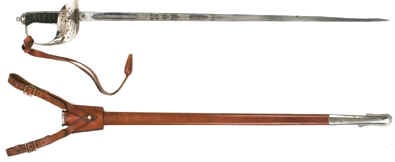
For true power, however, nothing came close to my Grandfather’s sword. It was kept in a special sheath of oilskin and only taken out on special occasions. The mixture of fear and awe that I experienced as a small boy as the long blade emerged from its leather scabbard is easily imagined.

For it was a thing of both beauty and power. Its greased blade was engraved with the most intricate filigree and just below the hilt a brass Star of David was inset. The initials of the King-Emperor, Edward VII, took pride of place on the finely-wrought guard to show at whose pleasure my Grandfather served.

It was a treasured heirloom of my family – a taonga filled with potent magic.

It rests now in the Oamaru Museum – where I hope it is accorded the same deep respect it always demanded – and received – from me. 

Tuesday, 12 October 2010

Making Connections

Big-ups to the new Super-Mayor: Len Brown’s mayoral campaign provides a text-book example of "the politics of connection".

HAD THE EARTH not moved on 4 September, it’s highly likely New Zealanders would have woken up on 10 October to find four new mayors in the four main centres.

The devastating earthquake which struck Canterbury, and Mayor Bob Parker’s response to the crisis it created, dramatically changed the electoral equation in Christchurch City.

In Mr Parker’s own words: "During the earthquake enough people saw something in me that they thought was worthy of their support. The community had a chance to see me experiencing all of the same trauma and getting on with the job, just like they had to, and I’m sure that did me no harm."

Few would dispute that assessment, and in a curious way Mr Parker’s explanation of why Cantabrians flocked to the incumbent’s mayoral banner also explains why in Auckland, Wellington and Dunedin so many voters deserted theirs.

Right across the country there is a growing sense of disconnection between ordinary citizens and the people who govern them.

For democracy to work, voters need to feel that their communities and their country are being run by people committed to serving their interests. More importantly, they strongly believe that big changes – the sort that have a real impact on their day-to-day lives – should never be made without their prior consent.

Before the earthquake, most Cantabrians were of the view that Mayor Parker had shown insufficient deference to the wishes of Christchurch voters, and that too many important Council obligations were being undertaken (or set aside) behind closed doors.

Mr Parker’s challenger, Jim Anderton, tapped into this vein of popular discontent with considerable success: the one big poll conducted prior to the earthquake placed him well ahead of his opponent.

It was only when Christchurch voters were able to see with their own eyes that their Mayor was experiencing the same intense emotions as themselves; that he, too, was worried about his family, his home, his neighbours and his city; only when their shared suffering had transformed him into one of them could Mr Parker be reconnected to the democratic power-grid.

And the moment that reconnection was made, Mr Anderton’s cause was lost.

In Auckland, Wellington and Dunedin, however, there was no natural disaster to reconnect the rulers with the ruled. In these cities (and many others besides) the voters’ growing disaffection with unaccountable politicians and bureaucrats was given dramatic political expression.

In Auckland, particularly, Len Brown’s mayoral campaign provides a text-book example of "the politics of connection".

From the get-go he aligned himself with the majority of Aucklanders who were either opposed to or uneasy about the way the amalgamation of Auckland’s eight local authorities into a single "super-city" was being managed.

Many people feared the new entity would become a political vehicle for the sort of far-right economic policies associated with the Act Party leader (and Minister for Local Government) Rodney Hide. They were angry that the new structures of local governance were being imposed on them without a clear democratic mandate.

Mr Brown became their champion. He promised to make the new super-city work for everyone – not just a wealthy few.

It would be futile to deny that there was a left-wing flavour to Mr Brown’s rhetoric, but what mattered much more was the strong connection which existed between the Manukau Mayor and Manukau’s voters.

In many ways Mr Brown is the antithesis of a modern-day leftist. He is a devout Christian who evinces what the Americans like to call "traditional family values", and he’s old-fashioned enough to use expressions like "for the love of the people" when explaining his political motivation.

Mr Brown’s traditional values are, however, the reason why so many Pasifika and Maori voters living in South Auckland look upon him as one of their own. It’s why so many Samoan ministers and Tongan pastors stood up in their churches and urged their congregations to go home and vote for the Palangi lawyer who – more than any other Mayoral candidate – makes a genuine connection with their people.

Some commentators are characterising the victories of Len Brown, Dunedin’s Dave Cull and (possibly) Wellington’s Celia Wade-Brown as harbingers of a 2011 Labour victory.

I’ve yet to be convinced.

The question that must be answered before predicting a change of government in 2011 is whether or not Labour, and its leader, Phil Goff, are making the sort of vital connections with their electoral base that swept Mr Parker and Mr Brown to victory.

The pollsters suggest that Labour’s not there yet. More importantly, they’re saying that the Prime Minister, John Key, still is.

Unless and until Labour and Phil Goff (or some fresher face) can bring about a seismic shift equal in magnitude to the real one of 4 September, any connection between the voting behaviour of 2010 and 2011 must remain moot.

This essay was originally published in The Press of Tuesday, 12 October 2010.

Friday, 8 October 2010

Driving In Illiberal Circles

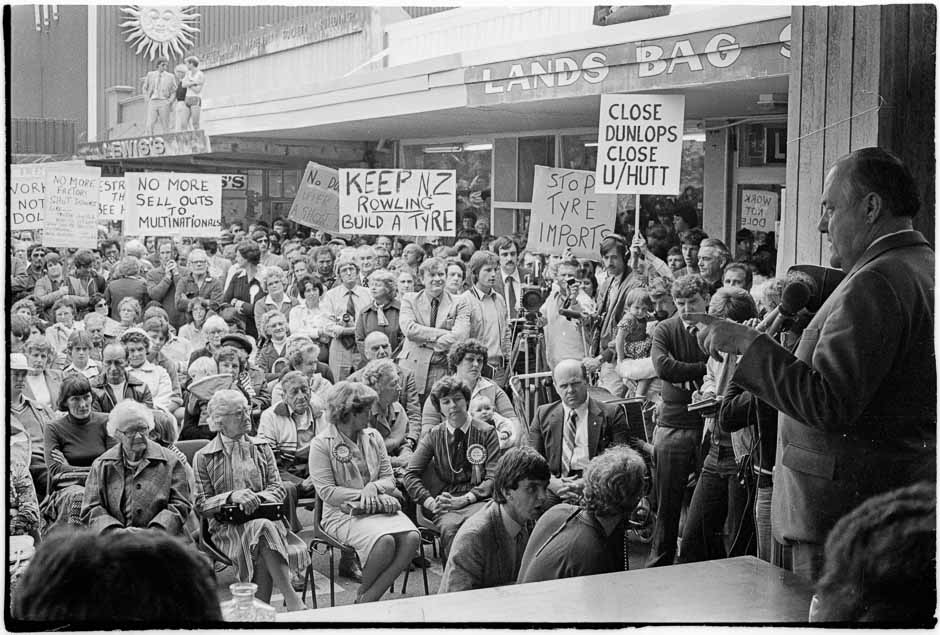
However did he win? Rob Muldoon addresses a National Party-organised campaign rally in the Upper Hutt Mall, 1981. Our eyes are drawn immediately to the placards carried by the Labour-supporting rubber workers, but it was the voting strength of all those undemonstrative electors listening attentively to "Mr Muldoon" which counted on election day. Disgraced Breakfast host, Paul Henry, may have many more supporters out there than Liberal New Zealand likes to think.

LIBERAL KIWIS said it so often that conservative comedians turned it into a joke: "I don’t know how Rob Muldoon got elected – nobody I know voted for him!"

You’d be surprised how many liberals struggled to see the humour in that sentence. Conservatives, on the other hand, got the joke straight-away.

They, at least, understood that liberal New Zealand constituted a small, self-referential elite that was ideologically, culturally and socially cut off from the overwhelming majority of the population.

And that, of course, was the whole point of the joke.

In the isolated liberal communities of academia, the artistic community, the news media and whatever passed for bohemia in the 1970s hardly anyone ever voted for the National Party.

Hence liberal New Zealand’s profound sense of shock and dislocation when the rest of the population turned away from Bill Rowling’s Labour Government in 1975.

I well recall the day, a few weeks before the 1975 General Election, when I found myself in a room chock-full of the Wellington cultural elite. In one corner sat the acting head of the Arts Council, a couple of nationally renowned poets occupied the sofa, and the rest of the space was filled up with writers, film-makers, academics and art students.

I had not long returned from a hitch-hiking tour of the South Island, during which I’d exchanged ideas with all sorts of New Zealanders. Mile after mile of these conversations had left me harbouring serious doubts about the longevity of Bill Rowling’s Labour Government.

Norman Kirk, it seemed, had been a man like themselves. But Bill Rowling? (Not to mention all those "intellectuals" surrounding him!) Well, he was a different matter.

Though they struggled to put it into words, many of the motorists who picked me up clearly believed the country was slowly slipping from their grasp. There were too many people like me, they said. Too many footloose, restless and unanchored youngsters. Too many long-haired hippies willing to challenge the ideas and institutions upon which they had built their lives.

"Rob Muldoon will sort your lot out", they would say, grinning widely. But I couldn’t help noticing that in their eyes there wasn’t the slightest trace of mirth.

Among the gaggle of liberal worthies I’d joined that day was the headmaster of my old secondary school – a wise, tolerant and generous man I greatly admired. I told him what I’d heard on my travels and asked for his thoughts on the imminent election.

"Don’t worry, Chris," he reassured me, "New Zealand will never vote for a man as far to the right as Muldoon."

Certainly, no one in that room did.

Thirty-five years later, with Breakfast host, Paul Henry, offering-up yet another gobbet of reactionary tripe to his television audience, I couldn’t help recalling those 1975 conversations.

They helped me resist the temptation to add yet another liberal voice to the cacophony of outraged protest.

That the redoubtable Joris de Bres, acting on behalf of left-thinking liberals everywhere, would bring to bear the full weight of the Race Relations Conciliator’s office, I hadn’t the slightest doubt. Just as I was certain that every left-wing blogger capable of spelling "bigot" and "redneck" would be reaching for the nearest keyboard.

Recalling those thirty-five-year-old conversations, I was equally certain that there wouldn’t be a single liberal commentator who didn’t consider Mr Henry’s comments regarding the identity of Governor-General Anand Satyanand to be both adolescent and unforgivable.

There’d be no votes for Mr Henry in liberal circles.

But what about out on the road?

What would New Zealanders living outside the charmed circles of Kiwi liberalism have to say about Mr Henry’s outburst?

"For crying out loud, mate, he was only saying what right-wing buggers like me are thinking. That Governor-Generals are supposed to be like everybody’s grand-dad – stuffed shirts with heads of white hair and plums in their mouths. At least they were when I was a kid.

"This guy we’ve got now, Satyanand or-whatever-his-name-is. Wasn’t he one of Aunty Helen’s appointments? Someone who ticked all the politically-correct boxes?

"That’s all Henry was trying to say for God’s sake. That Satyanand only got the job because the Labour Government needed to shore up its vote in the immigrant community. It’s hardly bloody rocket science – is it?"

To which I’d have to reply: "No, mate, it isn’t."

This essay was originally published in The Timaru Herald, The Taranaki Daily News, The Otago Daily Times and The Greymouth Evening Star of Friday, 8 October 2010.

Thursday, 7 October 2010

Executive Obligations

The service of their swords: For your average medieval knight the essence of the feudal deal was pretty simple: the land was yours, but only for as long as you were willing and able to protect it - along with all those who lived on it and off it. It's taken far too long, but finally our National Party lordlings have realised that if they cannot defend New Zealand's farmland their political tenure will soon be forfeit.

THERE WAS A TIME when the ruling elites had to put their money where their mouths were. More to the point, if they wanted to go on ruling (let alone remain one of the elite) they had to put their lives where their money was.

Back in the Middle Ages, if you weren’t willing to defend your own and your dependents’ lands, then in the eyes of your fellow aristocrats, your men-at-arms, your tenants and most especially your serfs, you weren’t fit to hold them.

That’s because the protection of land – the resource upon which everyone ultimately depends for survival – was the very essence of the feudal system. The serfs, who made up most of the population and supplied all the food, owed many kinds of services to their lord. But their lord, by the same feudal token, also owed services to them.

This reciprocity had a name: noblesse oblige. The obligations of nobility.

And the most important of these was the obligation to defend the demesne: the lands apportioned to lords by their master – the King. Above and beyond all other services, a feudal aristocrat owed his liege-lord (from whom he received the property and people entrusted to his care) the service of his sword.

Even today, defending the source of the people’s wealth and welfare is the sine qua non of executive responsibility. A lord who refuses to defend his demesne is traitor to both his King and his people.

How pleasing, then, that our own "feudal lords" – John Key and Bill English – have finally rendered us the service of their regulatory swords. What remains of this country’s productive farmland: the demesne apportioned to them by their liege-lord and sovereign – the New Zealand people – will not, now, be permitted to fall into foreign hands.

Not that we serfs should forget how much urging it took to recall these lordlings to the obligations of their democratic ennoblement. Nor should we overlook the startling fact that under the stewardship of those wearing Labour’s livery the Overseas Investment Office permitted foreigners to purchase an astonishing 650,000 hectares of the people’s demesne.

The Wearers of Red, who today criticise the Wearers of Blue for their tardiness in addressing the problem of strategic resource alienation, had nine years to redraft the legislation governing the scale and scope of foreign investment in New Zealand – and did little more than tinker around the edges.

But perhaps we shouldn’t be too hasty in condemning our political masters. Considering the multitude of evil counsellors whispering in their ears, it’s surprising we have any land left at all.

What advice do you suppose the foreign moneylenders are offering them? What demands are being made by our desperately indebted farmers? How many of them can afford to refuse the foreigners’ proffered gold?

And what about the mad monks of Treasury – and their even more ascetic brothers in the Business Roundtable? Having compelled us all to wear the hair-shirt of deregulation and the flesh-biting cilice of free trade, they are still urging our leaders to surrender what’s left of New Zealand’s patrimony to the Holy Church of Globalisation.

That the Prime Minister and his Minister of Finance refused to be swayed by such evil counsels is cause for celebration. But, while we are praising our lords for the service of their democratic swords, let us also offer up a word or two of thanks to the Crafar family.

Had their debt-laden farms not come so close to passing forever into foreign hands, it is very doubtful whether we inattentive serfs or our indifferent lords would ever have become sufficiently roused to rise in defence of our beleaguered demesne.

Having lifted not one finger to save the 650,000 hectares that disappeared into foreign ownership over the past decade, the pledge of every citizen, and every political party must now be: New Zealand for New Zealanders!

Whoever seeks to purchase New Zealand farmland must agree to live on it – or look elsewhere.

This essay was originally published in The Dominion Post, The Timaru Herald, The Taranaki Daily News, The Otago Daily Times and The Greymouth Evening Star of Friday, 1 October 2010.