Thursday, 13 August 2015

“TPPA, Or Not TPPA?” – Table Talk No. 5 At The Ika Seafood Bar & Grill.

Star Of The Show: Professor Jane Kelsey takes her role as an academic and public intellectual seriously. For her, the universities’ statutory obligation to be the “critic and conscience” of New Zealand society is keenly felt and courageously expressed. For much of her adult life she has criss-crossed the globe, from one set of trade negotiations to the next, making contacts, developing information networks, and struggling ceaselessly to bring the dark and dirty secrets of global capitalism - like the TPPA - kicking and screaming into the sunlight of public scrutiny.
 
CONGRATULATIONS ARE DUE to the organisers of last night’s (11/8/15) “Table Talk” at Laila Harré’s Ika Seafood Bar & Grill. The fifth such event, “TPPA or Not TPPA?”, was emceed by the irrepressible Wallace Chapman, and featured a panel which, for the first time, was evenly split between protagonists and antagonists.
 
And, it was a wee ripper!
 
In support of the Trans-Pacific Partnership were Dr Wayne Mapp (former Cabinet Minister under John Key and currently a member of the Law Commission) and Michael Barnett (CEO of the Auckland Chamber of Commerce). Opposing the TPPA were Professor Jane Kelsey (Professor of Law at the University of Auckland and author of the just published deconstruction of neoliberalism in New Zealand, The Fire Economy) and Dr Joshua Freeman (Clinical Microbiologist at Auckland City Hospital and an honorary academic at the University of Auckland School of Molecular Medicine and Pathology).
 
The huge benefit of having Wayne and Michael debating with Jane and Josh was that the audience (which, let’s be fair here, was overwhelmingly anti-TPPA) got the chance to compare and contrast, weigh and evaluate, the arguments of both sides of the issue. This is not always possible in those panel discussions where every participant pretty much agrees with every other. These might make people feel better (having one’s preconceptions confirmed is always gratifying) but it does not test them. To do that a genuine debate is required.
 
There’s no disputing that, over the course of an hour or so of lively discussion, the arguments, both for and against the TPPA, were tested. Equally indisputable, in my opinion, was the identity of the winners. Neither Wayne nor Michael were even close to being a match for Jane and Josh. Indeed, beyond a meagre collection of conventional “free trade” tropes, the TPPA protagonists had virtually nothing to offer.
 
In this they were, ironically, the victims of their own side’s obsession with secrecy. Operating almost exclusively on the tiny amount of information the Key Government has seen fit to release to the public, and utterly reliant on the solemn undertakings and promises enunciated by Messrs Key and Groser, Wayne and Michael could do little but point to the “success” of the NZ-China Free Trade Agreement and raise fears about what would happen to “poor little New Zealand” if it allowed itself to be “locked out” of an agreement as important as the TPPA.
 
Jane and Josh demolished these stock “free trade” arguments without breaking a sweat. Though I wouldn’t have said so before the debate, by the time it was over, it was painfully clear that the protagonists were out of their depth. As a clinical microbiologist, and the TPP spokesman for Ora Taiao, the New Zealand Climate and Health Council, Josh was absolutely on top of the likely consequences for Pharmac, and by extension, the future health of New Zealanders, should the transnational pharmaceutical corporations succeed in having the life of their patents extended. On more than one occasion during the hour, the facts and figures at Josh’s fingertips left Wayne and Michael floundering helplessly in their own ignorance.
 
But it was Professor Jane Kelsey who truly stole the show. Astonished by her encyclopaedic knowledge of just about every item of leaked information concerning the TPPA (as well as the details of all the other FTAs New Zealand has signed) Wallace could not restrain himself from demanding to know “How do you manage to read all this stuff?!” It was an entirely forgivable outburst.
 
The answer, of course, is that Jane takes her role as an academic and public intellectual seriously. For her, the universities’ statutory obligation to be the “critic and conscience” of New Zealand society is keenly felt and courageously expressed. For much of her adult life she has criss-crossed the globe, from one set of trade negotiations to the next, making contacts, developing information networks, and struggling ceaselessly to bring the dark and dirty secrets of global capitalism kicking and screaming into the sunlight of public scrutiny. It is easy for the Right to dismiss her arguments when she isn’t there to defend them, but put her on the same stage as people like Wayne and Michael, or pit her against Mike Hosking, live, on Seven Sharp, and her critics’ arguments are swept away like so much summer gossamer.
 
By the end of the hour, it was clear to everyone that the TPPA – like War in the old 60s poster – “is harmful to flowers, children and other living things”, and that only a truly mendacious government would commit its citizens to what is, in effect, an empowering charter for transnational capital.
 
In conclusion, the answer to the question: “TPPA, or Not TPPA?” is “Not TPPA!”
 
Be sure to join the Anti-TPPA protest march in your town on Saturday, 15 August.
 
This review was originally posted on The Daily Blog of Wednesday, 12 August 2015.

Tuesday, 11 August 2015

Winston Peters Seizes The Moment.

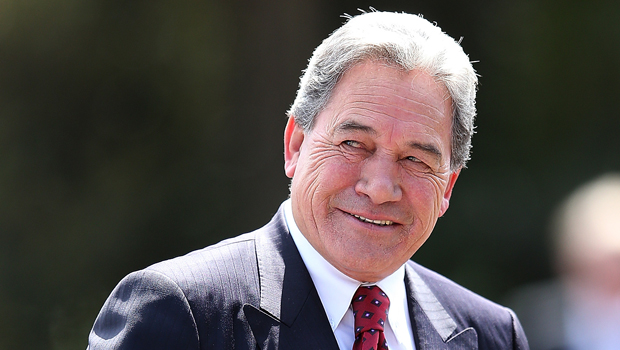
Eyes On The Prize: Success in the 2017 General Election will go to the politician best equipped to recognize - and exploit - the impending populist moment. There can be little doubt that the politician currently best placed to do both is the NZ First leader, Winston Peters.
 
THOSE SUFFICIENTLY CAPTIVATED by politics to spend their weekend mornings watching current affairs television were more than repaid for their dedication by Sunday’s Q+A. On display were the talents of Labour’s Andrew Little and NZ First’s Winston Peters. At the end of a week of unrelenting bad news for John Key’s National Government, both politicians were given an opportunity to shine. Only one of them took it.
 
Peters is on a roll that may yet see NZ First overtake the Greens as this country’s third-largest party. His performance on Q+A showed us how he might do it.
 
With New Zealand’s dairy farmers reeling from the grim news of “Black Friday” – when the numeral preceding Fonterra’s proposed pay-out per kilogram of milk solids changed from a 5 to a 3 – Peters presented himself as the agricultural sector’s saviour. Blessed with the perfect foil: Federated Farmers President, Dr William Rolleston; the NZ First leader did what he does best. He condemned Dr Rolleston as a Government apologist – hinting darkly that Kiwi farmers’ official representatives were failing in their duty.
 
For people under acute economic and social stress, the whiff of conspiracy is all-but-irresistible. It is much easier to believe that sudden and catastrophic events are the result of deliberate human agency than it is to accept them as the product of vast and impersonal forces, far beyond the conscious control of any single individual. But, on those not uncommon occasions when both explanations contain a portion of the truth, the scope for political mobilisation is huge. Watching Peters’ performance on Q+A there can be little doubt that New Zealand’s pre-eminent populist politician has seen it, understands it, and intends rousing rural and provincial New Zealand on the strength of it.
 
He saw it first in Northland: the loss of confidence in the future; the closing of the business person’s chequebook; the pervasive sense of drift – as if there’s no one on the bridge of New Zealand’s ship of state. As if this wasn’t alarming enough, he also picked up something else. It was just a feeling, but, for governments in their third terms, such feelings often prove fatal.
 
Across the whole of Northland, even among the well-heeled residents of Russell and Kerikeri, there was a feeling that the Government had lost interest in them; that the politicians who had ridden to power on their votes no longer cared about the fate of their farms, orchards or businesses. That, because they lacked the clout of Hollywood movie moguls, Aussie casino owners, huge transnational corporations, or the Prime Minister’s Hawaiian golfing-buddy, their voices were getting lost in the din.
 
NZ First’s campaign song for the Northland by-election was “Help Is On Its Way” by the Little River Band, and it struck precisely the right note. Chosen months before “Black Friday” dealt its body-blow to the nation’s dairy farmers, the prescient pertinence of the song’s refrain can only grow as the seasons pass and the quantum of farm debt becomes insupportable.
 
Rolleston accused Peters of panicking, but the tone of urgency in the NZ First leader’s voice was not only entirely appropriate, it was also, astonishingly, unmatched. Neither Rolleston, himself, nor the Prime Minister, nor the Labour leader, Andrew Little, sound even remotely like someone who grasps the seriousness of what is unfolding in rural and provincial New Zealand.
 
Under attack for being “Angry Andy”, Little has clearly been told to present as calm a façade as possible to the electorate. In a political environment less fraught with dangers, this would be good advice. Little’s problem, however, is that over the past month there has been a coming together of issues far too serious for the sort of phlegmatic responses he has been offering. With the economy teetering on the brink of recession, and the nation’s sovereignty under threat from the Trans-Pacific Partnership, the return of “Angry Andy” would be welcomed.
 
A debut appearance by “Decisive Andy” wouldn’t hurt either. Why Labour is so unwilling to rule out support for the TPP – at least in its present leaked and hinted-at colours – is a tactical mystery. Certainly, Little’s reticence on the subject offers a poor contrast to Peters’ long-standing and unequivocal rejection of TPP’s alleged contents. It’s all of a piece with his party’s foundational promise to put New Zealand first.
 
At his party’s recent conference in Rotorua, Peters urged delegates to drive up the membership of NZ First with an additional 10,000 new recruits, and to give him a war-chest of at least a million dollars. As New Zealand succumbs to the same political paranoia that has overtaken the democracies of Europe and North America, Peters expects his party to be match fit.
 
Angry and unequivocal: revelling in the role of prophetic outsiders; Peters and NZ First will meet 2017’s electoral questions with provocatively populist answers.
 
This essay was originally published in The Press of Tuesday, 11 August 2015.

Of Messengers And Messages: Reflections On Rachel Smalley's Controversial Column.

Greater Gender Balance Equals Greater Diversity? Well, yes, Rachel Smalley, but only in relation to gender - a factor which in no way guarantees a diversity of viewpoints. And it is, surely, the messages which are carried on the nation’s airwaves that matter most – not the gender of the broadcasters who carry them?
 
IT WAS ONE of the most “respectable” of the Suffragette arguments. Give women the vote. Allow them to stand for Parliament. Make them ministers – even prime ministers – and society will be transformed. The mere presence of women in the halls of power (respectable women, that is, because powerful men and disreputable women have never been far apart) can only soften the raw masculinity of the political process and usher in a more caring, a more productive, and – most importantly – a more peaceful world.
 
All nonsense, of course. No sooner was war declared in 1914, than the leader of the British suffragettes, Emmeline Pankhurst, and her ambitious eldest daughter, Christabel, were up on the nearest platform, loudly urging every able-bodied British male to enlist in the great fight for King and Country. From chaining themselves to railings, the Pankhurst’s impressive army of suffragettes were swiftly redeployed to handing out white feathers to any young man not in uniform. When it came to mass slaughter, the female of the species was determined to prove herself no less deadly than the male.
 
Or, even deadlier. Because, once again, when women did become prime ministers (be it Israel’s Golda Meir, India’s Indira Ghandi, or Britain’s Margaret Thatcher) they did not show themselves to be one whit less willing to unleash fire and death than their male counterparts. (As anyone familiar with the careers of Boudica, Isabella de Valois, Catherine de Medici, Elizabeth I or Catherine the Great could confidently have predicted!)
 
Old news, one might say. But, one would be wrong. Because no matter how many times it is knocked down, the argument that women, simply by being there, or by virtue of some magical essence peculiar to the female of the species, will make an important difference to the way everything from corporations to cabinets are run, keeps popping right back up again.
 
The argument’s latest protagonist is the broadcaster Rachel Smalley, who used the occasion of John Campbell’s appointment as Radio NZ-National’s new drive show host to lament the preponderance of male voices on prime time radio.
 
“The perspective a male host takes into an interview is often very, very different to that of a woman”, wrote Smalley, in her column on the Newstalk-ZB webpage. “The perspective any of these hosts take into an interview about domestic abuse, sexual violence, or funding cuts to women’s refuge will be very different to mine.”
 
Really? I would have thought that, on any issue, a journalist’s perspective – male or female – would be determined by their willingness to set aside stereotypes and prejudices and allow their professional judgement to be guided by the evidence on offer. And isn’t their personal response to domestic abuse and sexual violence as likely to be determined by their capacity for empathy as their gender? After all, it was a male, David Cunliffe, who told a women’s refuge conference that the statistics relating to sexual violence made him “sorry to be a man”. By no means all the people who pilloried him for that comment were men.
 
Indeed, Smalley’s assumptions regarding the positions a male journalist is likely to take on everything from paid parental leave, to aid for victims of the wars in the Middle East, might, themselves, be characterised as examples of sexist prejudice. Do fathers have no stake in the quantum of paid parental leave? Do journalists like Robert Fisk, and our own Jon Stephenson, not risk their lives to bring the stories of the victims of war to the world?
 
Smalley’s argument would have been a great deal stronger if she had couched it in terms of ideological, rather than gender, diversity. The problem with prime-time radio in New Zealand is not a preponderance of male voices, but of right-wing voices. It is, surely, the messages which are carried on the nation’s airwaves that matter most – not the gender of the broadcasters who carry them?
 
Mary Wilson (the broadcaster John Campbell is about to replace on week-nights between 5:00 and 7:00pm) will soon be playing a major role in shaping the messages coming out of Radio NZ-National. Reality TV suprema, Julie Christie, already plays a very similar role at MediaWorks.
 
Now, ask yourself: Are the radically different messages carried by these women’s respective networks more likely to be the product of their makers’ gender – or their politics?
 
This essay was originally posted on The Daily Blog of 10 August 2015.

Saturday, 8 August 2015

Revolution In Pipitea Street: The Listener Celebrates The Baby-Boomer Takeover Of The SIS And The GCSB.

Spook Central: Both the SIS and the GCSB are headquartered at "Pipitea Plaza", a 2011 building located just a few hundred metres from Parliament Buildings in Central Wellington.
 
WOW! The SIS Director marched against the Springbok Tour! And the Acting-Director of the GCSB is a lesbian. But, wait, there’s more: the Inspector General of Intelligence used to be a member of the Socialist Action League, and worked in a freezing works for six years! And they’re all women! Surely, with people like these in charge of New Zealand’s “intelligence community”, no reasonable, fair-minded citizen could have the slightest cause for complaint? Clearly, this is a new order in the making. No more Penthouses, no more pies. No more grim, trench-coated spies. The bad old days are as dead as Rob Muldoon. Gone, like the Cold War.
 
Or, at least, that’s what we are supposed to think. “We” being the readers of the Listener. (Issue Dated: August 15, 2015) Baby Boomers mostly. Well-educated and well-heeled. A great many of whom marched against the Springbok Tour, flirted with revolutionary politics in our student days, and then went on to bigger and better things. Some of our best friends are lesbians. Yep, “we” can rest easy now that our generation has taken over everything – even the SIS and GCSB. Baby-Boomers Rule – OK!
 
Was it Listener editor, Pamela Stirling, who came up with the idea? Or, did free-lance journalist, Rod Vaughan, pitch it to her? And was the deal clinched by the promise of access to all three chiefs? And whose idea was that? At some point, someone in the “intelligence community”, decided that a front page story about a “revolution” sweeping the corridors of Pipitea House would be just what the Director ordered. The question is: was that decision made in response to Rod Vaughan’s request for access? Or did someone make Rod an offer that he – and Pamela – couldn’t refuse?
 
Because a front-page story in the Listener, reassuring the Baby-Boomers that the SIS and GCSB are now being run by people just like themselves, was bound to prove very helpful - especially now. That’s because a Government-commissioned review of both agencies, led by Sir Michael Cullen and Dame Patsy Reddy, is about to start asking questions. A cynic might observe that Rod Vaughan’s article has very helpfully suggested most of the answers.
 
What is there to fear, after all, from an SIS staffed by scores of bright-eyed young university graduates determined to keep New Zealand safe from “extremist behaviours”? Or, a GCSB run by someone who understands the importance of reminding “the troops” to “remain focused on the job at hand and to remember their responsibilities to all New Zealanders.”
 
Not that Sir Michael is likely to deliver a report recommending the upsetting of too many apple carts. As Helen Clark’s finance supremo, he always appeared to be doing his best to deliver what the state expected of its ministers. Yes, in the House he could summon up a rhetorical storm fit to set the Tories a-trembling. But, in the Joint Intelligence Committee, sweet reason seems to have prevailed. If Michael Cullen has ever been guilty of troubling the sleep of the “Deep State”, there is scant evidence for it.
 
On the off-chance that there might be New Zealanders less willing to let the Deep State escape all serious scrutiny, however, why not engage in a little pre-emptive PR? A story in the Listener, in which all the “news media, politicians, bloggers and activists” guilty of poking their noses into “the labyrinthine world of the New Zealand intelligence community” were shown to be “completely oblivious to [the] revolution that [is] well under way” within its walls, would undermine any future attempts to “pillory and hold accountable” those responsible for keeping the nation’s secrets.
 
That this could well be the case is confirmed by the Listener’s choice of headlines for Rod Vaughan’s article. The story about SIS Director, Rebecca Kitteridge is called “Secrets & Spies” – a clear reference to Nicky Hager’s exposé of the malign influence of PR on New Zealand politics entitled Secrets and Lies. The story about Una Jagose, Acting-Director of the GCSB, boasts an even more in-your-face thrust at the critics of the SIS and GCSB. It is headlined “Moment of Truth” – which is, of course, the name of the Kim Dotcom-sponsored event featuring Glen Greenwald and Edward Snowden that was held in the Auckland Town Hall just days before the 2014 General Election.
 
The triumphalism of the Listener could hardly be more explicit. In the words Sir Michael Cullen is said to have used to taunt his Tory opponents following the 1999 Labour-Alliance victory:
 
“We won. You lost. Eat that!”
 
This essay was originally posted on The Daily Blog of Saturday, 8 August 2015.

Friday, 7 August 2015

Reports Of NZ First’s Death Are (Still) Exaggerated.

Still Smiling: New Zealand’s leading political journalists appear to operate a roster when it comes to disparaging Winston Peters and his party. This week it was the turn of veteran NZ Herald journalist, John Armstrong, to put the boot in. That NZ First's prospects have seldom looked better was not permitted to influence Armstrong's tale of decline and doom.
 
A JOURNALIST FRIEND of mine once told me that most politicians’ credibility was inversely proportional to their proximity. Which was just her fancy way of saying “familiarity breeds contempt”. Which is about the best reason I can come up with for the Parliamentary Press Gallery’s ongoing, undisguised and frequently ill-judged contempt for Winston Peters and NZ First.
 
New Zealand’s leading political journalists appear to operate a roster when it comes to disparaging Peters and his party. This week it was the turn of veteran NZ Herald journalist, John Armstrong, to put the boot in.
 
In addition to being “unfashionable – and deliberately so”, Peters followers were also, in Armstrong’s expert opinion, “politically dazed and confused”. With their vision of the future “based on nostalgia for the relatively recent past”, Armstrong described NZ First’s supporters as being “marooned in a time bubble”. And that time would be? The New Zealand of the prosperous 1950s. With Peters’ small-c conservatives revelling in “the suffocating social conformity of that era”.
 
Entertaining writing, to be sure, but it has little, if anything, to do with Peters or the NZ First Party. Indeed, it’s the sort of condescending tosh meted out (with only a name change or two) to any politician or political party which dares to defy the neoliberal orthodoxy of our own era. The purpose of the insults is to encourage the reader to identify with the writer, and not the subjects, of the commentary. Who in their right mind would admit to being “unfashionable”, “dazed and confused”, living in a “time bubble” or revelling in “suffocating social conformity”?
 
In reality, of course, NZ Firsters are none of these things. Far from being “dazed and confused”, they are considerably more focused on what is happening in New Zealand – especially rural and provincial New Zealand – than the great majority of the conventionally-wise metropolitans to whom Armstrong is, presumably, appealing. What Armstrong condemns as “suffocating social conformity” and the “myth of a better past”, they recall as a period of strong communities and mass participation, when there were jobs and homes for everyone, and an entire household could live comfortably on a single income.
 
That Armstrong goes to such lengths to ridicule the historical memory of the NZ First voter is actually highly instructive. History is Kryptonite to Neoliberalism. Like Pol Pot’s genocidal Maoism, it needs to erase the memory of everything that existed before the revolution – “Year Zero”. Only those who know nothing of the child and family-centred social policies of the 1950s and 60s could possibly accept Armstrong’s “suffocating social conformity” as an adequate characterisation of the New Zealand of 50 years ago. There was a time when journalists aspired to do more than promote historical amnesia. But, like so much else, that was before 1984 – our own “Year Zero”.
 
Armstrong comforts his readers with the thought that NZ First’s prime electoral demographic – the so-called “RSA Generation” born in the 1920s – is a wasting asset. He argues that the party’s refusal to confront the “myth of a better past” condemns it to a slow death: “as those who lived through those times and who gain comforting reassurance from Winston Peters’ pronouncements pass away.”
 
Had Armstrong but looked around him at NZ First’s Rotorua Conference, he would have realised the inadequacy of that analysis. In 1993, when NZ First was born, the RSA Generation was much in evidence. Twenty-two years later, however, a roll-call of delegates would reveal a preponderance of Baby-Boomers. Armstrong appears to have forgotten that the New Zealanders born between 1946 and 1966 all have direct experience of what New Zealand was like before Rogernomics. Over the intervening 30 years, a great many of them have reached the conclusion that there are much worse things in this world than mediocre coffee and Rob Muldoon. RSA Generation voters, alone, did not take the Northland seat off National.
 
Armstrong would have done better to analyse Peters’ Rotorua appeal for more party members and a bigger war-chest. Standing atop his mountain of Northland ballots, he has seen a nation struggling to keep its head above water. Old, middle-aged and young New Zealanders are desperate to hear that “Help is on its way”. A NZ First that offers up the achievements of the past as proof that the future can be better, will not lack for voters.
 
This essay was originally published in The Waikato Times, The Taranaki Daily News, The Timaru Herald, The Otago Daily Times and The Greymouth Star of Friday, 7 August 2015.

Thursday, 6 August 2015

The Contagion Of Hope: Musings On The Jeremy Corbyn Campaign.

Oh Come All Ye Faithful: How can Jeremy Corbyn possibly be in the lead? After all, the man is an open and unashamed socialist – an affliction which should have ruled him out of serious contention immediately. Even worse, Corbyn’s clothes look like they were bought at a jumble sale – and he has a beard!
 
POLITICS CAN BE HARD on friendships. Radically diverging views on the nature and worth of the Scottish National Party (SNP) and Greece’s Syriza-led government recently ended a relationship of more than 20 years. What student politics and the Labour-Alliance split could not break, was destroyed by my friend’s extraordinary, and, from a distance of 18,000 kilometres, utterly inexplicable, animosity towards any left-wing iteration more exciting that Gordon Brown’s watered-down Blairism. Ending the friendship was made easier, I suppose, by the fact that he has, for many years, lived in Scotland, while I’ve been here in New Zealand. Had I been there, or he here, I suspect things would have come to a head a lot sooner – and it would have been a lot nastier.
 
My own personal setback has, however, made it a lot easier to understand the rapidly rising level of aggro afflicting the British Labour Party’s leadership election.
 
The rise and rise of Jeremy Corbyn is threatening to split the party asunder. The Blairite Right, like my former pal, simply cannot understand the 60-year-old backbench MP for the London suburb of Islington North’s burgeoning popularity. After all, the man is openly and unashamedly left-wing – an affliction which should have ruled him out of serious contention immediately. Even worse, Corbyn’s clothes look like they were bought at a jumble sale – and he has a beard! So why have upwards of 20,000 people joined the Labour Party on the strength of his candidacy? Why have his younger followers taken to chanting “Jez we can!”? And why, oh why, do people insist on abbreviating his name to “JC”?
 
The simple answer is that the Corbyn Campaign is offering people hope. It’s what the SNP offered the Scots, and Syriza the Greeks: a sense that, actually, something can be done; a better tomorrow is possible. Significantly, hope was the attribute most conspicuous by its absence from Ed Miliband’s appeal to the British electorate. That’s because, if my ex-mate is anything to go by, the Labour Right treats hope as the political equivalent of nitro-glycerine – useful in small amounts, and in strictly-controlled settings, but potentially devastating if tossed about all over the place. Labour must be very careful not to raise people’s hopes too high. Why? Because then they’d have to fulfil them!
 
The so-called “left-wing” British commentariat are, for the most part, marching in lock-step with the Blairite Right. Their argument against Corbyn boils down to: He’s going to win, therefore he must not win.
 
That the MP for Islington North is filling halls from Manchester to Luton is, according to the pundits, the best reason for not voting for him. The people turning out for Corbyn, they insist, are nothing like the rest of Britain. The latter know nothing about him, and care even less. Apparently, the only sort of person who can lead Labour to victory, is the sort of person who knows how to woo these know-nothing/care-even-less voters.
 
That sort of leader will, of course, be given his lines by professional political consultants, who will, in turn, have plucked them out of focus groups – filled with, you guessed it, know-nothing/care-even-less voters. The idea that a candidate like Corbyn might, if elected, be able to generate the same sort of hope and enthusiasm among know-nothing/care-even-less voters as he is currently generating among Labour’s rank-and-file, is dismissed out of hand. And yet, all that really distinguishes the people who are turning out in the hundreds to hear Corbyn, from the know-nothing/care-even-less voters, is that somewhere along the line someone gave them enough knowledge to make them care.
 
It’s what lay at the heart of the falling-out between me and my old friend: how we viewed the electorate.
 
To him, the voting public are nothing more than an abstract electoral resource – something to be tapped. They cannot be entrusted with important decisions because they lack the knowledge and experience required to make them. Political power properly belongs to those with the best understanding of how the game is played. The rest of us are merely punters to be convinced.
 
To me, there is always much more that unites the voting public than divides them. This is because, when all is said and done, they are human-beings with human needs. Left-wing politics should be about uniting the electorate around these most basic needs, and then allowing the resulting political energy to change society in ways that allow them to be met.
 
Corbyn’s speeches are not examples of great oratory, but they are peppered with collective pronouns. He talks about “we”, and “us”, and the things that are “ours”. And in the surge of solidarity such language inevitably generates, his listeners catch a glimpse of an alternative future. In Luton, it brought them to their feet. The youngsters chanted “Jez we can!” And their parents reached for Labour Party membership forms.
 
Such is the contagion of hope.
 
This essay was originally posted on The Daily Blog of Thursday, 6 August 2015.

Wednesday, 5 August 2015

Breathless And Irrelevant: Tim Groser Dismisses the TPPA’s Opponents

Scold Mode: “We need adults to do this, not breathless children to run off at the mouth when the deal is not actually finished.” Trade Minister, Tim Groser, makes clear his disdain for the TPPA's opponents.
 
TIM GROSER is not known for saying silly things. In fact, he is one of that fast-dwindling number of public figures who still possesses sufficient faith in his own intellect to insist upon writing his own speeches. It was, therefore, rather shocking to hear him dismiss the organised opposition to the Trans-Pacific Partnership Agreement (TPPA) as “irrelevant”.
 
As a former Marxist, Mr Groser should be under no illusions about the power of radical ideas to shape the discourse of whole epochs of human history. The Pope may have dismissed Martin Luther’s 1517 protests as “irrelevant” – but that did not make them so. Indeed, the “protestant” church is named after them. Nor is it wise to confuse the strength of a protest with the number of people making it. It was Rosa Parks, alone, who refused to give up her seat on that Montgomery Bus back in 1955, but her protest against the injustices of the Jim Crow South touched off an explosion of change.
 
Without Professor Jane Kelsey’s patient amassing of evidence critical of the TPPA, the current upwelling of concern about its likely consequences for New Zealand and New Zealanders would have been much smaller, and considerably less well-informed. As one of the very few Kiwi academics to take seriously the universities’ statutory duty to act as the “critic and conscience” of society, Professor Kelsey has acted as a virtual one-person think-tank, testing the claims of the free-trade crusaders – often to destruction.
 
With Mr Groser arriving home empty-handed from Hawaii, and the next round of TPPA negotiations several weeks away (at least!) how exciting it would be if, in the interim, the Trade Minister and Professor Kelsey could be prevailed upon to participate in a public debate on the pros and cons of persisting with the TPPA. Outside of election campaigns, it’s been many years since a major public debate of this sort has been attempted. If our free-to-air television networks cannot be persuaded to screen the event pro bono, it could, at the very least, be live-streamed on the Internet.
 
A metropolitan town hall packed to the rafters, with tens-of-thousands more following the action on television or the Internet, would, of course, instantly render the opposition to the TPPA extremely relevant. For this reason, alone, Mr Groser and his boss, the Prime Minister, would likely be loath to participate. Merely by appearing on the same stage as Professor Kelsey, the Trade Minister would be acknowledging her as his equal. Given Mr Groser’s recent statement that: “We need adults to do this, not breathless children to run off at the mouth when the deal is not actually finished.” Such an acknowledgement seems … unlikely.
 
Which is a very sad reflection on the state of political affairs in New Zealand. Our leaders celebrate this country’s democratic credentials at every opportunity. Indeed, our historical predilection for “punching above our weight” on foreign policy issues was put forward as one of the best reasons for seating New Zealand at the UN Security Council table. The truth, however, is that it’s been quite a while since we Kiwis did any such thing. For most of the last 30 years, top-down has, rather forcefully, replaced bottom-up.
 
Demanding a major public debate on whether or not to persist with the TPPA would, therefore, be a fine first step towards re-learning the knack of making politicians dance only to the tunes composed by “We, the People” – the voters who elected them. After 30 years of distributing those high-pitched corporate song-sheets, the politicians have, surely, had their turn?
 
Not according to Mr Groser. The Trade Minister is adamant that the negotiation of trade agreements is a matter for the people who know what they are doing – not the people per se.
 
It’s a view deeply entrenched in the Ministry of Foreign Affairs and Trade (MFAT) whose senior officials are absolutely convinced that the ministry’s remit can only be delivered by the sort of elite specialists they have, decade after decade, made it their business to recruit and retain. Mr Groser was, himself, one of their brightest stars. Imagine the celebrations when John Key awarded him the Trade portfolio. Finally, MFAT’s long-term plan for luring the United States into a state-of-the-art, New Zealand-designed, free trade agreement, had a champion worthy of its ambition.
 
Breathless Children: 1 WTO's Millennium Round: 0 - The Battle For Seattle, 1999.
 
And he’ll be damned if he’s going to let the likes of Jane Kelsey and her “breathless children” muck it up. But surely, Mr Groser, you haven’t forgotten the events of 1999 in Seattle, when tens-of-thousands of “breathless children”, braved the riot squads’ rubber bullets and pepper spray to derail the World Trade Organisation’s (still uncompleted) Millennium Round? This world contains more than politicians, diplomats and business-people. Failure to acknowledge the all-too-relevant concerns of ordinary Kiwis will only end in the irrelevancy of Mr Groser.
 
This essay was originally published in The Press of Tuesday, 4 August 2015.