
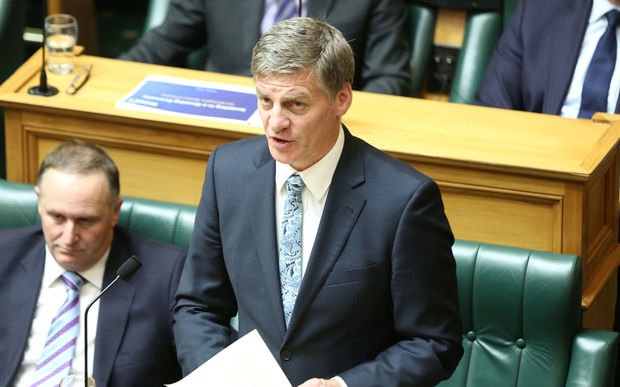
Fundamental Changes, Incrementally Advanced: Bill English delivers his eighth budget. The Finance Minister understands very well the degree to which Labour’s room for political manoeuvre has been circumscribed by the events of the past 30 years. It is what gives him the confidence to contemplate policies – such as his “social investment” programme – that will alter fundamentally the way the poor and disadvantaged are managed by the New Zealand State.
BILL ENGLISH’S LATEST BUDGET is a masterful exercise in
deception. He has done everything he can to mask the effects of the most rapid
expansion in New Zealand’s population since the 1970s. The monies allocated to
the core centres of state expenditure – Welfare, Health and Education – barely
match the rising numbers they are expected to serve. Faced with an intensifying
housing crisis, English’s response has been wholly inadequate. Determined to preserve
the vital political dividend of rapidly rising Auckland property prices,
English and his colleagues have steadfastly refused to address the supply-side
of the housing equation. The crash programme of state house construction that
would end the crisis must wait for a change of government.
All governments take care to tax and spend with an eye to
their re-election. It is a rare political party that will sabotage its own
chances of remaining in office by threatening the status and wealth of their
core constituencies. In the case of the National Party, self-preservation means
doing as much as is politically feasible to advance the interests of farmers,
businesspeople, managers and professionals. In the case of the Labour Party, it
means looking after public sector workers, low-to-middle-income private sector
employees, beneficiaries and those elderly New Zealanders more-or-less reliant
on NZ Superannuation.
English has clearly decided that the best way he can help
National’s core constituencies is to retire as much public debt as possible and
reduce the New Zealand state to approximately three-quarters of its present
size. Dismissing these goals as “purely ideological”, while true, largely
misses the point. It is simply what must be done to give National’s supporters
what they most want from “their” government: lower taxes for themselves, and
higher stress levels for everyone else.
This latter goal is a crucial aspect of right-wing politics.
Only by consistently reducing the political competency of their electoral
rivals’ core supporters can the Right be sure of not only making the gains they
seek – but keeping them. Simply maintaining the economic and social status quo
is never enough. To keep – let alone advance – the interests of their electoral
base, right-wing parties must seize every opportunity to reduce the electoral
heft of the Left’s.
This right-wing aggression presents social-democratic
parties like Labour with a massive dilemma. To advance the interests of their
electoral base it is necessary to advance the interests of New Zealand as a
whole. Investing heavily in upgrading the nation’s infrastructure; stimulating
employment growth; boosting Health and Education; building thousands of state
houses and subsidizing private sector house construction: such measures benefit
not only Labour’s voters, but also, thanks to their expansionary economic
effects, National’s. The balance of political forces is not materially
affected.
The only way for Labour to consolidate and increase its
political advantage is by becoming as aggressive as its right-wing opponents.
Providing decisive legislative support for the trade unions and intensifying
the progressivity of the taxation system are the traditional methods for
boosting the power of the lowest socio-economic groups. Unfortunately, any
Labour Government attempting to implement such a programme in today’s political
environment would instantly be identified as not only a deadly enemy of the
National Party and its supporters, but also of the entire capitalist system.
Every weapon in the Right’s extensive arsenal would be
deployed against such a government, leaving it with just two choices:
submission, or revolution. Our present crop of Labour politicians made that
choice a long time ago. Whatever else they may be, Labour’s Caucus are not
revolutionaries!
English understands very well the degree to which Labour’s
room for political manoeuvre has been circumscribed by the events of the past
30 years. It is what gives him the confidence to contemplate policies – such as
his “social investment” programme – that will alter fundamentally the way the
poor and disadvantaged are managed by the New Zealand State. That the Finance
Minister’s changes are being made incrementally will in no way diminish their
long-term impact.
English and his colleagues are also well aware of the impact
their policies are having on the lowest socio-economic groups propensity to
participate in the electoral process. Slashing and burning the lives of the
poor has not, so far, caused them to mobilise politically (let alone
electorally). On the contrary, the increasingly desperate character of their
existence has made them easy prey for the three “A’s” of social dysfunction:
Alienation, Apathy and Anomie.
None of this is acknowledged in English’s Budget Speech,
nor, for the most part, in the analyses of the mainstream news media. The
Finance Minister’s deception has, once again, proved highly successful. What’s
more, his ruthless reduction in the real value of state spending over the past
8 years has, finally, provided him with a series of substantial budget
surpluses. These are projected to be of sufficient size for English and Prime
Minister Key to offer their core supporters meaningful tax cuts in 2018-19. Any
ethical misgivings National’s supporters might be experiencing currently, about
the condition of the poor, are unlikely to survive their Finance Minister’s
election year munificence.
This essay was originally
posted on The Daily Blog of Friday,
27 May 2016.
