
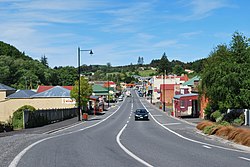
Just Passing Through: But would the social and economic problems confronting contemporary New Zealand have reached their current levels of urgency if the country had retained its former intimate character? If we really were what Statistics New Zealand, in presenting the 2013 Census results, asks us to imagine: a village of 100 people?
MANY NEW ZEALANDERS JOKE about the size of their population.
“Forget about six degrees of separation,” they chortle, “in this country you’re
lucky to make it as far as two!” The general consensus seems to be that if the
rest of the world is a collection of big cities, then New Zealand is a village
– and a pretty small one at that!
But if New Zealand’s a village – what sort of village is it?
A curious question? Not if you’re Statistics New Zealand and
you’re looking for a simple way to present the results of the 2013 Census.
Visit their website and you’ll be asked to think of “New Zealand as a village
of 100 people”.
The first thing you’ll notice about the village is how much
it has grown. Thirty-two years ago there were just 74 inhabitants – most of
them of European and Maori origin. It was also a much younger village. In 1981
half the population was under the age of 28. In 2013 the median age of the
village has climbed to 38 years.
The other thing you’ll notice is how many people living in
the village are now of Asian ancestry. Since 2001 the number of Asian
inhabitants has doubled. Where once there were 5 there are now 11 villagers of
Asian origin.
If the growth in the village’s Asian population is not
slowed appreciably, then the 14 villagers identifying themselves as Maori will
soon be displaced as the second-largest ethnic group. Already, in 2013, as many
villagers speak Hindi as Samoan.
What really stands out about the village in 2013, however,
is its seriously lopsided socio-economic structure. Only ten villagers of
working age earn in excess of $70,000 per annum. There are 25 working-age
villagers earning between $30,000 and $70,000, and 38 whose incomes are less
than $30,000. Over half of the village’s workers earn less than $28,500 per
annum.
The disparity between the earnings of male and female
villagers is ever starker. Over half the working-men in the village earn more
than $36,500, while half of its working-women earn less than $23,100.
The village’s poverty is also on display in the fact that
only 2 out of every 3 inhabitants own their own home. In 2013, more than a
third of the village’s residents live in rented accommodation. Thirty years ago
nearly 3 out of 4 villagers owned their own home.
Of course, for the 10 percent of working New Zealanders
earning a comfortable income it is extremely fortunate that they are not living
cheek-by-jowl with the 50 percent earning less than $28,500 – and that the
people renting their second, third or fourth property live 30 miles across town
and not just across the village street. Social-economic disparities are a great
deal easier to manage, and to bear, when the community’s social-geography
encompasses more than the few square kilometres required to support 100 souls.
The 10 percent of the workforce categorised as
“professionals” are only able to enjoy their well-remunerated and relatively
untroubled lives because they do not have to eyeball on a daily basis the young
women struggling in quiet desperation to raise families on less than $25,000
per annum. Would they really be able to pass them by on the other side of a
village street? Would they really find it so easy to brand them the
“undeserving” poor?
And would those struggling to survive on $25,000 really find
it as easy to sink into apathy and anomie if those living in the big houses and
earning the big bucks were to be found not in leafy suburbs they will never
visit, but just a stone’s throw away at the top of the hill.
If, as Hannibal Lecter so chillingly explained, we covet
what we see every day, then it would not be wise to be too wealthy in a
village.
Maybe that’s why, for a long time in New Zealand, the
distance between the rich and the poor remained so narrow.
This essay was
originally published in The Dominion Post, The Waikato Times, The
Taranaki Daily News, The Timaru Herald, The Otago Daily Times and The Greymouth Star of Friday, 6 December 2013.
