
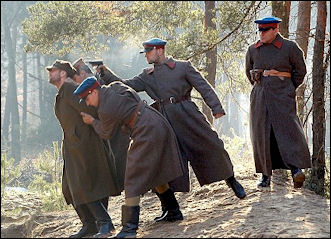
Massacre in Katyn Forest: Seventy years ago the nations of Europe attempted to overwhelm each other by force. Today there are easier ways of getting the better of your neighbours.
IN THE SPRING of 1940, on the orders of Joseph Stalin and his secret police chief , Lavrentiy Beria, close to 22,000 of Poland’s best and brightest citizens were murdered by the People’s Commissariat for Internal Affairs – the NKVD. We remember this crime as the "Katyn Massacre" – named after the Russian forest where the NKVD murdered approximately 3,000 Polish military officers. The mass grave containing the soldiers’ bodies was revealed to the world by the Nazi army of occupation in 1943.
Today, the Katyn Massacre is all-too-easily dismissed as just one more war crime among a host of much larger and more chilling war crimes committed during the Second World War (which began with the invasion of Poland exactly seventy years ago this month). And yet, possibly because it presents New Zealanders with a comprehensible number of victims – 22,000 is roughly the population of Timaru – Katyn may have more to tell us than the almost inconceivable horrors of the Holocaust.
Because the executions ordered by Stalin were not carried out in the name of some insane theory of racial purity. On the contrary, they were undertaken coldly and methodically, in order to more speedily facilitate Poland’s integration into the USSR.
Beria’s logic may have been murderous, but it was difficult to refute. He argued that, when one pares away all the rhetoric, a nation draws its existence from its most intelligent, creative and well-resourced citizens. Execute its senior military and police officers; kill its political and religious leaders; eliminate its intellectuals and artists; wipe out its scientists, engineers, doctors and teachers; get rid of its leading financiers, industrialists and entrepreneurs – and what do you have left? A body without a head. An ant-hill without a queen. A place that is yours for the taking.
Looking back over seventy years, it is Nazism’s twisted passions, and their genocidal consequences, that horrify and appal. With Stalin’s Communists, however, the opposite is true. What horrifies and appals isn’t their passion, but their cynical rationality. The dreadful power of political logic when released from all ethical restraint.
"When the triumph of the Communist International is two centuries old, and the world is at peace," says the NKVD officer, as he reloads his pistol. "Who will condemn, or even remember, what happened here, beneath these gloomy trees? When our great-great-great grandchildren are living the communist dream – who will dare to suggest that the Omelette of Social Justice wasn’t worth the breaking of a few Polish eggheads?"
I THOUGHT OF KATYN last week as I was reading a news item detailing the contents of the latest report from the New Zealand Institute of Economic Research (NZIER). According to NZIER economist, Shamubeel Eaqub, the biggest threat to a sustained economic recovery in New Zealand is the continuing exodus of its people to an economically resurgent Australia.
As I pondered the story, it occurred to me that the lure of a fatter pay-cheque, and the prospect of a more comfortable and secure life, could – if their effects were permitted to spiral out of control – do almost as much damage to a nation’s chances of survival as Beria’s death squads.
How many more years of economic deterioration has New Zealand got in it before a critical mass of her senior military and police officers; political and religious leaders; intellectuals and artists; scientists, engineers, doctors and teachers; leading financiers, industrialists and entrepreneurs all reluctantly conclude that, if it’s a better life for themselves and their families that they’re looking for, then the most likely place to find it isn’t here, in their homeland, but somewhere off-shore?
It’s very far from being an idle question. Because if nothing is done to stem the flow of the best and the brightest New Zealanders to countries where their talents are properly appreciated, and much more generously rewarded, then sooner or later we will arrive at that tipping-point where too few of the sort of people whose function it is too keep a nation functioning will be left to prevent New Zealand from mal-functioning.
When the day comes that too few doctors and nurses remain to keep our health system operational; when there are too few academics and teachers to maintain a First World education system; when the scientific talent simply isn’t here to warrant serious investment in research and development – what will happen? The grim answer, of course, is that all of the patriotic doctors, nurses, academics, teachers and scientists who have remained loyally at their posts, will also conclude that the time has come to leave New Zealand.
The only New Zealanders likely to welcome this failed state of affairs would be the tangata whenua. Statistically-speaking, Maori are over-represented in the unskilled and semi-skilled occupations. So, as more and more highly-skilled and professional Pakeha workers and their families depart these shores, the original New Zealanders will begin to look forward to reclaiming their patrimony. Paradoxically, the very prospect of an emerging Maori majority will become the single most important factor speeding its arrival.
It won’t happen, of course. Before Maori are in a position to proclaim the Kingdom of Aotearoa, one of two outcomes will occur. Either, what’s left of the Pakeha population will petition Australia to admit New Zealand as the Commonwealth’s eighth state. Or, the by now very sizeable ethnic Chinese population will join forces with embittered Pakeha and open the floodgates to immigrants from the People’s Republic.
The first outcome seems the more likely. The Australians are unlikely to relish the prospect of what’s left of Pakeha New Zealand seeking refuge across the Tasman, any more than they’d welcome a larger version of Fiji, or a burgeoning Chinese colony, on their geographical doorstep. Additional pressure for incorporation would come from Australia’s vast population of ex-patriot Kiwis. Who knows, it might even persuade some of them to return "home".
Pondering these possibilities, I got to thinking about John Key’s recent visit to Canberra, where he participated in the very first New Zealand-Australia "joint cabinet meeting". I recalled his enthusiasm for a single currency, and Kevin Rudd’s advocacy of an "ANZAC" ready-reaction force.
"Oh Comrade Beria," I chuckled to myself, "If you’d only known how easy it is to swallow a nation without firing a shot, you’d have told your NKVD troops to put away their pistols and save the ammunition."
This essay was originally published in The Independent of Thursday, 10 September 2009.
