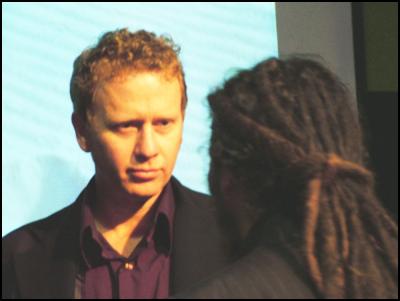
Not This Time - But Never Say Never: James Shaw and his fellow Greens cannot put off forever the hard decision of whether or not to reverse out of the Left-of-Labour cul-de-sac in which they have stranded themselves. As Nandor Tanczos so succinctly put it in a recent blogpost: “players only respect other players”. To negotiate the treacherous rapids of political power successfully, the Green waka’s load must be lightened – by offloading the excessive weight of its conscience.
MUCH HAS BEEN MADE of the “opportunity” the Green Party now
has to “make a difference”. Unsurprisingly, most of this much-making has come from
the right of the political spectrum. The prospect of being robbed of his
“kingmaker” role by a last-minute display of National Party + Greens political
jiu-jitsu, is clearly intended to keep Winston Peters on his tactical toes.
Not all of this tactical advice, however, is coming from the
Nats. The former Green MP, Nandor Tanczos, is also urging the Greens to escape
the self-imposed confinement of their Left-of-Labour cul-de-sac. In a recent
blogpost, he identifies the Greens’ fundamental problem as having bought into
an “inadequate conceptual model” of twenty-first century politics.
Specifically, “the idea that political philosophy can be represented in one
dimension on a straight line between left and right.”
The New Zealanders that Tanczos holds up as the unfortunate
victims of this one-dimensional conceptualisation of New Zealand politics are
the “450,000 small businesses in Aotearoa employing five people or less.”
Self-employment, according to the former Green MP, “speaks
to core Green ideals of supporting local economies, building self-reliance and
personal autonomy, helping people lift themselves out of poverty and fostering
stronger linkages between businesses and the social ecological communities in
which they are located.” Tanczos claims to know “a great many small business
owners who support the ideals of the Greens but who don’t connect with us a
party because we are not speaking to them.”
This is smart thinking on Tanczos’s part. Right from the
start, the Greens most obvious electoral deficiency has been a solid
socio-economic base from which to strike out in pursuit of political power.
Unlike the National Party, with its businessmen and farmers; and the Labour
Party, with its wage-workers and Maori; the core of the Green Party vote has never
consisted of a social class whose interests it protects, but always of a social
movement whose ideals it expresses. Since movements tend to be as varied as
they are volatile, it is no wonder that the level of Green Party support can
fluctuate wildly between one election and the next.
Historically-speaking, the transition from a movement-based,
to a social-class-based, political party is neither easy nor painless. To get
some idea of just how difficult and painful these ideological and sociological
shifts can be, one has only to study the evolution of the German Green Party –
Die Grünen.
Within all Green parties, the most obvious division is
invariably between those who come to the party from what might best be called
the conscientised, publicly-funded salariat (academics, scientists, teachers,
bureaucrats) and those who have made themselves into exemplars of alternative
ways of living in a world dominated by consumption-driven capitalism (students,
artists, hippies, anti-capitalist artisan-activists).
In Germany, the former group was dubbed the “Realos”
(realists) and the latter group the “Fundis” (fundamentalists). The tension
between the two factions became a constant feature of Die Grünen’s internal
politics. The event which tipped this tension into open and bitter intra-party
conflict was – of course – the German Greens’ acquisition of real political
power.
In alliance with Germany’s Social Democratic Party (the
equivalent of New Zealand’s Labour Party) the Greens soon found themselves
confronted with a decision that went to the very heart of their political
philosophy.
It was 1999, and NATO was bombing Serbia. The Greens’
leader, and Germany’s Foreign Minister, Joschka Fischer (a Realo) argued that,
for the first time since the Second World War, German fighter aircraft should
be sent to attack a nation which had not violated Germany’s borders. The Fundis
– many of them veterans of the huge German peace and anti-nuclear movements of
the 1980s – were horrified. Fischer was proposing to violate the core Green
principle of Non-Violence. A Special Conference of Die Grünen was convened in
the city of Bielefeld, in north-west Germany, to decide the matter.

Getting An Earful: Joschka Fischer's "realo" foreign policy prevailed over its "fundi" opposition within Die Grünen, but only at the cost of bitter internal strife.
New Zealanders who lived through the 1981 Springbok Tour
would have recognised all the signs of strife. The conference hall was ringed
with barbed-wire and guarded by hundreds of armed police officers. Delegates
were jostled, and as Fischer entered the hall he was struck by a bag of
blood-red paint. The anger of the Fundi protesters outside the hall was equalled
only by the fury of the Fundi delegates inside. All to no avail. By a margin of
415/335 the German Green Party’s idealistic fundamentalists were required to
make way for its power-wielding realists.
Eighteen years later, Die Grünen, alongside the Free
Democrats (the German equivalent of New Zealand’s Act Party) are engaged in
coalition negotiations with the conservative Christian Democratic Government of
Angela Merkel.
As Nandor Tanczos so succinctly puts it: “players only
respect other players”. To negotiate the treacherous rapids of political power
successfully, the Green waka’s load must be lightened – by offloading the
excessive weight of its conscience.
This essay was
originally published in The Press of Tuesday,
3 October 2017.