
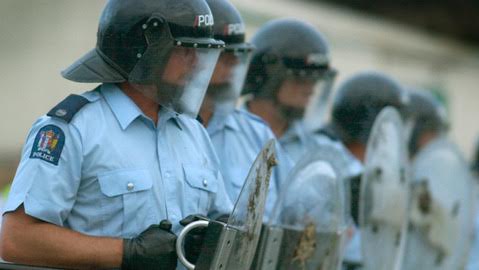
Off-Putting - And Then Some! There will be many “Middle New Zealanders” reconsidering their level of commitment to the anti-TPPA cause in the light of this information. Very few will want to risk either themselves of their families by participating in a demonstration where that sort of heavy-handed policing is in prospect. What's needed is a safe, non-confrontational, alternative.
ONE OF THE MANY INNOVATIONS pioneered by Halt All Racist
Tours (HART) in 1981 was the protest “menu”. Not every opponent of Apartheid
relished the prospect of going head-to-head with the infamous “Red” and “Blue”
riot squads. Nor, watching the violence unleashed following the cancelled
Hamilton game, were there all that many protesters willing to confront the
Springbok Tour’s most rabid supporters. Rather than see a large number of its
own supporters stay away from the protests, however, the HART leadership came
up with the idea of offering a menu of options.
For the most militant, there were “Special Ops”. Some of
these involved small bands of protesters taking out the television signal
relay-stations essential to broadcasting the games live. Other groups blocked
motorways, ran onto airport runways, and immobilised the public transport
services essential for getting Rugby fans to the match venue.
Perhaps the most famous of these “Special Ops” came on the
final day of the Tour when a light aircraft made repeated runs over the Third
Test, at Eden Park, dropping flour-bombs on Springbok and All Black alike!
Participants in these operations knew and accepted the risk
of being arrested, tried and convicted. The flour-bomber of Eden Park, Marx
Jones, spent eight months in prison for his spectacular protest. John Minto was
sentenced to six months jail for blockading Rotorua Airport. Special Ops were
not for the faint-hearted!

How The 1981 Springbok Tour Is Remembered: Helmeted protesters behind wooden shields face-off against Police riot squads wielding their signature PR-24 long batons. By no means all of the protests were so confrontational.
The next option on the protest menu involved testing the
perimeter of the stadium where the Springboks were playing. This was the option
that generated the images of the 1981 Springbok Tour with which New Zealanders
are most familiar. The protesters are helmeted and padded-up against the Riot
Squads’ infamous PR-24 long batons, and many carry wooden shields designed to
prevent the sort of baton attack that injured so many defenceless protesters
outside Christchurch’s Lancaster Park during the First Test.
The final option was intended for those who wished to avoid
any kind of confrontation with either the Police or the Tour’s supporters. Many
of those who availed themselves of this option were members of the mainstream
Christian denominations. Others were elderly, or the parents of kids who wanted
to participate safely in the anti-Apartheid protests. Such events took a
variety of forms. Some groups opted for candlelight vigils and/or prayer
meetings in the major centres’ churches and cathedrals. Others preferred to
join strictly non-confrontational street marches protected by ordinary (i.e.
non-riot-squad) police constables.
By offering its supporters these gradations of protest, HART
maximised the full potential of the movement it had so patiently assembled over
the entire decade of the 1970s. It was a shrewd tactical solution to the
problem of what to do with people who wanted to do more than simply march up
and down the street. The most militant opponents of the Tour were able to plan
and execute radical protest actions of which HART remained entirely ignorant.
Meanwhile, the perimeter-testers and the witness-bearers were able to engage in
protests with which they felt morally (and legally) comfortable.
There is probably insufficient time for the anti-TPPA
movement to develop a similar menu of protest actions against the signing of
the TPPA on 4 February. “It’s Our Future” appears to be a much less structured
organisation than HART, which boasted its own National Council for determining
the anti-Apartheid movement’s strategic and tactical priorities.
Some consideration should, nevertheless, be given to the
problem created by the Police’s announcement that it has been engaged for some
time in “Public Order Training” – a.k.a. Riot Control. There will be many
“Middle New Zealanders” reconsidering their level of commitment to the
anti-TPPA cause in the light of this information. Very few will want to risk either
themselves of their families by participating in a demonstration where that
sort of heavy-handed policing is in prospect. In the absence of a “safe”
alternative, people with jobs to lose and mortgages to pay are most unlikely to
venture much further than the Town Hall on 26 January.
If, however, they were invited to turn up to the Auckland
War Memorial in the Domain on 4 February, to recall the sacrifice of those who
gave their lives for New Zealand’s national sovereignty, and to condemn John
Key’s government for signing a document which puts that sovereignty at risk –
thereby negating the sacrifice of so many young Kiwis – then it is my belief
that many hundreds of Aucklanders who might otherwise have remained at home
will seize the opportunity of registering a safe and responsible protest.
Something for Jane Kelsey and her comrades to think about.
Because, this time, it’s not the rights and freedoms of Black South Africans
that New Zealanders are fighting for – it’s their own.
This essay was
originally posted on The Daily Blog
of Monday, 25 January 2016.
