
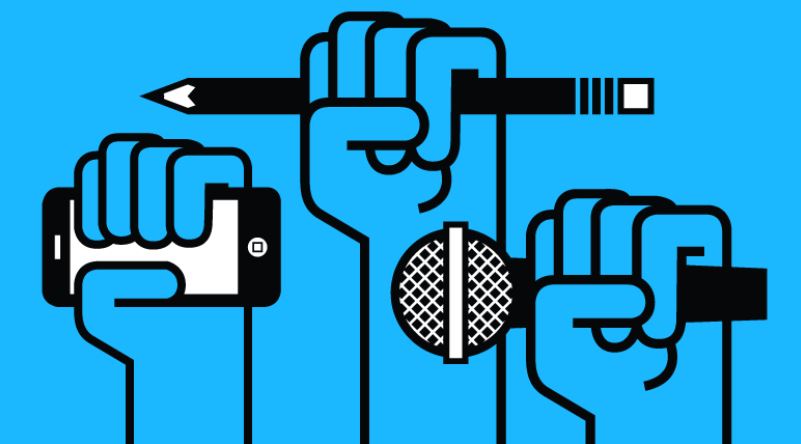
No Free Society Without A Free And Functioning News Media: If we are to surrender our civil rights to the broader cause of defeating Covid-19, then foreign corporations must, likewise, surrender their right to inflict immense economic and cultural harm on New Zealanders simply because it improves their bottom line.
I’M NOT SURE, after today, if we’re going to come through
this global pandemic in one piece. I just don’t think this government contains
enough decisive individuals to guarantee that what emerges on the other side of
this crisis will still be recognisably “us”. Where, for example, was the
outrage; the cold fury; the swift and ruthless response to the reckless
cultural vandalism of the German media conglomerate, Bauer’s, decision to
destroy the New Zealand magazine industry?
This government has voted itself almost unlimited emergency
powers to protect the people of New Zealand from the worst effects of the
Covid-19 virus. That mandate must go beyond simply looking after their physical
well-being. If it is to mean anything at all, it must extend to emotional and
cultural well-being also. If we are to surrender our civil rights to the
broader cause of defeating the virus, then foreign corporations must, likewise,
surrender their right to inflict immense economic and cultural harm on New
Zealanders simply because it improves their bottom line.
Where were the Prime Minister, the Minister of Heritage and
Culture, the Finance Minister, and the Attorney-General when we needed them?
Where was the cease and desist instruction to Bauer? Where was the threat of
instant nationalisation if it failed to heed the Government’s clear directive?
Where was the reassurance to all of Bauer’s New Zealand employees that this
nation’s most venerable and beloved periodicals would not be permitted to
simply blip-off the nation’s radar screen like so many downed airliners?
The answer, of course, is that none of these responses were
in evidence. It impresses me not one whit that Kris Faafoi released a media
statement clearly signalling his displeasure at Bauer’s decision. It might have
made him feel better, but it did nothing to preserve The Listener, North
& South, Metro, and the NZ Woman’s Weekly – or the jobs
of the journalists, artists, designers and administrators involved in their
publication.
New Zealanders are now entitled to know why the need for a
functioning national airline (however shrunken) was accepted by this
government, but the need for a functioning media industry (without which no
democracy can long survive) was not. If close to a billion dollars could be
diverted more-or-less instantly to the preservation of Air New Zealand, then
why wasn’t $100 million made available to purchase – at the very least – the
mastheads and the archives of Bauer’s New Zealand operation?
The preservation of these iconic magazines’ archives is
especially vital. The NZ Woman’s Weekly’s first issue came out in 1932,
the New Zealand Listener’s in 1939. The files and back issues of these
two, and all the other magazines in Bauer’s possession, contain a priceless and
irreplaceable record of this country’s cultural, social and political history.
To let a boardroom of foreigners living on the other side of the planet consign
these taonga to the skip would be a crime.
A truly New Zealand Government would have grasped these
issues immediately and moved decisively to stop Bauer in its tracks. But then, a
truly New Zealand Government would never have acquiesced in the almost complete
deregulation of their country’s news media in the first place. It may have been
a National Party cabinet minister, Maurice Williamson, who oversaw this process
in the early 1990s, but in the nine years that the Labour Party was in control
of the country’s fortunes not the slightest effort was made to re-regulate the
media industry.
Had they done so, New Zealand would never have ended up in
the situation where a roomful of German businesspersons could, in one fell
stroke, eliminate a swathe of its most iconic publications. Nor would it be in
a position where the fate of its second television network rested in the talons
of a bunch of vulture capitalists. Or, where the future of all its daily
newspapers south of Auckland and north of Dunedin depended on the whim of a
cabal of Aussie media moguls who really couldn’t give a rat’s arse whether the
Kiwis’ daily press lives or dies.
What sort of country behaves like this? The answer, sadly,
is the sort of country which agrees to lend its national carrier $900 million,
but then lumbers it with an interest rate roughly twice as high as the current
bank rate. Yes, that’s right, Air New Zealand is being charged 9 percent on its
majority shareholder’s loan. Why? Because, that way, it will be incentivised to
follow only the most cold-blooded and ruthless path to recovery. If the private
shareholders in Air New Zealand wish to avoid a complete government takeover of
the airline they will demand nothing less.
Nothing could illustrate with more clarity the neoliberal
strangle-hold Treasury still has over government decision-making. Even when the
market fails; even facing the fallout of a global pandemic; the Treasury
boffins are there to ensure that the logic of neoliberalism marches on
regardless. Like the American commander in Vietnam, they will not flinch from
the necessity of destroying the village in order to save it. Any New Zealand
Finance Minister looking to Treasury for support as his cultural heritage goes
up in flames – will look in vain.
Over the next few weeks more bad news is almost certain to
emerge from New Zealand’s collapsing media organisations. What’s needed is a
comprehensive rescue plan: something along the lines of a government takeover
of the entire industry pending a more considered re-organisation when the
pandemic has passed. Is there no one in the Labour-NZ First-Green Government
with the vision and courage to step in and save the single most important
guarantee of our democratic political system?
I know there are tens-of-thousands of New Zealand workers
who also need help from their government. I know that many of them will
forcefully object that there are more important things to save that a handful
of magazines with weak balance-sheets and dwindling readerships. My answer to
them is simple: “You’re right! And I will be just as loud in my criticism of
this government if it fails to protect your jobs. But, I also know how fragile
a nation’s culture becomes in moments of crisis. That’s why I am so vehement in
my objections to the seeming unwillingness of Jacinda and her colleagues to
save New Zealand’s daily newspapers and its very best periodicals.
Our country is on fire. The first priority is to get its
people safely away from the flames. The next most important move, however, is
to save as much of the people’s house and its contents as possible. To just
stand there and watch it burn to the ground, especially when the hoses and
water necessary to save it are at hand, would be an unforgiveable dereliction
of political duty.
This essay was originally posted on The Daily Blog
of Thursday, 2 April 2020.

