
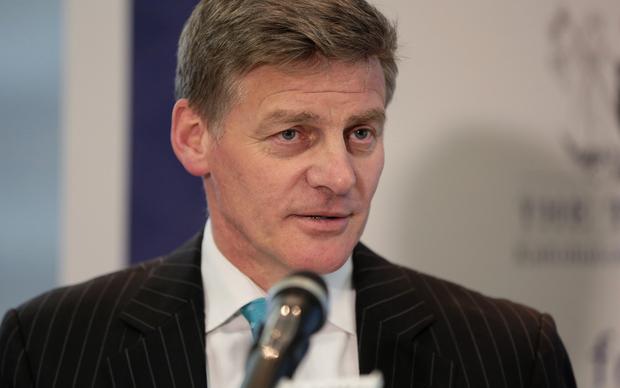
Jam Tomorrow - Maybe: Last Thursday morning (13/10/16) Finance Minister, Bill English told reporters that the unexpectedly large projected government surplus of $1.8 billion “means we have a few choices we didn’t have in the past”. He did not rule out tax cuts.
“THERE’S NEVER A BAD TIME FOR TAX CUTS”, was Rodney Hide’s
message to Radio Live’s listeners last Thursday afternoon. The Finance
Minister, Bill English, appeared to agree. At least, he didn’t rule them out.
On Thursday morning, English told reporters that the
unexpectedly large projected government surplus of $1.8 billion “means we have
a few choices we didn’t have in the past”.
Not that the National Party-led government’s fiscal goals:
“reduced debt, infrastructure investment, reduced taxes for lower and middle
income families”, were about to change. On the contrary, the Finance Minister
remained firmly wedded to the view that the best means of achieving his
government’s fiscal objectives were “expenditure control and a growing
economy.”
Civil society’s reaction was swift and unequivocal. The very
idea of deliberately reducing state revenue, when additional government
spending on crucial social services is needed so urgently, was greeted with
dismay.
“The government has left, over the last eight years or so, a
social deficit, which we are now seeing literally on the streets of Auckland
and elsewhere”, was how the Salvation Army’s policy analyst, Alan Johnson,
responded to English’s announcement. Adding bitterly that “it doesn't appear to
be interested in bridging that deficit.”
The NZ Council of Trade Unions’ economist, Bill Rosenberg,
was equally aghast at what he identified as the National Government’s strategy
of deliberate procrastination and deferral: “You can’t put off dealing with
child poverty indefinitely. You can’t put off dealing with a struggling health
system indefinitely.”
Compelling evidence that the Government’s fiscal stinginess
is generating a measurable electoral backlash would lend a deadly cutting edge
to Johnson’s and Rosenberg’s criticisms. Unfortunately for the institutions
they represent, no such evidence exists.
David Farrar, the owner of the National Party’s
indefatigable polling agency, Curia Research, averages-out the major polls for
his Kiwiblog blogsite. His latest calculations give National 44.3 percent of
the Party Vote, to the Labour-Greens’ 42.7 percent. Widespread public revulsion
at National’s fiscal strategies would see a Labour-Green government-in-waiting
positioned well ahead of its centre-right opponents. It isn’t.
If an angry electorate is out there, then the best that can
be said is that it’s very well hidden.
Clearly, there is a very large constituency for the views on
poverty expressed recently by the Police Minister, Judith Collins.
Asked how her government proposed to address the link
between gangs and childhood poverty, Collins asserted that there was always
sufficient money available for New Zealanders in need. What she saw in poor
households, she said, was something quite different from material deprivation:
“I see a poverty of ideas, a poverty of parental responsibility, a poverty of
love, a poverty of caring.”
Collins’ remarks were roundly criticised by experts on
social deprivation, who dismissed them waspishly as a “middle-class New Zealand
myth”.
“Forty per cent of children in poverty are in households in
paid work”, observed Associate-Professor Mike O’Brien on behalf of the Child
Poverty Action Group. “Are we saying there’s a large chunk of parents who are
working who are inadequate? That’s hard to sustain. This is not about
behaviour. It’s about access to resources, the way we distribute opportunity.”
“In some ways [and] at the risk of being simplistic”, said
O’Brien, “it’s easier to blame parents rather than doing something about the
social and economic setting.”
The Associate-Professor is right: it is easier. Which is,
presumably, why the National Government goes on doing it.
Bill English could inform the country that his surplus is
unavailable for tax cuts. That, instead, the extra revenue will be spent on
raising benefits, housing the homeless, and refilling the coffers of New
Zealand’s cash-strapped health and education services. He could commend to
voters the words of the celebrated American jurist, Oliver Wendell Holmes Jnr,
who said: “I like to pay taxes. With them, I buy civilization”. But, if he did,
how would “middle-class New Zealand” react?
Political parties tailor their policies to meet the
interests and prejudices of the people who vote for them. As an explanation for
poverty, “poor parenting” may infuriate the experts as a “middle-class New
Zealand myth”. But, since it is overwhelmingly the New Zealand middle-class
that turns out to vote in local and national elections – it’s a myth that
counts.
On the subject of voting, it is very tempting to paraphrase
Judith Collins:
“Poverty’s not the problem, it’s people who don’t understand
the role of voting in ending poverty, that’s the problem. Poverty persists
because these people no longer vote in elections, or even think they should
vote in elections.”
Poverty plummeted in New Zealand when the working-class poor
organised themselves industrially and
politically to end exploitation on the job and deprivation in the home. For
their own shot at civilisation, they happily voted for higher taxes. It’s an
historical lesson today’s working poor could help themselves enormously by
re-learning.
This essay was
originally published in The Press of
Tuesday, 18 October 2016.
