Showing posts with label Parliamentary Democracy. Show all posts

Friday, 7 June 2024

In Search Of Unity.

Kotahitanga: New Zealand’s future belongs to those who do not fear a nation carved out of unity and solidarity, and are willing to trust the carvers. Some New Zealanders will be required to step up, and others, perhaps for the first time in their lives, will be expected to step back.

BUDGET WEEK has thrown up two very different examples of political representation. In the House of Representatives what we have witnessed is the intentionally divisive squaring-off of Government and Opposition. Unity is not a realistic possibility under our system of representative democracy.

On the streets, however, New Zealanders have witnessed something very different. On the streets, the call from one of the largest indigenous minorities on earth (approximately 20 percent of the population) has been for “Kotahitanga” – unity. What’s more, among those for whom indigeneity constitutes the core of their identity, that unity is not only possible – it is likely.

What is it that causes peoples raised in the traditions of representative democracy to accept disunity? The most optimistic answer is that what many critics condemn as disunity isn’t disunity at all. The debates in Parliament, according to the optimists, are intended to improve the legislative process by requiring the governing majority to test its policies against the objections and/or proposed alternatives of the minority. What some perceive as petty squabbles are, by this reckoning, vital contributors to a much broader and more important unity – that of the citizenry’s faith and trust in the democratic system.

That’s the theory, anyway. But it is by no means certain that a majority of citizens are disposed to accept it. Many people find representative democracy’s angry parliamentary exchanges unedifying – to the point of being disgraceful. Many blame the party system for fostering and perpetuating socio-political divisions. They find it difficult to believe that ordinary, decent, citizens would not, given half-a-chance, coalesce naturally around a programme dedicated to the public good. Their instincts tell them that a political system which deliberately divides the nation is a liability, not an asset.

In the context of New Zealand’s democratic traditions, a cynic might point to the fact that between the mid-1850s and the mid-1870s – the period when the spirit of party and faction was suppressed by a franchise limited to Pakeha male property-owners (joined, after 1867, by four Māori Members of Parliament) – the spirit of unity was much more in evidence. Property-owners do, after all, share a unifying inclination to protect what they own from any political movement disposed to redistribute it among those who own next-to-nothing.

By the 1870s, the gravest threat posed to the “private” property of Pakeha New Zealanders was from dispossessed hapu and iwi. Indeed, nothing is more likely to create unity among Pakeha than the prospect of Māori coming together, under the aegis of the Treaty of Waitangi, to reclaim the collective property which the Pakeha, largely by virtue of controlling the Legislature, had empowered themselves to seize. It is no accident that the class antagonisms that would shape New Zealand for the next 100 years did not emerge as a significant historical driver until the Māori had been stripped of the power to defend their resources.

So, if our political system is, fundamentally, a process driven by the see-sawing struggle between those who own a disproportionate amount of property, and those who seek an equitable portion of the life-chances such ownership confers, then is the realisation of social and political unity a goal restricted to soft-headed idealists and hard-hearted revolutionaries?

As is her wont, the Goddess of History offers no easy or comforting answers. She will tell you that social and political unity is possible, but only when a nation is threatened with subjugation and/or annihilation. When an enemy threatens to destroy all that a people holds dear, then all other quarrels are momentarily, at least, set aside.

To the crowd assembled outside his royal palace on 1 August 1914, as war loomed over Europe, the German Kaiser, Wilhelm II, declared:

“I thank you from the bottom of my heart for the expression of your loyalty and your esteem. When it comes to war, all parties cease and we are all brothers.”

In New Zealand, too, the unity generated by the outbreak of the First World War brought Government and Opposition together in a coalition that would last until 1919. Something very similar happened at the outbreak of the Second World War in 1939. And, although the global Covid-19 Pandemic did not inspire a coalition government, it certainly produced a high level of political co-operation between all the political parties. Economic measures that would normally have engendered bitter opposition were introduced quickly, and largely without rancour.

How far away that crisis-induced unity seemed on Thursday, 30 May 2024 when Nicola Willis delivered her first budget to the House of Representatives. Those controlling a disproportionate amount of the nation’s wealth would have been well-satisfied with the economic and social policies of the conservative coalition government. Those whose life-chances were being limited by those same policies looked to the opposition parties for succour. Very soon, all the ideological binaries were on display.

When it came to solving New Zealand’s problems, division and rancour were more in evidence on the floor of the House than unity and solidarity.

Not so on the streets, or in Parliament Grounds. There it was all unity and solidarity. Under the aegis of Te Tiriti, Māori from all over Aotearoa had gathered in defence of everything they hold dear: their language, their mana, and the rights guaranteed to them 184 years ago at Waitangi. In the eyes of those thousands of marchers, the Pakeha colonisers are, once again, making war on their people, and, once again, the spirit of Kotahitanga is breathing upon the flames in the flax-roots.

On display across New Zealand on Thursday, 30 May 2024 was an indigenous people that still has faith in itself, and continues to believe that its hopes are not vain.

How different is the picture inside the Pakeha nation. There, the National Party, Act, and NZ First have thrown up a defensive palisade around the interests that elected them. Labour, the Greens and Te Pati Māori, far from walking forth gladly to find, in the words of James K. Baxter, “the angry poor who are my nation”, keep faith only with the thin social strata that long ago reconciled itself to the administration of a system it does not control, and will never own.

New Zealand’s future belongs to those who do not fear a nation carved out of unity and solidarity, and are willing to trust the carvers. Some New Zealanders will be required to step up, and others, perhaps for the first time in their lives, will be expected to step back.


This essay was originally posted on the Interest.co.nz website on Monday, 3 June 2024.

Tuesday, 4 June 2019

Who Is The Best Judge Of The People’s “Wellbeing”?

Happiness Relocated: The revelation that the model, and her young daughter, whose smiling faces adorned the cover of Grant Robertson's "Wellbeing Budget" had departed New Zealand in search of a better life on Australia's Gold Coast, provided a powerful symbol of the disconnect between the  experts' top-down approach to wellbeing, and the practical judgements of real people, on the ground, about their wellbeing - or the lack of it.

“THE WELLBEING BUDGET.” What a fantastic public relations confection this year’s budgeting exercise has turned out to be! Who could possibly raise a reasonable objection to the idea of gearing all the Government’s revenue-gathering and spending efforts towards securing the “wellbeing” of the New Zealand people?

Not Simon Bridges, that’s for sure. The Opposition’s case seems to rest on the assertion that they thought of it first. That “wellbeing” is just another name for former National Party leader Bill English’s programme of “social investment”.

And that’s a worry. Because the thinking behind both the “Wellbeing Budget”, as well as English’s “social investment” programme, runs counter to the most fundamental tenet of parliamentary democracy. Namely: that before money can be appropriated from the people in the form of taxes, their consent must first be obtained; and that such consent must be renewed annually, on the people’s behalf, by their freely elected representatives.

The entire Westminster System rests on the notion that there can be “no taxation without representation”. For breaching this fundamental principle, King Charles I lost his head, and King George III lost his 13 American colonies.

These grim precedents notwithstanding, the “wellbeing” principle enunciated by the Finance Minister, Grant Robertson, in yesterday’s Budget Speech, involves shifting the responsibility for signing-off on how the people’s money is to be spent from their elected representatives to their supposed servants in the Public Service.

Apparently, the whole notion of Members of Parliament determining and overseeing how the people’s taxes are spent has become woefully outdated. How much more efficient to simply vote money to a collection of government agencies and allow them to spend it as they see fit over the next four or five years. Annual appropriations, voted by the House of Representatives, is such an archaic way of operating what has become a fearsomely complex state machine. Much better to leave matters to the “experts”. They will keep their Minister informed, and s/he will tell Parliament when it’s time to wield its rubber stamp.

“Experts.” Aye, there’s the rub. For at least a century, the notion of government by experts (also known as “technocracy”) has enjoyed a solid following among … well … experts. Indeed, in the years following the First World War, a whole new approach to “manufacturing” the consent of the masses was developed by an arcane combination of journalists, psychologists and political scientists. It was the most accomplished of these manipulators, Edward Bernays, who refined the process into what we today recognise as the profession of “public relations”.

From a democratic perspective, the only true experts are the people themselves. That MPs need their votes to enter the House of Representatives means that, in theory at least, they enter that august institution with a pretty good idea of what a substantial number of voters regard as important and unimportant. It is on the basis of this knowledge that they appropriate money and frame legislation. To further inform and refine their thinking, MPs invite the people to make submissions to parliamentary select committees. At this point in the process, the contributions of experts are welcomed.

Political parties, once again in theory, are supposed to amplify the expression of the people’s needs and wants by organising them into a coherent package of proposed reforms. This is referred to as the party’s “manifesto”. It represents a kind of political contract with the electors, and the parliamentary representatives of the party, or parties, commanding a majority in the House of Representatives are expected to honour their manifesto’s “mandate” by conscientiously fulfilling its promises. The funding of these promises, via the elected government’s annual Budget, is the people’s most effective guarantee for securing their wellbeing democratically.

The only legitimate role for public servants in this process is to advise the elected Government on how best to implement its manifesto promises. The Public Service is not there to substitute its own judgement for that of the people’s – as expressed through the electoral process. Nor is it the business of elected politicians to ask bureaucrats to do the job they were chosen to do. All the “working groups” and “expert committees” in the world cannot relieve the people’s representatives of their sacred duty to – represent the people.

If the wellbeing of the people can only be secured by “experts”, then democracy is a lie.

This essay was originally published in The Otago Daily Times and The Greymouth Star of Friday, 31 May 2019.

Saturday, 26 May 2018

Testing The Speaker.

Parliament's Poacher-Turned-Gamekeeper: Mallard positively twinkles in the Speaker’s Chair. His many years in the Chamber have armed him against every trick in the Opposition play-book. Hardly surprising, since Mallard has, at one time or another, played every one of them. Knowing exactly what to expect, this parliamentary poacher-turned-gamekeeper lies in wait for the lumbering Nats and daily spoils their fun by dispensing a judicious measure of galling intellectual acuity and dead-eyed malice.

QUESTION TIME IN PARLIAMENT this afternoon was a useful reminder of what Jacinda and her government are up against. In theory, Her Majesty’s Loyal Opposition are supposed to impress the Visitor’s Gallery as a government-in-waiting: sagacious, witty and (to use a favourite parliamentary term) honourable. In practice, Simon Bridges’ National Party Opposition comes across as ignorant, boorish and disturbingly truculent.

Bridges’ people put one in mind of a hitherto unbeatable rugby team which has unaccountably lost the season’s most important game to a rag-tag bunch of scrawny and inexperienced ring-ins. “It shouldn’t have happened!”, has slowly-but-surely morphed into “It didn’t happen!” National appears convinced that if everyone had played by the rules they could not have lost the game. In their minds, Labour, NZ First and the Greens were only able to claim victory by cheating outrageously.

And so, they sit there on the Opposition’s side of the House, forced to swallow the bitter bile of defeat every time they lift their eyes to the mocking gaze of Jacinda Ardern, Winston Peters and James Shaw.

The person who makes them retch most violently, however, is the Speaker, Labour’s Trevor Mallard. There’s an insouciance about Mallard’s management of the House; a barely suppressed glee; that is quite clearly driving National’s MPs crazy.

Mallard positively twinkles in the Speaker’s Chair. His many years in the Chamber have armed him against every trick in the Opposition play-book. Hardly surprising, since Mallard has, at one time or another, played every one of them. Knowing exactly what to expect, this parliamentary poacher-turned-gamekeeper lies in wait for the lumbering Nats and daily spoils their fun by dispensing a judicious measure of galling intellectual acuity and dead-eyed malice. He isn’t the least bit scared of Gerry Brownlee, Paula Bennett, Jamie-Lee Ross or David Bennett. They know it – and he knows they know it.

And still they come at him: proud Tory Samurai whose traditional swords and arrows are utterly unequal to Mallard’s pearl-handled Colt 45. He shoots them down for sport.

It will be interesting to observe how long Bridges is prepared to let this unequal contest go on. He must know that a battle with the Speaker, if it is not to end in the Opposition’s complete humiliation, must be escalated to the point where the normal operation of Parliament becomes impossible.

The problem is that the raising of spurious points-of-order and refusing to withdraw and apologise for unparliamentary conduct is an extremely risky strategy. Open defiance of the Chair, leading to the naming of members, interventions by the Sergeant-at-Arms, mass walkouts and point-blank refusals to re-join Government members in the Chamber will certainly bring the business of the House to a standstill. Unfortunately, it may also send the National Party’s public support into free-fall. New Zealanders don’t tend to have much time for players who argue with the ref.

But, even if National’s 44 percent support-base stays solid behind their wronged heroes; and even if Labour, NZ First and the Greens buckle in the face of such reckless political hatred; New Zealand’s parliamentary democracy would be irreparably damaged. New Zealand would have reached the point so terrifyingly described in William Golding’s dystopian novel, Lord of the Flies, when Jack and his fellow savages overthrow the schoolboys’ brave attempt at self-government – symbolised by the beautiful conch-shell which guarantees whoever holds it a fair hearing.

“By him stood Piggy still holding out the talisman, the fragile shining beauty of the shell. The storm of sound beat at them, an incantation of hatred. High overhead, Roger, with a sense of delirious abandonment, leaned all his weight on the lever […..] The rock struck Piggy a glancing blow from chin to knee; the conch exploded into a thousand white fragments and ceased to exist. Piggy, saying nothing, with no time even for a grunt, travelled through the air sideways from the rock, turning over as he went. The rock bounded twice and was lost in the forest. Piggy fell forty feet and landed on his back across the square red rock in the sea. His head opened and stuff came out and turned red.”

Democracy, too, is a fragile thing and the rocks used to destroy it take many forms.

This essay was originally posted on The Daily Blog of Wednesday, 23 May 2018.

Tuesday, 23 January 2018

Smiling For Jacinda - And Democracy!

Prime Ministers Can Do Anything! Jacinda’s pregnancy not only constitutes a bold redefinition of gender roles, but also a radical redefinition of representative democracy itself. Overnight the highest office in the land has been made both more representative of, and more relatable to, hundreds-of-thousands of female voters. Quite suddenly, the Prime Minister has become a person much more like themselves.

"JACINDA’S PREGNANT!" For once, the exclamation mark was merited. There isn’t much that takes us by surprise these days, but the announcement that the prime minister and her partner were having a baby caught New Zealanders off-guard in the nicest possible way.

For younger New Zealanders, the news brought confirmation that the torch really has been passed to a new generation of leaders. For Kiwis under 40, it offered proof that the difference between political life and normal life continues to narrow, and that the House of Representatives is, at last, living up to its name.

For older New Zealanders, especially those who came of age to the strains of Helen Reddy’s “I am Woman”, Jacinda’s announcement was a kind of vindication.

This was the generation, after all, who had heard the dominant political figure of their day, Prime Minister Robert Muldoon, declare:

“Could we contemplate the situation where a woman getting equal pay is the bread-winner, and the husband stays at home and looks after the children? I don’t think we could.”

It was these same “Baby Boomers” who accepted, albeit reluctantly, the hard-nosed decision of their own generation’s pre-eminent politician, Helen Clark, to forego the experience of motherhood as the unavoidable price of achieving high public office.

These New Zealanders told their daughters that “Girls Can Do Anything!” – not as a description of the day-to-day realities of the 1980s and 90s, but as a statement of their abiding faith in feminism’s power to shape the future.

So, if a smile lingered on my lips all the way through last Friday, there was good reason. It lingered because I was thinking back to the time when, as a young married couple, we were refused a bank-loan because: “Your wife might get pregnant and have to give up her job – and how would you pay the mortgage then?” Or, recalling the expressions of scorn on the faces of “real” men when they discovered I was a stay-at-home dad, looking after our daughter while my bread-winning wife went back to work. Now, I could say to myself: “Those days are gone.”

How could anyone who had grown up amidst the debilitating sexism of “old” New Zealand not smile, and feel immense pride, when presented with two such brilliant role models as Jacinda Ardern and Clarke Gayford?

There will be some, of course, who look at this couple and frown. The unreconstructed sexists will whip themselves into a froth of rage at Jacinda’s repudiation of traditional gender roles. They will not, however, be the only ones made uneasy by her announcement.

The more “normal” our Parliament becomes, the more its elitist lustre will fade. To those who regard the cultivation of that lustre as an important feature of our Westminster system of representative government, the maintenance of its specialness is no small matter. For traditionalists, investing Parliament with pomp, ceremony and just a whiff of mystery, is all part of separating its deliberations from the ordinary and the everyday. Its members are, after all, invested with the power to upend the lives of ordinary, everyday citizens. For those who believe in our system of “managed democracy”, preserving a certain measure of distance between the people and their representatives is vital.

Jacinda’s pregnancy, therefore, not only constitutes a bold redefinition of gender roles, but also a radical redefinition of representative democracy itself. Never before in New Zealand’s political history have women been able to contemplate a pregnant prime minister. Overnight the highest office in the land has been made both more representative of, and more relatable to, hundreds-of-thousands of female voters. Quite suddenly, the Prime Minister has become a person much more like themselves.

Certainly, there have been many politicians who entered Parliament with young families. Overwhelmingly, however, these were men, whose domestic and child-rearing arrangements, far from challenging “normal” gender roles, actually reinforced them. The handful of women MPs who decided to combine raising babies with raising points-of-order encountered an institution determinedly reluctant to make itself child-friendly.

Thankfully, those days, too, have gone. The image of Trevor Mallard dandling an infant on his knee while seated in the Speaker’s Chair served as a delightful precursor to Jacinda and Clarke’s announcement. His message: The House of Representatives has become a place for everyone; fathers, mothers, children; the People’s House.

What began as a remote chamber, filled with wealthy, privileged men, has progressively been forced to open its ornate doors: first to Maori, then to propertyless men; and, finally, to the majority of the human species. With every dilution of its elitism, the number of citizens who could reasonably aspire to “do anything” has expanded. From the tangata whenua, to the working-class, to the people who hold up half the sky.

So, yes, I’m smiling. Not just for Jacinda and Clarke – but for democracy!


This essay was originally published in The Press of Tuesday, 23 January 2018.

Thursday, 31 March 2016

God Save The Royal Republic!

The English Revolution: In 1649, Oliver Cromwell famously decided to "Cut off the King's head with the Crown upon it" . The English Commonwealth, which replaced the monarchy, was a parliamentary republic, constituted in a fashion remarkably similar to our own. We have yet to cut off the Queen's head, but that's only because there's no real need to. Unlike Charles I, Elizabeth II wields no power. If she, or her Vice-Regal representative, the Governor General, ever attempted to interfere in our democratic politics, however, New Zealand's decorative royal figurehead would be gone - probably by lunchtime.
 
IS MITCH HARRIS RIGHT? Is New Zealand, for all intents and purposes, already a republic? Are all the monarchical appurtenances of our unwritten constitution nothing more than an entertaining illusion, as the veteran broadcaster insists? Full of pomp and ceremony, certainly. But in a nation where the people, as embodied by Parliament, are indisputably sovereign, of no relevance whatsoever to the way in which New Zealanders actually govern themselves.
 
Harris’ heretical opinions, broadcast on Tuesday night’s (29 March 2016) Waatea – Fifth Estate, cast the outcome of the flag referendum, and the earlier, almost totally ignored deliberations of the Constitutional Review Panel, in a new and very interesting light. Stripped of its talkback host’s bravado, Harris’s thesis asserts that over the course of the last 176 years New Zealanders have, with a minimum of fuss, fashioned one of the purest and least constrained democratic regimes on Earth.
 
What’s more, says Harris, we’ve done it surreptitiously. The Prime Minister may proudly proclaim himself a fan of Constitutional Monarchy, but he, like most New Zealanders, would bridle at the slightest suggestion that the legislature he dominates is anything other than absolutely sovereign. The idea that an unelected judiciary might one day possess the power to strike down legislation passed by the House of Representatives would strike him as a dangerous and undemocratic extension of judicial power. New Zealand is, and must continue to be, governed by those in command of a parliamentary majority – and nobody else.
 
You’ve got to go back a long way in the history of the English-speaking peoples to find a constitutional set-up like New Zealand’s. All the way back to the conclusion of the English Revolution, in fact, and the establishment in 1649 of the “English Commonwealth” – the world’s first parliamentary republic. Having cut off the King’s head with, in Oliver Cromwell’s memorable phrase, “the Crown upon it”, and dissolved the House of Lords, England was now governed by a 14-member Council of State, answerable (at least in theory) to the House of Commons. This latter body, representing the common people of England, was deemed to be the repository of “all just power” in the state. It was a principle destined to endure long after the English Commonwealth succumbed to Cromwell’s dictatorial “Protectorate”.
 
New Zealand, too, is governed by a council of state – The Cabinet – drawn from and answerable to the elected representatives of the people. Our own equivalent of the House of Lords, the Crown-appointed Legislative Council, was abolished with barely a murmur by the first National Party government, led by Sid Holland, in 1950.
 
For all practical political purposes, therefore, our unwritten constitution makes Parliament the supreme organ of power in the state. It passes the laws, makes appropriations of money for the administration of the state, and, if moved to do so, can bring down any government at any time simply by withdrawing its support from the Prime Minister and his or her Cabinet. The only other example of a unicameral parliament operating without the restraint of a written constitution is the State of Israel.
 
But what about the Queen? I hear you say. Legally and constitutionally Elizabeth II is Sovereign in Right of the Realm of New Zealand, and her Vice-Regal Representative is the Governor General. Quite true. But Harris’s point – and I agree with it – is that all this monarchical mummery is just a grand distraction from the realities of political power in New Zealand.
 
The only way the Queen could hope to influence events in New Zealand would be if she allowed herself to be drawn into a plot to topple a democratically elected government – as happened in the infamous conspiracy to bring down the Australian Prime Minister, Gough Whitlam, and his beleaguered Labor Government, in 1975. The only thing that saved the Queen and her Governor General, Sir John Kerr, on that occasion was the fact that the interim regime installed to replace the “dismissed” government went on to win the obligatory general election. Had Whitlam’s Labor Party been returned to office, Australia would, today, be a republic of 40 years standing.
 
What the “Dismissal” did demonstrate, however, was that royal and/or vice-regal interference in the democratic political process, unbuttressed by the electorate’s ex post facto validation, can only end in constitutional tears. Her Majesty was extremely fortunate that a majority of the Australian people concluded, notwithstanding the machinations of vice-regal ratbags, that Whitlam’s government wasn’t worth reinstating. The important lesson to take away being that the political decision was theirs – not hers – to make.
 
It is to be hoped that both Charles and William Windsor have absorbed this lesson, and that in the event of a New Zealand Governor General asking the Palace to support his or her plan to dismiss a government (or, more likely, refuse to appoint a government that the “business community” doesn’t like) the correct constitutional response is to immediately ask the New Zealand politician commanding a majority in the House of Representatives to advise him to dismiss the incumbent Governor General and propose a new one.
 
Because any other course of action: any attempt to circumvent the will of the New Zealand people; any reassertion of the royal “prerogatives” destroyed by Oliver Cromwell in 1649; will instantly see the monarchy’s gloriously retro decorativeness brought to an abrupt and permanent end. The Queen and the Governor General are like the diminutive Bride and Groom on the top of the Wedding Cake: sentimental favourites – but you wouldn’t expect them to impart serious marital advice.
 
Some would say it’s a typically Kiwi solution to the fraught business of defining the exact nature of the New Zealand state. A republic presided over by a queen may cause the political scientists to tear out their hair in bewilderment, but, as Mitch Harris might say, “we know what we mean”, and somehow, like a Taranaki gate, it works.
 
What our royal republic appears to represent, and what it actually stands for, would appear to be, like the flag we just voted to keep, two very different things.
 
This essay was originally posted on The Daily Blog of Thursday, 31 March 2016.

Friday, 26 February 2016

On Government Ground: The TPPA Struggle Shifts To Parliament.

The New Battleground: As the struggle over the TPPA shifts from the streets to Parliament the political rules-of-engagement will change. If Jane Kelsey and her followers are to avoid the fate of Queen Boudicca and hers, then she must never accept a battle fought on her enemies' terms. That means reigniting the extra-parliamentary struggle. If the Anti-TPPA movement attempts to fight John Key on his own turf - it will lose.
 
AND SO IT BEGINS. The Government’s counter-offensive against the opponents of the Trans-Pacific Partnership Agreement (TPPA) is slowly, but surely, gathering pace. It’s weight and relentless aggression will test the TPPA’s opponents’ fighting skills to the limit. Already, they have been found wanting. The massive protest demonstration of 4 February may have caught the TPPA’s protagonists off-guard, but it has not been followed-up. The pressure on the Government has eased. It is now John Key’s turn to demonstrate his power.
 
The best historical analogy I can think of is the Boudican Revolt of AD 60-61. Like Boudicca, the warrior queen of the Iceni tribe, Professor Jane Kelsey has been highly successful at rousing and mobilising her followers against the TPPA. Also like Boudicca, she has taken full advantage of the strategic opportunity her distracted opponents were foolish enough to give her.
 
The Roman Governor of Britain, Suetonius, having called in the Empire’s loans to the Iceni royal family and annexed their kingdom, added insult to injury by allowing his legionaries to first flog the loudly protesting Boudicca, and then rape her daughters. Convinced that the subjugation of the Iceni was now an accomplished fact, he carelessly led his legions West, to the island of Anglesey, where he exterminated what remained of the Druids.
 
Bad move.
 
While he was busy putting Druids to the sword and cutting down their sacred oaks, Boudicca was laying waste to the key Roman cities of Camulodunum and Londonium, and slaughtering upwards of 70,000 Romans and Romano-Britons.
 
Not good.
 
The Emperor Nero momentarily considered abandoning his new province to its murderous inhabitants. But then, at the Battle of Watling Street, his loyal Governor, Suetonius, reminded the Mediterranean World why Rome was its master.
 
Because, truthfully, it’s not that hard to get a lot of people all rarked-up about their beloved homeland being turned into a colony of the unbelievably powerful masters of the world. The same is true of slaughtering people by the thousand. That’s not hard, either. Especially when the legions normally dedicated to their protection are on the other side of the country putting an entire religious tradition to the sword.
 
It’s important to face facts. While Jane Kelsey’s crusade, like Boudicca’s rebellion, has tasted victories, these have all been won on battlefields of her own choosing. What happens when her rebels are forced to fight on their enemies’ chosen ground?
 
Fighting On Rome's Terms: Rigorously trained and highly disciplined, Suetonius's legionaries made short work of Boudicca's wild warriors.
 
In Boudicca’s case the answer was a bloody massacre. Suetonius’s two legions (roughly 10,000 men) may have been faced by upwards of 100,000 Britons, but they were undaunted. Roman legionaries were professional soldiers, highly trained and superbly disciplined. Against Rome’s well-oiled war-machine, Boudicca’s ill-disciplined warriors didn’t stand a chance. They were butchered with parade-ground precision.
 
John Key’s MFAT officials are no less professional than those Roman legionaries. Supported by the National Party’s most seasoned MPs, they know well how to exploit the rules of engagement of committee room and parliamentary chamber, where the TPPA conflict is now being played out.
 
If Professor Kelsey and the anti-TPPA “It’s Our Future” movement were able to pack the galleries and corridors of Parliament Buildings in the same way they packed Queen Street on 4 February, then they might have some hope of winning this battle. Instead, like Boudicca’s outmanoeuvred warriors, they are being driven into the saw-toothed shield-wall of the Government’s legions, where, their bravery and brilliance notwithstanding, the bureaucrats and politicians will stab them to death.
 
Their defeat will not be made any easier to watch by the sight of Phil Goff (and possibly David Shearer) striding across the parliamentary aisle to join National, Act and United Future in voting for the TPPA.
 
With the legislation giving effect to the content of the TPPA enacted in New Zealand, the hopes of its opponents will shift to the United States Congress. If President Trump, or  President Sanders, takes office on 20 January 2017, then the agreement will be a dead duck. Why, then, would President Obama not put the deal in front of his lame duck Congress for ratification? And why would those congressmen and women not, for once, oblige him?
 
Fighting Rome was easy. Beating Rome was not – as Boudicca discovered. Victory came only to those who fought Rome on their terms – not hers. If the anti-TPPA struggle is waged in Parliament, it will lose.
 
This essay was originally published in The Waikato Times, The Taranaki Daily News, The Timaru Herald, The Otago Daily Times and The Greymouth Star of Friday, 26 February 2016.

Wednesday, 11 November 2015

A Disgraceful Performance: Why John Key And The Speaker Need A Refresher Course In Democracy.

Extraordinary Accusations: John Key accuses the Labour Opposition of "supporting rapists and murderers". The Speaker's failure to require the Prime Minister to withdraw and apologise sparked a rare walk-out from the Chamber and, later, a Vote of No Confidence in the Speaker. That the Prime Minister may have a majority of New Zealanders backing his cruel denigration of Australian Immigration's detainees matters not one whit. Human rights are not the playthings of majorities: they are inherent and inalienable.
 
THE DAILY BLOG’S EDITOR, Martyn Bradbury, believes New Zealand is better than its present Prime Minister and Government. I hope, desperately, that he’s right. But, ours is a representative democracy, and my great fear is that this John Key-led, National Party-dominated, Government is just that – representative.
 
Were a majority of Kiwi voters shocked by the behaviour of the Prime Minister and the Speaker during Question Time, yesterday? (10/11/15) Or did John Key launch his extraordinary attack on the Opposition parties in the confident knowledge that, far from being shocked and disgusted, the New Zealand public was lined-up right behind him?
 
One has only to listen to the talkback radio stations, or hear the comments from listeners read out on RNZ-National’s Morning Report to know that there is a substantial number (quite possibly a majority) of New Zealanders who view the entire Australian immigration scandal from the Prime Minister’s perspective. How likely is it, really, that a politician as shrewd as Key would accuse the Opposition of “supporting rapists and murderers” if he wasn’t quietly confident that most New Zealanders saw things his way?
 
Fairfax Media’s political editor, Tracy Watkins, thinks it most unlikely: “He [did it] knowing he is on the right side of the argument politically – most people would have no argument with Key’s assessment New Zealand should not bother shedding any tears over the plight of the Kiwi detainees.”
 
Coming at it from a slightly different angle, the NZ Herald’s political editor, Audrey Young, was equally confident in her assessment of yesterday’s events: “The suggestions by some Labour MPs on Twitter that democracy was at stake was over-reaction and nonsense. There were plenty of errors in the high drama at Parliament today but there was nothing undemocratic in what occurred.”
 
The high drama and errors Young refers to relate to the behaviour of the Speaker of the House of Representatives, David Carter, and to the decision of about half the Labour Opposition to walk-out of the parliamentary chamber in protest. Against all precedent, Carter had ruled that the PM was under no obligation to withdraw or apologise for his repeated accusations that the Labour MPs were supporting rapists and murderers. When the furious Labour MPs finally returned to the House they moved a symbolic Vote of No-Confidence in the Speaker. Again, this was a most unusual and disquieting response to the Speaker’s behaviour.
 
The independence of the Speaker – most especially his or her independence from the Executive Branch of Government – is a cornerstone of the Westminster System of representative democracy. The tradition dates at least as far back as the 1640s in England.
 
It was in 1642 that King Charles I, accompanied by a company of soldiers, strode into the House of Commons to arrest five Members of Parliament on charges of High Treason. When asked to point out the five traitors, the Speaker, William Lenthall, replied:
 
“May it please Your Majesty, I have neither eyes to see, nor tongue to speak in this place, but as the House is pleased to direct me, whose servant I am here; and I humbly beg Your Majesty’s pardon that I cannot give any other answer than this to what Your Majesty is pleased to demand of me.”
 
Speaker Lenthall responds to Charles I: "I have neither eyes to see, nor tongue to speak in this place, but as the House is pleased to direct me, whose servant I am here."
 
As our constitution has evolved over the past 300 years, the Executive and Legislative branches of government have, in some respects, become one. The members of the Cabinet are all drawn from the House of Representatives, as is the Chair of Cabinet, the Prime Minister. The contemporary equivalent of King Charles I, the most important political figure in the land, must be a Member of Parliament.
 
This places a very heavy burden on the Speaker’s shoulders. If he or she is to be “Parliament’s Person”: the staunch protector of the legislators’ rights and privileges against the Executive’s natural inclination to make them dance to its tune; then it is vital that there be not the slightest hint of any bias in the Executive’s favour. Most vitally, the Speaker must ensure that the Prime Minister and Cabinet can be held to account for their actions. When questions are put to them by MPs, it is the Speaker’s duty to extract meaningful answers.
 
It is also vital that the Speaker defend the rights of those MPs who form no part of the majority that keeps the Executive in office – the Opposition. Any suggestion that the conduct of the Speaker is regularly failing the test of strict impartiality, and that the Opposition is being thwarted in its duty to hold the Executive to account, is of the most extreme seriousness. If true, then democracy would indeed be at stake. Because a parliament in which the Opposition is prevented from holding the Government to account, is a parliament from which the Executive is free to rule without restraint.
 
It is this absolute obligation on the part of the Speaker – and of our democratic system generally – to protect the rights of the minority against the power of the majority that goes to the heart of the arbitrary incarceration of New Zealand citizens by the Australian state. No matter what these detainees have done, as human-beings they have the right to be treated justly and humanely. That the Prime Minister has a majority of New Zealanders backing his cruel denigration of their characters matters not one whit. Human rights are not the playthings of majorities: they are inherent and inalienable.
 
In and out of Parliament, the protection of the rights of the minority is what allows our democracy to function. It is no over-reaction on the part of an Opposition to call out a Speaker who is failing to provide that protection. And to suggest that, in its absence, our democracy is not threatened, is the most dangerous kind of nonsense.
 
This essay was originally posted on The Daily Blog of Wednesday, 11 November 2015.

Friday, 6 March 2015

Employing Representatives: How Limiting MPs Pay Rises Increases The Democratic Deficit.

Representatives NOT Employees: The steady reduction in the status of our Members of Parliament: from democratically elected representatives to "our employees in Wellington" reflects New Zealanders increasing disengagement from the political process. Seriously, how much power do employees have in this country?
 
“WHAT HAPPENS NOW?” The newly elected Member for Manuwera, Phil Amos, still not quite believing that his days as a secondary-school teacher were over, had rung the Leader of the Opposition, Arnold Nordmeyer, for guidance.
 
“Well,” said Nordy, “we’ll probably have a Caucus meeting sometime in February. [The conversation was taking place in November.] And since the Nats don’t like to call the House together too early – far too many farmers in their Caucus, with far too much to do – things won’t get really busy around here until about the middle of the year.”
 
“What am I supposed to do until then?”, Phil responded plaintively.
 
The Labour Leader chuckled. “My advice, Phil, is to talk to as many people as possible, and just use the time to get to know your electorate.”
 
Phil Amos: MP for Manurewa 1963-1975
 
That’s the way it was for a brand new MP, in a brand new seat, back in 1963.
 
Fifty years ago New Zealanders held very different expectations of their Members of Parliament. Very few people in 1963 would have considered it either appropriate, or accurate, to refer to Members of Parliament as “our employees in Wellington”. Most voters understood that they had elected a representative: someone whose duty it was to reflect, protect and defend the interests of their electorate.
 
The idea that one’s MP is nothing more than a glorified civil servant: a person expected to turn up for work every day, do their “job”, and collect their (excessive) pay, is a much more recent notion.
 
In 1963, Parliament was still a deeply respected institution: a place through which awestruck school-children were led by school-teachers and guides who informed them, solemnly, that this was where the country’s laws were made.
 
Democracy, itself, was still a highly-valued and hard-won achievement in 1963. Hardly surprising when, just twenty years earlier, a significant number of MPs, Phil Amos among them, had been fighting in North Africa, Italy and throughout the Pacific for its survival.
 
Perhaps that explains why communities informed, in 1963, that their Member of Parliament was coming for a visit felt both pleased and honoured.
 
How was that respect so comprehensively forfeited?
 
Partly, it was the work of the Baby-Boom Generation. Shaped by decades of post-war affluence and the dramatic technological innovations that had fuelled it, the Baby-Boomers  aggressively challenged the conservative moral and political assumptions of their parent’s and grandparents’ generations. Artists, movie directors, television producers and songwriters grew increasingly impatient with yesterday’s values: the times they were a changing.
 
And those changing times were stoking the fears of bankers and businessmen, who were rapidly coming round to the view that democracy was getting out of hand. Politicians were responding to the demands of workers, women, blacks and gays in ways that threatened capitalism’s long-term profitability.
 
Their solution, which in New Zealand went by the name of Rogernomics, was to take as many of the important economic decisions as possible out of politicians’ hands and give them to bankers and businessmen. But, to make this solution work, it would be necessary to turn a whole generation of politicians into liars and cheats. Telling the voters that they were being stripped of the power that had made the post-war era such a levelling experience for the rich and the powerful was, obviously, out of the question. They would have to be tricked into giving it up.
 
The people who copped the blame were, of course, the politicians. Many of these were guilty-as-charged – but some were not. It was important, therefore, to foster the notion that politics was an entirely disreputable profession, to which only entirely disreputable people were attracted. Populist media personalities insisted that, because no politician could be trusted, it was necessary for them and their readers/listeners/viewers to keep politicians on the shortest possible leash.
 
Members of Parliament were, accordingly, re-branded as the voters’ “employees”. Every aspect of their lives was subjected to the closest media scrutiny, and any failings ruthlessly exposed. Inevitably, as the public was increasingly persuaded that all politics are “dirty politics”, politicians felt obliged to surrender what remained of their ancient rights and privileges as political representatives, and to embrace, instead, the democratically empty role of political employee.
 
Many will cheer the Prime Minister’s decision to align their “employees’” pay rises with their own. Fewer will ask whose interests Mr Key is representing.
 
This essay was originally published in The Waikato Times, The Taranaki Daily News, The Timaru Herald, The Otago Daily Times and The Greymouth Star of Friday, 6 March 2015.

Wednesday, 25 February 2015

Sharpening The Stick At Both Ends: "Lord Of The Flies" Comes To Parliament

"I've Got The Conch!" Democracy is a brittle construct and easily shattered. The Prime Minister's behaviour in the House of Representatives on Tuesday, 24 February 2015 plumbed new depths of intemperance and aggression. Like Jack in William Golding's Lord of the Flies, John Key evinces scant regard for the traditions of free speech and honest disagreement.
 
THE PRIME MINISTER’s conduct in the House of Representatives yesterday afternoon was disgraceful. It is doubtful if any of John Key’s predecessors have ever displayed such contempt for the dignity of their office. Shouting across the chamber in a manner which has been described, with considerable justification, as unhinged, Mr Key looked and sounded like someone on the verge of unleashing physical violence.
 
The Prime Minister, John Key: Unhinged?
 
“Get some guts! Join the right side!”, the Prime Minister screamed at the Opposition benches – as if it was an argument.
 
What happened then was, if anything, even more unnerving that John Key’s out-of-control demagoguery. As he dropped, exhausted, into his seat, the Prime Minister’s colleagues leapt to their feet, roaring and clapping.
 
Watching them on television, it was difficult not to mentally superimpose upon the screen the 1930s black-and-white footage of thousands of ecstatic Germans hoisted to their feet by the frenzied ravings of the Nazi leader, Adolf Hitler. If those National Party MPs had stretched out their right arms and begun chanting “Sieg Heil! Sieg Heil!”, it would not have been any more outlandish than the Prime Minister’s own conduct.
 
It is to be hoped that, having had 24 hours to reflect upon their conduct during yesterday’s debate on the Cabinet’s decision to deploy close to 150 troops to Iraq, Mr Key’s parliamentary colleagues are feeling appropriately shamefaced.  Because, in the course of delivering his response to the other party leaders’ near-unanimous opposition to the Government’s announced troop deployment, Mr Key crossed a vital constitutional line.
 
Parliament’s rules, its “Standing Orders” insist that all members are “Honourable Members” – and must be treated as such. Without this rule, the conduct of the legislature’s business would rapidly descend into rancorous disorder. Rational debate would become impossible – raising the spectre of MPs coming to blows on the Floor of the House. It has happened many times in other jurisdictions, it would be tragic if it happened here.
 
Parliamentary democracy is a brittle thing and very easily broken. All it takes is for those who have agreed to abide by its rules to suddenly renege on their agreement. This democratic vulnerability and fragility is captured brilliantly in William Golding's famous novel, Lord of the Flies.
 
In the story, a group of English school-boys, stranded on a desert island, create a democratic assembly in which all important decisions are debated. Anyone wishing to speak at these gatherings asks for and is given a beautiful conch shell which, while held, guarantees the holder a fair hearing. The boys’ final descent into barbarity occurs when Jack, driven by his lust for power and control, kills the cleverest boy on the island, Piggy, as, conch in hand, he attempts to persuade the boys to keep working together. The murder weapon is a giant boulder which Jack dislodges from above. Piggy is crushed, and the conch shatters into a thousand pieces on the rocks below.
 
Yesterday, in the House of Representatives, John Key became Jack. His intemperate outburst, bristling with insults and barely concealed threats against everyone who'd dared to speak out against his government’s decision to commit New Zealand to another war in the Middle East, was as unprecedented as it was chilling. If not shattered, the delicate conch shell of parliamentary democracy was very roughly handled.
 
Tellingly, instead of reacting to their leader’s extraordinary display with the same stunned expression of horrified disbelief as the Opposition, the faces of the Government members registered only the most delirious approbation.
 
In Lord of the Flies, Jack’s followers whisper darkly that their leader has “sharpened a stick at both ends”. It is a metaphor well suited to this Government’s announced intention to not only deploy troops to the Middle East, but to pass legislation further strengthening the powers of the security and intelligence services. The same Parliament which the Executive refused to entrust with a vote on the Iraq Deployment, will soon be asked to invest that same Executive with even more powers to keep the New Zealand people under surveillance.
 
After catching a glimpse of the Jack that lurks beneath the mask of genial John, the House of Representatives would be most unwise to oblige the Prime Minister in this regard. Or, at least, not before he gives proof that he accepts and understands that the Labour, Green and NZ First parties (and, in the case of the Iraq Deployment, the Maori and United Future parties as well) constitute Her Majesty’s Loyal Opposition.
 
That these parties have rejected the Government’s decision to re-join the Middle East conflict is both their right and their duty. In saying “No.” they are representing the very substantial number of New Zealanders who do not want their soldiers in Iraq. These people are not gutless. Nor are they on the wrong side of the argument merely because the Prime Minister believes himself and his government to be on the right side.
 
The aggression and intolerance which the Prime Minister displayed in the House yesterday afternoon should fill all New Zealanders with a deep sense of foreboding. If the Iraq Deployment gives rise to deadly reprisals by Islamic State, it is by no means clear that this government’s response will be either rational or restrained. Those who hold the conch of free speech in their hands will need to keep their eyes open and their backs against the wall.
 
This essay was posted simultaneously on The Daily Blog and Bowalley Road of Wednesday, 25 February 2015.

Thursday, 19 February 2015

With A Little Help From Your Friends: Labour Betrays The Greens - Again.

With Friends Like These: Andrew Little's decision to exclude the Greens from Parliament's Intelligence and Security Committee is proof of Labour's determination to shake the monkey of alleged Green "extremism" off its back. One is moved to inquire of the unfortunate Greens: "How's that Labour's left-wing conscience thing working out for you?"
 
DEAN PARKER, New Zealand’s leading left-wing playwright, tells a great story about two old Bolsheviks.
 
It’s 1917, half way between the February and October Revolutions, and these two old comrades are complaining about what’s happened to their local branch of the Russian Social Democratic Labour Party. They cannot believe the numbers turning up to branch meetings. Hundreds of people have been regularly packing out the little hall where, formerly, twenty was regarded as a good turnout. What’s more, most of the newcomers are people the regulars have never seen before. And so young! With no respect for older comrades who have been with the party for years and years – even when it was illegal – back before the Tsar granted Russia a parliament! Truth to tell, these poor old codgers actually preferred political life before the revolution. The meetings were quieter, and the comrades so much more polite.
 
According to Soviet historians, the membership of the “bolshevik” [majority] faction of the Russian Social Democratic Labour Party, in the year before the outbreak of World War I, 1913, stood at roughly 25,000. By the end of 1917, however, the ranks of the Bolsheviks had swollen to a figure in excess of quarter-of-a-million.
 
Dean’s story offers us a tiny glimpse of what that sort of explosive growth might have felt like on the ground. It is also a useful historical reminder of how ordinary people respond when politics suddenly stops being an elite sport and they find themselves invited to join the game. That’s when everything changes – including the rules.
 
The story should also remind us that the aspirations of most political parties – even those on the Left – are considerably less heroic when revolution is not in the air. In a capitalist society, under “normal” circumstances, the preoccupations of parliamentary parties are all about maximising their vote at the next election; securing more seats that their rivals; amassing sufficient funds; seeking out friendly journalists; and making themselves more electable by keeping the party’s radical elements under strict control.
 
It is absolutely pointless for non-parliamentary “revolutionaries” to wail about this state of affairs. Because behaving in any other way, under “normal” capitalist conditions, has been proved, over and over again, to be utterly self-defeating.
 
Which is why Andrew Little, as Leader of the Opposition, used the opportunity provided by Prime Minister John Key to humiliate and alienate the Greens. Rather than invite Metiria Turei to take Russel Norman’s place on the Intelligence and Security Committee of Parliament, Little nominated his colleague, David Shearer, to join him in over-seeing the work of the Security Intelligence Service and the Government Communications Security Bureau.
 
In the current political climate, Little is acutely aware that Labour’s close association with the Greens is a big political loser. Too many people who would like to vote Labour are declining to do so because they fear the influence of the Greens within what all the polls tell them would be a coalition government of the centre-left. It is one of the reasons why so many Labour supporters split their votes. They are happy to give their electorate vote to the Labour candidate, so long as, by party-voting National, they can keep the Greens out of government.
 
Clearly, by so publicly mistreating the Greens, Little hopes to convince potential Labour voters that his party is no longer willing to be lumped-in with Green “extremism”. His message is clear: in any future coalition government the Greens will serve on Labour’s terms – or not at all.
 
The Greens, having digested this latest helping of dead rat from their Labour “friends”, should ask themselves (one more time, and with feeling!) how the job of being Labour’s left-wing conscience is working out. Has the strategy of locating the Green Party to the left of the empty ideological husk that Labour has become been a good thing or a bad thing in terms of advancing the Green agenda? If it’s been a bad thing (and Lord knows, after 15 years in the wilderness, it’s hard to characterise it any other way!) might it not be time to consider a new strategy? One in which the slogan “Neither left, nor right, but in front!” is fleshed out programmatically in a way that leaves the Green’s parliamentary caucus open to offers from both sides of the political spectrum?
 
It took a world war and almost complete internal collapse to propel the Bolsheviks into the job of effecting the revolutionary changes demanded by the Russian people. As climate change begins to bite, and the planet’s carrying capacity is exceeded once, twice, three times over; what sort of party will find its membership exploding? Will it be the mean-spirited party of an attenuated social democracy? The party of discredited neoliberal extremism? Or, will it be the party which, like Lenin’s Bolsheviks, has never ceased telling anyone who would listen that this day would come?
 
This essay was originally posted on The Daily Blog of Wednesday, 18 February 2015.

Thursday, 5 February 2015

Firing Tony Abbott: Whose Job Is It To Make Or Break Australia’s Prime Minister?

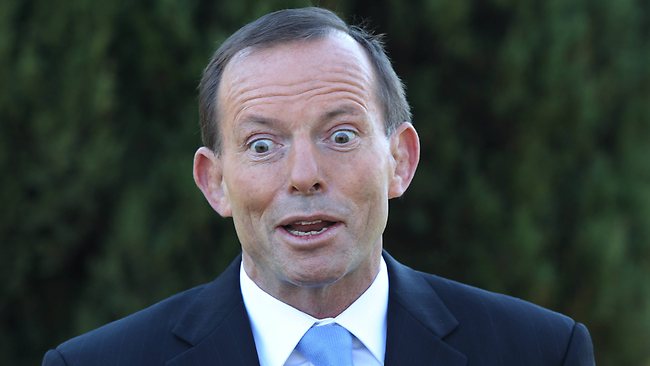
"Awh, Come On, Cobbers - Give Us A Fair Old Suck Of The Sav!"  Tony Abbott’s assertion that he is the government and the government is him, and that the House of Representatives has no right to depose him, is not only absurdly narcissistic but dangerously unconstitutional and undemocratic.

TONY ABBOTT’S QUERULOUS CLAIM that the Australian people, alone, have the right to “fire” him, misrepresents his country’s entire political system. Even worse, it suggests that the Australian Prime Minister has begun to conflate his own narrow personal interests with the broader interests of the nation as a whole. That Australia’s political leader is so heedless of his proper constitutional function is the most vivid proof of that country’s intensifying political difficulties.
 
Abbott’s argument – backed, irresponsibly, by the Murdoch press – is that he has been “hired” by the Australian people on a three-year contract, and that he should, therefore, be protected from any and all leadership challenges until that contract expires at the next election.
 
In other words, Abbott is not really a prime minister at all, but a president. Or, perhaps, given his recent knighting of Prince Philip, a king? He is clearly of the view that effective executive authority in Australia resides not in the Cabinet, whose ministers are drawn from the two elected houses of the Australian parliament, but in his own person. As is actually the case with the USA’s Barack Obama and France’s Francois Hollande, Tony Abbott wrongly believes that the buck of ultimate political responsibility stops with him.
 
Quite where his view of things leaves Australia’s official Head of State, Queen Elizabeth II, and her vice-regal proxy, the Governor-General, is anybody’s guess. The same place, one imagines, as Australia’s long history of representative democracy.
 
Central to that history, and, indeed, to the historical evolution of representative democracy throughout the Commonwealth, is the steady expansion of the constitutional authority of the elected parliamentary chamber: the House of Commons in England and Canada, the House of Representatives in Australia and New Zealand.
 
Nominally, the monarch exercises sovereignty over the realms of the United Kingdom, Canada, Australia and New Zealand. Historically, however, the power of the monarchy has been steadily reduced to the point where the sovereign now reigns but does not rule. It is in the body of elected representatives that sovereignty, for all practical purposes, has come to reside.
 
In both Australia and New Zealand the day-to-day decisions of government are made by the Sovereign’s council of ministers, the Cabinet, chaired by the Prime Minister. But even this powerful organ of executive power is, ultimately, responsible to the elected representatives of the people. The Prime Minister and Cabinet Ministers must be elected Members of Parliament, and remain in office only for so long as they enjoy the support of a majority of the House of Representatives.
 
The political dynamism of the Westminster system, as it has evolved over the past four hundred years, is located in the relationship between the relatively small fraction of the House that sits in Cabinet, and the much larger fraction that does not. This latter group is itself made up of those MPs who mostly vote in support of the Cabinet and those who range themselves in consistent opposition to its policies.
 
The survival of any “Ministry” – as the cabinet selected by the politician commanding a parliamentary majority (i.e. the Prime Minister) is rightly called – is thus dependent on that politician’s ability to retain the loyalty of the MPs who originally gave him or her the job. An effective prime minister, respected by his colleagues and warmly supported by the voting public will have little difficulty remaining in office. A prime minister who loses his colleagues’ respect and who finds him or herself despised by a majority of the electorate will (quite rightly) struggle to keep it.
 
Tony Abbott’s assertion that he is the government and the government is him, and that the House of Representatives has no right to depose him, is, therefore, not only absurdly narcissistic but dangerously unconstitutional and undemocratic.
 
It completely ignores the central reality of the Westminster system: that the Ministry must at all times enjoy the confidence of the House. If, by forfeiting the trust and support of his colleagues in the Liberal Party, Tony Abbott has called the solidity and reliability of his parliamentary majority into question, then his colleagues are perfectly entitled to depose him and install a leader with sufficient support to once again render all questions of confidence moot.
 
Or, as an Aussie Liberal MP might put it behind the closed doors of the Party Room:
 
“Tony, mate, if it was just a question of the punters hiring or firing you, we’d have no problem at all. But, as you well know, that’s not the case. If they want to fire you, sunshine, then, as things now stand, they’ll have to fire the Liberal-National Government as well. That’s us, mate! And, I’m sorry, but if you really expect us to go down with the good ship Tony Abbott, then you’re a bloody mug. With a new Prime Minister and a new Cabinet there’s every chance we can hold onto power well into the future. But, if we accept your version of the constitution, Tony, then this party has no future. So, sorry mate, but we think you ought to call it quits. For the good of the party, Tony. Piss off.”
 
The people don’t elect prime-ministers, parliamentarians do. But, that’s okay, because the  parliamentarians are chosen by the people. In the final analysis, it’s not about them, it’s about us.
 
This essay was originally posted on The Daily Blog of Wednesday, 4 February 2015.

Friday, 17 May 2013

The Lies That Bind: National's Attack On Parliamentary Sovereignty

No Higher Authority: The animating principle of the doctrine of parliamentary sovereignty is that no parliament may bind another: that the popular will recognises no impediments. In spite of former National governments taking full advantage of that principle, the present government is seeking to lock -in its "dirty deal" with Sky City Casino for the next 35 years.
 
BILL ENGLISH has just delivered his fifth budget. No doubt he is proud of his achievement, even if, like any experienced parliamentarian, he knows that all political achievements are as grass: “In the morning it is green, and groweth up: but in the evening it is cut down, dried up, and withered.”
 
The budget decisions, law changes and back-room deals of one parliament are always at risk of being laid low by the next. This is so because the animating principle of parliamentary sovereignty is that no parliament may bind another. Were it not so, democracy would be a cruel sham, and the expression “electoral mandate” would have no meaning.
 
The Greens understand the principle of parliamentary sovereignty very well. Indeed, we saw it applied earlier this week, when they declared that, if elected, they will void the compensation agreement just negotiated between the present, National-dominated parliament and Sky City Casino.
 
The Greens have strong moral objections to what they are calling “this dirty deal”. They do not believe that it’s “okay” for a government to promise extra pokie machines, more gaming tables and a thirty-five year extension of the casino’s gambling licence in return for Sky City building Auckland a convention centre. Nor will they accept the National Government’s attempt to bind future parliaments to the deal by promising Sky City millions of taxpayer dollars if a future government decides to modify or cancel the agreement.
 
The outraged response from senior government figures to the Green’s announcement is more than a little worrying. None of them appear to understand the long-standing constitutional convention that one parliament cannot bind another. The Economic Development Minister, Steven Joyce, in particular, appears to believe that forcing future parliaments to honour present deals is simply good business practice. Something akin to taking out insurance against unforeseen disasters. (By which he presumably means the election of a Labour-Green Government!)
 
Ironically, the National Party has never demonstrated the slightest respect for deals done, contracts signed, or even civil rights conferred by previous parliaments. Perhaps the most egregious example of a National Party-dominated parliament simply tearing-up a contract negotiated and signed by its Labour Party-dominated predecessor occurred 52 years ago, in 1961.
 
The Second Labour Government (1957-60) had embarked on an ambitious programme of industrial development. One of the more significant elements of Labour’s plan was the construction of a large cotton mill outside Nelson. Tenders were called and a contract eventually signed with a British-based company by the New Zealand Government.
 
Before construction could get underway, however, the 1960 General Election produced a National Party majority in the House of Representatives. A group of newly-elected National MPs, led by the pugnacious young Member for Tamaki, Robert Muldoon, were bitterly opposed to the Nelson cotton mill and prevailed upon their caucus colleagues to call a halt to its construction. The signed legal contract with the British company was simply abrogated. Obviously, the British were miffed, but, being followers of the same Westminster traditions of representative government as New Zealanders, they also understood: one parliament cannot bind another.
 
Twenty-three years ago, in 1990, an incoming National Government again felt under no obligation to respect the legislated will of previous New Zealand parliaments. The Employment Contracts Act of 1991 stripped nearly a century’s-worth of accumulated legal rights from hundreds of thousands of New Zealand workers. Their hard-won contracts of employment, known as “national awards”, were simply legislated out of existence.
 
Of course, the National Party and its ideological allies will neither recognise, nor concede, the flagrant political hypocrisy involved in any attempt to prevent the Left from invoking the same, long-standing, constitutional conventions to which the Right has had repeated recourse over the past six decades.
 
The conservative notion that the social, economic and political status-quo represents not the transitory victory of a particular political party, but the natural order of the universe, has a long and disreputable pedigree. It explains why statements of principled intent, like the Greens’, are treated as proof not only of wilful stupidity - but downright wickedness - by the Right.
 
What such responses betray is the Right’s deep-seated unease with the whole idea of democracy. National’s insistence that its deal with Sky City – a deal many Kiwis revile as both improper and immoral – must remain sacrosanct, is, of itself, the best reason for breaking it.
 
This essay was originally published in The Waikato Times, The Taranaki Daily News, The Timaru Herald, The Otago Daily Times and The Greymouth Star of Friday, 17 May 2013.