Showing posts with label Polls. Show all posts

Wednesday, 22 February 2017

Little’s “Broad Church” Widens Labour’s Appeal.

Pondering The Counterfactual: How many more percentage points might Labour have advanced in the latest One News Colmar Brunton poll had “discontented party activists” not spent the week prior to its execution demonstrating rank disunity and ideological extremism?
 
ONE SWALLOW does not make a summer, any more than a two-percentage-point lift in the latest One News Colmar-Brunton poll amounts to a massive political vindication. What Labour’s marginal rise in popularity does signal, however, is some very unhelpful news for some very unhelpful people.
 
Why do I say that? Because the furore over Willie Jackson’s return to the Labour Party can now be put in its more immediate context.
 
Before exploring that context, however, a word or two about polling.
 
Both of the major political parties have their own “internal” pollsters (David Farrar and Curia Research in the case of National, Stephen Mills and UMR for Labour) and both know when their researchers are in the field. Indeed, they often time their public policy pronouncements to coincide with such polling.
 
For very similar reasons most senior political operatives and public relations mavens also like to know when media-commissioned agencies like Colmar Brunton are on the job and when their results will be published.
 
In a society as small as New Zealand, acquiring such intelligence is relatively straightforward. Most of the people who believe they need to know, know someone who really does know when a poll is about to get underway.
 
The fieldwork for the Colmar Brunton poll that was broadcast on One News on Sunday, 19 February, was conducted between 11 and 15 February 2017.
 
This is significant, because in the week prior to the survey the Labour leader, Andrew Little, found himself under vicious attack from persons (including Poto Williams, the Labour MP for Christchurch North) opposed to Labour’s strategic recruitment of the broadcaster, community organiser, and former Alliance MP, Willie Jackson.
 
That Williams consulted a Christchurch public relations firm, Inform PR, to shape her criticism of Little, and to assist her in distributing the resulting statement to selected political journalists, prior to posting it on her Facebook page, struck many observers as odd. Now that we know Colmar Brunton was scheduled to be in the field by the end of the week, William’s behaviour appears much less so.
 
The same applies to the letter of protest posted on Facebook by members of Labour’s youth wing – Young Labour. Like William’s media statement, this document attracted considerable media attention throughout the week, especially after two former Labour MPs, Maryan Street and Marian Hobbs, added their signatures to the document.
 
Throughout the week Little was required to endure the less-than-friendly attentions of the parliamentary press gallery, as well as a succession of highly critical opinion pieces questioning his political judgement and challenging his commitment to Labour’s quest for gender parity.
 
By the end of the week, the proprietor of the POLITIK blog, Richard Harman, was reporting that:
 
“The events last week [5-11 February] seem to be connected to what has been what one senior party source described as a ‘parallel universe’ of discontented party activists who have been active on the left-wing blog ‘The Standard’ and who also organised to promote candidates for office within the party.”
 
It is, therefore, very tempting to see, with the benefit of hindsight, the timing of the criticism of Little’s recruitment of Jackson as something more than coincidental. If Harman’s “discontented party activists” had prior knowledge of when the Colmar Brunton survey would be in the field, it is not difficult to fathom why they might be tempted to seize upon the opportunity to put a spanner in the Leader’s works.
 
Clearly, there are many in Labour’s ranks who do not like the idea of the party once again becoming a “broad church”. How better to prove the unwisdom of Little’s policy than to orchestrate a week-long outpouring of protest against the Jackson recruitment, culminating in a falling-off in support for Labour – and Little – as measured in the oh-so-conveniently scheduled Colmar Brunton survey?
 
Except, of course, the campaign failed to achieve its objective. Far from registering a falling-off of support for Labour, the poll revealed a small, but very welcome, rise in support. At last, Labour was back in the 30s – an important morale-boost for both the caucus and the wider party. The recruitment of Jackson and the selection of the former Police Association President, Greg O’Connor, had produced precisely the effect which Little and his team had be working for.
 
The question that cannot be avoided, however, is as straightforward as it is disconcerting: How many more percentage points might Labour have advanced in the Colmar Brunton poll had “discontented party activists” not spent the week prior to its execution demonstrating rank disunity and ideological extremism?
 
This essay was originally posted on The Daily Blog of Monday, 20 February 2017.

Friday, 22 July 2011

Poll Axed

Going Down?: Labour morale, boosted by the generally positive critical reception given to its proposed Capital Gains Tax, sustained a crushing blow when the One News Colmar Brunton poll showed the party plummeting seven percentage points to its worst result in a decade. But are the opinion polls methodologically sound? And, if they're not, who benefits most from the news media's failure to correct them?

TWENTY-SEVEN PERCENT: the results from the One News Colmar Brunton Poll fell upon Labour’s hopes like a sledge-hammer. Party members and supporters who, just days before, had been feeling proud and confident stared at the numbers in blank amazement. Everything they’d experienced since last Thursday’s tax-policy launch had reassured them that the Party’s plans were being well-received by the public. And yet, there they were, those wretched numbers: the worst in a decade.

It was all so demoralising. Why go on fighting? What was the point? When, in spite of most experts hailing Labour’s Capital Gains Tax (CGT) as not only a courageous and much-needed fillip to economic development, but also as a statement of basic fairness, the voting public simply turned their backs.

Such a savage rejection must surely mean that Labour and its supporters constitute an eccentric – almost cultish – subset of the New Zealand electorate? A sort of political Amish, whose beliefs and policies appear as outlandish to “Mainstream New Zealand” as the Amish’s horse-drawn carts and buggies?

That is certainly what Labour’s opponents would like its supporters to think. Which gives rise to the very troubling question: “Are opinion polls being used, quite deliberately, to demoralise the Government’s opponents?”

Prior to the events of the past fortnight in the United Kingdom, such a question would have reeked of the political paranoia usually associated with conspiracy theorists. But, after the revelations exposing the corruption and collusion which has for decades defined the relationship between Britain’s news media and her politicians, it is a question that merits some sort of answer.

Let’s begin with Colmar Brunton. Since at least 2004 there has been persuasive academic evidence that a statistical bias in Colmar Brunton’s sampling methods causes it to consistently overstate the support of the political Right.

The company’s telephone survey is conducted Saturday to Thursday evenings (inclusive). But, by conducting its polling mostly on weeknights, Colmar Brunton’s academic critics (Rob Salmond, Keith Rankin) argue that the company is much more likely to make contact with higher income-earners – men and women whose electoral choices traditionally favour the more conservative political parties.

This statistical bias could be eliminated if Colmar Brunton’s data was weighted to overcome the preponderance of higher income earners among its respondents. But, although Colmar Brunton weights its results to match Statistics New Zealand’s population data on age, gender, household size and ethnic origin, it does not weight them to match the income-spread of New Zealand’s voters.

And neither, it appears, do the other major polling agencies: Reid Research, DigiPoll and Roy Morgan.

There is, however, one polling agency that does weight its data for income – with startling results. The latest HorizonPoll, taken shortly after the Budget (24/5/11) presents a picture of the New Zealand political scene that is radically different from the picture presented by its competitors.

In HorizonPoll’s survey, support for the “Left Bloc” (Labour, Greens, NZ First,) stands at 43 percent; with the “Right Bloc” (National, Act, United Future, Maori Party) only just behind them on 42.7 percent support.

Admittedly, there are more differences in the HorizonPoll’s methodology than simply allowing for voter income. Even so, a news media motivated by a genuine desire to obtain the most accurate description of the electorate’s mood would surely be concerned by the startling discrepancies between the HorizonPoll’s results and the findings obtained using “standard”  methodologies.

Indeed, the only plausible explanation for not being concerned is that, from the perspective of this country’s largest media corporations, the “standard methodologies” are exerting a consistent and positive influence over the public’s political perceptions and voting intentions.

By portraying the contest between Right and Left blocs as a hopelessly one-sided horse-race, the “standard methodologies” obviate the need for a more detailed examination of, and a more even-handed debate about, the political alternatives currently on offer.

But surely, if opinion polls possess the power to alter our perceptions (and they do) then the methodologies sanctioned by their sponsors must be above suspicion?

This essay was originally published in The Dominion Post, The Timaru Herald, The Taranaki Daily News, The Otago Daily Times and The Greymouth Star of Friday, 22 July 2011.

Thursday, 6 January 2011

Are The Polls Right?

Going Down? If the polls were a little black box, Labourites would be forever tapping it with their middle finger, giving it a none-too-gentle shake, and muttering: "There's something wrong with this bloody machine - because that can't be right!"

CAN THE GOVERNMENT really be so far ahead of Labour in the polls? Is it credible that voter support for the National Party is consistently calculated at more than 50 percent?

Labour supporters certainly don’t think so. If the polls were a little black box, Labourites would forever be tapping at it with their middle finger, or giving it a none-too-gentle shake. Re-reading the dial they’d mutter angrily: "There’s something wrong with this bloody machine – because that can’t be right", and throw it forcefully against the nearest wall.

But, this sort of denial only makes things worse. If there’s one thing in this world upon which it is still safe to rely – it’s mathematics. If three or four independent polling agencies, each one conducting its survey at different times and using its own idiosyncratic selection and weighting formulae have, for two years straight, produced results within a very few percentage points their rivals – then those results should be heeded.

Rather than insisting there’s something wrong with the polling agencies’ little black boxes, Labour should be devoting its energies to understanding the data. Phil Goff needs to understand why John Key’s government is so popular. Only then can the Labour Party begin making it unpopular.

A major obstacle to achieving such understanding is the historical record. Labour’s strategists look back over more than a century of election results and find only a handful of occasions where a single political party received more than 50 percent of the popular vote.

These were the elections of 1938, 1946, 1949 and 1951. All of those contests were classic First-Past-the-Post, two-party, elections in which 95 percent or more of the popular vote was shared between Labour and National. Since the election of 1954, when the Social Credit Political League debuted with an impressive 11.4 percent share of the votes cast, neither National nor Labour has ever won more than half of the electorate’s support.

It is highly improbable, Labour’s strategists insist, that the National Party, operating under a system of proportional representation and with six other parties holding seats in the House of Representatives, could take more than 50 percent of the Party Vote.

Improbable – but not impossible.

Deductive reasoning has its place, but it is not always true that simply because something has never happened in the past (or, at least, for a very long time) it cannot, therefore, happen in the future. Just ask Barack Obama.

If a set of conditions have come into existence between 2006 and 2011 – conditions that were not present when past general elections were conducted – then it is entirely reasonable to argue that this year’s general election will produce an outcome none of us have ever seen before.

What could those conditions be?

One of them might be an unwillingness, on the electorate’s part, to go on believing that governments can act outside the parameters of global capitalist norms without making a bad situation even worse. In a nation as small and economically vulnerable as New Zealand, such scepticism is likely to be well-founded. And, in circumstances where that nation is required to borrow $260 million per week, just to pay its bills, then scepticism is well on the way to becoming fact.

New Zealanders look abroad and witness the dire economic crises afflicting Greece and Ireland: they see the violent political consequences of the austerity measures forced upon those bankrupt countries’ governments; and they are hugely relieved that their Prime Minister made his millions negotiating the rapids of global finance.

In the absence of a Labour leader, and a Labour Party manifesto, sufficiently persuasive to negate John Key’s experiential advantages, why would New Zealanders vote for anybody else?

It will require a campaign of historic and heroic dynamism to jolt New Zealanders out of their fatalistic certitude that nothing can be done to protect their country from the ravages of a devastating global recession. And, since a period of economic austerity is now inevitable, who’s better placed to manage the whole painful process than our own, highly successful, former currency trader from Merrill Lynch?

Labour cannot count on the news media delivering, uncritically, any policy prescription fundamentally at odds with these dispiriting conclusions. Which leaves the Opposition Leader Goff with just two options.

If he’s unwilling to challenge the conventions of contemporary politics (in which the mainstream news media plays a crucial role) he’ll have to run what The Daily Show’s host, John Stewart, calls a "We suck the least" style of election campaign.

Or, if Mr Goff wishes to offer the voters something more than "A Kinder, Gentler Austerity Programme", he’s going to have to display a talent for radical-populist political mobilisation hitherto undetected in either himself or his caucus.

Accordingly, the chances of National’s stratospheric poll results proving anything other than prophetic seem rather slim.

This essay was originally published in The Press of Tuesday, 4 January 2011.

Friday, 16 July 2010

The Arrogant Left

It's for your own good, Mr McMurphy: The ice-cold "charity" of Ken Kesey's Nurse Ratched brilliantly exemplifies the key political functions of the managerial-professional class: infantilising the working-class and marginalising their representatives on the traditional Left.

FOR SOMEONE WRITING from a left-wing perspective, Rob Salmond’s "Poll of Polls" makes dismal reading. Reinstated, after a lengthy hiatus, on the "Pundit" blogsite, Rob’s scientific homogenisation of the findings of the four major media polls (Colmar Brunton, Reid Research, Roy Morgan and DigiPoll) illustrates all-too-graphically just how vast the ideological gulf between Right and Left has become.

Something, or someone, must be responsible for this widening gap: something or someone so objectionable that the majority, rather than be counted among the Left’s supporters, is prepared to overlook the lengthening list of right-wing policy failures. That willingness to turn a blind eye is now so pronounced that just under two-thirds of those most recently questioned by Roy Morgan’s pollsters agreed that the country was "headed in the right direction".

This is an extraordinary figure. New Zealand is only slowly hauling itself out of a deep recession. Job insecurity is rife; mortgagee sales are rising; the cost of living keeps going up and up – and yet, all of these difficulties notwithstanding, 65 percent of Roy Morgan’s respondents think we’re on the right track.

What is it about the Left’s beliefs, behaviour and overall policy prescription that has driven it below the 40 percent line on Rob Salmond’s Poll of Polls graph? And what is Labour doing (or not doing) that keeps it trailing behind National by a morale-sapping 21.1 percentage points?

At the heart of all these questions, I believe, lies the problem of left-wing arrogance. It’s the problem that has kept me firmly on the outside of the Left’s inner-circles for the best part of forty years. Even as a teenager (when, supposedly, I was most susceptible to the allure of the Left’s grand, all-encompassing theories) I found the superior attitude of left-wingers intolerable.

Like Plato’s ring of invisibility, Marxist-Leninist ideology seemed to grant its adepts the power to sin with impunity. The rest of humanity were regarded as mere raw material – objects upon which they were free to work without ethical restraint. The crimes of their enemies were shrilly condemned, while those committed by their friends and allies were passed over in silence.

This superior attitude was by no means restricted to the multitude of communist sects. If anything, it was even more pronounced among the radical followers of the so-called New Social Movements: Anti-Racism, Environmentalism, Feminism, Gay Rights. Like the heroes of the 1969 cult-movie Easy Rider, these "new" leftists saw themselves as an enlightened but despised minority trying to do right in a world populated overwhelmingly by the ignorant and hostile.

Even today, this deep contempt for the majority remains clearly evident in the Left’s language. To question the ideology of Maori nationalism is to reveal oneself as a racist "redneck". Working-class communities attempting to defend their jobs from the demands of environmentalists are dismissed as "feral" or "white trash". The slightest challenge to the sacred precepts of Orthodox Feminism will provoke torrents of vitriolic abuse.

Traditional Labour politics was very different. The premise here was that a working-class party can only be the political vehicle for working-class needs and aspirations. Labour politicians, if they were worth a damn, saw themselves as nothing more than the frothy margins of the popular tide: markers of the masses’ reach. For these sort of leftists the will of the majority was sacred.

It was only when Labour ceased believing in the wisdom and decency of the majority that its hold on popular affection began to weaken. It broke altogether when, in the mid-1980s, the brute arrogance of Roger Douglas and his fellow neoliberals made common cause with the smug superiority of the managerial-professional New Leftists who had taken over the party.

Labour only rebuilt its relationship with voters by aligning itself with the vast anti-neoliberal majority of the 1990s. Once in power, however, the parliamentary party’s distaste for the values and beliefs of its own supporters grew more obvious with every passing year. By the end of its term Labour’s distaste had matured into open contempt.

In 2008 many Labour voters happily returned the complement.

Nearly two years on and Labour may talk about polices for "the many – not the few" but it’s the few, not the many, who are writing them.

The Left’s poll-results will only start improving when it stops trying to lead the people – and starts following them.

This essay was originally published in The Timaru Herald, The Taranaki Daily News, The Otago Daily Times and The Greymouth Evening Star of Friday, 16 July 2010. 

Friday, 1 May 2009

May Day 2009

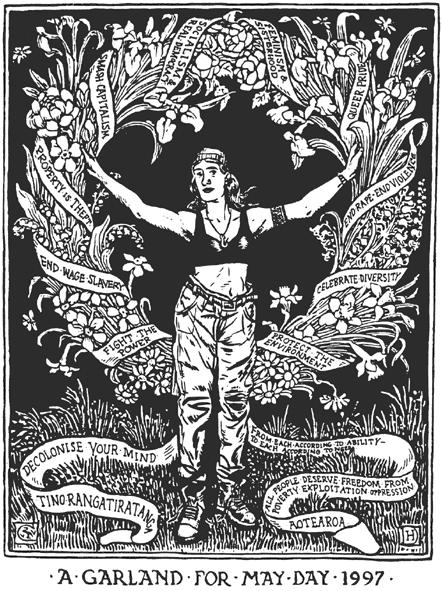
This homage to Walter Crane's famous woodcut was commissioned from leading New Zealand graphic novelist, Dylan Horrocks, by New Zealand Political Review in 1997.

TODAY is May Day. As the sun sets this evening, a dedicated handful of left-wing activists will make their annual excursion up Auckland’s Queen Street. Above their ranks, red flags will flutter and brightly-coloured banners will proclaim the time-honoured slogans of international labour solidarity. Upon reaching the Town Hall, speeches will be delivered, and words like "revolution" and "workers’ power" will float out over Aotea Square.

From the thousands of working-class Aucklanders hurrying to catch their trains and busses out of the central city, this dwindling collection of communists, socialists and anarchists will receive only the briefest of puzzled glances. The big questions preoccupying the Proletariat on its way home this May Day will be: What shall I cook the family for tea? And, what’s worth watching on TV tonight? Winning a world, by losing their chains, probably won’t get a look-in.

In Paris, the former premier, Dominique de Villepin talks fearfully of May Day turning into revolution. In Wellington, Prime Minister John Key is all smiles.

And why not? The latest 3News/Reid Research poll places the Labour Party 26 percentage points behind National. The Green Party, which should be well into double-figures, continues to stagger along the edge of the sub-five-percent MMP precipice. And the rest of the vote-seeking Left: the Alliance, RAM and the Workers’ Party; together, would barley muster one tenth of one percent.

As if this burden of electoral unpopularity wasn’t enough to bear, there’s another poll showing more than two-thirds of Kiwi voters are content with their country’s current course. According to the Australian-based polling agency, Roy Morgan, our Government Confidence Rating is "at the highest recorded, 151.5 (up 8.5 points) with 68.5% (up 3.5%) of New Zealanders saying New Zealand is ‘heading in the right direction’, compared to just 17% (down 5%) that say New Zealand is ‘heading in the wrong direction’."

Given what is actually happening in New Zealand and around the world, those numbers are truly astounding.

Our own Treasury (whose dire economic predictions are constantly being trumped by reality) told us nearly six months ago to expect 10 percent unemployment by the end of the year. While every reputable economist not employed by a bank (and even some of them) is warning that: a.) things are going to get a lot worse before they get better; and b.) John Key and Bill English have no viable policy options other than slashing government spending.

And still, 68.5 percent of us think John Key’s leading us into the "broad sunlit uplands" of peace and prosperity.

Okay, a lot of the blame for this has to be laid at the feet of this country’s most listened-to commentators, nearly all of whom are vehement right-wing talkback hosts who’ve spent the last three years campaigning quite unashamedly for a change of government, and who are so generously remunerated that, to their ears, all this gloomy chatter about "the most serious economic crisis in 70 years" sounds utterly bizarre.

On Sunday, one of these right-wing divas, fresh from the glittering emporiums of London’s Oxford Street, even went so far as to reassure her adoring public that she saw no evidence of a recession in the United Kingdom. The IMF, currently predicting a disastrous 4.1 percent contraction in the UK’s economy, would probably beg to differ.

But even were the entire commentariat channelling this sort of economic denial, it would not, of itself, be enough to explain that 68.5 percent confidence rating. For self-delusion on this scale, a lot more than the "there is no depression in New Zealand" mantra of National-friendly media personalities is required. To generate such a response, a huge amount of denial must be present in the electorate as well.

But what are the voters denying? Easy. They’re denying they need anybody’s help to survive and prosper; they’re denying that their social and economic security’s got anything to do with Labour, or the working-class traditions of solidarity and struggle it stands for. They’re also denying the all-too-visible signs that "nice Mr Key" and his right-wing mates are preparing to rip the guts out of what’s left of the welfare state.

Why are they denying these things? Because if two-thirds of them didn’t believe New Zealand was "heading in the right direction", they’d have no excuse for not heading up Queen Street with the Left.

This essay was originally published in the Dominion Post, The Timaru Herald, The Taranaki Daily News, The Otago Daily Times and The Greymouth Evening Star of Friday, 1 May 2009.