Showing posts with label The British Empire. Show all posts

Friday, 12 August 2022

The Flashman Factor.

The Empire Within Which Bullying Never Ceased: The bitter truth about Great Britain’s “public” schools (and their many imitators in the Empire’s far-flung dominions) is that they were consciously designed to produce a very particular kind of imperial administrator. These men needed to be courageous, but not compassionate; clever, but not too clever; up for anything their superiors deemed necessary, and indifferent to others’ pain and suffering. 

TOM BROWN’S SCHOOL DAYS defined a whole generation of “Muscular Christian” English gentlemen. The author of this immensely popular Victorian novel, Thomas Hughes, set out to redefine the values deemed essential to ruling the greatest empire the world had ever known. He had no time whatsoever for effeteness, and even less for arid intellectuality. What Great Britain and its sprawling empire needed were strong and practical souls – leavened by a sound education. What it had absolutely no need for, Hughes insisted, were bullies.

Tom Brown’s School Days provided the model for all the many “school novels” that succeeded it – the most recent of which, J.K. Rowlings’ Harry Potter series – owe a great deal to the original. The all-wise figure of Professor Dumbledore, for example, bears an uncanny resemblance to Dr Thomas Arnold, the real-life headmaster of Rugby School from 1828-1841 who “plays himself” in Hughes’ partly autobiographical novel.

In many respects, Tom Brown’s School Days represented a girding of British ruling-class loins for the great tasks that lay ahead, as British imperialism got its second wind in the Nineteenth Century’s second half. Certainly, the novel’s hero possesses an impressive tally of the virtues required for the daunting mission of imposing “civilisation”. He’s physically fit, amiable, courageous, and up for any challenge. As the novel unfolds, however, it becomes clear that these muscular qualities are not of themselves sufficient. Minds need training as well as bodies, and courage must always be tempered by compassion.

Lest their be any confusion, however, Hughes introduces the unforgettable figure of Flashman, Rugby’s biggest and most brutal bully. It is Flashman who supplies the novel’s most memorable scene, in which a defiant Tom is held in front of a roaring fire by Flashman’s accomplices. Although Tom is ultimately rescued from Flashman’s torture, it is the bully’s viciousness that remains with the reader.

As George MacDonald Fraser, author of the best-selling Flashman novels, realised, it would be the anti-hero’s amorality, not Tom’s Christian piety, that titillated readers in the much darker Twentieth Century.

Hughes’ civilising mission, though indisputably admirable, was always doomed to fail. A thousand Dr Arnold’s could not overcome the brutal fact that imperialism is a brutal business. Seizing and holding other peoples’ lands is an undertaking for which the Flashmans’ of this world are much more suited temperamentally than the Tom Browns.

The bitter truth is that Great Britain’s “public” schools (and their many imitators in the Empire’s far-flung dominions) were consciously designed to produce a very particular kind of imperial administrator. These men needed to be courageous, but not compassionate; clever, but not too clever; up for anything their superiors deemed necessary, and indifferent to others’ pain and suffering. Most importantly, these imperialists needed to enjoy wielding power and subjecting weaker peoples to their will.

In other words, producing bullies was what Eton, Harrow, Rugby, and all the other public schools, were all about.

Why else would public schoolboys be expected to read Caesar’s Conquest of Gaul in the original Latin? (Hint: It wasn’t because he demonstrated Muscular Christianity!) The other great lesson these privately educated gentlemen were required to learn, apart from the practicalities of genocide, is that what a ruling class tells the world it is doing, and what it actually does, are two very different things. Hypocrisy is, always, the indispensable aspect of effective governance. Take note of what I say, not what I do (or have done in the past) is the necessary expectation of those who wield power over others.

These, the instincts and habits of domination are much too important to learn on the job. That is why the pliable young saplings that enter our elite schools must be bent, twisted and violently pruned until they are ready to be released upon the world. It’s why the people responsible for running these schools turn a blind eye to the brutalities by their star pupils, and protect them when they go too far. After all, isn’t life just one long game of rough-and-tumble? And isn’t it better to win at that game than to lose?

The Powers-That-Be may say they want a world filled with the likes of Dr Arnold and Tom Brown. What they really want, however, is a world filled with the likes of Flashman.

Bullying isn’t a bug in the private education system – it’s a feature.


This essay was originally published in The Otago Daily Times and The Greymouth Star of Friday, 12 August 2022.

Monday, 6 June 2022

The Year Of Jubilee.

Apres moi ...? Queen Elizabeth II, photographed nearly 70 years ago at her coronation. A remarkable monarch, but she is faltering. Unable to attend so many of the Jubilee’s dazzling spectacles, the Queen’s frailty attests to the unalterable fact of human mortality. Unlike palaces and castles, human-beings cannot be strengthened and renovated. Time, remorseless and unforgiving, exacts its toll.

ON TUESDAY, 22 JUNE 1897, my Grandfather, William Marshall, rode through the streets of London to honour Queen Victoria. As a trooper in the North Otago Mounted Rifles he was part of the New Zealand military contingent sent to celebrate Her Majesty’s Diamond Jubilee. For sixty glorious years Victoria had reigned over the United Kingdom of Great Britain and Ireland, and an empire of unsurpassed extent and power.

One hundred and twenty-five years later, the streets of London are again filled with cheering crowds. Queen Elizabeth II has easily exceeded Victoria’s record, reigning for an astonishing 70 years. Her Platinum Jubilee has given the British people what is almost certainly their last opportunity to mark a milestone in the reign of the only monarch most of them have ever known.

To have a clear memory of King George VI, one would need to have been born in, or before, the late-1940s. And yet, when I was growing up in the 1960s, the late King’s image was everywhere. On ha’pennies, pennies, threepences, sixpences, shillings and florins. George wasn’t merely a “Rex”, he was an “Imp”: the King-Emperor from whom my father received his commission during the Second World War.

George’s daughter, Elizabeth’s, coins were never stamped with the “Imp”. India was gone by the time she became Elizabeth R in 1952. Her seventy years as queen have been distinguished not by the Imperial might to which my grandfather contributed (by helping Victoria’s ministers seize the Boer republics) but by imperial decline.

The British Empire is no more, and the United Kingdom itself is becoming an increasingly dubious proposition. The unification of Ireland has moved from an utter impossibility to a distinct likelihood. Scotland, too, is moving away from the “Great Britain” forged by the accession of James I in 1603. Even Wales is teetering.

Who else but Elizabeth II could have held this strange heraldic menagerie in check? Her great age encompasses so much of the UK’s recent history. She was there when Hitler’s bombers filled England’s skies. She donned a scratchy khaki uniform to “do her bit” for the “war effort”, saluting bravely alongside millions of her father’s subjects, caught up, like her, in the most terrible event of human history.

As the handful of still airworthy Spitfires and Hurricanes roared over the balcony of Buckingham Palace on Friday, Queen Elizabeth’s participation in the Second World War was acknowledged. It brought to mind my father’s own experiences as a Pilot Officer in the RNZAF, and my mother’s vivid high-school memories of “the War”. Both of them are gone now, but somehow, miraculously, Elizabeth endures.

But she is faltering. Unable to attend so many of the Jubilee’s dazzling spectacles, the Queen’s frailty attests to the unalterable fact of human mortality. Unlike palaces and castles, human-beings cannot be strengthened and renovated. Time, remorseless and unforgiving exacts its toll. New Zealand’s banknotes have told the story. From the young and radiant Elizabeth; to the mature mother of a fractious royal brood; to the Old Queen of today. The planet’s seventy journey’s around the Sun are etched upon her face for all to see.

There are some who say that she has carried her royal burden for far too long. At 73, Charles, Prince of Wales, appears to many as a man wronged and ruined by a surfeit of waiting. Had his mother abdicated in his favour at the age of 75, King Charles III would now be in the twenty-first year of his reign. Moreover, with the precedent of a retiring age of 75 firmly set, Charles would now be readying his own son, Prince William, to ascend to the throne in 2024.

Why, then, is the above counter-factual, rather than actual, history? Blame it on Elizabeth’s wicked uncle, Edward VIII. Thanks to him, abdication became a dirty word. A king or queen of England does not shrug off the solemn duties owed to the Realm like a soiled overcoat. Duties, no matter how burdensome, are to be borne to the bitter end – to the last breath.

And then, sadly, there is Charles himself. The poor man would have been so much better suited to the role of an eccentric aristocrat, only distantly related to the reigning monarch, whose peculiar interests, even more peculiar opinions, and “difficult” relationships with women, could inflict no lasting damage on the Royal Family. In the Heir Apparent to the Throne, however, these eccentricities were always going to give his royal mother and her ministers serious cause for concern.

Indeed, with the possible exception of her youngest son, Edward, all of the Queen’s children have allowed themselves to provide unfavourable contrasts with the unblemished track-record of their mother. It isn’t difficult to grasp why the disadvantages of stepping down from the Throne have always struck Elizabeth as being vastly greater than the advantages. Schooled by her grandmother, Queen Mary, in the sacredness of duty; and by her father, the King, in the obligations of service, Her Majesty has chosen to stiffen her shoulders, set her chin, keep calm – and carry on.

And so, as the years have passed, the sprawling ramshackle family pile that is the British Monarchy, has shown increasing signs of wear and tear. There’s a fragility about the whole edifice now that poses, to all who still care about it, an uncomfortable question: “Can it survive the present Queen’s demise?” Will the old “Dominions” – Canada, Australia, New Zealand – embrace King Charles III? Will the peoples of England, Scotland, Wales and Northern Ireland?

Perhaps, if Charles set a limit upon his reign of five years, or, with more prospect of saving “The Firm”, abdicated in favour of his 40-something son and his glamorous wife. That just might work. Indeed, skipping an entire generation, and crowning Princess Diana’s son King William IV, strikes many royalists as the only viable strategy for preventing the British people, and their far-flung progeny, from rather quickly falling out of love with the whole anachronistic notion of a head-of-state who is born – not chosen.

And yet, and yet … My grandfather Marshall (now a captain) was back in England for the Coronation of the King Emperor, Edward VII. As a little boy, I would, from time to time, be allowed to draw his dress sword from its scabbard. With shining eyes, I would trace Edward’s royal initials woven into the hilt. King’s man. That was my grandfather. And Marshall is my middle name. Passed down. Inherited.

King's Man: Captain William Marshall. The author's grandfather.
The continuity of family in a chaotic world.

Vivat Regina!


This essay was originally posted on the Interest.co.nz website on Monday, 6 June 2022.

Friday, 8 April 2022

America’s To Lose: But the Outcome Of The “Great Game” Remains Unclear.

Disputed Territory: By 1991 it looked as though America’s geopoliticians had won the Great Game. The Soviet Union had collapsed, Eastern Europe was theirs for the taking, and the People’s Republic of China had allowed itself to be transformed into a giant American factory. No wonder a US State Department analyst, Francis Fukuyama, had jubilantly penned a paper entitled “The End of History”.

THE GREAT GEOPOLITICAL CHALLENGE confronting the United States is that the Americas are separated from Eurasia by two broad oceans. Since the end of the Second World War, from which it emerged as the undisputed global hegemon, this geopolitical challenge has required the American government to transform Western Europe into a military, economic and cultural appendage of the United States.

Had the United States failed to effect this transformation, its own economy would have faltered, and capitalism, as a global system, could very easily have collapsed. Making the nations of Western Europe part and parcel of the American economy – principally as borrowers of American dollars and consumers of American exports – was crucial to preserving the American people’s economic prosperity and, hence, the USA’s political stability.

Had the USA not launched the “Marshall Plan” for European recovery, and intervened aggressively in the domestic politics of France and Italy, it is practically certain that the formidable Communist Parties of those two countries would have come to power, bringing the whole of Europe under the tutelage of the Soviet Union.

And Great Britain?

The United States had taken a majority shareholding in Great Britain Ltd during the darkest days of 1940. In return for the US President, Franklin D. Roosevelt, keeping his country in the war, Winston Churchill, was forced to set in motion the dissolution of the British Empire.

It is likely Churchill consoled himself for this capitulation to necessity with fairy tales about a “special relationship” between the USA and Great Britain. No doubt he truly believed that in the unfolding history of the English-speaking peoples, Britain would be seen to have played the role of Ancient Greece to America’s Ancient Rome: peacefully blending its old empire into something new and altogether larger and more powerful.

The Americans would not have disagreed with the last bit, but they were never foolish enough to believe in the rest. Since becoming the world’s banker during the First World War, US capitalism had been aching to get its hands on the protected markets and resources of the geographically vast British Empire. The only thing the Americans were willing to share with the British was the English language.

As the Brits found out to their cost during the Suez Crisis of 1956, the sun had well and truly set on the British Empire. It had become an expensive joke. The British lion was stuffed.

Which still left the USA facing the problem of Eurasia. The Soviet Union and China might be broken and destitute after years of oppression and war, but beneath the graves and the rubble lay resources that could make them rich enough to one day compete with the United States for the rest of the world’s allegiance.

The geopolitical planners in Washington understood that American hegemony could only be sustained by making damn sure that neither Russia nor China ever arrived at that strategically critical position. What they were in the process of doing to the British Empire, they were determined, eventually, to do to the Russians and the Chinese: break them into pieces and transfer their markets and resources into the safekeeping of Uncle Sam.

By 1991 it looked as though America’s geopoliticians had done it. The Soviet Union had collapsed, Eastern Europe was theirs for the taking, and the People’s Republic of China had allowed itself to be transformed into a giant American factory. No wonder a US State Department analyst, Francis Fukuyama, had jubilantly penned a paper entitled “The End of History”.

But, the clever boys and girls in the State Department, and their moronic friends in the military and the CIA, had not factored in the extraordinary historical resilience of the Russians and the Chinese. Henry Ford had told his fellow Americans that “history is bunk” – and they had believed him. Drunk on the heady brew of their “unipolar world”, US geopoliticians had called their global victory too soon. Eventually, after twenty years of getting its ass kicked in the Middle East, the United States had to confront the inconvenient truth that Eurasia wasn’t beaten yet – not by a long shot.

Inevitably, Russia and China had produced leaders in possession of the requisite political steel to exploit the Americans’ mistaken assumption that they could command the rest of the world to dance – and it would dance. Only when it was too late did Washington understand that Moscow and Beijing has music of their own, and dance-steps with which America was entirely unfamiliar. In the global edition of Dancing With The Stars, Vladimir Putin and Xi Jinping made Bush, Obama, Trump and Biden look like flat-footed rubes.

Snapping out of their premature imperial bender, the Americans did their best to re-energise the Drang nach Osten (Drive to the East) that had been set in motion by the Soviet Union’s collapse. The United States’ geopolitical catspaw, Nato, had been expanded all the way to the borders of the Russian Federation. Washington and its surrogates were stirring up trouble in China’s western border province of Xinjiang. Bait the Bear and Poke the Dragon had become the only games in town.

But these were no sand-blasted Middle-eastern dictators they were facing. Russia and China were nuclear powers. Getting rid of Putin and Xi would require something the Americans have never been over-endowed with – guile.

Regardless, they laid a trap for Putin, baited it with Ukraine, and waited. If Russia took the bait, the United States and Nato would unleash, as one pundit put it: “an economic and cultural Barbarossa”. And if Xi was foolish enough to come to Putin’s aid, then they were quite willing to declare full-scale economic war on the People’s Republic as well. A geopolitical twofer!

Except, the imposition of crippling sanctions cuts both ways. The USA is pinning all its hopes of finally subduing Eurasia on both Russia and China succumbing to the impact of the West’s economic warfare before it blows back into Europe, Africa, the Middle East, South Asia and, ultimately, and perhaps a lot faster than Washington anticipates, into America itself.

The Russian Federation has released a map of the world showing all those nations who have declared themselves “Enemies of Russia” by joining the economic blockade. The most striking thing about the map is that it identifies not only Putin’s (and potentially Xi’s) enemies, but also those parts of the world inhabited by white people.

If Eurasia survives the sanctions; and if, in the process, it creates a new economic order from which the great American hegemon and its hangers-on are excluded; then it will not be the USA that wins the Great Game, it will be Russia and China, the masters of Eurasia.

Because, as the inventor of geopolitics, Sir Halford Mackinder (1861-1947) wrote more than a century ago:

Who rules East Europe commands the Heartland; [Russia] Who rules the Heartland commands the World Island; [Eurasia plus Africa] Who rules the World Island commands the World.


This essay was originally posted on The Daily Blog of Friday, 8 April 2022.

Wednesday, 26 April 2017

Why They Went To War - Anzac Day 2017

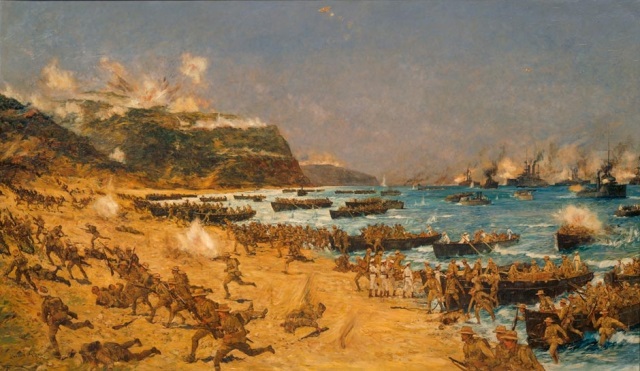
Heroism At ANZAC Cove: Hundreds of young New Zealanders and Australians died on the Gallipoli Peninsula on 25 April 1915. We can ask ourselves whether furthering Great Britain's imperial ambitions was worth the blood sacrifice - confident in the wisdom of hindsight that it was not. It is sobering, however, to reflect that, asked the same question, most the boys coming ashore that fateful morning would have answered with a resounding "Yes!"

“THEY DIDN’T EVEN THINK ABOUT IT.” That was the awestruck assessment of the young man interviewed for Television New Zealand’s Q+A programme. He was one of a small crowd of Wellingtonians gathered around New Zealand’s handsomely refurbished National War Memorial to hear the playing of the Last Post and the ritual recitation of “For The Fallen”. Every one of the 1,560 days of New Zealand’s participation in the First World War, now a hundred years in the past, is being commemorated in this fashion. The great tragedy of that conflict: a tragedy which endures; is that, like the thousands of young men who rushed to join up in August 1914, far too many New Zealanders still decline to even think about why they went to war.

If pressed, most Kiwis will mutter something about defending freedom and democracy. But that is the answer to another question. Defending freedom and democracy was why New Zealand and the other Dominions of the British Empire went to war against Nazi Germany in 1939.

Except, truthfully, it’s a trick question. Because, if the international crisis of June-August 1914 had been handled differently, then there would have been no need to go to war against Adolf Hitler in September 1939. World War I and World War II constitute the bookends of a single conflict. And what New Zealanders were fighting for at the beginning of this calamitous thirty-year struggle was very different from what they were fighting for at its end.

To say that World War I was spawned by imperial rivalries is simply to state the obvious. The question New Zealanders needed to (but didn’t) ask themselves in 1914 was: “Why is the empire we belong to – the British Empire – so willing to invest its blood and treasure in a quarrel between the empires of Russia, Germany, Austria-Hungary and France?”

The answer is simple: because the British Empire was frightened.

It was frightened of Russia’s growing capacity to project its military power in the direction of Britain’s most important, and vulnerable, imperial possession: India. The Royal Navy could not defend the Indian sub-continent from a concerted, land-based, Russian advance. It was, therefore, in Britain’s economic, military and diplomatic interests to keep Russia focused on opportunities for expansion in Europe – not Asia.

The British Empire also feared Germany. Since reunification in 1871, German industrial expansion had been phenomenal. Britain’s pre-eminent economic position, along with her ability to defend it, faced a formidable challenger. Unchecked, Germany would soon become the economic arbiter of Europe (just as it is today!) and that economic power, strapped to her undisputed military prowess, would soon make Germany the most powerful nation on earth.

That was not a position the British Empire was willing to relinquish – not yet.

The diplomatic outcome of all this was the Triple Entente. By aligning herself with Russia and France, Britain was able to neutralise the threat posed by the former, while quietly encouraging the anti-German ambitions of the latter. The designated victims of all this geo-strategic manoeuvring were to be the two weakest members of the imperial club: the Austro-Hungarian and Ottoman Empires. The prospect of dividing-up the territories of these decrepit dynasties (along with those of a defeated Germany) made Russia, France and Britain salivate like hungry dogs.

Not surprisingly, the Germans reacted to the machinations of the Triple Entente with considerable alarm. Faced with the prospect of the Russian “steamroller” lumbering towards them from the East, and the “revanchist” French rushing at them from the West, Germany’s generals applied themselves to devising a plan for fighting a successful two-front war. The one they finally settled on demanded the destruction of the French army before Russia’s could build up steam. It did not require a particularly brilliant strategic brain to realise that this would necessitate a massive flanking manoeuvre through neutral Belgium.

Long before August 1914, therefore, the British understood that Belgian neutrality could only be preserved by ensuring that the military obligations enshrined in the Triple Entente were never activated. In other words, by preventing the outbreak of a full-scale European war.

The British Empire thus found itself in the absurd position of wanting France to recover her lost provinces; Germany to be economically prostrated; Russia to be distracted from any southward push towards India: while, simultaneously, hoping that all these key strategic outcomes could be accomplished without anyone firing a single shot.

By August 1914, however, the British Government had reluctantly accepted that none of its objectives could possibly be secured without committing the peoples of the British Empire to a murderous global conflict. When, 1,560 days later, that conflict ended, Britain’s objectives were secured: Germany crushed; Russia imploding; the Middle-East theirs.

Freedom and Democracy? They could come later.

If we’d thought about it, I wonder, would we still have done it?


This essay was originally published in The Press of Tuesday, 25 April 2017.