Showing posts with label The Internet. Show all posts

Thursday, 24 March 2022

Keeping Things Simple.

Cut Through: A complex world is incompatible with a simple world. Explanation is incompatible with acceptance. Contrariwise, the ability to distinguish the majority view of reality from reality itself is arguably the most vital adaptation of human evolution, it’s what drives our species forward.

TO EXPLAIN IS NOT TO JUSTIFY. How astonishing, that in 2022 so few people appear to grasp this simple truth. It’s as if expending the mental energy required to understand what is happening in the world will, in some mysterious way, rob us of the capacity to make judgements about it.

And, therein, lies the problem: judging the world is now much more important than understanding it. Complexity has become the enemy of clarity – especially moral clarity. “Keep it simple, stupid” has become the motto of the modern politician: proof of just how dangerous complexity is now perceived to be. Such fetishization of simplicity certainly explains that other great political motto: “Explaining is losing.”

If the world really was a simple place, then the demonisation of those who attempt to explain it would not be necessary. It has always been a problem for those exercising authority over us that the longer we live in the world the more obvious it becomes that it is very far from being a simple place. The more ordinary people begin to appreciate the world’s complexity, however, the harder the job of ruling them becomes. While philosophers may argue that to know all is to forgive all, most rulers take a very different view. In their experience, the more people learn about the reasons behind the rules, the angrier they become.

Perhaps that is why it was generally considered wise, by the rulers, to bolster the authority of the state with the authority of organised religion. Nothing beats organised religion for whittling down the awesome complexity of the world to a few hard, fast, and – most importantly – simple rules. Moses made do with just ten!

Enslave people to the simple “truths” of their faith, and any need for them to come to terms with the complexity of human existence is averted. Omniscience is restricted to God. Only He is able to comprehend the entirety of His universe. Men and women need only know that the Lord moves in mysterious ways his wonders to perform. Keep his commandments and all will be well. (Oh, and it’s probably a good idea to keep the commandments of your earthly rulers as well!)

A partnership made in heaven, you might say. Or else, that heaven is the partnership’s most successful invention. Works either way.

The problem with organised religion and its simple truths is that the human imagination, combined with human species’ insatiable curiosity, are forever throwing up individuals who refuse to believe in the comforting fictions of their secular and religious rulers. They can, of course, be suppressed. (Nobody expects the Spanish Inquisition!) But the irritating thing about these seekers after knowledge is that they all-too-frequently come up with ideas and techniques that are simply too useful to ignore. Organised religion takes a hit. Living gets more complicated – and so does the whole business of governing an increasingly complicated population.

The answer to this new problem turned out to be relatively simple. Replace the voice of the priest in the pulpit with the voice of the teacher at the front of the class. Replace the wonder of God’s creation with the “nothingbutism” of science. Human-beings are “nothing but” the product of millions of years of evolution. Morality is what works. Evil is what works in ways that make no evolutionary sense. Bad equals broken. Good equals the absence of damage – and difference. The best thing to be is the same as everybody else. Uncomplicated.

The Internet makes simplicity easy. Thanks to social media, the voice of the teacher at the front of the class can be retired in favour of the voices on the individual’s Twitter feed, Facebook Page, Instagram or Tik-Tok. Sophisticated algorithms ensure that practically all of these voices are saying exactly the same thing – keeping the conversation as simple as possible. Never has it been easier for people to know what they think. Never have people had less cause to be tolerant of those who think for themselves.

Attempting to explain to others why they may be mistaken in their thinking is fast becoming a dangerous exercise. For many people, being wrong is an outright impossibility. How could it be otherwise when everyone they know is telling them they’re right?

Introducing the concept of complexity: the idea that in any given situation there are a host of competing factors at work; is interpreted by an increasing number of twenty-first century humans as a criticism of both themselves and their friends. Moreover, since they and their friends are always right, the person “explaining” can only be trying to justify being wrong. And pretending to be right when you’re not right, doesn’t just make you wrong, it makes you bad.

A complex world is incompatible with a simple world. Explanation is incompatible with acceptance. 

Contrariwise, the ability to distinguish the majority view of reality from reality itself is arguably the most vital adaptation of human evolution, it’s what drives our species forward.

Unfortunately, it can also get you killed.


This essay was originally posted on The Daily Blog of Thursday, 24 March 2022.

Friday, 20 August 2021

Of Prophets – True And False.

Billy Te Kahika Busted: In this age, the Internet has taken the place of God. And why not? It feels as powerful and omniscient as the Almighty, and seems to possess the same ability to reward the pious seeker with all manner of alarming insights and arcane knowledge. Jehovah is said to have communicated with Moses through a burning bush. Is a cellphone, laptop, or PC, any less preposterous as a vessel for the word of God?

WHAT DO THEY WANT? These motley collections of the angry and the ignorant in whose eyes the Covid-19 Pandemic is a “Scamdemic”. What do they hope to achieve? Some part of them, aware of their pitifully small numbers, must know that they have placed themselves beyond the comforting approbations of the tribe. How do they deal with such painful awareness? Human-beings are social animals: they draw strength and confidence from one another. So, to deliberately locate oneself outside the circle of the tribal firelight requires a motivating force of enormous power.

At the heart of their decision to step away lies an unshakeable conviction that they possess special knowledge. By “doing the research” they have discovered that the world is not as the Government and its “experts” would have them believe. They are convinced that these, the Powers-That-Be, mean them and their unenlightened fellow citizens harm. It is, therefore, their moral duty to call out these malign “mis-leaders”, and to bear steadfast witness to the “Truth” – no matter what.

This very old delusion (if ‘delusion’ is the right word) can lay claim to a surprisingly honourable cultural pedigree. For what else were the religious leaders and prophets of the past, if not a motley collection of individuals who believed fervently that they had been vouchsafed a vision of the Holy City, and had been chosen by God himself to rescue the sinful masses from themselves?

Nobody who has read the Old Testament will have the slightest difficulty in recognising the prophetic archetype: the outsider who descends upon the city from the wilderness: wild, unkempt, eyes ablaze with the certainty of God’s mandate; to stand before the King and rebuke him for his sinful failure to safeguard the welfare of the people.

In this age, the Internet has taken the place of God. And why not? It feels as powerful and omniscient as the Almighty, and seems to possess the same ability to reward the pious seeker with all manner of alarming insights and arcane knowledge. Jehovah is said to have communicated with Moses through a burning bush. Is a cellphone, laptop, or PC, any less preposterous as a vessel for the word of God?

Once the prophetic archetype is understood, it becomes much easier to comprehend why a group as tiny as the one which gathered outside the TVNZ studios in Auckland on Wednesday morning (18/8/21) did not feel in the least embarrassed. The prophetic narrative doesn’t work if the world around the prophet nods in enthusiastic agreement. The masses have to be so mired in sin and ignorance that they can no longer recognise the truth – even when it is laid bare before them. The evil mis-leaders, similarly, cannot slap their foreheads and cry ‘My God, you’re right! How could we have been so blind?’ They have to remain as steadfast in their vice as the prophets remain steadfast in their virtue.

An open confrontation with evil is critical to the prophetic narrative. One cannot be a true prophet in secret (or even online). It is crucial that the eyes of God, or, in this case, the cameras of TVNZ, witness his servant in action. Proof must be supplied of the prophet’s willingness to suffer for the Truth.

A man as well-versed in the Bible as the charismatic Billy Te Kahika knows that a true prophet goes Kanohi ki te Kanohi with the Devil, and that, in this fallen world, the Devil usually wins. Which is why, when the Police closed in upon him outside TVNZ he was at pains to calm his angry disciples, telling them that the officers were only doing their job. It wasn’t quite “Forgive them Father, for they know not what they do.” – But it was close.

The conundrum which presents itself to Billy TK – and to all others who aspire to be the mouthpieces of God – is how to differentiate the lies of the Devil from God’s truth. For the Devil is deceitful and delights in pretending to the wisdom and beneficence of the Almighty, while all the time leading the deluded down the primrose path to perdition. How can one know that what one believes to be the truth isn’t a big fat fib?

The greatest of all the biblical prophets, Jesus of Nazareth, wrestled with this question. This was his answer:

Beware of false prophets, which come to you in sheep’s clothing, but inwardly they are ravening wolves. Ye shall know them by their fruits. Do men gather grapes of thorns, or figs of thistles? Even so every good tree bringeth forth good fruit; but a corrupt tree bringeth forth evil fruit. A good tree cannot bring forth evil fruit, neither can a corrupt tree bring forth good fruit. Every tree that bringeth not forth good fruit is hewn down, and cast into the fire. Wherefore by their fruits ye shall know them.

What manner of evil king – or queen – would encourage her “team of five million” to be kind and keep one another safe? What true prophet would feed evil fruits to his people? Only the Devil craves the chaos and division in which evil takes root. If your harvest is all thorns and thistles, Billy, then maybe you’re barking up the wrong tree.


This essay was originally posted on The Daily Blog of Thursday, 19 August 2021.

Monday, 4 November 2019

Gainful Employment: A Cautionary Tale.

Transformative Politics: The idea is to turn each recipient into an unwitting accomplice in their own transformation. From interested observer to hyped-up activist, sharing our messages promiscuously with ‘friends’. You’ll be part of an ever-expanding circulatory system, Jennifer, for the ideas that will win us the election.”

JENNIFER SKITTERED her chair back from the workstation and sighed. Three more hours. And then what? Pick up something to eat and back to the flat. A glass of wine and bed. Life. Wow. She’d been expecting more.

Not that she didn’t value the job. It wasn’t all that taxing and the pay was great. But is this what a degree in Political Science and English Literature got you? Managing “Paulabots” in a National Party troll farm?

It was her old school-friend, Toby, now high up in the Young Nats, who had asked if she was interested in making some easy money for a couple of months. Some friends of his, he said, major cyber-geeks, had spent months fashioning a vast army of bots, priming them to swarm, on command, all over social media. Their content favoured raw emotion over reasoned argument and was micro-targeted. “Wake-up calls”, Toby called them, designed to provoke a visceral response.

“That’s where you come in”, Toby explained. “You’ll have a hundred or so of these bots to manage. The moment someone responds to one of them, it’ll look exactly like an ordinary account, you’ll reply – keep them talking. You’ll have all the day’s talking-points in front of you and the links to be sent. The idea is to turn each recipient into an unwitting accomplice in their own transformation. From interested observer to hyped-up activist, sharing our messages promiscuously with ‘friends’. You’ll be part of an ever-expanding circulatory system, Jennifer, for the ideas that will win us the election.”

Jennifer wasn’t sure that she agreed with those ideas, but she knew enough to appreciate that this was now the way a modern political party communicated with the electorate – or, at least, with the key demographics its pollsters and the focus-group moderators identified as being potentially receptive to its pitch. Toby called them “The Persuadables”: voters who, if stimulated correctly, might be moved off “Undecided” or “Not Voting” and into “Definitely Voting”. Or, as her old PolSci lecturer used to say: “Off the sofa and into the polling-booth.”

And that had to be a good thing – didn’t it? Better than letting all those thousands of people, once again, sit out a general election. Young men in the past had fought and died defending Democracy. So, even if the means might be a bit dodgy, the end, lifting voter turn-out, more than justified the dissemination of little bit of fake news – didn’t it?

Ooop! That was another ping. Another person responding to the “A Hand Up – Not A Hand-Out” bot. Jennifer screwed up her nose as she read the commenter’s racist screed. She checked her cheat-sheet and rattled-off the relevant stats regarding welfare fraud. A little voice in her head was objecting that the stats she was using couldn’t possibly be true.

“Not your department”, her supervisor had told her, very firmly, on her first or second day on the job. “Stick to the talking-points provided. We’re not paying you to be a fact-checker.”

The commenter came back immediately. Those numbers she just sent had nailed it. Exactly what he had always thought! Did she have a link? Jennifer smiled. Do I have a link? She sent it off without hesitation. Telling the little voice in her head to STFU.

Even so, it wasn’t easy, not altogether. Surely there was a moral question here? Ethics – that was the word. Was she behaving ethically? Jennifer gave her head a little shake – as if she had a twig caught in her hair. She recalled some lines from T.S. Eliot’s poem “The Love Song of J. Alfred Prufrock”:

Do I dare
Disturb the universe?
In a minute there is time
For decisions and revisions which a minute will reverse.

Coffee is what I need, she told herself. A nice strong cup of coffee. She wandered up distractedly between the neatly arranged workstations – their grey carpeted walls illuminated by the soft glow of the monitors – towards the expensive coffee-maker.

“S’it going, Jen? Alright?”

“Yep, all good. Lots of responses.”

“Tell me about it. This latest one has triggered all the nutcases!”

Jennifer sat down and sipped her coffee. J. Alfred Prufrock put in another appearance.

For I have known them all already, known them all –
Have known the evenings, mornings, afternoons,
I have measured out my life with coffee spoons

Much later. After a bus ride, a microwaved risotto, and a glass of wine, the doorbell rang.

The man on the doorstep seemed a bit ancient to be out after dark, knocking on doors. He wore, of all things, a cloth cap. In his hand he clutched a clipboard.

“Excuse me, young lady, I’m sorry to trouble you so late. My names Gerald, and I’m canvassing on behalf of the Labour Party. I was wondering, are there any Labour supporters in the household?”

Jennifer stared at the old man for a few flabbergasted seconds and burst out laughing.

This essay was originally posted on The Daily Blog of Friday, 1 November 2019.

Friday, 23 August 2019

Fade To White.

Too Much Of Nothing: In many respects it is the power of a free press to keep history’s images vivid and clear that renders it so important to the life of our democracy. It was the Czech writer, Milan Kundera, who said it best: “The struggle of man against power is the struggle of memory against forgetting.”

THERE WAS A TIME when the risk of losing something fundamental to the health of our democracy was powerfully motivational. Not today. Survey after survey has exposed a worrying disdain for democracy on the part of the young. Would 18-35 year-olds risk their lives, as their grandparents did, for the right to vote; to express themselves freely; to be informed by a free and independent news media? I’m not entirely sure that they would.

In the ears of the young, one of the central pillars of democracy – “Freedom of the Press” – must sound hopelessly old-fashioned: an antique concept from a time when people still read newspapers. That’s an activity their generation has largely given up, along with most other opportunities for absorbing the printed word. But, are these same young people aware that New Zealand’s practitioners of public relations outnumber its journalists by roughly 10-1? It’s entirely possible that those staccato bursts of supposedly factual and objective information, which their devices deliver to them as “news”, is something else altogether.

Do they care? If they knew they were being lied to by people paid twice as much as journalists to present the actions of public and private institutions in the best possible light, they very likely would. To realise they were being lied to, however, they would first have to have acquired a broad general knowledge of the world.

In modern parlance: they would need to possess their own personal Google. This would allow them to identify nonsense when they encountered it. Unfortunately, growing up with the Internet and its miraculous search engines has made the acquisition of general knowledge redundant. Why bother to commit the basic elements of science, art, literature and history to memory when you can just ask “Siri”? Always assuming you know enough to ask Siri the right questions – and that Siri is wise enough to supply you with an extensive selection of answers.

That’s the thing about democracy, and the free and independent news media which, alone, permits it to function. It presupposes an electorate that knows that it does not know; an electorate which is constantly asking questions so that the sum of what it knows can grow; an electorate which is then able to take what it knows and test it against what others claim to know. Without a free press, citizens are at risk of believing what they’re told. Moreover, without the open debate that a free press encourages, those same citizens cannot discover they are wrong.

These are the attributes whose absence allows us to denounce the news media of dictatorships. These latter may boast many newspapers, television networks and radio stations, but because the regime refuses to acknowledge that it does not know everything, the media it controls is blighted by exactly the same certainty. New ideas about how to improve society are denied a platform. Debate is forbidden. Inconvenient facts are over-written with lies deemed more serviceable to the regime’s long-term interests. History fades away, like a polaroid photograph exposed too long to the sun, leaving only a shiny white surface.

In many respects it is the power of a free press to keep history’s images vivid and clear that renders it so important to the life of our democracy. It was the Czech writer, Milan Kundera, who said it best: “The struggle of man against power is the struggle of memory against forgetting.”

But how do we struggle against a regime that does not suppress our memories, but succeeds in convincing us that we have nothing to remember?

Isn’t this the true danger which the Internet poses to democracy? Not that it suppresses information, but that, by declining to test and filter it, as journalists and their editors do, it causes us to be buried beneath its onrushing storm of data? True or False? Useful or Worthless? Important or Trivial? How are we to know? And why, if the data – the information – is entertaining, should we care?

Early last week, a story published in The New York Times revealed that more and more young people are forgetting the Holocaust. “Forty-one percent of Americans, and 66 percent of millennials, cannot say what Auschwitz was.” Gradually, but unmistakably, the polaroid of humanity’s most evil crime is fading.

Gradually, but unmistakably, the Internet’s unrelenting data blizzard is turning everything to white.

This essay was originally published in The Otago Daily Times and The Greymouth Star of Friday, 23 August 2019.

Friday, 23 March 2018

The Political Economy Of Mainstream Political Journalism.

New Faces - Same Old Spin: Sensationalism and scandal-mongering have become the bread-and-butter of political journalism. Politics is being reduced to an endless struggle between the good-guys (us) and the bad-guys (them). Complexity and nuance just get in the way of relating this Manichean struggle between darkness and light. All the punters need to remember is that all politicians are driven by the will to power; and all governments are out to get them.

FEW WOULD ARGUE that journalism is not in crisis. Beset by the manifold challenges of a global on-line culture, journalists struggle to keep pace with the demands of readers, listeners and viewers whose tastes they once led but now must follow. The mainstream news media’s dwindling share of the advertising dollar drives it inexorably towards the sensational, scandalous, salacious and bizarre: the “clickbait” upon which its profitability increasingly depends.

For political journalism the consequences of these trends have been particularly dire.

Prior to the arrival of the Internet, the coverage of politics by the mainstream media, like its coverage of the arts, was seen as a necessary and important contribution to the well-being of the community. A well-informed electorate was widely accepted as an essential prerequisite to the proper functioning of the democratic process. Covering politics soberly and comprehensively was just one of the many important services provided by the mainstream news media in return for the rivers of advertising gold flowing into its coffers.

As the revenue required for this sort of disinterested political coverage diminished, the mainstream news media was confronted with a very different set of imperatives. Political personalities and events, which had formerly provided the raw material for professional political journalists’ speculation and analysis, underwent a dramatic transformation. From being the passive subjects of political journalism, politicians and their actions were fast becoming the active drivers of it.

Readers, listeners and viewers were interested in politics, but only on their own terms. Political journalists whose copy failed to both reflect and amplify the prejudices of their mass audiences required the most steadfast of editors to keep their words in print; their voices and images on the airwaves.

How did the mainstream media’s consumers perceive politics? Poorly. As the “more-market” polices of the 1980s and 90s became bedded-in; and as political practice – regardless of which party was in power – took on a dismal and dispiriting sameness; the voting public’s respect for politicians (never all that high) sank even further. Increasingly, politics came to be seen as something which politicians did to – rather than for – the people.

Political journalism which did not reflect the public’s deep-seated cynicism and suspicion of politics and politicians became increasingly difficult to sustain. By far the best way to keep people reading, listening and watching political journalism was for journalists to affect the same cynical and suspicious air towards the entire political process.

Regardless of party, politicians were portrayed as being in it for what they could get: and what they most wanted was power. Those who attributed noble motives to politicians were mugs. It was all a game. It was permissible to admire a politician for how well he or she played the game – but not for any other reason. And the only acceptable measure of how well they were playing the game was the opinion poll.

The medieval saying Vox populi, vox Dei (the voice of the people is the voice of God) was re-worked by political journalists to read: The results of the polls represent the opinion of the people, and the opinion of the people is the only thing that counts.

It was a formulation that removed from political discourse every other criterion by which the voters could judge the political performance of their elected representatives. In effect, the political journalism of cynicism and suspicion had trapped them in an inescapable feedback loop. If a political party was losing support, then that was only because it was failing to give the people what they wanted. What did the people want? Whatever the political party ahead in the polls was offering them.

The other rule-of-thumb by which political journalists were now encouraged to operate was the rule that told them to regard every person in a position to wield power over others as automatically suspect. Since most people are not in a position to tell anyone what to do (quite the reverse!) this mistrust of authority allowed political journalists to cast themselves as the ordinary person’s champion; their courageous defender; their righter of wrongs. Which meant, of course, that they had constantly to be on the lookout for wrongs to right.

Sensationalism and scandal-mongering became the bread-and-butter of political journalism. Politics was reduced to an endless struggle between the good-guys (us) and the bad-guys (them). Complexity and nuance just got in the way of relating this Manichean struggle between darkness and light. All the punters were required to remember was that all politicians are driven by the will to power; and that all governments are out to get them.

Does it help to sell newspapers? Does it boost radio and television audiences? Of course it does. Human-beings have always been easy prey for those who insist that individuals and groups who thrust themselves forward to the front of the crowd are not to be trusted. And, of course, they’re right to be suspicious: not everyone who claims to have our interests at heart is telling the truth. And yet, the political journalism of cynicism and suspicion cannot, in the long-run, be constitutive of a healthy democracy.

Sometimes those in power are genuinely bad, and those seeking to turn them out of office are motivated by an honest desire to put things right. But, if political journalists are no longer willing to recognise any politician and/or political party as a force for good, what then? If their profession has become nothing more than an endless search for scandal and the abuse of power; if even the possibility that a politician might be idealistic and well-intentioned is rejected with a cynical smirk; then the always difficult process of implementing progressive political change will become next-to-impossible.

The tragedy of our on-line culture, is that to remain profitable the mainstream news media has little choice but to alarm, outrage and inflame its audiences. “If it bleeds it leads” turns tragedy into journalism’s most negotiable currency. For a news media on life-support, there is simply not enough clickbait in the stories generated by a properly functioning democracy. For the foreseeable future, therefore, the only news fit for political journalists to use – will be bad.

This essay was originally posted on The Daily Blog of Thursday, 22 March 2018.

Sunday, 9 May 2010

Silver Bullets

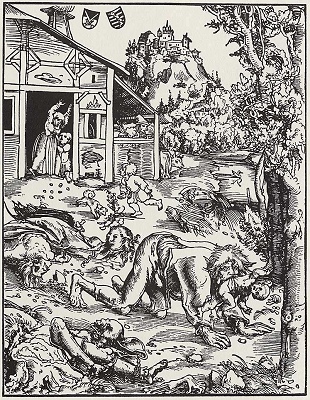
The Beast in Man: Folklore transports the conflicts of everyday social reality into a world of symbols where they can be more easily confronted and overcome. But the silver bullet that slays the werewolf, or the wooden stake that vanquishes the vampire, are magical, not substantial, remedies. Not even that modern "Philosopher's Stone" - the Internet - can free politicians from their obligation to develop real solutions to real problems in the real world.

SILVER BULLETS; wooden stakes through the heart; Philosophers’ Stones: all magical remedies for monstrous and besetting evils - and all derived from folklore.

Not that the lore of the volk should be despised, for it has much to teach us. But before we can draw any benefit from the tales of old wives, we must first learn how to read them.

The werewolf, for example, speaks to us of the beast that lurks in all men’s hearts.

Running in packs; singling out the weak and vulnerable; killing without mercy or regret; the wolf has for centuries symbolised the rapacious soldiery that laid waste to the fields and villages of a politically and militarily defenceless European peasantry. The only way to "slay" this ravening man-beast? Pay him off.

In symbolic terms: shoot him with a silver bullet.

And the vampire? The demon that does not die, but which feeds forever upon the lifeblood of its victims?

For the exploited and brutalised serfs of Eastern Europe, bled white by a parasitic class of undying aristocratic families, what more appropriate symbol of their condition could there be than the bloodsucking nosferatu?

Two things only could defeat them: the charitable ministrations of the Church; and the time-honoured remedy of assassination and revolt.

The power of the crucifix. Or, the poor man’s sword – a wooden stake – through the heart.

The Philosopher’s Stone – red sulphur – was the mythical catalyst through which, the medieval alchemists insisted, base metals could be transmuted into gold. It was also said to be the Elixir of Life, conferring upon its possessor the gift of eternal youth.

But what else is knowledge – if not the power to take the chaos and ugliness of existence and refine it into order and beauty? And don’t the insights of the wise, when put into words, live forever? Speaking to us down the ages with the same freshness and immediacy as the day upon which they were first committed to paper – or parchment?

The search for, and belief in, magical remedies is an abiding characteristic of the weak and oppressed. Folklore is their way of transporting the unconquerable realities of their lives into a universe of symbols – within which they can more easily be confronted and overcome. Soldiers become werewolves – to be brought down with silver bullets. Aristocrats become vampires – to be impaled. Chaos and ugliness – our base existence – awaits only the transmutative power of the mysterious Philosopher’s Stone.

The folklore of the 21st Century is, of course, very different from that of the Middle Ages. Ours is a more tangible age. We do not like our symbols to change shape or melt away at the touch of the first sunbeam. We believe in electronic magic.

Like the Internet.

In a world dominated by vast and powerful institutions we often feel like atoms flowing at the behest of forces we neither understand nor control. Against the corporate wolf and bureaucratic vampire we hold up the Internet as our very own version of the silver bullet; the wooden stake; the Philosopher’s Stone.

In the waste of lovelessness that is contemporary capitalism, Facebook offers an endless supply of "friends". Amidst all the white noise of corporate communications and PR spin, blogs will make us as powerful as The New York Times (or, at least, The New Zealand Herald).

Not even our politicians are immune.

Just the other day the Labour MP, Clare Curran, announced to readers of the "Red Alert" blog that her party was embarking on a bold experiment: "We want to hear all your ideas, suggestions, and the issues you think are important regards open and transparent government", says Clare. "At this stage any contribution is welcome and valid, no matter how left field."

Welcome to the virtual political party. Not for Labour the irreplaceable human chemistry of the public meeting, the branch debate, the annual conference floor-fight. No. Now you can sit in front of a keyboard and change the world – all by yourself.

No werewolf too fierce; no vampire too terrifying; no metal too base for "OpenLabourNZ"

Forgetting, of course, that politics is always made by those in the room. The real room – not the virtual town hall.

To pay-off the soldier, impale the aristocrat, learn from the wise – you have to be there and do it.

There’s no silver bullet to beat reality.

This essay was originally published in The Timaru Herald, The Taranaki Daily News, The Otago Daily Times and The Greymouth Evening Star of Friday, 7 May 2010.