
Showing posts with label Unite Union. Show all posts

Friday, 12 November 2010

As If You Were Free

The "right time" is right now: Matt McCarten's campaign for the working-class parliamentary seat of Mana is a timely reminder that the fight for justice preceeds us, envelops us, and will go on long after us. And though, as Marx observed, working people are everywhere in chains, the most important revolutionary lesson is learning to act "as if you were free".

WHEN MATT McCARTEN told me he was thinking of putting his name forward for the Mana by-election, I shuddered inwardly.

"For God’s sake, Matt," I wanted to say, "what about your health?"

I didn’t, of course. I just waited for Matt to make his case and, as always, he produced a host of compelling reasons for proceeding with his plan.

By choosing Kris Faafoi, a journalist with no discernible links to either the Labour Party or the wider progressive movement – until he became Phil Goff’s press secretary – Labour’s leadership have made it very clear that, as far as the Mana electorate is concerned, it’s going to be business as usual.

Even though, as Matt pointed out to me in the most forceful terms, "business as usual" in the streets of Porirua means poverty, unemployment, homelessness, crime and despair.

The political analyst in me pursed his lips and shook his head.

"With the Labour Party moving steadily to the Left," he intoned disapprovingly, "this is precisely the wrong time to challenge Goff’s hand-picked candidate in an important by-election in one of the party’s safest seats."

Then I caught the gleam in Matt’s eye, and I told my inner political analyst to go stick his objections where the sun don’t shine.

Because if being on the Left means waiting for the "right time" to fight for your principles, then, as the hero of Howard Spring’s wonderful political novel, Fame Is The Spur, discovered, when the fight comes to you, the bright sword of principle can no longer be drawn. Through all those years, while you were waiting for the "right time", the sword’s blade was rusting fast to the scabbard.

Matt McCarten has never been that sort of leftist. His sword never rests long enough in its scabbard to gather a speck of rust. And the trade union he built from scratch – Unite! – has never waited for the "right time" to do anything.

The way Matt set about organising the supposedly "unorganisable" workers of the service sector always reminded me of General Woundwort, the fearless rabbit leader in Watership Down. No matter how formidable the enemy, he always attacked. Watching Unite’s young, low-paid workers take on MacDonald’s, Sky City Casino, and Restaurant Brands, you could almost hear General Woundwort’s rallying cry rising-up from the picket lines: "Come on lads, dogs aren’t dangerous!"

And now Matt’s out there in the Spring sunshine, standing on the street-corners of Mana with his crew, talking to state house tenants about homelessness; to low-paid workers about a minimum wage of $15.00 per hour; to unemployed workers about creating jobs.

And there’s work to be done. Matt’s canvassers have already discovered several empty state houses, while just a few streets away a young family, crowded into a friend’s garage, waits for Housing New Zealand to find them somewhere to live. The empty properties are already being vandalised and the copper piping is long gone.

"What do we need?", asks Unite organiser, Joe Carolan: "We’ve got carpenters, we’ve got plumbers, we’ve got electricians. We can fix this place up. We’ve got people in need. A young family in need … Are you telling me that the only thing we need is to wait for a bureaucrat for another year or two years? We should move people in now."

That’s the way the Labour Party used to talk – back in the days when it still remembered how to fight.

I asked Matt if he’d heard of Slavoj Zizek – the Slovenian socialist currently setting a principled cat among the fat, pragmatic pigeons of the European Left.

"I’m busy, Chris", he chuckled, "of course I haven’t."

"Well, Matt", I replied, "Zizek is challenging Europe’s social-democrats to stop looking over their shoulder at the European Central Bank; to govern ‘as if they were free’.

"Maybe that’s what you should ask the Mana electors, Matt. To stop looking over their shoulder at Labour.

"Could be your slogan.

"Vote – as if you were free."

This essay was originally published in The Dominion Post, The Timaru Herald, The Taranaki Daily News, The Otago Daily Times and The Greymouth Evening Star of Friday, 12 November 2010.

Friday, 30 July 2010

Songs Of Our Fathers

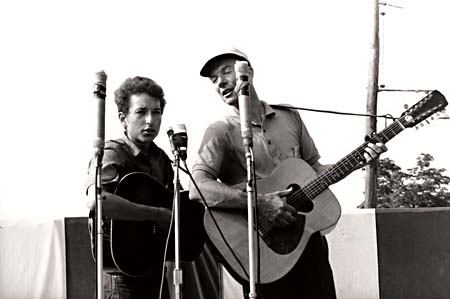
The Power of Song: A young Bob Dylan joins voices with veteran protest singer, Pete Seeger. "There is no life without song,’" said the Czech resistance fighter, Julius Fuchik, "as there is no life without the sun."

On Wednesday, 28 July 2010 I delivered the following speech to approximately 120 workers and students attending the "Fightback" rally organised by Unite on Campus (Auckland) in Basement Lecture Theatre B28 of the University of Auckland Library. Other speakers included The EPMU’s Bill Newson, the NDU’s Karl Andersen, Former Green Party MP, Sue Bradford and Unite General Secretary, Matt McCarten. The rally was chaired by Unite organiser, Joe Carolan.

WHEN JOE INVITED me to address this "Unite on Campus" protest rally last week, I must confess to feeling a pang or two of trepidation. It’s been many years since I stood in front of a room full of workers and students with clear rhetorical intent.

What could I possibly tell you about trade unionism or student activism that is even remotely relevant to your situation? The world has changed dramatically since I was last a trade unionist – let alone a student activist!

You don’t need me to tell you that back in the 1970s and 80s, when I was in my early 20s, it was so much easier to be both.

But the organisers of tonight’s rally have reassured me that a backward glance or two might actually be helpful in the battle to halt this Government’s attack on workers’ rights. And, as an historian, I can hardly disagree.

So I’ve asked myself: "What’s the easiest way to convey the sentiments of Activists Past to Activists Present?"

My answer is – their songs.

Protest songs were the You-Tube clips of their day: cheap to produce, easy to access, and if they were any good they could be passed on to tens of thousands of people in an astonishingly short period of time.

So I hauled out my copy of Kiwi Youth Sings – a songbook put together in 1951 by the Student Labour Federation and the Progressive Youth League. The songbook’s editors, Conrad Bollinger and Neil Grange, were in no doubt concerning the importance of political song.

"Locked in the dungeons of the Gestapo the Czech resistance fighter Julius Fuchik could not be stopped from singing", they told their youthful readers. ‘"There is no life without song,’" said Fuchik, "as there is no life without the sun."

The first song in "Kiwi Youth Sings" is, very appropriately, "The Internationale". Just listen to the anger and red-hot determination of its opening lines:

Arise ye prisoners of starvation!
Arise ye wretched of the earth!
For justice thunders condemnation,
A better world is now in birth.
No more tradition’s chains shall bind us!
Arise ye slaves no more in thrall!
The earth shall stand on new foundations,
We have been nought – we shall be all!

Stirring stuff!

But not all the songs rely on the rhythms and language of the Bible.

"It’s My Union", an Australian ditty, is much more colloquial:

They can call me agitator,
They can even call me traitor,
They can tell me that my brain is off the track.
But I’m smart enough to see
What the union’s done for me
So, I’m rolling up my sleeves and fighting back.

From England came the poignant "People’s Anthem" – the most popular song of that first great mobilisation of working-class people, the Chartist movement of the 1830s and 40s.

Rather than ask God to save the Queen, the song’s author, Ebenezer Elliot, implores the Almighty to save the people.

Shall crime bring crime forever,
Strength aiding still the strong?
Is it thy will, O Father,
That Man should toil for wrong?
No! say thy mountains, No! thy skies:
Man’s clouded sun shall brightly rise,
And songs be heard instead of sighs.
God save the People!

And, of course, we could not walk among England’s poor without acknowledging William Blake’s mysterious incantation of a poem "Jerusalem":

And did the countenance divine
Shine forth upon these clouded hills?
And was Jerusalem builded here
Among these dark satanic mills?

Nor could we leave them without at least quoting the chorus of what Bollinger and Grange called "the great hymn of the British Labour Movement:

Then raise the scarlet standard high!
Within its shade we’ll live or die!
Though cowards flinch and traitors sneer
We’ll keep the red flag flying here!

Years later, I’m reliably informed, Conrad Bollinger penned a wicked parody of "The People’s Flag":

O Labour’s flag is deep magenta
It flies on high – just right of centre!

Interestingly, on the night of 5 July 1945, when it became clear that the British Labour Party had won the General Election, the vast crowd of working-class Londoners which had gathered outside Transport House to welcome in the Red Dawn didn’t celebrate their victory by singing "The People’s Flag". The song they sang that night, to usher in Britain’s new welfare state was much older. It was William Blake’s "Jerusalem".

I shall not cease from mental fight
Nor shall my sword sleep in my hand
Til we have built Jerusalem
In England’s green and pleasant land

But nowhere, in the English-speaking world has the battle for workers’ rights been harder – or bloodier – than in the United States.

Small wonder, then, that it is from the USA that we have inherited what is, perhaps, the greatest union anthem of all – "Solidarity Forever!".

Just listen to the enormous confidence that rings out in the song’s verses: the absolute conviction that workers’ power can not only defeat the bosses, but transform the world:

They have hoarded untold millions
That they never toiled to earn,
But without our brain and muscle
Not a single wheel can turn.
We can break their haughty power,
Win our freedom when we learn -
That the union makes us strong

In our hands we hold a power
Greater than their hoarded gold,
Greater than the strength of armies
Multiplied a thousand-fold.
We can bring to birth a new world
From the ashes of the old -
When the union makes us strong!

The author of "Solidarity Forever!", Ralph Chaplin, was writing in the optimistic early years of the 20th Century – when it seemed that the long-awaited "Commonwealth of Toil" could not be long-delayed.

But the First World War, and coming of the Great Depression drove iron into the soul of the American Labour Movement.

Listen to the bare language and stark choices laid down by Florence Reece, who battled alongside her husband for miner’s rights in the Kentucky coal-fields during the 1930s. She wrote down these words on the back of a calendar after a gang of strike-breakers crashed into her home and attacked her family.

They say in Harlan County
There are no neutrals there
You’ll either be a union man
Or a thug for J.H. Blair
Which side are you on?

And that’s a sentiment, Comrades, that never changes. To every human-being, be they old or young, black or white, man or woman, rich or poor, a moment always comes when the choice that changes lives must be made, and an answer given.

Which side are you on? 

Friday, 16 October 2009

Enemy At The Gates

Lockout! Watch out! They'll call the cops out: Economic recession creates the ideal conditions for employers to deploy their most devastating bargaining weapon: the lockout.

IT’S NOT OFTEN you encounter Classical Greek history in a trade union campaign.

World War I is about as far back as most unionists are willing to go. "Rallying the troops." "Pulling the pin." "Going over the top." They’re all expressions which entered the vocabulary of militant trade unionism in the 1920s and 30s – and can still be heard today.

But Unite, the union for young, low-paid and casualised workers led by Matt McCarten, is going back much further than the killing fields of Flanders for inspiration. All the way back, in fact, to the Battle of Thermopylae.

It’s a stirring story.

When the Persian King, Xerxes I, invaded Greece in 480BC, the Spartan King, Leonidas, undertook to buy his allies the time they needed to re-establish their defences by denying the invaders Thermopylae – "The Hot Gates". According to legend, just 300 Spartans held this strategic pass for two, crucial, days and nights – until, undone by treachery, they were over-run and slaughtered.

With economic recession and a National Government bearing down on low-paid workers, McCarten’s union hopes to defend their living standards by means of a Citizens Initiated Referendum seeking a $15 minimum wage.

In the words of the union’s publicity material:

"A small number of committed people can make a huge difference. The movie "300" immortalised 300 Spartan heroes who defied 200,000 Persians at the Battle of Thermopylae. The $15 an hour campaign needs 300 modern heroes who will commit to getting 1,000 signatures each by May 2010. We'll send you forms, badges, stickers and pamphlets. Once you send us 300 signatures we will send you the official $15 working class hero badge, T shirt and cap."

It’s yet another example of McCarten’s talent for lateral thinking. Unite’s campaign not only declines to engage an increasingly hostile and aggressive employing class, but it also seeks to mobilise an increasingly fractured and demoralised working class. McCarten is building an army. Those 300 "working class heroes" will be the nucleus of its officer corps.

Were such a "working-class army" already in existence, the scene outside Open Country Cheese’s sprawling Waharoa dairy factory would look very different. Instead of thirty to forty locked-out employees maintaining a desultory picket in the October rain, there would be thousands of baying trade unionists.

Unionism is all about mobilising workers in sufficient numbers to overcome employer resistance. If McCarten’s successful, the headlines won’t be about lockouts – they’ll be about strikes.

 
BUT, FOR THE MOMENT, the Unions simply don’t have the numbers. Eighteen years after the passage of the Employment Contracts Act (ECA) in 1991, barely ten percent of the private sector workforce remains unionised. Even when the comparatively well-organised workers in the public sector are included, union density in New Zealand stubbornly refuses to rise above 25 percent of the total workforce.

The sharpest edges of the ECA may have been blunted by Labour’s Employment Relations Act (ERA) of 2000, but the political economy of trade unionism makes it exceedingly difficult to increase the percentage of unionised workers.

To remain economically viable, trade union organisers must devote themselves full-time to servicing the needs of their existing members. This makes the task of recruiting new members – on new sites – extremely difficult. Few unions possess the financial resources to hire "green-fields" staff – especially in a recession.

Economic recession and rising levels of unemployment have always made the unions’ job harder, but the severity of this latest down-turn could prove disastrous. Thousands of workers have been laid-off, and the unions’ membership base is shrinking. With the same number of sites to look after, but fewer workers contributing dues, more and more unions are struggling to maintain an adequate level of service to their members. Since the onset of the recession eighteen months ago, the membership base of the largest private-sector union, the EPMU, is reputed to have shrunk by three thousand – roughly six percent.

The most ruthless (or perhaps just the most desperate) of New Zealand’s employers are taking full advantage of this situation. They’re confident that, with a National Government in power, there’s zero chance of New Zealand’s industrial relations regime being changed in their employees’ favour. They also know that, for unions, weathering strikes and lockouts is an expensive business – especially if they’re prolonged.

While the boss at least saves on his wages bill, the union is obliged to dig deep into its dwindling reserves to prevent its members being starved back to work. Solidarity from other unions is there in spirit, but translating expressions of support into cold hard cash, in the midst of a recession, is hard work.

In short, it’s an ideal time for employers to wield the lockout weapon against both their staff and the unions which represent them – and that’s exactly what they’re doing.

At the time of writing, New Zealand Bus (owned by Infratil) has boldly locked-out 1,000 of its drivers; apparently relying on the pressure of 80,000 daily commuters, and their employees’ sub-$15 per hour wages, to drive them back to work on the company’s terms. Telecom has already manoeuvred some 900 telecommunications engineers into either becoming independent contractors or joining the ranks of the unemployed.

There are other, smaller, examples of the tactic at work, but the salutary effect of big operators like Telecom and Infratil – not to mention the sheer ruthlessness of Open Country Cheese’s principal shareholders, Nelson’s hard-nosed Talley brothers – is enough to make the rest of unionised labour think twice before asking for more.

 
IN McCARTEN’S brave new future, locked-out Dairy Workers would be able to call upon a much larger labour movement to bulk-up their modest picket-line. Reversing the path of Massey’s Cossack’s, thousands of Auckland workers might even decide to invade the Waikato. Enough to bring Open Country Cheese’s CEO, Mark Fankhauser, back to the negotiating table - pronto.

In the here and now, however, it’s a different story. Last week, when the call went out for a mass picket of Open Country Cheese, only a few dozen unionists and their officials turned up. With Waharoa’s gates assailed by such a rag-tag-and-bobtail crew, the company had scant incentive to negotiate. The financial reserves of the Dairy Workers Union might be substantial – but they’re not infinite. Subsidising locked-out workers’ week-in, week-out, isn’t cheap.

Unlike Xerxes at the "Hot Gates", Frankhauser and Open Country Cheese can afford to wait.

This essay was originally published in The Independent of Thursday, 15 October 2009.