
 |
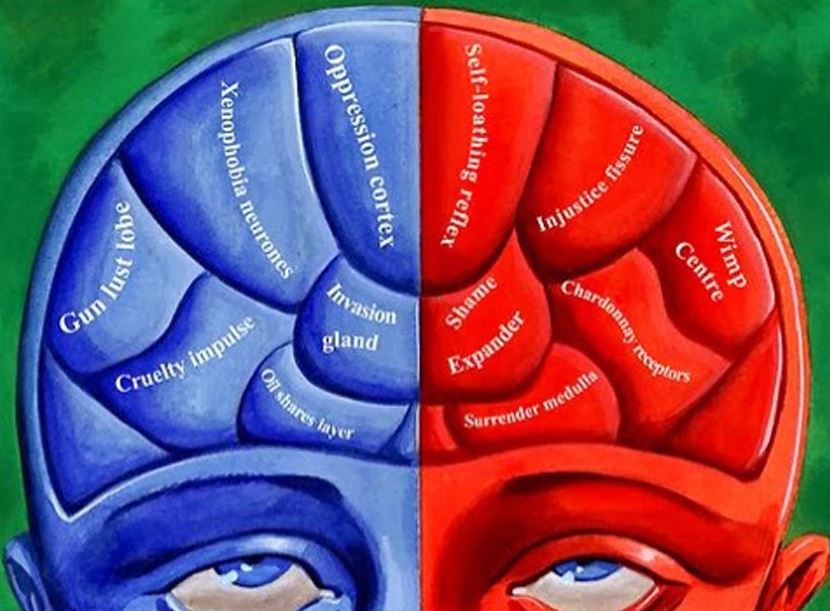
| It's All In Our Heads: Prefixing right and left with the word “centre” was once a gesture of moderation, intended to reassure voters that the people being put up for election by these “mainstream” parties weren’t crazies. Today, however, the use of the word in relation to parties like America’s Republican Party, Britain’s Conservatives and Australia’s Liberals is, simply, inappropriate. These are no longer centrist parties, they’re unabashed promoters of the policies of the far-right. |
IF PETER DUTTON is the answer, then the question should never have been put! The predicament of the Australian Liberal Party, left with no choice but to go from bad to worse, encapsulates the dilemma confronting all of the world’s centre-right parties.
Prefixing right and left with the word “centre” was once a gesture of moderation, intended to reassure voters that the people being put up for election by these “mainstream” parties weren’t crazies. Today, however, the use of the word in relation to parties like America’s Republican Party, Britain’s Conservatives and Australia’s Liberals is, simply, inappropriate. These are no longer centrist parties, they’re unabashed promoters of the policies of the far-right.
As such they have nothing positive to offer an electorate slowly becoming aware of just how much the planet will have to face – and overcome – in the years ahead. If they do not already, these voters will soon comprise a clear majority of their respective populations. In order to rip-up this emerging majority’s preferred policy track, it will be necessary for the parties of the far-right to rip-up democracy as well.
America’s Republican Party is leading the way in this regard: passing voter suppression legislation and shamelessly gerrymandering congressional districts in its favour. Britain’s Conservatives are more dependent on the fundamentally undemocratic first-past-the-post electoral system than ever. Boris Johnson’s 80-seat majority in the House of Commons was won with just 43.6 percent of the popular vote!
The fate of Australia’s Liberals was sealed by many factors, but their country’s complicated (and rort-resistant) preferential voting system must be counted among the most important!
Now, it may be that a comprehensive rorting of the democratic system is the far-right’s preferred option. Being the sworn enemy of moderation and compromise, extremism may simply be unwilling to countenance either. Assuming, however, that the far-right’s objective is not the “illiberal democracy” currently on display in Hungary, Brazil, and the Russian Federation, what must these errant movements do to earn the reapplication of the trusted centre-right label?
The answer provided by the Australian general election is unequivocal. No party of the centre-right can any longer afford to do anything other than affirm its unqualified belief in the science of Climate Change.
The social and economic consequences that follow logically from that crucial affirmation explains why far-rightists are so unwilling to make it. To meet the challenges of Climate Change it will be necessary to rebuild the machinery of collectivism. The state will have to become much, much larger, and the taxes of the super-wealthy will have to be set much, much higher. Since a small state and low taxes have constituted the sine qua non of centre-right parties since (at least) the late-1970s, what does that leave for them to champion?
The answer, surely, lies in what liberal democracy has always demanded, and will continue to demand, of the party system. At least one major party that is devoted to the protection of the rights of the small against the depredations of the large.
Individual liberty, with all its trappings – most particularly the freedoms of speech, communication, and association – would seem like the logical place to start. Building from there, a centre-right party should champion entrepreneurial enterprise and the creation of small businesses. It should also argue for what the Europeans call “subsidiarity” – the idea that decision-making bodies should remain as close as possible to those most directly affected by their decisions.
The new rule-of-thumb for the parties of the centre-right should be: big is oppressive, small is beautiful.
The political-economy of fighting Climate Change will ensure that this contention between bigness and smallness remains a constant theme of political debates for the foreseeable future. Accordingly, left-wing parties will also find themselves struggling to retain their centrist credentials. The temptation to simply crush any opposition to their radical measures will be very strong. Already, right across the planet, citizens of democracies have experienced how forcefully the state feels entitled to respond to a system-threatening emergency. The global Covid-19 Pandemic has revealed just how difficult defending the rights of the few can become when governments are confronted with the urgent demands of the many.
In the new political configuration that is fast approaching, individuals and communities will have need of centre-right champions. If only to remind us that a planet without freedom isn’t worth saving.
This essay was originally published in The Otago Daily Times and The Greymouth Star of Friday, 3 June 2022.

