Friday, 30 April 2010

In Harm's Way

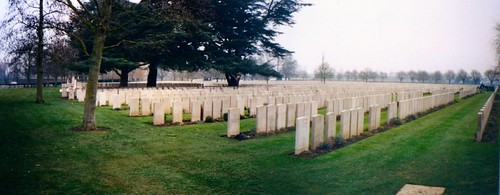
"And there's another country": Stoicism and sacrifice, the virtues that permitted a nation of barely one million citizens to bear the loss of 18,000 of its children in the First World War, are no longer much valued in the hyper-sentimentalised mass culture of the 21st Century.

THREE YOUNG SERVICEMEN die when a RNZAF Iroquois helicopter crashes into the hills above Pukerua Bay on ANZAC Day, 2010.

The bare facts: Who? What? Where? When?

We’ll wait a little longer, I suspect, for the How? And the Why?

And behind the bare facts – as always – are the torn and floating webs of family and friendship. Stories that could fill volumes. A private grief that never wholly departs. That aching sense of absence, that bitter taste upon the tongue, every time April 25th rolls ‘round.

For the families, friends and comrades left behind, ANZAC Day will never be the same.

There was so much we could have learned from this accident. An opportunity to follow the vivid threads of history back to the events that gave birth to the whole tradition of ANZAC Day commemoration. Tragically, however, we allowed this chance to link the raw emotions of the present with the thoughts and feelings of the past to slip through our fingers.

Instead of displaying the stoicism that a soldier’s death demands, we have been encouraged to wallow in the worst kind of public sentimentality. Our heartstrings have been worn to breaking-point by the news media’s relentless bows. Our capacity for sober reflection overwhelmed by the insistent journalistic clamour for everyone – from the Prime Minister on down – to emote, emote, emote!

We are told that our armed services are "like a family" – whose members have been "stricken" by the ANZAC Day crash. When interviewed shortly after the accident, Lieutenant-General Jerry Mateparae, Chief of the NZ Defence Force, seemed close to tears. The Prime Minister instantly cut short his planned visits to Saudi Arabia and the Middle East in order to be present at the funeral.

What does this tell us about New Zealand’s soldiers and citizens in the 21st Century? What does it say about our resilience? Our willingness to sacrifice? Our capacity to endure loss?

If this past week’s outpouring of grief at the accidental deaths of three servicemen is indicative of New Zealanders’ collective grasp of the brutal realities of military service, then we’re all in very big trouble.

Every nation, for its own safety and security, must regularly and ruthlessly send a percentage of its young men and women into harm’s way: harm from which not all of them will emerge unscathed; harm which an unavoidable and irreducible number will not survive at all.

A defence force that cannot take casualties simply isn’t worthy of the name. And a nation which is no longer able to stoically endure its losses has laid itself open to every kind of enemy assault.

This is not a popular line of argument in 2010. In an age of rampant individualism, the virtues of stoicism and sacrifice are scorned. The idea of "laying down one’s life for one’s friends" only makes sense on Facebook.

But just pause for a moment, and try to imagine the New Zealand which, in the days, weeks and months that followed the landing at ANZAC Cove, was flooded by a never-ending stream of fatal telegrams.

Imagine a nation of just over a million citizens, asked to absorb the loss not of three – but of three thousand – of its children. Imagine the families which, day after day, were torn asunder: the sons, brothers, husbands and sweethearts for whom there could be no funerals, no front pages. Imagine the enormous – the almost superhuman – effort required to hold up one’s head; to dry one’s eyes; to place one foot stubbornly in front of the other. To carry on.

Imagine a grief so vast, so unrelenting, that it escaped altogether the power of ordinary speech. Imagine its dreadful weight as each year’s ANZAC Day services drew near.

We look at the great memorials to the fallen, and we sense in the cold marble, in the endless lists of names, something awful. There’s a terrible void where life and talent should’ve flourished; the abiding absence of a whole generation which, with a stoical endurance that simply outdistances contemporary imagination, traded their present for our future.

Perhaps it’s this, the sense of being part of their country’s unending story, that makes even remotely bearable the sacrifices of military families.

And yet, as those three young airmen are borne to their final resting-place, I ask myself:

Could 21st Century New Zealand survive another Gallipoli?

This essay was originally published in The Dominion Post, The Timaru Herald, The Taranaki Daily News, The Otago Daily Times and The Greymouth Evening Star of Friday, 30 April 2010.

Thursday, 29 April 2010

Cynical Politics

Don't ask - don't tell: As Bobby Kennedy is said to have quipped after the 1960 Presidential Election: "Democracy is like a good sausage. Tastes great - but you really don't want to know what went into it."

CYNICISM is one of the great occupational hazards of politics. Born out of the inevitable collisions between idealism and reality, its corrosive effects are displayed to best advantage in representative democracies – where the consequences of political failure are only occasionally fatal.

All politicians are at risk from cynicism, and the few who escape its clutches generally prefer to keep the electorate ignorant of the moral damage it inflicts. As Bobby Kennedy put it: "Democracy is like a good sausage. It tastes great – but you really don’t want to know what went into it."

All of which suggests that the person (or party) approaching political life with a swag of weighty ideals is likely to come to grief. Conversely, those who enter politics unburdened by excessive sentiment can almost certainly look forward to a much easier ride.

This is good news for the Right – which prides itself on its "unsentimental" and "realistic" approach to political affairs. Historically averse to "airy-fairy" ideas, right-wingers also have the better chance of escaping the ravages of cynicism. It’s hard to become disillusioned and cynical if you have no illusions to discard: no ideals for a head-on collision with reality to damage.

The Right enjoys another advantage: knowing what it’s in politics to achieve. Unlike the Left, whose mission, at least historically, has been to improve the world; the traditional task of the Right is to make sure it stays the same. While the Left is riven with sectarian arguments about the nature and extent of the changes it should (or shouldn’t) attempt, the Right’s mandate is essentially conservative: to ensure that the proper people remain in the proper places and deliver the proper results.

Above all else, this mandate requires the Right to remain in office for as long as possible. The only changes a right-wing government should ever be prepared to countenance are the changes required to win the next election. In or out of power, for the Right, "winning" is everything.

John Key’s government embodies these conservative principles to a truly remarkable degree. It’s major achievement to date has been the restoration of the "proper people" to their "proper places". Labour’s appointees have been ruthlessly purged from the State apparatus and their replacements are hard at work delivering the "proper results". The pace and scope of that delivery is set to increase dramatically if/when Key wins a second term.

Even more remarkable, however, has been Key’s extraordinary political flexibility.

Unburdened by the ideological shibboleths that weigh down politicians like Act’s Sir Roger Douglas, Key manoeuvres with astonishing adroitness to keep a clear majority of the electorate in National’s corner. For the benefit of the urban liberals he reaffirms his support for the anti-smacking legislation. To Act’s law-and-order brigade he delivers the "Three Strikes" bill.

And to the Maori Party, which he and his colleagues correctly identify as the pivot upon which all future New Zealand governments will turn, he delivers a series of policy concessions which, for their political audacity, can only be described as "breathtaking". The repeal of the Foreshore & Seabed legislation; the launch of whanau ora; and, most recently, supporting the UN Declaration on the Rights of Indigenous Peoples.

These three concessions to Maori nationalism illustrate with particular clarity just how seriously the Prime Minister takes the Right’s "winning is everything" mantra – and just how determined he is to do everything to win.

The contrast with Labour could hardly be more dramatic. Nowhere are the corrosive effects of cynicism more clearly evident than on the Left.

Labour’s collision with reality back in the 1980s drove cynicism deep into the heart of the Parliamentary Party. What remained of Labour’s left-wing idealists migrated to the Alliance, where they thrived briefly before crashing head-on into the reality of Jim Anderton. In the first decade of the new century it was the Greens who kept the idealistic flame fluttering – until untimely death and resignation led them to their own damaging rendezvous with realpolitik.

The ironic conclusion to all of this electoral self-destruction isn’t that the Left has become too cynical, but that it hasn’t become cynical enough.

When National crashed to 21 percent in 2002 it had the wit to heed the advice of professional cynics like Peter Keenan, Bryan Sinclair and Matthew Hooton.

If National had to embrace its inner redneck to recapture the scattered tribes of the Right, then so-be-it. If it had to offer up a leader embodying the Right’s most radical neoliberal beliefs, then "Amen" to that as well. And if, after reconstituting National’s electoral base, the focus-groups told them it was time to switch from negative to positive messages, then "that nice Mr Key" would have Dear Old Don gone by lunchtime.

But Labour’s cynicism is neither as deep nor as ruthless as National’s. Rather than appeal to their party’s inner Bolshevik, and then, having run National close, genially postpone the revolution until Labour’s second term, the Opposition’s strategists have embarked on a public relations-inspired quest to rejuvenate the party’s "brand". Its risible goal? To make Labour "edgy", "out-there", "funky", "fresh" and "cool".

This is cynicism writ small: the paltry contribution of politicians who are no longer able to calculate the price, or recognise the value, of political nerve on an Orewa scale.

Labour’s cynicism prevents it from trusting either its own instincts or the better angels of the electorate. Public opinion is to be followed – not led. Innovative and inspiring policies (assuming, by some miracle, Labour acquired some) are always to be kept under wraps in case a political opponent steals them. What little faith remains to it is all in the power of negativity. The one question that must never be answered is: "What would Labour do?" The one question that must never be asked: "What should Labour do?"

In 1966, and again in 1981, Labour was defeated at the polls because it took a stand on principle. That its positions on Vietnam and Apartheid were later vindicated by history - and emphatic electoral victories – should be all the proof today’s Labour Party needs that in the inevitable collisions between idealism and reality both are changed – and not necessarily for the worse.

This essay was originally published in The Independent of Thursday, 29 April 2010.

Sunday, 25 April 2010

The Blood of Its Sons (ANZAC Day 2010)

Blood for Butter: The sacrifice of so many young New Zealanders was made not for democracy or freedom - but for the future prosperity of the nation's farmers. Painting of the Battle for Chunuck Bair by Ion Brown.

WHEN WAR BROKE OUT in 1914, Britain was fortunate to have as her point man in New Zealand a prime minister who recognised in the British Empire not only the source of his country’s income and guarantor of its continued prosperity, but also the secular manifestation of a divinely sanctioned racial hegemony. Not content with his participation in the mysteries of Freemasonry and the Grand Orange Order, William Ferguson Massey also belonged to a bizarre sect known as the British Israelites.

The central belief of the British Israelites was that the original inhabitants of the British Isles were descended from one of the "lost tribes" of Israel. God, having originally singled out the Jews as the instruments for perfecting his earthly creation, apparently decided to re-tool the project by hiving-off a tithe of the chosen people and relocating them in the wet and misty isles of Albion. Careful Biblical exegesis had further convinced the British Israelites that the British monarchy was traceable not merely to Norman brigands and Anglo-Saxon war-chiefs, but to the ancient throne of David and Solomon. Clearly, the British race was destined to rule the earth from pole to pole. That it already controlled a quarter of its land surface, and all of its seas, was proof of God’s approbation. Equally clearly, it was the duty of every Briton – old and new – to further God’s plan by ensuring that their King-Emperor got his holy mitts on everything else.

Nobody seemed to mind that the King-Emperor, George V, was a German, or that his father, Edward VII (of Saxe-Coburg-Gotha) had spent most of his reign inveigling the French and the Russians into an aggressive diplomatic and military alliance against his own despised nephew, Kaiser Wihlem II (his mother’s grand-son). One might have thought that a fanatical Protestant like Bill Massey would have recoiled in horror from the news that the heir to David and Solomon’s throne was plotting and scheming with the republican papists of France against the honest Lutherans of the House of Hohenzollern. And how pleased would his prime-ministerial predecessor, "King Dick" Seddon have been to discover that Britain had somehow become the ally of George V’s cousin "Nicky" – Tsar of all the Russias? Wasn’t it Nicholas II’s father, Tsar Alexander III, who had so frightened the parliament of New Zealand that it was persuaded to appropriate vast sums for the installation of gun emplacements at the heads of most of New Zealand’s major ports?

Such machinations were, of course, the common fare of the heavily armed imperial gourmands whose insatiable appetite for territory and markets and left very little of the earth’s surface unshaded by their respective flags. So long as the sea lanes between New Zealand’s ports and the London docks were kept open for the ever-growing fleet of ships bearing the dominion’s refrigerated cargoes to the British consumer, New Zealand politicians were content to leave the complex minuet of international diplomacy to men like Britain’s aristocratic foreign secretary, Sir Edward Grey.

Which presumably explains why Belich, with uncharacteristic reticence, could write: "New Zealanders in 1914 did not investigate the causes of conflict, and we can follow their example." While the dereliction of that sentence’s second half cries out for correction, the first part is no more than the truth. It really didn’t matter to most middle-class New Zealanders how or why the languid gentlemen of Whitehall came to the conclusion that Britain must go to war with Germany. It was enough for them that the King-Emperor’s government had called upon his subjects for aid. Certainly all those loyal sons of the Empire who had been drilled to obedience as high school cadets, and who now devoted their weekends to manoeuvres with their province’s regiment of "mounted rifles", neither asked for nor expected a more detailed explanation.

The war propaganda of the time depicted Britain as a mighty lion summoning his pride, and Canada, Australia, South Africa and New Zealand as "young lions" answering the imperial roar to range themselves proudly at their sire’s side. Few queried the war’s ostensible casus beli – Germany’s violation of "poor little Belgium’s" neutrality, and the Austro-Hungarian assault on "brave little Serbia". The mentality that had scrawled "God save the King!" above crude renditions of the Union Jack on the walls of the Waihi Miners’ Hall just two years earlier, was not attuned to the critical questioning of imperial policy.

For a brief period, however, a tiny chorus of protest did manage to make itself heard over the marching bands and cheering crowds. The Red Feast, a poem penned by the radical trade unionist, Ralph Chaplin, and re-printed in the working-class (and in those years unashamedly left-wing) newspaper Truth shortly after the outbreak of hostilities in 1914, makes it clear that the enthusiasm for martial sacrifice was not, quite, universal:

Tear up the earth with strife
And give unto a war that is not yours;
Serve unto death the men you served in life
So that their wide dominions may not yield.
Stand by the flag – the lie that still allures;
Lay down your lives for land you do not own.
And spill each other’s guts upon the field;
Your glory tithe of mangled flesh and bone.
But whether in the fray to fall or kill
You must not pause to question why or where.
You see the tiny crosses on that hill?
It took all those to make one millionaire.

Not that such open defiance of political conformity was permitted for very long. The proto-fascist impulses manifested in the ranks of Massey’s Cossacks barely ten months prior the outbreak of World War I, were swiftly augmented by all the powers of a state at war. Newspapers were seized or censored, street-corner orators (a good many of them future cabinet ministers and prime ministers) were arrested and imprisoned for sedition. And for those who refused to fight: the Christian pacifists and socialists who sought the protection of "conscientious objection"; Massey’s government reserved a suite of sadistic punishments, escalating in severity from internment in special concentration camps, to the extraordinary fate of this country’s most famous conscientious objector, Archibald Baxter – being bound to a cross in the middle of no-man’s land (Baxter’s inspiring memoir I Shall Not Cease is recommended reading for anyone who still refuses to believe that a great many New Zealanders embraced fascism long before it had a name.)

And so New Zealand’s human lambs were placed under British command, packed into troopships and dispatched for the slaughterhouse of France – at least they would have been had the First Lord of the Admiralty, Winston Churchill, not devised a "cunning plan" to outflank the Central Powers, knock the Ottoman Empire out of the war, unleash the armies of Bulgaria and Greece upon the Austro-Hungarians and open up a secure line of supply to the Tsar’s ill-equipped armies.

The Dardanelles Campaign – to which the Australian and New Zealand Army Corps was diverted without so much as a by-your-leave in 1915 – was not undertaken in the name of freedom and democracy (Tsar Nicholas II had little time for either concept) but to strengthen the sword-arm of one of the most brutal autocracies on the face of the planet. The King-Emperor’s cousin, for whom so many young Australians and New Zealanders were about to be sacrificed, had made his name a by-word for tyranny less than ten years prior to the Gallipoli landing. In 1905 thousands of workers and peasants had gathered outside the Tsar’s Winter Palace in St Petersburg, naïvely believing that their "Little Father" would redress their grievances. Nicholas’s troops had cut them to pieces. When the Red Feds dubbed Massey’s strike-breakers "Cossacks" they were alluding to the vicious Tsarist cavalrymen responsible for "Bloody Sunday".

Nearly a century has passed since the heroism on the heights of Chunuk Bair, but every 25th April thousands of young New Zealanders travel to the memorials erected along the Gallipoli Peninsula to recall the blood sacrifice of the dreadful, and ultimately futile, Dardanelles campaign. When questioned, they speak of the high ideals and noble causes for which those who were killed and maimed in the Great War sacrificed themselves. They do not know, because they have not been told, that the ANZAC’s died for an imperial economy which, even in 1915, had ceased to be internationally competitive. They do not know, because they have not been told, that Britain’s decision to go to war with Germany was not taken in defence of "poor little Belgium", but in the hope that, between them, France and Russia would destroy the British Empire’s principal economic rival. They do not know, because they have not been told, that the ANZACs slaughtered tens of thousands of young Turks so that the British and their French allies could carve up the territories of the Ottoman Empire between them – an act of diplomatic depravity which continues to generate death and despair across the Middle East to this very day. They do not know, because they have not been told, that in the very same year that Colonel Malone’s men were dying on Chunuk Bair, their Prime Minister was concluding an agreement with the British Government whereby it would "commandeer" every ton of butter and cheese that New Zealand could produce. They do not know, because they have not been told, that the Bill Massey’s government did not dispatch 19.4 percent of its male population to the killing fields of Gallipoli and Flanders to "make the world safe for democracy", but to keep safe and, if possible, expand New Zealand’s "protein industry".

Belich puts it like this:

"During the Crimean War of the 1850s, the leader of the Italian state of Piedmont-Sardinia, Count Cavour, decided to help out Britain and France in their struggle against Russia. He sent several thousand troops, and a few bewildered Piedmontese and Russian peasants killed each other outside Sebastapol. Cavour had nothing against Russia. He wished to create a moral debt in the official minds of Britain and France, which would make them sympathetic to his desire to liberate and unify Italy. He succeeded, and French troops helped free Italy from the Austrians a few years later. Massey, Ward and Allen might not have known much about Count Cavour, but I think they were playing his game. The objective of the New Zealand war effort was to entrench and augment the special relationship with Britain that we have called recolonisation. The method was to create a moral debt in British minds to New Zealand in particular by exceeding the unquestioning loyalty and eager sacrifice even of the other dominions."

Thus did New Zealand’s political and economic elites elect to repay Britannia’s imperial mortgage: in the butter and cheese of its dairy factories, and the blood of its sons.

The above posting is excerpted from No Left Turn: The Distortion of New Zealand’s History by Greed, Bigotry and Right-wing Politics, by Chris Trotter, published by Random House, 2007.

Saturday, 24 April 2010

Dangerous Preaching

Orwell's chilling revisionism: Are we, too, approaching the point where the principles upon which we believed our "farm" to be founded are beginning to fall victim to a series of subtle - and not so subtle - revisions?

I SUPPOSE I should have realised that priests, like motorists, need a licence. And if dangerous driving results in motorists losing their licences, then I suppose dangerous preaching can get a priest taken off the spiritual road. What really surprises me, however, is what the Church (in this case the Anglican Church) considers dangerous preaching.

Graeme Davidson has been an ordained member of the Anglican Church for forty years. He has degrees in psychology, philosophy and theology (the latter from Linacre College, Oxford). For many years he served a Wellington parish – during which time he also served as the Dominion Post’s columnist on religion and ethics.

That’s where he ran into trouble.

In October 2005, and again in January 2008, Graeme used his column to criticise the constitution of the Anglican Church of New Zealand. Describing the Church’s separation of its flock into Pakeha, Maori and Pasifika sheep as "a benign form of religious Apartheid", he argued that the Church’s constitutional arrangements were politically (rather than religiously) inspired and contrary to scripture.

Theologically speaking, Graeme would appear to be on pretty solid ground. In his letter to the Colossians, the Apostle Paul advises his Christian brethren to become "new men", made over in God’s image, and inhabiting a world in which there is "neither Greek nor Jew, circumcision or uncircumscision, Barbarian, Sythian, bond nor free, but Christ is all, and in all."

Stripped of its poetry, Paul’s message is clear: in the Christian church there are no distinctions, all human-beings are equal.

That has always been a dangerous doctrine – and remains so. Because while his ecclesiastical masters clearly considered Graeme a fit-and-proper person to drive the Christian message in Wellington, it’s been decided that letting him behind the spiritual wheel in Havelock North wouldn’t be "safe". Accordingly, the renewal of his priest’s licence has been denied.

"Big deal", you might say, "the Anglicans’ internal differences are no concern of ours."

True enough. And if the sort of punishment meted out to Graeme Davidson was restricted to the Anglican Church, I might be willing to let it pass. But it isn’t.

Not too many years ago the Green Party decided one of its members was ineligible for selection as a candidate because his views on the Treaty of Waitangi were unacceptable.

And civil servants tell me (albeit behind their hands) that anyone foolhardy enough to openly oppose the inclusion of "the principles of the Treaty of Waitangi" in departmental policy-formation, or who objects too loudly to the introduction of Tikanga Maori, can kiss their careers good-bye.

We should also be concerned about Graeme’s treatment because, as he was incautious enough to draw to his readers’ attention, the architect of the Anglican constitution, Professor Whata Winiata, also just happens to be the President of the Maori Party, and on more than one occasion has held up the Church’s racially-divided organisational structure as a model for a future New Zealand constitution.

Part of the confidence and supply agreement negotiated between the National and Maori Parties following the 2008 election (in case you’ve forgotten – or haven’t heard) is a full-scale review of this country’s constitutional arrangements – with particular reference to the constitutional status of the Treaty of Waitangi.

Interestingly, constitutional issues were also on the lips of Maori Party co-leader, Dr Pita Sharples, earlier this week when he addressed the United Nations Permanent Forum on Indigenous Issues. In announcing New Zealand’s belated support for the UN Declaration of Indigenous Rights, New Zealand’s Minister of Maori Affairs declared:

"Maori hold a distinct and special status as the indigenous people, or tangata whenua, of New Zealand. Indigenous rights and indigenous culture are of profound importance to New Zealand and fundamental to our identity as a nation."

"Distinct and special" – and here was I thinking that the Treaty merely conferred upon Maori the "Rights and Privileges of British Subjects".

Clearly, that’s where Graeme and I went astray. Instead of relying upon the words of the Apostle Paul in the Bible, we should have been guided by the words of George Orwell in Animal Farm.

Had we been guided by Mr Orwell, we wouldn’t have been in the least bit surprised to learn that while all human-beings might be equal in the sight of God; in the eyes of Dr Sharples: some human-beings are more equal than others.

This essay was originally published in The Timaru Herald, The Taranaki Daily News, The Otago Daily Times and The Greymouth Evening Star of Friday, 23 April 2010.

Thursday, 22 April 2010

Third Time Lucky?

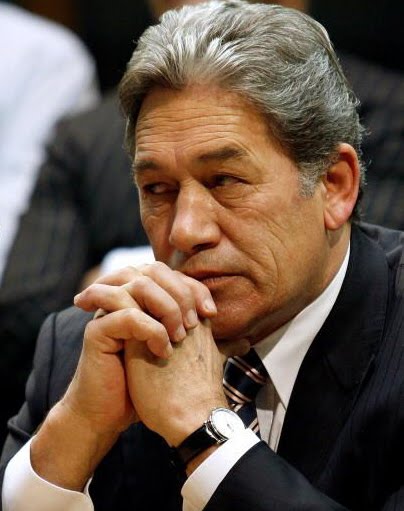
Praying for another chance? The current alignment of political constellations could hardly be more propitious for Winston Peters and NZ First to make it "third time lucky".

WINSTON PETERS, as the leader of NZ First, has twice received the Governor-General’s warrant: the first time from the National Party, the second time from Labour. On both occasions his ministerial sojourn ended badly.

With last week’s Roy Morgan poll registering an increase in NZ First support from 1 to 3 percent, many New Zealanders are now wondering whether, nineteen months hence, Peters will, for the third time, be asked to accept a ministerial warrant? And, will it be third time lucky?

Certainly, it is difficult to conceive of a conjunction of the political constellations more propitious for a Peters/NZ First comeback. Let’s just look at some of the issues which have already risen, or are rising, above the political horizon.

A Chinese business consortium at large in New Zealand, eyeing-up more than 100 Kiwi-owned dairy farms with a view to setting up a billion-dollar, vertically-integrated dairying operation in competition with this country’s single largest export-earner – Fonterra.

A Minister of Treaty Negotiations blithely conceding (to The Nation’s Duncan Garner) that, under the National-led Government’s proposed definition of Maori customary right, an iwi or hapu partnership-deal with Chinese interests seeking to invest $100 million in beach resorts holding a 100-year foreshore & seabed lease, would be subject only to the Resource Management Act and "other general pieces of legislation".

A "Whanau Ora" scheme promising to transfer hundreds-of-millions of dollars from publicly-administered and accountable welfare institutions to privately-owned, ethnically-driven providers (whose operations will be exempt from the scrutiny of the Official Information Act). A scheme which, Government reassurances notwithstanding, will operate according to a set of pre-modern cultural assumptions which most New Zealanders will neither accept nor endure. A scheme practically certain to detonate a sequence of financial and administrative explosions all the way from July 2010 to Election Day 2011.

A Government determined to intensify the consumption taxation of the poor so that it can attenuate the income taxation of the wealthy.

How could a politician of Peters’ skill and experience possibly fail to turn such a glittering array of political opportunities to his own and his party’s advantage?

In this regard, it’s leader’s electoral martyrdom and exile only works in favour of a NZ First comeback. Beyond the Beltway, and putting to one side those voters who have always experienced an allergic reaction to Peters’ political style, there are thousands of New Zealanders who, both at the time and with the benefit of hindsight, came to see the media-assisted crucifixion of the NZ First leader as not only an egregious misuse of media power, but also as a kind of modern-day show-trial designed to secure Peters’ absence from the new political environment the Key-led National Party was attempting to create.

Peters is the sworn enemy of the "neo-traditional tribal capitalists" National’s strategists have identified as a crucial element in the new combination of cultural and economic forces it believes will dominate the electoral politics of the 21st Century. NZ First’s absence from Parliament is crucial to making the ostensibly unlikely relationship between the National and the Maori parties politically durable.

Peters’ followers might not express the problem in quite those terms, but they know that his absence from Parliament is important – that it matters. They understand intuitively that over the past 17 months things have been done that could not have been done if Peters was still there.

NZ First’s return to Parliament would critically alter the balance of political forces, fundamentally weakening National’s grip on power. The inevitable attrition of the Government’s public support (already evident in the Roy Morgan poll) leaves Key dangerously exposed to a Peters-led crusade in 2011.

Rodney Hide’s super-city-inspired brutalisation of Auckland voters has compounded National’s difficulties. It places Act’s future in doubt – making Key utterly dependent on the Maori Party’s good-will. But, if Peters’ campaigning in the Maori seats threatens, even slightly, the Maori Party’s position, see how quickly that good-will evaporates!

What sort of platform would Peters and NZ First need to run on to make good that threat? And who should they target to garner five percent-plus of the Party Vote?

According to the American political scientist, Professor Jack H. Nagel, there are five salient socio-political "cleavages" around which an insurgent political party can be constructed in New Zealand: class; ethnicity; post-materialism; economic interventionism; religion and/or social conservatism.

At one time or another in its 17 year history, NZ First has sought to exploit nearly all of these categories. In 2010, however, with the ethnic and post-materialist cleavages already "taken" – by the Maori Party and the Greens respectively – NZ First is left with fewer "cleavages" to choose from. With Jim Anderton about to depart the political stage, Economic Interventionism is available, but Act’s David Garrett has already raised his party’s flag over Social Conservatism.

If Peters is really smart, however, he’ll focus on class – and one class in particular. Not Labour’s blue-collar, wage-earning working-class, but the class of self-employed and/or contract-dependent battlers which has grown like Topsy out of the wreckage of New Zealand’s once heavily-protected domestic economy.

Under enormous competitive pressure, resentful of those they see as the beneficiaries of "special privileges" and deeply suspicious of (or even overtly hostile to) immigrants of any kind, this classically petit-bourgeois, artisanal, "Waitakere Man" strata of society is ripe for the picking.

It encompasses not just the bloke who mows your lawns and the woman who styles your hair, but the share-milking couple despairing of ever being able to buy their own farm. You’ll find them in the heart of our big cities, but also in small provincial towns – and they constitute way more than five percent of the New Zealand electorate.

No one in NZ First understood this group better than the late Terry Heffernan. A very similar social strata had, after all, constituted the core of his original political home – Social Credit. The worst mistake Winston Peters ever made was choosing Michael Laws over Heffernan as his chief policy adviser in the run-up to the 1996 General Election. Laws turned NZ First into "National Lite" – a serious political blunder.

If Peters can re-capture in 2011 that curious mixture of patriotism, economic interventionism and progressive humanitarianism that Heffernan used to fuel NZ First’s assent of the opinion polls in the mid-1990s, then it’s possible, he just might, make it third time lucky.

This essay was originally published in The Independent of Thursday, 22 April 2010.

Friday, 16 April 2010

Dismissing Democracy

Grim Precedent: In this 1933 Punch cartoon, Adolf Hitler is carried to power on the shoulders of President Paul von Hindenburg (Left) and Chancellor Franz von Papen (Right). By dismissing Prussia's social-democratic state government in July 1932, Papen struck a fatal blow against the beleaguered Weimar Republic. Couldn't happen here? Think again.

DIE STRASSE FREI, dem braunen batallionen! Die strasse frei dem Sturmabteilungsmann! Clear the streets for the brown battalions! Clear the streets for the Stormtroopers!

The brutal lyrics of the National Socialist anthem, the Horst Wessel Leid, echoed off the walls of the tenements, warehouses and deserted factories of "Red Altona".

Perched on the rooftops of Hamburg’s most staunchly left-wing working-class suburb, communist sharpshooters took aim at the front ranks of the vast, 6,000-strong column of brown-shirted marchers.

It was Sunday, July 17th 1932 and the National Socialist German Workers Party was making good on its promise to march into the German Communist Party’s electoral heartland. Lying on the western outskirts of the city, along the banks of the River Elbe, Altona fell under the jurisdiction of the German State of Prussia.

Its residents, most of them connected in some way to the docks of the great port city, had vowed to keep the Nazis out. The waterside unions, the Communist Party and its paramilitary organisation the Rotfront (Red Front), and even the moderate Social-Democratic Party, poured their supporters onto the streets in an attempt to create a human stop-bank against the brown tide flowing through Hamburg and towards their poverty-stricken neighborhood.

Between them stood the Prussian Police – as divided in their way as the rest of Germany. Their officers, like the Nazis, despised the democratic Weimar Republic; but the ordinary cops on the beat identified more closely with the working-class neighbourhoods they’d sworn to protect.

No one knew who fired first (both the Stormtroopers and the Red Front were armed) but once the bullets started flying all hell broke loose. By nightfall two Stormtroopers and 16 residents of Altona lay dead and the city’s hospitals were overflowing with hundreds of wounded. The morning papers called it Altonaer Blutsonntag – Altona’s Bloody Sunday.

The civil strife in Altona was exactly what Germany’s right-wing Chancellor, Franz Von Papen, had been waiting for.

Prussia, the largest and most populous state in Germany’s federal republic was under the control of the left-wing social-democrats. Recent elections had weakened the Left’s grip on the state (and its 90,000-strong police force) nevertheless, it still constituted the single biggest obstacle to Papen’s plan to replace Germany’s democratic system with an authoritarian regime dominated by the nationalist Right. So long as Prussia and its blue-coated Schupos stood firm for the beleaguered Weimar Republic, it had a chance.

Papen went to see the aged German President, Paul von Hindenburg. The German Federal Government, he declared, had lost all confidence in the Prussian State Government. For the safety of the German people, he advised, the ineffectual Prussian Administration must be sacked and replaced with a government-appointed commissioner.

The President, using his emergency powers under Article 48 of the Weimar Constitution, dutifully signed a decree dismissing Prussia’s social-democratic ministers. Martial Law was declared and Prussia’s police were placed under federal command.

It was a blow from which the Weimar Republic never recovered. Six months later President Hindenburg appointed Adolf Hitler Chancellor.

Couldn’t happen here? It already had.

Throughout the "Angry Autumn" of 1932, massive civil disorder had convulsed New Zealand’s major cities. The right-wing coalition government of the day responded with the Public Safety Conservation Act – a draconian piece of legislation which essentially empowered the New Zealand Governor-General to suspend democratic government until such time as the Prime Minister advised him to restore it.

Fearful that the passions aroused by the Dunedin, Auckland and Wellington riots would spill-over into the General Election scheduled for 1934, the right-wing government of George Forbes and Gordon Coates arbitrarily extended the life of the 24th Parliament by 12 months.

Nineteen years later, the Coalition’s successor, the National Government of Sid Holland, used Emergency Regulations issued under the Public Safety Conservation Act to crush the Waterside Workers Union. Basic civil liberties such as freedom of the press and freedom of association were suspended throughout New Zealand for 151 days.

Couldn’t happen again?

On Tuesday, 30 March 2010 the Canterbury Regional Council was dismissed by John Key’s National-led Government and replaced by a commissioner. The council elections scheduled for October 2010 were cancelled.

"Across the board," declared Dr Nick Smith, "there has been a collapse of confidence in Environment Canterbury that has brought about the necessity of this government intervention."

Franz von Papen could not have put it better.

This essay was first published in The Dominion Post, The Timaru Herald, The Taranaki Daily News, The Otago Daily Times and The Greymouth Evening Star of Friday, 16 April 2010.

Impasse

Stalemate: New Zealand can move neither forwards, nor backwards, and yet it cannot stand still forever - but try telling New Zealanders that!

NEW ZEALAND stands at an impasse. Though New Zealanders’ deep-seated desire to break free of the economic and social constraints in which they find themselves remains undiminished, fears are growing that escape is no longer possible. At every turn, arguments for change are met with counter-arguments for doing nothing. For every bold step the National-led Government takes forward, it then takes two cautious steps to the side. Pundits mutter darkly of "government by opinion poll" and lament the lack of "strong leadership". New Zealand has stalled – and refuses to be re-started.

New Zealanders’ reactions to this impasse vary. The business community, for example, shows every sign of being in a state of denial. Confidence surveys reveal a wild optimism almost entirely lacking in evidentiary justification. Most economists agree that economic recovery – where it is happening at all – is occurring at a snail’s pace, and that there is significant risk of a second downturn. When required to focus exclusively on their own firms, most business-people share the experts’ pessimism. But ask them to pronounce on the prospects for the nation as a whole and what can only be described as "magical thinking" takes over.

It’s as if they cannot – or will not – allow themselves to entertain the thought that "their" Government is economically out of its depth, bereft of credible policies and drifting ineffectually on the unpredictable currents of public opinion. Rather than admit such a crushing dénouement to their hopes and dreams they’re attempting to will an unequivocal economic recovery into being through the collective projection of positive thinking.

But if the country’s business-people are wildly and unreasonably optimistic, its trade union movement is mired in a state of industrial and political passivity without precedent in New Zealand’s recent history. While the CTU’s fraternal peak organisations in Greece and France pour workers onto the streets in loud protest at their respective governments’ retrenchment policies, their Kiwi counterpart seems to have forgotten how.

Like the business community, the CTU is also in denial. Rather than admit its cowardly failure to defend trade unionism in the face of the 1991 Employment Contracts Bill – an admission that would at least allow it to "move on" from its current passivity to a more assertive stance – the CTU doggedly continues to repress its shameful historical memories.

The moral and organisational inertia created by this repression is manifested in the anti-democratic control-freakery and addiction to process that distinguishes today’s trade union leaders from the militant battlers of the past. In this respect, at least, the industrial wing of the labour movement is in perfect harmony with the political wing.

Ever since New Zealand became an unwilling host to the neoliberal army that ideologically occupied its intellectual landscape 25 years ago, both the CTU leadership and the Labour Party’s parliamentary wing have adapted themselves more-or-less willingly to life in the Occupation’s "Green Zone". The implementation of neoliberal policies in New Zealand’s workplaces and homes would’ve been next to impossible without the Labour Movement’s active collaboration.

"Waitakere Man" – the aspirational working-class battler who deserted Labour in the 2008 General Election – is almost entirely the product of this betrayal. Denied the opportunity to fight for his class through union and party, he has – since the debacle of "Rogernomics" – learned to fight for himself and his family alone. The diminished ideological horizons of this struggle have produced a corresponding diminution in the scope of his political engagement. Matters that impinge upon him and his family directly – interest rates, taxes, crime, healthcare costs and the education of his children – have retained their political salience. Those that do not have not.

For younger workers with no memories of New Zealand’s solidaristic and collectivist past, the narrow individualism which neoliberalism enforces is simply the norm. And yet, like their parents and grandparents, they also feel the loss of the worker-friendly economic order that neoliberalism swept away. Like the itch in an amputated arm, it bears witness to something that no longer exists – and that absence is resented.

Labour has yet to grasp the way in which Waitakere Man’s resentment is being played out politically – as punishment. It simply can’t understand why more and more "Labour people" are willing to cut off their noses to spite what they see as their erstwhile Party’s supercilious and unrepentant face.

Middle-class New Zealanders are also at an impasse.

Though not averse to the fundamental principles of the new economic order (which were, above all, the bourgeois principles of private enterprise and individual responsibility) they are nevertheless struggling to accommodate Neoliberalism’s practical consequences.

The social pathologies generated by burgeoning inequality are forcing middle-class people all across the Western World to embrace harsher and harsher methods of social control. It’s only recently begun to dawn on them, however, that these hard-line "solutions" necessarily entail the surrender of the moral and political foundations upon which bourgeois culture ultimately rests.
Increasingly, the progressive and humanitarian achievements of middle-class reformers in the 19th and 20th centuries are being challenged by extreme neoliberals touting remedies (like torture) which pre-date the era of bourgeois democracy.

That neoliberal and democratic values may not, in the end, be compatible is a frightening thought – but not as frightening as the sort of measures decent middle-class people will eventually be forced to condone once the cords of democratic accountability are severed.

Not surprisingly, these are prospects few middle-class New Zealanders are ready to contemplate. They, too, are in denial.

And thus we come to the very heart of the impasse in which New Zealand finds itself. We long to rid ourselves of the economic and social constraints that have steadily shrunk the space in which individual liberty can be meaningfully exercised, but we are not yet ready to accept that the origin of these constraints is the very neoliberal order we embraced more than a quarter-century ago to expand our freedom. That’s hardly surprising: who, after all, relishes confronting a difficulty without a solution? Or participating in an argument where no agreement is possible?

"The crisis", wrote the Italian socialist, Antonio Gramsci, "consists precisely in the fact that the old is dying and the new cannot be born; in this interregnum a great variety of morbid symptoms appear."

Thus is the impasse defined. Though "morbid symptoms" are driving our politics, we find ourselves both unable and unwilling to treat them.

This essay was originally published in The Independent of Thursday, 15 April 2010.