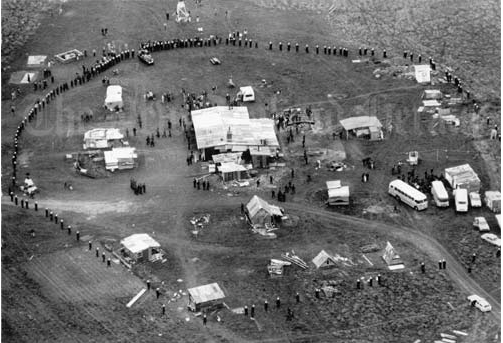
Mixed Historical Motives: The simple clauses of the Treaty of Waitangi masterfully embraced the complex agendas of both its British and Maori signatories.
IT’S JANUARY 1840, two sailing vessels are fast approaching
the North Island of New Zealand. His Majesty’s Ship Rattlesnake carries Captain William Hobson bearing instructions
from the Colonial Office to organise the voluntary cession of the islands of New
Zealand to the British Crown. The other ship, Aurora, carries settlers to the newly established settlement of
Port Nicolson. It has been chartered by the privately owned and organised New
Zealand Company.
Captain Hobson’s instructions are not unrelated to the
purposes for which the Aurora and her
passengers set sail. The islands of New Zealand, conveniently located in the
temperate zone of the southern hemisphere, are large but sparsely populated
(the indigenous Maori population numbers approximately 125,000). Not
surprisingly, therefore, they have begun to loom large in the sights of
European entrepreneurs, missionaries and imperialists.
Under pressure from the aristocratic backers of the New
Zealand Company, and wary of the pretensions of competing powers – particularly
the French – the Colonial Office in London is determined to regularise the
confused situation then prevailing in Australasia. If the land titles being
sold to settlers by the New Zealand Company are to be legally enforceable, the
question of sovereignty must be settled – and quickly. By fair means or by
foul, New Zealand is to be annexed to the British Crown.
The cheapest, the most politically expedient, and (in the
face of the Missionary Society’s strenuous submissions) the most morally
defensible means of securing possession of New Zealand is to persuade the
indigenous Maori tribes to cede sovereignty to her Britannic majesty, Victoria,
voluntarily. Indeed, British agents and
missionaries in New Zealand have been assiduously laying the groundwork for
just such a solution since the mid-1830s. The British Resident, James Busby,
has even secured a “Declaration of Independence” from his purpose-built
“Confederation of Chiefs” so the Crown has something to sit down with when the
time to negotiate a plausible treaty of cession finally arrives.
As HMS Rattlesnake
drops anchor in the Bay of Islands in February 1840, this is exactly what
Hobson and his confreres, Busby and Freeman, are preparing to do.
THE MAORI LEADERS gathered at Waitangi to korero with
Captain Hobson have come with an equally clear set of priorities.
First and foremost, they are seeking protection.
From the early 1830s a rough “balance of terror” has
prevailed among the indigenous people as more and more of them acquired
firearms. Even so, the slaughter and dislocation of the so-called “Musket Wars”
are still a very recent memory, and nobody’s ready to wager the lives of their
whanau and hapu on the blood-letting never breaking out again. Information
gleaned from Maori who’ve travelled to Australia – and further afield –
suggests that the British Empire holds out the best hope of keeping the peace
between the tribes.
They’re also keen for the British to keep the roughly 2,000
unruly Europeans who’ve settled amongst them to trade, hunt whales and seals,
or simply to outrun the writ of whoever’s justice system is after them, under
some semblance of control. There’s a lot of wealth to be had from these folk,
but only if the tribes can enlist the aid of an entity with sufficient power to
make sure they keep their side of any bargain – and pay up.
Having learned the hard way how skittish the Pakeha become
when Maori exercise their own robust forms of tribal justice, they reckon it
will make things a lot easier if their “guests” are forced to live under their
own laws.
Among the shrewder Maori – including the wily Hone Heke –
there is also a nagging fear that the ever-increasing inward flow of European
settlers will not stop. They’ve learned that these new arrivals are different –
not the usual traders, whoremasters, grog-sellers, whalers, sealers and
fugitives that the tribes have grown used to accommodating.
More than anything else, the settlers arriving on the New
Zealand Company ships desire land – Maori land. And as more and more of them
arrive, that hunger for Maori land can only increase. That’s why the better
educated and more travelled Maori are determined to secure their tribal
possessions against settler pressure by placing them under the protection of
the world’s most powerful nation – Great Britain.
Also at Waitangi are the Christian Maori – the products of
more than twenty years of missionary effort. To these men and women the Pakeha
have vouchsafed an entirely different understanding of the human condition.
Christianity has conferred upon its native converts a new kind of power: a new
mana.
They understand that the Pakeha’s morality, knowledge and
technology offer their people a way-in to a world their ancestors could never
have imagined. For them the future lies in a voluntary melding of their own and
the newcomers’ cultures – and that melding cannot happen soon enough.
THE SIMPLE CLAUSES of the Treaty of Waitangi masterfully embraced
the complex agendas of both its British and Maori signatories. It is, however,
naïve in the extreme to characterise the document as a contract.
Treaties are not contracts: at least not in the sense that a
mortgage or hire-purchase agreement is a contract. What a treaty actually
amounts to is a description of the power relations existing between two peoples
at a precise moment in history.
Almost always (and the Treaty of Waitangi is no exception)
the relationship between the signatories is an unequal one (usually reflecting
the stronger party’s military victory over the weaker). What makes the Treaty
of Waitangi so interesting is that it was signed in anticipation of – and as a way of avoiding – the military
clash which would have become inevitable if a voluntary cession of sovereignty
to the British Crown had been refused.
But Maori did not emerge from the negotiations of February
1840 empty-handed. The quid pro quo, in return for making things easy for the
Colonial Office, was the guarantee of what they had been seeking all along –
the protection of the Crown. Protection against any return to the slaughter of
the Musket Wars; protection against social disorder and commercial trickery;
and protection against the Pakeha they were most afraid of: the ones who were
coming to stay.
This was the real partnership enshrined in the Treaty: the
partnership between the Maori tribes and the Colonial Office, or, to put it
more precisely, with the executive arm of the British Government in London.
This was the power the chiefs had aligned themselves with: a power which, in
the person of the Governor, would stand between them and the predatory approach
to land acquisition represented by the New Zealand Company and its growing body
of imitators.
And there’s no question that the chiefs’ fears in regard to
the settlers were entirely justified. Here, for example, is how one of the
Governors of the New Zealand Company viewed the Treaty:
“We have always had very serious doubts whether the Treaty
of Waitangi, made with naked savages by a consul invested with no
plenipotentiary powers, without ratification by the Crown, could be treated by
lawyers as anything but a praiseworthy devise for amusing and pacifying savages
for the moment.”
THAT OMINOUS “for the moment” offers us a chilling reminder
of just how historically contingent all treaties are. Certainly the Treaty of
Waitangi – as a means of protecting the things Maori treasured – did not long
survive the moment when the settler population reached a size sufficient to
persuade London to grant it a measure of self-government (1852).
It was at that point that the Crown effectively ceased to be
the protector of New Zealand’s indigenous inhabitants, and became, instead, the
protector of the new settler state. In vain did the chiefs appeal to the
Governor to uphold the Crown pre-emption clause of the Treaty. And when, in
growing desperation, they crowned their own king and attempted to defend what
remained of their tribal lands, the Settler Government promptly declared them
rebels and traitors, and the British Government in London dispatched a vast
army to crush the resistance of the nascent Maori state.
It is difficult to envisage any other outcome. The moment
London acquiesced in the formation of a New Zealand State, they set in place an
entity which could only grow and prosper at the expense of the country’s
original inhabitants. Because, as the chiefs rightly apprehended back in
February 1840, if the new breed of settlers came to stay – it could only be on
Maori land.
TO SAY that the Treaty of Waitangi was breached is,
therefore, an accurate but ultimately trivial historical observation. Had it
not been breached, New Zealand – as a colonial society inextricably enmeshed in
the political, economic, social and cultural life of the British Empire –
wouldn’t have existed. For the Settler State to become real, the Treaty had to
become, in Chief Justice Prendergast’s brutal phrase: “a simple nullity”.
Was that wrong? Should the undertakings given by Captain
Hobson on 6 February 1840 have been honoured? Removed from its historical
context, the question is easily answered in the affirmative. Except that those
who go in search of such unencumbered moral judgements, do so without
understanding that such questions can never
be extracted from history.
To judge the dead may give some comfort to the living, but
no matter how fervently the misdeeds of previous generations are condemned,
they cannot be undone. Therefore, whatever justice we seek to do here and now,
let it be to right the wrongs of the present – not the past.
We fair-skinned Polynesians are not – and can never be –
“Europeans”. Just as contemporary Maori are not – and can never be again – the
Maori who inhabited these islands before colonisation. Both of us are the victims
of historical forces too vast for blame, to permanent for guilt.
And both of us have nowhere else to go.
This essay was originally published on the Bowalley Road blogsite on 12 May 2011.