Showing posts with label Rob Muldoon. Show all posts

Tuesday, 5 August 2025

Vox Populi: Ageing Boomers, Laurie & Les, Talk Politics.

“Old Baldy was booed by the Gender Gap.”

“THEY BOOED HIM.”

“Booed who?”

Hannah, the bar manager, couldn’t help overhearing the banter of her two favourite Boomers, right-wing Laurie and left-wing Les. She paused in her rounding-up of empty glasses and dirty plates to listen.

“Luxon, Laurie, the Prime Minister turned up to the netball final, and the crowd booed him. Since when did New Zealanders start booing their prime ministers at sporting fixtures?”

“Oh, come on, Les, your memory’s not that bad. Jacinda Ardern wasn’t our prime minister that long ago.”

“And if I recall rightly, Laurie, she received more abuse than any other New Zealand prime minister. But, it was only a certain sort of Kiwi who came after her. And, the hate they had for her was out of all proportion to her actual conduct as their prime minister. There was something quite deranged about Ardern’s enemies’ animosity. Looking back, I reckon she wasn’t vilified on account of who, or what, she actually was, but on account of the huge event she was conflated with – the Covid-19 Pandemic.”

“Spoken like a true Labour man, Les! But, you try running that line on those who were kept from the bedside of a dying parent. Or, the people who lost their jobs because they refused to be injected with a hastily developed RNA vaccine. Tell it to the retailers who watched their life’s work sicken and die. Tell it to the schoolkids fretting alone at home. Truthfully, Les, I think Jacinda’s ‘actual conduct’ merited quite a lot of animosity.”

“I think you’ve just proved my point, mate!”

“Touche! Les. But Ardern still isn’t the only New Zealand prime minister to have been monstered by her fellow citizens. Have you forgotten the 1984 incident when David Lange was set upon by a mob of Otago cockies? His driver and protection officers had to throw him into the back of the prime-ministerial limousine and power away before the furious farmers could tear the nation’s newly-elected leader limb-from-limb.”

“Hell’s bells, Laurie, I’d forgotten all about that! It was just after Roger Douglas had announced the abolition of all agricultural subsidies. A lot of those cockies faced economic ruin.”

“Not happy chappies, Les, that’s for sure!”

“And it reminds me of an even earlier incident – 1977, I think it was – when Rob Muldoon’s limousine was dented all to hell by the boots of a dozen or so sturdy Dunedin cops trying to hold back an angry throng of Otago students and trade unionists calling themselves ‘The July Front’. The constables had turned their backs to the crowd, linked arms, and, bracing themselves on the prime minister’s car, expedited his entry to the Dunedin Town Hall – where the National Party was holding its annual conference.”

“Let me guess, Les, you were there.”

“Might have been, Laurie. It was a long time ago. As you say, my memory’s not what it was.”

“Proves my point though, doesn’t it? Luxon’s very far from the first prime minister to be poorly received by the voting public.”

“Okay, but it also proves my point, Laurie. Ardern, Lange, Muldoon: they all came under fire from aggrieved minorities. Victims of the Covid regulations. Farmers stripped of their state support. Students and unionists venting their left-wing spleens at Rob’s Mob. But, being booed by the audience at a netball game? That’s a bit different, isn’t it? I mean, these were just ordinary Kiwis out for a night of sport. They hadn’t come to protest, they’d come to cheer. But, when they saw Old Baldy they just saw red – or, in his case, blue – and started booing. That’s got to mean something, surely?

“Could mean a lot of things, Les. It could mean the fans were just pissed-off at Luxon trying to muscle-in on a sporting fixture which, were he not the prime minister, he’d never dream of attending. Maybe they were annoyed at being used, quite cynically, as the backdrop for yet another National Party photo-op.”

“Yeah, well, when you put it like that.”

“And, I’ll offer you another explanation, Les. It was a netball final.”

“So?”

“So, who follows netball – mostly?”

“Women and girls.”

“Exactly! And who, by a scarily wide margin, favour Labour over National?”

“Women and girls!”

“Old Baldy, as you call him, was booed by the Gender Gap.”

“Go it in one, mate”, muttered Hannah.


This short story was originally published in The Otago Daily Times and The Greymouth Star of Friday, 1 August 2025.

Saturday, 16 March 2024

A Powerful Sensation of Déjà Vu.

Been Here Before: To find the precedents for what this Coalition Government is proposing, it is necessary to return to the “glory days” of Muldoonism.

THE COALITION GOVERNMENT has celebrated its first 100 days in office by checking-off the last of its listed commitments. It remains, however, an angry government. It is angry with the poor. It is angry with the regulatory environment. It is angry with those who resist its policies. Some would say it is angry with the last 50 years of New Zealand history, and with the political forces that have driven it. Inevitably, anger breeds nostalgia. The explanation, presumably, for the powerful sensation of déjà vu in which this government is now wreathed.

The Coalition’s anger at the poor is manifested in many ways. It began with the restoration of the sanctions which Labour had removed from the MSD’s repertoire of responses to what it regarded as the delinquent behaviour of beneficiaries. As the first 100 days drew to a close, the Housing Minister, Chris Bishop, reinforced this trend by announcing the phasing-out of emergency motel accommodation for the homeless who have run out of options.

On the face of it, putting an end to accommodating homeless people and their families in motels sounds like a positive and compassionate policy. What began under Bill English’s government as a genuinely ad-hoc and temporary response to the burgeoning housing crisis, morphed under Labour into a seemingly permanent answer to the growing discrepancy between need and supply. Entirely predictably, this concentration of the most vulnerable into the “motel rows” of New Zealand’s cities and tourist towns attracted all manner of dangerous predators. What had started out as a short-term fix, turned into a long-term nightmare.

And an expensive one. By the time the government changed, the state was pouring in excess of a million dollars a day into the pockets of New Zealand’s motel owners. Just as well, given that it had not taken New Zealanders and travel organisers very long to twig that motel accommodation was not an option to be considered seriously unless one actually enjoyed the soundtrack of immiseration. Loud music played at all hours, accompanied by frighteningly imaginative offensive language and behaviour, frequently spilling-out into the motel car-park, where a situation could deteriorate from the merely disruptive to the outright criminal in the flash of an illegal blade.

Stories multiplied of kids roaming unsupervised under the predatory gaze of gang members; of drunkenness and drug-use, and of the MSD’s wards “trashing” motel units. The effective nationalisation of the nation’s motel accommodation, far from mending homelessness, had created crime-ridden no-go zones, where defenceless victims were thoughtfully gathered for the convenience of their victimisers. Included among whom, as the years passed, turned out to be the very same state that had set the whole sorry mess in motion.

It was enough to make anybody mad. But, what turned out to be much harder for the Coalition’s ministers was getting mad at the right people. Rather than ask themselves whether the clamour from moteliers and developers to kick out the homeless beneficiaries might have been prompted by the end of the Covid emergency and the steady recovery of the tourism industry, the ministers called for ever more aggressive invigilation of the homeless.

MSD was instructed to make even tougher checks of their wards’ eligibility. Were they guilty of biting the hands that fed them? Did they have a history of trashing their rooms? Was there really no one who could take them in? Never mind that in the absence of such MSD scrutiny the homeless would never have been provided with a motel room. Scrutinize them harder!

Such intensification of what is already a profoundly stressful environment only makes sense if those responsible believe poverty to be the fault of its victims. It’s what happens when it is both ideologically and politically impossible to address fundamental causes.

A society which, forty years ago, gave up on the idea that it is the state’s duty to ensure that all its citizens are adequately housed, is left with no option but to look to the market for solutions. These will not be forthcoming, for the very simple reason that there is nowhere near enough profit in poverty. (Unless, of course, the state is willing to provide that profit by paying exorbitant prices for the motel rooms in which the market economy’s victims are warehoused.)

And then there’s the state’s ever-increasing collection of rules and regulations – society’s legal acknowledgement that an unregulated marketplace is a dangerous marketplace. How can society be so sure? Because, 150 years ago, society witnessed with its own eyes the consequences of allowing public health and safety to be ignored. It was around the same time that people began to become alarmed at how rapidly their country’s natural environment was falling foul of Capitalism’s costless externalisation of its waste. The response of the politicians was to create reserves and national parks.

It wasn’t enough. Post-war New Zealand was hungry for energy, and its electrical engineers, working alongside the Ministry of Works, gave it to them. It wasn’t until the early-1970s that the costs of such breakneck development became insupportable. The campaign to “save” Lake Manapouri grew into New Zealand’s first mass environmental movement. The “Baby Boom” generation, now old enough to vote, made sure it would not be the last.

The electoral heft of that generation was sufficient to limit the plans of those who had been encouraged to “rip-in, rip-out and rip-off” in the name of national development. It presented the Right with a problem: how to keep National’s long-term love-affair with mining companies, forestry interests, roading contractors, and urban developers hot and steamy. The strength of the environmental movement, and the rise of “green” politics, enforced a frustrating measure of discretion – and it rankled.

But in 2024, with the political phenomenon of “wokeness” having driven strategically devastating wedges into the Left’s electoral coalition, the numbers are finally with the Parliamentary Right. All that pent-up fury with the constraints imposed upon those willing to dream and think “big” is now being released. For the first time since the neoliberal revolution of the 1980s and 90s, New Zealand has a government that understands the state’s key role in fostering and protecting national development. That, without the state riding shotgun, the market – especially in a country the size of New Zealand – is too weak to play the role of nation-builder.

The truth of this proposition has been clear since the 1870s, when Sir Julius Vogel launched New Zealand’s first “national development” plan. It was equally clear to Bill Sutch in the 1950s. And even clearer to Rob Muldoon when he launched his own “Think Big” push for economic growth in the late1970s and early-1980s.

To make it work, however, the House of Representatives will have to reassert its supremacy over all the other players in the New Zealand polity: the judiciary, the public service, te iwi Māori, the trade unions, the universities, and the mainstream news-media. All the elements, in short, whose resistance to the Coalition Government’s plans, be it actual or merely potential, is fuelling the Coalition’s leaders’ resentment and anger.

That the Coalition’s political conduct harks back to the days of Rob Muldoon is no accident. To find the precedents for what this government is proposing; and for its willingness to engage in the most ruthless kind of majoritarian politics to make it happen, it is necessary to return to the “glory days” of Muldoonism.

No wonder so many New Zealanders are gripped by the feeling that they have been here before.


This essay was originally posted on the Interest.co.nz website on Monday, 11 March 2024.

Thursday, 29 February 2024

The Clue Is In The Name.

Truth In Advertising? The Nats do best when they take the “National” part of their name seriously,

WHEN ITS FOUNDERS christened New Zealand’s newest anti-socialist party “National”, they had two objectives. The first was largely cosmetic. The second, and much more important objective, was ideological.

In 1936, the year in which the New Zealand National Party was formed, the “Mother Country” – as a great many New Zealanders still referred to Great Britain – was under its third “National Government”. Although dominated by his own Conservative Party, the new Prime Minister, Stanley Baldwin, saw no reason to dispense with the fiction that he was leading something very similar to the government of national unity that had been formed to fight the Great Depression in 1931.

Essentially a “grand coalition”, the first British National Government had contained a substantial chunk of the British Parliamentary Labour Party. Indeed, the first leader of Britain’s first National Government was the Labour leader, Ramsay MacDonald.

It isn’t difficult to understand why the men who drew together the defeated Reform and United Parties into a new and permanent coalition decided to call their creation “National”. By consciously referencing its British namesake, and the example it set of bringing together all “responsible” political actors for the sake of the nation; New Zealand’s conservatives hoped to borrow a little of its lustre.

But, more important by far than referencing the Mother Country was the deeper, ideological objective behind the “New Zealand National Party” name. Its founders were determined to differentiate the new party’s purpose and principles from the class-driven imperatives of the Labour Party.

Except for the most socialist of its followers, Labour’s name has always been a problem. It speaks unashamedly of the class conflict lying at the heart of New Zealand’s capitalist society, and of its founders’ avowed determination to put the interests of the working-class – Labour – ahead of those of the employing-class – Capital. Unsurprisingly, Labour’s enemies never tired of accusing Labour of sowing conflict and division. Years after the Great Depression, Labour leader Norman Kirk still fretted about the party’s name, confiding to his private secretary, Margaret Hayward, his wish to drop the word “labour” altogether, in favour, simply, of the “New Zealand Party”.

Had National’s founders been as recklessly honest about their political goals as Labour’s socialists, they would have called their new party “Capital”. Given the numerical paucity of the country’s capitalist elites, however, such forthrightness would have been ill-advised. In New Zealand’s parliamentary democracy, such ideological candour would have condemned the new party to permanent opposition.

Hence the bid to equate the interests of all those who belonged to, and/or voted for, the National Party with the national interest per se. In sharp contrast to the Labour Party, which it portrayed as sectarian, divisive, and disloyal, National presented itself as the great unifier, open to all New Zealanders, and dedicated to the nation’s continuing progress and prosperity.

In a strictly practical sense, the new party was correct – it did represent the preponderant interests of New Zealand. United under its moniker were the rural-based interests of the country’s principal income earners, the farmers; along with the principal generators of New Zealand’s economic activity, the owners of private enterprises large and small. The poet and broadcaster Gary McCormick spoke more truly than he knew when, many years ago, he quipped: “The National Party stands for all New Zealanders – farmers and businessmen alike!”

It is this curious, almost contradictory, combination of political motives: seeking to advance and unite the whole nation, while simultaneously protecting the private and special interests of its farmers and businesspeople; that has dogged National ever since its formation.

In times of prosperity, when farmers and businesspeople, along with the rest of the nation, are doing well, the National Party’s expansive and inclusive political rhetoric finds a ready audience. When times are hard, however, and a choice must be made between looking after everyone, and making the welfare of farmers and businesspeople the National Party’s No. 1 priority, then New Zealand politics can turn decidedly nasty.

Christopher Luxon, National’s ninth prime-minister, has assumed office in times that look set to grow increasingly hard. True to National Party form, he and his colleagues, egged on by their party’s coalition partners, Act and NZ First, are aggressively prioritising the claims of the farming and business communities over those of the rest of the New Zealand population – most particularly social-welfare beneficiaries. Under the rubric of “Tough Love”, Luxon is brazenly playing social and economic favourites.

Historically, this class oriented strategy has not turned out well for the National Party. The last time it turned nasty, during the first and third terms of the Fourth National Government (1990-1999) it set the scene for nine years of Labour-led governments. National only recovered power on the strength of John Key’s wink-wink, nudge-nudge, commitment to pick up where Helen Clark left off.

Luxon could do himself and his party a power of good by studying closely the strategy of National’s fourth prime minister, Rob Muldoon, who, in spite of holding the prime-ministership through some of New Zealand’s most challenging and tumultuous years, won three general elections on the trot. The secret to Muldoon’s electoral success lay in his decision to take the “national” part of National’s name seriously.

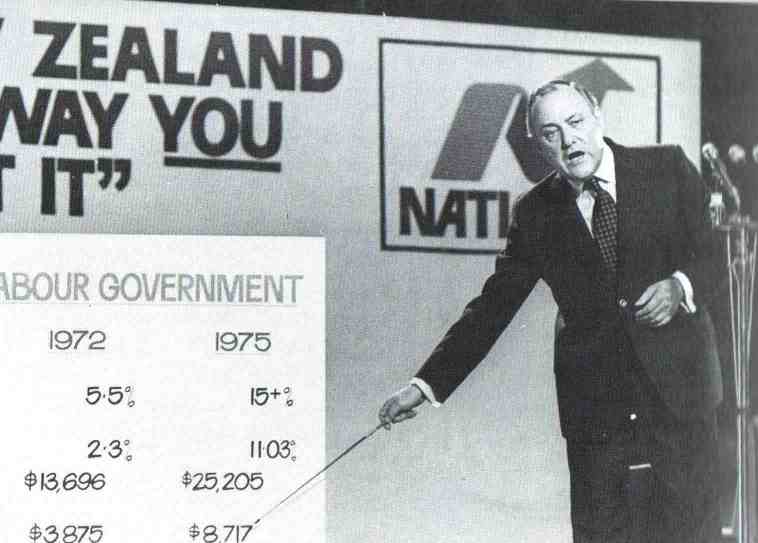
His 1975 slogan, “New Zealand the way YOU want it” indicated clearly the populist path Muldoon was determined to follow. Three years later he insisted that his government had pulled off an “economic miracle” and counselled against doing anything rash (like voting for Labour or, yikes, Social Credit!) that might undermine it.

In 1980 Muldoon refashioned the economic-nationalist policies formulated by the 1957-60 Labour Government – policies he had won his political spurs opposing back in 1960-61 – and presented them to the country as his own “Think Big” national development strategy. With these, and having demonstrated, with “batons and barbed wire”, his party’s unflinching commitment to New Zealand’s national game, Muldoon eked out a third consecutive electoral victory in 1981.

Critical to Muldoon’s destruction of Labour’s 23-seat majority in 1975 was his populist promise to outdo Labour’s contributory New Zealand Superannuation scheme. Seldom has so much been offered to so pivotal a voting bloc! Muldoon’s “National Superannuation” promised what amounted to a universal basic income, equivalent to 70 percent of the average wage, to every New Zealand citizen over the age of 60 years. The elderly would remain National Party loyalists – “Rob’s Mob” – for the best part of the next decade.

According to University of Auckland economics professor, Tim Hazledine, a similar opportunity exists today for a politician with imagination and daring to dramatically reconfigure the delivery of state support. Excluding the over-65s, there are more than 600,000 New Zealanders in receipt of transfer payments from the New Zealand state. Noting that many of the recipients of these benefits will remain dependent of the state’s charity for more than 10 years, Hazledine correctly observes that our social welfare system has morphed into something its creator, Labour’s Michael Joseph Savage, would struggle to recognise.

The Professor’s solution? Redirect the $10 billion currently being spent on state transfer payments into a non-means-tested Universal Basic Income of $300 per week for all citizens currently receiving state support.

“Yes, that is somewhat less than what beneficiaries get now,” writes Hazledine in his NZ Herald op-ed piece, “but not a lot less, and it would liberate the productive energies of several hundred thousand able-bodied citizens.”

It might also do for Christopher Luxon what New Zealand’s original UBI did for Rob Muldoon: demonstrate that National is, as it says on the tin, a party committed to the welfare of the whole nation; and, as an added bonus, cement-in the support of a hitherto unresponsive voting-bloc for the best part of the next decade.


This essay was originally posted on the Interest.co.nz website on Monday, 26 February 2024.

Tuesday, 28 November 2023

Who’s Driving The Right-Wing Bus?

Who’s At The Wheel? The electorate’s message, as aggregated in the polling booths on 14 October, turned out to be a conservative political agenda stronger than anything New Zealand has seen in five decades. In 1975, Bill Rowling was run over by just one bus, with Rob Muldoon at the wheel. In 2023, Labour was run over by a million busses – driven by ourselves.

BILL ROWLING told New Zealanders that he felt as though he had been run over by a bus. The metaphor was apt. Rob Muldoon’s 1975 electoral victory represented one of the great turnarounds in New Zealand political history. Three years earlier, Labour’s Norman Kirk had sent the National Government of Jack Marshall packing. But, just three years later, Muldoon, Marshall’s populist successor, exactly reversed Kirk’s landslide. National’s majority in the House of Representatives was identical to Labour’s – a whopping 23 seats. New Zealand had voted for the nation they wanted – and Muldoon was determined to give it to them.

It is nearly 50 years since Muldoon’s bus flattened poor Bill Rowling, but, for those with long political memories, the parallels with the election of 2023 are striking. The greatest of these is the profound sense of shock and disorientation among the activist supporters of the Left. Their discomfort is born not only of the brute facts of the election results, but also by the growing realisation that the incoming coalition government is determined to roll back practically all of the Left’s policy advances of the past six years.

Two generations have grown to adulthood since Muldoon’s reactionary political agenda was unleashed upon New Zealand. Young New Zealanders are not accustomed to governments committed to actually dismantling the changes of their predecessors, or, at least, not outside specialist areas such as workplace relations and educational assessment. For citizens under 50, the changes of the last few decades have all been in more-or-less the same direction. Economic policy has been neoliberal. Social policy has been “progressive”. Indigenous policy has been concessionary. Matters may have moved more swiftly under Labour, and slowed down a little under National, but, since 1984, the direction of travel has always been the same – onwards and upwards!

That’s what makes the experience so wrenching for the progressives of 2023. Especially with regard to the one, recurring issue which New Zealanders cannot escape: Race.

It was the National Government led by Jim Bolger that set in motion the Treaty of Waitangi settlement process – ably guided by his Treaty Settlements Minister, Doug Graham – in the early 1990s.

Not to be outdone, Labour, under the leadership of Helen Clark in the early 2000s, launched a policy effort dedicated to “closing the gaps” between Māori and Pakeha. The public backlash created by the policy was hugely strengthened by the Court of Appeal’s surprise affirmation of an enduring Māori proprietary interest in the foreshore and seabed. To keep Labour’s electoral prospects alive, Clark was forced to rein-in Māori expectations dramatically, a move which led to the creation of the Māori Party.

Don Brash, Leader of the Opposition in the run-up to the 2005 General Election, capitalised on the growing public disquiet over ethnic relations by throwing the National Party’s support behind calls for a comprehensive rolling-back of the state’s support for Māori sovereignty.

Brash lost the 2005 election, but only narrowly. “Progressive” New Zealand had been profoundly disturbed by the breadth of support for National’s reactionary policies. Brash, himself, was forced to endure what amounted to excommunication from “polite” political society. His fate was intended to serve as a warning to all serious politicians: mess with Māori (and Te Tiriti) at your peril.

Brash’s successor, National’s John Key, restored his party’s reputation (in the eyes of the political class) by sending the Māori Party’s co-leader, Pita Sharples, to New York to add New Zealand’s signature to the United Nations Declaration of the Rights of Indigenous People.

Labour’s next prime minister, Jacinda Ardern, went one better; commissioning a group of hand-picked “experts” to compile a secret report, He Puapua, setting forth a pathway to the UN Declaration’s full implementation by the 200th anniversary of the Treaty of Waitangi’s signing in 2040. Driven forward by Labour’s radical Māori caucus, Ardern and her Pakeha colleagues felt obligated to support their colleagues controversial, Te Tititi-driven constitutional innovation of “co-governance”.

As happened in 2004-05, these bold moves towards Māori sovereignty ignited a Pakeha backlash. In 2023, however, the Left lacked the collective political strength to head-off the forces of reaction.

Across a broad front of social issues, public hostility towards the scope and speed of proposed and/or actual changes neutralised almost entirely the massive support Labour had received in 2020 for its highly successful early handling of the Covid-19 pandemic. Indeed, the psychological and material damage inflicted upon the population by the pandemic, and the measures adopted to contain it, after 2020, contributed significantly to what the Left only belatedly registered as an alarming swing to the Right.

Separated by nearly 50 years from the strikingly similarly political derangement that followed the onset of the global oil crisis in October 1973, the sudden collapse of public trust and confidence in the Labour Government in 2022-23 was experienced by the Left as a Black Swan event of perplexing severity.

Young leftists had read about the swift succession of progressive moves undertaken by Norman Kirk’s Labour Government. The abolition of compulsory military training; the troop withdrawal from Vietnam, the recognition of “Red” China; the sending of a NZ frigate to protest French atmospheric nuclear testing at Mururoa; the cancellation of the 1973 Springbok Tour; the creation of ACC and the NZ Superannuation Fund. This is what Labour was capable of delivering – from the left.

Less well understood were the social dynamics which made it possible for a right-wing politician as shrewd and ruthless as Rob Muldoon to bring about an absolutely catastrophic change in the political climate. In the 15 months following Kirk’s sudden death in August 1974, New Zealanders egalitarian instincts were harnessed to an aggressively populist campaign directed against a Labour Party portrayed as having been taken over by intellectuals and radicals whose values were wildly at odds with those of “the ordinary bloke”. Not only was Muldoon able to present himself as the saviour of the country’s middle-class, but of its working-class as well. National’s slogan: “New Zealand the way YOU want it”, said it all.

Depressing though it is to admit, New Zealanders’ deeply ingrained social conservatism; their fury at any person, or group, who see themselves as being better than everybody else; their unwillingness to tolerate one rule for thee, and another for me; their impatience with intellectuals and artists; their wariness of difference; their hatred of privilege; and their comfort in conformity; remains as powerful today as it was 50 years ago.

Perhaps, not seeing a Muldoon figure looming over the electoral landscape, the Left felt itself to be safe. But, 50 years on from 1974-75, charismatic leadership is no longer strictly necessary. Fifty years on, we have the Internet, social-media, and algorithms. Today, we can manufacture a Muldoon for every taste. A protean Muldoon, who addresses tens-of-thousands of voters every day, with a message cleverly crafted for them alone, and delivered instantaneously through those magic rectangles of glass that never seem to leave the voters’ hands.

The sum total of these messages, as aggregated in the polling booths, is a conservative political agenda stronger than anything New Zealand has seen in five decades. In 1975, Bill Rowling was run over by just one bus, with Rob Muldoon at the wheel. In 2023 Labour was run over by a million busses – driven by ourselves.


This essay was originally posted on the Interest.co.nz website on Monday, 27 November 2023.

Wednesday, 10 August 2022

The Way We Used To Want It – And, Maybe, Still Do.

Representing Pakeha Racism: The important thing to remember about Rob Muldoon, and the racist policies with which his name is associated, is that he drew his power from the hundreds-of-thousands of anxious, angry, and yes – racist – Pakeha who voted for him, and that his most effective campaign slogan was:
“New Zealand the way 
YOU want it.”

GREEN MP TEANAU TUIONO hopes to introduce a Private Members Bill repealing the Citizenship [Western Samoa] Act 1982. The Act, introduced by the National Government of Rob Muldoon, and supported by the Labour Leader of the Opposition, Bill Rowling, prevented Samoans born between 1924 and 1949 from exercising the rights of New Zealand citizenship.

Had the legislation not been passed, the decision of the Privy Council (then New Zealand’s highest court) affirming the New Zealand citizenship of all Samoans born when New Zealand exercised a League of Nations “Mandate” (later becoming a United Nations “trusteeship”) over Samoa, would have stood, and tens-of-thousands of Samoans would have enjoyed free entry to New Zealand.

Yet to be drawn out of the Private Members Bill “lottery”, Tuiono’s proposed legislation would presumably restore the citizenship rights of Samoans born between 1924 and 1949. Obviously, this would encompass a much smaller group of people than was the case in 1982. Samoans born in 1949 would today be 73 years old – coincidentally the average life expectancy of a Samoan citizen.

In much the same way as the formal New Zealand Government apology for the notorious “Dawn Raids” of 1974-76, Tuiono’s PMB would stand as a marker of both condemnation and regret for the racist policies inflicted upon Pasifika by the New Zealand state.

Given that any legislation would, after 40 years, be almost entirely symbolic – i.e. only a handful of Samoans would be in a position to take advantage of their restored New Zealand citizenship – the Greens stand to lose very little by their endorsement of Tuiono’s gesture. Slightly more challenging for the Greens’ would be the following counterfactual.

Let us suppose that Tuiono’s bill passes, and citizenship is restored to Samoans born between 1924 and 1949. Then, let us further suppose that a new legal case is mounted, and that the New Zealand Supreme Court ultimately determines that the Samoan descendants of the New Zealand citizens born between 1924 and 1949 are also New Zealand citizens. Suddenly the number of people affected by Tuiono’s legislation jumps from hardly any, to a just about all of Samoa’s population of roughly 200,000.

In these circumstances, the Greens would be faced with the same political dilemma as Labour’s Bill Rowling in 1982. Should they uphold the law and welcome 200,000 new citizens to Aotearoa-New Zealand, or, should they bow to the deafening racist clamour for closing the country’s borders to what would be, in effect, an entire Pacific nation?

Back in 1982, Rowling chose the second option. He calculated that Labour would sustain much less damage, electorally, by throwing in its lot with National, passing the legislation quashing the Privy Council’s judgement with all possible speed, and simply living with the loud moral objections of their Pasifika supporters and the increasingly vociferous anti-racist movements of the time.

As well as, it must be said, the loud objections of Labour’s own youth wing, whose president, Sean Fleigner, released a statement bitterly critical of his own party’s capitulation to the undisguised racism of Pakeha New Zealand. For this gutsy demonstration of moral fortitude, Sean and his fellow Dunedin radicals received a “visit” from the party’s dynamic young president, Jim Anderton, who, no doubt acting on Rowling’s instructions, warned them against any further gestures of public defiance which, in addition to being unsupported by all but a handful of party members, and therefore doomed to fail – were bloody embarrassing to the Leader.

Some young New Zealanders will be appalled at Labour’s open collaboration with the Rob Muldoon depicted in the 2021 television series about the Polynesian Panthers. The very same Rob Muldoon who set New Zealander against New Zealander by refusing to ban Apartheid-era South Africa’s Springbok Rugby team from touring New Zealand in July-August 1981. But, what appears outrageous with the benefit of 40 years hindsight, was almost always perceived very differently by the people living at the time.

The Privy Council’s bombshell decision had been handed down in September 1982 – barely twelve months after the civil strife that so shocked and dismayed New Zealanders the previous year. In a manner oddly foreshadowing contemporary New Zealanders’ determination to avoid any further lockdowns and just “live with” Covid-19, the Kiwis of 40 years ago wanted no more unpleasantness about racism, and were keen to put all the violent passions of 1981 behind them. Very few voters would have thanked Bill Rowling and Labour for dying in a ditch over the Citizenship [Western Samoa] Bill – and expecting them to do the same.

Labour’s concern for what was in the minds of its (overwhelmingly Pakeha) supporters was no less influential in March 1974 when Norman Kirk set in motion the policies that would culminate in Muldoon’s draconian Dawn Raids of 1976.

Kirk and his government were acutely aware of how deeply unpopular his decision to ban the scheduled 1973 tour of the Springboks was among Labour voters. While the Commonwealth Games held in Christchurch in January-February 1974 had given his government an enormous boost (which wouldn’t have been the case if the Springboks’ tour had gone ahead) Kirk was anxious to reaffirm Labour’s attachment to his country’s longstanding “White New Zealand” immigration policy. With the economy faltering, and mass unemployment threatening, sending the “Islanders” home appealed to his government as the least electorally damaging option.

Difficult though it may be to accept, such openly racist policy-making enjoyed solid bi-partisan support. Following Kirk’s death in August 1974, the anti-Pasifika feeling only intensified. Indeed, between September 1974 and November 1975, when Muldoon’s National Party decisively defeated the Labour Government, New Zealand shifted sharply to the right. Over the ensuing months, the New Zealand electorate expected – and was treated to – some of the most retrograde and vicious policy-making in New Zealand’s political history. The Dawn Raids were just one aspect of White New Zealand’s backlash.

Watching The Panthers television series, one could be forgiven for thinking that the Polynesian Panthers played a critical role in the Dawn Raids drama. The truth is they were never more than a minor irritant to the authorities. In spite of their name, they experienced nothing like the level of repression visited upon the Black Panther Party of the United States – most of whose leaders were either murdered by the Police and the FBI, or incarcerated for lengthy periods.

The Panthers’ obsessive focus on Muldoon unhelpfully obscures the fact that most New Zealanders were more than happy to limit Pasifika immigration. Politically, the Dawn Raids offered the public dramatic proof that the Government was “doing something”. Having demonstrated the requisite “hard line”, Muldoon quietly wound the theatrics down. By 1977 it was all over.

Herein lies the virtue of putting the Greens to the test of an historical counterfactual: to see whether they fully appreciate just how deeply racism remains embedded in the Pakeha population. Socially liberal New Zealanders have either forgotten, or been given the wrong information, about their country’s recent past. Much has changed since the mid-1970s and early 1980s – but an awful lot has remained the same.

It’s easy to say “sorry” when your apology can be made without political cost, and in the absence of a political leader capable of harnessing the popular resentments and prejudices it might inflame. 

The important thing to remember about Rob Muldoon, and the racist policies with which his name is associated, is that he drew his power from the hundreds-of-thousands of anxious, angry, and yes – racist – Pakeha who voted for him, and that his most effective campaign slogan was: “New Zealand the way YOU want it.”

White and Right.


This essay was originally posted on The Daily Blog of Tuesday, 9 August 2022.

Wednesday, 27 July 2022

Fighting Inflation – What Would A Democratic-Socialist Government Do?

Think Big: A democratic-socialist government could remove GST from basic food items. It could re-nationalise and centralise the generation and distribution of electric power, and then retail it to citizens at an affordable price. A democratic-socialist government could nationalise the public transportation system and make it free for everyone. A democratic-socialist government could even impose a “Carbon Footprint Tax” on imports. Only among neoliberals are “subsidy”, “tax”, and “tariff” dirty words.

CONFRONTED WITH THE CHALLENGE of a worsening cost-of-living crisis, what would a democratic-socialist government do? Right now, answering that question coherently and believably is the Left’s most important assignment.

The Right’s response to this challenge is relatively clear: throw the economy into recession, maintain strong downward pressure on aggregate demand; reduce public spending. The Centre-Left’s approach to the crisis differs in no serious respect from the Right’s. It hopes to achieve the same goals, using the same methods, but in such a way that their inherent social violence is masked by the rhetoric of “kindness”.

Unfortunately for Jacinda Ardern and her Cabinet, there is no “kind” way of bringing inflation under control while remaining within the ideological parameters of neoliberalism. The classical definition of inflation: too much money chasing too few goods; more or less writes the neoliberal government’s policy for it.

The first and most important objective is to reduce the amount of money in circulation. Neoliberals achieve this key goal by raising the cost of borrowing money. Those with mortgages are required to pay more, leaving households with less to spend. The price of capital also rises, applying the brakes to business expansion and investment. In the face of these developments the labour market contracts: raising the level of unemployment, increasing workers’ fear of “the sack”, and setting off a steady decline in real wages.

In short order, the problem of too much money in too many people’s pockets simply disappears – along with their cash and credit. But wait, there’s more. If a farmer cannot make a dollar by supplying the market with one cabbage, then he will supply it with two. There will be more cabbages to buy, and at a lower price.

And there you have it! The cost of living falls. The inflationary tide recedes. The problems confronting neoliberal economists and politicians are solved.

All well and good for the neoliberal economists and politicians, but not in any way good for the human-beings on the receiving end of their decisions. The great virtue of these macroeconomic measures, from the neoliberals’ perspective, is that they save them from having to deal with the devastating micro effects of their policies.

They don’t have to witness the expression on workers’ faces when they’re told that their employer is “letting them go”. They don’t hear the sobs of the young couple leaving the house they struggled so hard to buy, but whose mortgage they can no longer afford. The small businessman who cannot make the numbers add-up, no matter how hard he tries, suffers alone – a casualty of capitalism’s “creative destruction”. The real-world effects of a neoliberal government’s economic policies occur in places where the politicians who set them in motion seldom visit.

In the long run, though, everyone is better-off for having helped to beat inflation and bring the cost-of-living under control. Such is the refrain of the neoliberal decision-makers. It is a bleak sort of consolation, akin to that of the General who praises the sacrifice of thousands of conscript soldiers – all of them killed by the murderous ineptitude of his military tactics. There are ways to win battles that do not necessitate slaughter. There are ways to beat inflation that do not depend on simultaneously beating-up the nation’s poorest and most vulnerable citizens.

But, what are these ways? How can inflation be beaten without inflicting economic pain on the weakest members of society?

For democratic-socialists, the answer lies in using the enormous power of the state to regulate the economy. Exactly the same power that neoliberalism currently uses to entrench the power and privilege of the capitalist elites.

Because the power of the state does not have to be used to keep the private sector profitable. The power of the state could just as easily be used to freeze mortgage rates, cap the prices of necessities, and control rents; to raise appreciably more revenue from its wealthiest citizens; and to levy “windfall” taxes on all those corporations guilty of racking-up excessive profits during the Covid-19 pandemic. (Even Boris Johnson’s Conservatives did that!)

At the same time, a democratic-socialist government could remove GST from basic food items. It could re-nationalise and centralise the generation and distribution of electric power, and then retail it to citizens at an affordable price. A democratic-socialist government could nationalise the public transportation system and make it free for everyone. A democratic-socialist government could even impose a “Carbon Footprint Tax” on imports. Only among neoliberals are “subsidy” “tax” and “tariff” dirty words.

To be fair to Jacinda and her Finance Minister, Grant Robertson, they have made a modest effort towards subsidising petroleum and public transport. They have also provided many New Zealanders with a “Winter Energy Payment”. These are good moves, but they are nowhere near enough.

Sadly, the full mobilisation of the state’s powers to bring down the cost-of-living, tax excess profit and  wealth out of circulation, and reconfigure the ownership of what are, in truth, “social” industries for the benefit of the many, not the few, is still beyond the range of this Government’s political imagination. Nearly 40 years of neoliberalism has robbed Labour of the courage and creativity that, in the 1930s and 40s, made New Zealand a model democratic-socialist state.

Conservatives reading this post will shriek “Muldoonism!” And, they will be right. But there is another way to look at Rob Muldoon’s economic management, apart from using it as shorthand for everything that was wrong with New Zealand in the 1970s and 80s.

It is possible to recast Muldoon’s policies as proof of how deeply ingrained the determination to look after the interests of ordinary people had become in the New Zealand political system. Muldoon subsidised and regulated and controlled because the alternative – letting “market forces” rip – would leave far too many casualties in its wake. When Rob Muldoon promised “New Zealand the way YOU want it” – he meant it.

That the Labour Party was willing to inflict those casualties; that to keep the good opinion of Treasury and The Business Roundtable it was willing to abandon its democratic-socialist principles; and that, to this very day, its political creativity remains stunted by the neoliberal dogma it cannot seem to abandon; strikes me as a far greater crime than any Rob Muldoon may have committed. In the end, even the Springbok Tour made New Zealand a stronger country.

But, neoliberalism has not made New Zealand a stronger country, it has made it weaker. When the instinct of both its major parties is to use the nation’s weakest citizens as economic cannon-fodder, then surely it is time New Zealanders made “neoliberalism” a dirty word? Imposing cruelty in the name of kindness has only ever left humanity with more that is cruel, and less that is kind. It is not what democratic-socialists do.


This essay was originally posted on The Daily Blog of Friday, 22 July 2022.

Monday, 4 July 2022

Forwards And Backwards.

The Right In Action: Nothing in politics is ever settled. The hands of History’s clock can go backwards, as well as forwards.


IT REALLY WAS THE BEST OF TIMES. The brief recession of the late-1950s was over. The United States was led by a young, Harvard-educated war hero, with the dashing style and good-looks of a Hollywood movie star.

The Kennedy Administration had made idealism sexy, and politics heroic. “Ask not what your country can do for you,” John F. Kennedy had declared in his Inaugural Address of 20 January 1961, “ask what you can do for your country.”

The Cuban Missile Crisis of October 1962, and its peaceful resolution, offered proof positive that “the best and the brightest” of the “Free World” were more than a match for the hard men of Soviet Communism. There was a confidence and purposefulness about the United States that not only lifted the spirits of Americans, but fuelled the hopes of people all over the world.

Even the great American scars of racism and poverty no longer seemed beyond remedy. Dr Martin Luther King’s non-violent civil rights movement was galvanising young Americans of all colours in ways not seen since the Civil War of the 1860s. It recalled the high idealism of the Abolitionists: that extraordinary fervour for racial justice reflected in the words of The Battle Hymn of the Republic: “As [Christ] died to make men holy, let us die to set men free.”

Kennedy had also invited Michael Harrington, democratic socialist and author of the 1962 best-seller, The Other America, to the White House for a briefing on those pockets of poverty Roosevelt’s “New Deal” had left in place, and how, finally, they might be eradicated.

Underlying all this optimism and idealism was a rising tide of Keynesian-inspired economic prosperity that had lifted all boats high enough for the usual hardscrabble, hand-to-mouth priorities of ordinary Americans to be temporarily set aside. If the United States was rich enough to contemplate putting a man on the moon by 1970, then perhaps the elimination of racial inequality and poverty could be overcome.

Paradoxically, Kennedy’s assassination only hardened the resolve of Americans to meet the challenges their fallen leader had set before them.

President Lyndon Baines Johnson pledged unreservedly to make good his predecessor’s promises. In January 1964, just weeks after the tragedy in Dallas, “LBJ” used his first State of the Union Address to declare an unconditional “war on poverty”. In November of that same year, Johnson handed Barry Goldwater, the presidential candidate of a Republican Party hi-jacked by its far-right lunatic fringe, a stunning and humiliating defeat.

In his most effective campaign ad’, Johnson said, simply: “Either we must love each other, or we must die.” Less than sixty years ago, an American President had secured a landslide victory on a platform of delivering racial justice, ending poverty, and keeping America at peace.

In the bitter aftermath of the US Supreme Court’s revocation of Roe v. Wade, the above history lesson should serve as a sharp reminder of just how tenuous, and temporary, political progress can be. In the space of just four tumultuous years, the United States had retreated so far from its progressive high-water mark, that Richard Nixon was able to re-take the White House for the Republican Party. Nothing in politics is ever “settled”. The hands of History’s clock can go backwards, as well as forwards.

Nor are such dramatic political reversals peculiar to the United States. In 1972, the New Zealand electorate swung sharply left, propelling the Labour Party into power with 48.4 percent of the popular vote and a whopping 23-seat majority. The professors and the pundits of the time were unanimous in their opinion that a majority of 23 could not be overturned in the space of a single term. Labour, they insisted, was good for at least six years.

They couldn’t have been more wrong. Between 1972 and 1975, the mood of the New Zealand electorate soured to the point where National’s right-wing populist leader, Rob Muldoon, was able to exactly reverse the 1972 election result. Politically and socially, New Zealand voters had swung as sharply to the right as, only 36 months before, they had swung to the left.

Fear was the key: fear and its associated need for reassurance and protection. Muldoon’s success was built on the sudden failure of the New Zealand economy. Rampant inflation, rocketing petrol prices, and the widespread conviction that something very serious had gone wrong with the stable (some might say smug) New Zealand so gently mocked in Austin Mitchell’s in/famous bestseller The Half-Gallon, Quarter-Acre, Pavlova Paradise.

Which is why, when professors and pundits glibly reassure us that there is no way New Zealanders could turn against a woman’s right to choose an abortion, we are entitled to a small snort of derision.

Four years ago, approximately 65-70 percent of New Zealanders were in favour of legalising cannabis. That’s roughly the same percentage of the population that supports the current abortion law. After 18-months-to-a-year of extremely sophisticated campaigning by the anti-cannabis lobby, however, the percentage of voters supporting marijuana law reform had plummeted to just under 50 percent – a fall sufficient to cost the reformers the 2020 referendum. Public opinion doesn’t just change, it can be made to change.

With most economists predicting an imminent recession, many New Zealanders will enter 2023 in fear of what lies in store for them, and resentful of a Labour Government they believe has let them down. If extra-parliamentary forces like the Family First organisation are able to associate Labour’s political leadership with an ideology that despises and derides the beliefs and values of ordinary people, linking their lack of empathy with New Zealanders’ declining economic fortunes, then the chances of them producing a dramatic shift in the electorate’s thinking are relatively high.

In a commentary-piece written for The Conversation, the Auckland academic Suze Wilson warns New Zealanders against placing too much stock in Opposition Leader, Christopher Luxon’s, reassurances that National would not pursue a change to this country’s abortion laws should it win government.

“Even if Luxon’s current assurance is sincerely intended,” writes Wilson, “it may not sustain should the broader political acceptability of his personal beliefs change. And on that front, there are grounds for concern.”

Wilson draws particular attention to the sharp rightward drift set in motion by the Covid-19 Pandemic and the measures adopted by Jacinda Ardern’s Labour-led Government to protect New Zealanders from its worst effects. The early success of those measures, sufficient to secure Labour’s landslide victory in 2020, has not been maintained. Voters who, just 18 months ago looked upon “Jacinda” as a national hero, are daily falling prey to extreme right-wing conspiracy theories depicting her as a power-crazed tyrant.

“If these kinds of shifts in public opinion continue to gather steam, it may become more politically tenable for Luxon to shift gear regarding New Zealand’s abortion laws”, Wilson warns.

The same America that gave us JFK, also gave us Richard Nixon and Donald Trump. The same New Zealand that gave us Norman Kirk, also gave us Rob Muldoon. Except they weren’t really the same countries, were they? Because, when Prosperity leaves the building, Empathy is seldom very far behind.

Nothing in politics is ever settled.


This essay was originally posted on the Interest.co.nz website on Monday, 4 July 2022.

Friday, 3 December 2021

Can Luxon “Reimagine Capitalism” – Like Muldoon?

Outflanking The Socialists: Because there really isn’t any other way that National can win. Christopher Luxon, like Rob Muldoon (above) needs to go fishing where there are fish to catch. Using what for bait? Simple. A solemn promise to halt the upward redistribution of wealth among the sort of highly-educated, middle-class bureaucrats who get paid for telling working people what to do.

THE PROBLEM with Jim Bolger’s sagacious intervention of last Sunday was that it diagnosed National’s disease, but supplied no remedy. It is all very well to tell National’s new leader, Christopher Luxon, that he must articulate a clear “vision” to the electorate. Who would disagree? Much more helpful, however, would’ve been some indication as to what that vision might be.

The nearest Bolger got was a suggestion that the new Leader of the Opposition might like to “reimagine capitalism”. Now, as a man of the Left, I have to say this was a pretty startling piece of advice. Most of those on the centre-right of politics struggle with the idea that there is anything about capitalism that requires “re-imagining”. What Bolger’s radical diagnosis appeared to be saying, however, was that National’s longstanding mistrust of political imagination might just lie at the heart of the party’s electoral difficulties.

Fair enough. But asking Luxon to re-imagine capitalism strikes me as a rather tall order for someone who’s only just celebrated his first year as an MP. Tall, but not impossible. Because, as Newsroom journalist Nikki Mandow reminded us on Monday morning (29/11/21):

“[I]t was Luxon who first introduced former KiwiRail chief executive Peter Reidy to the high engagement, high performance management model.

‘He’d been using it for a couple of years at Air New Zealand and was getting great results in terms of engaging frontline workers and their union to improve productivity’.”


Does this “high engagement, high performance management model” count as an example of reimagining capitalism? Maybe it does. It certainly counts as persuasive evidence that Luxon isn’t afraid of new ideas, new ways of working, and – wonder of wonders for a National Party politician – that he isn’t afraid of interacting productively with workers and their unions.

And that lack of fear is likely to prove crucial to Luxon successfully hauling National out of the rural and provincial swamp in which his predecessor, Judith Collins, had allowed her party to become mired.

Because, if there is one fact that National’s new leader must make his colleagues understand, it is that there simply aren’t enough farmers, small businesspeople and conservative Christians living in New Zealand to carry their party to victory. Nor is it any longer the case that a middle-aged White male, with a background in business, can expect to be automatically deferred to by centre-right voters – let alone centre-left converts.

Not that I’m suggesting a business background is a handicap, merely that it’s not enough. Not with half the workforce made up of women. Not when the blue collars of New Zealand’s proletariat are, increasingly, fastened around brown necks. Not when a growing proportion of New Zealand’s population grew up in powerful and active states, for whom the planning and implementation of economic development remain core government functions. (As was once the case right here in New Zealand!)

If Luxon’s caucus is unwilling to exercise their collective political imagination upon these electoral and cultural fundamentals, then National’s future is bleak. Eventually, Labour – which understands, at least theoretically, that these key transformations must be acknowledged and responded to – will work out how to make change happen.

Luxon’s tenuous – and presumably temporary – advantage is that Labour has yet to master the art of turning theory into practice. If, while his political opponents continue to faff about, Luxon reaches out, like Boris Johnson, to that part of Labour’s traditional working-class base that is no longer quite sure whose side Jacinda Ardern and her government is on, then National can begin to amass the additional numbers it needs to reclaim the Treasury Benches.

Outlandish? You reckon. Impossible? Well, it certainly won’t be easy, but it should not be forgotten that National has done it before. Luxon could do a lot worse than to set about rehabilitating the reputation (and some of the policies) of Rob Muldoon. Not the whole shebang, mind, but, at the very least, Muldoon’s willingness to reimagine, and reconfigure, capitalism in the way ordinary New Zealanders wanted it.

Because there really isn’t any other way that National can win. Luxon, like Muldoon, needs to go fishing where there are fish to catch. Using what for bait? Simple. A solemn promise to halt the upward redistribution of wealth among the sort of highly-educated, middle-class bureaucrats who get paid for telling working people what to do.


This essay was originally published in The Otago Daily Times and The Greymouth Star of Friday, 3 December 2021.

Monday, 26 July 2021

Engineering A Miracle: Can Judith Collins Reprise Rob Muldoon?

Miracle Worker? But Judith Collins and National cannot regain power by simply hoping for the worst. Elections are won by politicians like Rob Muldoon, who persuade the voters that the incumbent government is the worst choice.

WAITING FOR THE MIRACLE, as Leonard Cohen observed, is an agonising test. Especially if its arrival is far from certain. Judith Collins is living through that test right now. Convinced that political disquiet is taking hold of more and more New Zealanders, she waits for evidence of its existence outside National’s rural heartlands. Collins’ “Demand the Debate” campaign has undoubtedly stirred the latter, but is her caucus capable of holding its nerve until those former National supporters who voted Labour in 2020 start showing similar signs of feeling “left out”?

The “Groundswell” protests of 16 July 2021 were generated primarily by the Government’s unrelenting imposition of regulatory responsibilities on an already stressed rural sector. Farmer anger and impatience was readily mobilised because rural dwellers still enjoy a significant degree of effective political representation and are well-used to participating in decision-making forums. Federated Farmers, in particular, reaches into every wool- and milking-shed in the country. The Fonterra co-operative is run by and for its highly engaged farmer members. Farmers are used to having their say – and being heeded.

Collins’ problem is that the rest of New Zealand has become decidedly rusty at defending its interests. Gone are the days when working-class Kiwis could rely upon their peak trade union body, the Federation of Labour, to flex its industrial and political muscle on their behalf. The current peak union body, the NZ Council of Trade Unions, is overwhelmingly a middle-class institution dominated by the Public Service Association, the teacher unions and the Nurses Organisation. Since its formation in 1987, the NZCTU has operated as a “top-down” organisation. Recent historical experience suggests that middle-class unions don’t ask their members – they tell them. (That Labour and Green activists are drawn disproportionately from this social layer and its representative structures is no accident – a point we shall return to presently.)

That the National Party lacks the ability to raise Cain in either the working-class or the professional middle-class with the same swift effectiveness that it rouses the ire of rural New Zealand is a truism of New Zealand politics. Only Rob Muldoon demonstrated any facility for breaching the electoral and cultural defences of the working-class, and even then, his infamous “Rob’s Mob” encompassed only a small fraction of New Zealand workers.

National’s grasp upon the professional middle-class first began to weaken in the 1970s, but it was the Springbok Tour of 1981 that generated the first really significant migration of professional support from National to Labour, where – with a worrying wobble-or-two under John Key – it largely remains. Poor performance by Labour may send some of this social-liberal support leftward to the Greens, but only rarely does it flow rightward to National.

Among the conventionally wise, National’s “Demand the Debate” campaign is dismissed as dangerously mistargeted. By their reckoning, Covid-19 and its economic fallout remains the central issue of New Zealand politics. A serious misstep on the part of Jacinda Ardern’s government in relation to the Coronavirus – most especially an outbreak of its highly infectious Delta variant in the community – is seen as the eventuality most likely to move the needle decisively in National’s direction.

While it is hard to argue that a Delta variant outbreak would not, indeed, rebound to National’s electoral advantage, that does not free the main Opposition party from its obligation to take the political fight to the Government on other issues of public concern. After all, the Delta variant may not break through the border. By the end of the year, most adult New Zealanders may have received both jabs of the Pfizer vaccine. As predicted, inflationary pressures may prove to be temporary. New Zealand’s economic growth may continue to surge ahead of forecasts. National cannot regain power by simply hoping for the worst.

While massive and widespread economic dislocation remains the principal reason for Governments being hustled out of office, the same result may befall political leaders for whom a sudden loss of public faith has been engineered. The fates of Richard Nixon, Gough Whitlam, Bill Rowling and Donald Trump bear testimony to how rapidly political fortunes can change when a decisive majority of the voting public gives up on you in disgust. Engineering such a reversal is never easy, but Collins could learn something by studying Muldoon’s demolition of Labour’s Bill Rowling in 1975.

At the heart of Muldoon’s campaign was fear. The First Oil Crisis of 1973 had raised well-justified fears of impending economic dislocation. Rowling’s decision to borrow his way through the crisis was attacked to great effect by the National Party’s “Economic Wizard”. With his in/famous “Dancing Cossacks” political ad’, which characterised the Labour Government’s newly-established Superannuation Fund as an anti-Capitalist Trojan Horse, Muldoon also exploited New Zealanders’ Cold War-stoked fear of socialism.

It was, however, a much more diffused fear that Muldoon exploited most effectively. The fear that the New Zealand in which most of the voting public had grown up was under insidious attack. The moral and political certainties of the post-war years, he asserted, were being undermined by liberals and radicals who held the “traditional values” of the majority in ill-disguised contempt.

Muldoon’s stroke of political genius was to implant the suspicion that these revolutionary ideas had found a home in the upper echelons of the Labour Party. Ideas which had received short shrift when “Big Norm” Kirk was alive, Muldoon insinuated, were now tolerated – even encouraged. The ill-conceived “Citizens for Rowling” campaign was portrayed by National’s leader as a bunch of academics and liberals pouring scorn on a humble champion of the “Ordinary Bloke”. It was out of this febrile political atmosphere that Muldoon distilled National’s winning election slogan of 1975: “New Zealand the way YOU want it.”

If Collins can pull off a reprise of Muldoon’s political miracle, then she, too, can win. For that to happen, however, the normal electoral order of things must be reversed. In 1975, for example, it was not uncommon to see eager young university students waving placards celebrating Labour’s promise of “A New Society” being shouted down by young working-class adults chanting “We Want Rob!” Those young workers had jobs they feared losing, and mortgages they feared being unable to pay. They interpreted Labour’s new society as a threat – not a promise.

Collins must blend together the twin challenges of responding to Climate Change and fighting racial injustice into a single, frightening, threat to the way of life of New Zealand’s comfortable majority. If she can persuade voters that getting rid of their prized SUV’s, sending people to jail for “Hate Speech”, and setting up a separate Maori justice system for the Mongrel Mob, are all illustrative of Labour’s and the Greens’ determination to change everything – irrespective of the wishes of the majority – then there is every chance the electorate will respond negatively.

Should Collins further lace her political concoction with the idea that the Labour/Green “social revolution” is being driven by a new priesthood of public servants, academics, journalists and “woke” members of the helping professions – all of whom have come to regard their less-enlightened (deplorable?) fellow citizens as “suitable cases for treatment” – then she will lead the National Party to an election result as dramatic as Muldoon’s miraculous reversal of fortune.

The only questions that remain to be answered are whether Collins possesses Muldoon’s ruthless and unwavering political aggression; and whether or not her caucus is as terrified of her as Muldoon’s caucus was of him. If the answer to both questions is ‘No’; and Covid-19 can be kept at bay; then in 2023 Jacinda Ardern and Labour will ensure that National remains left out of the debate. Still waiting for the miracle to come.


This essay was originally posted on the Interest.co.nz website of Monday, 26 July 2021.

Friday, 16 July 2021

Drawing The Heat.

A Matter Of Signals: What is a government saying about itself when it parlays with known criminals? What is it signalling about its willingness to openly confront them? More to the point, what message does it send to all the decent, law-abiding, charity-workers who struggle every day to convince their neighbours that gangs are a curse upon their community to be resisted and shunned? 

TIME WAS when people observing the transfer of funds from politicians to gangsters knew what they were looking at – graft. The “Five Families” of the New York Mafia were justly notorious for the number of politicians, judges and cops they had “in their pockets”. One suspects, however, that even Lucky Luciano and Joe Bonanno would have raised their eyebrows at a transfer of $2.7 million from the US Government to La Cosa Nostra! Such outlandish behaviour was bound to “draw the heat”.

So what was Jacinda Ardern and Grant Robertson thinking of when they approved a $2.7 million grant to a chapter of the Mongrel Mob? Officially, they were hoping to enlist at least some members of the Mongrel Mob in the fight against methamphetamine abuse and addiction. Working, presumably, on the principle that “it takes a thief to catch a thief”, or, in this case, “it takes the sellers of a dangerous illegal drug to reduce the harm of a dangerous illegal drug”, the Government has clearly decided that there is more to be gained by working with the gangs than against them.

References have even been made to the strong working relationship that developed between the former National Party Prime Minister, Rob Muldoon, and Black Power gangsters back in the early 1980s. But, one might as easily describe the Anglo-Saxons’ payment of the “Danegeld” to the marauding northmen as evidence of their “strong working relationship”. Certainly, Muldoon’s intervention was instrumental in persuading Black Power to keep the peace vis-à-vis Pakeha New Zealand. Such arrangements, however, can only ever be temporary. At some point the “price” of peace becomes too high – even for Rob.

It all boils down to signals. What is a government saying about itself when it parlays with known criminals? What is it signalling about its willingness to openly confront them? More to the point, what message does it send to all the decent, law-abiding, charity-workers who struggle every day to convince their neighbours that gangs are a curse upon their community to be resisted and shunned? What do they tell them when they see millions of dollars handed over to (allegedly) “reformed” gangsters, while charities are forced to jump through endless bureaucratic hoops to secure a few thousand?

In a recent web posting, the veteran left-wing journalist Gordon Campbell wrote: “Engaging with gangs doesn’t mean you’re coddling them or condoning their criminal actions or granting them a legitimacy they otherwise lack. But because they exist, and because they are in contact with other, marginalised members of society, it is worth talking to them, at least.”

I could not disagree more strongly. Those other “marginalised members of society” the gangs are in contact with are their victims: the people upon whom their criminality heaps all manner of pain and sorrow. Dear God! One might just as easily observe that Neville Chamberlain “engaged” with Adolf Hitler at Munich! Not to coddle him, you understand, or condone his criminal actions, or lend his naked gangsterism toward the Czechs a legitimacy it would otherwise have lacked. No. Chamberlain “engaged” with Hitler because he wasn’t ready to fight him. What’s more, Hitler knew it.

What must Hamilton’s Mongrel Mobsters have been thinking as they pocketed the $200 “koha” from Paul Hunt, New Zealand’s Chief Human Rights Commissioner? Were they nodding sagely and silently praising the soft-spoken bureaucrat for his willingness to engage so fulsomely with their organisation? (Unlike the Green co-leader, Marama Davidson, who declined to offer this customary gratuity?) Or, did their lips curl in scorn at Hunt’s pusillanimous naiveté? Were they thinking to themselves: what a funny old world it is when, one week, the cops bust you for distributing “P”, and the next you’re being patronised – and paid! – by the Chief Human Rights Commissioner himself!

Either way, the message conveyed was the same: weakness and confusion.

In addition to the Anglo-Saxons’ silver and gold, the Danes would have carried away a very similar message. Likewise, Lucky Luciano and Joe Bonanno, in their gangster paradise, would have lamented the unbelievable stupidity and cowardice of the authorities. “Saps!”

Jacinda Ardern must understand that organised crime is out there. It can’t be bargained with. It can’t be reasoned with. It doesn’t feel pity, or remorse, or fear. And it absolutely will not stop – until her Government decides to stop it.


This essay was originally published in The Otago Daily Times and The Greymouth Star of Friday, 16 July 2021.

Tuesday, 29 June 2021

Of Commoners And Kings: Steve Bannon’s New Traditionalism

Telling It Like It Was: In order to restore the natural balance of society, New Traditionalists like Steve Bannon (above) argue, it is necessary to look deep into the heart of the ordinary people whose daily labours keep society going. Only when guided by the simple but durable virtues of those at the bottom of society, they argue, will those positioned at the top re-discover the wisdom, strength and power required to restore their nation to greatness.

CONSERVATIVE POLITICS in New Zealand is running out of puff. Both National and Act are struggling to offer voters much in the way of new political insights. The radical right-wing ideas that swept all before them in the 1980s and 90s have solidified into a pallid orthodoxy: one increasingly at odds with observable reality. The Churches’ political influence in New Zealand has been in steady decline since the 1970s. Robust though it may be in caucus, National’s right-wing Christian faction merely testifies to the growing distance between their party and the electoral mainstream.

When a political party is fortunate enough to possess a charismatic leader, such ideological frailty counts for much less. Absent such a leader, however, philosophical cluelessness constitutes a formidable barrier to electoral success. Unfortunately for their respective parties, Judith Collins and David Seymour cannot be included in the same company as Sir John Key and Jacinda Ardern. It remains to be seen whether Winston Peters still possesses the power to harness the political zeitgeist to NZ First’s battered chariot.

If Peters has spent the last few months scouring the conservative landscape for an ideology to match the temper of the times, then it is likely he will already have encountered the most radical right-wing movement since the rise of fascism, almost exactly a century ago. Although “Traditionalism” predates fascism by at least two decades, it shares the latter’s comprehensive rejection of Enlightenment values, liberal capitalism, scientific rationalism and democratic politics. When one considers that the leading promoters of Traditionalism in the world today are Steve Bannon – formerly Chief Strategist to President Donald Trump – and Aleksandr Dugin – long-time behind-the-scenes adviser to the Kremlin – any temptation to dismiss the movement as something wacky from the fringe should be resisted.

Like so many of the reactionary creeds emanating from fin-de-siècle Europe, Traditionalism fetishized what it considered to be the core values of the pre-modern era: hierarchy, spirituality and the (now very rare) ability to live honourably in the moment, unburdened by the weight of material concerns. The two individuals most closely associated with the early Traditionalist doctrine were the Frenchman, René Guénon, and the Italian proto-fascist, Julius Evola. Their Traditionalist utopia combined theocratic government with what amounted to a socio-economic caste-system. Cloaked in this antique guise, the doctrine’s prospects of political success in the Twentieth Century were slim. As modified by Bannon, however, Traditionalism has the capacity to act as an extremely powerful solvent of the electoral status-quo all over the Western World.

Bannon’s Traditionalism imputes to what New Zealanders would call the “ordinary Kiwi bloke” (or, in colloquial American, “the average working stiff”) the core definitive values of the nation’s character. It is in such folk: most particularly in their faith, generosity and resilience; that the nation’s ability to endure and triumph over all manner of adversities is located. They are the bedrock: the best; the people without whose support nothing of any lasting worth can be accomplished.

In the unanticipated triumph of Brexit and Trump, the world witnessed the extraordinary political resonance of Bannon’s version of Traditionalism. It had the power to mobilise electorally groups which had, for decades, been disengaging from their traditional electoral champions – Labour in the UK, the Democratic Party in the USA. It was Bannon’s strategic, and Trump’s performative, genius that caused these disillusioned and disgruntled citizens to reassess, at a personal level, the costs and benefits of political engagement. Hillary Clinton may have dismissed them as “deplorables”, but Trump transformed her insult into a badge of honour: convincing them that they were the only people who could make America great again.

To be politically effective, however, Traditionalism needs a special kind of enemy. In this regard, an elite layer of effete professionals and managers, who look down with disdain upon “ordinary people” and their beliefs, and who react with abject horror at the very thought of these usually biddable yobbos intervening decisively in the political process, is exactly what Traditionalists are looking for.

In the eyes of the elites, this ignorant lumpen element presents itself as an army of terrifying zombies. Civilly dead, but now, by the power of Bannon’s weird political voodoo, electorally re-animated, they represent the very deepest fears of the people in charge. Shuffling menacingly towards them, their arms outstretched for ballot papers, these possessed political corpses must be cut down where they stand. Under no circumstances can general elections be turned into re-runs of The Night of the Living Dead.

A less tendentious presentation of Traditionalism may be found in the television series Yellowstone. In their sprawling ranch, “Yellowstone”, set in the rock-ribbed Republican stronghold of Montana, live the Duttons – a powerful family in whom the best constitutive elements of the American character are embodied.

On every side, however, a hostile world is pressing in upon them. From the adjoining Native American tribal reservation – in which an even older embodiment of America is stirring – to the avaricious development buccaneers poised to turn the Dutton patrimony into ski resorts and casinos. Interestingly, those “best constitutive elements” include a willingness to defend the family’s interests with deadly, and often illegal, force. (Which is, at least, an honest admission of core American values!)

In the lead character, John Dutton (played by Kevin Costner) the viewer is frequently presented with something approximating that Zen-like ability to live in the spiritual moment which the original Traditionalists prized so highly. The series’ general contempt for the democratic process, and its clear preference for maintaining the established hierarchy of ‘natural’ leaders, similarly echoes the ideas of Guénon and Evola.

New Zealand political leaders as different as Rob Muldoon and John Key have secured lengthy stints of political power on the strength of elevating ordinariness into something very special. Muldoon pitted his “ordinary blokes” (aka “Rob’s Mob”) against the hapless “Citizens For Rowling” – whom he successfully portrayed as an ineffectual collection of over-educated snobs who thought they were better than everybody else. Key’s trick was to convince nearly half the electorate that they were already the ones in charge; and all they had to do to prove it was make an ordinary millionaire their Prime Minister.

At the moment, few conservatively-minded New Zealanders would admit to feeling in charge of very much at all. Quite the reverse, in fact. In Traditionalist terms, all the worst elements of modernism are in the saddle and riding New Zealand hard. Even worse, no political party of the Right is currently willing (or, seemingly, able) to swing the axe in defence of the values of “Real New Zealanders”, or even explain, in simple terms, what those “real” values are. While this remains the case, the conservative cause will continue to languish.

What Bannon and his Russian equivalent, Dugin, understand is how quickly Democracy exhausts the ordinary man and woman. How ready they are to put their faith in those they recognise as belonging to the natural hierarchies of wisdom, strength and power. And how angry they become when those they trust to lead them prove unequal to the task.

In order to restore the natural balance of society, the Traditionalists argue, it is necessary to look deep into the heart of the ordinary people whose daily labours keep society going. Only when guided by the simple but durable virtues of those at the bottom of society, they argue, will those positioned at the top re-discover the wisdom, strength and power required to restore their nation to greatness.

This is, indeed, a step backward into pre-modernity. What Bannon and Dugin are describing is the enduring political alchemy of leaders and followers: that allegedly sacred bond between sovereign and subject which owes nothing to the intervention of elite interests, or, at least, not to those elite interests who refuse to make their first two priorities the protection of the leader and the welfare of the people. Bannon and Dugin may call this Traditionalism, but a better name for their system might be “Monarchical Socialism”.

Think, the King and the Commons, without the Barons and the Bishops: the doomed dream of the Peasants’ Revolt. Or, the Fuhrer and the Volk, without the Capitalists and the Jews: the murderous dream of Hitler’s stormtroopers.


An earlier version of this essay was posted on the Interest.co.nz website of Monday, 21 June 2021. This version was originally posted on The Daily Blog of Tuesday, 29 June 2021.

Friday, 11 June 2021

Hard Questions - Hard Answers.

Bodies On The Line: Unsurprisingly, in the aftermath of the 1981 Springbok Tour, Maori asked their Pakeha friends and comrades to explain why they were willing to get their heads broken for the rights of indigenous Africans, but had yet to put their bodies on the line for the rights of indigenous New Zealanders?

NATIONAL’S PAUL GOLDSMITH has become the target of considerable criticism for his stance on the impact of colonisation on Maori. Most particularly, he has been attacked for expressing the view that “on balance” the legacy of colonisation must be adjudged positive. Goldsmith’s explicitly historical perspective is, necessarily, a broad one. Politically-speaking, however, his opinions are downright incendiary. If he didn’t anticipate the fierce reaction his words were bound to provoke, then much of the National Party’s tone-deafness on Maori-Pakeha relations is explained.

Certainly, it is hard to fathom how National could have been part of the general political discourse in Aotearoa-New Zealand without grasping the centrality of colonisation to the current debate about the future shape of this country’s institutions. How could the party have missed the way in which the colonisation of Aotearoa-New Zealand has come to play the same role here as slavery plays in the race-driven ideological conflicts currently convulsing the United States?

Is National genuinely unaware of just how many of the ills currently afflicting Maori are attributed to the impact of colonisation? Every set of negative statistics: from consistently low levels of educational attainment, to the grossly disproportionate number of Maori in Aotearoa-New Zealand’s prisons; the whole sad saga of a people’s on-going under-performance has been laid unhesitatingly – and with undeniable justification – at the door of colonisation. How can the country’s largest political party not know this?

Part of the answer, perhaps, lies in the common misconception that “colonisation” is a word to be conjugated exclusively in the past tense. That it relates only to long-dead statesmen wearing wing-collars and staring out at us stiffly from the black-and-white plates reproduced in history books. Something that happened long ago. Something done and dusted. Something about which it is possible (and permissible) for Opposition National MPs to offer considered historical judgements.

Well, it’s not – and it really is astonishing that Paul Goldsmith and his colleagues could possibly believe that it is. The clearing of Bastion Point didn’t happen in the Nineteenth Century, it happened just 43 years ago, in 1978. That’s well within the lifetime of the Baby Boomers – and even of some Generation Xers. Paul Goldsmith, for example, would have been a 7-year-old the last time a pugnacious National Party prime minister staged a full-scale demonstration of the political, legal and military power of the New Zealand colonial state – for the benefit of tangata whenua.

It was that same prime minister, Rob Muldoon, who, just three years later, communicated an equally unmistakeable message to his core supporters – i.e. that the rights of people of colour counted for much less than the rights of White Rugby supporters living in Aotearoa-New Zealand and Apartheid-era South Africa. Unsurprisingly, in the aftermath of the 1981 Springbok Tour, Maori asked their Pakeha friends and comrades to explain why they were willing to get their heads broken for the rights of indigenous Africans, but had yet to put their bodies on the line for the rights of indigenous New Zealanders?

Could it be, they wondered, that fighting for South African Blacks cost them nothing, except a few bruises and a few nights in jail (for which they could claim bragging rights for the next 40 years!) while fighting for the lost lands, language and dignity of the original Maori inhabitants of Aotearoa could end up costing them everything that 140 years of colonisation had bequeathed Pakeha?

That was a hard question – and only a few of the Springbok Tour protesters were willing to give Maori an honest answer.

Forty years later, exactly the same question is being put to all Pakeha – with even greater force. More importantly, it is not just Maori doing the asking. Two generations after the Tour, the same challenges that were once laid at the feet of a relatively small group of left-wing activists are being laid down for the whole nation of Aotearoa-New Zealand to pick up. The children and grandchildren of those Springbok Tour protesters are looking at their elders with a steadfast gaze. As if to say: “It’s time.”

And still, apparently, Paul Goldsmith and his National Party colleagues, do not get it.

Perhaps Abraham Lincoln, who ended slavery in North America, can help them. These words are from his second inaugural address, delivered on 4 March 1865:

Fondly do we hope ─ fervently do we pray ─ that this mighty scourge of war may speedily pass away. Yet, if God wills that it continue, until all the wealth piled by the bond-man’s two hundred and fifty years of unrequited toil shall be sunk, and until every drop of blood drawn with the lash, shall be paid by another drawn with the sword, as was said three thousand years ago, so still it must be said ‘the judgments of the Lord, are true and righteous altogether’.

Paul Goldsmith appears to believe Maori are in some way indebted to Pakeha. In truth, it’s the other way ‘round.


This essay was originally published in The Otago Daily Times and The Greymouth Star of Friday, 11 June 2021.