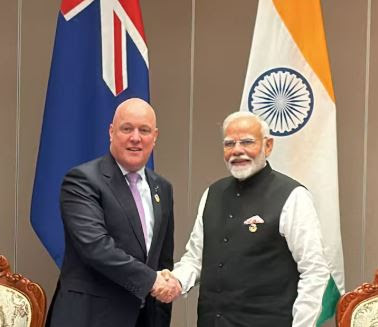
Showing posts with label Christopher Luxon. Show all posts

Wednesday, 3 September 2025

Recognising Palestine.

The Road Not Taken: Palestine’s half-completed parliament is still there, a dark and cavernous testimonial to diplomatic and moral failure. The building’s grey concrete walls are stained, as if by the tears of all those on both sides of the conflict who were forced to abandon their dream of a peaceful two-state future.

CHRISTOPHER LUXON has announced that by late-September 2025 New Zealand might be ready to recognise Palestinian statehood. This curiously equivocal statement contrasts sharply with Australian Prime Minister Anthony Albanese’s firm commitment to recognise that unfortunate entity. Australia’s pledge matches those already given by France, the United Kingdom, and Canada. Of New Zealand’s ‘Five Eyes” partners, only the United States stands unequivocally behind Israel. Benjamin Netanyahu’s list of reliable allies grows thin.

But, does New Zealand’s reticence merit the criticisms levelled at it by supporters of the Palestinian cause? When the Australian Foreign Minister, Penny Wong, can tell journalists that Australia is moving to recognise Palestine “while there is still a Palestine to recognise”, then, surely, New Zealand awaiting the outcome of the monstrous events currently convulsing Gaza and the West Bank bears all the hallmarks of wisdom?

It might also be prudent to ascertain exactly what sort of “state” New Zealand is being called upon to recognise. If we are talking about the partitioned territory offered to the Palestinians in 1947, the boundaries of which the Palestinian authorities, such as they were at the time, emphatically rejected, then the harsh truth of the matter is that, within those boundaries, there is precious little left out of which a recognisable state of any kind could be fashioned.

As anyone who watches the news networks is only too aware, the Gaza Strip (as it was known in 1947) has been turned into a grey waste of dust and rubble. In their biblically ferocious quest for vengeance, the Israeli Defence Force has done its best (and its best is terrifying) to leave not one stone standing upon another. Indeed, not since Rome conquered Carthage has the victors’ determination to utterly destroy their enemy been so openly displayed.

The Roman historian Tacitus famously observed that “Rome makes a desert and calls it peace.” Benjamin Netanyahu goes one better. He will not even talk of peace until he has made a desert out of Gaza – and strewn it with the bones of Hamas’s fighters.

The West Bank is larger than Gaza, but only marginally more favoured. Bisected by walls, bedevilled by endless checkpoints, its people are hemmed in on every side. Israeli soldiers and their bulldozers flatten whole blocks of the West Bank’s beleaguered towns – pour encourager les autres. The flower of Palestinian youth: those whose slingshot stones have not been repaid with the explosive bullets of Israeli snipers; rot in Israeli jails. Their grandparents’ olive groves burn in the night, their livestock are driven off. Those who venture out bravely in search of their stolen goats are beaten, stabbed, shot.

Because not all the hills of the West Bank have been disfigured by the Israeli occupation. Cascading down some hillsides are the gleaming homes and lush gardens of the settler communities. As beautiful as they are illegal these settlements are peopled by fanatics every bit as bright-eyed and implacable as Hamas. When it comes to their Palestinian “neighbours”, there is only one state these settlers are looking forward to recognising – their absence.

There was a time when the “two-state solution” promoted by the United Nations seemed a viable prospect. So much so that, with generous donations from the backers of a free, democratic, and independent Palestine, its presumptive rulers commenced constructing an impressive parliamentary complex for its legislators to sit in.

Elegant of line, impressive in its austere functionality, the structure took shape in Abu Dis a neighbourhood of East Jerusalem – the designated capital of the Palestinian state. In 2003, however, construction ceased. The Second Palestinian Intifada (uprising) was in the process of suffocating the Oslo Peace Accords in tear-gas, shrapnel and blood. The Israelis responded by building their infamous “Separation Wall”.

From the river to the sea there would be only one state.

Palestine’s half-completed parliament is still there, a dark and cavernous testimonial to diplomatic and moral failure. The building’s grey concrete walls are stained, as if by the tears of all those on both sides of the conflict who were forced to abandon their dream of a peaceful two-state future.

Nations that present the recognition of Palestine as some sort of panacea, should be made to argue their case from the cold concrete platforms of that doomed and gloomy monument. Hopefully, Christopher Luxon knows better than to sit there with them.


This essay was originally published in The Otago Daily Times and The Greymouth Star of Friday, 15 August 2025.

Tuesday, 5 August 2025

Vox Populi: Ageing Boomers, Laurie & Les, Talk Politics.

“Old Baldy was booed by the Gender Gap.”

“THEY BOOED HIM.”

“Booed who?”

Hannah, the bar manager, couldn’t help overhearing the banter of her two favourite Boomers, right-wing Laurie and left-wing Les. She paused in her rounding-up of empty glasses and dirty plates to listen.

“Luxon, Laurie, the Prime Minister turned up to the netball final, and the crowd booed him. Since when did New Zealanders start booing their prime ministers at sporting fixtures?”

“Oh, come on, Les, your memory’s not that bad. Jacinda Ardern wasn’t our prime minister that long ago.”

“And if I recall rightly, Laurie, she received more abuse than any other New Zealand prime minister. But, it was only a certain sort of Kiwi who came after her. And, the hate they had for her was out of all proportion to her actual conduct as their prime minister. There was something quite deranged about Ardern’s enemies’ animosity. Looking back, I reckon she wasn’t vilified on account of who, or what, she actually was, but on account of the huge event she was conflated with – the Covid-19 Pandemic.”

“Spoken like a true Labour man, Les! But, you try running that line on those who were kept from the bedside of a dying parent. Or, the people who lost their jobs because they refused to be injected with a hastily developed RNA vaccine. Tell it to the retailers who watched their life’s work sicken and die. Tell it to the schoolkids fretting alone at home. Truthfully, Les, I think Jacinda’s ‘actual conduct’ merited quite a lot of animosity.”

“I think you’ve just proved my point, mate!”

“Touche! Les. But Ardern still isn’t the only New Zealand prime minister to have been monstered by her fellow citizens. Have you forgotten the 1984 incident when David Lange was set upon by a mob of Otago cockies? His driver and protection officers had to throw him into the back of the prime-ministerial limousine and power away before the furious farmers could tear the nation’s newly-elected leader limb-from-limb.”

“Hell’s bells, Laurie, I’d forgotten all about that! It was just after Roger Douglas had announced the abolition of all agricultural subsidies. A lot of those cockies faced economic ruin.”

“Not happy chappies, Les, that’s for sure!”

“And it reminds me of an even earlier incident – 1977, I think it was – when Rob Muldoon’s limousine was dented all to hell by the boots of a dozen or so sturdy Dunedin cops trying to hold back an angry throng of Otago students and trade unionists calling themselves ‘The July Front’. The constables had turned their backs to the crowd, linked arms, and, bracing themselves on the prime minister’s car, expedited his entry to the Dunedin Town Hall – where the National Party was holding its annual conference.”

“Let me guess, Les, you were there.”

“Might have been, Laurie. It was a long time ago. As you say, my memory’s not what it was.”

“Proves my point though, doesn’t it? Luxon’s very far from the first prime minister to be poorly received by the voting public.”

“Okay, but it also proves my point, Laurie. Ardern, Lange, Muldoon: they all came under fire from aggrieved minorities. Victims of the Covid regulations. Farmers stripped of their state support. Students and unionists venting their left-wing spleens at Rob’s Mob. But, being booed by the audience at a netball game? That’s a bit different, isn’t it? I mean, these were just ordinary Kiwis out for a night of sport. They hadn’t come to protest, they’d come to cheer. But, when they saw Old Baldy they just saw red – or, in his case, blue – and started booing. That’s got to mean something, surely?

“Could mean a lot of things, Les. It could mean the fans were just pissed-off at Luxon trying to muscle-in on a sporting fixture which, were he not the prime minister, he’d never dream of attending. Maybe they were annoyed at being used, quite cynically, as the backdrop for yet another National Party photo-op.”

“Yeah, well, when you put it like that.”

“And, I’ll offer you another explanation, Les. It was a netball final.”

“So?”

“So, who follows netball – mostly?”

“Women and girls.”

“Exactly! And who, by a scarily wide margin, favour Labour over National?”

“Women and girls!”

“Old Baldy, as you call him, was booed by the Gender Gap.”

“Go it in one, mate”, muttered Hannah.


This short story was originally published in The Otago Daily Times and The Greymouth Star of Friday, 1 August 2025.

Wednesday, 16 April 2025

What does India Want? What is New Zealand willing to give?

Give me what I want, what I really, really want:  And what India really wants from New Zealand isn’t butter or cheese, but a radical relaxation of the rules controlling Indian immigration.

WHAT DOES INDIA WANT from New Zealand? Not our dairy products, that’s for sure, it’s got plenty of those. Indeed 45 percent of the Indian population are small-scale farmers, most of them running a few head of cattle – not to eat, you understand – but to milk. If it once made no sense to send coals to Newcastle, it makes even less sense, in 2025, to send dairy products to India.

So, what does India want?

To answer that question it is important to understand where India currently stands in the process of economic maturation. In the most brutal terms, India stands in roughly the same place as Britain stood when the agricultural and industrial revolutions were generating population pressures that were fast becoming unsustainable. For a while, Britain’s industrial revolution was able to soak up most of the victims of its agricultural revolution. Those who could not, or (understandably) would not, be absorbed into the “dark satanic mills” of industrialisation, took the option of emigration.

The crucial difference between Britain’s options in the Nineteenth century and India’s options in the Twenty-First is that the Earth is carrying roughly eight times as many human-beings as it was in 1825.

Two hundred years ago there were places for Britain’s (and Europe’s) excess population to go. North America and Australasia were blessed with land – vast quantities of land – whose numerically insignificant (thanks to the arrival of European pathogens against which they had no natural immunity) indigenous peoples could not hope to defend, and the colonisers took it. Resource rich, and soon to become people rich, these territories contributed decisively to the global reach and power of the European way of doing business.

Returning to that extraordinary statistic relating to India’s primary production sector – i.e. that 45 percent of its population are small-scale farmers – what must happen if India wishes to conform to the historical rules of economic development? Simply put, those small farmers must be replaced by the sort of large-scale, and vastly more efficient, farming enterprises that characterise North American, European, and Australasian agriculture.

Will the small farmers of India go quietly into the good historical night? Unlikely.

Viewed dispassionately, the political raison d’être of Narendra Modi’s Bharatiya Janata Party (BJP) has always been to capture India’s small farmers before they were captured irretrievably by ideological forces less malleable to the needs of India’s elites. Modi’s Hindu nationalist populism has proved itself many times over, albeit at the cost of dismantling the Congress Party’s secular dream of a modern, religiously tolerant, and inclusive Indian state.

But, if India’s elites are to be congratulated for saving the world from the emergence of not one nation with a billion-plus citizens under the control of a communist party, but two, then that success has been won at the cost of seriously distorting the evolution of India’s economy.

Fewer than 20 percent of India’s labour force are employed in the nation’s secondary industries, and most of them are construction workers. As things now stand, there is simply no way India’s vast numbers of small-holders and agricultural labourers can be absorbed (as Britain’s were) in its factories. Not to put too fine a point upon it, China has already beaten India in the race to create a second “workshop of the world”.

Barring a geopolitical cataclysm, China’s victory is not about to be reversed anytime soon. [Although Donald Trump is doing his best! - C.T.]

So, where does that leave Christopher Luxon and his ambitious plans to open up India to New Zealand’s exports?

It leaves him facing a nation that must somehow earn enough from its secondary and tertiary sectors to keep its small-holders safe from the ambitions of investors determined to rationalise Indian agriculture.

This raises a number of possibilities for “New Zealand Inc”. Not the least of which is the contribution this country’s agricultural expertise could make to the voluntary consolidation of small-scale Indian farming operations into larger, more efficient, and much more profitable units. This country’s long history of successful farmer co-operatives makes it the ideal partner for a more equitable, owner-driven, transformation of India’s agricultural sector.

New Zealand could also embark on a major upscaling of it educational exports to India. This could be done in two ways: firstly, by providing New Zealand’s tertiary institutions with the resources required to make many more places available to full-fee-paying Indian students; and secondly, by inviting Indian investors to participate alongside New Zealand universities in establishing “franchise” institutions in India itself.

Tuition in English, at New Zealand’s well-established and (generally) well-respected universities, remains a powerful selling-point to middle-class Indian parents anxious to see their offspring well-credentialled in an increasingly competitive society. Most particularly when merit-based access to the upper-ranks of income-earners – via the most prestigious Indian universities – can no longer be guaranteed.

None of these options are a “sure thing”, however, while the offer that would really open doors for New Zealand Inc continues to be ruled out-of-bounds by New Zealand’s negotiators. What India really wants from New Zealand isn’t butter or cheese, but a radical relaxation of the rules controlling Indian immigration.

India isn’t seeking this concession because it is in love with New Zealand’s scenery, or its values. The Indian government is seeking similar changes from the United States, Canada, and Australia – as well as New Zealand. By increasing the Indian diaspora, it is hoped, India will follow in China’s footsteps. Trade may or may not follow a nation’s flag, but it sure as heck follows its people.

It is difficult to see the National Government being willing to court the political backlash that such a dramatic increase in Indian immigration would doubtless engender. Were Luxon to secure his promised New Zealand-India FTA by giving India what it most wants, NZ First would have all it needed to campaign against its former coalition partner with every prospect of increasing its tally of seats. Te Pati Māori would, similarly, be free to its indulge its worst xenophobic impulses without fear of losing votes. One suspects that even Labour would struggle to stay off the anti-immigrant band-wagon. Only the Greens could embrace the new policy without reservation.

That said, facilitating Indian immigration makes solid historical sense. The expectation that New Zealand could remain forever a proud redoubt of British ethnicity and culture at the bottom of the world should never have survived the demise of the British Empire. Indeed, there are those who argue strongly that it didn’t. They point to the 1986 Burke Report that quietly recommended the discarding of the de facto “White New Zealand” policy in favour of an immigration policy geared towards creating a multicultural New Zealand.

Given the fact that, in 2025, upwards of 20 percent of New Zealand residents were born somewhere else, the policy must be accounted a success.

An interesting exercise in counterfactual history is to ask what sort of country New Zealand would have grown into had the Burke Report recommended the continuation and strengthening of the White New Zealand policy. Rather than the generally welcoming and inclusive multicultural society that Aotearoa-New Zealand has grown into over the last 40 years, an alternative vision, of an embittered and isolated nation of increasingly unapologetic white supremacists, is distressingly easy to imagine.

Quite where that would have left Māori is anybody’s guess. Without Te Reo? Without the Waitangi Tribunal? With Te Tiriti once again dismissed as “a simple nullity”. Reduced to an unrelenting diet of white-bread and butter?

Faced with that dismal vision, a bowl of spicy Rogan Josh, with a side-plate of Naan Bread, doesn’t sound so bad!

This essay was originally posted on the Interest.co.nz website on Monday, 24 March 2025.

Thursday, 20 March 2025

Luxon’s Guests.

Speilmeister: Christopher Luxon’s prime-ministerial pitches notwithstanding, are institutions with billions of dollars at their disposal really going to invest them in a country so obviously in a deep funk?

HAVING WOOED THE WORLD’s investors, what, if anything, has New Zealand won? Did Christopher Luxon’s guests board their private jets fizzing with enthusiasm for a little country palpably eager to embark on a new national adventure? Or, did they depart in a more sombre mood, disappointed by New Zealanders’ lack of spirit? Will institutions with billions of dollars at their disposal invest them in a country so obviously in a deep funk?

Or will they, like Michael Corleone in Godfather Part II, take note of more than the sales pitch of the gangster asking him to invest in the Mob’s Cuban casinos in 1959?

MICHAEL CORLEONE: I saw a strange thing today. Some rebels were being arrested. One of them pulled the pin on a grenade. He took himself and the captain of the command with him. Now, soldiers are paid to fight; the rebels aren’t.
HYMAN ROTH: What does that tell you?
MICHAEL CORLEONE: They could win.

It’s a safe bet that the real global investment community pays at least as much attention to what’s happening inside the countries asking for their money as the fictional Michael Corleone. After all, they pay a great deal of money to secure the most accurate and up-to-date information about their hosts. Not just the raw economic data, but information concerning the general disposition of the nation. Not only about the mood of the men and women seated around the boardroom table, but also about the mood of the men and women thronging the streets below.

Interviewed on Radio New Zealand, Tainui strongman, Tukoroirangi Morgan, boasted that he had told the global investors not to waste their time talking to the Crown, but to approach directly the iwi engaged in growing the Māori economy.

Though he gave it his best shot, Christopher Luxon’s pitch to the assembled global investors is unlikely to have resonated as loudly as Morgan’s. New Zealand’s prime minister, as they would have been well aware, leads a state whose outgoings far exceed its incomings, and a beleaguered government desperate for economic growth. All the corporate jargon in the world cannot disguise the brute fact of Luxon’s political need.

By contrast, Morgan and the many other iwi leaders presiding over the burgeoning Māori economy, would likely have struck Luxon’s guests as loud, proud, and hungry for the capital needed to keep their tribal enterprises growing. Māori businesspeople are not begging to be bailed out, they are asking to be built up. Because, as they were no doubt quick to remind these trillion-dollar tauiwi, the only place tangata whenua can succeed is right here. They have to win.

Were Luxon’s guests able to travel back in time 150 years they would have encountered Pakeha with almost as much skin in the burgeoning enterprise of “New Zealand” as the Māori of today.

These were immigrants who had travelled 16,000 miles, leaving behind everyone and everything they had known, and betting all they had on their ability to wrest a future from these distant islands. And what would have impressed today’s big investors – just as it did the big, mostly British, investors of the Nineteenth century – was how much these settlers were willing to wager on the proposition that New Zealand had a future, and how confident they were of winning the bet.

That confidence was crucial to securing the capital investment necessary to make a nation. Fortunately for the colonisers of New Zealand, the Nineteenth Century was awash with confidence.

In his book “Replenishing the Earth: The Settler Revolution and the Rise of the Anglo-World, 1783-1939” (Oxford, 2009) the New Zealand historian James Belich examines the extraordinary racial confidence that fuelled and underpinned the breakneck economic development, demographic conquest, and cultural domination of North America and Australasia:

“Though somewhat unmilitary, they were dangerous people, especially when in full-frothing boom frenzy. When they had the help of their trusty oldlands, as well as massive boom time numbers and the fanatical ideology of the colonising crusade, hardly anything could stop them. They destroyed, crippled, swamped, or marginalised most of the numerous societies they encountered. They also built new societies faster than anyone had ever done before.”

Certainly, it is hard to argue with that final sentence. In the century that followed the signing of the Treaty of Waitangi in 1840, the Pakeha population of New Zealand exploded from around 2,000 to nearly 2,000,000. The four main centres grew from a few hastily erected wooden structures to substantial cities of stone and brick. Railways and roads linked rural villages and provincial towns to the major ports. Industries grew and flourished.

The cultures and politics of Belich’s “Anglo-World” were shaped by what he identifies as the boom-bust-recolonisation phases that first created and then consolidated it.

In this regard, the history of New Zealand conforms very neatly to Belich’s template. First came the great investor-fuelled rush for land and resources; drawing in tens-of-thousands of immigrants and driving off the Māori tribes. This initial speculative and extractive economic boom was succeeded by a period of contraction and retrenchment – the “bust” – which was followed by a second, much less anarchic, surge of immigration and investment – both prompted by the nation-defining technological innovation of refrigeration.

The question to be decided by Luxon’s guests is whether or not Belich’s three phases are still driving the economic and social history of New Zealand, and, if they are, which phase is the country going through in 2025 – boom, bust, or recolonisation?

It is difficult to sustain the argument that New Zealand is in the middle of a boom. In terms of metrics and mood the nation would appear to be situated squarely in the middle of a bust. Equally difficult to sustain is the argument that New Zealand is now, or ever likely to be again, driven by the “fanatical ideology of the colonising crusade” which underpinned its first 100 years. Booms seldom follow the mass emigration of the dominant culture’s best and brightest. Nor are the chances high that Mother England, or even Uncle Sam, will come to the rescue of the Anglo-World’s most remote outpost. Only in te Ao Māori is the cultural confidence of which booms are made on display.

What does that tell us? What should it tell the world’s big investors? Possibly, that the best returns are likely to come from backing the most daring and innovative sectors of the fast-growing Māori economy.

They could win.


This essay was originally posted on the Interest.co.nz website on Monday, 17 March 2025.

Monday, 10 March 2025

Leadership Problems.

Contenders: The next question after “Will Luxon really go?” is, of course, “Will that work?” The answer to that question lies not so much in the efficacy of Luxon’s successor as it does in the perceived strength of the Centre-Left alternative.

AT LEAST TWO prominent political commentators are alluding publicly to the imminence of a leadership spill in the National Party. Matthew Hooton and Duncan Garner have both written recently about the National Party’s growing dissatisfaction with Prime Minister Christopher Luxon’s performance. This sort of commentary would be much easier for conservatives to dismiss were it coming from the usual left-wing suspects, but neither Hooton nor Garner fall into that category. If the Centre (let alone the Right) cannot hold, then things are most certainly falling apart.

The next question after “Will Luxon really go?” is, of course, “Will that work?” The answer to that question lies not so much in the efficacy of Luxon’s successor as it does in the perceived strength of the Centre-Left alternative.

Chris Hipkins is pulling out all the stops to convince New Zealanders that Labour can indeed assemble a more effective and efficient coalition government than the fractious assemblage currently running the country. He used the occasion of his (rather belated) State of the Nation address to the Auckland Chamber of Commerce on Friday (7/3/25) to reassure the business community that his party is committed to comporting itself in a thoroughly non-threatening fashion.

As proof of these moderate intentions, Hipkins later announced a reshuffled, ‘all the talents’, shadow-cabinet – presumably committed to rolling out equally non-threatening policies. It is many years since horses crowded the nation’s streets, but even if they were still there, we may be certain that Labour has nothing planned that would frighten them even a little.

Does that mean that Labour has abandoned all thought of raising taxes, or, even worse, imposing that perennial horse-frightener – a Capital Gains Tax (CGT)? Not at all. It simply means that, in marked contrast to earlier Labour leaders, Hipkins intends to make the case for Labour’s revenue-enhancing policies well before the formal campaign launches in September/October 2026.

In this regard, Labour will be able to draw on the widespread global support for CGTs. New Zealand remains an outlier among the members of the OECD for the disinclination of its political leadership – Left as well as Right – to introduce a comprehensive tax on capital gains. Beset by the same demographic pressures as the rest of the developed world, the New Zealand state remains unusually reliant on income and sales taxes to pay for its core services. As the cost of these services, health in particular, continues to grow, the ability of the state to pay for them, without increasing its revenue, must be called into question.

Finance Minister Nicola Willis’s willingness to meet her government’s core obligations by incurring more and more debt will, as her Treasury advisers were quick to point out, very rapidly become economically unsustainable. But diluting those obligations, by reducing or privatising core public services will, even more rapidly, become politically unsustainable.

The present government’s economic and political difficulties are attributable almost entirely to its unfathomable decision to slash billions off the state’s income by cutting taxes when virtually every part of the state apparatus was crying out for more, and just about every responsible economist was arguing against it. Attempting to resolve the inevitable (and self-imposed) fiscal crisis by cutting state expenditure, has only compounded the Coalition’s difficulties.

On its face the Coalition’s behaviour seems self-defeating, which is why left-leaning commentator Rob Campbell’s latest contribution to The Post is so intriguing. In brief, Campbell sees a great deal more method than madness in the Coalition’s behaviour.

Stripping away its pious posturings and well-worn excuses, the former trade union leader reveals what he considers to be five key shifts at the heart of the Coalition’s policies:

  • From public to private investment and delivery.
  • From an emergent bi-cultural, back to a colonial nation.
  • From universal to user charges.
  • From regulated to market-use of resources.
  • From limits on, to incentives for, private investment returns.

The temptation for Hipkins and his colleagues to pledge themselves to rolling-back the Coalition’s right-wing policy transitions will be strong. If they succumb, it would require an incoming centre-left government to reprioritise:

  • Public provision over private enterprise.
  • Tino rangatiratanga over colonial institutions.
  • Universal provision over user pays.
  • Rational regulation over laissez-faire.
  • The public good over private interest.

This isn’t quite the pitch Hipkins made to the Auckland Chamber of Commerce. His purpose there was to play up the continuities embedded in National and Labour policy – especially with regard to the restoration of New Zealand’s decrepit infrastructure. Picking up on the growing disquiet at the Coalition’s apparent obsession with tearing down everything Labour had built, Hipkins was also careful to reassure his audience that while Labour might amend the policies of its predecessor, it does not share its affinity for the wrecking-ball.

The name for this approach is the “small-target strategy”. The idea being that the less one’s opponents have to aim at, the less they can hit. Sir Keir Starmer’s emphatic 2024 victory over the British Conservatives represented a huge vindication of the strategy, which might also be described as relying upon your opponent’s failures, rather than your own party’s policies, to carry you into office. Or, as Napoleon expressed the same idea: “Never interrupt your enemy when he’s making a mistake.” Bold and detailed policies are a dangerous distraction.

In the context of MMP, however, one’s own party’s commendable policy discipline can easily be compromised by the wild policy incontinence of one’s putative coalition partners. A strong and measured argument in favour of introducing a CGT on the part of Labour could all-too-easily be undermined by the Greens trumpeting a swingeing Wealth Tax on the non-tax-paying rich. And even that degree of fiscal radicalism might be overwhelmed by Te Pāti Māori demanding that full compensation for the crimes of colonisation be paid to tangata whenua.

Small wonder, then, that Hipkins is asking all those New Zealanders anxious to be rid of the National-Act-NZ First Coalition to play it safe by making sure that Labour receives by far the largest share of the anti-government Party Vote. Keeping the parliamentary representation of Labour’s potential coalition partners as small as possible will also limit dramatically their ability to demand excessive and/or outlandish policy concessions.

A Green Party heading into the election with 15 percent of the vote is much more likely to make trouble for Labour than a Green Party hovering just above the 5 percent threshold. A Te Pāti Māori facing stiff competition from Labour in all the Māori seats, and registering insufficient voter support to crest the MMP threshold, will find it harder to justify the angry performative politics at which it excels.

The chances of Labour winning back all those voters who deserted it for the Right in 2023 would, of course, be seriously enhanced if Hipkins felt confident enough in his position to execute what might be called a “Newsom Turn”.

Gavin Newsom, the Democratic Governor of California, last week turned his face against his party’s uncompromising support for transgenderism. By coming out against biological males participating in sports formerly restricted to biological females, Newsom signalled that he would run for President in 2028 on a “non-woke” policy platform. His decision is the strongest signal yet that the Democratic National Committee’s hold on the party’s ideological direction is faltering.

A similar signal from Hipkins, indicating that Labour’s infatuation with Identity Politics was also waning, would hasten the return of the tens-of-thousands of supporters alienated by Labour’s 2020-23 policies. The true test of Hipkins’ leadership, however, would be whether or not he could prevent tens-of-thousands of outraged “progressives” responding to his “Newsom Turn” by deserting Labour for the Greens and Te Pāti Māori.

Clearly, Christopher Luxon is not the only politician with leadership problems.


This essay was originally posted on the Interest.co.nz website on Monday, 10 March 2025.

Thursday, 30 January 2025

Going For Growth?

Mr Mojo Rising: Economic growth is possible, Christopher Luxon reassures us, but only under a government that is willing to get out of the way and let those with drive and ambition get on with it.

ABOUT TWELVE KILOMETRES from the farm on the North Otago coast where I grew up stands the Brydone Monument. Constructed atop Sebastopol Hill, the Oamaru stone monument memorialises Thomas Brydone’s pioneering role in exploiting one of the great industrial innovations of the Nineteenth Century – refrigeration.

It was the consignment of sheep and lamb carcasses from the Totara Estate’s slaughterhouse, and loaded into the SS Dunedin’s refrigerated hold at Port Chalmers, that departed Otago Harbour on 15 February 1882. Ninety-eight days later, those same, frozen carcasses were unloaded in England. In today’s money, that single Totara consignment returned Brydone’s employer, the Australian and New Zealand Land Company, a profit of $200,000.

In the absence of an innovative breakthrough as transformative as refrigeration, Christopher Luxon’s energetic promotion of economic growth rings a little hollow.

In the century that followed Brydone’s original 1882 shipment, this country’s economy expanded enormously. Refrigeration not only rendered the raising of sheep and cattle for slaughter profitable, it more-or-less created New Zealand’s dairy industry. In historian James Belich’s memorable metaphor, it created a 16,000 kilometre-long protein conveyor-belt from the farm gates of New Zealand to the ports – and, ultimately, the tables – of Great Britain.

Refrigeration not only made billions for the largely British concerns that oversaw New Zealand’s economic evolution in the Nineteenth and Twentieth Centuries (fair enough, it was their capital that made it possible) but also formed the material foundation upon which New Zealand’s colonial society and culture was built. Our national character, forged on the owner-operated family farms that refrigeration made economically viable, would have been very different without it.

Is there an equivalent industrial innovation which today presents itself to those with capital to invest as ideally suited to New Zealand?

The disruptive innovation that immediately springs to mind is Artificial Intelligence. In New Zealand, however, the potential of AI would appear to lie in the human labour it replaces. In sharp contrast to refrigeration, AI looks set to get rid of jobs – not create them. Compared to New Zealand’s flesh and blood economy, an economy evolving out of AI would be a much more ethereal affair. Certainly, it is difficult to envisage the AI equivalent of a freezing-works.

Still, the world in which AI promises to play an increasingly vital part may see in New Zealand a secure, faraway location, plentifully supplied with the cheap, climate-friendly, and renewable energy supply needed to power the colossal computing resources AI demands. From farming sheep and cattle, could New Zealand become an energy farm for the tech lords of the Northern Hemisphere?

Luxon’s forward vision fell short of confronting that possibility. Instead, the Prime Minister homed-in on two economic sectors: tourism and education. Sadly, his goals for both would appear to embrace nothing more than the restoration of the economic status quo ante.

His ambition for the tourism sector is “more”. More bums on the seats of tour busses; more budget accommodation; more huge crowds at New Zealand’s premiere attractions; more pressure on an already inadequate infrastructure. His Labour predecessors wanted fewer, but richer, tourists. Unsurprisingly, perhaps, Luxon, the former CEO of Air NZ, is looking for an increase in tourist numbers.

“Mexicans with cell-phones” was how American producers described the Kiwis who staffed New Zealand’s film industry in the 1990s. How will investors describe the workers in Luxon’s low-wage, low-skill, tourism sector of the 2020s? “Filipinos with cash-registers.”

More bums on the seats of the nation’s lecture theatres is also what Luxon is looking for in the education sector. Full-fee-paying overseas students, the golden geese of the pre-Covid era, returning to these shores in ever-increasing numbers: that is what former health minister, now universities minister, Dr Shane Reti, is being asked to deliver. Such is the fate of this unusually intelligent and thoughtful politician: to be asked to do things that are not only impossible, but stupid.

Insufficient funding, compensated for by the financial contributions of overseas students, is steadily wrecking New Zealand’s universities.

Charging students for their tertiary education may have been justifiable when universities were basically finishing-schools for the ruling classes. In modern, highly-complex, societies and economies, however, user-pays is deeply subversive of the crucial role higher education is expected to play in refreshing and reinvigorating the nation.

Supplying credentials in return for a hefty sum of money transforms students into customers. Unfortunately, when it comes to the arts and sciences, the customers are not always right. Pretending they are undermines the entire meaning and purpose of a university.

As is the case with tourism, the tertiary education sector would benefit from fewer but better students. When tertiary education is state-funded the whole of society becomes the universities’ customer, and the quality of the knowledge and skills imparted, rather than the quantity of degrees awarded, becomes the sector’s primary goal. Graduates are thus reassured that not only do their qualifications possess genuine academic value, but so, too, do they. Indeed, “the best and the brightest” will be viewed by their fellow citizens as crucial to the social and economic development of their country.

But, this is not the state of mind in which the nation finds itself. New Zealand has spent the last 40 years telling its citizens that, barring the handful of social services its political class has – so far – been unwilling to dismantle (although David Seymour and Act are up for it) they are on their own.

If you purchased your tertiary education, and are still paying off the necessary loans, then the resulting qualification is yours, and yours alone. If somebody overseas is willing to pay you more for it than a New Zealand employer, then you are perfectly entitled to take up their offer. What is New Zealand, after all, but a name on the cover of a passport?

There is nothing in Luxon’s 2025 State of the Nation address suggesting than he regards this rugged and morally unimpeded individualism as a cause for government concern. On the contrary, it is precisely the “mojo” made manifest in such clear-eyed selfishness that he is so eager for New Zealanders to recover and display. Economic growth is possible, he reassures us, but only under a government that is willing to get out of the way and let those with the drive and ambition needed to succeed get on with it.

Luxon would have loved Thomas Brydone’s mojo. By all accounts he was a burly, bruising, bully of a man who got things done and wasn’t too particular about how. The men who worked in the Totara slaughterhouse fought heat, filth, stench, flies, and exhaustion to get those carcasses to Port Chalmers on time. Their efforts may not have been deemed worthy of a monument, and the quantum of their “profit” went unrecorded, but they, too, had mojo. Except the mojo of Nineteenth Century New Zealanders was very different from the Twenty-First Century mojo that Luxon prizes.

The extraordinary expansion of Europeans across the globe in the Nineteenth Century reflected something much more profound than mere demographic pressure. It was driven by a desire to create a new home for themselves and their descendants. A home very like the home they had left, but stripped of the evils that were driving them from it. These new homes – in Canada, the United States, Australia and New Zealand – may have been built with the capital of the elites they were fleeing (and upon the bones of indigenous peoples) but they were constructed differently, and in the name of objectives that were not exclusively commercial.

To have mojo in 1882 a New Zealander had to be a strong individual, but not an individualist. The great attraction of refrigeration wasn’t just its immediate profitability, but the vista it opened up of a national home that was prosperous, and growing constantly in confidence and ambition. A nation that would be better tomorrow than it was today. To have mojo in 1882 you had to be driven by dreams a lot bigger than yourself.

When I was a boy, a stand of tall trees surrounded the elegant homestead of the Totara Estate. John Macpherson, who acquired the property in 1906, and farmed it until his retirement in 1920, would never have seen them attain their full height and splendour. He planted them anyway.


This essay was originally posted on the Interest.co.nz website on Monday, 27 January 2025.

Wednesday, 30 October 2024

Out Of Sympathy.

Unsympathetic Characters: Christopher Luxon should be grateful that his principal opponent, Chris Hipkins, is as out of sympathy with the temper of the times as he is.

CHRIS HIPKINS had both a good week and a bad week. He and his team were able to press home Labour’s attack on the self-destructive behaviour of the Minister for Small Business and Manufacturing, Andrew Bayly. Winston Peters’ mid-week counterattack, however, immediately placed Labour on the defensive.

Hipkins was forced to endure the embarrassment of having to walk-back his description of the public servant at the heart of Peters’ conflict-of-interest claims as a “distant relative” of Ayesha Verrall, Labour’s health spokesperson. As Peters gleefully pointed out, the individual in question was, in fact, Verrall’s sister-in-law.

So, not that distant.

The attack on Bayly, while successful, risked the accusation that Labour was shooting an already wounded fish in a barrel. The walk-back forced upon Hipkins by Peters, by contrast, made the Leader of the Opposition look just a little bit shifty, and a lot foolish.

Even worse, Peters had floated a story calculated to shift the public’s attention away from the controversial actions of NZ First’s Associate Health Minister, Casey Costello, towards the equally controversial possibility that ideologically-driven public servants might be deliberately sabotaging the ministers they are employed to serve.

Peters is entirely justified in querying the failure of the Ministry of Health to alert Costello to the potential conflict-of-interest which Verrall’s sister-in-law had promptly, properly and professionally identified to her employer prior to working alongside the Associate Health Minister.

The Ministry’s failure to adequately brief Costello has placed their employee in an extremely uncomfortable position. Verrall has led the charge in Parliament against Costello’s actions in relation to New Zealand’s long-standing, and hitherto bi-partisan, effort to reduce the population’s consumption of tobacco products. Verrall’s attacks were amplified by the impact of a number of dramatic information leaks. The potential, now, for members of the public, alarmed by Peters’ revelations, to put two and two together, and make five, is considerable.

Peters’ intuitive feel for the sort of story most likely to gel with the mindset of the Coalition’s conservative supporters can only be admired. Justified, or not, there is a widespread conviction on the Right that the Coalition Government’s electoral mandate is not respected by institutions whose acceptance of the majority’s right to govern is essential to the proper functioning of a representative democracy.

The impression left with right-wing New Zealanders, from the way these institutions have conducted themselves since October 2023, is that the victory of the three parties making up the Coalition Government represents a deeply problematic triumph of ideas, attitudes, and policies inimical to the optimal development of Aotearoa-New Zealand.

Public servants, judges, academics, journalists and the liberal clergy are all, rightly or wrongly, perceived to be working against the Government, and doing everything within their power to impede the roll-out of policies deemed morally unjustifiable and evidentially unsustainable. The degree to which conservative voters are invested in these policies is a pretty reliable indicator of the animosity directed at those believed responsible for delaying – or even halting – their implementation.

Such political frustration is far from novel. What is new, however, is the general apprehension of those who identify as right-wing, that “the system” is ideologically rigged against them. Those subscribing to this notion are convinced that across-the-board resistance to conservative policies is not only prevalent in the upper echelons of New Zealand society, but that it also enjoys the unofficial blessing of an unhealthily large number of the nation’s unelected leaders.

As evidence of this phenomenon many of them would point to the Waitangi Tribunal’s apparent refusal to accept that the Coalition Government has a clear electoral mandate to implement policies which, in the Tribunal’s view, run counter to its understanding of te Tiriti and its constitutional significance. That the Tribunal’s judgements are typically met with the enthusiastic support of academia and the news media only confirms the Right’s belief that New Zealand’s state and social infrastructure has been tilted decisively to the left.

The surprising appointment of Richard Prebble to the Tribunal will serve as an important test as to whether that quasi-judicial body is open to being tilted to the right.

Prebble’s comeback notwithstanding, conservative New Zealand’s confusion is entirely understandable. The left-wing biases they detect in today’s institutions are the exact opposite of the biases evident across the same institutions in times past.

Historically, it was the Left who looked with dark suspicion on all the key institutions of capitalist society. Citing The Communist Manifesto, Marxists reminded their comrades that: “The executive of the modern state is nothing but a committee for managing the common affairs of the whole bourgeoisie.” No genuine left-wing government, they averred, would ever be permitted to implement an authentic socialist programme.

“Don’t believe us? Just look at what happened to Salvador Allende, Harold Wilson, Norman Kirk, and Gough Whitlam in the 1970s.”

Deep down, one suspects, conservative New Zealanders are struggling to resist the terrifying conclusion that, somehow, Capitalists have convinced themselves that, far from sending their system broke, going woke is actually more likely to strengthen its hegemonic grip on the sensibilities of the post-modern West.

Perhaps it is this deep fear that explains Andrew Bayly’s self-destructive behaviour. There was a time when the servants of power found it advantageous to advertise the superior status of their masters by demonstrating the inferior status of their servants – commonly referred to “sucking up by kicking down”. Bayly’s background as an army officer, and as the paid protector of other people’s capital, would certainly have exposed him to this sort of behaviour. Unfortunately for him, however, the social strategies of the past are no longer the social strategies of the present. Drawing attention to the oppressor/oppressed dichotomy is no longer appreciated by today’s businesspeople – small or large.

Which is why Chris Hipkins’ decision to highlight Prime Minister Christopher Luxon’s unwillingness to remove Bayly’s ministerial warrant was such a shrewd one. It provided the voters and, more importantly, the business community, with a vivid illustration of just how all-over-the-place Luxon’s understanding of twenty-first century politics truly is.

Andrew Bayly isn’t a bad man, but he shows every sign of being an outdated one. No politician wishing to succeed in 2024 would contemplate interacting with a fellow citizen so crassly, or so cruelly – not even in jest.

Were Luxon committed to reaffirming and reinstating all the old conservative values – i.e. a right-wing populist – then his handling of Bayly would make perfect sense. There is nothing, however, that suggests Luxon has any sympathy with the populist impulses of NZ First – or Act. On the contrary, he tries to present himself as the quintessential twenty-first century businessperson – an ambition radically at odds with the anti-woke expectations of a significant percentage of the Coalition Government’s electoral base.

Luxon should be grateful, then, that when it comes to not “getting” the frustration and resentment of conservative New Zealand – a designation which includes a large number of former Labour, as well as National, voters – his principal opponent, Chris Hipkins, is as out of sympathy with the temper of the times as he is.


This essay was originally posted on the Interest.co.nz website on Monday, 28 October 2024.

Thursday, 10 October 2024

Gut Feelings.

Vox Populi: It is worth noting that if Auckland’s public health services were forced to undergo cutbacks of the same severity as Dunedin’s, and if the city’s Mayor and its daily newspaper were able to call the same percentage of its citizens onto the streets, then the ensuing demonstrations would number in excess of 400,000 protesters. No New Zealand government has ever survived such levels of public distress and anger.

IF YOU BELIEVE Talbot Mills “internal polling” for the Labour Party, the probability of a one-term National Government is rising. Made available to Sunday Star-Times journalist Henry Cooke, the Talbot Mills data reportedly shows the “Left Bloc” positioned just two percentage points behind the “Right Bloc”.

To which supporters of the National-Act-NZ First coalition government will doubtless (and quite justifiably) respond with a curt “Yeah, right.” Poll data should not be taken seriously before all of it is released – not just the numbers guaranteed to grab a headline.

Even so, it is telling that this carefully staged release of information was permitted to form the basis of a news story. When it comes to assessing the mood of the electorate, most political journalists place considerable store upon what their “gut” is telling them. That a seasoned journalist was prepared to run with Labour’s self-serving, but strictly limited, release of confidential polling-data suggests strongly there’s a “feeling” that the coalition is in trouble, and it’s spreading. Now would not be a good time to dismiss the whispers of journalistic intuition out-of-hand.

The outpouring of anger in Dunedin, where 35,000 citizens, a number approximating a quarter of the city’s entire population, marched down George Street on Saturday afternoon (28/9/24) will do nothing to still this journalistic apprehension of impending electoral doom.

It is doubtful that Dunedin has ever witnessed a protest march so large. In the absence of a government reversal, such public fury must surely portend a serious drop in National’s Party Vote. Not just in Dunedin (which has always been a staunchly Labour city) but in electorates all the way from Waitaki to Invercargill. Two whole provinces rely upon the services of Dunedin Hospital. If National refuses to bend on this issue, then Otago and Southland voters may feel compelled to break it.

Even more sobering, is the news that the Coalition’s retrenchment in Dunedin may only be the beginning of a savage government cost-cutting programme. According to the Deputy-Secretary of the Treasury, Dominick Stephens, reining-in the Government’s projected deficit is likely to require cuts on a scale “unprecedented in recent history”. In response to Stephen’s comments, Richard Harman, the editor of the Politik website, is predicting that Finance Minister Nicola Willis will soon be tasked with pulling together a second “Mother of All Budgets”.

Harman’s reference to the then National Party finance minister, Ruth Richardson’s, devastating first budget, delivered on 30 July 1991, is telling. Because, the electoral consequences of the Jim Bolger-led National Government’s austerity measures were dire.

The year before the Mother of All Budgets, National had crushed its incumbent Labour rival by a popular vote margin of 13 percentage points. Two years later, in 1993, National’s vote would crash from 48.7 percent to just 35.05 percent.

Between them, the parties openly opposing National in 1993: Labour, the Alliance, NZ First; secured 61.28 percent of the popular vote. Only because the opposition vote was split three ways was National able to secure a second term. Bolger, himself, avoided going down in history as the leader of National’s first one-term government largely on account of the distortions of New Zealand’s First-Past-the-Post electoral system. Interestingly, 1993 was also the year that FPP fell to MMP. The new, proportional, system of representation emerged triumphant from the referendum held concurrently with the General Election.

If the Treasury’s Deputy-Secretary is right, and the ever-widening government deficit inspires two years of agonising cost-cutting, then the present recession-like conditions can only worsen. More businesses will shut their doors, unemployment will rise, consumer-spending will shrink, and the tax-take will fall – necessitating even harsher cuts in government spending. By that point, the fate of Dunedin Hospital will have been repeated many times over.

It is worth noting that if Auckland’s public health services were forced to undergo cutbacks of the same severity as Dunedin’s, and if the city’s Mayor and its daily newspaper were able to call the same percentage of its citizens onto the streets, then the ensuing demonstrations would number in excess of 400,000 protesters. No New Zealand government has ever survived such levels of public distress and anger.

In such circumstances it would be most unwise to present the voters of 2026 with a referendum offering them the option of extending the term of a New Zealand Parliament from three years to four. The great Kiwi maxim regarding the parliamentary term – already confirmed emphatically in two previous referenda, one in 1967, the other in 1990 – states that “Three years is too short for a good government, but too long for a bad one.” And a National-led government seen to be imposing measures more extreme that Ruth Richardson’s Mother of All Budgets would likely be branded a very bad government indeed.

New Zealand history buffs might even be called upon to remind their fellow citizens of the infamous “stolen year”. Had New Zealand’s usual three-year election cycle been in operation in 1934, then November of that year would have featured a general election. That it did not was on account of the conservative coalition government of the day being unwilling to put its handling of the Great Depression to the electoral test. Indeed, after the nationwide riots that convulsed New Zealand’s major cities in 1932, the country’s farmers’-and-businessmen’s government was in mortal fear of what the scheduled election might produce.

Accordingly, the Government first equipped itself with the Public Safety Conservation Act, which empowered the Governor-General, upon the advice of the Cabinet, to declare a State of Emergency under which the government might be given extraordinary powers to keep the populace under control. Just how extensive those powers could be was revealed in 1951, when the National Party’s first Prime Minister, Sid Holland, made use of the Act to crush the Watersiders’ Union. The conservative Coalition Government’s second step was to use its parliamentary majority to extend its own life by a year.

It was not a popular decision. As New Zealand historian, Tony Simpson, notes in his book The Sugarbag Years:

When the election loomed up in 1934, the government postponed it for a year, hoping that things would be better by 1935. If anything, the ‘stolen year’, as it was called, made matters worse for them. People resented it, and the Labour promises of widespread social change made an irresistible appeal to the electorate. The stage was set, the fuse was lit, and on that fateful night in 1935, it all went off with a bang that was heard around the world.

Economic recession, made more intense and socially destructive by a cost-cutting government, cannot help giving rise to the notion that the government in question’s lease on life may not be a long one. When the burden of that cost-cutting is widely perceived to be unfair, and public anger intensifies, it is hardly surprising that political journalists begin feeling in their gut all those familiar twinges that presage the defeat of the cost-cutters and the victory of the street-marchers.

Perhaps Christopher Luxon should put aside his biographies of businessmen, and pick up Tony Simpson’s The Sugarbag Years. Who knows, he just might experience a few intuitions of his own?


This essay was originally posted on the Interest.co.nz website on Monday, 30 September 2024.

Friday, 27 September 2024

Is National A White Supremacist Party?

By Their Deeds Shall Ye Know Them: When the defeated Reform and United parties were persuaded to unite under the rubric of “National” in 1936, the values advanced were unashamedly imperialist and white supremacist. Eighty-eight years later, National is at pains to distance itself (coalition agreements permitting) from the most obvious forms of racism. Even so, its attachment to the substance of racial oppression remains disturbingly strong.

THE NATIONAL PARTY has, with an unmistakeable measure of pride, distanced itself from David Seymour’s “Treaty Principles Bill”. The narrative presented by the Prime Minister, Christopher Luxon, is of a party acting under the duress of MMP.

According to Luxon, his first responsibility, as the leader of the largest party represented in the House of Representatives, was to give New Zealand a stable government. To achieve that objective, he and his party had no choice but to negotiate with Act and NZ First. The resulting coalition agreements were, inevitably, a collection of compromises.

Had National won an absolute majority, Luxon argues, the Treaty Principles Bill could only ever have made it to the floor of the House as a Private Members Bill. As such, it would not have been given a First Reading, and New Zealand would have been spared months of divisive debate.

But, National did not win an absolute majority, and so Seymour got his debate. Short of calling a second election, Luxon insists, compromising with Act was his only other choice. New Zealand may rest assured, however, that the Treaty Principles Bill will not be read a second time.

It’s a good story, made all the better for being true. In possession of an absolute parliamentary majority, National, the party of Jim Bolger and Doug Graham, John Key and Chris Finlayson, wouldn’t have dreamed of assaulting te iwi Māori with a weapon as crude and obvious as Seymour’s proposed legislation.

That does not mean, however, that te iwi Māori are not being attacked by National ministers wielding weapons every bit as inimical to the interests of tangata whenua as Seymour’s bill. As a political party, National has always worked for a society based on the rigid hierarchies of class, race, and gender. Its purpose continues to be the promotion and protection of private property and private advantage. Such relationships as National has been compelled to form with Māori have invariably reflected the party’s conservative political values.

When a cabal of former army officers and erstwhile members of the quasi-fascist New Zealand Legion persuaded the defeated Reform and United parties to unite under the rubric of “National” in 1936, the values advanced were unashamedly imperialist and white supremacist. Eighty-eight years later, National is at pains to distance itself (coalition agreements permitting) from the most obvious forms of racism. Even so, its attachment to the substance of racial oppression remains disturbingly strong.

Understandably, given the white supremacist assumptions built into the conservative political movements of the British dominions (Canada, South Africa, Australia and New Zealand) National only interacted seriously with Māori when it became politically inescapable.

Labour’s close association with the morehu (remnants of the tribes, survivors) drawn to Ratana, prompted National to cultivate equally close relationships with the chiefly elements of Maoridom. Like National, these rangatira were strong believers in the principles of hierarchy and lineage. They also tended to be the richest and most powerful personalities in their communities. Patriarchal beliefs were similarly shared. For conservative Māori and Pakeha, alike, it was a man’s world.

The post-war mass migration of Māori from the rural periphery of New Zealand to its largest towns and cities presented multiple affronts to conservative Pakeha sensibilities. The sheer proximity of so many brown faces triggered deep-seated fears and prejudices – many of them traceable to the colonial violence and corrupt land acquisitions of the Nineteenth Century. These were in no way relieved by the new arrivals’ easy assimilation into the workforces, unions, and sports clubs of the Pakeha working-class. The political threat represented by this potential Māori augmentation of Labour’s urban electoral base was considerable.

Small wonder, then, that National Governments, from the 1950s to the 1970s, used their command of state-housing policy to concentrate as many Māori (and, later, Pasifika migrants) in as few electorates as possible. Under the First-Past-the-Post system it didn’t matter that Labour racked up huge majorities in a few seats. Much more dangerous was the possibility that Māori and Pasifika voters, unconcentrated, but registered on the General Roll, might tip the balance of votes in the so-called “marginal” seats where New Zealand elections, prior to MMP, were lost and won.

By the 1980s it had become a race between the socio-economic pressures bearing down on an increasingly brown – and bolshie – working-class, and the cultural/political aspirations of the small, but fast growing number of Māori middle-class professionals. These latter had as little to gain from an assertive brown working-class, inspired by the ideals of New Zealand’s idiosyncratic brand of socialism, as the economic interests represented by National. That the neoliberal policies imposed by the Fourth Labour Government were exacting an appalling toll on Māori families up and down the country, immiserating thousands, only made the choice facing Māori leaders more urgent. The political stakes had been raised to dangerous levels.

When Labour finally fell in 1990, National faced two daunting challenges. Meeting and defeating the threat of an angry brown proletariat, while diverting the energies of the burgeoning Māori middle-class into cultural politics. Disconnected from the urban Māori poor, these new leaders’ capabilities could be redirected towards resurrecting the claims of traditional iwi and hapu, and transforming them into vehicles for what the Auckland academic, Dr Elizabeth Rata, calls “neo-tribal capitalism”.

The Employment Contracts Act took care of the first challenge, while the Treaty Settlement Process more than met the second. Not only was the old Māori aristocracy given a new lease on life, but the new, settlement-funded, Māori corporations were fast creating a new one.

This elevation of Māori interests and issues was received uneasily by National’s electoral base. Where would it end? Leading Māori intellectuals spoke openly of reclaiming all the lands lost to the Pakeha. Bolger and Graham described a “fiscal envelope” containing one billion dollars! Where was National taking New Zealand? Were the conquests of the 1860s and 70s secure? Farmers and businesspeople needed to know.

It is doubtful whether the Māori cultural renaissance, or the economic compensation awarded to iwi by the Treaty Settlement Process, would have happened had the grim process of pressing down upon the Māori and Pasifika poor not unfolded alongside it. The National Government’s Finance Minister, Ruth Richardson’s 1991 “Mother of All Budgets” may have been billed as the long overdue curtailment of a welfare-state grown large enough to defeat its own purposes, but, looked at another way, it was also a brutal reimposition of economic, racial and gender hierarchies.

Just as the Victorian division of the lower orders into the “deserving” and “undeserving” poor enjoyed a state-assisted come-back in 1990s New Zealand, so, too, did the Nineteenth Century division of tangata whenua into “friendly Maoris” and “rebels”. Not that they were identified as such by late-Twentieth Century National Party politicians. In the 1990s, troublesome Māori were identified as: “gangs”, “welfare fraudsters”, “solo mothers”, and, even less subtly, the incorrigible perpetrators of domestic violence, child abuse, and illegal drug consumption. A dysfunctional collectivity referred to as the “Māori Underclass”.

As “progressive” Pakeha oohed and aahed over the Te Māori exhibition, life in New Zealand’s Māori and Pasifika communities endured all the cruelties and indignities of which a systemically racist state apparatus is capable.

White South Africans fleeing the final demise of Apartheid in the early-1990s were astounded at the ease with which Pakeha had established something very similar in New Zealand – and all without resorting to pass-laws, tear-gas, water-cannon, or live-rounds. They found “brown towns” and “white towns”, “brown schools” and “white schools”, and nobody not raised amid signs saying “Blankes” and “Nie-Blankes”, or reminded daily of the dishonoured promises of the Treaty of Waitangi, seemed capable of seeing, let alone acknowledging, New Zealand’s racially bifurcated system.

Only under the leadership of Don Brash did the National Party adopt a policy programme that attempted to meld the racially-charged socio-economic divisions with which it placated its atavistic base, with a disarmingly honest attempt to roll back the divide-and-conquer policies embodied in the Treaty Settlement Process. The neo-tribal capitalism of the Māori corporations; the positive discrimination measures that had fed the steady growth of the Māori middle-class; all of it was to go. That Brash’s “Iwi/Kiwi” campaign lifted National’s Party Vote from 20.9 percent in 2002 to 39.1 percent in 2005 indicates just how deeply embedded the question of race has always been in National’s political philosophy.

John Key’s reversion to the Bolger/Graham strategy was as swift as it was successful. His coalition government even included the Maori Party, an inspired MMP manoeuvre which provided him the political cover he needed as the immiseration of Māori and Pasifika proceeded without significant government remediation. The state houses National had built in the 1950s and 60s were either sold-off or allowed to decay. Raw sewerage ran down the walls of “brown” hospitals. Crime and drug addiction in the “brown” towns and suburbs grew steadily worse. National was, however, willing to sanction New Zealand’s adherence to the United Nations Declaration of the Rights of Indigenous Peoples.

That Luxon would have attempted to steer a similar course to Key’s is certain. Unfortunately, the “decolonisation” and “indigenisation” policies of the Sixth Labour Government were sufficiently radical to re-animate the electoral coalition that had so nearly won power in 2005 – only this time in numbers sufficient to place the racially-agitated right on the Treasury Benches.

National’s – and Pakeha New Zealand’s – problem, in 2024, is that the Māori of the urban slums, the Māori of the iwi corporations, and the Māori of the public sector commissariat, are fast approaching the critical political mass, the kotahitanga, that will make them one, unstoppable, force for change.

The Treaty Principles Bill may not be read a second time, but in the battle between Iwi and Kiwi that now seems inevitable, there is absolutely no doubt that National will be found fighting alongside the white supremacist forces it has always led.

This time, minus the mask.


This essay was originally posted on The Democracy Project substack page on Thursday, 19 September 2024.

Wednesday, 4 September 2024

A Time For Unity.

Emotional Response: Prime Minister Christopher Luxon addresses mourners at the tangi of King Tuheitia on Turangawaewae Marae on Saturday, 31 August 2024.

THE DEATH OF KING TUHEITIA could hardly have come at a worse time for Maoridom. The power of the Kingitanga to unify te iwi Māori was demonstrated powerfully at January’s national hui, where upwards of 10,000 people answered King Tuheitia’s summons to the Turangawaewae marae. But now, at this fractious historical hour, the power of the Kingitanga is passing into untested hands.

If the traditional “kingmakers” of the royalist iwi choose unwisely, then the divisions and tensions between Tangata Whenua and Tangata Tiriti may widen further. In the weeks and months that lie ahead, rash and angry words from King Tuheitia’s successor have the potential to ignite a political conflagration. In these circumstances, Māori and Pakeha have an equally pressing need for the Kotahitanga [Unity] that was the late King’s guiding star.

This need for unity was expressed with affecting sincerity at the King’s tangi by someone many New Zealanders would regard as its most unlikely champion. As the leader of the conservative coalition government responsible for sharpening the points of Māori-Pakeha difference, Christopher Luxon’s participation in the King’s funeral ceremonies could easily have been construed as perfunctory, or, even worse, provocative. That he spoke of his relationship with the King with such obvious emotion, his voice close to breaking, unquestionably impressed his Tainui hosts. That said, the thought surely crossed their minds: “What is it with this Pakeha, who weeps with us, even as his ministers assault us?”

What indeed? The most obvious answer is that Luxon, like all politicians, is a complex mixture of emotion and calculation; sincerity and subterfuge. What’s more, though reason reels from the thought, Luxon, like many politicians, can be both at the same time. Very few Pakeha New Zealanders are immune to the extraordinary, almost magical, power which Maoridom is able to summon at moments of great historical significance. It brings our emotions suddenly, and often unexpectedly, to the surface, catching us off-guard.

This blending of the spiritual with the material was a skill which, until relatively recently, was manifest in all cultures. Those over the age of 70 will recall the state funeral of the slain President, John F. Kennedy: the soldiers slow-marching with arms reversed; the riderless horse, its master’s boots facing backwards; and that unforgettable image, almost unbearably poignant, of Kennedy’s young son innocently snapping his father a filial salute as the funeral cortege passed by.

Symbols, and the powerful feelings they evoke, were much more available to Westerners sixty years ago. New Zealand, now one of the world’s most secular societies, was then an emphatically Christian nation. Pakeha religiosity was strong in the 1950s and 60s, and, come Sunday morning, most of the nation’s churches were full. Back then, the spiritual world and the material world overlaid each other and intermingled in ways that today’s secular Pakeha would struggle to accept.

But not today’s Māori. In te Ao Māori the spiritual infuses the material in ways that at once entrance and confuse Pakeha. A cynic might say that this spirituality, this affinity for the metaphysical, is Maoridom’s secret weapon, and that Christopher Luxon is as susceptible to its magic as any number of his equally entranced compatriots.

Why, then, does he not take advantage of it? Why impress Tainui and the Kingitanga with your tears, and then return to a Parliament where Act and NZ First continue to drag the National Party down the path of “pernicious polarisation?

Typically, “pernicious polarisation” is initiated by political elites that have been electorally sidelined and are willing to do almost anything to get back in the game. They deliberately stoke class, racial and/or religious divisions – often in cahoots with more extreme groups. Their hope is to extend their electoral reach by advancing under the cover of their new allies’ more inflammatory political rhetoric, and by quietly promising to introduce at least some of the extremists’ most radical policies as soon as power has been reclaimed.

Clearly, the National Party, alongside Act and NZ First, has been drawing heavily from the pernicious polarisers’ playbook. Equally clearly, it has worked: National has reclaimed the Treasury Benches and is sitting pretty as the dominant party within a conservative coalition government.

National’s problem, now, is that, having been assisted into office by its more extreme coalition partners, it is required to deliver on the promises made to get them (and keep them) onside. Since these commitments are mostly bound up with Act’s and NZ First’s determination to rein-in what both parties believe to be an over-mighty Maoridom, New Zealand’s politics risk becoming convulsed to a degree not seen since the 1981 Springbok Tour.

Such convulsions are most unlikely to spare the National Party. Its record on race-relations is a proud one, and trashing it to keep David Seymour and Winston Peters happy is not a course of action a significant number of National Party MPs and members are likely to accept with equanimity. Indeed, the louder the chorus of protest from Māori and progressive Pakeha New Zealanders grows, the more misgivings National is likely to experience.

There will be some in the party who look to National’s past and argue that civil unrest has always been the Right’s friend. Certainly, National romped back into office after the 1951 Waterfront Dispute, and Rob Muldoon’s facilitation of the 1981 Springbok Tour saw National returned (narrowly) to power. But, the past is not always prelude, sometimes it represents an end, not a beginning.

With the King’s tangi as a backdrop, Christopher Luxon could earn considerable praise from across the country if he was to announce that, as a coronation gift, he was giving the new Māori monarch his solemn promise that the National Party would not allow Act’s Treaty Principles Bill to reach the floor of Parliament.

Would David Seymour respond by breaking up the Coalition? Quite possibly. Luxon should let him. National still has plenty of money. Labour, the Greens and Te Pāti Maori are in no position to mount a credible threat to National’s re-election chances. Indeed, the parties of the Left would be hard-pressed not to cheer Luxon on!

Moreover, if National categorically ruled out entering into another coalition with Act and NZ First, and Luxon, taking inspiration from Kamala Harris’ playbook, declared it time to “turn the page” on the politics of racial division, then he and his party would likely be rewarded with a runaway electoral victory. Kiwis don’t like political confrontation at the best of times – especially not with their own friends and whanau.

Kotahitanga, in addition to being King Tuheitia’s guiding star, could very successfully double as National’s campaign slogan.


This essay was originally posted on the Interest.co.nz website on Monday, 2 September 2024.

Tuesday, 30 April 2024

Ending The Quest.

Dead Woman Walking: New Zealand’s media industry had been moving steadily towards disaster for all the years Melissa Lee had been National’s media and communications policy spokesperson, and yet, when the crisis finally broke, on her watch, she had nothing intelligent to offer. Christopher Luxon is a patient man - but he’s not that patient.

MELISSA LEE should be deprived of her ministerial warrant. Her handling – or non-handling – of the crisis engulfing the New Zealand news media has been woeful. The fate of New Zealand’s two linear television networks, a question which the Minister of Broadcasting, Communications and Digital Media could have settled long ago, remains inexcusably obscure. Given the simplicity of its answer, Lee’s failure to offer it is unacceptable. Prime Minister Christopher Luxon should sack her.

He won’t, of course, for the very simple reason that Luxon and his colleagues do not believe that Lee has done anything wrong. National and Act have a visceral aversion to state participation in cultural affairs. Were it not for the practised intervention of elite patrons of the arts, it is probable that the leaders of both parties would decree that if cultural producers cannot attract paying customers, then they should share the fate of every other business that fails to satisfy the market. Though they could never afford to admit it, National and Act would likely find much to commend in the words of the Nazi-sympathising poet and playwright, Hanns Johst, who famously admitted: “Whenever I hear the word ‘culture’, I reach for my pistol.”

Winston Peters and NZ First almost certainly do not share such extreme attitudes towards the arts. They are as much cultural, as economic nationalists, with an altogether firmer grasp on the vital relationship between a nation’s culture and its politics. It is even possible that Peters and NZ First understand the vital role played by free-to-air television networks in the fashioning and preservation of social cohesion. But for one thing, NZ First and its leader may well have been filling the policy vacuum created by Lee’s inaction.

Unfortunately, that “one thing” is the television networks’ history of unrelenting hostility towards and, at times, active sabotaging, of Peters’ political career. Winston wouldn’t piss on the NZ news media if its bum was on fire – which, of course, it is.

[In spite of all the above, but certainly on account of the political failure it describes, the Prime Minister, Christopher Luxon, finally relieved Melissa Lee of her broadcasting portfolio on Wednesday, 24 April 2024, replacing her with Paul Goldsmith - C.T.]

So, what is this “simple” answer to the television network’s problems? The resolution to the financial difficulties afflicting both TV3 and Television New Zealand requires nothing more than that this nation adopt the solution long ago arrived at by the countries with which we like to compare ourselves: Australia, the United Kingdom, Ireland and Canada.

Nominally publicly-owned TVNZ should become a genuine, non-commercial, public broadcaster like the ABC, the BBC, Raidió Teilifís Éireann (RTÉ), and the CBC. This would allow TV3 to pick up the advertising revenue currently accruing to TVNZ. There may not be enough advertising dollars in our economy to sustain two commercial television networks, but there are more than enough to sustain one. The money currently allocated to New Zealand on Air would go to fund the public broadcasters RNZ and TVNZ.

If more financial support was required, then it wouldn’t be hard to find. According to Myles Thomas of the Better Public Media Trust: “TVNZ’s annual budget is roughly $300 million. For the cost of just $5 a month per capita, New Zealand taxpayers could fully fund TVNZ so that it need no longer rely on any advertising at all”. Given that a huge number of Kiwi’s shell out in excess of $15.00 per month for streaming services such as Netflix and Neon, a broadly comparable deduction for public broadcasting shouldn’t be too big a shock to the nation’s system.

A blindingly obvious solution? Of course it is! So, why on earth didn’t Labour and the Greens, in office for six years, do the blindingly obvious thing? Knowing the answer to that question would certainly help New Zealanders understand why the parties of the Left failed so comprehensively to accomplish so many other blindingly obvious things.

One possible answer is that the sort of people who now inhabit New Zealand’s political parties are loathe to approve anything that might turn out to work brilliantly. The idea of a state-owned entity rising boldly and innovatively to the challenges of the twenty-first century makes them uneasy. Very few politicians in this country are comfortable with people and/or institutions that take the independence vouchsafed to them by the system seriously. The New Zealand state may hand out the crayons and the colouring books to its creative children, but it expects them, always, to stay inside the lines.

Māori Television, for example, was formally guaranteed full editorial independence and supplied with the money to make that promise real. The result? Its initial headquarters, in Auckland’s Newmarket, quickly became a buzzing hive of questing creativity. Its broadcasters, equally quickly, proved themselves to be among the best in New Zealand. In very short order, MTV began to show up TVNZ and TV3 for the crass, commercially-driven behemoths they had become.

What happened? What do you think happened! Māori Television’s journalists, in full accordance with its charter, began to ask questions – embarrassing questions. Not just of Pakeha politicians and bureaucrats, but of their own elites. What followed bore out the old trade union saying: “The bosses give you all the rights and privileges of free and independent citizens on only one condition – that you never use them.”

Pressured by the outraged Māori elites and their political mouthpieces, MTV’s Newmarket studios were shut down and its studios relocated to East Tamaki. The channel’s fearless journalists found it expedient to offer their talent to less “traditional” employers. Responsibility for MTV’s future was deemed to require an extremely safe pair of hands. Questing creativity no longer fizzed through its corridors.

Ask yourself. In all the fuss about Newshub closing down and TVNZ ceasing to produce “Sunday” and “Fair Go”, has there been any mention of Māori Television – sorry, “Whakaata Māori”? How many New Zealanders are even aware that it’s still broadcasting?

Now, some may say that all that bad stuff happened under National. But, in the six years they were in office did Labour do anything at all to restore Whakaata Māori’s questing creativity? Nup. Too risky. Even in its own caucus. Even in its own Māori caucus.

The contrast between the present Labour Party’s approach to public broadcasting and that of Norm Kirk’s Third Labour Government could hardly be more stark. The Broadcasting Minister of the day – a young, questing, entrepreneur of a politician called Roger Douglas – set in motion what most media historians still regard as the “golden age” of New Zealand television.

Kirk and his ministers understood what Labour politicians of the twenty-first century only fear: that giving creative and intelligent producers and journalists the freedom to make the best television they can is never going to work against the cause of developing a vibrant national culture; and that developing a vibrant national culture is never going to disadvantage the Left.

Pretty obviously, Melissa Lee, understands understood that too.


This essay was originally posted on The Democracy Project website on Thursday, 18 April 2024.