Showing posts with label Tino Rangatiratanga. Show all posts

Wednesday, 4 September 2019

A Step Too Far.

A Crown Asset? For reasons relating to its own political convenience, the Crown pretends to believe that “No one owns the water.” To say otherwise would re-vivify the promises contained in the Treaty of Waitangi – most particularly those pertaining to the power of the chiefs and their proprietary rights to the lands, forests and fisheries belonging to their iwi and hapu. 

“WHO OWNS NEW ZEALAND’S freshwater?” In resolving issues as fraught as this one it often helps to engage the imagination. Picture these islands before the arrival of human beings roughly 700 years ago. Who owned the water then? Ask the same question of the period between 1300 and 1769 when this country was occupied exclusively by Maori. Finally, ask the present inhabitants of Aotearoa-New Zealand: “Who owns the water?” To offer the same answer to all three of these questions invites ridicule. Clearly, each answer will be different.

When these islands were the exclusive preserve of the flora and non-human fauna which lived in, on, above and around them, the ownership of freshwater wasn’t an issue. Every living thing which dwelt here needed water, but none of them owned it. Ownership is a human concept. It arrived here with the Maori. That makes it very difficult to argue that Maori were not freshwater’s first owners. It is equally difficult, however, to argue that they are still its owners. Not after 250 years of European colonisation.

Even according straightforward “ownership” of freshwater to the Maori of the pre-European contact period is problematic. “Maori” is one of those collective nouns that only come into existence in response to the creation of another collective noun – in this case “Pakeha”. Before the arrival of Europeans the people who now call themselves “Maori” called themselves something else – the collective nouns iwi, hapu and whanau spoke to their tribal, clan and family identities. In 2019, we use the word “Maori” to designate a race, or, as we prefer to say nowadays, an ethnicity. But race and ethnicity are concepts that came ashore from sailing ships, not ocean-going waka.

The owners of freshwater in pre-European Aotearoa-New Zealand were, therefore, iwi and hapu. Access to freshwater was basic to their survival. Not only did springs, streams, rivers, marshes and lakes supply these groups with drinking water, but they were also important sources of food, as well as the raw materials necessary for making clothing, tools and weapons. Obviously, once secured, these water resources had to be defended. They may not have been tribal or clan “property” in the European sense, but woe betide the person or persons who attempted to convert these resources to their own use. Stealing another clan’s freshwater was an act of war.

The protection guaranteed to the chiefs’ “lands, forests and fisheries” in the Treaty of Waitangi is difficult to interpret as anything other than a recognition of tribal and clan property rights. Equally difficult, one would think, would be to separate the proprietorship of freshwater from the proprietorship of  the springs, streams, rivers, marshes and lakes in which fish tend to be found. The Waitangi Tribunal’s argument that iwi and hapu retain a proprietary interest in water is, accordingly, well-founded. Whether “Maori” own the water is, however, much less certain.

The nearer iwi and hapu came to transforming themselves into a united political and economic entity – a Maori realm or nation – the more urgently did the Pakeha colonisers petition London for the means to disrupt, defeat and disinherit Aotearoa-New Zealand’s indigenous inhabitants. They were only too aware that the moment the traditional property rights of the many tribes and the clans were codified into a specifically Maori system of land and freshwater ownership, then the whole process of colonisation would come to a shuddering halt. The idea of two distinct political and economic entities – one Maori and the other Pakeha – held in place by the promises of the Treaty was anathema to the new-born settler state.

For traditional British forms of land ownership and resource use to prevail, the Crown’s writ had to run from Cape Reinga to the Bluff. There could be only one legal system: one means of determining who owned what; one method for transferring titles of ownership; one code for protecting the freshwater that falls and runs freely upon the earth; and one means of granting persons the right to use this vital resource.

It was to establish these, the preconditions for a unitary and sovereign state, that the colonial government of Sir George Grey, in 1863, sent 12,000 imperial troops into the Waikato to destroy the nascent Maori realm that was taking shape under the Kingitanga. And when the guns finally fell silent in the 1870s, so too did the voice of the Treaty – for close to 100 years.

This, then, is the answer we must give to the question “Who owns this country’s freshwater in 2019?” It is the New Zealand State – a.k.a “The Crown”.

For reasons relating to its own political convenience, the Crown pretends to believe that “No one owns the water.” To say otherwise would re-vivify the promises contained in the Treaty – most particularly those pertaining to the power of the chiefs and their proprietary rights to the lands, forests and fisheries belonging to their iwi and hapu. Were the Crown to keep the promises of 1840, it would be forced to acknowledge the very same truth it fought a war to deny: that in Aotearoa-New Zealand sovereignty is shared between two peoples – not exercised exclusively by one.

This is precisely what the Waitangi Tribunal’s Stage 2 Report on the National Freshwater and Geothermal Resources Claims makes clear.

Unsurprisingly, the Opposition spokesperson on Crown-Maori Relations, Dr Nick Smith, has come out swinging:

“National rejects the proposals for Maori being given an ownership interest in freshwater as proposed by the Waitangi Tribunal”.

Dr Smith goes on to reiterate the position taken by his party when in government:

“National has consistently and sensibly maintained that no one owns freshwater. We urge the Government to reject the more radical recommendations in this report on water ownership. The Government is creating uncertainty and confusion by not clearly ruling out Maori having an ownership interest in freshwater.

“Water is a public resource, like air. Maori have a right to be involved in decision making on freshwater and National provided for that in changes to the Resource Management Act and Treaty Settlements. Transferring ownership or providing a veto to iwi over water is a step too far.”

Hapu and iwi leaders are hoping that Jacinda Ardern’s government will have the “balls” to heed the Waitangi Tribunal’s report’s recommendations. But that would require of Labour, NZ First and the Greens more courage than any of them have shown to date. If you can picture David Parker, Andrew Little and Winston Peters bravely contradicting the statements of Dr Smith, then you possess a much more vivid imagination than I do!

This essay was posted on The Daily Blog of Friday, 30 August 2019.

Wednesday, 24 July 2019

The Greens Used To Be So Likeable – What’s Gone Wrong?

Once Were Likeable Eco-Warriors: The Green Party's parliamentary line-up is now a very long way from Rod’s beaming optimism, Jeanette’s grandmotherly wisdom, Sue B’s and Keith’s commitment to social justice and peace, Sue K’s safe food, and Nandor’s illegally resinous dreadlocks. Today's Green Party is fast taking on the character of a political cult: filled with zealots determined to enforce their policies on what we should be permitted to drive; what we should be encouraged to eat and drink, what it is acceptable for us to think; and what we should be allowed to say.

THERE WAS A TIME when it was really quite hard to dislike the Greens. Back in the days of Rod Donald and Jeanette Fitzsimons; of Nandor Tanczos and Sue Bradford; of Sue Kedgley and, yes, even the rather dour Keith Locke. There was also that bloke who called himself the “Musterer” (instead of the “Whip”) whose name I have completely forgotten. [Ian Ewen-Street – thankyou Google!] When they first made their way up the steps of Parliament, back in 1999, I called them “The Magnificent Seven” – so perfectly did they cover all the bases of ecological politics.

If you counted yourself among the Left of New Zealand politics, and you didn’t vote for the Greens, you needed to be able to supply yourself with a very good reason why not. The Party made not voting for them a lot harder by being so damn nice. They practiced politics in the way most people agreed it should be practiced: by sticking to ideas and to the policies those ideas gave birth to; by refusing to get down in the gutter with those politicians who seemed to regard politics as an excuse for being personally vicious and cruel.

On Wednesday afternoons, during the General Debate, you waited eagerly for the Greens’ turn to speak. It always came as such a welcome relief from the personal attacks, the snide remarks, and the puerile arguments which their fellow MPs resorted to. Invariably, the Greens’ contribution would be about something real and important. There was always an argument for listeners to follow – an argument based on, and backed up by, facts. You know, evidence. It was like the sun’s rays breaking through clouds: proof that somewhere out there, beyond all the bullshit and braggadocio, there remained a world of light.

It is still possible to catch an echo of the Magnificent Seven in the 2017 intake of Green MPs. Chloe Swarbrick, in particular, would not have been out of place in that special company. Sadly, however, Swarbrick is the exception. For the most part, her Green party colleagues have lost that tremendous likeability that made it so hard for the Left to vote for anyone else.

Partly, that’s because the Left itself has changed. Always among the Greens there was a powerful libertarian current. By and large the Greens did not like the idea of the State, or big corporations, or the petty tyrants who run so many small businesses, interfering in the harmless and victimless activities of their fellow citizens.

No one appealed to the libertarian fraction of the electorate like Nandor Tanczos. With this dreadlocks, his skateboard and his green hemp suit, he became a poster-boy: not only for the legalise marijuana movement, but for that fiercely contrarian bunch of New Zealanders who, without him, has veered over the edge into anti-vax and anti-1080 fanaticism.

But, it’s not just the unfortunate way in which the vacuum created by Tanczos’ departure from political life has been filled that’s the worry. Libertarianism, itself, has largely disappeared from the ranks of the twenty-first century Left. Even worse, in the ideological space formerly occupied by libertarian leftism, New Zealand now finds its exact opposite: Left Authoritarianism.

It does not require a very long acquaintance with the Green variety of Left Authoritarianism to realise that, in 2019, the number of activities defined as harmless and victimless has become vanishingly small.

To be fair, there has always been an element of authoritarianism present in the ranks of the Greens. On a number of issues – the Treaty of Waitangi in particular – those responsible for vetting potential candidates have always exercised zero tolerance for anything other than the full-recognition, tino rangatiratanga, line. Until relatively recently, however, this “politically correct” element of the Green Party apparatus was encouraged to keep itself out of sight. Today, however, among party activists and MPs alike, it operates loudly and uncompromisingly in plain sight.

The political and electoral consequences for the Greens are likely to mirror those which overwhelmed the Left generally in the early 1980s. The 1981 Springbok Tour had radicalised a great many New Zealanders who, in its aftermath, were eager to keep pushing for social change. For many Pakeha leftists, however, the concurrent upsurge in Maori nationalism proved too confronting. The aggressive pursuit of “Maori Sovereignty”, in particular, drove many Pakeha out of the so-called “New Social Movements”, where the sovereigntists were most active.

Organisations which considered themselves progressive, such as the aid organisation Corso, may have decked themselves out in the trappings of bi-culturalism, but only at the cost of making insincerity an unwelcome requirement of membership. The upshot was an emptying-out of many of the institutions of the “White Left” – a not inconsiderable number of whom took refuge in the much friendlier ranks of the Labour Party, which, in the early 1980s, boasted a mass membership in excess of 100,000.

With the benefit of hindsight, it is clear that the Greens, founded in 1989, attracted a large number of members for whom the precepts of identity politics formed the core of their political ideology. The Greens’ consensus-based decision-making processes allowed these ideologues to operate for many years within the party without the wider electorate paying them much attention. While the Greens were led by the likes of Rod Donald and Jeanette Fitzsimons, the influence of the “id-pols” could be managed. Following Donald’s death and Fitzsimons’ departure, however, the Greens parliamentary line-up has become at once less likeable and less representative than the seven-strong caucus which marched up Parliament’s steps in 1999.

The great problem now facing the Greens is that Labour finds itself in possession of the most likeable political face New Zealanders have encountered for many decades. When set against “Jacinda”, the Greens’ James Shaw comes across as a low-energy compromiser. Meanwhile, his co-leader, Marama Davidson, strobes identity politics in a fashion calculated to make a sizeable majority of the electorate feel decidedly queasy.

Neither Shaw, nor Davidson, is likely to hold in place many voters not already completely sold on the Greens’ brand of identity politics. The party is fast taking on the character of a political cult: filled with zealots determined to enforce their policies on what we should be permitted to drive; what we should be encouraged to eat and drink, what it is acceptable for us to think; and what we should be allowed to say.

It’s a long way from Rod’s beaming optimism, Jeanette’s grandmotherly wisdom, Sue B’s and Keith’s commitment to social justice and peace, Sue K’s safe food, and Nandor’s illegally resinous dreadlocks.

I liked them.

POSTSCRIPT: This essay was written before the Greens released their attack ad criticising National's Climate Change policies - mostly by ridiculing Simon Bridges' broad Kiwi accent. That the current leadership initially okayed the release rather proves my point. That the membership loudly demanded it be taken down (which it was) proves something else. That the spirit of 99 hasn't entirely disappeared! - C.T.

This essay (minus the postscript) was originally posted on The Daily Blog of Tuesday, 23 July 2019.

Tuesday, 21 July 2015

Foreign Investors.

Foreign Investment: The Native Land Court transferred more land from Maori to Pakeha than Queen Victoria's regiments ever managed. Without land, no people may be counted free. Restricting the access of foreigners to New Zealand real estate isn't about racism - it's about the preservation of our national sovereignty.
 
IT IS THE EARLY 1860s in the Waikato. A Maori newspaper editor, and fervent supporter of the Kingitanga movement, has a great idea for a story. He summons his best journalist and explains what he has in mind.
 
“I want you to travel to all the major cities,” he says, “visit the Land Registry offices, and discover the identity of everyone who’s been purchasing land that formerly belonged to Maori.”
 
“That’s a pretty expensive exercise, Boss”, the young journalist replies, “especially when we both know what the answer will be.”
 
“You’re right,” says the editor, “but I need more than mere conjecture, more than just anecdotal evidence. What I’m looking for are cold, hard facts! Under the Treaty of Waitangi, we Maori can only sell land to the Crown. But who is the Crown selling it to? Is it being sold to New Zealanders? Or is it being purchased by foreigners with huge sums of money to invest? That’s what I want you to find out.”
 
“Hmmmm?” The journalist responds, doubtfully. “I’m not sure the Pakeha keep that sort of information.”
 
“Yes, yes, I’ve thought of that. What I want you to do is look at the surnames of the purchasers. That’ll give you are reasonably good steer. After all, somebody called McKenzie is unlikely to be of Tainui descent, is he?”
 
“No. But, there are quite a few McKenzies already here in New Zealand. How are we supposed to sort out the local sheep from the foreign goats?”
 
“I’ve thought about that, too”, says the Editor, warming to his theme. “What percentage of the total population do you think the Pakeha currently comprise – especially here in Te Ika A Maui?”
 
The young journalist scratches his head. “Surely not much short of 4 in 10? With more arriving all the time. It would be higher in Te Wai Pounamu.”
 
“Exactly so!”, says the Editor. “So, if your research shows that 8 out of 10 purchasers of former Maori lands has a surname like McKenzie, or O’Reilly, or Twyford, then doesn’t it stand to reason that overseas British investors are disproportionately involved in buying up this country from under the feet of its original inhabitants? That we Maori are fast becoming tenants in our own land?”
 
“Actually, Boss, I’m not sure it does. Couldn’t it mean that the British settlers already here are just buying up as much land as they can – as quickly as they can get their hands on it?”
 
“Oh come on!”, the Editor snorts derisively. “Most of the Pakeha disembarking at the ports don’t have a pot to piss in! Where are they going to get the money to buy land?”
 
“I’m not talking about the ones who come in steerage, Boss. I’m talking about the ones who make the voyage in private cabins. The youngest sons of good English and Scottish families who arrive here with a very healthy bank balance – courtesy of Papa back in London or Edinburgh. They’ve got plenty to spend.”
 
“Alright. But even if that’s true, the result is exactly the same – isn’t it? They apply to the Crown, and the Crown obliges them – at our expense.”
 
“But only so long as we go on selling our lands to the Crown, Boss. I mean, who else are they going to buy land from in these islands – if not from Maori? Isn’t that the whole point of the Kingitanga? To stop the sale of any more Maori land to the Crown?”
 
“Yes, of course it is! Which is why I want you to write this story for me. To give the Kingitanga the facts about what’s happening to their whenua – to their future!”
 
“The Settler Government in Auckland isn’t going to like a story that singles them out on the basis of their surnames”, the young journalist observes, ruefully. “They’re going to point to it as yet more evidence of Maori mischief-making. Yet another reason why the Governor should send troops south to destroy the Kingitanga.”
 
“No! No! Governor Grey will never make war upon the Maori people. He is a good man. He believes this country can only be improved by British capital and Maori enterprise. He also recognises the importance of Maori autonomy – he made provision for it in the Constitution Act!”
 
“He did, Boss. Yes. But the settlers seem ill-disposed to granting us that autonomy. And, I think I know why.”
 
“Tell me.”
 
“Because they want everything, Boss. Not just what Maori consent to sell them – but everything. Just think of how much we depend on them for already – and it’s only going to get worse. There’s millions of them, Boss – numbers our language has no words for. And we’re in their way.”
 
The Editor turned and gazed out over the lush Waikato countryside. There were tears in his eyes.
 
This essay was originally published in The Press of Tuesday, 21 July 2015.

Thursday, 12 February 2015

Questions Of Sovereignty: Who Has The Final Say In New Zealand? – And Should We Be Frightened Of Finding Out?

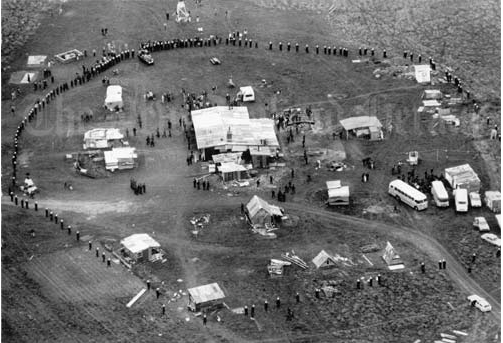
Day 506: On 25 May 1978 a massive Police operation, backed by the NZ Army, evicted 218 protesters from their occupation village on Bastion Point. This was the last time a Kiwi prime minister unequivocally answered the question: "Who has the final say in New Zealand?"
 
ONLY A FOOL would attempt to portray sovereignty as an unimportant issue. (See The NZ Herald, Editorial, 11/2/15) It takes a special sort of smugness and a huge amount of ignorance to suggest that “practical” people don’t really care who has (or should have) the final say in their country. Only someone for whom the idea of not having the final say is genuinely inconceivable would make so absurd a claim. And only someone with no real knowledge or understanding of the past could possibly believe that sovereignty is ever acquired cheaply or relinquished lightly.
 
The question of precisely where sovereignty is located in Aotearoa/New Zealand is by no means an easy one to answer. Indeed, it has been many years since anyone seriously tried. The first instinct of our politicians, bureaucrats, and even of our police officers, whenever the question of sovereignty raises its deeply problematic head, is to fudge, fudge, fudge, and, if necessary, fudge again.
 
The last time a New Zealand political leader unequivocally asserted the indivisible sovereignty of the post-colonial Settler State was Rob Muldoon. Faced with the refusal of Ngati Whatua protesters to abandon their 506-day occupation of Auckland’s Bastion Point, Prime Minister Muldoon ordered their forcible eviction.
 
This was by no means a straight-forward exercise. Hundreds of Police, supported by the NZ Army, were required to remove the 218 people who refused to vacate their ancestral land. The images broadcast to New Zealand on the evening news of 25 May 1978 were deeply disturbing to a great many of its citizens – so much so, that no similar operation was authorised until the ill-starred “Operation Eight” of 2007.
 
Certainly, when confronted with the Whanganui people’s occupation of Pakaitore (Moutoa Gardens) in 1995, the government of Jim Bolger steadfastly refused to authorise the use of force to secure their eviction. Nearly 20 years on from Bastion Point, and with many Maori openly asserting tino rangatiratanga, or Maori Sovereignty, it was by no means certain that the protesters and their supporters would “go quietly”.
 
Fortunately, for the peace of the realm, the Whanganui people were equally unwilling to answer the question: ‘Who has the final say in New Zealand?’ Instead, like their warrior ancestors, they quietly “abandoned the Pa” – slipping away into the night and leaving the gardens empty.
 
Though the ill-fated “Operation Eight” was not launched in response to a land occupation, the manner of its execution left a great many New Zealanders – Maori and Pakeha – with a bitter taste in their mouths. The television images of heavily armed Police manning road-blocks and carrying out property searches and interrogations throughout the tiny Tuhoe settlement of Ruatoki revealed just how high the sovereignty stakes had been raised since 1978.
 
Any New Zealand government intending to assert state power over Maori in the second decade of the twenty-first century must anticipate considerably more than the passive resistance of Bastion Point, and the self-restraint of Pakaitore. It must be ready to use deadly force.
 
The Herald’s editorial writer would, of course, reject all such statements as alarmist. He is quite certain that “practical” Kiwis will never let things come to such a pass. But that is only because a willingness to compromise has always been the strongest component of the Maori-Pakeha relationship. Faced with stepping forward into open and uncompromising confrontation, Maori and the Crown (some disgruntled Pakeha might say ‘especially the Crown’) have, for the most part, chosen to step back.
 
But it requires an heroic leap of faith to accept that one’s country’s rulers are going to be lucky all the time. A day may come when New Zealand is again ruled by a person with the same autocratic temperament as Rob Muldoon. When the issue in dispute is too important for compromise. When neither side feels able to step back from the brink without suffering a catastrophic loss of mana. It is on that day that the all-important question: “Who has the final say in New Zealand?” will be answered. And the only “practical matters” to be considered on that day will be: Who’s will is the stronger? and, Who has the most guns?
 
This essay was originally posted on The Daily Blog of Wednesday, 11 February 2015.

Tuesday, 25 November 2014

Nothing Wrong With John Key's History.

Done Deal: The Prime Minister's comments regarding the peaceful settlement of New Zealand have been ridiculed by his detractors, but they were considerably less controversial than the Waitangi Tribunal's assertion that Maori never ceded sovereignty to the British crown. (Image drawn from the TVNZ docudrama About Waitangi: What Really Happened?)

THE PRIME MINISTER, John Key, has been much mocked over the past week for his claim that New Zealand was settled peacefully. Hoots of derision have echoed through the Twittersphere from those who profess to know their New Zealand history a great deal better than the Prime Minister.
 
Are they right? Is Mr Key wrong?
 
It might help to place the Prime Minister’s comments in context. His remarks followed the Waitangi Tribunal finding that the tribal chieftains of the far-North did not cede sovereignty to the British Crown when they signed the Treaty of Waitangi on 6 February 1840.
 
This finding is considerably more controversial than anything the Prime Minister decided to offer by way of commentary. The Auckland-based historian, Paul Moon, has already derided the Tribunal’s historical conclusions, and his intervention is unlikely to be the last.
 
Indeed, it is extremely difficult to understand how the Waitangi Tribunal’s latest finding could be so provocatively definitive. The Tribunal’s enabling legislation allows the Crown to test the evidence presented to it by cross-examining witnesses and by introducing evidence of its own. It may also commission professional historians to assess evidence presented in support of radically revisionist interpretations of New Zealand history.
 
Did the Crown take full advantage of its interrogative powers in this case? Did it seize the opportunity to open up the vital constitutional issues under consideration to wider public scrutiny and debate? Apparently not. The strongly held beliefs of those bringing the claim were accorded a decisive credibility. The settled view of more than 150 years of historical research? Not so much.
 
A crucial element of the settled view is that the Maori chieftains who signed the Treaty, many of whom had enjoyed long and mutually beneficial relationships with the Europeans who had taken up residence in New Zealand since Cook’s exploratory voyages of the late eighteenth century, knew exactly what they were agreeing to at Waitangi on 6 February 1840.
 
Captain William Hobson was guaranteeing them the inviolability of their traditional territories and the safety of their people. In the light of what had befallen the iwi and hapu of Niu Tirani (New Zealand) between 1769 and 1840, the existential value of these guarantees is readily appreciated.
 
The indigenous population of these islands at the time of first European contact is estimated at 100,000. Between 1800 and 1830 as many as 30,000 Maori were killed and/or driven from their traditional lands by enemy iwi and hapu armed with the devastating military technology of the Pakeha. The protection of Queen Victoria (symbolising the world’s most powerful nation) was what they needed. Hobson offered it. The chiefs grabbed it with both hands.
 
So, in the sense that New Zealand was gazetted as a possession of the British Crown by virtue of a treaty of cession, rather than by outright military conquest, the Prime Minister’s assertion that “New Zealand was one of the very few countries in the world that were settled peacefully” is not only historically uncontroversial but also, in general terms, correct.
 
That correctness is bolstered when we compare the wholesale slaughter, land seizure and population displacement that accompanied the so-called “Musket Wars”, with the death-toll of the Land Wars of 1845-1872. Over the course of those three tumultuous decades roughly 2,000 Maori and 2,000 Pakeha fell victim to fatal violence. On the Maori side of the ledger, a significant proportion of those fatalities were inflicted by Maori fighting for the Crown. And, if we divide the total number of fatalities by the 28 years the conflict lasted, then the average fatality rate is 143 deaths per annum – less than the 2013 road toll.
 
Even the relatively large-scale conflict encompassing Taranaki, the Waikato and the Bay of Plenty between 1860 and 1863 was more of a civil war than a war of conquest. The Kingitanga’s brave attempt to re-define the terms of Hobson’s deal, by proposing a two crowns/one flag formula, was deemed to be unacceptable by Governor Grey; antagonistic to the fast-expanding settler interest; and a doomed attempt to wind back the clock by those Maori leaders who knew that, for better or worse, the Pakeha had come to stay.
 
In the smaller flare-ups of the late-1860s and early-1870s, it was these “Loyal Maoris” who played a crucial role in extinguishing the isolated bush-fires of iwi and hapu resistance. That the Waitangi Tribunal masks their participation by subsuming their contribution under the all-encompassing rubric of “The Crown” says it all really.
 
Accordingly, I will not be participating in the condescension and derision of the Twitter handle #johnkeyhistory.
 
Is the history of Maori-Pakeha relations entirely free of violence and injustice? Of course not. There’s blood in the foundations of every state. But, if John Key’s saying there’s a lot less in ours than most, then I, for one, agree.
 
This essay was originally published in The Press of Tuesday, 25 November 2014.

Tuesday, 11 February 2014

The Banner Of Us All

Symbol of Sovereignty: The tino rangatiratanga flag has the virtue of emerging naturally out of our recent history. It flies over the Auckland harbour bridge on Waitangi Day and has become the symbol of that part of the New Zealand nation which yearns to put the dubious legacy of British imperialism behind them.

WHAT IS A FLAG? Like so many of the things that go into the making of a state, flags have their origins in war. Large swathes of cloth bearing simple, easily recognised devices, made it possible for an army’s identity to be determined from a considerable distance. Those who marched beneath these fluttering banners were, accordingly, bound to its fortunes. While their flag flew the soldiers knew there was reason to go on fighting; when it fell, or was hauled down, they knew the battle was lost.
 
The Prime Minister, John Key, has suggested that the time is right for New Zealanders to consider changing their flag. Mr Key appears to subscribe to the widely held belief that the current design lacks distinction and fails to identify New Zealand as a unique and independent nation of the South Pacific. On 29 January he raised the possibility of holding a referendum on the issue in which the current New Zealand flag is pitted against an alternative of the Government’s choosing. Mr Key’s preferred replacement is the silver fern flag so beloved of All Black supporters.
 
The first thing to note about the Prime Minister’s suggestion is its utter disdain for any kind of public participation. Mr Key proposes to give the voters just one alternative to the status quo, its design to be decided by himself and his colleagues. End of story.
 
This is clearly an unsatisfactory (not to say undemocratic) way of handling any change to such an indispensable symbol of our national identity. Indeed, the procedure is so clearly deficient that it raises questions about the amount of thought the Prime Minister has given the subject. The most famous and successful example of the flag-changing process, Canada’s 1965 adoption of its universally admired maple leaf flag, left the final decision to a multi-party parliamentary committee.
 
In terms of speed and simplicity the Canadian model has much to recommend it. But if New Zealanders are determined to have the final say, then I’d advise adopting the following three stage process. First Stage: a special multi-party parliamentary committee invites public submissions from which it produces a short-list of three alternative designs. Second Stage: a referendum is conducted asking New Zealanders to rank the three alternatives in order of preference. Third Stage: the most preferred design is “run off” against the present New Zealand flag in a final, binding, referendum.
 
Such a process would almost certainly produce the following three contenders: the tino rangatiratanga or Maori sovereignty flag; Kyle Lockwood’s graceful combination of the silver fern and the southern cross; and the “All Black” flag featuring the silver fern on a sable field.
 
If the silver fern flag emerged as the most preferred option, I would vote for the existing New Zealand flag. Black has always conferred a palpable sense of power and menace to our national rugby team, but making black the dominant colour of our national flag would be a singularly ill-omened decision. In war, flying a black flag warned one’s enemy that no prisoners would be taken. Much the same bloodthirsty intent became attached to the pirates’ skull and crossbones flag. As the international banner of Anarchism, the black flag is burdened with many negative historical associations. Across the world, black is also recognised as the colour of death and mourning.
 
Kyle Lockwood's New Zealand flag gracefully incorporates the familiar symbols of Silver Fern and Southern Cross with the red-white-and-blue of the existing New Zealand Ensign.
 
Combining as it does the two symbols most commonly associated with New Zealand, along with the red, white and blue of the existing flag, it is difficult to fault Kyle Lockwood’s much admired design. It compares very favourably with Canada’s maple leaf flag in terms of both elegance and simplicity and would quite probably gain the latter’s instant and near universal acceptance.
 
My own preference, however, would be for the tino rangatiratanga flag. As a design, it, too, is a masterful combination of simplicity and elegance. But looking good is by no means all it has going for it.
 
Designed by Hiraina Marsden, Jan Smith and Linda Munn in 1990, its adaptation of the traditional Maori koru motif and its use of Maoridom’s red, white and black colours has imbued this flag with a primal dynamism, a sense of somehow being “right”, that led to its instant adoption by most of Maoridom as well as many Pakeha.
 
The tino rangatiratanga flag also has the virtue of having emerged, naturally, out of our recent history. It now flies over the Auckland harbour bridge on Waitangi Day and has become the symbol of that part of the New Zealand nation which yearns to put the dubious legacy of British imperialism behind them.
 
It is difficult to imagine a more potent gesture of Pakeha goodwill, or of this nation’s determination to unequivocally proclaim its bi-cultural identity, than voting to adopt the flag of Maori sovereignty as the banner of us all.
 
This essay was originally published in The Press of Tuesday, February 11, 2014.

Saturday, 29 May 2010

Taking The Greens Seriously

Worth Waiting For: The people of South Africa, oppressed for decades by a system which conferred exclusive political, economic and social authority upon a militant ethnic minority, queued in the sun for hours to exercise "one person, one vote". The New Zealand Greens dismiss this fundamental democratic process as "the limited concept of conservative Pakeha that one man, one vote is the only manifestation of democracy possible in Aotearoa".

THE MOST DANGEROUS thing a journalist can do when dealing with radical politicians and parties is fail to take them seriously. The news media is supposed to function as the public’s ears and eyes. If journalists fail to scrutinise a party’s policies for no better reason than they regard them as a joke, then ideas and policies of the most extraordinary and pernicious kind can easily pass unnoticed into a nation’s bloodstream.

The radicalism of Green parties, for example, extends a lot further than criticising consumerism, opposing military aggression and trying to stave off global ecocide. The movement can trace its ideological genealogy all the way back to William Morris and Prince Kropotkin; to the promoters of garden cities, vegetarianism, and post-World War I pacifism; or, in the case of the original German Greens, to the folk-singing nature ramblers, nudist colonies and adolescent sex hostels of the Weimar Republic.

It was precisely this "wackiness" that encouraged chief reporters and news editors to transform the Greens into figures of fun. To be fair, the Greens made it easy for them. Television footage of a troupe of Morris Dancers performing at an early Green Party conference in New Zealand was replayed over and over again.

The message: these people should not be taken seriously; was all too clear. Not surprisingly, other politicians were quick to take advantage of the Greens’ alleged enthusiasm for hemp suits, composting toilets and organic wine. "The Greens love for this planet is quite remarkable", quipped one Labour wit, "considering how little time they spend on it."

But, among all the merriment, some pretty strange stuff was passing most journalists by. At their 1985 conference in Ludenscheid, for example, the North Rhine-Westphalia Green Party called for the decriminalisation of "nonviolent sexuality" between children and adults.

Believe it or not, the idea of consensual paedophilia had won broad acceptance in the radical sub-cultures of Western Europe in the 1960s and 70s. (Daniel Cohn-Bendit, who, as "Danny the Red", became the face of the 1968 student revolution in France, and is now a leading Green Party Member of the European Parliament, openly explored the subject in his 1975 autobiography Le Grand Bazar.) Consequently, the policy was endorsed and included in the party’s comprehensive election manifesto. It’s discovery by a sharp-eyed conservative journalist in the midst of the subsequent state election campaign proved electorally disastrous for the Green Party and its supporters.

In New Zealand, it wasn’t the Greens’ (largely conventional) attitudes towards sexual behaviour that generated moral panic, but their commitment to decriminalising marijuana. Interestingly, the outcry came not from the news media (most of whose senior journalists had at one time or another "inhaled") but from those front-line fighters for Conformity, Conventional Wisdom and the Kiwi Way – school principals. Ignoring his status as a Member of Parliament, conservative headmasters adamantly refused to allow the Greens’ Nandor Tanczos onto the nation’s secondary school campuses.

The United and NZ First parties backed the principals’ stance and, by refusing to serve alongside any party advocating the decriminalisation of marijuana, successfully manoeuvred the Labour Party into excluding the Greens from its second- and third-term Cabinets.

Much more significant than the New Zealand Green Party’s marijuana policy, however, is its almost unqualified support for the key demands of the Maori nationalist movement. Like the German Greens’ willingness to decriminalise consensual paedophilia, the New Zealand Green Party’s rock-solid determination to atone for the sins of the nation’s colonial fathers emerged from the deepest layers of the radical political sub-cultures of the 1980s and 90s.

A willingness on the part of Pakeha leftists to be guided by the Maori nationalist advocates of tino rangatiratanga had by the mid-1980s become the litmus test of authentic revolutionary praxis. As proof of their commitment to the cause of the tangata whenua individuals and institutions were required to elevate Te Tiriti o Waitangi to the status of holy writ. In these matters, the Greens proved to be no exception.

Commitment to the cause of tino rangatiratanga is, however, incompatible with a commitment to the fundamental principles of representative democracy. In pledging to uphold the rights of an indigenous minority, the Greens have rendered themselves incapable of upholding the right of an ethnically undifferentiated majority to pursue a course of action to which the indigenous minority is opposed.

Consider the following Parliamentary speech from the Green List MP, Catherine Delahunty. Responding to criticism of legislation establishing Crown/Tainui "co-management" over the Waikato River, Delahunty declared:

I was not going to take a call on the Waikato-Tainui Raupatu Claims (Waikato River) Settlement Bill, but sometimes the rhetoric around one is overwhelming. I am very excited that we are moving into a more sophisticated era under Te Tiriti o Waitangi, and we are moving beyond the limited concept of conservative Pakeha that one man, one vote is the only manifestation of democracy possible in Aotearoa. I stand as a Pakeha, proud to live with Te Tiriti o Waitangi as our founding document, and absolutely committed to finding new ways through the colonisation effects of the past. Only people who do not understand what colonisation means would say that this is not a step forward, and that the co-management that is being proposed is not an incredibly positive model for Pakeha, for tangata Tiriti, for tauiwi katoa as well as for Maori.

Had an Act MP publicly suggested that his party was moving beyond the "limited concept" that "one man, one vote is the only manifestation of democracy possible in Aotearoa" it would have been headline news. Act – unlike the Greens – is taken seriously by journalists, and so are the statements of its representatives.

It is entirely possible, however, that eighteen months from now Act’s parliamentary representation will be reduced to a single seat, and that the Greens and the Maori Party will find themselves in the media spotlight.

As these two contenders bicker and haggle with the major parties over seats at the cabinet table and support for radical social, environmental and constitutional reforms, it is surely in the wider interest of the New Zealand electorate to know that, when it comes to sealing the deal, the core democratic tradition of one person, one vote is a constitutional taonga to which neither the Maori Party, nor the Greens, have declared a serious commitment.

This essay was originally published in The Independent of Thursday, 27 May 2010.

Friday, 18 December 2009

Distress Signal

A nation in distress: The anti-war film In The Valley of Elah ends with the hero running the US flag up the flagpole upside down - the international signal of distress. John Key's decision to fly the Tino Rangatiratanga flag alongside the New Zealand ensign has caused many New Zealanders to wonder whether their own nation might soon be in need of rescue.

IN THE VALLEY OF ELAH is one of the best anti-war films to come out of Hollywood since America declared war on terror in 2002. In the film, Tommy Lee Jones plays the role of Hank Deerfield, a retired army investigator, who sets out to discover the fate of his missing soldier son.

As he heads out of town at the beginning of his quest, he notices the Stars and Stripes has been raised upside down outside the local high school. In a sharp exchange with the school’s indifferent Hispanic janitor, the ex-Marine asks:

"Do you know what it means when a flag flies upside down?"

"No."

"It’s an international distress signal."

"No shit?"

"No shit! It means we’re in a whole lot of trouble so come and save our asses ‘cause we ain’t got a prayer in hell of saving it ourselves."

"It says a lot …" murmurs the janitor.

"Yes, it does …" says Hank Deerfield.

 
I COULDN’T HELP RECALLING that scene when, last Monday afternoon, the Prime Minister, John Key, announced that the Cabinet had given its official sanction to the flying of the Tino Rangatiratanga flag over government buildings on Waitangi Day.

We are asked to interpret this decision as a gesture of reaffirmation toward the bi-cultural partnership enshrined in the Treaty of Waitangi.

I am extremely doubtful, however, whether a majority of New Zealanders will see it that way.

Sadly, their views will get short shrift from "Official" New Zealand.

The politicians and public officials whose business it is to align public opinion with state policy have already framed this issue in such a way that any criticism of the Government’s decision will be dismissed as "immature", or, should that label prove ineffective, be decried as "racist".

Whatever the critics are branded, the ultimate effect will be the same: the suppression of genuine public debate and the marginalisation of the Government’s opponents. All those individuals and groups in some measure dependent on the grace and favour of the state will lower their heads and shut their mouths.

The resulting silence will then be interpreted as assent.

Thus will Official New Zealand lay yet another carefully-fashioned stone in the edifice of our distress.

Thus will ordinary New Zealanders’ anger: their sense of being ignored, belittled and despised; grow and fester.

A government that plays fast and loose with the core symbols of its citizens’ national identity does so only at the gravest risk to its own survival. Mr Key’s apparent ignorance of just how important these core symbols are – especially to the people who elected him – is, therefore, deeply troubling. Like the immigrant janitor in the scene I have quoted from In The Valley of Elah, our Prime Minister does not appear to know what his country’s flag means, nor that how it is flown can send a powerful message.

The Tino Rangatiratanga flag is not a symbol of bi-cultural harmony – but its opposite.

No matter how much oil the Minister of Maori Affairs, Dr Pita Sharples, attempts to pour over the troubled waters of its history, the flag which Mr Key’s Cabinet has just authorised to be flown alongside New Zealand’s flag – "says a lot."

It declares Maori nationalism’s fervent desire to reverse the verdict of history: to re-constitute the "absolute power of the tribal chieftains" (the literal meaning of tino rangatiratanga) and to re-establish the same conditions of dual sovereignty that prevailed immediately prior to the land wars of the Nineteenth Century.

That was the last time two flags – one representing the tangata whenua, the other the tangata tiriti – flew side-by-side. And no one back then was in the slightest doubt about what those flags meant.

The two flags stood for two sovereignties. And where two sovereignties are asserted, there also will be two states. And where there are two states there will be two economies; two bureaucracies; two codes of justice; two systems of health, education and welfare; two parliaments – and two armies.

Wittingly or unwittingly, Mr Key’s Government has struck a blow against the safety of the New Zealand realm. They have signalled to the Maori Party that their cherished dream of making two states out of one will not be thwarted.

At least, not by them.

If New Zealand’s flag must fly alongside Dr Sharples’ banner – then fly it upside down.

This essay was originally published in The Timaru Herald, The Taranaki Daily News, The Otago Daily Times and The Greymouth Evening Star of Friday, 18 December 2009.

Wednesday, 16 December 2009

Banners in the Bush


This article, originally published in The Independent of 7 May 2003, anticipates the intense debate which John Key’s recognition of the Tino Rangatiratanga flag has set off. Written before the Court of Appeal’s decision on the foreshore and seabed; before Orewa; before the Hikoi; before the Maori Party (and the emergence of the latter’s fundamentally right-wing political identity) the article reveals both my own, and I believe the rest of progressive New Zealand’s, willingness to at least engage with the Maori sovereignty project. I read the article today with a great sense of sadness. What had seemed plausible in 2003 comes across as much less so in 2009. And, how very glad I am that it is National, rather than Labour, which has ended up aligning itself with neo-tribal capitalism – and all it entails.

TRAVELLING east on Highway 25A a few weeks ago, I was momentarily distracted by a tall flagstaff rising out of the dense Coromandel bush. Fluttering proudly in the late afternoon sunlight was an enormous Maori sovereignty flag. Curious as to why this emblem was flying in the middle of nowhere, I slowed the car and peered up a long gravel driveway into what appeared to be some sort of compound. A roughly painted sign at the gate proclaimed "Tino Rangatiratanga" and declared the owners’ solidarity with tangata whenua in a local land dispute. As I drove away, I pondered the significance of what I had just seen, recalling as I did so a very similar compound – complete with sovereignty flag - that I had passed while on holiday in Northland.

In the weeks since, I seem to have seen that same "Tino Rangatiratanga" emblem everywhere. On the T-shirts of a Maori youth group featured on the Marae programme, at the top of Internet websites, on bumper stickers, and fluttering above peace marchers in Queen Street and Lambton Quay.

Its apparent ubiquity speaks to me of a slow, but irreversible, process of political metamorphosis which is working its way through New Zealand. Beneath the institutional husk of the colonial state, a new political order is taking shape; an order based on the triple pillars of Maori economic self-sufficiency, Maori demography and Pakeha electoral dependency on Maori votes. Young Maori fly the Tino Rangatiratanga flag not simply as a gesture of ethnic pride, but in the confident expectation that within fifty years it will have replaced the New Zealand ensign as this country’s national flag.

The political sophistication with which this process of metamorphosis is being managed puts to shame the clumsy manoeuvrings of Pakeha interest groups. Whether it be in the fields of economic development, education, health, social welfare or media communications, the steady advance of Maori "self-management" speaks volumes about the extraordinary dexterity of Maori politicians – both in and out of Parliament.

Take, for example, the Ngai Tahu corporate empire. The original $170 million settlement with the Crown has grown in the space of just a few years to a capital base of nearly half-a-billion dollars. The Iwi has a controlling interest in firms specialising in fishing, forestry, farming and tourism. It also possesses pre-emptive rights on any Crown lands which come up for sale – a legal privilege of enormous financial value. Through the astute use of tertiary scholarships the Iwi is rapidly equipping itself with a cadre of highly educated professionals – skilled men and women who can advance Ngai Tahu’s interests in every field, from the law and medicine to media and publishing. Expanding at their present rate the Iwi’s corporate interests will soon pass the billion-dollar mark and by the middle of the 21st Century this one Maori tribe will rival the largest of New Zealand’s Pakeha-owned businesses.

As more and more settlements with the Crown are negotiated and the Ngai Tahu model of economic development is embraced by an increasing number of Maori tribes, the commercial power of Maori corporations will expand commensurately. Barring a major shift in official policies, it can only be a matter of decades before both the fisheries and the forests guaranteed to iwi and hapu in Article II of the Treaty of Waitangi are once again safe in Maori hands. As Fletcher Forests CEO, Ian Boyd, noted in a speech last week, "Maori interests are our natural partners".

The steady growth of Maori economic – and hence political - power arising out of the Treaty settlement process must surely give rise to some to wry amusement among Maori politicians. For a great many Pakeha the idea of making restitution for past wrongs has long possessed a comfortingly distant quality. The Treaty, with all its unsettling implications for the present relationships of power and status among New Zealand’s ethnic communities, could, according to this principle, be safely quarantined in the realms of historical time - where its contagious political fevers could do little harm.

But, as Maori understand only too well, past and present cannot be so easily separated. At the time of the Treaty’s signing Maori held the upper hand in New Zealand – militarily, economically and culturally. Logically, therefore, all compensation for the colonial state’s illegal appropriation of Maori resources in the past – especially when it takes the form of large capital grants or the wholesale cession of valuable natural resources to Maori tribes – can only lead, as we have seen with Ngai Tahu, to the enhancement of Maori influence in the present. Paradoxically, those who try to evade the contemporary ramifications of Tino Rangatiratanga, by limiting the Treaty’s role to the settling of past grievances, are only bringing the reality of Maori sovereignty closer.

The truly radical response to this political paradox lies in the "single standard of citizenship" policy of the National Party. Bill English has recognised, in a way that NZ First and ACT have not, that attempting to put the genie of Tino Rangatiratanga back into the bottle - by settling all the outstanding Waitangi Tribunal claims in double-quick time - will only speed-up the developing crisis in New Zealand race relations.

Anyone who doubts this need only cast their mind back to early 1995 and the response of Maoridom to the then National Government’s "fiscal envelope" proposal. The symbolic aggression at Waitangi and the occupation of Moutoa Gardens – both of which were fuelled by the Crown’s unilateral assertion of political sovereignty - showed how quickly the relationship between Maori and Pakeha can descend into angry confrontation and violence.

The crucial issue facing the politicians of 21st Century New Zealand is the nature of relationship between Maori and Pakeha. Are we to be competitors or collaborators? The idea of sovereignty will only cease to be a "zero-sum game" when both communities are encouraged to view the future as a place where ethnic identity is no longer a key determinant of one’s life chances.

Sadly, Labour’s approach to the Treaty is very different from that of Bill English. Just how different was spelled out by Dr Michael Cullen in his controversial speech to the Central North Island Labour Party Conference on 27 April. The key problem with the speech was not with its author’s interpretation of the Treaty’s meaning – which accords pretty closely with that of most New Zealand historians – but with his implied characterisation of the document as a de facto New Zealand constitution.

According to Dr Cullen, the open-ended nature of the guarantee offered to Maori by the inclusion of the word "taonga" – or "treasures" – in the definitive Maori text "genuinely makes the Treaty a living document where new applications or implications may arise as circumstances change".

Instead of developing a constitution which recognises the fact of 200 years of Maori and Pakeha cohabitation in New Zealand, Labour clearly prefers to spend the 21st Century defining and re-defining the present meaning of an 1840 agreement originally intended to do no more than ameliorate the worst immediate side-effects of two mutually incomprehensible cultures in collision.

Labour’s motives for so elevating the Treaty are relatively straight-forward: it locks in the electoral support of voters who identify themselves as Maori first and New Zealanders second. The political benefits are mutual. On their long march toward Tino Rangatiratanga, Maori politicians have worked tirelessly to secure a plentiful supply of sympathetic allies at the highest levels of the state. Labour, both as a political party, and as the driver of bureaucratic reform in the 1980s, has been crucial to the radical re-orientation of official policy in the direction of Maori self-management.

It is an arrangement which both sides are determined to preserve. Both Labour and Maori politicians know that New Zealanders claiming Maori descent represent an expanding electoral bloc whose votes will one day be crucial to deciding who will govern New Zealand. But that bloc can only function effectively if issues of ethnicity and identity retain their political salience. Bill English’s dream of subsuming racial distinctions in "a single standard of citizenship" is, therefore, anathema to both Labour and Maori. Labour needs Maori as its political clients; Maori need Labour as their political accomplices.

In the end, it may simply come down to a question of patience and resolve. Maori have inhabited these islands for more than a thousand years, Pakeha for barely two hundred. Michael Cullen is wrong when he asserts that the British Crown’s sovereignty has been exercised, "unbroken and largely unchallenged" since 1840. What does he think the Land Wars were all about? What does he think Te Whiti O Rongomai was trying to do? From the moment they understood that the Europeans were too strong to defeat militarily, the political leadership of Maoridom wisely adopted a long-term view of how "whenua" should be reunited with "tangata". They may have given in, but they have never given up.

Like the slowly regenerating bush on the Coromandel hillsides, iwi and hapu are steadily reclaiming both the ground – and the sovereignty – that was taken from them. And that puts the onus upon the rest of us to determine how best we should come to terms with the undeniable fact of expanding Maori power. In the not too distant future, it may prove necessary for Pakeha New Zealanders to remove the old colonial symbols from their national emblems and embrace a new definition of citizenship in Aotearoa.

A change of flag will not seem so disconcerting if it is preceded by a change of heart.