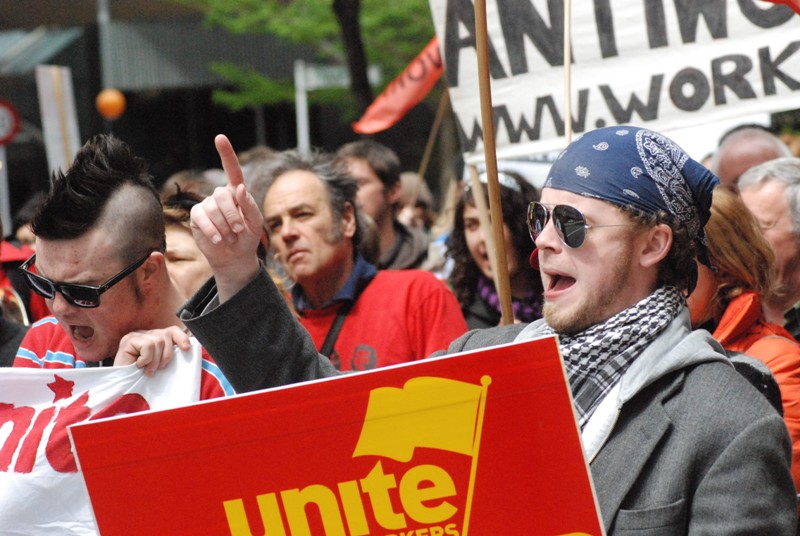
Uttering The Deplorable Word: David Cunliffe has outraged the Right and befuddled the Left by speaking openly of renationalising any assets partially privatised by John Key's Government.
DAVID CUNLIFFE has placed the question of renationalisation back on the political agenda. In doing so he’s provoked an extraordinary flurry of indignant condemnation from Newstalk-ZB’s Mike Hosking, who lost little time in raising the dread spectre of Hugo Chavez’s Venezuela. The Labour Party itself seemed rather non-plussed by the suggestion (like the husband whose wife's just encouraged him to visit a brothel). Throughout the election campaign didn’t Phil Goff insist that once the assets were gone, they were gone for good? If they’re as easily recoverable as Cunliffe seems to be suggesting, what was all the fuss about?
The cost of re-purchasing privatised state assets is, of course, the biggest “fuss” associated with any policy of renationalisation. It was a problem that occupied some of the sharpest minds in the Alliance back in the early 1990s. “Buying back the farm” may have been party policy, but no one was really sure how to pay for it. I well recall receiving a call from an Alliance member in search of a cheap alternative to forking out the billions required to repurchase Telecom. I promised to do some reading on the subject.
By far the cheapest option turned out to be straightforward expropriation. The government simply passes a law declaring the telecommunications system, the railways, the banks, etc, to be an inalienable part of the national patrimony. Such assets to remain the property of the people and be administered, on their behalf, by the state.
The only problem with expropriation is that any aggrieved foreign owners will almost certainly seek redress under international law. The offending country may find its financial assets frozen in foreign banks, and its national property (like airliners on the ground at foreign airports) seized. If you’re a small and vulnerable trading nation, this is not a good thing.
The other way to re-acquire your country’s assets on the cheap is to argue that their owners have reaped an unwarranted harvest of super-profits from the privatised business, and that in assessing the quantum of compensation to be paid to the “owners”, these super-profits must be deducted from the business’s re-purchase price. This was the formula employed by Salvador Allende when computing the level of compensation payable to the (mostly American) owners of Chile’s copper industry. And I strongly suspect, had New Zealand applied a similar formula to Telecom, it could’ve taken the company back into public ownership without paying a single cent.
The downside of this approach is that, once again, you lay your country open to retaliation. At the urging of the dispossessed Anaconda Copper Company, President Richard Nixon and his National Security Adviser, Henry Kissinger, undertook to “make the [Chilean] economy scream”. The rest is history.
Probably the most effective (and safest) way to recover one’s country’s privatised assets is to do so one little bite at a time. Citing the “strategic” nature of the asset, and the vital role it plays in preserving the nation’s security and/or well-being, the Government passes a law requiring an initially small, but annually rising, percentage of the private company’s shareholding to be placed in the hands of the State. At the same time, the Government introduces a raft of perfectly justifiable (but regrettably very expensive) regulations which (again, very regrettably) reduce the company’s profitability quite dramatically.
Not surprisingly, the private company’s share price plummets – whereby the State simply steps in and re-purchases its erstwhile assets for the proverbial song.
Although the situation was not produced by such a policy of renationalisation, there was a point, around the middle of the last decade, where New Zealand’s privatised rail network’s value reached such a low point that the Clark-led Labour Government could have picked it up for about a third of the price the State ultimately paid to bring the railways back under public control. Of course, what happens “naturally” under capitalism, a genuinely socialist government can very easily induce.
David Cunliffe has been severely criticised by both the Right (and elements of the Left) for uttering the deplorable word “renationalisation” in polite neoliberal company. For what remains of the campaigning period, those who've attempted to paint him as the candidate of the more conservative elements within Labour’s caucus will win far fewer converts.
Because the brutal fact of the matter is that if Cunliffe is successful in his bid to become Labour’s leader his statement on the possibility of renationalising partially privatised assets will have a pronounced – possibly decisive – dampening effect on the degree of overseas investor interest. Nobody invests billions in an asset that could be renationalised in a year’s time.
That’s why “renationalisation” is such a dangerous, such a deplorable word. Merely to utter it is to stir to life ideas that have not been seriously debated in this country for close to forty years. The ghost of Norman Kirk must be smiling down on the Member for New Lynn. If he had a vote next Tuesday, I’m pretty confident which way he would cast it.
This posting is exclusive to the Bowalley Road blogsite.