Showing posts with label Nationalisation. Show all posts

Sunday, 23 June 2024

The Realm Of The Possible.

The People’s House: What would it be like to live in a country where a single sermon could prick the conscience of the comfortable? Where a journalist could rouse a whole city to action? Where the government could be made to respond to the people’s concerns? Where real change was possible? And we could make it.

IN A YEAR of important elections, some already held, some yet to come, one common factor has become very clear. The ideological shift that rescued mainstream political parties from the seemingly endless crises of the 1970s has, in the intervening decades, become a serious electoral liability.

Neoliberalism may have provided the political mainstream with the circuit-breaker it was looking for in the 1970s and 80s, and its success in burying the social-democratic orthodoxy of the post-war era may have provided mainstream politicians with a field cleared of credible opponents, but the problems its adoption was supposed to solve have not disappeared. Indeed, many have grown.

Certainly, forty years on from the Snap Election of 1984 and the neoliberal revolution it ushered in, New Zealand’s mainstream parties stand in urgent need of a new circuit-breaker. If a tsunami of radical populism is not to roll over the centre ground, then a new set of answers is required to the key questions of democratic politics: “What is possible – and what is not?”

Since the late-1980s, for example, nationalisation, or even significant public ownership of key infrastructure and services, has been rejected outright as politically impossible, or been characterised with some asperity as the least effective alternative to untrammelled private ownership. At virtually every level of government, and regardless of the manifest severity of key infrastructural failures, both legislators and administrators continue to shy away from the most obvious and financially rational solutions.

Since the state is far ahead of all other borrowers in terms of how much it can borrow and at what cost, it makes obvious sense for it to take over New Zealand’s “three waters” and carry out the necessary upgrading and extension projects that long ago exceeded the ability of local authorities to finance. Cost recovery could be negotiated with the local government sector over a period of sufficient length to render it fiscally bearable. Easy-peasy?

Apparently not. That the option of straightforward nationalisation was never considered seriously by either Labour or National bears testimony to the remarkable persistence of the neoliberal vision. Even in the United Kingdom, where the privatisation of water is an accomplished fact, the abject failure of the experiment – as attested to by the open sewers that were England’s rivers and streams – has been insufficient to make nationalisation the preferred option of anybody except the voting public.

Restoring the organised working-class as one of the great “estates” of the realm has similarly been dismissed as impossible by the neoliberal clerisy. Their reticence on this subject is understandable, since it was the growing power of the trade unions in the advanced capitalist states of the 1960s and 70s – especially their real or potential influence over the major parties of the Centre-Left – that made the identification and introduction of an ideological circuit-breaker so urgent.

New Zealand’s destruction of organised labour in the early 1990s was of a thoroughness unequalled in the democratic West. Over a period of 30 years, union density declined from just under half the workforce to less than 10 percent. Take out the unions representing teachers, nurses, salaried medical specialists and public servants, and the percentage of private-sector workers enrolled in trade unions shrinks away to something not much better than nothing.

Except that, as is so often the case with the neoliberal “reforms” of the past 40 years, the cure for the apprehended “socialist” disease has proved to be worse than the complaint. The elimination of union power removed one of the most powerful drivers of productivity. By making it possible for employers to keep wages low, investment in more efficient plant and machinery, and the uplifting of employee skill levels, could be more-or-less permanently deferred.

The consequences of making it possible for businesses to ‘live’ with low productivity are clearly illustrated in the widening gulf between wage levels in New Zealand and Australia. That this differential (upwards of 30 percent) acts as a powerful magnet for what skilled workers New Zealand has left, not only strips the country of the people best placed to lift its productivity, but also entrenches its status as a low-skill, low-wage economy. The downward spiral becomes self-reinforcing.

The stripping-out of New Zealand’s manufacturing base, justified by the neoliberals’ unbreakable attachment to the Eighteenth Century economic doctrine of “comparative advantage”, may have offset the effects of declining real wages by lowering the price of manufactured goods, but it also robbed the New Zealand working-class of the pride and dignity that attaches to those who make real things in the real world. Emptying container-loads of manufactured imports is a poor substitute for the satisfaction derived from participating in their creation.

Allowing your best and brightest workers to seek a better life elsewhere, while allowing the self-esteem and skill levels of those who remain to fall in unison, is a recipe for socio-economic polarisation. It encourages those positioned higher on the socio-economic ladder to look down on those below them – a disdain which is all too easily translated into self-reproach and self-loathing by those so regarded. Just because the comfortably positioned in the social hierarchy do not have to endure the hidden injuries of class does not make them any less real.

New Zealand was once a society in which the exploitation of citizens was deemed unacceptable. The most dramatic illustration of this determination to be a nation in which few were rich and none were poor may be found in the story of Dunedin’s “sweated” tailoresses – women and girls paid starvation wages for sewing garments all day and late into the night.

An 1888 sermon, “The Sin of Cheapness”, penned and delivered by local clergymen, the Rev. Rutherford Waddell, inspired a local journalist to take up the tailoresses’ cause in The Otago Daily Times. At a public meeting the following year middle-class and working-class activists, acting together, decided to form the Tailoresses Union. In 1890, the New Zealand Government felt sufficiently pressured to set up a Royal Commission of Inquiry into “sweated labour”. Legislation followed.

Harriet Morrison of the newly formed Tailoresses Union attacks the monstrous practice of sweated labour in this New Zealand Observer cartoon of 1892.

A Christian preacher, a crusading journalist, a conscience-stricken middle-class, an energised working-class, New Zealand’s first union for women, a Royal Commission, legislative reform, socio-economic change. In 1888, all these factors contributed to defining the realm of the possible in New Zealand.

It was precisely to reduce the constantly expanding scope of what was considered possible, and to address the radical implications of such expansion for the social and economic future of the nation, that persuaded so many powerfully placed New Zealanders to unleash the neoliberal revolution of 1984-1993.

Few would argue that they did not succeed in lowering Kiwis’ expectations of what their society, their government, and they, themselves, were capable of achieving. This shrugging-off of what were depicted as excessively onerous collective responsibilities made it much easier to believe that individual success had been made correspondingly easier, and that individual failure, while regrettable, was no longer society’s business.

But, forty years on, are we really better off for living in a political environment where so little is considered achievable? What would it be like to live in a country where a single sermon could prick the conscience of the comfortable? Where a journalist could rouse a whole city to action? Where the government could be made to respond to the people’s concerns. Where real change was possible?

And we could make it.


This essay was originally posted on the Interest.co.nz website on Monday, 17 June 2024.

Thursday, 9 April 2020

“Lord, give us Democratic Socialism – but not yet!”

Not Now, Not Ever, Never! The problem with Labour's leading activists is that there is never a good time for democratic socialism. Never. They are like Saint Augustine who prayed to the Almighty: “Lord, give me chastity and self-control – but not yet.” In the case of Labour's "junior officers", however, the prayer is a little different: “Lord, let the Labour Party give New Zealand democratic socialism – but not yet.”

IT PAINS ME to ignore the Prime Minister’s advice, but it’s time to kick some Labour Party butt. As the saying goes: “Sometimes you have to be cruel to be kind.” And, no, I’m not talking about putting another boot into the tragic posterior of the Minister of Health. My beef is with the junior officers of Labour’s army. These are the folk who should be the most aggressive in the fight for social justice. The ones willing to take the risks necessary for victory. The ones with their eyes firmly fixed on the democratic-socialist prize. Unfortunately – and frustratingly – this is not what we’ve got.

On display is the sort of military prowess that saw a gaggle of chinless, baggy-panted British toffs hand over Singapore to a near-exhausted, numerically inferior and utterly astonished Japanese army in February 1942. Rather than delighting Labour’s allies and supporters with bold and imaginative contributions to the debate on how best to wrestle down the looming Covid-19 recession, Labour’s junior officers are offering nothing but orthodoxy and caution. Even worse, they are expending what little energy they can summon-up on upending buckets of cold water on every radical idea that comes forward.

Why do they always do this? How did dreary pragmatism become Labour’s default-setting? A full explanation would require a book-length answer. Suffice to say that once a party embraces the fundamental tenets of neoliberalism, anything other than orthodox and cautious policy responses will be treated as the political equivalent of upending a can of petrol over your head and striking a match. To be considered a credible contender for bigger things (an electorate seat or a high position on the Party List) requires constant proof that one’s hands are nothing if not “safe”.

Hence the following snippy little comment from lawyer, Greg Presland (The Standard’s “Mickey Savage”) responding to my criticism of his casual dismissal of the suggestion that Kris Faafoi should’ve rescued the best of New Zealand’s magazines by accepting Bauer Media’s offer to sell its entire stable to the Crown for $1.00:

“Gee Chris. In the middle of a pandemic when the country’s collective health and economy are under major threat and possibly a third of businesses are going to the wall do you really think the Government should be sweating about saving the Listener?”

Yeah, Greg, I do. I really do. Because even Blind Freddie (and The Spinoff’s Duncan Grieve) can see that Bauer’s ruthless cutting of its losses is about to be replicated across the entire media industry, and that only the Crown has the resources (not to mention the responsibility) to keep our news media alive and kicking against the pricks. Unless, of course, Greg’s desired outcome is actually the more-or-less complete collapse of this country’s independent media – with an all-powerful state media monopoly the last man standing. That there is absolutely nothing “social” or “democratic” about such a “solution” should surprise no one.

And lest any reader feel tempted to nod in agreement with Greg’s heartfelt concern for “possibly a third of businesses” poised to go “to the wall”: please, just stop and think it through. Is he suggesting that while the Government cannot afford to “sweat” about saving this country’s magazine publishing industry, it can afford to – and fully intends to – save all the others? Can the nation’s small and medium-sized enterprises now breathe a huge sigh of relief, secure in the knowledge that the same ministers who refused to lift a finger to shore-up the foundations of our democracy will nevertheless work like Trojans to rescue their little businesses?

Isn’t it more likely that the only New Zealand businesses with any reasonable hope of being bailed-out by the Crown will be the ones which are, in that memorable phrase from the Global Financial Crisis of 2008-09, “too big to fail”. Remember that Newsweek cover proclaiming “We are all socialists now”? Published the same week Barack Obama nationalised the auto industry.

Now, don’t get me wrong. Obama was right to take over General Motors. Nationalisation is what you do in a crisis – especially when the industry your saving is vital to the future of your country. And that’s the amazing thing, Greg. That you still don’t get that. But don’t feel too bad, because no one in a position to make a difference in the Labour Party has had an intelligent thought about the New Zealand media since the government of Norman Kirk!

So, if the Government is not going to be in a position to rescue every small business in New Zealand, and if up to a third of those small businesses could “go to the wall”, in Greg’s none-too-felicitous phrase, then wouldn’t this be the very best time to introduce a Universal Basic Income? Especially when the ability of the MSD to process and monitor tens-of-thousands of additional beneficiaries promptly, efficiently and sympathetically is just a teeny bit questionable?

Nope. Wrong again. According to Andrew Little’s former Chief-of-Staff, Neale Jones:

“I cannot think of a worse time to implement a UBI than in the middle of this economic crisis. Some of us are doing fine. Others need unprecedented government support just to stay afloat. UBI would spread that support thinner, or quickly spend 10s of billions we may need later.”

Meaning Neale has no grasp at all of Keynesian economics. No understanding of the crucial importance of keeping up the level of aggregate demand. No historical grasp of the crucial role spending plays in lifting a nation out of an economic slump. Nor does he understand the practical and moral efficiency of universal, as opposed to means-tested, state support. The massively positive effect of telling every Kiwi: ‘You are important in your own right, not because you’re in need of charity but because you are a citizen of New Zealand.’ Everyone keeps telling us that “we’re all in this together” – a UBI would prove it.

But, no. Neale says that being in the middle of a once-in-a-lifetime economic crisis is actually the worst time to consider a payment to every citizen to keep them and the economy afloat. The worst time.

The problem is, Neale, there is never a best time for you guys. Never. You and Greg remind me of Saint Augustine who prayed to the Almighty: “Lord, give me chastity and self-control – but not yet.” In the case of you two junior Labour officers, however, the prayer is a little different:

“Lord, let the Labour Party give New Zealand democratic socialism – but not yet.”

Not yet.

This essay was originally posted on The Daily Blog of Thursday, 9 April 2020.

Friday, 6 December 2019

Adrian Orr – The Reserve Bank’s Revolutionary Governor?

New Zealand's Underarm Banker: It bears recalling that the “independence” of the Reserve Bank Governor was for decades held up by neoliberal capitalists as the most compelling justification for passing the Reserve Bank Act. Interesting, is it not, how the ruling class’s support for the Bank’s independence lasted no longer than its Governor’s first attempt to regulate (albeit modesty) the behaviour of Australasian capital?

I’M BEGINNING to suspect that Reserve Bank Governor, Adrian Orr, is, at heart, a revolutionary. The decision of the Reserve Bank of New Zealand to nearly double the “Big Four” Australian banks capital requirements – from 10.5 to 18 percent – has deeply shocked financial communities on both sides of the Tasman. What Orr has triggered in the minds of the Australian bankers is a truly fateful question: “At what point does our involvement in the New Zealand finance sector become unprofitable?” It’s a question fraught with potentially revolutionary implications for New Zealand’s economic sovereignty.

The reaction from the Right confirms the boldness of Orr’s move. The consensus among those opposed to the Reserve Banks’s decision is that it will make it harder for the Australians to perform to their shareholders’ expectations. In other words, Orr stands accused of reducing the Australian banks’ profitability. New Zealanders are being warned that they will have to endure higher interest rates on their borrowing, and lower rates for their savings, as a consequence of Orr’s actions. National’s Finance Spokesperson, Paul Goldsmith, is predicting a substantial hit to the country’s growth prospects:

“The two primary effects of today’s decision will be higher borrowing costs than would otherwise have been the case and businesses and farmers will find it harder to access the funds they need to grow.”

The NZ Initiative (the successor organisation to the dark knights of Business Roundtable) echoes Goldsmith’s fear:

“The RBNZ’s decision to increase the capital banks are required to hold will have adverse effects for borrowers and the wider economy. The effects are likely to be felt most acutely by high loan-to-value borrowers, the rural sector and small-to-medium-sized enterprises.”

Exposed in these statements, however, is a reality which both authors would undoubtedly prefer to keep hidden from New Zealanders. Namely, the degree to which we have become slaves to the financial power of Australia. Not only that, but how little – if anything – our ruling class is prepared to do to defend (let alone rebuild) New Zealand’s economic sovereignty.

A party calling itself “National” might have been expected to applaud the Reserve Bank Governor’s decision to protect New Zealand depositors from the worst effects of a catastrophic financial collapse. Instead, we have its finance spokesperson chiding the Bank for daring to twist the Kangaroo’s tail. Meanwhile, the front organisation for the country’s biggest capitalists mutters darkly about the need to curb the Reserve Bank’s powers.

It bears recalling that the “independence” of the Reserve Bank Governor was for decades held up by these same neoliberal capitalists as the most compelling justification for passing the Reserve Bank Act. Interesting, is it not, how the ruling class’s support for the Bank’s independence lasted no longer than its Governor’s first attempt to regulate (albeit modesty) the behaviour of Australasian capital?

For those few adherents of “democratic socialism” (still the official ideology of the NZ Labour Party BTW) who continue to soldier-on, the reaction of big capital is extremely instructive. It points the way to how the Australian banks might one day be “persuaded” to relinquish their dominant position in New Zealand.

Way back in the early-1990s, when Jim Anderton’s Alliance was considerably more popular than the Labour Party, I remember being contacted by one of the Alliance’s policy activists with an intriguing question. He wanted to know, in practical terms, how one might go about re-nationalising privatised public enterprises without the legally required compensation payments bankrupting the nation.

Whew! That was a poser! Where to begin? Why not with a country that had already confronted and solved the problem? How did the largest surviving communist state – the People’s Republic of China – deal with/to the private sector? The answer proved to be both remarkably shrewd and surprisingly simple.

What the new communist government of China did, in the early 1950s, was to pass a law requiring all existing capitalist businesses above a certain size to make the Chinese state a 25 percent shareholder in the enterprise. Naturally, such a large shareholding would also entitle the state to be represented on the enterprise’s board of directors. As the years passed and the new regime consolidated itself, the legislation was amended constantly. Year by year, the state’s shareholding in the enterprise was increased – along with the number of its directors.

Unsurprisingly, the value of these enterprises’ shares plummeted. Seeing which way the wind was blowing, all those Chinese capitalists with a lick of sense offered-up their business’s remaining shares to the state. The latter generously agreed to take these off their hands – albeit for a handful of cents on the dollar. In this way, China’s largest capitalist enterprises were legally, peacefully – and cheaply – acquired by the state. As an added bonus, most of the by-now-former capitalists took what was left of their money and ran – to Taiwan, Singapore and the United States.

So, that was how you did it. By deploying the state’s legislative and administrative powers against the entrenched economic power of private enterprise. Far from sending in the revolutionary guards to seize, in the name of the people - and without compensation – the banks, insurance companies, department stores and factories, a democratic-socialist government would send in … its lawyer.

Like the ruthless, clear-eyed hero of the television series McMafia, the state’s representative will patiently explain to the people who used to be in charge, the new rules of the game:

“From now on” he’ll quietly inform the Chairman and his CEO, “your bank will be obliged to meet a capital requirement of 18 percent. In two years’ time that will rise to 25 percent. Three years after that the Reserve Bank’s CR will be 33 percent.”

“But that will ruin us!”, the Chairman and the CEO of the Aussie bank will wail. “We will have nothing to offer our shareholders.”

“With respect to that”, the young, clear-eyed lawyer will respond, with just the flicker of a smile, “the Minister of Finance has authorised me to make you the following offer …”

This essay was originally posted on The Daily Blog of Friday, 6 December 2019.


Thursday, 25 August 2016

Sitting Down For Socialism: Jeremy Corbyn Infuriates The British Establishment - Again.

It Certainly Is Jeremy! The image of Corbyn sitting on the floor of a railway carriage, alongside the many other passengers unable to find a seat, sends a powerful political message about how strongly he identifies with the frustrations of every citizen forced to depend upon sub-standard public transport. That he so unabashedly links their frustrations with his party’s determination to renationalise the service is taken as proof of Corbyn’s readiness to be guided, not by the demands  billionaires, but by the priorities of the long-suffering British people.
 
RICHARD BRANSON, the billionaire owner of the Virgin Group, paints himself as a progressive, twenty-first century capitalist. With his trademark long hair and beard, and his very public concern for the environment, he has created a brand which suggests to the world, especially its younger inhabitants, that you can be a friend of the planet, make a profit, and have a tremendous amount of fun in the process.
 
Beneath the hip-billionaire image, however, lurks what can only be described as an old-fashioned, Mr Moneybags loathing of socialism and all its works.
 
Confronted with a video produced by Jeremy Corbyn’s leadership campaign-team, in which the Labour leader is shown sitting on the floor of one of Virgin Trains’ ridiculously overcrowded passenger services, Branson saw red.
 
Stung by Corbyn’s criticism of Britain’s privatised railway system, and rattled by his plans to renationalise it, Branson released security-camera footage, purportedly showing Corbyn and his crew walking past multiple empty seats, to the media.
 
Predictably, the conservative British press have had a field day. Corbyn has been painted as a liar and a cheat, and his Blairite opponents in the Labour Party have lost little time putting the boot in.
 
Unfortunately for Corbyn’s critics, a number of people who were on the same train as the Labour leader have come forward to corroborate his version of events. The apparently empty seats had, according to these witnesses, been “reserved” by passengers placing bags and clothing upon them for their friends – something missed in the Virgin Trains’ video on account of the elevated positioning of its security cameras.
 
Corbyn’s team has not been unduly fazed by Branson’s tactics. Alluding to a letter released by Virgin Trains, in which an attempt is made to justify its overcrowded services, Sam Tarry, Corbyn’s campaign director, was reassuring. “Some of you might have seen on social media today there’s been a little bit of a spat,” he told an East London Corbyn rally. “Richard Branson has decided he’s very upset about our not particularly radical plans to renationalise our railways, so he’s having a little pop at us […] I’d just say that’s very, very indicative – the establishment is absolutely petrified about what this campaign is about, what this movement is about.”
 
Corbyn’s rival for the Labour leadership, Owen Smith, was careful to keep his own response light-hearted. “My campaign remains on track.”, he tweeted. “Proud to be genuinely standing up for ordinary people.”
 
The entire episode epitomises the way in which the British Establishment and its media attack-dogs have sought to deal with the Corbyn threat. Not even Branson was prepared to argue that the privatised railways aren’t an inefficient and unreliable mess. But if the message is irrefutable, the messenger is not. Every opportunity is, therefore, taken to discredit Corbyn as both a human-being and a political leader.
 
It remains to be seen just how successful Corbyn’s enemies have been in undermining his support among Labour Party members and the broader Labour-voting public. If the tens-of-thousands of Britons who have joined the Labour Party over the past few weeks are any indication (most of them with the express purpose of voting to keep Corbyn at Labour’s helm) one would have to say that the Establishment hasn’t been very successful at all.
 
The image of Corbyn sitting on the floor of a railway carriage, alongside the many other passengers unable to find a seat, sends a powerful political message about how strongly he identifies with the frustrations of every citizen forced to depend upon sub-standard public transport. That he so unabashedly links their frustrations with his party’s determination to renationalise the service is taken as proof of Corbyn’s readiness to be guided, not by the demands of Tony Blair’s billionaire buddy, Richard Branson, but by the priorities of the long-suffering British people.
 
This essay was originally posted on The Daily Blog of Wednesday, 24 August 2016.

Monday, 27 February 2012

Proceed With Asset Sales At Your Peril, Mr Key.

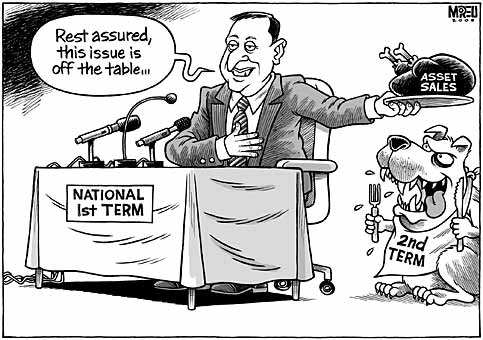
Transformer: From the benign Prime Minister of National's first term, to the dangerous Prime Minister of it second, John Key has startled those New Zealanders who'd convinced themselves they'd elected a new kind of conservative leader. Three months out from the 2011 election, and with long-forgotten numbers blasting out from the Treasury's juke-box, many New Zealanders are looking at Mr Key through new, less trusting, eyes.

NATIONAL'S MANDATE to sell state assets is indisputable. If a government goes into an election promising to sell up to 49 per cent of the state-owned energy companies' shares to private investors, and then wins more votes than its political opponents combined, well, it's hard to argue that it doesn't have a mandate.

The National Government's problem is that its mandate to "partially" privatise state assets is unusable. Prime Minister John Key may have earned the right to dilute the state's ownership of its energy companies, but it is becoming increasingly apparent that in exercising that right he would inflict so much political damage upon himself and his party that the project would become self-defeating.

The opposition to asset sales extends across the political spectrum, across all social classes, age groups and both sexes. National's election win has not changed the all-encompassing nature of this opposition. Clearly, Kiwis re-elected Mr Key's government in spite of – not because of – its policy on asset sales.

In his heart, I believe Mr Key knows this. His pollsters will certainly have registered a subtle but unmistakable shift in the electorate's mood. Like the low growl of a watchdog at the approach of an intruder, voters are signalling their displeasure at National's ideological belligerence. They hear long-forgotten tunes coming out of the Treasury's juke-box and are reminded of Roger Douglas and Ruth Richardson: people and policies they would rather forget.

New Zealanders warmed to Mr Key in his incarnation as "King Log" – the relaxed, ideologically-inert leader, who for three years floated inoffensively across the antipodean frog-pond. They are considerably less enthusiastic about Mr Key's new role as "King Stork". The last thing an electorate of frogs wants is a swift-striding leader with a murderous, spearing beak.

And Mr Key himself would do well to study the history of privatisation in New Zealand. It has never been popular, and governments which have taken advantage of their temporary possession of a parliamentary majority to strip the nation of its most valuable assets have paid a high electoral price.

When told that 90 per cent of the electorate had opposed the fourth Labour government's sale of Telecom, Richard Prebble is said to have remarked that New Zealanders should be grateful they had a government willing to resist such a large and vocal pressure-group.

That sort of arrogance is neither forgotten nor forgiven by Kiwi voters. Mr Prebble and his colleagues were thrown out of office for their disdain of democracy. And, when their National Party successors proceeded to repeat Labour's policy offences, the voters not only threw up two insurgent political parties to restrain them (the Alliance and NZ First), but they then for good measure, and as an insurance policy against future chicanery, changed New Zealand's electoral system.

Most New Zealanders, as Mr Key apparently warned the Americans in a "Wiki-leaked" diplomatic cable, are socialists at heart. Their political instincts tell them that certain industries and services should never be placed in private hands. National voters, however, should perhaps be reminded of the four great justifications for nationalisation.

One: Placing healthcare, education, energy, mass communications and transportation, and the provision of key financial services in private hands only, confers on their owners an unwarranted and potentially hazardous degree of economic, social – and so political – power.

Two: It redirects the vast revenues of these vital industries from their former private owners into the public accounts.

Three: It disperses these new revenues to the public good, especially to the protection of a natural environment despoiled by the ruthless quest for private profit.

Four: It establishes and extends the rights of employees to play a significant role in the development and management of all enterprises – public and private.

Privatisation, by reversing the direction of these progressive objectives, can only augment the wealth and power of private owners, diminish the public treasury, impede the public good, and suppress the rights of working people. It is risible to claim that your aim is to achieve these ends only "partially". Once private interests are recognised in the administration of state assets, the power to assert the public good, and defend the rights of indigenous peoples, is relinquished.

Proceed at your peril, Mr Key.

This essay was originally published in The Otago Daily Times, The Waikato Times, The Taranaki Daily News, The Timaru Herald and The Greymouth Star of Friday, 24 February 2012.

Monday, 5 December 2011

Renationalisation: It's Easy If You Know How

Uttering The Deplorable Word: David Cunliffe has outraged the Right and befuddled the Left by speaking openly of renationalising any assets partially privatised by John Key's Government.

DAVID CUNLIFFE has placed the question of renationalisation back on the political agenda. In doing so he’s provoked an extraordinary flurry of indignant condemnation from Newstalk-ZB’s Mike Hosking, who lost little time in raising the dread spectre of Hugo Chavez’s Venezuela. The Labour Party itself seemed rather non-plussed by the suggestion (like the husband whose wife's just encouraged him to visit a brothel). Throughout the election campaign didn’t Phil Goff insist that once the assets were gone, they were gone for good? If they’re as easily recoverable as Cunliffe seems to be suggesting, what was all the fuss about?

The cost of re-purchasing privatised state assets is, of course, the biggest “fuss” associated with any policy of renationalisation. It was a problem that occupied some of the sharpest minds in the Alliance back in the early 1990s. “Buying back the farm” may have been party policy, but no one was really sure how to pay for it. I well recall receiving a call from an Alliance member in search of a cheap alternative to forking out the billions required to repurchase Telecom. I promised to do some reading on the subject.

By far the cheapest option turned out to be straightforward expropriation. The government simply passes a law declaring the telecommunications system, the railways, the banks, etc, to be an inalienable part of the national patrimony. Such assets to remain the property of the people and be administered, on their behalf, by the state.

The only problem with expropriation is that any aggrieved foreign owners will almost certainly seek redress under international law. The offending country may find its financial assets frozen in foreign banks, and its national property (like airliners on the ground at foreign airports) seized. If you’re a small and vulnerable trading nation, this is not a good thing.

The other way to re-acquire your country’s assets on the cheap is to argue that their owners have reaped an unwarranted harvest of super-profits from the privatised business, and that in assessing the quantum of compensation to be paid to the “owners”, these super-profits must be deducted from the business’s re-purchase price. This was the formula employed by Salvador Allende when computing the level of compensation payable to the (mostly American) owners of Chile’s copper industry. And I strongly suspect, had New Zealand applied a similar formula to Telecom, it could’ve taken the company back into public ownership without paying a single cent.

The downside of this approach is that, once again, you lay your country open to retaliation. At the urging of the dispossessed Anaconda Copper Company, President Richard Nixon and his National Security Adviser, Henry Kissinger, undertook to “make the [Chilean] economy scream”. The rest is history.

Probably the most effective (and safest) way to recover one’s country’s privatised assets is to do so one little bite at a time. Citing the “strategic” nature of the asset, and the vital role it plays in preserving the nation’s security and/or well-being, the Government passes a law requiring an initially small, but annually rising, percentage of the private company’s shareholding to be placed in the hands of the State. At the same time, the Government introduces a raft of perfectly justifiable (but regrettably very expensive) regulations which (again, very regrettably) reduce the company’s profitability quite dramatically.

Not surprisingly, the private company’s share price plummets – whereby the State simply steps in and re-purchases its erstwhile assets for the proverbial song.

Although the situation was not produced by such a policy of renationalisation, there was a point, around the middle of the last decade, where New Zealand’s privatised rail network’s value reached such a low point that the Clark-led Labour Government could have picked it up for about a third of the price the State ultimately paid to bring the railways back under public control. Of course, what happens “naturally” under capitalism, a genuinely socialist government can very easily induce.

David Cunliffe has been severely criticised by both the Right (and elements of the Left) for uttering the deplorable word “renationalisation” in polite neoliberal company. For what remains of the campaigning period, those who've attempted to paint him as the candidate of the more conservative elements within Labour’s caucus will win far fewer converts.

Because the brutal fact of the matter is that if Cunliffe is successful in his bid to become Labour’s leader his statement on the possibility of renationalising partially privatised assets will have a pronounced – possibly decisive – dampening effect on the degree of overseas investor interest. Nobody invests billions in an asset that could be renationalised in a year’s time.

That’s why “renationalisation” is such a dangerous, such a deplorable word. Merely to utter it is to stir to life ideas that have not been seriously debated in this country for close to forty years. The ghost of Norman Kirk must be smiling down on the Member for New Lynn. If he had a vote next Tuesday, I’m pretty confident which way he would cast it.

This posting is exclusive to the Bowalley Road blogsite.

Wednesday, 22 June 2011

Buying Back The Farm

On The Right Track: But Labour's embrace of public ownership owed less to the party's socialist ideology than it did to rescuing privately-owned infrastructural companies that were too important to fail. If Labour really is interested in "buying back the farm" there are many well-tested ways of going about it.

THERE WAS SOMETHING immensely reassuring about Dr Don Brash’s outrage. His angry media release, in which he railed against Trevor Mallard’s “wanton economic thuggery”, vividly illustrated the Right’s abject terror at even the threat of effective state intervention in the economy.

All it had taken was a warning from Mr Mallard and his colleague, Clare Curran, that a future Labour Government would review and, if necessary, revoke legislatively, any contract/s conferring monopoly wholesale powers on the company (or companies) chosen to roll-out ultra-fast broadband across New Zealand.

According to Dr Brash, such statements – even when uttered by Opposition MPs – amount to nothing less than “economic sabotage”,  and immediately render the political party responsible “unfit for the Treasury benches”.

Strategically-speaking, Dr Brash’s outrage was extremely unwise. One should never allow one’s enemies to identify the weak-points in your defensive edifice. But identify them he did: warning that: “The threats about retroactive increases in fines for breaches of requirements are especially insidious.  Mr Mallard may just as well have erected a sign at Wellington airport saying, ‘Invest here at your peril. If we get in, all bets are off.’”

In those two pithy sentences, Dr Brash revealed to Labour exactly how it could prevent the National-led Government’s planned privatisation of state assets. They also show how, if it was of a mind to do so, Labour might set about “buying back the farm”.

A simple statement from the Labour Party that any sale of publicly owned businesses would be overturned legislatively and the purchaser/s compensated with slow-maturing government bonds, would instantly send potential investors running (and quite probably screaming) in the opposite direction.

But, in the nine years it was out of power (1990-1999), the Labour Party refused to issue any such threat, a fact that speaks volumes about its true level of commitment to the maintenance and revitalisation of a mixed, social-democratic economy.

For a brief period during the early 1990s the Alliance and NZ First did that job for them, with both of the insurgent parties promising to take the privatised state assets back into public ownership. The exigencies of coalition government, however, proved incompatible with the Alliance’s and NZ First’s re-nationalisation programmes – to the point where, by 2001, the very mention of the idea was enough to send Jim Anderton into a towering rage.

One of the reasons for abandoning the policy was its enormous cost. If the purchasers of state assets were to be fully compensated for the loss of their property rights the state would have to come up with nearly $20 billion. That international lenders would stump up the cash for such an ideologically passé programme was highly unlikely. Nor was outright confiscation a realistic option. (Not if one wanted to continue sending expensive airliners around the world without having them impounded.)

There are, of course, many more ways to skin a privatised cat than by re-purchasing it at market price or confiscating it outright, but so long as Labour remained uninterested (except when required to rescue the key infrastructural companies Air NZ and Tranzrail from abject market failure) no one was very interested in discovering what these might be.

To facilitate this process of discovery, it is necessary to take a look at how revolutionary regimes have handled the task of moving from an economy dominated by the private sector to one controlled, at least at the level of its “commanding heights”, by the state.

In this respect, the People’s Republic of China offers some interesting models.

The final victory of Mao’s People’s Liberation Army in 1949 did not, as many right-wingers probably assume, lead to the immediate socialisation of the means of production, distribution and exchange. In reality, the transition from capitalism to socialism took the best part of a decade.

The most successful technique for socialising private concerns involved a law requiring private and publicly-listed companies to issue shares to the state. Initially, this public shareholding was quite small – 5 to 10 percent – just enough to ensure that at least one of the company’s board of directors was an appointee of the government.

Not surprisingly, the passage of this law caused huge alarm among private investors, most of whom made haste to sell their shares to whoever was willing to buy them. With the price of publicly-listed companies’ shares plummeting, the opportunity naturally arose for the state to step in and acquire (at a huge discount) an even greater share of the nation’s leading businesses. [Labour Finance Minister, Michael Cullen, could have done the same with Tranzrail when their shares hit rock-bottom in 2003. His refusal to do so cost the taxpayers approximately $400 million!]

With the socialist writing now extremely clear on China’s wall, the remaining large-scale privately-owned Chinese businesses negotiated whatever deals they could with the Communist Government and exited the market. By 1960 the private-sector economy of China had all but ceased to exist.

China’s re-embrace of the market in the 1980s offers ample proof that the process is readily reversible (even if “Capitalism with Chinese Characteristics” is a very different beast from the neo-liberal variety familiar to us in the West).

It should be clear, however, even from this brief description of the socialisation of the Chinese economy, how very right Dr Brash was to be alarmed at what he called the “political caprice and retrospective vandalism” of Mr Mallard. The financial spigot that prevents capitalism from becoming fatally dehydrated is, in practice, pathetically simple to shut off. Investors confronted with the prospect of even modest state interference at the microeconomic level will almost always cash-up and run.

And, of course, such microeconomic intervention is almost always complemented by a series of equally “persuasive” macroeconomic “reforms” – particularly in relation to taxation and the re-organisation of the labour market.

The deliberate undermining of investor confidence, combined with a concerted weakening of managerial prerogatives by the state and its legislatively empowered trade union allies, is all that a genuinely socialist government really needs to do to send the edifice of capitalism crashing to the ground.

Dr Brash gets it.

I wonder if Labour ever will?

This essay is exclusive to the Bowalley Road blogsite.

Tuesday, 1 February 2011

Vesting Day (In Praise of Nationalisation)

On Behalf of the People: With the privatisation of state assets back in the headlines, it is useful to recall why privately owned industries were nationalised in the first place.

IT’S ONE OF THOSE PHOTOGRAPHS that capture history in the making. Taken by a proud mineworker on 1st January 1947, it records the erection of a large wooden sign outside the gates of a grim and grimy British coal mine. The sign says: "This Colliery is now managed by the National Coal Board on behalf of the People."

Thousands of miners’ lives had been lost to lung disease, gas explosions and cave-ins. The miners’ unions had been forced to engage in some of the most prolonged and bitterly contested industrial conflicts in British history. But at last, after a century-and-a-half of constant struggle, "Vesting Day" – when the proprietary interest in Britain’s coal industry was prised from the fingers of its private owners and vested in public hands – had dawned.

At the little colliery of Berry Hill, near Fenton, in Staffordshire, a group of miners posed for a formal "Vesting Day" photograph. The broad grins beneath the cloth caps bear testimony to the enormous hopes working people all over the world had invested in the nationalisation programmes of their Socialist and Labour parties.

Just a year earlier, and half a world away from Fenton, five thousand trade unionists had marched through the streets of Wellington in support of the New Zealand Labour Party’s long-delayed promise to fully nationalise the Bank of New Zealand. Many of the marchers wanted to go further. They had only to glance at their party membership card to be reminded that Labour’s succinctly formulated political objective was "the socialisation of the means of production, distribution and exchange".

But what did that mean? What was nationalisation/socialisation supposed to achieve?

At the most basic level it was intended to lift the burden of private ownership from the shoulders of the men and women who laboured in its service. Returning a healthy dividend to their shareholders all-too-often obliged private industrialists to extract more effort from their employees for less reward. Health and safety considerations were similarly subordinated to the owners’ over-riding imperative to increase the rate of return on capital. Public ownership was – at the very least – intended to construct a solid floor under the workers’ wages and conditions.

But that was just the beginning. The workers in nationalised industries also hoped to play a central role in their management. To "socialise" production was to break down the artificial hierarchies separating those who made the decisions from those who carried them out.

Socialisation was also intended to broaden radically the definition of who held a legitimate interest in the nation’s mines, factories, warehouses, shops and offices. "Stakeholders" in these enterprises were said to include not only the workers, their families, and the local community, but also those who worked in the civic, cultural and agricultural infrastructure which sustained them.

Nationalisation would thus allow democracy, hitherto reserved for the ballot-box, to flow inexorably into the workplace, where, the socialists insisted, it has always been needed most.

The historical experience of nationalisation fell well short of the millenarian hopes of the 1940s. Only the most basic expectations of the process were fulfilled. Because, although the State generally proved to be a better employer than the private capitalist, it opted to run the nationalised industries in exactly the same fashion. The strict division between "the bosses" and "the workers" endured, and the latter’s vast store of knowledge about the enterprise’s operations remained as under-utilised in the state-owned industries as it did in the private sector.

In New Zealand, the nationalised industries did acquire an unintended – but important – social dimension by being used by successive governments to absorb large numbers of workers who would otherwise have found themselves unemployed. By soaking-up this surplus labour, the State protected New Zealand society from the manifold curses of mass unemployment: domestic violence; child abuse; family break-up; juvenile delinquency, alcohol and drug addiction, and rising crime-rates.

The great post-war wave of nationalisations was finally broken by the countervailing force of the neoliberal revolution. By the late 1980s, in New Zealand, all publicly-owned entities had been forced to abandon their fiscally unsustainable "social" functions and become profit-making "State Owned Enterprises". Operated as if they were privately-owned business, the new SOEs were required by the Treasury to deliver market-determined rates-of-return to their "share-holding ministers". All of the state-owned banks and insurance companies; the nationalised telecommunications sector; the state airline; and the publicly-owned railways were privatised.

The neoliberal justification for privatising state-owned industries has always been that the private sector, on balance, is more productive. That being the case, it makes more sense to cash them up and use the proceeds to retire government debt.

The miners photographed outside Berry Hill Colliery in 1947 would probably agree. Collective exploitation is clearly a contradiction in terms. Fairness seldom turns a profit. And the coal-master’s girth was always inversely proportional to their own.

This essay was originally published in The Press of Tuesday, 1 February 2011.