Showing posts with label Privatisation. Show all posts

Monday, 20 February 2023

The Privatisation Two-Step: Is Three Waters A Masterpiece Of Misdirection?

Profit Uber Alles: The sort of people who see nothing objectionable in taking over another country’s water resources are unlikely to be put off by the objections of its citizens. Where there’s a will, there’s a way – all the investors have to do is find it.

IF CABINET FAILS to scrap Three Waters and start again, New Zealand may very quickly come to resemble Bolivia. Not the Bolivia of today, where a socialist government elected by a huge majority holds sway, but the Bolivia of 1997. That Bolivia had been ordered by the World Bank to privatise its water – on pain of being refused the loans it so desperately needed to keep its economy afloat. Taken over by French and American corporations, Bolivia’s water resources were very quickly priced beyond the reach of its poorest – that is to say, its indigenous – citizens.

Unsurprisingly, the Bolivian Government soon found itself in the grip of a massive popular uprising. In 2005, after five years of unrelenting struggle, the indigenous Bolivians forced their government to terminate the concessions granted to the French and the Americans.

In place of these foreign-owned private corporations, a publicly-owned water utility, the Empresa Pública Social de Agua y Saneamiento (EPSAS) was established. A strong case can be made that the popular struggle to reclaim Bolivia’s privatised water resources laid the groundwork for the nation’s sharp political turn to the Left. Indigenous interests in water, and socialism, it would seem, go hand-in-hand.

That being the case, one can easily imagine that a foreign investor, or group of investors, anxious to get their hands on New Zealand’s abundant water resources, would be particularly sensitive to the likely response of its indigenous citizens. As the sole possessors of Aotearoa for half-a-millennium, the Māori are linked to its lands, forests and fisheries by immensely strong bonds of lineage and tradition. Any attempt to place those resources in the hands of foreigners would provoke resistance every bit as strong as the indigenous Bolivians’.

Nor would the Māori stand alone. New Zealanders’ experience of the neoliberal privatisations of the 1980s and 1990s – and the partial privatisation of energy generators in the 2010s – has left a sizeable portion of the population implacably hostile to the privatisation process. The idea that something as basic to human existence as water might be handed over to private, profit-seeking interests has become a very hard sell.

But, the sort of people who see nothing objectionable in taking over another country’s water resources are unlikely to be put off by the objections of its citizens. Where there’s a will, there’s a way – all the investors have to do is find it.

Investors making a close study of New Zealand will quickly realise that Māori are the key interest group to neutralise. If the privatisation of water could be disguised as the indigenisation of water, then not only would the potentially unrelenting opposition of Māori be finessed away, but also the opposition of those Pakeha concerned to restore self-determination to Māori after nearly two centuries of colonisation. All the foreign investors need to identify is an appropriate vector through which their two-step process – indigenisation to privatisation – can be realised. (Interestingly, exactly the same two-step process was employed by the Fourth Labour Government to finesse the first wave of privatisations back in the 1980s: corporatisation to privatisation.)

The most obvious vectoral candidate is the National Iwi Chairs Forum. This is an outgrowth of the Treaty Settlement Process – the New Zealand state’s inspired mechanism for de-radicalising Māori nationalism by setting-up a series of neo-tribal capitalist buffers between the traditional/professional Māori elites and the urbanised, poorly-educated and culturally unmoored Māori working-class. The leaders of these tribal corporations are already more than half-way into the deracinated world of global capitalism – a fact they keep well-hidden from their own people behind swirling veils of Māori mysticism.

Enlist the support of these commercial rangatira, and the journey towards the privatisation of water will be underway long before the nation realises. And if an iwi already seething with bitter historical resentments steps forward to lead the process of detaching New Zealand’s water resources from the state, then so much the better. What’s more, any politician willing to front this iwi power grab is bound to become a lightning-rod for all manner of racially-charged criticism and abuse. Cui bono from this cynical exercise in political misdirection? Who else but the true instigators of the project: the always silent, always patient, foreign investor/s.

That this exercise might be all-too-real is attested to by the involvement of those front-of-house facilitators of foreign direct investment – the international credit-rating agencies. Advising the Sixth Labour Government (represented primarily by Local Government Minister Nanaia Mahuta) on what was now being called “Three Waters” was Standard & Poor’s (S&P Global Ratings). It’s advice was unequivocal: make sure the entities charged with the management of New Zealand’s drinking, storm and waste water are hermetically-sealed from democratic interference. Above all, keep their books and the State’s books entirely separate.

Had political journalists not been so distracted by the so-called “co-governance” arrangements built into the Three Waters proposal, the credit-rating agency’s stipulations would have pointed clearly to the project’s ultimate goal. What could be easier to privatise than a stand-alone, financially “independent” entity, slowly sinking beneath an insupportable burden of foreign debt?

Before that point could be reached, however, the whole process had to be turned into a hot mess of White Supremacists versus De-Colonisers. In this regard, the Three Waters legislation’s author, Nanaia Mahuta, could hardly have performed more obligingly. The deeper the project’s critics dug into the details of the legislation, the more evidence they found for the argument that Three Waters was all about the indigenisation of Aotearoa-New Zealand’s water. Not the least important feature of the legislation in this regard were the “Te Mana o Te Wai” statements – directives relating to both the public and private use of water that have the force of law, and that only Māori can issue!

Among the most vocal critics of Three Waters has been the radically neoliberal Act Party. Its active participation in the debate raises an intriguing (and potentially worrying) question. Is Act just another dupe of the foreign investors’ bait-and-switch operation, or is it surreptitiously giving them a helping hand? Act has always been a strong advocate of privatisation – an objective that would be made considerably easier by thoroughly discrediting the option of indigenisation and, along with it, the whole idea of public ownership.

In an ironic twist to this story, the first person to realise the long-term privatisation agenda built-in to the Three Waters project may well have been Nanaia Mahuta herself. Certainly, it would explain the Minister’s panic-stricken, last-minute attempts (in collusion with the Greens) to entrench anti-privatisation provisions in her legislation. If this is what happened, then it is difficult to avoid feeling sorry for the Minister. She could not adequately explain why her drastic (and arguably unconstitutional) amendments were necessary, because to have done so would have been to acknowledge her stalking-horse role in a project most New Zealanders would have condemned as unconscionable.

One crucial outcome of the entrenchment debacle, however, is that Mahuta’s fellow ministers were no longer content to rely upon her assurances that Three Waters was a sound and necessary project. Accordingly, they took a much closer look at the legislation. In doing so, they could hardly avoid the alarming question: “Is there anything in this legislation to prevent Iwi corporations from entering into agreements that could ultimately facilitate the privatisation of one or more of the four Three Waters entities?”

The answer to that question will be indicated by just how decisively Prime Minister Hipkins rejects Three Waters. Getting rid of the co-governance provisions will not be enough. If the legislation continues to empower the four entities to take on debt that is ultimately redeemable out of the pockets of New Zealand’s ratepayers, then the momentum towards their ultimate sale to foreign investors will not be slowed. If that is Hipkins’ decision, however, then either he, or his successors, will eventually be confronted with the same sort of popular uprising that convulsed Bolivia.

And in that battle, Māori and Pakeha will be fighting shoulder-to-shoulder. Proof that caring for and managing the waters of Aotearoa-New Zealand is the responsibility of all its peoples – and theirs alone.


This essay was originally posted on The Daily Blog of Friday, 17 February 2023.

Friday, 2 December 2022

Parliament’s Collective Failure To Defend The Constitution.

Unbitten: It is one of the oddest and most worrying aspects of the events surrounding Green MP Eugenie Sage’s late-night attempt to re-write the constitutional convention on entrenched legislation while a weary House of Representatives was sitting under Urgency. Sherlock Holmes’ famous observation concerning the dog that did not bark, might be applied with equal justification to the Opposition that did not bite.

WHILE WE MAY be reasonably confident that the attack on New Zealand’s constitution will be repelled, it should never have happened. That it was legal scholars who sounded the alarm over the entrenchment of a section of the Three Waters legislation, should cause all 120 of our parliamentarians to hang their heads in shame. Their collective failure to grasp what Green MP Eugenie Sage was doing points to a woeful lack of political and constitutional awareness among those whose first and most important duty is to protect the integrity of our democratic system.

Had a similar effort to screw the constitutional scrum been attempted even ten years ago, the perpetrator would have been red-carded immediately. Not even Rob Muldoon, who was not above the odd instance of constitutional skulduggery, would ever have contemplated a stunt like Ms Sage’s. He would have known that his National Party colleagues would have intervened decisively to prevent him bringing their party into such disrepute.

It is one of the oddest and most worrying aspects of the events surrounding Ms Sage’s late-night introduction of her controversial SOP (Supplementary Order Paper) while a weary House of Representatives was sitting under Urgency. Sherlock Holmes’ famous observation concerning the dog that did not bark, might be applied with equal justification to the Opposition that did not bite.

Tired though National’s and Act’s MPs may have been, and eager to get home to their beds, Ms Sage’s SOP should have had the same effect upon them as a bucket of cold water. Members of the Opposition parties should have risen instantly to their feet, baying like bloodhounds for the Speaker to rule upon the constitutional propriety of the Green MP’s SOP. Expressions of anger and disgust should have been ringing off the Chamber’s walls like the echoes of heavy artillery.

Those Cabinet Ministers present in the House, and their colleagues listening to the proceedings with one ear back in their offices, would have known immediately that something was wrong. Leader of the House, Chris Hipkins, would have hurried to the side of the Minister in charge of the Three Waters legislation, Nanaia Mahuta, seeking urgent clarification as to what the hell Eugenie Sage was playing at.

A fair question – even at this stage of the proceedings. What was Ms Sage playing at? More to the point, was Ms Mahuta aware of her game? Did the Green MP’s SOP come out of nowhere, or was the entrenchment of the section prohibiting the privatisation of any or all of the four water “entities” part of a long-planned attempt to distract the public from the co-governance provisions of the legislation, by making it practically impossible for the Opposition parties to sell off the people’s water to private interests? (That the Opposition parties had categorically ruled out the privatisation of water was deemed an insufficient barrier to its introduction.)

Journalistic inquiries have established that the entrenchment of prohibitions against privatisation was being recommended by supporters of Three Waters months ago. It has also emerged that the Crown’s legal advisers had warned those responsible for the legislation (Ms Mahuta presumably) that such a course of action would be constitutionally abhorrent. It is further suggested that Cabinet received the same advice.

All to no avail. Neither Crown Law, nor the Attorney-General, were able to dissuade the Prime Minister from writing to the Opposition leaders, seeking their support for adding anti-privatisation to the list of core democratic rights and freedoms entrenched in our electoral legislation.

That privatisation is so very clearly “one of these things [that] is not like the others” in no way dissuaded the three women of Three Waters from undermining the integrity of New Zealand’s sixty-six-year-old, unanimously enacted, entrenchment provisions – along with the parliamentary consensus that had rendered them sacrosanct for so long.

The beauty of this country’s unwritten constitution is its simplicity and flexibility. It is not beholden to unelected judges, and vouchsafes to all citizens the right to overturn with their votes what arrogant politicians have set up with their own. The only right our constitution sets in stone, is the right of citizens to participate in the government of their country. Those who seek to remove the power of the people’s representatives to amend and/or repeal the laws, are not their friends – they are their enemies.


This essay was originally published in The Otago Daily Times and The Greymouth Star of Friday, 2 December 2022.

Thursday, 25 August 2016

Sitting Down For Socialism: Jeremy Corbyn Infuriates The British Establishment - Again.

It Certainly Is Jeremy! The image of Corbyn sitting on the floor of a railway carriage, alongside the many other passengers unable to find a seat, sends a powerful political message about how strongly he identifies with the frustrations of every citizen forced to depend upon sub-standard public transport. That he so unabashedly links their frustrations with his party’s determination to renationalise the service is taken as proof of Corbyn’s readiness to be guided, not by the demands  billionaires, but by the priorities of the long-suffering British people.
 
RICHARD BRANSON, the billionaire owner of the Virgin Group, paints himself as a progressive, twenty-first century capitalist. With his trademark long hair and beard, and his very public concern for the environment, he has created a brand which suggests to the world, especially its younger inhabitants, that you can be a friend of the planet, make a profit, and have a tremendous amount of fun in the process.
 
Beneath the hip-billionaire image, however, lurks what can only be described as an old-fashioned, Mr Moneybags loathing of socialism and all its works.
 
Confronted with a video produced by Jeremy Corbyn’s leadership campaign-team, in which the Labour leader is shown sitting on the floor of one of Virgin Trains’ ridiculously overcrowded passenger services, Branson saw red.
 
Stung by Corbyn’s criticism of Britain’s privatised railway system, and rattled by his plans to renationalise it, Branson released security-camera footage, purportedly showing Corbyn and his crew walking past multiple empty seats, to the media.
 
Predictably, the conservative British press have had a field day. Corbyn has been painted as a liar and a cheat, and his Blairite opponents in the Labour Party have lost little time putting the boot in.
 
Unfortunately for Corbyn’s critics, a number of people who were on the same train as the Labour leader have come forward to corroborate his version of events. The apparently empty seats had, according to these witnesses, been “reserved” by passengers placing bags and clothing upon them for their friends – something missed in the Virgin Trains’ video on account of the elevated positioning of its security cameras.
 
Corbyn’s team has not been unduly fazed by Branson’s tactics. Alluding to a letter released by Virgin Trains, in which an attempt is made to justify its overcrowded services, Sam Tarry, Corbyn’s campaign director, was reassuring. “Some of you might have seen on social media today there’s been a little bit of a spat,” he told an East London Corbyn rally. “Richard Branson has decided he’s very upset about our not particularly radical plans to renationalise our railways, so he’s having a little pop at us […] I’d just say that’s very, very indicative – the establishment is absolutely petrified about what this campaign is about, what this movement is about.”
 
Corbyn’s rival for the Labour leadership, Owen Smith, was careful to keep his own response light-hearted. “My campaign remains on track.”, he tweeted. “Proud to be genuinely standing up for ordinary people.”
 
The entire episode epitomises the way in which the British Establishment and its media attack-dogs have sought to deal with the Corbyn threat. Not even Branson was prepared to argue that the privatised railways aren’t an inefficient and unreliable mess. But if the message is irrefutable, the messenger is not. Every opportunity is, therefore, taken to discredit Corbyn as both a human-being and a political leader.
 
It remains to be seen just how successful Corbyn’s enemies have been in undermining his support among Labour Party members and the broader Labour-voting public. If the tens-of-thousands of Britons who have joined the Labour Party over the past few weeks are any indication (most of them with the express purpose of voting to keep Corbyn at Labour’s helm) one would have to say that the Establishment hasn’t been very successful at all.
 
The image of Corbyn sitting on the floor of a railway carriage, alongside the many other passengers unable to find a seat, sends a powerful political message about how strongly he identifies with the frustrations of every citizen forced to depend upon sub-standard public transport. That he so unabashedly links their frustrations with his party’s determination to renationalise the service is taken as proof of Corbyn’s readiness to be guided, not by the demands of Tony Blair’s billionaire buddy, Richard Branson, but by the priorities of the long-suffering British people.
 
This essay was originally posted on The Daily Blog of Wednesday, 24 August 2016.

Saturday, 30 January 2016

Oh Lucky Man! Phil Goff's "Dispensation" Is As Ill-Considered As It Is Ill-Deserved.

You Bet He's Smiling! Phil Goff has somehow managed to convince Andrew Little that it's okay to have a senior Caucus member telling the world that the Labour Party's policy on the TPPA is wrong, and that the National Government's stance is correct. As they say: "With friends like these ..." And it's not even as if Phil has a proud history of approving dispensations for others - just ask Jim Anderton! For some reason, when it comes to Caucus collective responsibility, no exemptions are ever made for the Left.
 
PHIL GOFF IS A LUCKY MAN. Had Andrew Little extended to him the same measure of tolerance that he extended to Jim Anderton, 28 years ago, he’d no longer be a member of Labour’s caucus.
 
Goff was among those Rogernomes who, on 4 August 1988, passed the following resolution:
 
“This Caucus declares that the following understanding governs the relationship of Caucus members with each other: Members shall vote in Parliament in accordance with decisions of the Caucus. Where a member deliberately abstains from voting, or votes against a Government measure in the House which has been passed by Caucus, such action automatically removes the member from membership of the Caucus unless express permission to take that action has been given by Caucus.”
 
Referred to at the time as the “loaded gun” resolution, it was intended to block any member (but most particularly, Anderton) from either voting against, or abstaining from voting for, legislation setting in motion the privatisation of state assets. Anderton’s colleagues were well aware that the Labour Party’s official stance was one of opposition to privatisation, and that, strictly speaking they were all bound – as Labour MPs – to uphold Labour Party policy. They simply didn’t care.
 
By December of 1988, the circumstances anticipated in the Loaded Gun Resolution had come to pass. A bill enabling the government to partially privatise the BNZ was on the floor of the House. In spite of the Labour Party’s New Zealand Council informing the Caucus that privatisation would directly contravene the party’s 1987 manifesto, and contradict the expressed will of the Labour Party Conference, the David Lange-led Labour Government pressed ahead with the legislation.
 
On Saturday, 10 December 1988, Jim Anderton told a hushed House of Representatives:
 
“I cannot give my support to this enabling legislation. If we are not going to sell the Bank of New Zealand, we do not need this legislation. If we are going to sell it, then I am opposed to it and must show my opposition here, at this time, because there will be no other parliamentary opportunity to protest at or prevent the Government having the power to sell the Bank. As I said at the Committee Stages, I will not vote with the Opposition National Party. Their anxiety to sell the Bank of New Zealand and other state assets is well known. I will, therefore, record my opposition by formally abstaining when the vote is taken on this Third Reading.”
 
On Tuesday, 13 December 1988, the Senior Government Whip, Margaret Austin, wrote to Anderton informing him that he would receive no further Caucus communications and was stripped of his membership of Caucus committees. The Whip had been withdrawn; Jim Anderton was out of the Labour Caucus.
 
Not for Anderton the dispensation granted to Goff by his Caucus colleagues. Regardless of the fact that he was attempting, in good conscience, to uphold Labour Party policy (as required of him, and all of his colleagues, by the Labour Party constitution) permission for Anderton to abstain on the enabling legislation was denied.
 
Twenty-eight years later, the same Phil Goff who had voted to expel anyone who defied the will of Caucus has not only been extended the privilege of abstaining from voting against the Trans-Pacific Partnership’s enabling legislation, but also of actually crossing the floor of the House of Representatives and voting in favour of it.
 
The relevant Labour Party media release of 28 January 2016 sates: “Opposition Leader Andrew Little has given dispensation to MP Phil Goff to take his own position on the Trans Pacific Partnership Agreement due to his historic involvement in negotiating its predecessor, the P4.” According to Little:  “Phil has had a longstanding involvement and public commitment to this agreement which differs with the Labour Caucus’ decision that it cannot support the deal in its current form due to its compromise of New Zealand’s sovereignty.”
 
But the 2005 P4 free-trade initiative, which the Helen Clark-led Labour Government had set in motion, and which Goff played a key role in negotiating, is in no way comparable to the TPPA. The P4 was a modest and mutually beneficial free trade agreement involving New Zealand, Singapore, Brunei and Chile. The TPPA, in sharp contrast, is a freedom charter for US transnational corporations. Granting Goff a dispensation on the grounds that he had a hand in negotiating P4 is, therefore, a political non-sequitur.
 
Moreover, in dissenting from his Caucus colleagues’ view that support for the TPPA compromises New Zealand’s sovereignty, Goff is actually asserting that what Labour is presenting to the electorate as the truth is, in fact, a lie. Which means that Little has given Goff a dispensation to declare that up is down, black is white, and the TPPA is a good thing. And why would a party leader anxious to enhance his own, and his party’s, credibility do that!
 
What’s more, the irrelevance of the P4 argument makes Little’s treatment of David Shearer’s dissidence utterly inconsistent and unfair. If Goff is entitled to deny the truth of Labour’s position, then why isn’t Shearer also being granted a pass from the reality-based community? Or, for that matter, any other Caucus member not yet convinced that the TPPA represents a dangerous corporate assault on what’s left of New Zealand’s democracy and independence.
 
What Little and his colleagues all need to find – and quickly – is a measure of the clarity and courage demonstrated by Jim Anderton on 10 December 1988. If the TPPA is a bad thing, then allowing a Labour MP to vote in favour of it cannot be ethically, or politically, justified. It follows, therefore, that those Labour parliamentarians who do not believe the TPPA is a bad thing; and who are unwilling to abide by the contrary judgement of their colleagues; have only one morally consistent course of action to take. They must resign, forthwith, from both the Labour Caucus and the Labour Party.
 
This essay was originally posted on The Daily Blog of Friday, 29 January 2016.

Friday, 4 April 2014

Old Battles - Fought Unequivocally

Let's Do The Time Warp Again! Labour has been accused of "re-fighting too many old battles", but history suggests that it is precisely this willingness to stoutly defend traditional political values that explains the phenomenal success of politicians like Margaret Thatcher and Ronald Reagan. It is equivocation that turns voters off - not conviction. So, come on Labour: "It's just a jump to the Left!" 
IN A RECENT COLUMN the veteran political correspondent, John Armstrong, accuses the Labour Party of “fighting too many old battles”. The perennial socialist causes, for which Labour’s politicians should still feel duty-bound to draw their swords, declares Armstrong, “have long been lost or are no longer relevant to most voter’s daily existence”.
 
By way of example, Armstrong draws attention to Labour finance spokesperson, David Parker’s, snappish criticism of Treasury’s “Investment Statement”.
 
This latter document, released nearly a fortnight ago, was responsible for raising considerably more than Parker’s eyebrows by suggesting that public ownership of health and education services, “should not be seen as the default setting”.
 
Labour’s finance spokesperson was having none of it and came out swinging. The Department, he said was “out of touch” with New Zealanders and accused it of promoting privately-owned “McSchools” and “McHospitals” instead of publicly-owned (and, therefore, accountable) education and health facilities.
 
“I can be completely clear”, thundered Parker, “Labour rejects that philosophy. Public ownership of public schools and public hospitals is essential to provide opportunity and protection for all New Zealanders. This is what people pay their taxes for.”
 
Borrowing a line from his predecessor in the finance role, Dr Michael Cullen, he characterised the Treasury’s highly contentious statement as yet another example of its unnerving predilection for unleashing random “ideological burps”.
 
Parker concluded his media release by challenging the Prime Minister and Finance Minister to combat Treasury’s rebarbative ideological offerings with the same antacid remedy as Dr Cullen.
 
That neither John key nor Bill English accepted Parker’s challenge, Armstrong argued, is attributable to the National Party’s belief that Labour is trapped in an “ideological time-warp”. The clear implication being that when it comes to the traditional Left/Right squabbles over Private versus Public ownership – the average voter no longer cares.
 
Armstrong’s concluding paragraph is bleak:
 
“National argues that if Labour could not prompt a voter backlash against the partial floats of the remaining state-owned electricity generators, it will struggle to stop the growing trend for private provision worldwide. The genie is well and truly out of the bottle. Labour has little hope of stuffing it back in.”
 
That the Right struggled very successfully to stop the growing trend toward public provision worldwide, and found it surprisingly simple to stuff the socialist genie responsible back in his bottle, seems to have escaped Armstrong.
 
And if he were to recall that, in New Zealand, the whole privatisation process was initiated by Labour, then the public’s unwillingness to be convinced by their re-conversion to the virtues of public ownership might look less like indifference and more like once-bitten-twice-shy caution. And who can blame them – given Labour’s repeated refusal to commit unequivocally to the repurchase of the privatised shareholdings?
 
Parker’s stout defence of public health and education speaks eloquently of Labour’s determination not to be caught equivocating on the last remaining bastions of collectivism in New Zealand society. Were the Right to be successful in privatising our schools and hospitals (and finally taming the education- and health-sector unions) there would be little left for Labour to defend.
 
The key strategic question Labour has yet to answer, however, is: when will it finally make the transition from defence to offence?
 
When the Right finally realised (in the mid-1970s) that the last great bastions of private enterprise – those the British Labour firebrand, Tony Benn, described as the “commanding heights of the economy” – were about to come under full-scale assault by the forces of the Left, its more far-sighted and aggressive advocates realised that defensive tactics were losing them the battle. Tory hardliners like Sir Keith Joseph, Airey Neave and Margaret Thatcher didn’t bleat on about it being too late to stuff the socialist genie back in its bottle – they made stuffing the socialists their No. 1 priority.
 
The greatest enemy any ideology – Left or Right – will ever face is not indifference but equivocation. The achievements of the Liberal Government of 1890-1912 and of successive Labour Governments up to 1984 were not laid low for want of voters willing to defend them, but by politicians unwilling to re-state – unequivocally – the reasons why socialists must never for a moment cease “re-fighting old battles”.
 
Margaret Thatcher always referred to her country as “Great” Britain, because reclaiming Britain’s greatness was her whole manifesto.
 
What will Mr Cunliffe ride forth to battle to re-claim?
 
This essay was originally published in The Waikato Times, The Taranaki Daily News, The Timaru Herald, The Otago Daily Times and The Greymouth Star of Friday, 4 April 2014.

Monday, 14 January 2013

Indisputable Mandate

Key Policy: In 2011 Labour made opposition to a partial sale of the state's energy assets the centerpiece of its election campaign. National's long-signalled privatisation plans were thus thrown into sharp electoral focus. Significantly, the final result put Labour 20 percentage points behind National. With nearly 50 percent of the votes cast, Mr Key's Government not surprisingly claimed a strong mandate to proceed with its sales programme.

THE TARGET of 310,000 signatures has been reached – or so we are told. The coalition of interest groups and political parties seeking a Citizens’ Initiated Referendum (CIR) on the National Government’s plans to partially privatise the state-owned energy generators has yet to submit its petition to the Clerk of the House for checking. But even if this final hurdle is cleared, the petitioners will still have to find their way around a much more daunting obstacle: the Government’s mandate.
 
That the Government has a mandate to sell-off 49 percent of Mighty River Power, Genesis, Meridian and Solid Energy is hotly contested by the four organisations petitioning for a CIR. Grey Power, The NZ Council of Trade Unions, The Labour Party and The Greens all deny the legitimacy of the Government claiming a specific electoral mandate for its partial privatisation programme. According to the petitioners’, the voters have (at best) given the National-led Government a general mandate. To claim a specific mandate, they say, it must first ask the electorate a specific question – hence the need for a referendum.
 
This argument would carry more weight if the National Party’s principal challenger in the 2011 General Election – the Labour Party – hadn’t itself specified National’s privatisation plans as the best reason for voting it out of office. “Stop Asset Sales” was the Labour Party’s most coherent slogan in 2011. That only 27.4 percent of the voters were prepared to back its flagship policy with their ballots strongly suggests that privatisation was not the electoral game-changer Labour’s focus-groups had suggested.
 
The Greens’ were much less willing than Labour to give the privatisation issue such critical electoral salience. They promised New Zealanders “a richer future” of which the retention of state assets was certainly an important (but not an essential) feature. How, then, can the Greens argue that National’s claim to a specific electoral mandate is illegitimate when their own policy pitch was so general? If National isn’t entitled to claim a specific mandate for asset sales, then, by the same logic, the Greens cannot claim one against them.
 
The same applies to all the other political parties offering manifestoes in which, inter alia, the Government’s plans to partially privatise the State’s energy companies were opposed. It’s simply not fair to aggregate the Greens 11.6 percent, NZ First’s 6.5 percent, the Maori Party’s 1.4 percent, Mana’s 1.0 and the Conservative Party’s 2.6 percent of the Party Vote with Labour’s 27.4 percent to claim a minimum anti-asset sales bloc of 50.5 percent. Opposition to asset sales was not deemed important enough to preclude a confidence and supply agreement between National and the Maori Party. Nor would it have been had the Conservatives managed to cross the 5 percent threshold.
 
National, of course, has no need to aggregate percentages for its partial privatisation programme as desperately as its opponents. With 47.3 percent of the Party Vote, the governing party came within an ace of securing an absolute majority of the votes cast. It would have been an outstanding tally even under the old First-Past-the-Post electoral system, but coming within 2.8 percent of an outright majority under our Mixed-Member-Proportional system was close to miraculous. Any political party racking up such a total is entitled to claim a very strong electoral mandate for all its policies.
 
National’s claim to a specific mandate for its asset sales programme is, accordingly, very strong. The policy was announced nearly a year prior to the election and was subjected to the intense scrutiny of not only the parliamentary opposition, but also the news media and a broad cross-section of civil society. The 2011 election was no 1980s or 1990s exercise in duplicity and fraud: the public understood that a vote for National was a vote to privatise 49 percent of Solid Energy, Meridian, Genesis and Mighty River Power. Nearly half of them voted for the Government anyway. If Prime Minister John Key’s government doesn’t have a mandate to proceed with its privatisation policy, then the word no longer has any political meaning.
 
New Zealand’s representative system of government entrusts the administration of the nation to the political party, or parties, which alone, or in combination, command a majority in the House of Representatives. National and its allies played by these rules – and won. Their performance referendum is scheduled for 2014 – and it’s binding.
 
This essay was originally published in The Waikato Times, The Taranaki Daily News, The Timaru Herald, The Otago Daily Times and The Greymouth Star of Friday, 11 January 2013.

Tuesday, 14 August 2012

Running On Different Lines

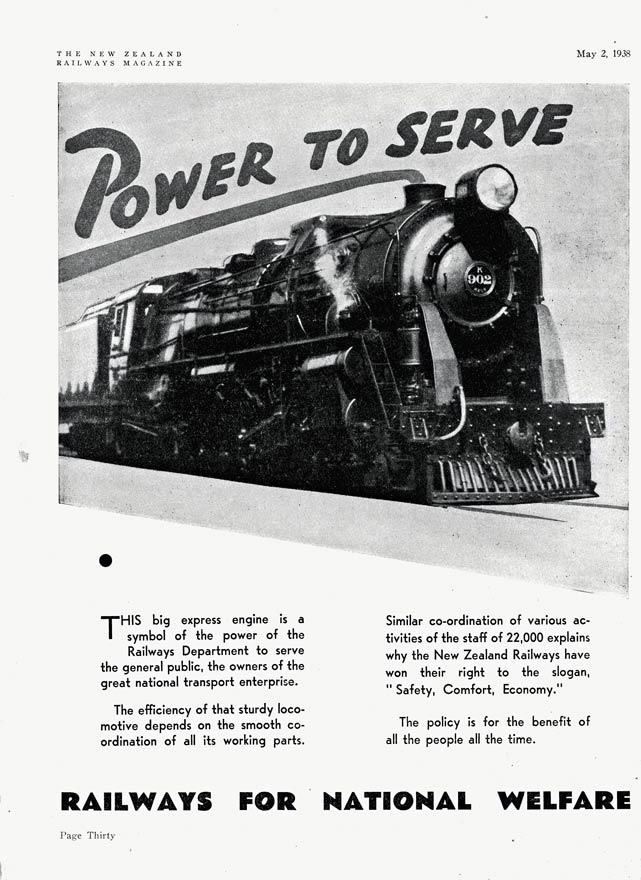
A Different Ethos: A page from the May 1938 issue of the New Zealand Railways Magazine. There are more ways to measure the value of an enterprise than simple profit and loss.

THE FLINTY-FACED MEN who run everything these days will call me a hopeless romantic, but I won’t care. They’ll point to the bottom line of the company’s accounts and shake their heads. “This is a business,” they’ll say, using that patient tone reserved for fools and children. “It must be run as a business.” But I won’t be convinced.

“Business”, no matter how hard its backers try to convince us otherwise, does not belong in the same ontological category as “Weather”. It’s not something we simply have to live with because, no matter how much we talk about it, or complain about it, we cannot change it. Businesses are the work of men and they are whatever men tell them to be. Bottom lines can be made to measure more than profit and loss.

The New Zealand Railways used to have 20,000 workers on its payroll. On the trains and railcars and electric units there were engineers, conductors and guards. In the stations and marshalling yards there were station-masters, schedulers, pointsmen, shunters and ticket-sellers seated in narrow booths. In the railway workshops hundreds of highly skilled tradesmen designed and built locomotives and rolling stock, refurbished carriages and undertook running repairs and maintenance. Up and down the thousands of miles of track gangs of railway workers checked the signalling gear, maintained the rails and ties and sleepers, noted signs of wear and tear and assessed the risk of washouts and slips. In between keeping the network safe, at ten and twelve and three o’clock, you’d see them hunched around a primus stove, boiling a billy, smoking a fag, chewing the fat. Working men, gainfully employed, bringing home a living wage to their wives and children.

How do you fit that picture into your bottom line, Mr Businessman?

How do you measure the value of kids growing up in working families where Dad and Mum pointed with pride to the great machines that the brains and hands of working people had made? What price do you put on the mastery of the complex tools, the lathes and presses, that produced the components that kept the machines running? Or the lifetime of productive work that their makers could look back on, and their sons and daughters aspire to? Where, on your bottom line, Mr Businessman, do you account for the vibrant neighbourhoods radiating out from the marshalling-yards and workshops at their heart? The shops and the supermarkets where people gathered and swapped gossip; the pubs and clubs where they argued about sport and politics? Are they not worth as much as the working-class neighbourhoods of China?

If you were honest, Mr Businessman, you’d tell me (sotto voce) that, really, it’s not THE bottom line that matters, but WHOSE.

The railways belonged to the people, but the road haulage companies belonged to their shareholders. Hardly surprising, then, that under the shareholders’ political party roads and lorries began to take precedence over rails and locomotives. When budgets were being drawn up it was to concrete and bitumen that the funds were allocated – not diesel oil, steel and hardwood sleepers. In other parts of the world the symbols of modernity were high-speed trains and light-rail public transportation networks, but here in New Zealand the future belonged to six-lane highways and 18-wheeler trucks.

Symbols Of Modernity: High-speed trains became emblems of progress and technological prowess in Japan, Western Europe and China - but not in New Zealand.

In 1986 the party that had pledged to “Save Rail” corporatized it. NZR became an SOE and from that moment on it was to be run as a business, with a business’s bottom line, and a business’s ruthlessly “downsized” workforce.

At the stroke of a pen, all the benefits that could not be accommodated in the accountant’s ledger ceased to matter. The benefit of having people gainfully employed and paying taxes instead of rotting on the dole. The benefit of working-class kids aspiring to be skilled tradespeople rather than patty-flippers at Macdonalds. The benefit of having socially coherent and flourishing neighbourhoods rather than decaying factories and weed-infested marshalling yards full of young people without jobs getting high on drugs where their fathers and mothers once earned a decent wage.

But that’s the way it was. New Zealand had joined the “Real World” of global markets and bloodless calculators. Railways were so … well … Nineteenth Century. Horny-handed sons of toil poring coal into puffing-billies. Away with them! Sell it to the highest bidder (and the friends of the highest bidder). Strip out the assets. Let the rest run down. Then (and this is the point where it’s really important to keep a straight face) sell it back to the people at a price that has nothing to do with the bottom line.

Still, we romantics are patient folk. As the Earth’s atmosphere heats up, and Peak Oil plays havoc with the truckers’ profits, those much-despised and long-neglected rails are beginning to hum.

This essay was originally published in The Press of Tuesday, 14 August 2012.

Tuesday, 7 August 2012

Imperial Lessons

Water Rights: If Maori are able to remain united in their attempts to clarify the nature of any proprietary rights they may still enjoy over New Zealand's water resources, John Key's asset sales programme may yet fall victim to an indigenous strategy of "divide and rule".

DIVIDE ET IMPERA – “divide and rule” – was the central principle of Roman imperial government. Identify a conquered people’s long-standing social, economic and political fissures and drive your wedges home – as many as possible. Not for nothing did the British aristocracy set their sons to the systematic study of classical texts. Britain’s imperialists, like Rome’s, were masters at dividing and ruling. The easy British victories in the New Zealand Land Wars owe a huge debt to “the loyal Maoris” who were cajoled into taking Queen Victoria’s shilling.

New Zealand’s colonial elites came rather late to the art of dividing and ruling. Like their counterparts in Canada, the United States and Australia the assumption of the settler societies nurtured beneath Britannia’s imperial shield was that their troublesome “natives” would simply succumb to the Anglo-Saxon invaders’ genetic superiority (or, failing that, their guns and germs). In all but New Zealand’s case these genocidal expectations were largely (if not wholly) fulfilled. The “first peoples” of Britain’s non-tropical empire did indeed dwindle to politically insignificant percentages of the “White Dominions’” populations.

But not here. Successive settler governments’ efforts to “smooth the pillow of a dying race” notwithstanding, Maori numbers recovered and grew. Currently comprising between 10-15 percent of the population, New Zealand’s indigenous people constitute a significant and un-ignorable minority. Too few to win back their lost lands, but far too many to be simply shunted out of sight (and mind?) in the manner of the Canadian, American and Australian settler regimes. How to govern a settler state in which the indigenous population steadfastly refuses to fade into history has thus become one of the New Zealand political class’s most intractable problems.

The looming impasse over the partial sale of the four state-owned energy companies offers an excellent opportunity to see practically all of the New Zealand State’s Maori management mechanisms in play and to assess their effectiveness. Among the many institutions and groups involved are the NZ Maori Council, The Waitangi Tribunal, The Iwi Leaders Group and the Maori Party.

Each, in its own way, represents an attempt by Pakeha to either co-opt and/or pacify Maori resistance, or, by Maori, to exploit and/or challenge the post-colonial Pakeha Establishment. Ironically, the institution established to bring traditional Maori leaders into the Settler State’s tent (the Maori Council) and the quasi-judicial body set up to mollify the angry Maori masses (the Waitangi Tribunal) have become the primary vectors of indigenous resistance. By contrast, the Maori Party, launched to overturn the Foreshore & Seabed Act, which many Maori regarded as another raupatu (confiscation) has taken on the historical role of those “Loyal Maori” of the Land Wars.

Only the Iwi Leaders Group has yet to show its hand in this game of post-colonial poker. How it chooses to play its cards may yet determine whether the National-led Government’s controversial asset-sales programme proceeds smoothly, or becomes hopelessly, perhaps fatally, mired in legal challenges.

The Iwi Leaders Group, like the Maori Council before it, owes this position to the Pakeha Right’s rather belated attempt to copy the divide and rule tactics of the British imperialists from whom it inherited its economic dominance.

By enlisting the men and women of aristocratic lineage and/or great mana, the National Party hoped the Maori Council would off-set the political advantage its socialist rivals had acquired through their electoral alliance with the revitalist religious-political movement of Tahupotiki Wiremu Ratana.

In another historical irony, however, it was the Labour Party’s privatisation drive of the 1980s which gave rise to the judicially-inspired notion of a Treaty of Waitangi-mandated, Maori-Pakeha “partnership”. Seeking to mollify the growing anger of a new generation of Maori nationalists, Labour had extended the purview of the long-disregarded Treaty of Waitangi all the way back to the year of its signing in 1840. The subsequent “Treaty settlements”, negotiated by National Party ministers, saw hundreds of millions of dollars passing into the hands of tribal representatives. The elaboration of these significant capital transfers into powerful tribal corporations gave rise to a new Maori elite which the Right has attempted to fashion into a protective shield against the urgent social and economic claims of the growing Maori underclass.

The choice now confronting the Iwi Leaders Group is, therefore, a profound one. Either, it will facilitate the National Government’s partial asset sales programme by negotiating some form of tribally-based compensation, or, it will throw its weight behind the Waitangi Tribunal and the Maori Council. The latter course would align them in a politically significant way with the needs and aspirations of non-elite Maori: the beleaguered whanau and hapu who constitute the primary victims of National’s neoliberal policies.

Looking at the large number of Pakeha opposed to asset sales, Maori might then decide to practice a little “divide and rule” of their own.

This essay was originally published in The Press of Tuesday, 7 August 2012.

Thursday, 26 July 2012

Doing The Right Thing For The Wrong Reasons. Labours "Unprincipled" Opposition To Asset Sales.

Are You Serious, David? Labour's reasons for opposing the partial sale of state energy generators have been as inadequate as they have been changeable. It's position would be improved dramatically if the party's leaders allowed themselves to be guided by the "democratic socialist" principles set forth in Labour's constitution.

“THE NATURAL RESOURCES of New Zealand belong to all the people and these resources, and in particular non-renewable resources, should be managed for the benefit of all, including future generations.” In any debate over the merits of public versus private ownership in New Zealand one might assume that these words, taken from the second, “Principles”, section of the Labour Party Constitution, would constitute the bedrock of the Labour Caucus’s argument.

For, surely, if any resources belonging to the people are alienated from the people, then they should be restored to the people. Indeed, such restoration should be mandatory given Labour’s “principle” that: “All people, either individually or in groups, may own wealth or property for their own use, but in any conflict of interest people are always more important than property and the state must ensure a just distribution of wealth.”

If ever there was a “conflict of interest” between the right of the people to benefit from the resources they own, and the right of wealthy individuals to convert public resources to private profit, it lies in the struggle over the partial sale of state-owned energy generators. On the basis of its founding principles, Labour’s position on these asset sales should be very simple and very clear. First: The assets belong to every New Zealander and should not, under any circumstances, be sold. Second: If the assets are sold they will be repurchased by the state at the earliest practical opportunity.

On this issue, Labour’s principles do not permit very much in the way of wiggle-room. If it is the obligation of the state to ensure a just distribution of wealth, then it is vital that the citizens’ access to something as important as energy not be restricted or rationed according to their ability to pay. The right of commoners to gather firewood on the lord’s estate was recognised as far back as the middle ages. To deny people the means of lighting and heating their homes, and cooking their food, was simply unthinkable. In the social-democratic New Zealand of 1935-1975, the successors of those medieval barons were required to pay their workers “a living wage” which incorporated the cost of energy. Massive state investment in hydro-electric power schemes from the 1940s to the 1980s made this possible by ensuring all New Zealanders had access to cheap and abundant electrical power. A Labour Party committed to its constitutional principles would make energy security a cornerstone of its appeal to Twenty-First Century voters.

Why then did the Phil Goff-led Labour Caucus shy away from basing its opposition to asset sales on the Labour Party’s constitutional principles mandating the public ownership of natural resources and a just distribution of wealth? And why hasn’t its successor, the David Shearer-led Labour Caucus, made a point of re-stating the party’s “democratic socialist” commitments? Could it be that Mr Shearer and his colleagues no longer subscribe to those beliefs?

From the very beginning of this latest privatisation drive Labour’s parliamentary leadership has offered a bewildering combination of explanations as to why the state-owned electricity generators should not be sold. Initially we were told that the energy assets were too profitable to justify privatisation. That the dividends they paid to the Treasury were so substantial that it made more commercial sense to simply borrow the sum any asset sales were likely to realise from international lenders. Then we were told that the sale of the state’s energy generators would see the shares in these strategic infrastructural assets being flicked on from domestic to foreign investors. Now we are told that the National-led Government’s efforts to ensure that most of the shares remain in Kiwi hands can only be achieved by ordinary taxpayers subsidising the Government’s “Loyalty Scheme”. Most importantly, however, from the point of view of first principles, New Zealanders have been told repeatedly that the Labour Party can give no guarantee that a future Labour Government will buy back the private sector’s shareholding in the state’s energy generators.

This refusal to commit to renationalisation is explained, in part, by Labour’s 2010 decision to exclude energy generation from the “closed list” of strategic infrastructural assets that the party’s economic policy-makers had recommended be run “in the New Zealand interest” and which foreign investors should be debarred from purchasing either in whole or in part (see here and here).

A more honest explanation for Labour’s refusal to endorse renationalisation, however, is simple embarrassment. Most Labour MPs would feel “naïve and stupid” advocating such a policy. Business leaders, civil servants and academics would ridicule their “1930s thinking” and they would be branded dinosaurs by their right-wing opponents in Parliament and the media. Labour’s Constitution may still declare that New Zealand’s natural resources “belong to all the people” and avow the state’s duty to “ensure a just distribution of wealth”, but the sort of people who make up Labour's current caucus are no longer prepared to pay even lip service to such “principles”.

That is why the Labour Caucus’s opposition to asset sales rings so hollow, and why the justifications for its position on this issue have been so inadequate and so changeable. Ideologically-speaking, the views of the party’s current MPs are little changed from those of the men and women who introduced and supported Rogernomics (and initiated the policy of full-scale privatisation in New Zealand). They no longer believe that the opportunities for private individuals to profit from the existential needs of their fellow human-beings should be progressively diminished and, ultimately, extinguished. The duty of twenty-first century policy-makers, as they see it, is to inform and expand the choices of free individuals operating in free markets. The only real difference between Labour’s spokesperson, David Parker, and National’s Finance Minister, Bill English, is that the former sees the state playing a much greater role in informing and expanding those choices than the latter.

Labour Party members should be on their guard. The weird peregrinations of their parliamentarians when it comes to explaining their opposition to asset sales is proof that their hearts are not truly in the fight. Eventually (and it may be sooner rather than later) the Caucus and its advisers will realise that the policy preferences of “modern social democracy” are incompatible with Section Two of Labour’s existing Constitution. Like Tony Blair, they will insist that the old commitments to wealth redistribution, public ownership and the “principles of democratic socialism” generally, be jettisoned in favour of a “new” Labour Party.

One that even Tories can vote for with a clear conscience.

This posting is exclusive to the Bowalley Road blogsite.

Friday, 20 July 2012

Heading Backwards?

Missionary Zeal: Labour's finance spokesperson, David Parker, seems to be on a mission to reassure the New Zealand business community that a Labour Government will not deviate in any alarming way from the prevailing economic orthodoxy.

“I’M BECOMING INCREASINGLY CONCERNED at the Labour Caucus (and Leader) moving Labour to the Right,” observed a former Labour MP recently in an e-mail to a Labour friend and trade union stalwart of many decades standing. “As a long-time Labour Party member/activist, I find it disturbing to think the Labour Caucus is heading backwards to the Rogernomics era that was so damaging to NZ communities. Comments made by various MPs at the latest Labour Caucus Dinner at Waitangi last week did not reassure me.”

Alas, I have yet to learn what those “various MPs’” were talking about. What I do know, however, is that those who share this former MP’s concern at their party’s political direction don’t need to eavesdrop on the dinner conversations of Labour’s caucus to discover where it’s going. Labour leader, David Shearer, and his finance spokesperson, David Parker, have been telling New Zealand loud and clear, and in public, for weeks.

Speaking to a group of corporate head-hunters on 11 July, Mr Parker spelled out the details of Labour’s policy on foreign investment. Concerned to prevent “infrastructure assets with monopoly characteristics” from being sold to offshore buyers, Labour, in the run-up to last year’s election, drew up a “closed list” – to keep a “bright line” between “what is to be sold and what is not.” Among the infrastructure that was not to be sold was any: electricity line, water storage or irrigation networks; no seaports or airports; and no public hospitals, schools, railway lines or roads.

Not included in Labour’s “closed list” were telecommunications networks and – amazingly – “electricity generators”.

According to Labour’s policy:  “While the electricity market is on the cusp of becoming uncompetitive and exhibits monopoly-like characteristics, generation assets are diverse in nature, location and ownership.”

What this means is that although Labour went into the last general election on a policy of “No Asset Sales”; and in spite of the fact that its campaign advertising showed a vast banner, displaying that very message, being draped over a hydro-electricity generating dam; the party was unwilling to include electricity generators on the list of state-owned infrastructure that “ought to be run in the New Zealand interest” – and never be sold to foreigners.

Am I alone in thinking that Labour’s foreign investment policy fatally compromises its current campaign against asset sales? If the generation of electricity is an activity which properly belongs to the market, and if New Zealand’s electricity generation assets are “diverse in nature, location and ownership” and, therefore, able to be purchased by foreign interests, then I’m at a loss to know why the Labour Party is opposed to their partial privatisation.

Perhaps opposing the sale of state assets is just (if I may quote the former Labour cabinet minister, Steve Maharey) “One of those things you say in Opposition, but forget about in Government”. Certainly, the decision to keep state-owned energy generators off Labour’s “closed list” would explain why Mr Shearer keeps telling New Zealanders that: “Once they’re gone, they’re gone for good.”

I like David Shearer, he’s a good, down-to-earth Kiwi bloke. But, I also fear him. Why? Because he’s been so easily persuaded that what’s wrong with New Zealand can only be fixed by inflicting radical and wrenching change on ordinary working people. (As if ordinary working people have spent the last twenty-five years living with anything else!) He scares me because he and the people he listens to lack the courage to devise a manifesto that imposes the radical and wrenching change where it belongs – on the rich and powerful. And, like the former Labour MP quoted at the top of this column, I’m concerned that those voters too young to remember the devastation wrought by the ideas of Roger Douglas are about to let Labour’s present leader give them another go.

Mr Shearer’s convinced we’ve a “good chance” of becoming “a twenty-first century peasant economy” if he doesn’t. I’m concerned that’s exactly what we’ll become if he does.

This essay was originally published in The Dominion Post, The Otago Daily Times, The Waikato Times, The Taranaki Daily News, The Timaru Herald and The Greymouth Star of Friday, 20 July 2012.

Tuesday, 17 July 2012

Power To The People?

People Power: Radical photographer, John Miller, took this photograph of people gathering for an anti-Vietnam War protest march down Queen Street on Bastille Day 1972. Forty years later another, much smaller, crowd gathered to protest against the partial sale of state assets. One of the saddest themes of the politics of the past four decades has been the steady demobilisation of the citizenry. In 2012, the demonstrators' cries of "Power to the People!" have taken on an increasingly hollow ring.

JOHN MILLER has been taking photographs of demonstrations for more than forty years. On Saturday, as the numbers slowly built for Auckland’s “Aotearoa is NOT for Sale” protest march up Queen Street, we ran into each other in Queen Elizabeth Square. With a wry grin, John handed me a photograph he’d taken of demonstrators at the same assembly point, on the same date, exactly forty years ago – 14 July 1972.

The cause that day was, as so many causes were in the 1960s and 70s, someone else’s. Though American troops were being pulled out of Vietnam as fast as President Nixon dared, the war in Indo-China rumbled on, with New Zealand, at least nominally, a part of it. The thousands of young faces in John’s photograph reflected their generation’s willingness to stand up and be counted as opponents of the morally insupportable contest between a nation of rice farmers and the most destructive military machine the world had ever seen.

“That one was clearly a lot bigger than this one’s going to be”, I commented, looking around the little square and registering how empty it was. Others seemed to share my sense of embarrassment at the low turnout, self-consciously lining the sides of the square. The only people willing to occupy its empty space were a brave band of young Chinese Christians. They held placards saying “Jesus Loves You” and sang hymns to the demonstrators.

“We could certainly use a little divine support!” I thought to myself as John hurried off to share his historical treasure with the other grizzled veterans of protests-gone-by. The first of the “Aotearoa is NOT for Sale” protests, on 28 April, had attracted up to 8,000 people, but it was already clear that this one wasn’t going to be even half that size.

I had feared it would be so. The law enabling the partial sale of the state-owned energy generators has been passed (albeit by a single vote) and the Government’s $120 million promotional effort is about to begin. Many New Zealanders, though deeply opposed to the sale of Mighty River Power, must’ve heard about Saturday’s protests and asked themselves: “What’s the point?”

On the other hand, the country’s attention had been focused for a whole week on the Maori Council’s bid to convince the Waitangi Tribunal that the sale of the hydro-electricity SOEs should be postponed until the vexing question of who does, and who does not, hold a proprietary interest in the water that spins their humming turbines is resolved. It was just possible that people might reconsider their decision that partial asset sales are now a “done deal” – and re-join the protest movement.

It was a false hope. While Maori are obviously concerned to secure a seat at the table when it comes to dividing up the spoils of the partial privatisation process, it is by no means clear that Maoridom as a whole is opposed to the sale of state assets per se. There was encouraging testimony at the Waitangi Tribunal hearings from individual Maori hapu who promised to act as the kaitiaki – guardians – of New Zealand’s lakes, rivers and streams. But, representatives of the much more powerful Iwi Leaders Group spoke elsewhere (and approvingly) of “market mechanisms”, “reserved share-holdings” and “royalties”.

There are times when your enemy’s enemy is not your friend.

And so the drums started beating, the marchers chanted “Power to the People!”, and the ragged column of 2,500 to 3,000 souls began it’s slow trudge up Queen Street. I looked around me and saw the multi-coloured union and political party flags fluttering, and the hand-painted banners bobbing up and down. (The best I saw read: “New Zealand: 51 percent pure – 49 percent for sale.”). “Who’s got the power?” Someone bellowed. “We’ve got the power!” the marchers bellowed back.

I lifted up my eyes and the gleaming towers of the banks and finance houses seemed to lunge towards me: BNZ, AXA, Deloittes, ANZ, National Bank: giants of glass and steel standing like sentinels along the length of Queen Street. I wondered how impressive we looked from those top floors. Did the financiers, looking down, see a torrent of angry humanity pouring through that narrow canyon like a river in flood? Or did they see a line of scurrying ants: too tiny and remote to merit more than a dismissive sneer?

A Question Of Perspective: A raging human torrent - or scurrying ants?

At the end, as always, there were speeches and resolutions. Representatives from the Opposition parties spoke: Phil Twyford for Labour (last time it was David Shearer) Julie Anne Genter and Russel Norman for the Greens. I listened carefully, but only John Minto, speaking for the Mana Party, was willing to make the one political commitment capable of worrying the watchers in those glass towers:

“If elected,” said Mr Minto, “we will renationalise any asset that has been sold, and deduct any dividends paid from the purchasers’ compensation.”

This essay was originally published in The Press of Tuesday, 17 July 2012.

Thursday, 12 July 2012

No Joke: Why I'm Not Laughing At Labour's Latest Speeches.

Waiting For The Punchline: If "energy generation" isn't even on the "closed list" of state-owned assets David Parker is determined to keep in public ownership, then everyone collecting signatures and marching in protest to save the energy SOEs has just become the butt of a very bad Labour joke.

IF LABOUR’s a “joke”, as the Prime Minister insists, then I’m not laughing. Now, my sense of humour has always veered toward the traditional, so it’s possible that what we’re dealing with here is a very esoteric variety of black humour. Perhaps Labour’s finance spokesperson, David Parker, was pitching to this darker side when he told the following side-splitter to the corporate head-hunters at Robert Walters Finance:

We also think infrastructure assets with monopoly characteristics are especially important to the functioning of the wider economy. Labour published a closed list of assets that we believe ought to be run in the New Zealand interest because they have monopoly characteristics - assets such as electricity line networks, water and airports.

The list excludes telecommunications and electricity generation.

If you enjoy your humour at other people’s expense, that’s quite a punch line. What Mr Parker was telling his audience of top-level banking and accounting talent spotters was that Labour does not include electricity generation on its list of “infrastructure assets” that ought to be “run in the New Zealand interest”.

So, all those people standing on street corners with clip-boards collecting signatures for a Citizens Initiated Referendum on asset sales; all those thousands of people planning to march in the “Aotearoa Is NOT For Sale!” protest this Saturday; all those hundreds of Labour Party members who’ve been reassuring their workmates and neighbours that the Caucus is rock-solid against the sale of Mighty River Power and Genesis Energy; all of them are wasting their time. Because “energy generation” isn’t even on Labour’s “closed list” of assets that should never be sold.

Some joke!

While we’re on the subject of Mr Parker’s speech, it’s worth noting the language he uses when talking about state assets. Rather than saying that industries and businesses with “monopoly characteristics” should be ‘kept in public ownership’, or ‘remain in government hands’, Labour’s finance spokesperson says that they “ought to be run in the New Zealand interest”. Could a former state owned enterprise be “run in the New Zealand interest” by a private New Zealand company? His audience undoubtedly thought so.

Mr Parker’s repertoire of drolleries was not confined to the fate of New Zealand’s publicly-owned assets. Consider these statements about the nature of the Labour Party:

Labour is a progressive party: fundamentally it is the party of change, the party that is willing to make structural changes when necessary ..... It’s always up to Labour to make the case for why change is needed, and why the status quo isn't working. So the difference between [Labour and National] is not that the Government is pro-business, and we are anti. Nor are we talking about ‘tax and spend’, or ‘cutting the pie differently’. Those are tired clichés. What we are talking about is the need to modernise because we can’t keep going as we are. We need to take some hard decisions and shatter some orthodoxies that are past their use-by date.

Who do you think Mr Parker was more likely to have been channeling when he wrote those words: Mickey Savage or Roger Douglas? And what sort of “change” does Mr Parker have in mind? The sort that empowers working people? The sort that gives them more say in their workplace? More security of tenure in their rented home? A better set of outcomes for their children from our health and education systems?

Let’s see:

What I’ve laid out for you is a comprehensive sweep of modernising reforms across superannuation, pro-growth tax reform, help for innovation and exporting, and modernising our savings and investment policy.

Once again, that sounds a lot more like Roger than Mickey!

What’s truly unfunny about Labour at the moment, however, is that Mr Parker is not the only senior member of its caucus who is talking like this. The Leader of the Opposition, himself, has picked up the same 1980s dialect of economic modernisation and sweeping structural change.

On 12 July, Mr Shearer addressed the Arbitrators and Mediators Institute of New Zealand. After regaling them with tales from his time as a United Nations administrator, he moved into a peroration that had more than a little of the “short term pain for long term gain” about it:

If we don’t make big changes, we stand a fairly good chance of becoming a 21st century peasant economy. And this is where you have to ask a fundamental question about leadership. Is it fair to people to go on doing what we are, when you know that what we’re doing is not enough? The Prime Minister said in a lecture last week that it's not constructive politics to get ahead of people – that if you don’t take them with you, your reforms will run out of engine power. That’s right, as far as it goes, but the lesson I take from that is that leadership is also not being timid and giving people only small and imperceptible change. The lesson I take from it is that you should listen, find the right words and the right arguments to paint the picture or vision of where we should be – and set out where we could be if we’re prepared to make big changes.

Once again, we are left wondering about the precise nature of these “big changes”. Unfortunately, Mr Shearer does not spell them out. And it is here that the difference between the Labour Party of Mickey Savage, Walter Nash and Norman Kirk stands in such stark contrast to the party of David Shearer and David Parker. Theirs was also a party of change – radical change. But it was also a party which spelled out in the clearest terms how the policies driving that change would work, and how working people would benefit from them.

With the bleak example of the Lange-Douglas Government before it, the electorate has every right to feel a shiver of dread run up its spine when it hears a Labour leader talk about leadership “not being timid”. After all, it was no less a Rogernome than Richard Prebble who used to talk about how brave the Fourth Labour Government was: about how much courage it took to defy the will of the people and sell Telecom.

In his speech to the Arbitrators and Mediators, Mr Shearer spoke movingly about how important it was to “understand as much as you can about the person on the other side of the table … If you can put yourself in their shoes, if you can imagine how the world looks through their eyes, you’ll have something solid to work with.”

If the Labour Leader were to do that now: if he were to try and understand how his words might sound to an electorate grown wary and weary of politicians who think there are more important political priorities than taking the people with them; then he might begin to understand why so many of us disagree with John Key.

Because when Labour talks like this the joke is usually on us, and when it’s all over nobody feels like laughing.

This posting is exclusive to the Bowalley Road blogsite.