Showing posts with label David Parker. Show all posts

Sunday, 27 August 2023

The Election Labour Has To Lose.

Bonjour Tristesse: The next time you see Chippy on the news, take a look at his eyes. There you will see the sadness and resignation of a man who not only knows that he cannot, but also that he must not, win. Labour is going to lose the election, not because it wants to, but because it has to – before it remembers who it was created to serve.

LABOUR’S GOING TO LOSE the General Election, and everybody with a shred of objectivity left to them knows it. The government of Chris Hipkins is doomed, and it’s not just the polls that are giving us the bad news, it’s Hipkins himself. He has nothing to offer the electorate: nothing that it wants to hear; and he knows it. Political promises are useless now. There are simply too many voters convinced that, after 14 October, Labour will be in no position to honour them. Hipkins is in the same position as a country experiencing hyperinflation: no matter how many zeros get added to the notes rolling off the printing presses, the currency remains worthless.

The real question is: “Why is Labour going to lose?” At the beginning of the year the party stood at 38 percent in at least one of the major polls. Hipkins’ takeover from Jacinda Ardern had been executed flawlessly and his “bonfire of unpopular policies” had been well-received. For a few precious weeks, the electorate believed Labour was listening to them. Had Hipkins and his colleagues followed through: focussing, laser-like, on “bread and butter” issues as promised; they would now be odds-on-favourites to win the electoral race. But, they didn’t follow through, they stopped listening, and Labour’s long, slow slide into the sub-30 percent electoral “death-zone” commenced.

It is clear now that Hipkins’ really didn’t care one way or the other about the “unpopular policies” – and neither did most of his colleagues. There was no factional divide in either Cabinet or Caucus over issues like Three Waters or Free Speech: no ideological conflict with passions running high on all sides; just the polls, the focus-group findings, and the tactical opportunities they presented.

That’s why what was probably the least popular of the “unpopular policies”, Three Waters, underwent only cosmetic changes. The Māori caucus wanted it because Iwi leaders wanted it, and if they didn’t get it, they might start knocking on Te Pāti Māori’s door. No one else in the Labour caucus proper felt strongly enough about the issue to organise any kind of serious resistance. So, Hipkins allowed Three Waters to be tweaked and re-named, and hoped that the public would be satisfied with a ludicrous name change. They weren’t.

It was left to Labour’s resident policy boffins, Grant Robertson and David Parker, to come up with something to replace the “unpopular policies” theme. It had to be about tax (because tax was National’s headline policy initiative) and it had to be bold enough to get the voters thinking and talking about Labour’s radical proposals all the way to the polling booths. To give Robertson and Parker their due, the plan they came up with felt like a winner. Certainly, it would have kept the political spotlight fixed upon the Government. Parker’s investigation into who-pays-what in tax had already predisposed the public to radical change – the polls were saying so quite emphatically – so, it just might have worked.

But, if the polls were pointing to widespread public support for making the super-wealthy pay their fair share of tax, Hipkins was adamant that the focus-group reports were all pointing the other way. From the other side of the world, in Vilnius, Lithuania, the Prime Minister issued his “Captain’s Call”, voiding Robertson’s and Parker’s plan, thereby making Labour’s election defeat inevitable.

Why did he do it? Because, deep down, Hipkins is a conservative politician, with a conservative politician’s deep-seated horror of anything that threatens to upend the status quo, and a genuine conservative’s loathing for all those who presume to challenge it. Oh sure, he is a Labour Party politician, but only because he got into parliamentary politics via student politics, where a rhetorical commitment to the Left is more-or-less de rigueur.

At heart, however, “Chippy” believes in the hierarchies of expertise and competence by which New Zealand politicians are surrounded from the moment they enter Parliament. It matters not at all whether they enter the circles of power as political advisers, Members of Parliament, or, in the cases of Hipkins’, Robertson and Ardern, a good measure of both: the idea that all great political ideas come from below, from the people, is dismissed out-of-hand as antiquated nonsense. Those who believe otherwise do not fare well in the NZ Labour Party of the Twenty-First Century.

The great irony, of course, is that if the Labour Party had somehow remained a mass party, made of, by, and for the New Zealand working-class, then Labour’s present difficulties would never have developed. A party permitted – nay, encouraged! – to engage in robust policy debates would have equipped its parliamentary representatives with a set of policies which enjoyed the democratic imprimatur of a political movement boasting powerful and organic attachments (through trade unions and community groups) with something very close to a majority of the voting public. A party of that sort would require a lot of convincing to take on board policies that struck its members as peculiar, offensive, unfair, unscientific and/or at odds with plain, old-fashioned, human decency.

Such a party is, of course, an impossibility in a society dominated by neoliberal ideology. Such a society cannot countenance any serious political movement that is not dedicated to preserving the interests of the ruling elites, or run by anyone other than their enablers in the professional and managerial class. What Chris Hipkins (and Jacinda Ardern) have shown us is that remaining in office is, ultimately, much less important than ensuring that no policies are contemplated – let alone enacted – which might undermine the neoliberal order.

Unpopular policies, especially those that encourage social division, are nothing for neoliberals to worry about. It is the policy capable of attracting two-thirds or more of the electorate’s support, the policy holding out the promise of actually challenging and changing the neoliberal status quo, that must be resisted – at any cost. A policy calling for the introduction of a Wealth Tax, for example.

The next time you see Chippy on the news, take a look at his eyes. There you will see the sadness and resignation of a man who not only knows that he cannot, but also that he must not, win. Labour is going to lose the election, not because it wants to, but because it has to – before it remembers who it was created to serve.


This essay was originally posted on The Daily Blog of Friday, 25 August 2023.

Friday, 28 July 2023

A Distracting Tragedy.

Using Kiri For Cover: Ironically, the idea of using a dramatic event to distract the public’s attention from something politically embarrassing was picked up by David Parker. Unwilling to front his party’s “revised” tax policy, Labour’s most progressive cabinet minister quietly relinquished the Revenue Portfolio.

THERE IS AN IRONIC TWIST buried at the heart of the Kiri Allan tragedy.

The word “tragedy” is used advisedly in this instance, since it is always tragic to see politicians of principle and promise dragged down by their own inner demons. Most pundits are assuming that the extraordinary events of Sunday night also spell tragedy for the Labour Government. Certainly, its chances of retaining office appear to have sustained a fatal blow.

The twist of irony in this political debacle is to be found in Chris Hipkins high-handed decision to rule out the one indisputably exciting move that might have distracted the electorate from Labour’s ministerial malfunctions.

Had the Prime Minister, from the Lithuanian capital of Vilnius, not informed New Zealanders that there would be no Wealth Tax or Capital Gains Tax while he remained leader of the Labour Party, “end of story”, then the acute political discomfort occasioned by Kiri Allan’s misadventures would have been swept off the front pages by the release of his government’s radical new tax policy. Flanked by his Finance and Revenue Ministers, Chris Hipkins could have set the terms of the 2023 General Election in a single media conference.

The policy he was supposed to announce – about now – had been quietly developing within the Labour Cabinet, Caucus and Party for several years. The Finance Minister, Grant Robertson made no secret of his support for a Capital Gains Tax. Indeed, had it not been for the application of Winston Peters’ “handbrake”, he would likely have made history by introducing New Zealand’s first comprehensive CGT in this Labour government’s first term.

David Parker, beneath whose grey exterior beats a surprisingly red heart, was keen to top Robertson’s CGT with a Wealth Tax. Inspired by the radical French economist, Thomas Piketty, Parker commissioned an IRD study into the distribution of wealth in New Zealand. To the surprise of very few, it showed the wealthiest New Zealanders paying a proportionately smaller amount to the taxman than the average wage and salary earner.

Before they could take their tax package public, however, Robertson and Parker needed draft legislation. At Treasury and Inland Revenue, the wheels were set in motion. Alarmed at the speed of the policy’s development, Hipkins grabbed for the handbrake himself, bringing the work at Treasury and Inland Revenue to a sudden, screeching halt. A few weeks later, the Prime Minister issued his infamous “Captain’s Call” from Vilnius, killing the Robertson/Parker Tax Package stone-dead.

This is what he killed. A tax package that would have made the first $10,000 of personal income tax-free. Worth roughly $1,000 per year, this change would have made every taxpayer around $20.00 per week better-off. It was to have been paid for by a Wealth Tax levied on the richest families in New Zealand. These wealthy few would not have been impoverished by the tax, but within ten years they would have been contributing billions to the state’s revenues. Whether Labour’s package would have addressed the problem of “fiscal drag” (a move that would have neatly undercut National’s tax policy) paid for by a CGT and a new top tax rate for those earning in excess of $250,000 per annum, we shall never know. The whole thing lies dead at Chippy’s feet.

Word was spread that the Robertson/Parker package had been very badly received by Labour’s focus-groups. Like Jacinda Ardern before him, Hipkins appeared spooked by the prospect of having to win the country over against the fierce opposition of big business and the right-wing news media. He remained unmoved by the argument that the election could be transformed into a referendum on a fairer tax system and all the pro-social things it could buy. “We have no mandate”, chorused Hipkins’ defenders. The idea of seeking and winning one, was rejected.

One can only speculate on Hipkins’ response to the suggestion that the announcement of the Robertson/Parker package would have refocused the public’s attention dramatically. Kiri’s crash forgotten, voters might now be arguing about something of real importance to their own, their families’, and their country’s future.

Ironically, the idea of using a dramatic event to distract the public’s attention from something politically embarrassing was picked up by Hipkins’ principal victim. David Parker, unwilling to front Labour’s “revised” tax policy, quietly relinquished the Revenue Portfolio. Presumably, Grant Robertson is waiting for October.


This essay was originally published in The Otago Daily Times and The Greymouth Star of Friday, 28 July 2023.

Sunday, 16 July 2023

Captain’s Call.

Not Now, Not Ever, Never! That Labour has meekly accepted Chris Hipkins’ “Captain’s Call”, nixing both a Wealth Tax and a Capital Gains Tax while he’s in charge, is deplorable. Given the centrality of tax policy to everything a political party seeks to accomplish when in office, his decision to rule out key instruments of revenue gathering without consultation, debate, or vote indicates that tangible accomplishments are no longer on the party’s agenda.

IT WAS THE AUSSIES who came up with the “Captain’s Call” tag, and we Kiwis have followed along behind. In the context of sport, the term has a rough and ready legitimacy. After all, our national teams are not democracies, so the idea of allowing the team captain (instead of the team coach) to make the occasional decision on strategy, tactics, and/or personnel, seems entirely reasonable. Otherwise, why bother having a captain at all?

But political parties are not sports teams. No matter how often politicians and journalists talk about “the team”, politics is not a sporting fixture. Indeed, the more a nation’s politics comes to resemble a sporting fixture, the more certain you can be that nothing important is riding on the outcome of the “game”.

In the past, people joined political parties to change the world. It is a moot point as to whether this is still the case. What is certain, however, is that a political party whose only objective is to beat the other team/s has long since degenerated into something else. The members of such a party might well accept a “Captain’s Call” as the end of the story, but only because they’ve forgotten how to make decisions for themselves.

That the New Zealand Labour Party has meekly accepted the Captain’s Call of its Leader, Chris Hipkins, that his government will not introduce either a Wealth Tax or a Capital Gains Tax (CGT) while he’s the one in charge is deplorable. Given the centrality of tax policy to everything a political party seeks to accomplish when in office, the decision to rule out key instruments of revenue gathering without consultation, debate, or a vote – not even around the cabinet-table – indicates that tangible accomplishments are no longer on the party’s agenda.

When political leaders issue a Captain’s Call, they are effectively inviting their parliamentary colleagues to either back them or sack them. They are signalling that key policies, key decisions, are no longer to be decided democratically by Cabinet, Caucus and/or the wider party; but from above, by the Leader and his/her closest advisors. Where democratic leaders are content to let the party determine policy, seeing themselves as simply the chief salesperson of its policies to the electorate; autocratic leaders have no interest in discussion or debate. It is their judgement, their will, which alone determines whether a policy lives or dies. This sort of leader, once they have made their “call”, can no longer be persuaded, or outvoted. They can only be deposed.

What has led Chris Hipkins to this crucial Captain’s Call on Labour’s taxation policy? That he was the unanimous choice of his colleagues to lead Labour into the 2023 General Election suggests that Hipkins and, at least, the parliamentary party were on the same political wavelength. His bonfire of Labour’s unpopular policies also seemed to have the blessings of the caucus, and was well received by the voters. Hipkins appeared to be on track to win his party a third term.

But, somewhere amid the havoc unleashed by storm and cyclone, the bonfire went out. The Māori caucus refused to countenance the jettisoning of co-governance, and so fiercely were a clutch of expensive pet projects defended by their originating ministers, that it seemed prudent to leave them in place. Even more troubling, from the new Prime Minister’s perspective, was the news that policy development on radical tax reform targeting the super-wealthy was well advanced. Hipkins, who had introduced himself to the country as Mr Bread-and-Butter (with positive results in the preferred prime minister stakes) was not at all keen on being re-branded as Mr Fire-and-Brimstone.

Hipkins’ colleagues, Finance Minister Grant Robertson and Revenue Minister David Parker, found it impossible to persuade the Prime Minister that their tax reform plans were a plus, not a minus, for the Labour Party. Nor could they convince him of the wisdom of their time-line. Robertson and Parker wanted to introduce their tax package in the May 2023 Budget, but delay its coming into force until 2024. By explicitly seeking a popular mandate for the reforms, Labour could set the tone of the forthcoming election campaign: pitching hope and fairness against fear and greed.

Hipkins wasn’t convinced. His advisers had warned him that focus-group reports indicated that a radical tax policy would be a very hard sell. More to the point, all of Hipkins personal political experience told him that most of the privately-owned news media, and all of the interest-groups representing the big end of town, would wage an unrelenting campaign against Labour’s tax package. A campaign loud enough to drown out the Government’s message of hope.

It is also likely that Hipkins feared the consequences of unleashing such a left-populist campaign. Temperamentally, Hipkins is ill-at-ease with the sort of politics that mobilises too many ordinary people. Ever since the political divisions unleashed in the 1980s, the strongest factions in the Labour Party (which Hipkins has been careful to cultivate) have thought it wiser to keep control of the losing side in the class war, than lose control of the winning side.

Hence Hipkins’ Captain’s Call from Vilnius.

That there were public servants in Treasury and IRD willing to tell National’s Nicola Willis exactly what questions to ask and which documents to seek in relation to Robertson’s and Parker’s tax plans, had already put the government on the back foot. If the tax package had been released in the Budget, as planned, Labour might have avoided looking shifty and secretive on tax. But, Hipkins had put a stop to that. And, now, he would put a stop to this.

The upshot of all this political caution is that Labour will go into the election with very few achievements to boast of, and with next to no policies bold enough to persuade the electorate to overlook its many failures. Hipkins’ refusal to risk his own and his party’s future on a policy platform that would’ve helped to make New Zealand a fairer and more hopeful country, coupled with his refusal to let the Greens and Te Pāti Māori make the same promises with any credibility, have made the victory of fear and greed a near certainty.

It was a chance for Captain Hipkins to show his quality, and sadly, he has.


This essay was originally posted on The Daily Blog of Friday, 14 July 2023.

Monday, 1 May 2023

David Parker’s Tax Ammunition: Use It, Or Lose It.

For Pity’s Sake, Chris, Load Up! Chris Hipkins’ refusal to slip a few rounds of Parker’s ammunition into his prime-ministerial rifle and open fire on National, came as a deep disappointment to a great many of Labour’s members and supporters. Disappointment that was only compounded by his evident lack of enthusiasm for responding to the unfairness exposed in the IRD’s report with tangible tax reform.

NICOLA WILLIS, somehow managing to keep a straight face, claims to be the defender of working people. That the deputy-leader of the National Party, by no means a stupid woman, is prepared to offer up such a ludicrous proposition indicates just how deranged our politics have become. That there are working-class voters out there who will take Willis’s claim seriously should not, however, be received as proof that National has quietly embraced socialism. Rather, it should be taken as a measure of just how emphatically so many of Labour leaders have rejected it.

Not all of Labour’s leaders, however. Not while David Parker remains a member of Chris Hipkins’ Cabinet. Parker is a stern critic of economic inequality, most particularly of the way New Zealand’s tax system allows the über-rich to avoid paying their fair share of tax. For nearly two decades he has championed the introduction of a Capital Gains Tax (CGT) finding sufficient support among his own caucus colleagues and Labour’s rank-and-file to embed the policy in a succession of Labour election manifestos.

Not that this broad-based support within Labour was sufficient to propel a CGT across the line. At the summit of the party there has long been a junta of past and serving Labour leaders who invariably dismiss the whole idea of significant tax reform as electoral poison. Those members brave enough to defy this junta are subjected to the Labour eye-roll – a gesture signalling both political naivety and economic stupidity – from which its victim’s career seldom recovers.

It is worth teasing out both the causes and the consequences of the baleful Labour eye-roll. Above all else, it represents the idea that there are some policies which are simply unacceptable within the context of the neoliberal order introduced by the Fourth Labour Government and consolidated by its National Party successors.

New Zealand’s reasonably flat income tax, supplemented by its highly regressive Goods and Services Tax, is sufficient to keep the country’s no-frills welfare state coughing-and-spluttering along – but that’s all. More importantly, the filing of land, wealth, inheritance and (most especially) capital gains taxes in the “Under No Circumstances” file, makes damn sure the welfare state stays that way. More than that, New Zealand’s tax system presents no serious impediments to the steady accumulation of massive personal wealth. Nominally “progressive”, the tax system’s actual effect is to exacerbate inequality – not reduce it.

Those who position themselves as “centre-left’ on the political spectrum are supposed to know all this and, more importantly, to have come to terms with it. They are further supposed to understand that any attempt to change the arrangements that have now been in place for the best part of 40 years will, inevitably, be met with the most vicious resistance. Any politician, or political party, setting out with the intention of seriously addressing inequality – i.e. of dismantling the neoliberal status quo – are asking for the worst kind of personal and political trouble, and, most assuredly, they will find it.

All of which makes David Parker’s commissioning of the IRD’s and the Treasury’s reports into the “fairness” of New Zealand’s taxation system a decidedly subversive act. Not least because, for the first time, the New Zealand voter has been given the hard data on who gets what out of the system. The conclusions to be drawn are not exactly flattering to the very rich. If those advocating for a CGT and other redistributive tax measures may be compared to a revolutionary band hiding out in the mountains, then Parker’s reports are the equivalent of a bloody great ammunition dump!

The brute fact of these explosive reports on tax, like the brute fact of the controversial He Puapua Report, points to a Cabinet riven by powerful factions that must, somehow, be placated. Or, if placating them is not an option, bringing potentially dangerous moves to a sudden halt by issuing a “Captain’s Call”. Knowing that she could count on the support of Winston Peters, this is exactly what Prime Minister Jacinda Ardern did to prevent her own cabinet, caucus, and Green Party allies from introducing a CGT in her Government’s first term. She made it clear that a CGT would only be introduced over her dead political body.

Those who doubt this analysis should consider the recent statements of Foreign Minister Nanaia Mahuta. Questioned closely on New Zealand’s stance in relation to the AUKUS anti-China agreement linking Washington, London and Canberra, Mahuta stoutly stood by her assertion that the biggest threat facing her Pacific neighbours was Climate Change. Delivering a stinging blow to those public servants who have been briefing intensely on behalf of those who would have New Zealand become a sort of AUKUS auxiliary, Mahuta declared that her country’s foreign policy would be determined by “the Cabinet” – not unelected “government agencies”.

The only sensible reading of these comments is that serious disagreements exist within both Cabinet and the Labour Party caucus over the merits, or otherwise, of aligning New Zealand too closely with those powers seeking to “contain” China – still the country’s biggest trading partner. It is entirely possible that Mahuta, who (successfully) led the charge on Three Waters, has put herself at the head of the faction determined to confront the negative impact of colonialism in the South Pacific – not just in the past, but today.

All of which suggests that Labour’s ability to hold the neoliberal consensus together is nowhere near as strong as it was under Helen Clark and Michael Cullen, or the troika that emerged triumphant from the ideological conflicts that divided Labour between 2008 and 2017 – Jacinda Ardern, Grant Robertson and Chris Hipkins. Thanks to Peters, NZ First, and Covid-19, Ardern was (just) able to keep Labour’s lid from blowing-off during her first term. Paradoxically, by leading Labour to an absolute majority in 2020, Ardern only made it more difficult to say “No” to her cabinet and caucus.

The carefully planned “coup” which (with Ardern’s assistance) placed Hipkins in the Prime Ministership on 22 January 2023 may now be viewed – at least in part – as an attempt by the Troika to re-establish its control of the Sixth Labour Government’s overall direction – mostly by reining-in the factions’ more outré policies. Clearly, this attempt has met with only partial success. Pressure is building inside Labour for serious change, and Hipkins is struggling to contain it.

Certainly, his refusal to slip a few rounds of Parker’s ammunition into his prime-ministerial rifle and open fire on National, came as a deep disappointment to a great many of Labour’s members and supporters. Disappointment that was only compounded by his evident lack of enthusiasm for responding to the unfairness exposed in the IRD’s report with tangible tax reform.

It is this perception of Labour not being willing to take the bold steps necessary to improve the lot of working-class New Zealanders, that Nicola Willis is exploiting for all she is worth. Those disillusioned by Hipkins’ reticence are, however, unlikely to spot the contradiction in the National Finance Spokesperson’s position.

What is National defending working people from, if not Labour’s refusal to do anything meaningful about the inequities of the tax system? But, if Labour’s not going to do anything about tax, then why is she insisting (on the basis of at least two independent sources!) that redistributive tax reform is exactly what Hipkins, Robertson and Parker are plotting to announce just days out from the October election? Both of these claims cannot be true.

Leaving us with another, related, question: What is a massive pile of ammunition most likely to call into existence, if not the people, and the guns, to use it?


This essay was originally posted on the Interest.co.nz website of Monday, 1 May 2023.

Thursday, 3 November 2022

David Parker Rejects Co-Governance.

Stubbornly Thoughtful: According to veteran political journalist, Richard Harman, the Environment Minister David Parker rejected the inclusion of co-governance provisions in his Natural & Built Environments Bill, facing-down the opposition of Nanaia Mahuta and Labour’s Māori Caucus “in what may be seen as a defining move by the Government, which has been under fire over the Three Waters co-governance proposals.”

ON HIS POLITIK WEBSITE, Richard Harman reveals how Environment Minister David Parker upset the co-governance project. Labour’s Māori Caucus saw co-governance becoming a central feature of Parker’s Natural & Built Environments Bill – the legislation poised to replace the Resource Management Act. On the all-important regional bodies established by the legislation, it was assumed that 50 percent of the seats would be reserved for Māori, leaving the rest for the rest.

According to Harman, Parker refused: successfully facing-down the opposition of Nanaia Mahuta and the Māori Caucus “in what may be seen as a defining move by the Government, which has been under fire over the Three Waters co-governance proposals.”

While Harman is undoubtedly correct to interpret Parker’s successful resistance as an important straw in the wind, it would be wrong to count it as a total victory. As Harman, himself, went on to report, the proposed clause in the Natural & Built Environments Bill which states: “that in achieving the purpose of this Act, those exercising functions and powers under it must give effect to the principles of Te Tiriti o Waitangi”, remains intact.

It is important to remember that the co-governance project is justified as a way of giving effect to the principles of the Treaty. Fifty-fifty representation is promoted as the political expression of the supposed Treaty “partnership”. The Natural & Built Environments Bill isn’t out of the woods yet.

Even so, the fact that a Labour cabinet minister has taken a stand against co-governance – with the support of both a Cabinet and a caucus majority – is an extremely important political development. Without Labour, the co-governance project could never have progressed so far. If Parker’s stand is emulated by other Labour MPs, then co-governance will be stopped in its tracks. Neither the Greens nor the Māori Party have the numbers to push it forward against Labour resistance.

What Harman’s reporting makes clear is the alarm which even rumours of Parker’s resistance generated. The Māori Council and their corporate iwi allies – represented by the former National Party Attorney-General, Chris Finlayson – took their concerns to the Waitangi Tribunal. While legal niceties prevented the Tribunal from releasing a definitive judgement on co-governance and the Natural & Built Environments Bill, it did suggest that its absence from the legislation would be undesirable.

Clearly, the Tribunal has become an integral part of the co-governance political machinery: a body of sufficient mana to offer cover for both the project and its political sponsors. The same applies to much of the media, academia, and – more worryingly – the courts. And yet, even this impressive line-up of allies could not hope to save co-governance if it was openly repudiated by a Government.

How far would the co-governance project have proceeded had John Key not agreed to ratify the UN Declaration on the Rights of Indigenous Peoples? How could the Treaty’s “principles”, and its expectations of “partnership”, have been embedded in so many Acts of Parliament had not successive governments declined to take issue with them? The co-governance project may not be the historical offspring of senior National and Labour politicians (like Geoff Palmer and Chris Finlayson) but they certainly provided the room in which it was conceived.

Only now, and only to thoughtfully stubborn individuals like David Parker, is the extraordinary naivete and arrogance required to facilitate the co-governance project becoming clear. It simply did not occur to those Pakeha politicians who set about creating a Māori middle-class to keep the increasingly restive Māori underclass from setting the country on fire, that their creation might one day turn on its creator. Locating cultural and ideological enemies at the very heart of the colonial state was never likely to produce a happy ending.

Extracting these racial revolutionaries from the strategic locations they have occupied in the course of their “long march through the institutions” is not going to be easy. Judges, in particular, cannot be removed without a great deal of fuss. Ideologically-driven public servants, academics, teachers and journalists are similarly well-placed to defend the “gains” of the racial revolution. And then there’s the younger generations of New Zealanders. These youngsters may not be intellectually or emotionally equipped to challenge the radical orthodoxy of their revolutionary mentors, but they are more than equal to the task of inflicting a lot of harm on their behalf.

All of which adds up to a difficult and potentially dangerous mission should Mr Parker and his Labour comrades agree to accept it. They will have to re-learn both the liberal-democratic catechism of universal human-rights and freedoms (the freedom of expression in particular) as well as the good old democratic-socialist creed that bound the Labour Party and the Ratana Church together so tightly all those years ago. Fortunately, they have at least two very important things going for them. 1) Most New Zealanders – Māori and Pakeha – do not want co-governance. 2) The electorate will reward any government that has the guts to say: “This far, but no further!”


This essay was originally posted on The Daily Blog of Thursday, 3 November 2022.

Saturday, 30 October 2021

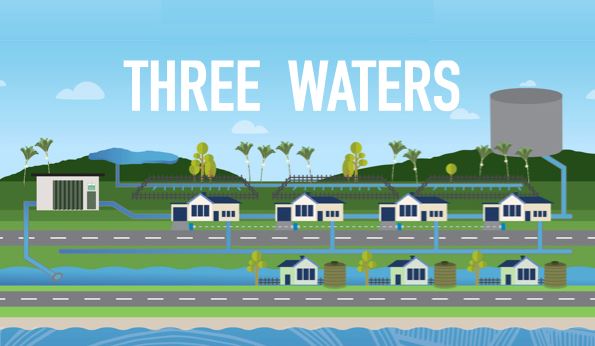
Three Waters: What’s Not To Like?

Zero Choices: The Sixth Labour Government’s plan: to seize the entire drinking, storm and waste water infrastructure of the nation, wrap it up in layer upon layer of legal Kevlar, and then, with the cheapest money taxpayers’ money can borrow, implement the sort of upgrades that generation after generation of cowardly local politicians have considered it more expedient to defer. What’s not to like?

WHERE ARE THE HEADS of Labour’s Caucus at? What was going through them when Nanaia Mahuta brought her “Three Waters” plan to them for ratification? What’s that you say? Nanaia didn’t bring Three Waters before Labour’s Caucus for ratification.

What a perfectly marvellous pre-1984 concept: Caucus Power!

No, this massive reform programme was just as likely to have been a Cabinet decision pure and simple. And, if The Daily Blog’s esteemed editor is to be believed, Three Waters wasn’t even Nanaia Mahuta’s idea – not really.

Apparently, the whole thing was dreamt up by David Parker, the Sixth Labour Government’s scary éminence grise. He sold his monstrous plan to Nanaia as the long-sought solution to the vexed issue of Māori and Water. A delighted Nanaia then sold it to her Māori colleagues, who, desperate for any sort of policy win (the latter being rather thin on the ground) seized it with both hands.

Which means that even if the Three Waters plan was brought in front of Labour’s Caucus for ratification, what Pakeha Labour MP in his or her right mind was going to incur the odium of raising “colonialist” objections to the fulfilment of the Crown’s te Tiriti obligations? Nobody – that’s who.

So, assuming that it was indeed the Talented Mr Parker who came up with this plan: to seize the entire drinking, storm and waste water infrastructure of the nation, wrap it up in layer upon layer of legal Kevlar, and then, with the cheapest money taxpayers’ money can borrow, implement the sort of upgrades that generation after generation of cowardly local politicians have considered it more expedient to defer; where’s the problem?

Surely it makes the very best kind of sense to nationalise the whole shebang? Surely, Mr Parker’s four “Entities”, all of them operating under “professional governance”, will manage the three waters for the benefit of the whole community – not just in the interests of the farmers, developers and industrialists who, for more than a century, have run local government as a wholly-owned subsidiary of Kiwi Capitalism Incorporated? Surely, what Mr Parker is offering us is Socialism? So, come on Comrades – what’s not to like?

One word, six syllables: Sub-sid-i-ar-it-y.

Never heard of it? Well, yeah, that’s because most of us grew up in New Zealand, not Europe. Subsidiarity is a well understood and respected concept in the nations of the European Union.

Terrific. What does it mean?

According to Wikipedia: “Subsidiarity is an organizing principle [which holds] that matters ought to be handled by the smallest, lowest or least centralized competent authority. Political decisions should be taken at a local level if possible, rather than by a central authority.”

It does not require a Professor of Political Studies to point out the synergies between Subsidiarity and Democracy. If all politics is, ultimately, local, then all democratic politics must have a local component.

Who do you call if your rubbish isn’t collected? The Council.

Who lays on the bus service? The Council.

Who makes sure clean water comes out when you turn the tap? The Council – oh – wait a minute.

Yes, yes, yes, I know: when people turned on their taps in Havelock North the water that came out wasn’t clean. Four people died. Thousands became ill. The locals were enraged. They demanded answers – and clean water. And, guess what: they got both. Subsidiarity and Democracy worked.

If “The Council” hadn’t cleaned up Havelock North’s water, then the voters of Havelock North would have elected themselves another. That’s what Democracy is all about: accountability from the governors because, ultimately, they derive their “just powers” from “the consent of the governed”.

Now, ask yourself, how accountable will these Parker/Mahuta “Entities” be to the people who turn on their taps? Because, let’s be very clear here, no ordinary person gets to vote for any of the people providing “professional governance” for the Three Waters “Entities”. Indeed, the entire system is designed to keep the ordinary person as far away from the people making the decisions as possible.

As currently designed the system works like this: Your vote contributes to the formation of a Council. Your Council’s vote contributes to the formation of a group of people whose job it is to appoint the people who will appoint the people who will run the “Entity”.

So, if there’s a problem with your water, who do you call? Not your Council – that’s for sure. While it may technically “own” the “entity” (or, at least, a part of it) it does not control it. There’s no point in calling the bodies which appoint the people who run the “entity” either, their job is done.

So, where’s the problem? You just call the “Entity”.

Yep, you can do that. It may be headquartered in a city 200 kilometres away. The person at the other end of the phone may never have so much as driven through your town. Complaints may be coming into the call centre you’ve reached every few seconds. So – good luck with that.

What featherbrained bunch of bureaucrats dreamed up this complicated and unaccountable system? The answer, sadly, is bureaucrats who wanted the new Three Waters “Entities” to be able to borrow the billions needed to upgrade our drinking, storm and waste water systems as cheaply as possible. To achieve this, they rang Standard & Poors – the credit-rating agency – and asked them what they needed to do – structure-wise – to get the best deal. The ratings agency (surprise, surprise) told them that the “Entities” had to be sealed-off, hermetically, from the influence and interference of interested parties – i.e. you and me. In the jargon: the Councils and the “Entities” had to have “separate balance sheets”.

Please don’t tell me you’re surprised. That’s how Neoliberalism works. It does all it can to insulate the key economic and social decision-makers from the influence and interference of politicians elected by the people on the receiving-end of those same decision-makers’ resolutions. On the Neoliberal balance sheet, Subsidiarity and Democracy simply do not add up.

Whatever else his Caucus colleagues may discover on the Talented Mr Parker’s “To Do” list, they will not find any plans to introduce Socialism via the water supply.


This essay was originally posted on The Daily Blog of Friday, 29 October 2021.

Friday, 24 January 2020

The Thoughtful Mr Parker.

Stunningly Wrong-Headed: So blinded are the “left-wing” believers in free markets and free trade (like Trade Minister, David Parker) that even when they are staring directly at the wreckage of the lives and communities which these “unconscionable freedoms” (to borrow Marx’s telling phrase) have left in their wake, they cannot see it.

DAVID PARKER is among the more thoughtful members of Labour’s caucus. On his Politik website, the veteran political journalist, Richard Harman, describes him as someone with “an unerring ability to get up the noses of his many critics”, a talent I have long taken as proof positive of serious cogitation. But, as Harman goes on to say, Parker is also “a sober-suited Dunedin lawyer who was a close associate of the buccaneering entrepreneur, the late Howard Patterson”. He is, therefore, a man to whom it is reasonable to attribute a solid working knowledge of free-market capitalism, and profound ignorance of the tenets of democratic socialism.

Like so many of Labour’s neoliberal-capitalism’s-about-as-good-as-it-gets brigade, Parker is no fan of populism. Truth to tell, it frightens him. Fear is, however, an important step up from scorn – which has, for some time, been the default setting for all those “centre-left” politicians who still regard Bill Clinton and Tony Blair as “pretty straight-up guys”. The sort of people who actually believe that Hillary Clinton was defeated by the Russians, rather than weighed in the balance and found wanting by her fellow citizens.

One of the reasons why Hillary was found wanting was her notorious description of opponent Donald Trump’s supporters as a “basket of deplorables”. It is actually quite hard to think of a description more calculated to enrage those working-class voters from Pennsylvania, Wisconsin and Michigan who had twice pulled the lever for Barack Obama, yet remained unconvinced that the First Lady who’d been such a strong supporter of her husband’s North America Free Trade Agreement was the sort of Democrat to put the interests of American workers ahead of American bosses. (Their doubts in this regard were, by the way, entirely justified!)

I sense that Parker struggles just as hard to see those who oppose “free trade” as anything other than deplorably ill-informed. Thinking about it, however, he has come to the conclusion that the populist push for protectionism is, in reality, a symptom of what he calls “middle-class insecurity”.

What has prompted these feelings of middle-class insecurity? Well, as Parker told last year’s Otago Foreign Policy School, the causes are “pretty easy” to identify:

 “[E]normous rises in inequality, with so much wealth going to the one per cent, not just overseas, but also in New Zealand, which is exemplified by dropping homeownership rates and a sense amongst the public that trade agreements have been made for the benefit of multinationals rather than small businesses.”

Parker’s analysis is stunning in its wrong-headedness. In concentrating upon the feelings of the middle-class, it fails to identify the central core of populism’s attraction for the working-class voters who opted for Trump over Clinton and Boris Johnson over Jeremy Corbyn. Namely, their deep-seated loathing of precisely the sort of middle-class people who dismiss them as deplorable losers in the game of life they are so obviously winning.

So bitterly do working-class people resent the disdain in which the professional middle-class enablers of the One Percent’s excesses hold them, that they are willing to vote for a narcissistic billionaire, a tousle-haired toff, and all the other killer-clowns shrewd enough to recognize their pain – and not blame them for it.

That recognition is both the key to populism’s success and the explanation for the steady collapse of social-democratic and labour parties around the world. So blinded are the “left-wing” believers in free markets and free trade, that even when they are staring directly at the wreckage of the lives and communities which these “unconscionable freedoms” (to borrow Marx’s telling phrase) have left in their wake, the Parkers of this world cannot see it. Almost unbelievably, they’ve convinced themselves that its “middle-class insecurity” that’s jeopardising their political fortunes; utterly unaware that the real cause of their parties’ electoral disintegration is old-fashioned working-class rage.

It takes a special kind of political operative to grasp this reality: someone whose driving motivation is to tear the whole rotten edifice down and begin again; someone like Trump’s Steve Bannon or Johnson’s Dominic Cummings; Neos who haven’t swallowed the Blue Pill.

Fortunately – or unfortunately – that’s not David Parker. A thinker he may be, but his thoughts never seem to stray towards the unconventional. Rather than learning his politics at the feet of a capitalist buccaneer, he’d have done better to find himself an anarchist.

This essay was originally published in The Otago Daily Times and The Greymouth Star of Friday, 24 January 2020.

Saturday, 12 October 2019

Sage Decisions Unwisely Over-Ruled.

Overruled: The joint decision of Finance Minister, Grant Robertson (Labour) and his Associate Minister, David Parker (Labour) arguably the two most powerful ministers in Jacinda Ardern’s government, to grant OceanaGold the consents which Land Information Minister, Eugenie Sage (Greens) had earlier denied them, offers bitter proof of how hard fighting Climate Change is going to be.

EARLIER THIS WEEK, several hundred young Wellingtonians laid siege to the Ministry for Business, Innovation and Employment (MBIE) on Stout Street in the heart of the capital. Their Extinction Rebellion protest was the first in a noisy series of similar demonstrations set to take place across the world. Had they known that two senior Labour ministers would, the very next day, over-rule the anti-mining decision of the Greens Land Information Minister, Eugenie Sage, their protest might not have been so good humoured.

The joint decision of Finance Minister, Grant Robertson, and his Associate Minister, David Parker (arguably the two most powerful ministers in Jacinda Ardern’s government) to grant OceanaGold the consents which Sage had earlier denied them, offers bitter proof of how hard fighting Climate Change is going to be.

In refusing the company its consents, Sage had argued that the mine’s proposed expansion was “inherently unsustainable, will increase emissions, and will provide only moderate employment benefits relative to winding down the operation and remediating the site”.

If Climate Change is to be fought successfully, judgements such as Sage’s will have to be issued by the thousand. Businesses large and small, in the cities as well as in the countryside, will have to be told, bluntly, that what they are proposing has become unacceptable. That the days of companies making profits, by passing on the environmental costs of those profits to future generations of taxpayers, are over. That the facts of economic life have changed.

A progressive government that was serious about its promise to make Climate Change the nuclear-free moment of its generation, would have stood behind Sage’s decision. If only to demonstrate that the painful but necessary decisions it would increasingly be required to make could not be undermined, second-guessed and generally got-around by hiring expensive lobbyists to whisper scary stories in senior ministers’ ears. Leading the charge in this respect should be the Finance Minister. No one else can speak to the business community with such authority.

But, what did the Finance Minister and his Associate Minister actually do? How did they express their solidarity? Well, in their media release of Tuesday, 8 October, they expressed it like this:

“In August 2019, Land Information New Zealand’s Overseas Investment Office (OIO) received two new applications from OceanaGold to buy the parcels of farm land totalling approximately 180 hectares near its current Waihi mines.

“In respect of the new applications the ministerial decision making roles were transferred to Ministers Robertson and Parker, who have policy responsibilities under the Overseas Investment Act, to ensure a fresh analysis of the application.

“The OIO considered the new applications under the benefit to New Zealand pathway of the Overseas Investment Act and recommended to Ministers the applications be approved.”

Ministers Robertson and Parker duly approved the OIO’s recommendation. OceanaGold’s investment, they said would: “benefit New Zealand because of the retention of about 340 full-time jobs over nine years and exports valued at $2 billion over nine years.”

It is hard to think of a more naked admission by this government that, when confronted with a choice between acting to save our environment and “business as usual”, it will unfailingly choose “business as usual”. Robertson and Parker have stripped away all the star-dusted rhetoric, and thrust forward the unadorned reality for everyone to see. Jobs and export earnings: the very same drivers that have persuaded government-after-government to put off saving the environment until tomorrow, on account of the heavy political costs associated with saving it today, clearly remain as powerful as ever.

Is this what the Greens signed-up for? To see their ministers humiliated? To have their policies ignored and their decisions over-ruled? To have the threat of corporate legal action trump any and every attempt at climate action?

In the light of this decision, the Greens must surely reassess their position vis-à-vis Labour and NZ First, Those among them (yes, we are looking at you James Shaw) who argued that ministerial portfolios would allow the party to do things that shouting from the side-lines could never achieve, stand rebuked by Robertson’s and Parker’s ruthless intervention. They have made it clear that any Green Party ministers who believe themselves free to act independently, according to the evidence, should think again.

And so should Extinction Rebellion, because, clearly, MBIE is the least of their worries.

This essay was originally published in The Otago Daily Times and The Greymouth Star of Friday, 11 October 2019.

Friday, 4 January 2019

2019 - If We Get Lucky.

Sweet Dream Scenario:  As Vice-President Mike Pence is being sworn-in as the 46th President of the United States - following Trump's sudden resignation - he suffers a massive heart attack and dies. His constitutionally designated successor is the Speaker of the House of Representatives, Nancy Pelosi. By a strange twist of fate, the United States of America gets its first female president after all.

PREDICTING THE FUTURE is a mug’s game. If it could be done, then gambling would be impossible and stockmarkets would crash. Not that these and a host of equally strong objections ever prevented professional seers from giving us the benefit of their prognostications. Some of them, by the simple law of averages, will be correct. Most, however, will not. This is because, as a wise woman once said: “We do not see things as they are, we see them as we are.”

In that spirit, allow me to describe the coming year as it might look – if we get lucky.

If we get lucky, then Special Prosecutor Robert Mueller will present a report which damns President Donald Trump in ways unanticipated in even his worst nightmares. Republican and Democratic legislators, alike, conclude that his continuing occupation of the White House has become untenable.

Congressional leaders privately inform the President that there is more than enough support in both the House and the Senate to secure his impeachment. The President reaches for his cell-phone – only to discover that the Deep State has prevailed upon Twitter to shut down his account. Realising that the jig is up, the President resigns.

As Vice-President Mike Pence is being sworn-in as the 46th President of the United States he suffers a massive heart attack and dies. His constitutionally designated successor is the Speaker of the House of Representatives, Nancy Pelosi. By a strange twist of fate, the United States of America gets its first female president after all.

If we get lucky, then the House of Commons decisively rejects Theresa May’s Brexit Deal. Defeated and exhausted, the Prime Minister advises the Queen to dissolve Parliament and call an early General Election. May then resigns.

A Special Conference of the Labour Party votes decisively in favour of making a Second Brexit Referendum the centrepiece of its election manifesto.

With the Conservatives torn by all manner of political and personal conflicts, Labour cruises to a landslide victory. For the first time in forty years, the United Kingdom has a socialist prime minister and an unashamedly left-wing government. The Second Referendum records upwards of 60 percent of Britons opting to remain in the European Union.

If we get lucky, then the Russian President, Vladimir Putin, negotiates a general peace settlement and mutual defence pact involving Turkey, Syria, Lebanon, Iraq and Iran. The Kurds secure regional autonomy within the Syrian state, guaranteed by the Russian Federation.

If we get lucky, then the Politburo of the Chinese Communist Party, fearful that President Xi Jinping is about to launch a massive purge of senior party cadres, deposes him. A hastily-summoned National People’s Congress, in a climate of unprecedented independence, elects a moderate reformer as Xi’s successor.

If we get lucky, then the National Party responds to a sharp decline in public support by jettisoning its current leader, Simon Bridges, and replacing him with Judith Collins. The choice of Collins is itself a reaction to the rapid rise of the right-wing populist New Conservative Party. Collins, it is hoped, will staunch the flow of National support to the NCP.

Appalled by this dramatic shift to the far-right, thousands of moderate National Party supporters swing in behind NZ First and Labour, lifting their combined support to nearly 60 percent of voters.

The Coalition Government, buoyed by this sudden shift in its fortunes, decides to reject the Tax Working Group’s recommendation favouring the imposition of a Capital Gains Tax. The Prime Minister, Jacinda Ardern, is persuaded by Winston Peters that such a tax would turn every farmer, small business owner and landlord in the country into her personal enemy. Finance Minister, Grant Robertson, resigns in protest. Jacinda replaces him with David Parker.

If we get really lucky, then the leadership changes in the USA, the UK and China produce a sudden and radical shift in the global approach to anthropogenic global warming. Rather than relying on yet another international conference, the leaders of the five permanent members of the UN Security Council meet in secret and thrash out a concrete plan for keeping the planet’s remaining reserves of oil and gas in the ground while they co-ordinate a planet-wide “Green New Deal”.

According to the wise, the only sure thing about luck is that it changes.

I’m counting on that being true.

Happy 2019!

This essay was originally published in The Otago Daily Times and The Greymouth Star of Friday, 4 January 2019.

Thursday, 22 February 2018

Too Little, Too Late: The Opportunity To Stop the CPTPP Has Passed.

Off The Hook: Since early-November 2017, the Labour-NZF-Green Government has been able to sell its message that the CPTPP represents a genuine improvement on the TPPA. So much so, that the street-based protest option has quietly dropped-off the anti-TPP agenda. That’s why the anti-TPP pressure group "It's Our Future" is promoting a “Day of Action” on 4 March 2018, rather than an honest-to-goodness protest march like the one that stunned New Zealand on 4 February 2016.

“TOO LITTLE, TOO LATE.” That’s what I would say to David Parker on the day he released the text of the Comprehensive and Progressive Trans-Pacific Partnership (CPTPP). With the signing ceremony due to take place in the Chilean capital, Santiago, on 8 March – a mere fortnight from the document’s release – the time available for thorough public scrutiny and debate is simply too short.

I would also say “Too little, too late” to Oliver Hailes, the new spokesperson for the anti-TPP pressure-group, It’s Our Future (IOF). He has announced a “Day of Action” against the CPTPP on Sunday, 4 March. But, at just four days out from the signing ceremony, what is IOF’s “action” supposed to achieve?

It’s hard to tell. In the bulletin released by Hailes, the Day of Action is described as:

“[A] Nationwide Day of Action across New Zealand in opposition to the Government’s plans. The Government intends to sign the treaty in Chile on Thursday 8 March and there will be an organised presence at Parliament on that day - watch this space, details are to come!”

Reading on, it becomes clear that IOF’s strategy in relation to the CPTPP is fundamentally unchanged from the strategy it adopted against its predecessor, the plain old Trans-Pacific Partnership Agreement (TPPA).

In Hailes’ own words:

“Signing is not the end of the process! [The CPTPP] must be presented to Parliament for debate, and then it will be referred to the Foreign Affairs, Defence and Trade Select Committee for examination. These are opportunities for all of you to have your say through written or oral submissions. Eventually the Select Committee will make a recommendation to the Government as to whether or not it should ratify the text and adopt implementing legislation to bring New Zealand law into line with its international commitments. And then, if the Government gets its way, New Zealand will undertake binding action. Each one of these steps provides an opportunity for you to intervene and let the Government know why it should turn back. Remember, the whole plan fell to pieces last time.”

Well, yes, it did, but only because President Donald Trump yanked the United States out of the Agreement at the last minute. Submissions to the Foreign Affairs, Defence and Trade Select Committee made absolutely to difference to the National Government’s plans to bring the TPPA into effect. It is fanciful to suggest that submitting to the same select committee on the CPTPP will produce anything other than exactly the same outcome.

Albert Einstein defined insanity as “doing the same thing over and over and expecting a different result”? The IOF should turn that quotation into a poster and pin it up on the wall above Oliver Hailes’ desk.

So, what would work? The answer, sadly, is that, right now, a fortnight out from the signing ceremony, it’s hard to see anything working.

Jacinda Ardern, Winston Peters and David Parker were vulnerable to the critics and opponents of what was then being called TPP-11 for only a very brief moment: the period immediately preceding, and immediately after, the Apec Meeting in Danang, Vietnam on 6-11 November 2017.

That was the period during which it became clear to all those who had trusted in Labour’s, NZ First’s and the Greens’ declared opposition to the TPPA, that the new coalition government was preparing to renege on its promises. If the IOF movement had called its 20,000-plus supporters onto the streets in early-November 2017, under the slogan “Hold Them To Their Word!”, then there might have been a chance of spooking Jacinda, Winston and David into resisting the pressure from MFAT, MBIE, MPI, Federated Farmers and Business NZ to treat their pre-election promise to defend New Zealand’s sovereignty as “just one of those things you say in Opposition and then forget about it Government”.

Sadly, the IOF did not activate its data-base of followers and lead them into the streets, with the result that, in the weeks and months that followed, the Government has been able to sell its message that the CPTPP represents a genuine improvement on the TPPA. So much so, that the street-based protest option has quietly dropped-off the anti-TPP agenda. That’s why Oliver Hailes is promoting a “Day of Action”, rather than an honest-to-goodness protest march like the one that stunned New Zealand on 4 February 2016.

Getting a handful of worthy souls to gather in city-centres and parks on 4 March 2018 and hold up a tired display of re-cycled placards and banners, is something IOF can manage. Putting 50,000 angry Kiwis on Queen Street is no longer within its power.

The impact will be negligible. A Government riding-high on 48 percent in the latest Colmar Brunton opinion poll has nothing to fear from a single day of [in]action.


This essay was originally posted on The Daily Blog of Thursday, 22 February 2018.

Tuesday, 14 November 2017

A Very Lucky Escape.

Brave Faces At Danang: David Parker and Jacinda Ardern field questions from the news media at the meeting of Apec in Danang, Vietnam. What the new Labour-led government needed more than anything else from this meeting was what they came home with - Time.

THE TRANS-PACIFIC PARTNERSHIP (TPP) is not dead, but neither can it be said to be in the rudest of health. Considerable last-minute diplomatic scurrying was required to save the Japanese government from a humiliating loss of face. Negotiations, accordingly, are said to be “continuing”. Nothing, however, should be expected before February 2018 – at the earliest. Which means that, for the moment at least, Prime Minister Jacinda Ardern and Trade Minister David Parker, like Canada’s Prime Minister, Justin Trudeau, have taken possession of the commodity they most needed to bring home from Danang – Time.

The situation into which Ardern was flying aboard the RNZAF’s Boeing 757 at the end of last week offered no guarantee that such precious time would be on offer. Danang was fraught with multiple dangers: economic, diplomatic and political.

As the leader of a small trading nation, New Zealand’s prime minister simply cannot affect a take-it-or-leave-it attitude to something as big as the TPP. The inescapable truth confronting Ardern (as it has every one of her predecessors) is that this country’s status as a first-world nation is inescapably contingent upon earning sufficient overseas currency to import the sort of lifestyle to which most Kiwis believe themselves entitled. Bluntly: faced with the choice of announcing whether her government is “in” or “out” of a major trade agreement; no New Zealand prime minister can say “out” with impunity.

All of the official advice the Prime Minister has received to date on the TPP will have kicked-off from that position. Certainly, it will have been the argument reiterated by the Ministry of Foreign Affairs and Trade (MFAT). It will also have been the lustily repeated refrain of this country’s major exporters. Likewise, from what might be called the “globalisation lobby” imbedded in NGO-land, academia and the media.

Taken together, a very large and intimidating crowd to say “no” to!

Even larger and much more intimidating, however, are the nation states determined to see the TPP (or, as it has rather tendentiously been re-named, the Comprehensive and Progressive Trans-Pacific Partnership – CPTPP!) ratified and implemented. The agreement’s principal cheerleader (now that the USA has withdrawn) is Japan, whose diplomatic reach proved to be more than long enough to secure Justin Trudeau’s return to the negotiating table. (It may have been Canada’s wish to walk away from the TPP-11 altogether, but Japan’s “arguments” were clearly “persuasive” enough to cause its prime minister to have second-thoughts and turn around!)

If Canada, with 36.3 million people and the second-largest economy of the remaining TPP signatories, couldn’t make it all the way to the departure lounge at Danang, then what were the odds of little New Zealand making it even as far as the door? New Zealand political leaders have only to review their country’s diplomatic, military and economic experience with the USA between 1984 and 2010 to gain some appreciation of the costs associated with taking a “principled stand”. World headlines last only a few days – their consequences can last for decades.

And then, of course, you have to come home.

It is probable that the National Party was hoping more earnestly than Professor Jane Kelsey and the entire New Zealand Left that Prime Minister Ardern would take a “principled stand” on the TPP. Had she stood up and said “no”, not only would she have felt the full wrath of Japan and its allies, but, from the moment her feet once again touched New Zealand soil, she would also have felt the full blast of a searing political firestorm.

The Urgent Debate in Parliament, which Speaker Mallard would have no choice but to grant the National Opposition, would only be the beginning. Day after day, the voices of exporters, business leaders, bank economists, business journalists, media commentators, academic experts and the globalisation lobby would be ringing in the Labour-NZ First-Green Government’s ears.

The Prime Minister and her Cabinet colleagues would then have just two political options: either back-down, or double-down.

If they backed-down, then Ms Ardern and her government would stand exposed as a bunch of juvenile attention-seekers who simply had not thought through the consequences of their irresponsible actions. It would be a full-scale debacle from which they could not recover.

But, doubling-down would be even worse. By adopting a sharp-edged, radically left-wing, stance on international trade at both the diplomatic and domestic levels, Ms Ardern’s government would rapidly find itself re-positioned among the world’s “nutty” nation states. Inevitably, New Zealand would find itself drifting, economically and diplomatically, under the influence of China and Russia. For an overwhelming majority of New Zealanders, this would represent an unmandated repudiation of everything their country stands for. Politically, it would be unsurvivable.

To Ms Ardern’s and Mr Parkers’ no doubt immense relief, both of these catastrophes have been avoided. They have had a very lucky escape.


This essay was originally published in The Press of Tuesday, 14 November 2017.

Friday, 3 November 2017

TPP: Fix It, Jacinda, Or Forget It.

Either render it harmless, Jacinda, or cast the TPP Ring of Power into the fires of Mt Doom. Otherwise, it will consume your own - and your government's - political will, and fatally undermine New Zealand's national sovereignty.

WHAT WILL HAPPEN if Prime Minister Ardern and Trade Minister Parker sign-up to the Trans-Pacific Partnership (TPP) without fixing it?

For a small, but powerful, group of New Zealanders it will be taken as a sign that the new, Ardern-led government can be relied upon to ‘do the right thing’. Like proud parents who’ve entrusted the family car to the care of their teenage daughter – and had it returned to them unscathed – the promoters of free trade will praise Ms Ardern for her political responsibility and maturity. That she put the interests of her country ahead of the wishes of her loopy left-wing supporters will be hailed as proof that New Zealand is in safe hands.

The nation’s editorial writers will take up the chorus: praising Ms Ardern’s steely resolve even as they pour scorn upon her critics’ complaints. The TPP’s opponents will be cast as a ridiculous collection of dinosaurs and dingbats; Trump supporters and tin-foil hat wearers. Any hopes they might have entertained of being listened to by the Labour-NZ First-Green Government will be publicly and viciously dismissed as delusional.

The National Party Opposition will delight in heaping their own shovelful of hot coals on the heads of Labour’s coalition partners. They will ferret out every impassioned plea from the Greens to reject the TPP as a corporate thieves’ charter. Likewise, every NZ First condemnation of the agreement as a deadly threat to New Zealand sovereignty. Every argument against the agreement will be rehearsed to a chorus of Tory chortles and guffaws. “Meet the new Labour bosses,” Bill English will perorate to his 56-strong parliamentary team: “same as the old Labour bosses!”

“How’s that hopey-changey thing goin’ for ya?”, Paula Bennett will demand of the Prime Minister in her best Sarah Palin drawl. “Tell us, sweetie, how’s the supply of stardust holding up?”

And the thousands of New Zealanders who marched against the TPP in February of 2016 – how will they react? Those Maori protesters who’d cut their political teeth on the hikoi against the alienation of the foreshore and seabed back in 2004, and had turned out again, twelve years later, in the face of what they perceived to be an even graver threat to the sovereignty of Aotearoa – what will they make of Labour’s decision?

How will Willie Jackson respond to Labour’s voters on the Maori Roll? The ones he’d so successfully persuaded to abandon the Maori and Mana parties for a renewed and reformed “Te Rōpū Reipa”? When they charge Labour with, once again, deceiving and betraying them – what will he say?

“If Labour can’t even say ‘No’ to the TPP’s Investor/State Dispute Settlement clauses, Willie, how can it – with any sort of credibility – say ‘Yes’ to Article Two of Te Tiriti o Waitangi? Our people tried to stop foreigners from purchasing Maori land – and we all know how that ended. It beggars belief that the Pakeha, having acquired virtually the whole of Aotearoa, are now getting ready to sell her all over again!”

And Jacinda, herself? How will she be changed by a decision to sign the TPP without fixing it first? Without paying heed to the Labour Party’s own warning, recorded in the parliamentary select committee report, that the TPP “will have ramifications for generations of New Zealanders. For their sake, we should not so lightly enter into an agreement which may exacerbate long-term challenges for our economy, workforce, and society.”

Because no leader can emerge unscathed from such a base repudiation of solemn promises given and received. If a political party undertakes to protect its compatriots’ homes and farms from foreign speculators; if it vows to prevent multinational corporations from bringing their government before an international tribunal for the ‘crime’ of defending its people’s interests; then that political party’s leader is going to pay a very high price for any failure to follow-through.

It won’t happen immediately, but with every broken promise (and there will be many because, after the first, breaking promises gets easier and easier) that sacred light in the eyes of her supporters will go out. The hope on their faces; the smiles on their lips; their delight in the selfies she helps them take: slowly at first, but then with gathering speed, all these manifestations of her specialness will fade.

 “Jacinda” will have become “just another f***ing politician”.


This essay was originally published in The Waikato Times, The Taranaki Daily News, The Timaru Herald, The Otago Daily Times and The Greymouth Star of Friday, 3 November 2017.

Thursday, 2 November 2017

Is The Government’s TPP “Solution” Too Good To Be True?

"Just one of those things you say in opposition and then forget about when you're in government." - Steve Maharey, former Labour cabinet minister. On the question of whether or not to support the TPP, is the new Trade Minister, David Parker (pictured above addressing an Auckland anti-TPP rally in 2016) preparing to follow in Maharey's philosophical footsteps?

WHAT WORRIES ME MOST about the proposed “No Foreign Buyers” amendment to the Overseas Investment Act (OIA) is its apparent simplicity. Nothing in politics is ever that easy! And isn’t it remarkable, the way the proposal just happens to solve Labour’s primary objection to the Trans-Pacific Partnership (TPP)? It’s almost as if somebody at the Ministry of Foreign Affairs and Trade (MFAT) had the relevant file tucked away in a draw somewhere, ready to be presented to the incoming Trade Minister, David Parker, with a Yes Minister-style flourish, at just the right moment.

Come to think of it, exactly when did the foreign-buyer problem become Labour’s primary objection to the TPP? More importantly, when did it become a more important issue than carving out the Investor/State Dispute Settlement (ISDS) provisions from the agreement? How did that ISDS carve-out end up as a sort of secondary issue? When did it become what Bill English used to call a “Nice To Have”? An outcome the Prime Minister and her Trade Minister will do their utmost to achieve, but not something over which neither of them are willing to offer concessions.

It makes no sense. The ISDS provisions of the TPP are the ones permitting foreign investors (a.k.a huge multinational corporations) to sue the New Zealand Government for imposing legislative and/or regulatory restrictions on their existing or proposed investments. Such litigation to occur not in a New Zealand courtroom, in front of a New Zealand judge, but before an international tribunal staffed and adjudicated by the sort of lawyers more usually to be found working for – you guessed it – “huge multinational corporations”.

How does that work? Well, a government pledged to uphold the provisions of a multilateral trade agreement might decide that, in order to secure its people’s right to access affordable housing, it will legislate to prevent foreign buyers from bidding-up the price of private dwellings beyond their reach.

“Oh no you don’t!”, objects the huge multinational corporation dedicated to acquiring foreign real estate on behalf of its fabulously wealthy international clients. And before that government can say “goodbye national sovereignty”, it finds itself in front of an ISDS tribunal.

I know, I know! The Trade Minister, David Parker, has assured us that providing the OIA is amended before the TPP comes into force, then New Zealand will be protected from the ISDS provisions of the agreement.

To which I offer the following two objections.

My first, is that David Parker’s “solution” logically foresees New Zealand being bound, in all other respects, by the TPP. Why else would he bother using this rather convoluted way of banning foreign property speculators? There must be simpler ways. The only logical answer is: because the new Labour-NZ First-Green Government is committed to signing the TPP – ISDS provisions included – and Parker’s “solution” is the only way it can keep its big election promise to end foreign property speculation.

My second, is that the new Government’s “solution” may prove to be not a solution at all. Even if the OIA is amended prior to the TPP coming into force, I believe that those foreign property investors affected might still have a crack at New Zealand under the ISDS provisions.

They could argue that the legislation banning them amounts to a pre-emptive circumvention of the agreement. The OIA’s original purpose of protecting “sensitive” land was to ensure that sites of environmental, historic and cultural significance remained in New Zealand hands. They could, therefore, argue that the amendment’s redefinition of “sensitive sites” to include private dwellings represents a deliberate perversion of the OIA’s original intention. As the victims of a pre-emptive circumvention of the TPP, they could demand that the ISDS tribunal award them billions of dollars by way of reparation. And what guarantee do we have that the corporate lawyers sitting in judgement of the New Zealand state’s actions wouldn’t find in favour of the plaintiffs?

That’s why I’m so uneasy about this amazing, eleventh-hour “solution”. I can’t help seeing it as too good to be true. Yes, it is acting as a superb distraction from the most dangerous aspect of the TPP – its ISDS provisions – but why? The arguments in favour of refusing to sign the TPP until New Zealand is exempted from those provisions are very easy to make – hell, they’re core NZ First and Green policy! – so why aren’t Jacinda and David making them?

What would make me a whole lot happier, is a rock-solid guarantee from the Prime Minister and her Trade Minister, that a TPP agreement containing ISDS provisions applicable to its own actions will not be entered into by the New Zealand Government.

Aotearoa must not surrender its tino rangatiratanga.


This essay was originally posted on The Daily Blog of Thursday, 2 November 2017.

Tuesday, 31 October 2017

Passing The TPP Test.

Test Mission: The way in which Prime Minister Ardern and Trade Minister Parker conduct themselves at the TPP-11 discussions in Danang, Vietnam, will have a major bearing on how the new Labour-NZ First-Green Government is perceived by its supporters. To sign the TPP, without first fixing it, would be to "Fail" the first major test of the Coalition's political resolve.

IN JUST NINE DAYS, Prime Minister Ardern, and her Trade Minister, David Parker, will be in Vietnam. At a side-bar gathering to the Apec Conference that summons them, they will meet with the remaining 11 signatories to the Trans-Pacific Partnership (TPP). At that gathering, the New Zealand government will attempt to negotiate a number of minor modifications to the agreement.

Essentially, the Prime Minister and Trade Minister will be asserting their country’s right to prevent foreign speculators from purchasing urban property and farmland within its borders. A right the previous National government, for reasons it never adequately explained, failed to assert. A right reserved by just about every other signatory to the TPP agreement.

The Prime Minister and Trade Minister will also assert New Zealand’s right to renegotiate its predecessors’ acceptance of the Investor/State Dispute Settlement (ISDS) procedures of the TPP. These are the procedures which grant foreign corporations the power to sue the New Zealand Government for legislating in what it believes to be the best interests of its own people. Such litigation will take place in corporate-controlled tribunals, without reference to the New Zealand judiciary. Once again, the previous National government’s failure to defend this, the most fundamental duty of any sovereign state, awaits a convincing explanation.

Presented in this fashion, the mission of the Prime Minister and Trade Minister is not only an important, but also a necessary, act of remediation. In its present form, the TPP should never have been signed by the former National Government. Accordingly, any failure on the part of the remaining 11 signatories to accede to the Labour-NZ First-Green Government’s entirely reasonable requests for minor, country-specific, modifications (President Donald Trump has already pulled the United States out of what he dismissed as “a very bad deal”) should trigger New Zealand’s immediate withdrawal from the agreement.

What a pity, then, that the Prime Minister’s and Trade Minister’s mission is not being presented in this fashion. Ms Ardern and Mr Parker will depart for Danang shrouded in the same obfuscating clouds of free-trade rhetoric that have prevented the New Zealand public from ever being vouchsafed a clear understanding of the TPP agreement.

Rather than allowing an open and informed debate on the pros and cons of the TPP, the free-trade lobby is presenting Ms Ardern’s trip to Apec as a crucial test of her political and economic maturity. Any outcome other than New Zealand’s unequivocal ratification of TPP-11 will be publicly represented as a significant failure.

Even if the Prime Minister and Trade Minister manage to secure their desired modifications to the TPP text, the free-trade fanatics will still insist that the Labour-NZ First-Green Government has fallen at its first hurdle. By displaying hostility to globalism in general, and foreign investment in particular, the new government will be accused of endangering New Zealand’s economic security.

As if that wasn’t reason enough for Ms Ardern and Mr Parker to feel nervous, the opponents of an unmodified TPP are as likely to turn her trip to Vietnam into a critical test of her government’s intentions as its supporters.

The fight to turn Labour away from what its “free-trade-right-or-wrong” position under Helen Clark has been as gruelling as it was long. For those engaged in this fight, persuading the Labour caucus to take a firm position on the critical question of national sovereignty constituted a pivotal victory. Without it, Labour’s relationships with NZ First and the Green Party would have come under enormous strain. Indeed, had Labour not refused to sign-on to the TPP, as negotiated by the National Government, it is difficult to see the formation of a Labour-NZ First-Green government ever becoming a realistic possibility.

Labour’s opposition to TPP was also an important factor in deescalating the vociferous protest movement which reached its crescendo in February 2016. Had all the parties committed to changing the government not been more-or-less on the same page in relation to the inadequacy of the National Party’s TPP, it is debateable whether or not the massive protest demonstrations it was beginning to inspire would have proved so easy to wind down.

To the New Zealanders who feared that TPP would bring with it a permanent loss of their nation’s sovereignty, the following words from Labour were a source of considerable reassurance:

“The TPPA will have ramifications for generations of New Zealanders. For their sake, we should not so lightly enter into an agreement which may exacerbate long-term challenges for our economy, workforce, and society.”

The votes that made the Labour-NZ First-Green government possible were inspired by many factors. That the three parties’ common opposition to the TPP was one of then cannot be disputed.

As Ms Ardern and Mr Parker wing their way to Vietnam, they should consider very carefully whose test of free-trade principles they most wish to pass.


This essay was originally published in The Press of Tuesday, 31 October 2017.