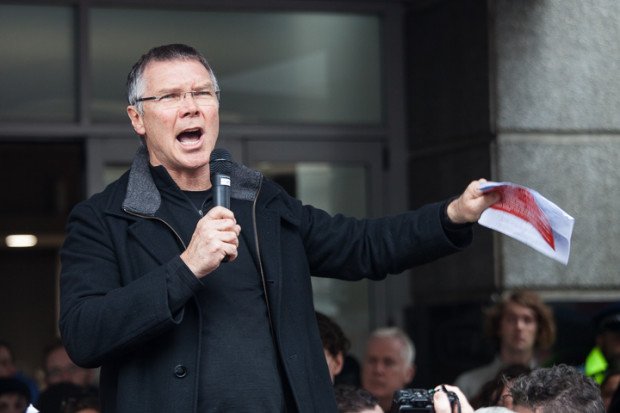
Off The Hook: Since early-November 2017, the Labour-NZF-Green Government has been able to sell its message that the CPTPP represents a genuine improvement on the TPPA. So much so, that the street-based protest option has quietly dropped-off the anti-TPP agenda. That’s why the anti-TPP pressure group "It's Our Future" is promoting a “Day of Action” on 4 March 2018, rather than an honest-to-goodness protest march like the one that stunned New Zealand on 4 February 2016.
“TOO LITTLE, TOO LATE.” That’s what I would say to David
Parker on the day he released the text of the Comprehensive and Progressive
Trans-Pacific Partnership (CPTPP). With the signing ceremony due to take place
in the Chilean capital, Santiago, on 8 March – a mere fortnight from the
document’s release – the time available for thorough public scrutiny and debate
is simply too short.
I would also say “Too little, too late” to Oliver Hailes,
the new spokesperson for the anti-TPP pressure-group, It’s Our Future (IOF). He
has announced a “Day of Action” against the CPTPP on Sunday, 4 March. But, at
just four days out from the signing ceremony, what is IOF’s “action” supposed
to achieve?
It’s hard to tell. In the bulletin released by Hailes, the
Day of Action is described as:
“[A] Nationwide Day of Action across New Zealand in
opposition to the Government’s plans. The Government intends to sign the treaty
in Chile on Thursday 8 March and there will be an organised presence at
Parliament on that day - watch this space, details are to come!”
Reading on, it becomes clear that IOF’s strategy in relation
to the CPTPP is fundamentally unchanged from the strategy it adopted against
its predecessor, the plain old Trans-Pacific Partnership Agreement (TPPA).
In Hailes’ own words:
“Signing is not the end of the process! [The CPTPP] must be
presented to Parliament for debate, and then it will be referred to the Foreign
Affairs, Defence and Trade Select Committee for examination. These are
opportunities for all of you to have your say through written or oral
submissions. Eventually the Select Committee will make a recommendation to the
Government as to whether or not it should ratify the text and adopt
implementing legislation to bring New Zealand law into line with its
international commitments. And then, if the Government gets its way, New
Zealand will undertake binding action. Each one of these steps provides an
opportunity for you to intervene and let the Government know why it should turn
back. Remember, the whole plan fell to pieces last time.”
Well, yes, it did, but only because President Donald Trump
yanked the United States out of the Agreement at the last minute. Submissions
to the Foreign Affairs, Defence and Trade Select Committee made absolutely to
difference to the National Government’s plans to bring the TPPA into effect. It
is fanciful to suggest that submitting to the same select committee on the
CPTPP will produce anything other than exactly the same outcome.
Albert Einstein defined insanity as “doing the same thing
over and over and expecting a different result”? The IOF should turn that
quotation into a poster and pin it up on the wall above Oliver Hailes’ desk.
So, what would work? The answer, sadly, is that, right now,
a fortnight out from the signing ceremony, it’s hard to see anything working.
Jacinda Ardern, Winston Peters and David Parker were
vulnerable to the critics and opponents of what was then being called TPP-11
for only a very brief moment: the period immediately preceding, and immediately
after, the Apec Meeting in Danang, Vietnam on 6-11 November 2017.
That was the period during which it became clear to all
those who had trusted in Labour’s, NZ First’s and the Greens’ declared
opposition to the TPPA, that the new coalition government was preparing to
renege on its promises. If the IOF movement had called its 20,000-plus
supporters onto the streets in early-November 2017, under the slogan “Hold Them
To Their Word!”, then there might have been a chance of spooking Jacinda,
Winston and David into resisting the pressure from MFAT, MBIE, MPI, Federated
Farmers and Business NZ to treat their pre-election promise to defend New
Zealand’s sovereignty as “just one of those things you say in Opposition and
then forget about it Government”.
Sadly, the IOF did not activate its data-base of followers
and lead them into the streets, with the result that, in the weeks and months
that followed, the Government has been able to sell its message that the CPTPP
represents a genuine improvement on the TPPA. So much so, that the street-based
protest option has quietly dropped-off the anti-TPP agenda. That’s why Oliver
Hailes is promoting a “Day of Action”, rather than an honest-to-goodness
protest march like the one that stunned New Zealand on 4 February 2016.
Getting a handful of worthy souls to gather in city-centres
and parks on 4 March 2018 and hold up a tired display of re-cycled placards and
banners, is something IOF can manage. Putting 50,000 angry Kiwis on Queen
Street is no longer within its power.
The impact will be negligible. A Government riding-high on
48 percent in the latest Colmar Brunton opinion poll has nothing to fear from a
single day of [in]action.
This essay was
originally posted on The Daily Blog
of Thursday, 22 February 2018.