Showing posts with label Railways. Show all posts

Tuesday, 20 April 2021

A Fast Train To A Sustainable Future.

Future Proofed: KiwiRail needs to become an all-electrically-powered, broad-gauged, and comprehensively re-equipped state-owned enterprise with state-of-the-art locomotives and rolling-stock. An infrastructure project of massive proportions and prodigious expense is required. But, when it is completed, New Zealand will have a sustainable, twenty-first century transportation network, capable of carrying both passengers and freight at high speed from Cape Reinga to Bluff – and all important points in between.

TE HUIA, the “fast train” to “Auckland” has been a subject of some contention in my family. My brother-in-law thinks it’s a great thing. His sister (my wife) thinks it’s the worst sort of white elephant – the eye-wateringly expensive kind. I agree. Te Huia represents the very worst kind of compromise: the sort that saps the strength of the original proposition by confirming the strongest arguments of its detractors. This train isn’t fast and it doesn’t take you to Auckland. The best that can be said for Te Huia is that it reminds us of what we should have – but don’t.

In a sensible country – a grown-up country – Hamilton would be linked to Auckland by the sort of rail services New Zealanders encounter (and travel on) overseas. Trains like Trenitalia’s alta velocita (high speed) service that took my family from Venice to Florence – a journey of 260 kilometres – in just 2 hours. Hamilton is 93 kilometres from Te Huia’s destination, Papakura. The journey takes 1.5 hours! Hamilton to Papakura by car is a journey of barely an hour. To put it bluntly: Te Huia is not a serious rail service. A serious rail service would take passengers from downtown Hamilton to downtown Auckland in half-an-hour.

A serious rail service cannot be delivered to New Zealanders, however, unless and until our narrow gauge railway tracks are replaced by the much broader gauge required for high-speed trains. That New Zealand engineers weren’t permitted to opt for a broader gauge at the time the tracks were laid is just another example of those idiotic penny-pinching decisions that have plagued this country’s development for more than 150 years. The narrow-gauge “solution” was cheaper and allowed more track to be laid, but the long-term consequences were dire. New Zealand’s railway tunnels are as narrow as its railway tracks. Opting for a broader gauge would necessarily entail widening those tunnels – an eye-wateringly expensive proposition.

Too expensive. For New Zealand governments of all complexions it was easier to just go along with the conventional wisdom that dismissed railway transportation as yesterday’s technology. The private motor vehicle and the heavy lorry were deemed to have done away with the whole economic rationale for a comprehensive rail network. Investment faltered, efficiency declined, and the public lost faith in the state-owned New Zealand Railways.

This suited some people just fine. For the Right, railways had always smacked of socialism. Capitalism may have made billions out of railways in the nineteenth century, but in the twentieth all the smart money was on cars, trucks and aeroplanes. Even on the Left, arguments in favour of rail transport tended to be dismissed as the grunting of technological dinosaurs. Rail’s glory days, it was confidently assumed, had come and gone.

In New Zealand, this dismissive attitude was further entrenched by the gauge problem. The arrival of high-speed trains in the 1960s and 70s may have altered the financial calculations in places like Japan and France, but not here. New Zealand’s narrow gauge could not accommodate the new “bullet trains”, and no one was prepared to invest the sort of money that would allow the country to begin again with the new and improved rail technology.

Matters were not improved by the decision of the neoliberal Fourth Labour Government to turn NZ Railways into the poster-child of inefficient public ownership. Story after story was fed to the news media about the rail network’s extraordinary stuff-ups. Heavy machinery was said to have simply disappeared – only to turn up months later on some forgotten railway siding. Even worse, the whole organisation was described as over-manned. State ownership permitted workers who would otherwise be unemployed to have a job – or, as Richard Prebble might have said: "If sitting around brewing tea and smoking cigarettes can be called a job!"

The 1993 fire-sale of the once proud NZ Railways to private American interests was thus presented as a sort of mercy killing. At least the New Zealand taxpayer was no longer on the hook for its costly inefficiencies. A decade later, however, it was clear that New Zealand simply couldn’t do without a functioning railway network – not if Kiwis wanted highways they could drive on safely. What had been TranzRail became KiwiRail, as, once again, the network was brought under state control.

Just as well. The looming threat of Climate Change meant that the fossil-fuel powered transportation systems of the nineteenth and twentieth centuries could no longer be permitted to carry the lion’s share of passengers and freight. Though no one was brave enough to come right out and say so, New Zealand (along with many other countries) was objectively required to completely reconfigure and upgrade its rail network.

KiwiRail needs to become an all-electrically-powered, broad-gauged, and comprehensively re-equipped state-owned enterprise with state-of-the-art locomotives and rolling-stock. An infrastructure project of massive proportions and prodigious expense is required. But, when it is completed, New Zealand will have a sustainable, twenty-first century transportation network, capable of carrying both passengers and freight at high speed from Cape Reinga to Bluff – and all important points in between.

This new KiwiRail would make it possible for a commuter bound for downtown Auckland to board the high-speed Te Huia service in the heart of Hamilton at 7:45am and meet his business contact in Aotea Square at 8:20am for breakfast.

My brother-in-law should not settle for the present service’s very, very poor second-best – and neither should the rest of us.


This essay was originally posted on The Daily Blog of Tuesday, 20 April 2021.

Tuesday, 14 August 2012

Running On Different Lines

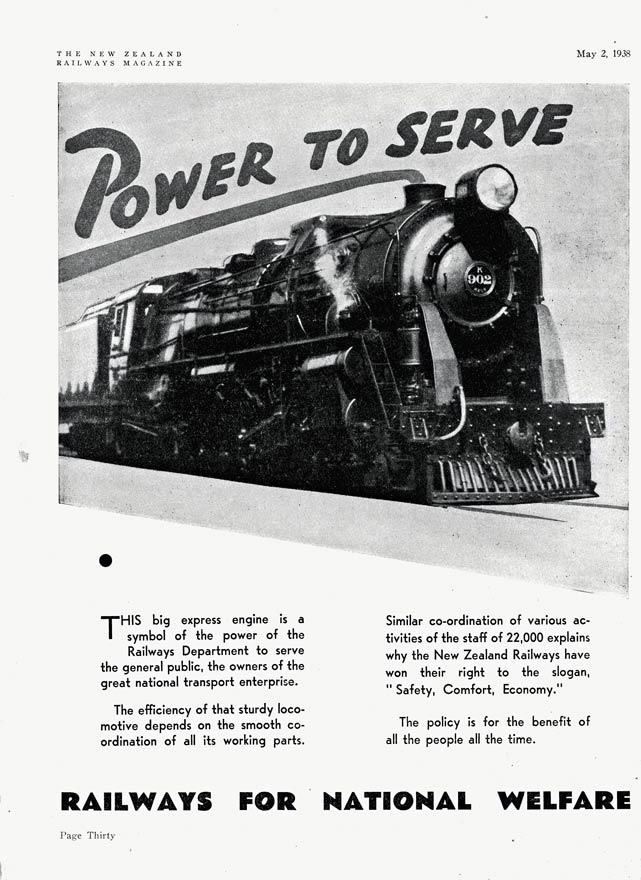
A Different Ethos: A page from the May 1938 issue of the New Zealand Railways Magazine. There are more ways to measure the value of an enterprise than simple profit and loss.

THE FLINTY-FACED MEN who run everything these days will call me a hopeless romantic, but I won’t care. They’ll point to the bottom line of the company’s accounts and shake their heads. “This is a business,” they’ll say, using that patient tone reserved for fools and children. “It must be run as a business.” But I won’t be convinced.

“Business”, no matter how hard its backers try to convince us otherwise, does not belong in the same ontological category as “Weather”. It’s not something we simply have to live with because, no matter how much we talk about it, or complain about it, we cannot change it. Businesses are the work of men and they are whatever men tell them to be. Bottom lines can be made to measure more than profit and loss.

The New Zealand Railways used to have 20,000 workers on its payroll. On the trains and railcars and electric units there were engineers, conductors and guards. In the stations and marshalling yards there were station-masters, schedulers, pointsmen, shunters and ticket-sellers seated in narrow booths. In the railway workshops hundreds of highly skilled tradesmen designed and built locomotives and rolling stock, refurbished carriages and undertook running repairs and maintenance. Up and down the thousands of miles of track gangs of railway workers checked the signalling gear, maintained the rails and ties and sleepers, noted signs of wear and tear and assessed the risk of washouts and slips. In between keeping the network safe, at ten and twelve and three o’clock, you’d see them hunched around a primus stove, boiling a billy, smoking a fag, chewing the fat. Working men, gainfully employed, bringing home a living wage to their wives and children.

How do you fit that picture into your bottom line, Mr Businessman?

How do you measure the value of kids growing up in working families where Dad and Mum pointed with pride to the great machines that the brains and hands of working people had made? What price do you put on the mastery of the complex tools, the lathes and presses, that produced the components that kept the machines running? Or the lifetime of productive work that their makers could look back on, and their sons and daughters aspire to? Where, on your bottom line, Mr Businessman, do you account for the vibrant neighbourhoods radiating out from the marshalling-yards and workshops at their heart? The shops and the supermarkets where people gathered and swapped gossip; the pubs and clubs where they argued about sport and politics? Are they not worth as much as the working-class neighbourhoods of China?

If you were honest, Mr Businessman, you’d tell me (sotto voce) that, really, it’s not THE bottom line that matters, but WHOSE.

The railways belonged to the people, but the road haulage companies belonged to their shareholders. Hardly surprising, then, that under the shareholders’ political party roads and lorries began to take precedence over rails and locomotives. When budgets were being drawn up it was to concrete and bitumen that the funds were allocated – not diesel oil, steel and hardwood sleepers. In other parts of the world the symbols of modernity were high-speed trains and light-rail public transportation networks, but here in New Zealand the future belonged to six-lane highways and 18-wheeler trucks.

Symbols Of Modernity: High-speed trains became emblems of progress and technological prowess in Japan, Western Europe and China - but not in New Zealand.

In 1986 the party that had pledged to “Save Rail” corporatized it. NZR became an SOE and from that moment on it was to be run as a business, with a business’s bottom line, and a business’s ruthlessly “downsized” workforce.

At the stroke of a pen, all the benefits that could not be accommodated in the accountant’s ledger ceased to matter. The benefit of having people gainfully employed and paying taxes instead of rotting on the dole. The benefit of working-class kids aspiring to be skilled tradespeople rather than patty-flippers at Macdonalds. The benefit of having socially coherent and flourishing neighbourhoods rather than decaying factories and weed-infested marshalling yards full of young people without jobs getting high on drugs where their fathers and mothers once earned a decent wage.

But that’s the way it was. New Zealand had joined the “Real World” of global markets and bloodless calculators. Railways were so … well … Nineteenth Century. Horny-handed sons of toil poring coal into puffing-billies. Away with them! Sell it to the highest bidder (and the friends of the highest bidder). Strip out the assets. Let the rest run down. Then (and this is the point where it’s really important to keep a straight face) sell it back to the people at a price that has nothing to do with the bottom line.

Still, we romantics are patient folk. As the Earth’s atmosphere heats up, and Peak Oil plays havoc with the truckers’ profits, those much-despised and long-neglected rails are beginning to hum.

This essay was originally published in The Press of Tuesday, 14 August 2012.

Thursday, 22 September 2011

Party Like It's 1949

The Auckland That Never Was: The visionary 1940s urban design of Ernst Plischke would have given birth to an Auckland with a decidedly European feel. Held together by its ultra-modern light-rail system and high-density state-housing, the city would have become the Stockholm of the South Seas. The defeat of the First Labour Government in 1949 put an end to the Ministry of Work's grand plan, and, under successive National Government's, Auckland was transformed into the car-dependent, South Seas version of  Los Angeles we have today.

THE DEBACLE that was Auckland’s public transport system last Friday night was more than sixty years in the making. That’s how long it’s been since a group of brilliant urban planners, based in the Ministry of Works, sent their blueprint for post-war Auckland to Parliament. Had the Labour Party won just 50,000 more votes in the 1949 general election, that blueprint would have become reality, and Auckland would now be a very different city.

But, Labour lost the ’49 election, and the National Party government which replaced the planning-friendly administration of Peter Fraser was not impressed by the MoW’s version of Auckland’s future.

As far as the National Party was concerned, Auckland’s post-war growth was the business of the private sector – not the state. Housing construction, and the infrastructure required to service the new suburbs of the 1950s, would, as far as possible, be the preserve of commercial builders and contractors.

National’s belief in individualism and self-reliance similarly militated against the MoW’s plans for an Auckland woven together by an extensive network of electric railway units on the Hutt Valley model. The government of Sid Holland was convinced that the future belonged to the private automobile. In the nostrils of the Nats, trains always carried the whiff of socialism.

They still do – as anyone who has listened to Transport Minister Steven Joyce’s paeans of praise to the virtues of the motor car can attest.

To be fair, however, the failure to create a modern public transportation network in Auckland is not the National Party’s alone.

One of the largest and most important elements in the import substitution plans drawn up by the Second Labour Government, were the car assembly plants. Not only were these factories intended to save overseas funds, but they were also excellent devices for manufacturing loyal Labour voters. The MoW’s plans for an Auckland that ran on rails continued to gather dust.

It would be another 12 years before Labour was again in office. By the 1970s, the party needed little convincing of the shortcomings of Auckland’s congested car culture. Finally, Labour was ready to back (but not to fund) the plans for a light-rail network that Auckland’s indomitable Mayor, Sir Dove-Myer Robinson, had been advocating for more than a decade.

They had not reckoned on Sir Robert Muldoon.

The monstrous hydra of motorways continued to grow, along with the number of cars crawling along it’s sinuous necks.

Labour’s neoliberal conversion in the 1980s saw the railways ruthlessly downsized and readied for privatisation. Free marketeers drove cars: public transport (especially trains) were for state-subsidised losers.

Not even the election of a Labour-Alliance government in 1999 was enough to halt the madness. And when Prime Minister Helen Clark backed and won New Zealand’s bid for the Rugby World Cup 2011, there was scant understanding of what that would require of Auckland’s public transportation system, and even less enthusiasm for making it happen.

Labour’s finance minister, Dr Michael Cullen, could have left Auckland with a modern, electrified, light-rail network. Egged on by his Treasury advisers, he chose instead to prevaricate and delay. His successor, Bill English, at least had the excuse of a global financial crisis – not to mention the disadvantage of a Transport Minister who never saw motorway plans he didn’t fall in love with at first sight.

And so, when we most needed it to succeed, Auckland’s rail network simply collapsed under the sort of numbers most modern cities move about every day of the week.

Visitors here for the World Cup from Western Europe and North America must have wondered what they’d struck. Gazing incredulously at last Friday’s hopeless snarl of decades-old, diesel-belching locomotives, and SRO carriages lacking effective air-conditioning, a working PA system, and the professional assistance of trained railway-guards; they must have asked themselves if they really were in a first-world city, in the 21st Century.

Nope – on both counts. In Auckland, if you’re looking for efficient public transport by rail, it’s always 1949.

This essay was originally published in The Dominion Post, The Timaru Herald, The Taranaki Daily News, The Otago Daily Times, The Greymouth Star and The Waikato Times of Friday, 16 September 2011.

Thursday, 1 October 2009

The Auckland Racket

Roads to Real-Estate: Auckland always has been, and remains, a racket.

AUCKLAND has always been, and looks set to remain – a racket. At its heart lie two crucial elements: land, and the transportation networks that inflate its value. To be a true Aucklander one must have a proper understanding of this all-important relationship: real estate = roads, roads = real estate.

The man who first demonstrated the centrality of this relationship was Auckland’s most notorious merchant adventurer, Thomas Russell. It was Russell and his political cronies who, in the early 1860s, persuaded Governor George Grey to build the Great South Road – a feat of military engineering which not only made war with the Maori King Movement inevitable, but also (and this, of course, was its true purpose) transformed Auckland, and the lush plains of the Waikato, into a happy hunting ground for property speculators and developers.

Auckland, as a viable commercial centre, owes its existence to the war made possible by Mr Russell’s Road, and to all the other roads the speculators and developers who came to dominate the city’s ruling class have, for nearly 150 years, persuaded the rest of New Zealand to build for them.

It’s been a constant struggle – to secure this public subsidisation of private greed – and at the forefront of the public fightback has been the Auckland Racket’s perennial rival: the state-owned railways.

Railways and the State have enjoyed a long and mutually rewarding historical relationship in New Zealand. Not only did they knit a geographically chellenging nation together, but they also provided successive governments with a cheap and effective model of urban and rural development.

Though costly to construct, New Zealand’s railway network largely paid for itself by opening up vast swathes of the countryside to settlement. The Crown, as New Zealand’s primary title-holder, was able to recoup the capital required to lay the track and acquire the locomotives and rolling-stock by selling-off the land the railway passed through. As a means of building a nation it had only one significant drawback: it severely restricted the profit-making opportunities for private speculators.

It was the internal combustion engine that rescued the Auckland racket – but only in the nick of time.

Had the rail-based plan for its post-war development been carried out, Auckland would’ve been a very different city. Drawn up by the Ministry of Works between 1946 and 1949 – the final term of the First Labour Government – the plan called for a much more compact city than the sprawling conurbation we know today. Following the Hutt Valley model, public housing would’ve been clustered around the stations of an electrified commuter rail network linking all the communities of the isthmus. The main arterial roads would have gone ‘round, rather than through, the MoW’s Auckland.

It was the election of the First National Government that saved the Auckland Racket from Labour’s social architects and the MoW’s civil engineers. By the mid-1950s, National in Wellington, working hand-in-glove with its local-government surrogate, Citizens & Ratepayers, had hauled Auckland’s future out of its electric railway unit and thrown it onto the back seat of the property developers’ Bentley. Auckland became a loose collection of taxpayer-subsidised (but privately constructed) dormitory suburbs, held together by taxpayer-funded (but privately exploited) motorways.

Instead of becoming the southern hemisphere’s Copenhagen, Auckland became a cut-price Los Angeles.

And that’s the way the people who run the Auckland Racket would like to keep it. Sixty years after Labour’s plan was ditched, the NZ Herald is still trumpeting the virtues of the automobile and the motorway, and belittling the advocates of rail.

In an editorial headed "ARC’s ‘green’ transport plan ignores reality", the paper blithely declares: "Auckland is not and never will be a ‘compact and contained urban form’. Its environment and terrain invite sprawl. The regional plan has been trying for 10 years to contain coastal ribbon development and force population growth into higher density concentrations near railway stations.

"Aucklanders have resisted for good reason. They have come to the region for its coastlines and climate. Planners of land use and transport need to work with the demonstrable demand, not against it."

No prizes for guessing exactly who will be constructing all that "coastal ribbon development" – the very same people responsible for generating all that "demonstrable demand".

Seldom has the Auckland Racket’s ingrained hostility towards any and all forms of democratic urban planning been so overtly displayed. The Herald’s leader-writer openly celebrates the pending elimination of the Auckland Regional Council and its replacement by the new Auckland "SuperCity": "… Auckland’s transport will then be managed by an ad hoc authority representing the Government as well as the Auckland Council."

In other words, the very same arrangement that characterised the region’s development in the 1950s, 60s, 70s, 80s and 90s. When the Auckland Racket’s political friends in Wellington repeatedly forced the long-suffering New Zealand taxpayer to fund the construction of a succession of multi-million dollar motorways, linking together an ever-growing number of multi-million dollar subdivisions, erected by the Queen City’s indomitable clique of multi-millionaire property speculators and developers.

Opponents of the new Auckland SuperCity have characterised it as a thinly disguised mechanism for privatising what remains of the region’s publicly-owned assets. No doubt there are those among the new structure’s boosters who drool at the prospect, but privatisation may not, in the end, turn out to be their principal objective.

One has only to consider the fiasco over the Cabinet’s attempt to split the Rodney District Council in half, to see the Auckland Racket’s extraordinary political influence at work.

First get a new road built from Albany to Puhoi – thereby opening up the northern "coastal ribbon" that’s in such "demonstrable demand". Then, re-design the entire political architecture of the Auckland region so that you and your mates can get their hands on the aforesaid real-estate without having to clamber over all those pesky democratic hurdles.

It’s just possible, however, that the Auckland Racket has over-reached itself. Have none of the people behind the SuperCity scheme ever paused to ask themselves: "What if we fail to win control of the new council?" Like the Great South Road, Auckland’s new constitutional framework is designed to facilitate plunder, but, when you think about it, Mr Russell’s Road could just have easily brought the Waikato Maori into the city, as kept them out.

The Auckland Racket simply must win next year’s election – it can’t afford to lose.

This essay was originally published in The Independent of Thursday, 1 October 2009.