Wednesday, 6 November 2013

Two Out Of Three Ain't Enough

Number One Of Three: In David Cunliffe Labour now has a leader who is willing to be as radical as his party. Significantly, it is the third leg of the tripod - the Labour Caucus - which is visibly wobbling. The KiwiAssure policy is a worrying case in point. Radical in intent, radical in expression, but disappointingly conservative in execution.

LABOUR’S NEW “KIWIASSURE” policy neatly expresses the party’s current strengths and weaknesses.
 
At first blush it seems to represent a radical leftward lurch all the way back to the 1970s – as Economic Development Minister, Steven Joyce, gleefully pointed out. Upon closer examination, however, KiwiAssure, is considerably less than it seems.
 
Before being signed-off by the next Labour-led government, the proposed insurance company will have to pass what finance spokesperson, David Parker, calls a “business test”. Mr Parker also makes it clear that KiwiAssure will not come with a government guarantee.
 
Now, the average Labour supporter might well object: “What on earth is the point of a state-owned insurance company that will, in every respect that matters, be indistinguishable from its private sector competitors?”
 
Given the fate of AMI, that same voter might also ask what would motivate the ordinary Kiwi family to put its faith (not to mention its future financial security) in a state-owned insurer that not even its own creator is willing to stand behind?
 
Radical in its intent; radical in its expression; but deeply conservative in its execution: Kiwiassure is symbolic of a Labour Party whose three key components have yet to mesh together.
 
At the summit of the Labour Party stands its new leader and his hand-picked team of professional advisers. David Cunliffe has surrounded himself with men and women of considerable talent and experience. Not quite JFK’s Camelot, but certainly a reasonable approximation of Aaron Sorkin’s “The West Wing”.
 
Mr Cunliffe’s team, and the business people who have agreed to act as his sounding-boards, all display a rare willingness to embrace the radical visions of the “policy aggressor” Labour’s new leader is shaping-up to be.
 
This radical vision is answered overwhelmingly, and with undisguised enthusiasm, by the Labour Party’s rank-and-file branch members and trade union affiliates. Indeed these latter give Mr Joyce’s quip about the 1970s more than a little substance.
 
The eighth decade of the twentieth century represented the high-water mark of social-democracy in the post-war era. At the beginning of the 1970s, predictions of capitalism’s imminent demise did not seem at all exaggerated. By their end, social-democratic parties all around the world were in headlong retreat before the extraordinary force of the neoliberal counter-revolution.
 
As is so often the case with New Zealand, neoliberalism arrived here five years late and on the arm of the most unlikely of promoters. Sir Roger Douglas was also a policy aggressor, but unlike Mr Cunliffe, his aggression was informed by and implemented on behalf of the Right from a strategically pivotal position within a party of the Left.
 
That made Sir Roger and his followers the most dangerous cuckoos ever to take up residence in Labour’s nest, and it has taken the best part of 30 years to eradicate their legacy within the party organisation.
 
Observing the party closely since the departure of Helen Clark in 2008 has been a little like watching Rip Van Winkle rousing himself from twenty long years of slumber.
 
The radicalism which had built up such a head of steam in the Labour Party following the 1981 Springbok Tour, and which helped to generate the record 93.7 percent voter turnout at the 1984 snap election, was brought to a shuddering halt by Rogernomics.
 
But the civil wars of the 80s and 90s are over and the long reign of Queen Helen has ended. Radical political pressure in the rank-and-file’s boilers is again rising and David Cunliffe is ready to put it to good use.
 
Which leaves only the third component in Labour’s machine – the Caucus. At the conference just concluded a distressingly large number of Labour MPs put on a display of childish pique that bodes very ill for the party’s future.
 
This surly, sulking behaviour is driven by the fact that the caucus’s understanding of itself and its role has proved to be the most difficult legacy of Rogernomics to eradicate.
 
Before Rogernomics, Labour’s caucus arose almost organically from the party organisation: its values and the party’s values being both consistent and compatible. But the imposition of neoliberalism from within the framework of a left-wing political party radically recast the caucus’s role. Rogernomics required Labour MPs to overawe and repress the rank-and-file. Far too many Labour MPs still see their role as bringing the membership into line with their views.
 
And so we have KiwiAssure: a policy announced by a radical party leader; supported by a radical party membership; but whose final shape was dictated by the doubts and objections of a not at all radical Labour caucus. A caucus that still insists (albeit where neither its leader nor the party’s rank-and-file are listening in) that it knows best.
 
Meatloaf reckons that “two out of three ain’t bad”, but to win, all three of Labour’s moving parts must be in sync.
 
This essay was originally published in The Press of Tuesday, 5 November 2013.

A Cold Day In Hell: Motivating the Non-Vote Will Not Be Easy

Politics? ZZZZZZ: New Zealand’s political culture is nothing like as vibrant as it was 25 years ago. Most people have little in the way of contact with either politicians or political parties, and very few remain loyal to the great ideological narratives of the twentieth century. On the contrary, for many electors deciding who to vote for is as simple as asking: “What’s in it for me?”

DUNEDIN NIGHTS are often cold, observed James K Baxter in the opening line of his celebrated “Ode To Mixed Flatting”. He should probably have added that the days can be pretty darn chilly as well. Saturday, 14 July 1984 was one such day. In France it was Bastille Day. In New Zealand it was the day of Sir Robert Muldoon’s final folly – the Snap Election. And in Dunedin it was snowing.
 
I remember the snow because of the old woman who was doggedly making her way through it to the polling-booth. The scene is imprinted on my memory both visually and aurally. That’s because her response to my offer of assistance was not easily forgotten:
 
“No thank you dear, I’m quite capable of getting rid of that bastard Muldoon all by myself!”
 
That indomitable old dame was not alone in her determination to have her say that icy election day. The turnout on 14 July 1984 was a staggering 93.7 percent – the highest in our history.
 
What a contrast we find when we turn from the election of 1984 to the election of 2011. Two years ago there were 3,070,847 New Zealanders registered to join in the precious democratic rituals of electing a government. The number who ended up actually casting a vote, however, was just 2,278,989. At 74.21 percent, the turnout was the lowest since the introduction of universal suffrage in 1893.
 
Cui bono? Who benefited from this extraordinarily low (by New Zealand standards) turnout? That’s easy. Out of the 2,278,989 citizens who did their democratic duty, an astonishing 1,058,636 voted for John Key’s National Party.
 
I say astonishing because Mr Key actually increased his party’s share of the vote. From 44.9 percent in 2008 the Government’s plurality jumped to 47.3 percent in 2011. (Interestingly, only 5,238 more actual votes were cast for National, but with the record low turnout that relatively small number was enough to lift the party’s vote-share by an impressive 2.4 percentage points.)
 
The big question for the 2014 General Election must, therefore, be: Will the number of citizens entering the polling booths return to a figure approximating the average turnout of the past quarter-century (82.6 percent) or will it continue its downward slide towards the much lower participation rates characteristic of the USA and the UK?
 
Putting the question another way: What will it take to rouse the 791,858 abstainers of 2011 from their political slumber and thus prevent the National Party from winning an outright majority of seats with fewer actual votes than it received in either of the past two elections?
 
It’s a question that looms much larger for the leader of the Labour Party, David Cunliffe, than it does for the Prime Minister, Mr Key. Those on the right of politics are, by and large, much more conscientious and reliable voters than those who, when they can be bothered voting at all, tend to support the parties of the left.
 
To win in 2014, Labour must find some way of rousing its dormant electoral base. By contrast, to remain prime minister, Mr Key has only to hold the voters he already has. If Mr Cunliffe cannot devise a strategy which appreciably inflates the turnout of “traditional” Labour voters he cannot hope to defeat the government.
 
This is an extraordinarily difficult thing to do. New Zealand’s political culture is nothing like as vibrant as it was 25 years ago. Most people have little in the way of contact with either politicians or political parties, and very few remain loyal to the great ideological narratives of the twentieth century. On the contrary, for many electors deciding who to vote for is as simple as asking: “What’s in it for me?”
 
For the farmer, the business person, the property owner, and the financial investor it’s all pretty straightforward. What’s in it for National’s electoral base is economic growth, low inflation, reduced taxation and a reasonable rate-of-return. What they’re not looking for is more economic regulation, higher taxes, rising prices or inflationary wage demands.
 
Getting the attention of those who feel that their stake in New Zealand society is much too meagre to matter is a considerably more daunting task. Contemporary politics mocks their lack of anything to lose – not even Marx’s chains.
 
It will be a cold day in Hell before they vote again.
 
This essay was originally published in The Waikato Times, The Taranaki Daily News, The Timaru Herald, The Otago Daily Times and The Greymouth Star of Friday, 1 November 2013.

Tuesday, 29 October 2013

A Photograph Taken On Labour Day

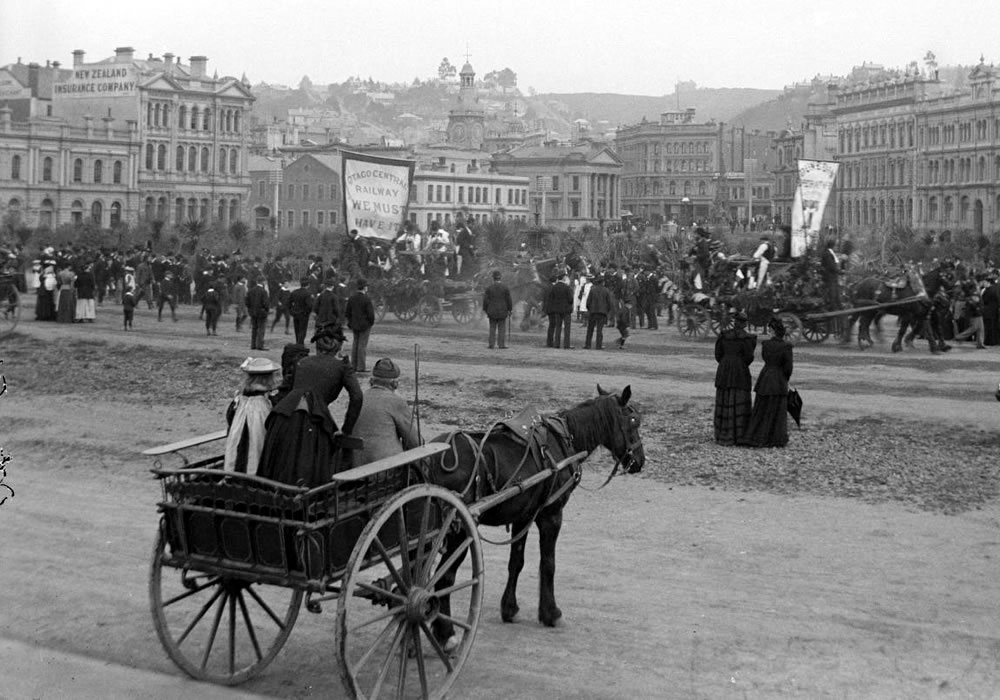
Labour Day, Dunedin, 1894: As the unions mass in what is now Dunedin's Queen's Gardens, a mother leans forward to tell her children about the meaning of Labour Day. What would a mother tell her children about "the cause of labour" in 2013? That it died in 1991? Or, that it will be reborn in 2014?
 
WHAT SORT OF PEOPLE were they, this mother and her children? The photograph is dated Labour Day, 1894. The little family stands in a dog cart, watching, while across the dusty roadway several hundred unionists, their bright banners billowing against the regular lines of the city’s commercial hub, muster for their grand procession. The strict Victorian civility of the scene cannot mask the underlying political context: Labour versus Capital. How did that mother convey Labour Day’s meaning to her children on that overcast morning in October, 109 years ago?
 
Perhaps her husband, the children’s father, was among the union throng. He may have helped to build one of the many floats about to make their way up the city’s main street. Most of the trades were represented: carpenters, butchers, bakers; their carts festooned with the all the paraphernalia of their occupation. The bakers have loaded up great barrels of flour. On the cart’s sideboards a painted banner proclaims: “Peace and Plenty”.
 
The connections were clearer then. When work lay at the very heart of the human experience, and when the correspondence between the condition of labour and the condition of the community was obvious and indisputable. Without the carpenters, stonemasons and glaziers there would be no city to live in. Without the butchers and the bakers, no meat and no bread.
 
In the minds of the nineteenth century working-classes, mere ownership did not constitute the be-all and end-all of social significance. A factory without workers was an empty and expensive shell. The butchery or bakery, without butchers or bakers, had nothing to sell. Capital without Labour was a ledger entry – nothing more.
 
And perhaps that brute fact was easier to see in the colonies than in the Old Country. The churches and the town halls of nineteenth century New Zealand and Australia (and the rapidly growing states of the American West) may have looked as though they had stood above their Squares and Octagons for centuries, but the colonists knew better. The men and women who had built Christchurch, Dunedin, Melbourne, Adelaide and Chicago, all understood that the great settler cities which had exploded out of the raw landscapes of imperial ambition were overwhelmingly and unquestionably collective enterprises. Capital and Labour had arrived together: neither lived but by the efforts of the other.
 
It’s what the carpenter, Sam Parnell, had grasped the moment his feet touched the Petone foreshore in 1840. That this was a new land, with new rules, where the expectations of the masters back in England would be subject to radical revision. Here, the worker would labour for eight of the day’s 24 hours. Eight more would be for his rest. And the remaining eight would be for himself and his family. If the masters wanted or needed more than eight hours, then they would be obliged to pay their employees a handsome premium for the “over-time”.
 
Perhaps this was the grand old tale that the mother in the photograph told her children as they watched the Labour Day procession form up on that October morning long ago.
 
Newer stories, too, she’d have to tell. About how the Reverend Rutherford Waddell had preached against “The Sin of Cheapness”, exposing the sweated labour of the seamstresses, and how, from the resulting public outrage, the Tailoresses’ Union had been born. Of the Great Maritime Strike of 1890, she would have spoken. Of how the seafarers, the watersiders and the coal miners came together on 28 October 1889 to form the Maritime Council (New Zealand’s first effective union combination). She would have told her children how, though the nationwide strike was broken, the cause of labour did not falter: for in that same year the Liberals were swept to power on the votes of working men. And re-elected, she would have added, her eyes shining with pride, on the votes of working women. And of how the Liberal Government, earlier that very year, had passed the Industrial Conciliation and Arbitration Act – which would, on New Year’s Day, make the workers of New Zealand the envy of workers all the world around.
 
That woman’s children would, of course, live to see the great wave of social progress in which their parents participated rolled back upon the rocky reefs of war and economic catastrophe. The millennial dreams of their mother’s and father’s generation would not be realised, but the unrelenting push of the unions would achieve many of their most cherished objectives. The Welfare State and the 40-hour week would both become law when Labour finally took up the reins of government in its own name in 1935.
 
So what, if anything, should mothers tell their children about the meaning of Labour Day in 2013? That dreams, like photographs, can fade? Or that history, like spring, reminds us what hope is for?
 
This essay was originally published in The Press of Tuesday, 29 October 2013.

Friday, 25 October 2013

"Will You Take Revolution With Your Tea?"

Grass Roots Fervour: The American political class is only now becoming aware of how dangerous the monster created by billionaire far-right activists like the Koch brothers truly is. The recent stand-off between the Tea Party faction of the Republican Party and the Obama Administration - far from being interpreted as a defeat by the radical right - has only made it hungrier for more and larger confrontations with "Big Government". The New Zealand left could learn some valuable lessons from the American right's revolutionary intransigence.
 
SO, YOU THINK the Tea Party has just taken a “shellacking” from President Obama? Well, think again. Forget about the sneers and jeers of those inside the Washington Beltway: the people Tea Partiers dismiss contemptuously as “the political class”; because out there in “Redland” (the Republican heartland) the true believers are celebrating.
 
As they see it, victory was very nearly theirs. For 16 days, the whole, corrupt edifice of “big government” (as they would characterise the monuments, museums and national parks their representatives shut down) had ceased to function. Even more thrilling, from their perspective, was how very close they came to causing the United States to default on its debts.
 
And they’re right. The Tea Party came within an inch of plunging the whole world into a new financial crisis. Are they ashamed of themselves? Hell no! Are they downhearted? No way! Indeed, they can hardly wait until January and February 2014 when their “suicide bombers” in the House of Representatives will do it all again. Because next time – or the time after that – they absolutely will succeed.
 
Like the Bostonians who tipped chestfuls of British tea into Boston Harbour in 1773, the eponymous Tea Partiers of 2013 are looking to bring down an entire politico-economic system. In the twenty-first century, the Tea Party (and grass-roots citizens’ movements like it) is what revolution looks like.
 
Not like the Occupy Movement? Surely the youngsters who attacked Wall Street’s “one percenters” are more deserving of the title “revolutionaries” than these middle-aged (and older) mid-westerners who cannot distinguish President Obama’s minimal, privately-led and Republican Party-inspired health insurance scheme from fully-fledged “socialism”?
 
No, not the Occupy Movement. Because the Occupy Movement failed to do what every good revolutionary must learn to do: speak to people in language they can understand.
 
In 1917,when Lenin alighted at the Finland Station in Petrograd and was promptly hoisted onto an armoured car to address the workers and peasant soldiers who had come to greet him, he didn’t launch into a complicated explanation of the various hand-signals to be employed in reaching a consensus on what the soviets (workers’ councils) should do next. He shouted: “Peace! Bread! Land!” The three things his audience most wanted to hear. Adding for good measure the truly revolutionary slogan: “All power to the soviets!”
 
The Tea Partiers are only right-wing because they haven’t yet had an opportunity to realise how mistaken they have been in their choice of targets. The moment their social security payments are disrupted, or a Wall Street collapse wipes out their pension fund, their naïve prairie anger will very swiftly identify new, more traditional, scapegoats.
 
In the meantime, the left-wing of the New Zealand Labour Party could learn a thing or two from the Republican Right about how to keep their elected representatives under control.
 
The threat the Tea Party deploys with such astonishing effect against those who refuse to toe its political line is the threat of being “primaried”. In New Zealand terms: having someone run against you for your party’s endorsement. Nothing curbs a politician’s independent streak faster than a credible threat of de-selection.
 
Naturally, creating a credible threat first requires professional rabble-rousers to whip-up a firestorm of ideological fervour among the party faithful. The incumbents are then presented with a list of radical demands which they either adopt as their own, or find themselves replaced by somebody whose ideological purity is beyond question.
 
Thanks to Labour’s right-wing MPs’ all-too-evident disdain for their party’s left-wing policy preferences, conditions akin to those which allowed the Republican Party’s conservative base to be mobilised against Washington’s RINOs (Republicans In Name Only) are now fast maturing in both the Labour Party and the trade unions.
 
The political class should be very, very afraid. Because the rise of both the Tea Party in the USA and the Labour Left in New Zealand are but harbingers of the radical and unstoppable populist revolt that will soon bring financial capitalism to its knees.
 
This essay was originally published in The Dominion Post, The Waikato Times, The Taranaki Daily News, The Timaru Herald, The Otago Daily Times and The Greymouth Star of Friday, 25 October 2013.

Tuesday, 22 October 2013

A Difficult Transition: Maori Abandon Enchanment For Transparency

Driving The Transition: The large iwi-based corporations - epitomised by Ngai Tahu's impressive corporate structure, headed by Mark Solomon (above) are driving the transition from tribal traditionalism to the rational bureaucratic norms of secular society. The journey was difficult and uncomfortable for the Pakeha's ancestors, it will be no less so for Maori.

IF WINSTON PETERS did not exist, Pakeha New Zealand would have to invent him. Very few politicians are willing to risk the opprobrium which inevitably accompanies serious criticism of things Maori. But as a Maori himself, Mr Peters enjoys a sort of immunity from “sickly white liberal” prosecution. It’s as well that he does. Otherwise, holding Maori individuals and institutions to account for the expenditure of public funds would be even more difficult than it is.
 
And Mr Peters willingness to point the finger at his own people’s shortcomings would appear to be catching. Over the past month we have witnessed two important examples of Maori journalists exposing what they claim to be serious problems with the management of significant amounts of public money by Maori trusts.
 
The first of these exposés involved accusations of mismanagement against senior figures within the Kohanga Reo movement. It was Maori Television’s Annabelle-Lee Harris and Mihingarangi Forbes who broke the story. In an item entitled “Feathering the Nest”, the Native Affairs programme drew attention to unusual patterns of credit card expenditure and a number of large unreceipted donations.
 
Considerable effort was devoted to thwarting the Native Affairs investigation – not least an unsuccessful attempt to secure a court injunction against the programme’s broadcast.
 
As a result of Native Affairs courageous journalism, the Ministers of Education and Maori Affairs have jointly demanded a full investigation of the alleged irregularities.
 
The second example involved what might be called a “whistle-blowing” broadcast alleging  serious instances of mismanagement at Tokoroa’s Maori radio station Raukawa FM. In an extraordinary sequence of events, the station manager, Rosina Hauiti, last month took to the airwaves with a long list of allegations against the station’s trustees. When the latter attempted to evict her from the building, Ms Hauiti barricaded herself against all-comers.
 
Though charges and counter-charges continue to fly, Ms Hauiti’s broadcast, like Ms Forbes, has produced the desired outcome – an official intervention. Te Mangai Paho, the station’s principal funder (to the tune of $384,100 per annum) has asked the accounting firm, Deloitte, to investigate Ms Hauiti’s allegations as part of their scheduled review of the trust board’s activities.
 
Speaking at the NZ First Party’s annual conference in Christchurch on Saturday, 19 October, the NZ First leader recalled the late 1980s and early 90s when many businesses engaged in “the greatest deceit” until dragged into line by improved systems of accountability.
 
Mr Peters said Maoridom had called for transparency in the past, but now fended off legitimate investigation with accusations of “Maori bashing”.
 
He claimed that: “Certain ones have gone back to that behaviour, where to challenge them was to challenge their mana, their breeding, any concocted excuse to get out of their responsibility to their own people and the taxpayer. It means that honest Maori, who are the great bulk of Maori, are imaged in the worst possible light, and it cheats them of a certain future.”
 
This newfound willingness to hold itself to account signals that a profound sociological shift is underway in Maoridom. Max Weber, the nineteenth century “father” of modern sociology, would have immediately recognised the processes at work.
 
As Maori capitalism develops (most obviously in the form of the large iwi-based corporation) it is producing scores of tertiary-educated, highly-skilled young graduates. Increasingly, these young Maori professionals are unwilling to tolerate either the business inefficiencies generated by traditional practices, or the injustices so often associated with charismatic leadership. They are past making excuses for, or (even worse) covering up the behaviour of those who will not budge from the old ways.
 
Weber, himself, described the process as a progression from the pre-modern to the modern: “The fate of our times is characterised by rationalisation and intellectualisation and, above all, by the ‘disenchantment of the world’.”
 
The Maori Party’s co-leader, Tariana Turia, is emblematic of Maori who still dwell in the “enchanted” realms of Maoridom. Early on in her political career she spoke openly about having a constant invisible companion: a spirit guardian who protected her from harm and guided her through important decisions.
 
Suffice to say this is not the sort of leadership-style, or decision-making process, the big iwi corporates’ young professionals are being taught at the Auckland Business School. Nor are they encouraged to regard the keeping of accurate records and being able to account for all items of expenditure as responsibilities fit only for lesser breeds. When dealing with shareholders – or taxpayers – neither inherited rank nor charismatic power is entitled to a free pass.
 
The transition from tribal traditionalism to the rational bureaucratic norms of secular society has largely been accomplished in the nations from which Pakeha New Zealand's forebears originated. It was not an easy or a comfortable journey. Nor will it be for Maori – as the recent examples cited above attest.
 
Transparency and enchantment do not dwell in the same house.
 
This essay was originally published in The Press of Tuesday, 22 October 2013.

Friday, 18 October 2013

"Low Trust Clients" Meet "No Sympathy State"

The Implacable Face Of An Implacable Regime: Victor Hugo's unforgettable bloodhound, Inspector Javert (played here by Russell Crowe) pursued the redeemed hero, Jean Valjean, with a zeal bordering on fanaticism. The so-called "low trust clients" of WINZ who, like Valjean, may have broken the law simply in order to survive, must now feel as though they are living in the pages of Les Miserables.

EARLIER THIS WEEK the Associate Minister for Social Development, Chester Borrows, announced a new category of beneficiary. From Monday, 14 October 2013, he said, Work and Income New Zealand (WINZ) would be applying the new “low trust client” rules.
 
According to the Minister, “low trust clients” are people already convicted of welfare fraud, or who have “had overpayments established following a fraud investigation”.
 
He expected the new rules would affect around 1,500 people per year.
 
“Give a dog a bad name and you may hang him by it” runs the proverb. And it is certainly very difficult to think of a reason why politicians and bureaucrats would want to pin the “low trust client” tag on beneficiaries other than their wanting to “hang” them by it.
 
Of course the State doesn’t hang people anymore – at least, not literally. (Although I’m sure there are more than a few New Zealanders who would gladly string up all these “welfare cheats”!) But those who have made it their business to make sense of MSD policy (Sue Bradford, for example) are in no doubt that the true objective of these highly provocative new rules is to make “low trust clients” feel so utterly wretched and worthless that they exit the welfare system altogether.
 
From the point of view of the MSD and WINZ, purging the welfare rolls of low trust clients is a “win/win” solution. Not only is the state spared the expense of paying out legitimate entitlements, but the MSD’s new policy practically guarantees a sharp decline in all claims – fraudulent and legitimate.
 
Few New Zealanders would have any idea of how fraught the entire experience of signing-on for, receiving and retaining a social welfare benefit can be. The whole process is anything but straightforward and to a great many people seems calculated to belittle, stress and all-too-frequently humiliate the applicant/recipient.
 
The most vivid memory most people take away from their first visit to WINZ is how long they were made to wait. Even those who followed the rules assiduously: made appointments and arrived ahead of time; will regale their family and friends with horror stories of being made to wait for hours at a time.
 
Many people who live at some distance from their nearest WINZ office and are reliant on public transport simply cannot wait, and so miss their appointments. Predictably, missing an appointment with one’s WINZ case-worker is regarded as a serious misdemeanour: do it too often and one’s benefit may be docked – or even stopped.
 
Only rarely will these citizens encounter a WINZ staffer who clearly and comprehensively spells out exactly what they are entitled by law to receive from the state. The consensus view among those receiving WINZ “assistance” is that the MSD operates on the rule-of-thumb that if applicants don’t ask, then WINZ staff are not obliged to tell.
 
At the average WINZ office what you don’t know (and are not told) can prove extremely costly – both to you and to those who depend on you.
 
Even the much-decried “benefit fraud” isn’t always what it seems.
 
WINZ’s over-riding priority is to get people off welfare and into work. Unfortunately, it does not distinguish part-time and/or casual work from full-time employment. At WINZ, a job’s a job, and the moment you get one you’re no longer entitled to a Jobseeker’s Allowance. And if your job only lasts a month? Well, that’s too bad, because now there’s a “stand down” period lasting several weeks for you to get through before once again becoming eligible for state assistance.
 
In the meantime there’s rent, food and power bills to be paid. What WINZ calls fraud is often no more than the actions of desperate people doing whatever they have to do to keep themselves and their families fed and clothed and a roof over their head.
 
It’s what makes the note of smug self-righteousness in Mr Borrows’ latest announcement so very hard to take.
 
Like Jean Valjean in Victor Hugo’s Les Miserables, New Zealand’s beneficiaries find themselves pursued by a state as remorseless and relentless as the implacable Inspector Javert.
 
The great French novelist coined phrases like “social asphyxia” do describe the constricting effects of poverty and injustice, but even the mighty Hugo would have tipped his hat to a phrase so utterly suffocating in its unkindness as “low trust client”.
 
This essay was originally published in The Waikato Times, The Taranaki Daily News, The Timaru Herald, The Otago Daily Times and The Greymouth Star of Friday, 18 October 2013.

Tuesday, 15 October 2013

Low Turnout Won’t Be Fixed By “Online Voting”

Hackers To The Rescue? Professor J. Alex Halderman (second from right) and his merry band of hackers showed just how vulnerable online voting is to outside interference. According to Halderman, "it’s going to be decades, if ever, before we’re able to vote online securely".
 
THE JUNIOR WOODCHUCKS GUIDEBOOK was one of the comic-book artist’s, Carl Barks’, most prescient gags. Whenever the hapless Donald Duck’s adventures with his three nephews and his squillionaire Uncle Scrooge went awry, it was to this extraordinarily handy little book that Huey, Dewey and Louie – Woodchucks all – invariably turned. You’ve fallen from a plane without a parachute? Need a quick course in basic Lizard? Want to know how to lull a dragon to sleep? Then - quick! Consult The Junior Woodchuck Guidebook!
 
For those of you wondering what a Junior Woodchuck might be: they are Carl Barks’ gentle send-up of the American scouting movement. What makes the master comic-book storyteller’s creation of The Junior Woodchucks Guidebook so prescient, however, is that in 2013, nearly 60 years after its first appearance in 1954, practically everyone carries the equivalent of the Woodchucks’ Guidebook in their pocket.
 
Our smartphones, with their connection to the Internet and its vast, inexhaustible search-engines, can now transform us, just about instantly, into experts on just about everything. Who needs The Junior Woodchucks Guidebook when they’ve got “Google”?
 
This increasing reliance on the Internet and its wonders is worrying. Carl Barks may have relied upon The Junior Woodchucks Guidebook to get himself and his cartoon creations out of innumerable tight spots, but we would be extremely unwise to do the same.
 
Writers, dramatists and comic-book storytellers are allowed to bring in a deus ex machina to keep the narrative moving along, but politicians and administrators have no such licence. Though we might be forgiven for thinking otherwise, the conduct of democratic elections is not the stuff of comic-books or classical Greek tragedies.
 
And yet we are subjected to constant claims from politicians, challenged to “do something” about the declining participation-rate in national and local government elections, that the solution lies “online”.
 
This is what the Mayor of New Zealand’s largest city, Len Brown, told reporters on Saturday after being re-elected by barley a third of Auckland’s eligible voters:
 
“We will do online voting next time, there is no doubt about that. I think that maybe postal voting has had its day. People really don’t do much in the way of sending mail anymore.”
 
Not a good idea, Len, as a moment’s consultation of your electronic Junior Woodchucks Guide would have told you.
 
According to the Professor of Computer Science specialising in cyber-security at the University of Michigan, J. Alex Halderman, putting the electoral process online would be extremely risky:
 
“In order to vote online safely, we’re going to have to solve some of the hardest problems in computer security. How do you secure servers against remote attackers? How do you secure people’s home computers against spyware? How do you prevent people from being tricked into visiting the wrong website and giving away their passwords? All of these things are subjects of active research, but it’s probably going to be many, many years until we solve them. That’s why I think it’s going to be decades, if ever, before we’re able to vote online securely.”
 
And Professor Halderman knows what he’s talking about, because three years ago he and three of his top computer science graduates successfully (and perfectly legally) hacked into an online election pilot set up by the District of Columbia’s Board of Education.
 
The Board, supremely confident that their online voting system was secure, cockily challenged anyone who thought they could hack into their software to go ahead and give it a try. Professor Halderman’s team more than rose to the challenge. Not only did they successfully hack the Board’s system, but they also made sure that the test election was “won” by “writing in” the fictional robot anti-hero, Bender, from Fox-TV’s animated sci-fi series Futurama. (The runners-up were HAL from 2001 – A Space Odyssey and the Master Control Programme from Tron.)
 
Those wishing to learn more about Professor Halderman’s slam-dunk demonstration of the dangers of online voting should watch the YouTube video – just search “Hacking the Washington DC Internet voting system”. I would heartily recommend that Mayor Len Brown treat himself to repeated viewings.
 
And before all the computer geeks out there respond with the example of Estonia: permit me to point out that the Estonian on-line voting system relies upon the fact that every Estonian citizen is required to carry an identity card bearing a unique identity number. Personally, I’m not so sure that New Zealanders are ready for mandatory identification cards. Not after all that passionate debate over the GCSB surveillance legislation. But, I could be wrong.
 
The other problem with Estonia is this: if the Estonian government decided to elect its own “Bender” – who would know?
 
Online voting, warns Professor Halderman, is no different from any other system reliant upon computer software. (Novopay? WINZ? ACC?) “Small mistakes” can lead to “huge problems.”
 
This essay was originally published in The Press of Tuesday, 15 October 2013.