Showing posts with label Anglo-Saxon Powers. Show all posts

Wednesday, 13 January 2016

The Club That Rules The World.

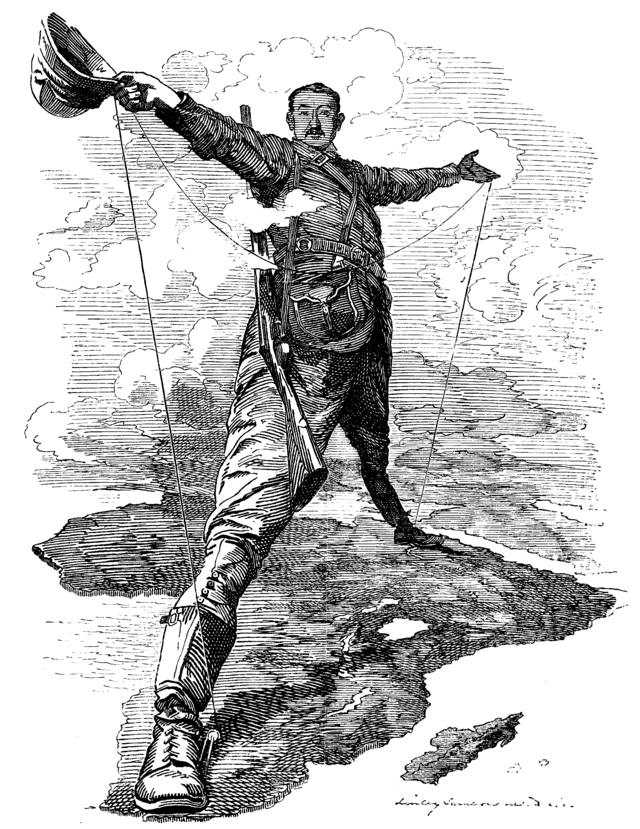
The Colossus That Was Rhodes: Britain's ur-imperialist not only dreamt of constructing a railway from "Cairo to the Cape", but also of expanding the dominion of the Anglo-Saxon powers to encompass the entire planet. A century on, the United States, aided by the United Kingdom, Canada, Australia and New Zealand, has indeed become the global hegemon. The GCSB spy-base at Waihopai is part of that hegemony.

WHAT DO CECIL JOHN RHODES and the Waihopai Spy Base have in common? The answer is: the maintenance of a world in which the Anglo-Saxon powers continue to play a dominant role. Rhodes, the great nineteenth century British imperialist, could not have imagined the raw technological power which installations like the GCSB’s Waihopai Station have added to the imperial mission, but he would have approved – wholeheartedly.
 
He would also have felt entirely vindicated by the current disposition of global economic, military and political power. His vision of the future was one in which the might of the British Empire and the United States had become fused in an Anglo-Saxon imperium to which the rest of the world paid homage.
 
Naturally, Rhodes foresaw the British Empire taking the lead role in this geopolitical drama. In the late nineteenth century, when he was at the summit of his remarkable career, the power of the USA remained veiled. (Although, the exertions of the Civil War, 1861-65, should have alerted Rhodes to America’s prodigious potential.) Even so, his most enduring legacy, the Rhodes Scholarship, was intended to create a special brotherhood of Anglo-Saxon leaders, drawn overwhelmingly from the British Empire and the USA, into whose hands the grand mission of bringing as much of the world as possible under Anglo-Saxon control could be safely reposed.
 
At the heart of Rhodes’ plan to create a global elite lay Oxford University – among whose dreaming spires the Rhodes Trust’s carefully selected scholars were expected to imbibe that noxious mixture of classical idealism, medieval obscurantism and contemporary chauvinism from which the British Empire had been fashioned.
 
Just how toxic this amalgam could be may be judged by Rhodes’ own justification for the creation of Anglo-Saxon hegemony:
 
“I contend that we are the finest race in the world and that the more of the world we inhabit the better it is for the human race. Just fancy those parts that are at present inhabited by the most despicable specimens of human beings what an alteration there would be if they were brought under Anglo-Saxon influence, look again at the extra employment a new country added to our dominions gives.”
 
Rhodes was by no means the only statesman in the British Empire to evince such crude and unabashed racism, and he certainly wasn’t the most peculiar. Not only was New Zealand’s Prime Minister from 1912 to 1925, William Ferguson Massey, a bigoted Orangeman and fervent British imperialist, but he was also a “British Israelite” – a believer in the absurd notion that the inhabitants of the British Isles are descended from one of the lost tribes of Israel and, therefrore, as God’s chosen people, destined to rule the world!
 
It is one of history’s ironies that when men felt free to believe in and give voice to such ideas, full Anglo-Saxon hegemony remained an imperial dream. A century later, with Anglo-Saxon hegemony an accomplished fact, only the most foolhardy British or American statesman would consider drawing the world’s attention to it.
 
Just occasionally however, the world’s reminded of the hegemon’s existence – as when our Prime Minister, John Key, spoke openly of the price of membership of “the club”. He was, of course, referring to New Zealand’s participation in the UK-USA (“Five Eyes”) Agreement alongside Canada and Australia. Although, helping the British and Americans to spy on the rest of the world is very far from being the only “service” members of the Anglo-Saxon “club” are required to provide.
 
Regardless of whether the power contributed is “hard” (military) or “soft” (financial and cultural) members of the Club are expected to keep their subscriptions current. Indeed, it is highly questionable as to whether resignation is even possible. Like the Hotel California, the Anglo-Saxon Club can be a hard place to leave.
 
Contributing To Anglo-Saxon Hegemony: The Waihopai Spy Base.
 
And yet, every January an apparently indefatigable group of protesters gather outside the Waihopai Spy Base to demand its closure and New Zealand’s withdrawal from the Five Eyes Agreement. The sub-text of their annual protest, however, is this country’s long association with the sins of Anglo-Saxon imperialism.
 
The protesters mission is to persuade New Zealanders to disentangle themselves once and for all from Rhodes’ vision: to cease and desist playing even the tiniest role in exerting Anglo-Saxon hegemony.
 
It’s a big ask. Who resigns voluntarily from the club that rules the world?
 
This essay was originally published in The Waikato Times, The Taranaki Daily News, The Timaru Herald, The Otago Daily Times and The Greymouth Star of Friday, 8 January 2016.

Tuesday, 17 March 2015

Empire Games: How Nicky Hager's Revelations Are Re-Shaping The Nationhood Debate.

The Anglo-Saxon Empire: As World War II ended the imperial baton passed from the United Kingdom to the United States. Bounding to Uncle Sam's side were the old empire's eager puppies - Canada, Australia and New Zealand. The current debate about the "Five Eyes" espionage network is in the process of morphing into a much broader debate about who New Zealanders are - and whom they should serve.
 
“I’M SENTIMENTAL – if you know what I mean – I love the country but I can’t stand the scene.” So sings Leonard Cohen in the final verse of his grand 1992 anthem “Democracy”. The country he’s singing about is, of course, the United States of America, and his conflicting feelings about the place are shared by millions of people around the world. There is a great deal to love about America and Americans, but there is, equally, a great deal that rest of the world, like Cohen, cannot stand.
 
The tragic human cost of US “diplomacy”. The vast powers wielded by what President Dwight Eisenhower dubbed the “military-industrial complex”. The evident inability of the “special interests” which now control the US Congress to any longer even recognise, let alone serve, America’s national interests. All of these political afflictions, combined, have created a “scene” to which no sane person (or nation) would pledge allegiance.
 
And yet that is exactly what the tight little political and journalistic clique clustering around John Key (like the doomed 300 at Thermopylae?) is demanding of New Zealanders. We are being told that, in spite of its manifest failings, the United States remains the last, best, hope of humanity, and that any person, or group, who dares to question the NZ-US relationship is guilty of something very close to treason.
 
Nicky Hager: Patriot.
 
The prime target of this latest thrust against the Key Government’s critics is Nicky Hager. No other journalist has so consistently – and accurately – mapped the moral fault-lines running through the NZ-US relationship. Whether it be the exposure of our own Government Communications Security Bureau’s unacknowledged participation in the US National Security Agency’s Echelon spy system in Secret Power (1996) or the NZ Defence Force’s unmandated determination to range itself alongside America in Other People’s Wars (2011) Hager’s investigative journalism has for the best part of 20 years undermined successive New Zealand governments’ attempts to remain a member in good standing of the Anglo-Saxon “club”.
 
It is worth taking a moment to consider what New Zealand, as a member of this 70-year-old club (the USA, the United Kingdom, Canada, Australia and New Zealand) has signed-up to.
 
Though these five states represent less than 7 percent of the world’s population, the USA and its four closest allies constitute the Earth’s most powerful military, economic and diplomatic combination. English-speaking, and still predominantly white, the Anglo-Saxon club holds the rest of humanity (overwhelmingly non-English-speaking and non-white) in its grip. The global reach of the so-called “Five Eyes” intelligence gathering apparatus is but one aspect of the Anglo-Saxons’ “full-spectrum dominance” of the planet and its peoples.
 
When we consider the extent to which these powers dominate the world’s key resources – especially oil, coal and iron-ore; when we add up the number of nations that, in one way or another, are beholden to them; when we recall that the US Dollar remains the world’s fiat currency; and when the five Anglo-Saxon nations’ ability to project decisive military resources to any point on the Earth’s surface is taken into account; are we not justified in discarding the word “club” and replacing it with the much more appropriate “empire”?
 
No one likes to hear it called that, of course. The world is supposed to have rid itself of empires in the years immediately following World War II. Ours is a democratic age, and as every good historian knows, imperialism and democracy don’t mix. And yet, the behaviour of the five Anglo-Saxon powers, in the 70 years since the end of World War II, is difficult to characterise as anything other than imperialistic. If the “club” looks like an empire, speaks like an empire, and acts like an empire, then, chances are, it’s an empire.
 
Anglo-Saxon Imperialism: If it looks like an empire, speaks like an empire, and acts like an empire, then, chances are, it’s an empire. (Magnum photo by Philip Jones Griffiths)
 
The Prime Minister’s media defenders condemn Hager as “anti-American” because he has been able to correlate directly the strength of New Zealand’s military and intelligence ties to the United States with New Zealand’s loss of diplomatic independence. This would be dangerous enough in itself, but Hager’s revelations also help to remind New Zealanders of those occasions when their leaders had the courage to stand apart from the American-led Anglo-Saxon Empire. That Hager was an active player in the events that led to New Zealand declaring itself nuclear-free in the mid-1980s only sharpens the Right’s determination to blacken his reputation.
 
Indeed, it is becoming increasingly clear that New Zealand’s most senior and effective right-wing journalists are engaged in an attempt to fundamentally re-shape New Zealanders’ perceptions of the anti-nuclear movement. Rather than an expression of our growing sense of nationhood, they intend to re-cast it as the unfortunate result of a left-wing conspiracy to extricate New Zealand from the “Western Alliance” (also known as the Anglo-Saxon Empire). According to this revised history of the past 30 years, Kiwis have been duped by leftist radicals like Hager (and Helen Clark?) whose ultimate objective is to thrust New Zealand naked and alone into an increasingly dangerous world.
 
And to whom should this duped and defenceless New Zealand turn for protection? Why, Uncle Sam, of course! Hager’s revelations have upped the ante of the national independence debate and, in Poker parlance, the Right has opted to “see him” and “raise him”. The debate about New Zealand’s involvement in the Five Eyes alliance is, accordingly, being broadened out to embrace the much more vital questions of who we are and whom we should serve. Will New Zealand continue striving to become an independent South Pacific nation, or will it opt to remain a far-flung, but intensely loyal, province of the Anglo-Saxon Empire?
 
For those who love this country, but can’t stand the political scene, the stakes have never been higher.
 
This essay was posted on The Daily Blog and Bowalley Road blogsites on Tuesday, 17 March 2015.

Saturday, 24 January 2015

To Lunchtime And Beyond! Why There’s No More Loyal Servant Of The Anglo-Saxon Empire Than The New Zealand National Party.

Put Your Heart In It: The National Party’s visceral attachment to the English-speaking brotherhood has found a more than worthy champion in the present Prime Minister.
 
THERE IS A REASSURING CONSISTENCY about the prejudices of the National Party. No matter how thick the spin-doctors and PR specialists apply the lacquer of moderation to the institution’s exterior, the reactionary timber beneath just keeps rotting away.
 
Nowhere is the utterly unreconstructed nature of National’s political mission more apparent than in the fraught arena of war and peace. The antiquated diplomatic responses these crucial foreign policy issues excite in what passes for the National Party’s intelligentsia are especially disconcerting.
 
The first real hint we got of just how atavistic those instincts might be came with Dr Don Brash’s infamous “gone by lunchtime” quip to a group of US officials back in January 2004. Clearly, the National Party has only ever paid lip-service to New Zealand’s anti-nuclear stance. Yes, it had embraced a Nuclear-Free New Zealand as far back as 1990, but, clearly, the party’s “conversion” to foreign policy independence had, in all respects, been both cynical and cosmetic.
 
Dr Brash’s promise that the policy would be abandoned “by lunchtime, probably” in the event of a National Party victory in 2005, showed that National’s MPs were only willing to wear the “No Nukes!” T-Shirt because that was part of what it took to regain power. The moment they got their feet under the Cabinet Table, however, and well before the next scheduled meal break, all such left-wing fripperies would be headed straight for the incinerator.
 
In marked contrast to Dr Brash’s unabashed impatience, the present National Prime Minister has displayed admirable forbearance in the matter of New Zealand’s anti-nuclear stance. Six years after he was swept into office, John Key has yet to initiate anything resembling a serious review (let alone repeal) of New Zealand anti-nuclear legislation.
 
Is this because Mr Key is a convert to anti-nuclearism? Has the Prime minister embraced the independent spirit of Norman Kirk’s foreign policy and learned, finally, “the trick of standing upright here”? Well, no. His refusal to get all het up about nuclear weapons and nuclear power is because he understands that the big issues of the 1980s are not the big issues of the 20-teens.
 

Nuclear-Free New Zealand: Yesterday's issue?
 
Like any good blitzkrieg general, Mr Key has simply directed his armoured columns around this potentially dangerous obstacle. He knows that if he pushes past it far enough the anti-nuclear policy will begin to look like the diplomatic relic of some long dead foreign-policy consensus. When that eventually occurs, there will only be a handful of people who will notice, and even fewer who will care that, following some distant future lunchtime, the policy has gone.
 
And when it does, be in no doubt, unreconstructed National Party stalwarts will all be displaying wolfish grins of satisfaction. Those forced to live through the anti-nuclear policy’s creation, will be able to mentally tick-off yet another faded remnant of the Left’s policy legacy.
 
Just how eagerly the Right is anticipating that moment was revealed earlier this week (20/1/15) when the NZ Herald published an article by the National MP for Manawatu from 1978 to 1987, Michael Cox. Entitled Clark’s Sad Legacy In ’84 Affair Shrinks UN Hopes, the think-piece positively revels in the presumed unwillingness of the USA and the UK to sanction Helen Clark becoming the next UN Secretary-General.
 
While careful to acknowledge Ms Clark’s undoubted strengths and her eminent eligibility for the United Nations’ top job, Mr Cox informs his readers that this is where “her positives” stop. Because two of “the most powerful members of the Security Council, the United States and Britain, will not have forgotten that she led the charge that weakened Western resistance to the USSR during the Anzus debacle in 1984.”
 
It is difficult to imagine a sentence more weighted-down with National Party ignorance and prejudice than this little gem.
 
Yes, both the US State Department and the Pentagon were pissed-off with New Zealand for breaking ranks in 1984, but they weren’t that pissed-off. By 1984 it was already clear to the Americans that the Soviet Union had no plans to impede seriously the advance of the new, global, market-driven economic order. They were also well aware that when it came to offering examples for the world to follow, New Zealand’s sterling efforts in radical, top-down, market liberalisation were easily outshining (where it mattered) her quaint, bottom-up, ban on all things nuclear.
 
To make his case against Ms Clark, Mr Cox draws heavily on the historical research of Gerald Hensley, Head of the Prime Minister’s Department under David Lange. In his book Friendly Fire, Mr Hensley suggests that it was well understood by the Americans that Ms Clark “accepted Roger Douglas’s right-wing financial policies [because] there had been a trade-off by which those on the Left, led by her, gained the mandate for the anti-nuclear ship policy in return for going along with his economic reform”.
 
If this is true (and as someone who was very active in the Labour Party Left during the 1980s, I’m not sure that it is) then both the Americans and the British will actually be more – not less – likely to back Ms Clark’s bid for the Secretary-General’s job. There is no better qualification for such a position than a proven track-record of making, and sticking-to, such Faustian political pacts.
 
Mr Cox does not see this. Like Mr Hensley, his sensibilities are those of the backwoods conservative raised on the uncompromising slogans of anti-communism, and whose loyalty to the global interests of the English-speaking peoples is absolute and unquestioning. In the eyes of such people, Ms Clark remains an oath-breaker and quasi-traitor, whose disloyalty will never be forgotten, and certainly not forgiven, by the five “fingers” of the Anglo-Saxon fist.
 
Viewed from this perspective, Ms Clark’s 2003 refusal to let New Zealand’s armed forces join in the illegal invasion of Iraq can only have heaped more hot diplomatic coals upon the heads of her country’s erstwhile allies – further compounding her earlier, anti-nuclear, treachery.
 
For the Brits and the Yanks, however, it will be Ms Clark’s diplomatic behaviour in the aftermath of the Iraq War that really counts when they vote for the next UN Secretary-General. Quite how Messrs Cox and Hensley reconcile their blue-stockinged quasi-traitor with the New Zealand Prime Minister whom the US Secretary of State, Colin Powell, described as his “very, very, very good friend” is anybody’s guess.
 
What cannot be doubted, however, is that the National Party’s visceral attachment to the English-speaking brotherhood has found a more than worthy champion in the present Prime Minister. Witness his extraordinary comment that New Zealand’s sending troops to train the Iraqi armed forces for war against Islamic State, should be seen, simply, as “the price” we must pay for membership of the Anglo-Saxon “club”.
 
Making particular reference to the “Five Eyes” intelligence-sharing agreement, to which New Zealand is a signatory, the Prime Minister stated that it was important that his country was regarded as a reliable member of the club. Because, “we do know that, when it comes to the United States and Canada and Australia and Great Britain and others, that we can rely on them.”
 
And clearly, our “very, very, very good friends” (the 1984 anti-nuclear “affair” notwithstanding) can still rely on us. Or, at least, on those of us who continue to vote, unwaveringly, for the New Zealand National Party.
 
A version of this essay was posted on The Daily Blog of Friday, 23 January 2015.

Tuesday, 20 August 2013

The Wind Shifts: Auckland Town Hall, Monday, 19 August 2013

"You don't need a weatherman to know which way the wind blows" - Bob Dylan.

A SYMBOLIC VICTORY might have been won by John Key on Campbell Live last Wednesday, but last night, in the Auckland Town Hall, the victory won was very real. Last night, for the first time in decades, one of New Zealand's stately civic buildings found itself full-to-bursting with angry citizens.

You don't need a weatherman to tell you there's been a shift in the wind.

If the organisers of last night's event allow themselves to be guided by the quiet wisdom of Nicky Hager, it will go down in New Zealand political history as being not the end of a campaign against the GCSB Amendment Bill, but the beginning of a nationwide movement against New Zealand's continuing participation in the UKUSA/Echelon/Five Eyes Agreement.

Only amputation can sever New Zealand from the other four murderous fingers of the Anglo-Saxon fist. That will not be accomplished without pain, but when it is done this country will at last be free of American tutelage. Not even our anti-nuclear legislation could achieve that. No matter how angrily the Americans scolded us for denying entry to their warships, Waihopai kept on sending the signals intelligence to NSA headquarters in Ford Meade, Maryland.

Only by dismantling Waihopai, abolishing the GCSB and withdrawing New Zealand from the "Five Eyes" intelligence sharing protocols can we finally proclaim ourselves to be a free and independent South Pacific nation.

The energy unleashed in last night's meeting in the Auckland Town Hall, if harnessed intelligently, can lead us to that long cherished objective.

We have 15 months to make it happen.

The New Zealand nationalist poet, Allen Curnow, looking forward to the day when his little country would finally cease bowing and scraping to its various imperial masters, wrote:

Not I, some child, born in a marvellous year
Will learn the trick of standing upright here.

Let that year be 2014.

This posting is exclusive to the Bowalley Road blogsite.

Tuesday, 16 April 2013

Testing The Anglo-Saxons

Know Thy Enemies: China's Nineteenth Century history recommends a thorough process of getting to know exactly who and what you're dealing with. The Celestial Kingdom's disdain for "Foreign Barbarians" did not work out so well. New Zealand offers the Chinese Government a risk-free environment in which to master the idiosyncrasies of the Anglo-Saxon cultures challenged by its rising economic power.
 
THE PRIME MINISTER has given his recent trip to China a perfect score.
 
“They have really given us great access, they are totally committed to moving the relationship on, there has been a real opportunity to renew friendships and understandings with the new leadership team and we’ve announced things that will make a difference here.
 
“I think it’s a 10 out of 10.”
 
There can be no disputing the value which the People’s Republic places upon its relationship with New Zealand. What we offer our now pivotal trading partner is access to a fully developed, English-speaking, democratic, capitalist society. With our tiny population and strategic irrelevance, China can test and refine here the techniques it must perfect if its increasingly up-close-and-personal interactions with the United States, the United Kingdom, Canada and Australia are to bear diplomatic and commercial fruit.
 
More bluntly, China has chosen New Zealand as its testing-ground. Mistakes made here can simply be written-off to experience. New Zealand is too small (and too dependent on the Chinese demand for its dairy products) to impose any kind of effective sanctions on the Chinese state.
 
What we do have, however, is the ability to reveal the pitfalls awaiting China in jurisdictions large enough to inflict serious damage on both its government and economy. Though we may only be its smallest digit, New Zealand remains one of the five fingers of the Anglo-Saxon fist. And if the exponential growth of China’s productive capacity has reduced its economic power, the Anglo-Saxon Fist still packs an unanswerable military punch.
 
As a policy, pissing-off the Anglo-Saxon’s has not served the Chinese state well in the past, and is most unlikely to do so for the foreseeable future.
 
And that’s where we come in.
 
How will the citizens of the Anglo-Saxon states respond to large-scale land purchases by state-owned, or capitalised, Chinese corporations? That is something the big-wigs in Beijing should probably know before allowing their surrogates to buy up half of Herefordshire or Ohio.
 
And, thanks to New Zealand, they have been given a pretty good idea. Though far greater chunks of the New Zealand landscape had been hocked-off to Americans, Canadians, Indonesians and Israelis, the very idea that even a tiny amount of New Zealand farmland might end up in Chinese hands was enough to bring Kiwis out in a rash.
 
New Zealand’s bi-partisan commitment to keeping Sino-New Zealand relations harmonious was sufficient to prevent any large-scale political exploitation of that popular antagonism. Even so, China’s rulers had been given a taste of the sort of reaction likely to greet large-scale Chinese land purchases in English-speaking countries containing political classes less constrained by considerations of size and economic dependence. The far-right of the US Republican Party, for example. Or, the frankly xenophobic “backwoodsmen” of the British Conservative Party.
 
A recent news-story (published in The Sunday Star-Times of 14 April 2013) offers the Beijing authorities another opportunity to test the political and social reactions of Anglo-Saxons to Chinese ideas and aspirations.
 
Mr Easter Wu, a prominent figure in the New Zealand Chinese business community, has apparently been campaigning for the right to pay immigrant workers less than the statutory minimum wage. In advocating that his compatriots engage in what is a clear breach of New Zealand employment law, Mr Wu confined himself to Chinese-language media outlets.
 
Now that his comments: “How much you are worth is how much you get. You got an $8 skill, I pay you $8.”, have been translated into English, the response of ordinary New Zealanders is likely to be extremely hostile.
 
Not only has Mr Wu been using his high media profile in the expatriate Chinese community to suggest that Chinese employers should ignore the laws of the country in which they have been permitted to operate, but he has also, wittingly or unwittingly, raised up the spectre, in the minds of native-born New Zealanders, that Chinese business leaders are conspiring to undermine their wages and conditions. With New Zealand currently experiencing high levels of unemployment, such behaviour has the potential to produce an ugly and diplomatically unhelpful anti-Chinese backlash.
 
Perhaps the most worrying aspect of Mr Wu’s campaigning is that China’s diplomatic representatives in New Zealand appear to have made no attempt to rein-in their wayward compatriot. Within the Chinese Embassy there will certainly be officers tasked with the close monitoring of the local Chinese-language news media. It is very puzzling (to say the least) that the Embassy does not appear to have taken Mr Wu aside and warned him about the very serious consequences his campaigning risked unleashing.
 
Then again, it’s possible this unwillingness to intervene reflects the Chinese Government’s interest in discovering how Anglo-Saxons react to the idea that Chinese employers should be allowed to operate outside the law.
 
If so, we should let them know.
 
This essay was originally published in The Press of Tuesday, 16 April 2013.

Tuesday, 8 January 2013

Spooks In The Spotlight

Permanent Interests: Elected politicians come and go; political parties move backwards and forwards between the Treasury and the Opposition benches; the news media reports, critiques and, very occasionally, exposes the actions of the powerful; but the Permanent Government endures - and its servants are almost never held accountable for their actions.
 
WILL THE GOVERNMENT Communications Security Bureau (GCSB) end up in the dock? Is it really possible that senior GCSB officers will be required to give evidence in the Kim Dotcom Case? The answer is: “probably not.” The maintenance of state security is arguably the most important function a government has. It is, therefore, extremely unlikely that anyone will sanction publicly exposing the blurred lines of authority, legality and accountability so basic to effective state security.
 
Though it is nowhere clearly spelt out, it is nevertheless firmly believed by those who inhabit them that the vital institutions of a fully-functional modern state: the professional civil service; the Armed Forces and Police; the Judiciary; senior local government officials; constitute the “Permanent Government” of the Realm.
 
Elected politicians come and go; political parties move backwards and forwards between the Treasury and the Opposition benches; the news media reports, critiques and, very occasionally, exposes the actions of the powerful; but the Permanent Government endures. Over the centuries, it has been forced to concede a number of important roles to the people’s elected representatives, but obstructing the duties of the Permanent Government isn’t one of them.
 
The Kim Dotcom Case is unusual because the conduct of the Permanent Government is being disrupted by one of its own – the Judiciary. While there are many examples of politicians frustrated by the actions of a security apparatus only notionally under their control, it is rare to see the “spooks” brought to heel by lawyers and judges. So rare, in fact, that it raises the possibility that Kim Dotcom and his legal team have unleashed some kind of rogue judicial energy. It has already seriously embarrassed the Prime Minister and his National Party Government, and now threatens to compromise the operational reliability of the GCSB.
 
This is no small matter. New Zealand’s signals intelligence operation is inextricably bound up with those of the four other Anglo-Saxon powers: the USA, the UK, Canada and Australia. It is barely conceivable that the global security reach of these “Five Eyes” might be compromised by some arcane dispute over the intellectual property rights of the American film and music industries.
 
Even more unlikely is the prospect that the FBI – a principal player in the Dotcom Saga – will meekly submit to the orders of a New Zealand High Court Judge (or even our Supreme Court). The FBI may include the entire planet in its jurisdiction, and consider every Western police force to be an extension of the already very long arm of American law enforcement, but, when it comes to external scrutiny of its own investigations, the FBI answers solely to the Attorney-General of the United States.
 
The most likely outcome of the Dotcom Saga, therefore,  is that, somehow, the case will be made to disappear. Somewhere – both here in New Zealand and (hopefully) in the United States – a collection of wise old heads will be reviewing the succession of public relations, political and security disasters which followed the spectacular arrest of Mr Dotcom in January 2012 and asking how many more disasters it’s going to take before someone in authority locates the “Off” switch.
 
The whole extraordinary story calls to mind a knitted jersey with a loose thread. The garment which once comfortably covered the naked power of the Permanent Government has, thanks to Mr Dotcom’s legal team, unravelled to the point where all manner of formerly hidden things are now on clear display.
 
Before the arrest of Mr Dotcom how many New Zealanders were aware that the GCSB regularly co-operated with the New Zealand Police by intercepting the cell-phone and e-mail messages of their fellow citizens?
 
Who among us was aware that it was within the power of our Prime Minister to sign a document suppressing any and all references to the GCSB in a New Zealand court of law? When was that extraordinarily undemocratic and dangerous power conferred upon a politician?
 
Did anyone suspect that the FBI in Washington had only to pick up the phone to the New Zealand Commissioner of Police to set in motion a full-scale armed assault on the property of a man accused of nothing more sinister than copyright violation?
 
And, how many Americans would have believed that a handful of irritated movie moguls and record producers could activate the enormously complex and expensive machinery of the National Security Agency, the Department of Homeland Security, the CIA and the FBI for no better purpose than to scratch a longstanding commercial itch?
 
Is it really all that likely that this litany of embarrassing revelations is going to be lengthened by the FBI handing over its evidence to Mr Dotcom’s lawyers? Or that one of this country’s most distinguished Queen’s Counsels is going to be unleashed on our top spooks?
 
I don’t think so.
 
This essay was originally published in The Press of Tuesday, 8 January 2013.

Tuesday, 2 October 2012

The Kiss Of Fealty

The Kiss Of Fealty: In return for their protection, we place ourselves in the thrall of those powerful enough to provide it. Their enemies become our enemies, and when they ask for "a service", or "make us an offer", we dare not refuse. No matter whether the powerful be kings, gangsters or nation states, the relationship is always the same.
 
NEW ZEALAND is a vassal state: always has been; probably always will be. We are a small and vulnerable country whose security remains the obligation of much stronger powers. For a quarter-century, while the rest of the world re-arranged itself after the Cold War, we have enjoyed the illusion of independence. Now, thanks to Kim Dotcom, the age of illusion is over.
 
“Nuclear-Free New Zealand” may have ruffled the feathers of the American eagle and turned the ANZUS Treaty into a dead letter, but it did not amputate the New Zealand pinky finger from the Anglo-Saxon fist. Our membership of the UKUSA Agreement linking the intelligence agencies of the United States, the United Kingdom, Canada, Australia and New Zealand remained intact throughout.
 
The United States may have excluded the New Zealand Defence Force from its military and naval exercises and blanked our diplomats at Washington cocktail parties, but its National Security Agency (NSA) never shut down the continuous feed of signals intelligence (SIGINT) from our Government Communications Security Bureau (GCSB).
 
Labour and National Governments may come and go, but “Echelon”, the NSA’s global SIGINT collection and analysis network, is forever – as are the GCSB’s electronic eavesdroppers at the Tangimoana and Waihopai “listening posts”.
 
It’s what vassals do: they pay their dues.
 
Medieval lords held their lands from the king and within the boundaries of those lands their word was law. In return, the king’s vassals were obliged to take the king’s part in all quarrels, pay his taxes and send men and supplies to fight in his wars. Those who served a medieval vassal needed two good eyes. One to watch over their lord’s needs and the other to look out for the interests of their king.
 
It did not suit the United States to make too much of their vassal state’s breach of fealty in the late-1980s. It’s anti-nuclear policy may have posed “the threat of a good example” (to use Noam Chomsky’s trenchant phrase) but for the makers of the Washington Consensus that threat was more than off-set by the Lange Government’s radical example of free-market economics. So long as New Zealand remained a part of the Echelon network, a few relatively gentle diplomatic slaps would suffice as punishment.
 
Had David Lange and his ministers got serious about severing New Zealand’s military and intelligence connections to the US, and attempted to pull the plug at Tangimoana and Waihopai, then the reaction of the Reagan Administration would have been very different – and much more painful.
 
The full force of American retribution was, however, avoided because the servants of the New Zealand state all had two good eyes. While Treasury kept Washington’s good-will by persuading the Lange government to implement the most radical structural adjustment programme ever attempted in the OECD, the New Zealand foreign affairs, defence and intelligence communities quietly reassured their American counterparts that a bi-partisan policy of incremental reconnection to the United States was the New Zealand (if not the Labour) government’s Number One priority.
                                                                                         
The king was thus reassured by his errant vassal’s own servants and men-at-arms that their lord’s lapse of loyalty was purely temporary and that his successors would doubtless prove considerably more obliging.
 
And so it has proved. The smiling face of Mr Leon Panetta, the US Secretary of Defence, and his good news about New Zealand’s warships’ re-admittance to America’s naval facilities, was startling vindication of our foreign affairs and defence establishment’s patient diplomacy. The king’s favour has been restored: the kiss of fealty given and received.
 
Fitting, too, that just days after receiving our liege lord’s blessing, New Zealand’s Prime Minister and his deputy were forced to reveal its price. Remembering always that a king’s enemies are his vassal’s enemies also. And Mr Dotcom is, without doubt, the United States’ enemy.
 
Those New Zealanders who were surprised and alarmed by the extreme light-handedness of the political oversight of our security and intelligence services are still trapped in the illusion of independence. Our political leaders learned long ago what lapses in loyalty can mean for a vassal state. Much better to leave these matters to the permanent guardians of our own – and our masters’ – interests.
 
How else to explain Bill English’s casual admission that, were he given it all to do again, he wouldn’t hesitate to re-order the suppression of all evidence relating to the activities of the GCSB. Why else would John Key refuse a comprehensive and transparent inquiry into the illegal surveillance of Mr Dotcom? And be backed in his refusal by a former Labour Prime Minister, Sir Geoffrey Palmer?
 
 “You can’t have an open inquiry like a commission of inquiry with evidence in public about that,” Sir Geoffrey told TV3’s The Nation, “because these agencies will cease to be any use if their secrecy is not preserved”.
 
Of use to whom?
 
This essay was originally published in The Press of Tuesday, 2 October 2012.

Friday, 9 September 2011

The Anglo-Saxon Fist

The Tight Five: From the moment the Japanese bombed Pearl Harbour on Sunday, 7 December 1941, the five Anglo-Saxon powers - the USA, UK, Canada, Australia and New Zealand - have, like a closed fist, constituted a whole considerably greater than the sum of its parts. Guarded by its own supra-national priesthood of spies, soldiers, businesspeople and journalists, the Anglo-Saxon imperium brooks no challengers.

GLOBAL SHARE MARKETS teeter on the brink. The Eurozone rocks backwards and forwards. Even China, the world’s workshop, looks a bit wobbly. Is there nothing solid left in this world?

Though they’ll never admit it, the mandarins at MFAT (Ministry of Foreign Affairs and Trade) know the answer to that question. They were taught it by the people David Lange long ago derided as “geriatric generals”. And these, the retired senior officers of the Army, Navy and Air Force, learned it the hard way – in the crucible of war.

What did they discover? What is it that still possesses the strength to hold us up – even when the rest of the world is falling down?

The five fingers of the Anglo-Saxon fist.

Let’s count them off: there’s the United States of America, Great Britain, Canada, Australia and us, the smallest finger of the fist, New Zealand.

At the end of the Second World War it was this, the great alliance of what Winston Churchill liked to call “the English-speaking peoples”, that stood watch over those regions of the planet not dominated by the war’s other great victor – the Union of Soviet Socialist Republics.

Oh yes, I know, there was the United Nations – that sophisticated Manhattanite, resplendent in her glittering ideals and high-minded notions. And later we met the European Economic Community. But the real power, the hard power, the power that kept capitalism humming, remained exactly where it had finally and irrevocably coalesced on Sunday, 7 December 1941: in the long, strong fingers of the Anglo-Saxon fist.

America dominated. Unscathed by bomb and shell; unmatched in wealth and productive power; unchallengeable in her atomic might; the United States looked forward to an “American Century”. But this did not mean that the other four fingers were powerless.

Great Britain and her empire might have been crippled by the war, but she remained an old and undefeated state. Her ruling class could call upon centuries of guile and an instructive imperial legacy. If the USA saw itself as the new Rome, then Britain claimed “the special relationship” of the Greeks.

And the English-speaking dominions? Canada, Australia and New Zealand. What would their contribution be?

When Russia got the Bomb, Canada’s strategic straddling of the Arctic circle gave the USA the crucial few minutes it needed to respond to a Soviet first strike. Australia and New Zealand, positioned with equal strategic facility beneath Asia’s vulnerable underbelly, promised instant power projection north, into the Indonesian archipelago; west, into the Indian Ocean; and east, across the island-dimpled Pacific, to South America.

Spread wide, the Anglo-Saxon fingers encompassed more than half the planet. Striking together, in a closed fist, they were all but invincible.

Unless …

For the fist to retain its strength, it had to remain united. Politicians with independent ideas: men like Jack Kennedy, Harold Wilson, Pierre Trudeau, Gough Whitlam and Norman Kirk; constituted a serious problem.

Serious, but not insoluble.

Because, in the decades since the Fist first came together it has brought into being its own, very special, priesthood. For these: intelligence and military officers; diplomats and trade representatives; businesspeople and journalists; the Anglo-Saxon Fist is a whole infinitely greater than the sum of its parts. The loyalty of this secret priesthood is not given to weak and ideologically compromised governments, but to the hegemonic power of the Anglo-Saxon imperium – and woe unto anyone who stands in its path.

Had the fourth Labour government not been presiding over New Zealand’s indoctrination into the new Anglo-Saxon creed of neoliberalism, while, simultaneously, implementing its deeply subversive anti-nuclear policy, it would have been as ruthlessly undermined as the government of Norman Kirk. Fortuitously, Rogernomics and the fall of the USSR persuaded the priesthood to wait.

That policy of wearing-down and waiting-out has borne fruit. New Zealand’s pinky finger is once again firmly embedded in the Anglo-Saxon Fist.

And, if you want to know the detail of how that was accomplished, I recommend Nicky Hager’s Other People’s Wars.

This essay was originally published in The Timaru Herald, The Taranaki Daily News, The Otago Daily Times, The Greymouth Star and The Waikato Times of Friday, 9 September 2011.

Monday, 25 May 2009

Dangerous Winners

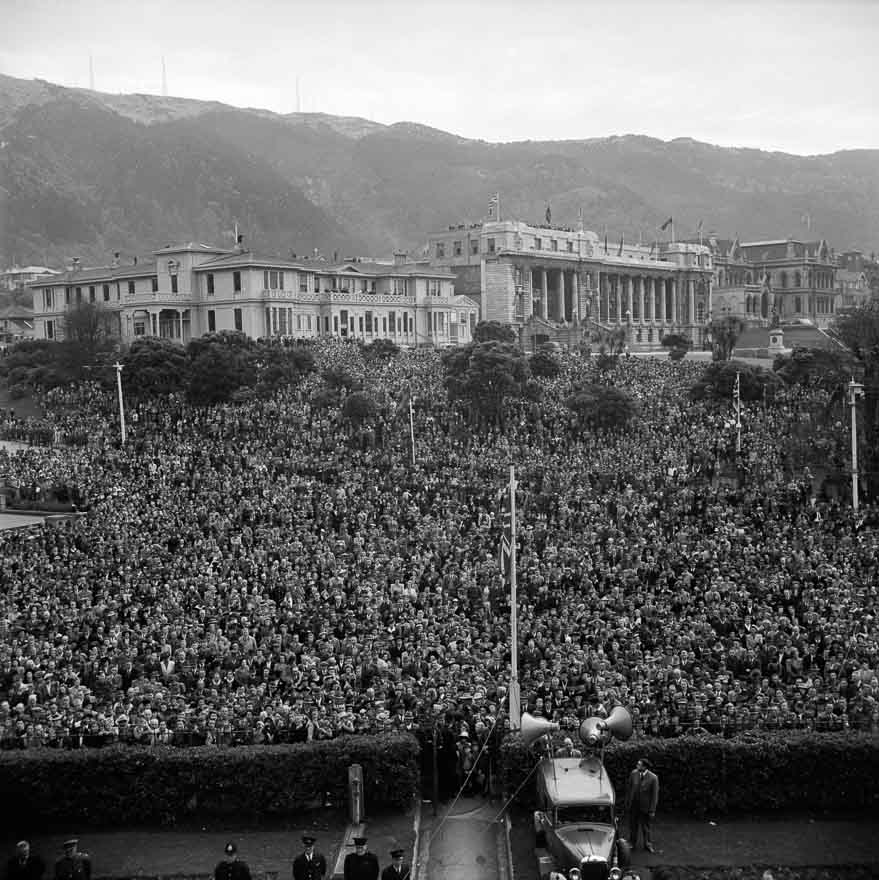
Tens of thousands of Wellingtonians celebrate the defeat of Nazi Germany in the streets below Parliament, 9 May 1945. But what would have happened to the Anglo-Saxon powers if they had failed what British military historian, Correlli Barnett, calls "the audit of war"?

THERE’S a price to be paid for always being on the winning side. States and peoples who have been found wanting by the twin audits of war and revolution are forced to learn from their mistakes. The victors are under no such obligation.

New Zealand has been on the winning side of practically every war it has ever fought. Alongside the other fingers of the Anglo-Saxon fist: the United States, the United Kingdom, Canada and Australia; New Zealand has never had to endure the ignominy of military occupation, nor the harrowing rigors of that other handmaiden of defeat – social revolution. On the contrary, our armed forces and our political institutions have emerged from the storm and stress of successive wars not only intact – but wreathed in the laurels of victory.

In the face of such incontrovertible evidence of success, even the most muted and respectful attempts at criticism tend to sound like crankiness – or worse.

But, just imagine that the First World War had been won by Germany, and that, in defeat, New Zealand, along with the other Anglo-Saxon powers, had undergone a series of debilitating economic and social upheavals, culminating in the establishment of a cruel and arbitrary dictatorship.

Upon finally emerging from this nightmare of repression, would we not, as a people, be extremely wary of the instruments of coercive state power: the Army, the Police, the Courts, and the Penal System? And wouldn’t we also place a much higher value on the traditional protections against such arbitrary and undemocratic regimes: the public administration of justice; the presumption of innocence; and the right to be tried by a jury of our peers?

I’d like to think so.

But, of course, the Anglo-Saxon fist has yet to meet its historical match. And that, I suspect, is why so many of us still put so much faith in the coercive instruments of the New Zealand State. They have, after all, never let us down. It would certainly explain why so many thousands of Kiwis flock to ANZAC Day parades, and why the funerals of slain policemen take on the character of state-funerals – replete with honour-guards, pipers and aerial salutes.

It might also explain why so many New Zealanders’ prefer retributive – as opposed to rehabilitative or restorative - justice. The outrage talk-back callers routinely express at the very idea that prison-cells might be constructed with under-floor heating, or that inmates might occasionally be permitted to watch a flat-screen television set, says a great deal about this darker side of the Kiwi character.

If they, or their loved ones, had ever spent time in a dank prison cell, reeking with the stink of their own excrement, I wonder if these talk-back callers would, like the Dutch, Danes and Norwegians (whose homelands were all occupied by the Nazis) begin to take a more humane view of crime and punishment?

It would certainly help them to understand why Maori, whose armies were defeated, whose society was forced to undergo a wrenching series of economic and social upheavals, and whose homeland has been occupied for more than one-and-a-half centuries, look upon the Police, the Courts and the Penal System of the New Zealand State through very different eyes.

Or, if that’s too big an empathetic ask, they could simply carry out this little thought experiment.

Imagine you’re living under a Government which has removed the right to elect trial by jury for offences punishable by less than three years imprisonment. Then imagine that, in spite of a referendum indicating the contrary, this same government has refused to repeal the law eliminating the defence of "reasonable force" for hitting one’s kids. Now imagine a Crimes Act which mandates a maximum of two years imprisonment for common assault (which includes smacking).

What does it all mean? It means that if you’re arrested by the Police, charged with assaulting your child, and you enter a plea of Not Guilty, you will no longer have the right to be judged by a jury of your peers. Instead, your case may end up being heard by a female District Court judge, with a law degree from Waikato University, who just happens to believe that Sue Bradford’s anti-smacking legislation is the bees-knees.

You see now how foolish it is to assume that the never-defeated, all-powerful, Anglo-Saxon state is always your protector?

This essay was originally published in The Timaru Herald, The Taranaki Daily News, The Otago Daily Times and The Greymouth Evening Star of Friday, 22 May 2009.