Showing posts with label Anti-Vaccination Protest of February-March 2022. Show all posts

Saturday, 10 June 2023

Unequal To The Task?

A Dark Day: More than 40 years of affirming New Zealanders’ Right to Protest had left the NZ Police without the training or the equipment to “move on” hundreds of determined protesters (many of whom were working-class battlers and not at all averse to mixing-it-up with the cops). It took weeks to assemble the person-power necessary to clear the anti-vaccination mandates protesters’ encampment from Parliament Grounds. 

THOSE WHO DISMISS mass political protest as historically ephemeral, leaving nothing of significance behind it, are wrong. The Springbok Tour protests of 1981 made a huge impression on the NZ Police. So much so that, in the 40 years that have elapsed since the Tour, the policing of political protest in New Zealand has undergone a profound change. Just how vulnerable that change has left the New Zealand people was made frighteningly clear during the occupation and eventual clearing of Parliament Grounds in 2022. If the NZ Police are not now conducting a root-and-branch reform of their political protest policing methods, then they are failing in their duty as protectors of the state and its citizens.

In the weeks and months that followed the Springbok Tour, the Police found themselves repeatedly humiliated in the New Zealand courts. Thousands of New Zealanders had been arrested during the Tour but only a tiny minority of them were convicted – and even fewer were jailed. In case after case it became clear that, right from the start, the Judiciary had been ill-disposed towards the Tour, would rather it had not taken place, and were not prepared to saddle those who had protested against it with a criminal record. Consequently, only those guilty of the most egregious acts of protest (especially those involving aircraft) were subjected to the full rigor of the law.

The Judiciary’s unwillingness to punish protesters conveyed a disturbing message to the Police. On some issues, the usual close co-operation between the Judiciary and the Police could not be relied upon – quite the reverse, in fact. As instanced by the famous case in which protesters pled “Not Guilty” to being unlawfully on a building, but without the intent of committing any other offence. Their lawyer argued that his clients had every intent of committing other offences – hence their “Not Guilty” plea. The Judge, clearly amused, acquitted the defendants. The look of dismay and bewilderment on the face of the Police Sergeant prosecuting the case is readily imagined!

It did not take the Police very long to realise that they were being told to go easy on the sort of people who participate in protests against morally indefensible systems like Apartheid, and/or the pernicious ideologies that spawn them. Regardless of the fact that they are sworn to uphold the law, while it remains the law, Police researchers were left in little doubt that, in the Tour’s aftermath, a great many members of the New Zealand public identified the Police as the Government’s enforcers and the Springboks’ protectors. More bluntly, the Police had made it possible for an immoral and divisive tour by a racist Rugby team to go ahead.

The research data was unequivocal: the policing of the Springbok Tour protests had resulted in a significant decline in the public’s trust and confidence in the NZ Police. Worse, the people whose trust and confidence had been dented the most were, by-and-large, members of the urban professional middle-class. This was not a social formation whose support the Police could afford to lose. Their skills, coupled with their location in the power-structure, made them indispensable mouthpieces for, and buttresses of, the state. The working-class was expected to despise the fists and boots of the Police – but not the middle-class. Henceforth, its protesting children would be treated with kid gloves.

Winning back the trust and confidence of the urban professional middle-class wasn’t the only, or even the most daunting, of the challenges facing the NZ Police after the Springbok Tour. Police commanders were acutely aware that in policing the Tour their human and material resources had been stretched to the limit. Had someone been killed in the protests, the Police’s ability to preserve law and order without resorting to deadly force would likely have been exceeded. As it was, on the day of the Third Test between the Springboks and the All Blacks serious violence broke out on the streets surrounding Eden Park. Armed naval personnel from HMNZS Philomel were very close to being called to the assistance of the Civil Power. Deadly force came within an ace of being used.

Senior Police and the nation’s political leaders would have been aware of just what a near-run thing they had lived through in 1981. Very few of them, if any, would have wanted to risk another highly organised challenge to government policy.

The more thoughtful among them would have considered the policing of the Springbok Tour alongside the Police operation mounted three years earlier at Bastion Point. Clearing away the Māori occupiers of the Point had required an enormous number of Police officers, backed by significant logistical support from the NZ Defence Force. Politicians, public servants, police commanders and senior defence personnel, seeing the effort required to clear a few hundred protesters, operating in a single city, would have shuddered at the thought of one, two, many Bastion Points. In such circumstances, the use of deadly force would be inevitable.

But, even the possibility of the state resorting to deadly force was abhorrent to most New Zealanders – as the Police would learn the hard way in 2007 during the course of Operation Eight. The possibility of an armed terrorist cell training in the Ureweras could not be ignored by the Police – and it wasn’t. The deployment of masked police officers wearing helmets, body armour, and carrying semi-automatic rifles to the tiny settlement of Ruatoki, however, shocked and angered not only the local Tuhoe iwi, but also that same urban professional middle-class whose support for the Police had been so sorely tested 26 years before. Once again, the Judiciary and its minions were less-than-impressed. Once again the Police were humiliated.

The cumulative effect of these lessons in how far the Police’s “social licence” might be stretched was on display in February-March 2022 when Parliament Grounds were occupied by hundreds of New Zealanders protesting against the Labour Government’s handling of the Covid-19 Pandemic – most particularly its coercive vaccination mandates.

Over and over again, New Zealanders heard the Police Commissioner, Andrew Coster, reiterate the citizen’s “Right to Protest”.

Confronted by protesters who refused to play by the rules, however, Coster and his commanders were at a loss. Their confusion grew when the all-important urban professional middle-class began insisting that the Police clear the grounds – by any means necessary. The same people who had objected to 81’s riot squads, and the gun-toting “ninjas” at Ruatoki, were now insisting that Coster’s officers start cracking heads.

Except that more than 40 years of affirming New Zealanders’ Right to Protest had left the NZ Police without the training or the equipment to “move on” hundreds of determined protesters (many of whom were working-class battlers and not at all averse to mixing-it-up with the cops). The Police’s first attempt to enforce the law ended in ignominious retreat, and it took weeks to assemble the person-power necessary to clear the protesters’ encampment. Even then, the operation ended in fire and fury on a scale not seen in this country for 90 years.

Horrified New Zealanders, looking at the extraordinary photograph of Police officers with their backs to a granite wall, huddled together and cowering behind their Perspex shields, as all manner of missiles are hurled at them by furious protesters, suddenly realised that their state was no longer equal to the task of protecting its citizens from serious political violence.

What was (just) possible in 1978 and 1981, had ceased to be a sure-thing by 2022. And, on all three occasions, it was political protest that provided the critical test of what New Zealanders were – and were not – prepared to tolerate from the forces of the state.


This essay was originally posted on The Daily Blog of Friday, 9 June 2023.

Wednesday, 21 December 2022

A New Government, But No Change, In 2023.

A Distinction Without A Difference: Labour is likely to lose next year’s election because it has become little more than New Zealand’s alternate governing party. New Zealanders lucky enough to live in their nation’s comfort zones will turn to Labour when National appears to have exhausted itself, and to National when Labour fails to impress. The only task which mainstream voters set themselves is determining which of National or Labour is more likely to administer the status quo efficiently and effectively.

WITH THE END of the year racing towards us, the temptation is strong to review the twelve months just gone. Some political journalists even go as far as issuing awards for the best and the worst of the nation’s political players. Others channel their inner schoolmarm and award grades, or marks out of ten. Away with all such malarky! What most interests the politically aware is not the past, but the future. Never is this more true that when the new year fast approaching is an election year.

I would be remiss, however, not to reference to the most jarring political event experienced by New Zealanders in 2022 – the occupation of Parliament Grounds. The full significance of this episode has only become clear with the benefit of hindsight. It intensified a prejudice against ordinary New Zealanders that, already strong, has since become a badge-of-honour among a distressingly large percentage of the political class. Before the Occupation, ignoring the wishes of the Great Unwashed could still elicit feelings of unease among “progressive” MPs. After the Occupation it became a positive duty.

How else to explain the outpouring of official concern at the amount of misinformation and disinformation coursing through the veins of the body politic. So swollen had these “rivers of filth” become that the Security Intelligence Service was prevailed upon to issue a booklet identifying the tell-tale signs of potentially lethal radicalisation in the boy next door. Concerned citizens were even given a number to call. 0800-STASI perhaps? It was all of a piece, however, with the melodramatic “Fire and Fury” documentary produced by Stuff’s Paula Penfold. In it, the time-honoured traditions of journalistic balance were jettisoned in favour of journalism which travelled in (if not at) the direction of the Government.

Clearly, democracy – unguided by the morally superior members of the political and academic mandarinate – can degenerate very quickly into the terrifying mobocracy that unleashed arson and violence in Parliament Grounds. These feelings of personal vulnerability, aroused among parliamentarians and journalists by the Occupation’s fiery end, were both palpable and novel. For the first time in decades they had been made aware of just how destructive those excluded from the nation’s political discourse could become – if sufficiently provoked.

The historical precedent for this outrage and anguish can be found in the reaction of “respectable” politicians and journalists to the rioting and looting that broke out in New Zealand’s four main centres in the summer and autumn of 1932 – when the Great Depression was at its deepest. The NZ Herald’s cartoonist, Gordon Minhinnick, captured the disgust of the newspaper’s middle-class readers by depicting the rioters as rats erupting from the sewers. The governing conservative coalition responded to the violence by passing the draconian Public Safety Conservation Act. Unconstrained by entrenched electoral clauses, the Reform and United parties were also moved to postpone the general election scheduled for 1934 until 1935.

As the Labour Party confronts the New Year, it will not only struggle to move beyond its now visceral mistrust of the Occupiers, but also of the third of the country who believed their anti-vaccination mandate grievances worth worthy of a hearing. There will be some among Labour’s ranks who feel keenly the irony of a supposedly working-class party living in terror of the actually existing proletariat, but most of the party’s members and MPs will dismiss the whole notion that the people Trevor Mallard turned the sprinklers on are working-class.

Certainly, they were very different from the ageing, Pakeha, blue-collar trade union delegates who turn up to Labour Conferences, or the loyal Pasifika workers who sit beside them. What Labour has forgotten, however, is that barely 10 percent of private sector workers any longer belong to a trade union. The world that the Employment Contracts Act made in the 1990s – and which Labour has never seen fit to unmake – changed the New Zealand working-class no less thoroughly than Thatcherism and Reaganism changed the British and American working-classes. Driven from the political stage, they have wandered into strange pastures and swallowed strange fruits. The degree to which these abandoned and marginalised workers are able to surprise the contemporary parties of the centre-left can be summed up in just two words: ‘Brexit’ and ‘Trump’.

‘Idiot Savant’, the hard-working blogger behind “No Right Turn” asks rhetorically: “Why won’t Labour keep its promises?” His favoured explanation is that the party has become too beholden to the lobbyists and donors that keep it solvent. He’s right, of course, but there’s much more to the problem than that. Labour is vulnerable to lobbyists, and increasingly dependent on wealthy donors, for the very simple reason that it is deeply fearful of ever again becoming a mass party – most particularly, a mass party of today’s working-class.

Such a party would be economically radical and socially conservative – precisely the opposite of the entity Labour turned itself into by embracing the more-market ideas of the Reserve Bank and Treasury in the 1980s. A key aspect of that transformation was the catastrophic defection of the tens-of-thousands of Labour members who did not sign-up for Rogernomics. But the dramatic reduction in the size of the Labour Party was a feature, not a bug, of the neoliberal transformation. Having a lot of members is more-or-less a guarantee of having a lot of trouble.

It used to be the case that New Zealand’s political fault-line ran not between National and Labour, but squarely down the middle of the Labour Party itself. Up until 1984, the really big arguments concerning New Zealand’s economic and social future were those that took place between the right and left wings of the Labour Party. But, when Rogernomics caused Labour to split in 1989, it lost virtually all of its left-wing members to Jim Anderton’s NewLabour (later the Alliance). That was critically important, because although it has gone largely unnoticed and unreported by this country’s political journalists for the last 30 years, the transformations of 1984-1993 relocated the nation’s political fault-line to the left of both National and Labour where, ever since the demise of the Alliance and NZ First, there is only the swirling and inchoate rage of unrepresented rebels in search of a cause.

Labour is likely to lose next year’s election because it has become little more than New Zealand’s alternate governing party. New Zealanders lucky enough to live in their nation’s comfort zones will turn to Labour when National appears to have exhausted itself, and to National when Labour fails to impress. The only task which mainstream voters set themselves is determining which of National or Labour is more likely to administer the status quo efficiently and effectively. In the face of a Labour Government struggling to cope with record inflation, a cost-of-living crisis, and all the other side-effects of the Covid-19 pandemic, National’s hopes of reclaiming the Treasury Benches are, justifiably, high.

And that swirling mass of unrepresented and cause-less rebels: unimpressed by National and Labour, or their respective outriggers, Act and the Greens; what will they do in 2023? In the absence of a truly charismatic populist leader (sorry Winston) most of them will abstain from the electoral process altogether. Overall turnout is likely to be well down in next year’s election. An abstention rate of 25 percent is not inconceivable.

Not that National or Labour will care all that much. They have seen what the Deplorables can do when they get angry. They have no desire to see what they could make of Aotearoa-New Zealand if they ever got organised.


This essay was originally posted on the Interest.co.nz website on Tuesday, 20 December 2022.

Monday, 15 August 2022

Too Many Angels And Devils.


He’s got the fire and the fury
At his command
Well, you don’t have to worry
If you hold on to Jesus’ hand
We’ll all be safe from Satan
When the thunder rolls
We just gotta keep the devil
Way down in the hole

─ Tom Waits, “Way Down In The Hole”


WHAT’S NOT TO LIKE about Stuff Circuit’s Fire and Fury? It’s a well-made documentary of the sort New Zealand television used to make, but now only produces intermittently. It seeks answers to the questions many New Zealanders have been asking themselves since Parliament Grounds went up in flames on 2 March 2022. The driving force behind Fire and Fury, the highly-experienced journalist, Paula Penfold, has delivered on her promise to go behind the events of that day and name the names of those who were, at least in part, responsible for the disturbing scenes that marked the end of the weeks-long anti-vaccination protest.

Why, then, has the documentary left me feeling vaguely uneasy? And, before you object – “It’s meant to! – my uneasiness has nothing to do with the unsavoury cast of proto-fascist conspiracy theorists and “influencers” whose faces and words feature so prominently throughout the documentary. Sure, these people are loathsome, and their comments teeter alarmingly on the brink of outright criminality, but that is entirely unsurprising. From the get-go, the tone, sound-track, and crepuscular palette of the production cues the viewer for the darkness of its subject-matter.

Borrowing their title from Tom Waits’ Way Down In The Hole suggests that the makers of Fire and Fury see their subjects as being down there with the Devil. Perhaps that’s it? Perhaps it was my unconscious conflation of “Jesus’ hand” with the hands of the documentary’s producers, that gave me the uneasy feeling that I was being led to someone else’s holier-than-thou explanation for the rolling political thunder of our times.

Bluntly, Fire and Fury relies much too heavily on the “expert” commentary of Kate Hannah, a principal investigator and director of The Disinformation Project, a state-funded research exercise run out of Te Pūnaha Matatini at the University of Auckland. In an interview with Dale Husband on the Māori radio station, Waatea, Hannah revealed that The Disinformation Project had been set up in February 2020, immediately prior to the outbreak of the Covid-19 Pandemic, to counter the anti-government, anti-scientific, and anti-medicine narratives that the authorities were clearly anticipating.

What is it that disturbs me about The Disinformation Project? Surely, having people monitor the misinformation and disinformation being spread deliberately during a major medical emergency is an entirely sensible government initiative? Any undermining of the collective effort to protect the population from the effects of a potentially deadly virus is prima facie evidence of evil intent. Many would say that identifying and neutralising such anti-social elements is an important state responsibility.

True enough, but why bury such a unit deep in the dense undergrowth of academia? And why appoint as its director a woman whose Masters thesis was on Nineteenth Century American literary culture, rather than a qualified medical administrator? If such a unit was needed, then why not set it up within the Ministry of Health, and make it answerable to the then Director-General of Health, Ashley Bloomfield?

The problem is, the moment you start asking questions like this you immediately run the risk of being branded a conspiracy theorist. And that just circles the whole argument back to its starting-point: the dark narrative of evil intent which lies at the heart of Fire and Fury.

The question, never satisfactorily answered, which lies at the heart of the heart of Fire and Fury is – Why? What is it that prompts individuals to create false political, economic and cultural narratives in the first place? More importantly, what is it that makes otherwise perfectly sensible and caring people follow these fantasists down their rabbit holes?

Well, what led Alice down the rabbit hole in Lewis Carrol’s famous children’s story? Wasn’t it the sight of a waist-coated white rabbit consulting a pocket-watch and muttering “I’m late!”? Who wouldn’t want to get to the bottom of a sight as peculiar as that!

Many people find themselves caught up in events over which they exercise no control, and which they do not understand. Since, in small matters, they find it easy to identify cause and effect, they assume (wrongly) that big events can be equally easily explained.

This is by no means an unreasonable assumption, given the propensity of governments to explain large events in the most simplistic terms. Those who remain unconvinced by these official versions, all too often discover their scepticism is entirely justified. Nothing encourages the growth of conspiracy theories faster that citizens discovering that their own governments have conspired to deceive them.

In Fire and Fury, Kate Hannah explains the concept of what she calls “necessary” or “protective” violence. Once a group of citizens convinces themselves that their government, motivated by pure evil, is “coming after their kids”, then there is nothing they will not contemplate to keep their loved ones, and their homeland, safe.

Step this argument back a few paces, and it is possible to grasp how individuals of an authoritarian and/or paranoid temperament, having learned that their government has deliberately lied to them, decide that striking back with lies of their own is not only justified – but also the only effective way to balance the scales.

Like the evil wizard in the tale of Aladdin, the conspiracy theorists come offering “new lamps [lies] for old”. And, like all good liars, they mix in a hefty portion of the truth in with their falsehoods. “Why is it,” they ask, “that you will never encounter people with information contradicting the government’s claims in the mainstream news media?” While most people will respond by pointing out the idiocy of spreading false information during a pandemic, a not inconsiderable minority will accept the conspiracy theorists’ explanation that the news media are nothing more than the paid mouthpieces of a government unwilling to tell its citizens the truth.

It is a great pity that Paula Penfold and her team did not spend more time talking to the fiery and furious individuals around whose behaviour the documentary was constructed. A pity, too, that they did not explore in greater depth the popular conviction that the Public Interest Journalism Fund – which paid for Fire and Fury – is proof of the conspiracy theorists’ contention that the mainstream news media has, indeed, been bought and paid for.

Yes, there is an argument to be made that it is better to allow these “influencers” to condemn themselves out of their own mouths, than it is to interview them one-on-one. Equally, there is an argument for doing both: broadcasting their views – and also asking them to explain why they continually engage in such dangerous speech. Watching Fire and Fury, it is easy to apprehend its makers’ fear of “the mob”. The hostility directed towards journalists who were “just doing their job” by militant anti-vaxxers certainly was frighteningly intense.

And yet, these people are New Zealanders, too. And perhaps that is what, in the end, made me feel so uneasy about the Fire and Fury documentary. Watching it, the viewer cannot help being struck by the vast epistemological gulf separating its subjects from its makers.

Listening to Hannah and the other, equally disdainful “experts” consulted by Penfold and her team, the viewers could be forgiven for thinking that they was listening to a team of anthropologists describing the cultural practices of a particularly belligerent tribe of indigenes. Certainly, the inclusion of Rebecca Kitteridge, Director of the SIS, among that commentary team does not bode well for the future safety of this truculent tribe.

Fire and Fury didn’t quite call them “deplorables” – but it came close.


This essay was originally posted on the Interest.co.nz website on Monday, 15 August 2022.

Sunday, 8 May 2022

Trespassers?

Not Wanted On Grounds Of Political Rejuvenation: Winston Peters did nothing more than visit the protest encampment erected by anti-vaxxers on the parliamentary lawn. A great many New Zealanders applauded him for meeting with the protesters and wondered why the Prime Minister and Leader of the Opposition could not do the same.

THE DECISION by Parliament’s Speaker, Trevor Mallard, to trespass Winston Peters from Parliament Grounds is outrageous. For New Zealand’s former Deputy Prime Minister and Foreign Minister to be treated in this fashion raises so many questions that I cannot help thinking that, by the time you read these words, the decision will have been reversed.

After all, Mr Peters did nothing more than visit the protest encampment erected by anti-vaxxers on the parliamentary lawn. A great many New Zealanders applauded him for meeting with the protesters and wondered why the Prime Minister and Leader of the Opposition could not do the same.

It is probably helpful, at this point, to rehearse the actions that the Speaker took in relation to the occupation of Parliament Grounds.

Once again, we are confronted with the word “trespass”.

It has been argued that, by deeming the protesters to be trespassers and calling upon the Police to evict them from the parliamentary precincts, the Speaker heightened the tensions already developing between the protesters and the authorities; setting up an unhelpful “Us” versus “Them” binary that could only make matters worse.

Then, to the consternation of a very large number of New Zealanders, the Speaker authorised the persistent broadcast – at uncomfortable volume – of music considered likely to drive the protesters from their tents. More seriously, he caused the grounds’ sprinkler system to be turned on, soaking the protesters and transforming Parliament’s green lawns into a muddy morass.

To say that these actions did not improve the chances of a peaceful resolution to the protest would be a considerable understatement. Indeed, they raised serious concerns about the Speaker’s judgement.

And now, Speaker Mallard is advising former members of Parliament that they may not enter the parliamentary precincts for two years. That Matt King (the former National MP for Northland) and Winston Peters are both leaders of political parties preparing to contest the 2023 General Election only renders the Speaker’s actions all the more contentious. Neither of these gentlemen have been found guilty of any crime. They remain citizens of New Zealand in good standing, whose only offence appears to have been participating in a political event of which Speaker Mallard disapproved.

At the time of writing, political commentators of every political hue are either scratching their heads, or pulling out their hair, at Speaker Mallard’s actions. On one thing, however, they are in broad agreement: these trespass notices represent a stupid and dangerous escalation of the political conflict between “the elites” and “the people”.

Which makes me wonder why the Prime Minister and her Cabinet colleagues have not already intervened to forestall the right-wing populist eruption which the Speaker’s actions seem calculated to transform, from a clear and present danger into a stone-cold certainty. Perhaps, as I write these words, they are doing exactly that – intervening.

The $64,000 question, of course, is: will it do any good? The Speaker, once elected by the House of Representatives, cannot be removed from his office by any other entity. If Prime Minister Jacinda Ardern suggested quietly that it might be time for Mr Mallard to step aside, and he refused, her only recourse (other than quietly stepping away) would be to enlist the support of the other parliamentary parties in the embarrassing process of forcing him from the Speaker’s Chair. On the basis of the behaviour we have seen so far, it cannot be confidently predicted that Mr Mallard would go quietly.

The other, even more disturbing, possibility is that neither the Prime Minister, nor her colleagues, want to replace the Speaker. They may well consider his exploits against the noose-waving mob outside ‘The People’s Place’ to be nothing short of heroic. Their collective judgement may be that Messers King and Peters are getting exactly what they deserve. By choosing to align themselves with the “Far-Right extremists” behind the occupation, the former parliamentarians have made their beds – and now they must lie in them.

If this is, indeed, their judgement, then the Speaker’s future is secure. The same cannot be said, however, of this government’s future. With every passing day, the impression grows that Ms Ardern’s party sees less and less to like and admire in the people whose votes elected it. We seem to have become a huge source of disappointment for them.

Democratic trespassers.

Turn on the sprinklers!


This essay was originally published in The Otago Daily Times and The Greymouth Star of Friday, 6 May 2022.

Friday, 11 March 2022

This Meddlesome Human Rights Commissioner.

Who Asked You? Hunt’s visit to the protesters illegal encampment sent a message to the rest of New Zealand that was as unfortunate as it was untrue. Having spurned the social obligation to be vaccinated in the midst of a global pandemic, the protesters’ demands: that the defences  erected by the government to protect their fellow citizens from the consequences of their anti-social behaviour must be abandoned; “should be acknowledged and heard”.

ONE OF THE BIGGEST SURPRISES of the recent anti-vaccination protest/riot was the visit of the Chief Human Rights Commissioner. The presence of Paul Hunt, in the midst of an unlawful protest, condemned by the Speaker of the House, and which the leaders of all parties had agreed to keep at arm’s length, was jarring – to say the least.

I found myself reaching back into medieval history for a precedent. Hunt, it seemed to me, was venturing into the same dangerous territory as Thomas Becket (1118-1170) the Archbishop of Canterbury who challenged the prerogatives of King Henry II – and paid for it with his life.

It’s possible Hunt has already apprehended how badly his decision to go among the protesters has been received in certain quarters. Why else would he have risked compounding his political sins by penning an opinion piece for Stuff? Clearly, he felt he owed someone (the Prime Minister perhaps?) an explanation.

Given that Hunt’s visit was an astonishing slap in the face to Prime Minister Jacinda Ardern, who had made it crystal clear what she thought of the reactionary gathering of law-breakers and malcontents on Parliament’s front lawn, his explanation would need to be a very good one.

It isn’t.

While acknowledging that the protesters have been “moved on” from their illegal encampment on Parliament Grounds (without, it must be said, a word of condemnation of their appalling conduct towards the Police as that process unfolded) Hunt still felt obligated to give heed to “the messages they conveyed”. In particular, the Chief Human Rights Commissioner believed that “those adversely affected by the vaccination mandates and passes (or “certificates”) should be acknowledged and heard.”

“Adversely affected”. Hunt seems to be suggesting that the vaccination refuseniks had been “adversely affected” in the same way that a farmer is “adversely affected” by a severe snowstorm at the start of the lambing season. But their failure to get vaccinated – and, hence, to fall foul of the vaccination mandates – was not an Act of God, it was an act of their own free will. An act, moreover, which came with well-advertised consequences, of which they were entirely conscious. These anti-vaxxers have not “lost” their jobs. Rather than participate in the nationwide effort to defeat Covid-19, they have given them up.

As Chief Human Rights Commissioner, Hunt knows that our Bill of Rights Act guarantees that citizens cannot be forced to undergo medical treatment against their will. But, he should also know that by exercising this human right those same citizens, having declined to be vaccinated against it, are in no way entitled to put other citizens at risk of contracting a potentially lethal virus.

Hunt’s visit to the protesters illegal encampment sent a message to the rest of New Zealand that was as unfortunate as it was untrue. Having spurned the social obligation to be vaccinated in the midst of a global pandemic, the protesters’ demands: that the defences (vaccination mandates, vaccination certificates) erected by the government to protect their fellow citizens from the consequences of their anti-social behaviour must be abandoned; “should be acknowledged and heard”.

What alternative construction can we put on Hunt’s behaviour, other than human rights in New Zealand are now whatever individuals say they are, and that no acknowledgement of the rights of other citizens is any longer required? What can it mean except that the “public welfare, peace and tranquillity of New Zealand” (to quote the old Parliamentary prayer) now counts for nothing. Certainly, there was bugger-all “peace and tranquillity” on display as the fires raged and the paving stones flew on Wednesday, 2 March 2022.

Hunt, however, is not finished: “When Covid-19 arrived in Aotearoa, the commission devised a human rights and Te Tiriti test to check whether the Government’s initiatives are striking fair and reasonable balances between competing rights.”

Talk about your Thomas Becket moment! This unelected public servant has arrogated unto himself the right to judge the actions of a democratically elected government. In the midst of a global pandemic, he, Paul Hunt, will “check” the state’s actions to determine whether they are “fair and reasonable”. Not only that, but he will deliberately flout the Prime Minister’s rāhui on meeting with representatives of an unlawful protest.

How tempted Jacinda Ardern must be to cry: “Will no one rid me of this meddlesome priest!”


This essay was originally published in The Otago Daily Times and The Greymouth Star of Friday, 11 March 2022.

Tuesday, 8 March 2022

Conservatives and Revolutionaries: Together At Last!

Peaceful Protest? The inescapable problem for the defenders of the occupation of Parliament Grounds is how to explain the extraordinary violence of the twenty-third day of the protest. They manage it, however, by employing the oldest explanation in politics: the minority responsible for the fires and the violence were in no way representative of the overwhelming majority of the protesters.

WHAT HAS HAPPENED to the conservatives and the revolutionaries of this country? How is it possible that these two groups, separated by ideology, are nevertheless equally persuaded that the occupiers of Parliament Grounds were ordinary, decent New Zealanders engaged in a political protest indistinguishable from a host of similar demonstrations scattered across New Zealand’s recent history?

The most obvious answer is that on both sides of the political spectrum there is a powerful ideological and emotional need to represent the protest as neither threatening nor unusual. Both conservatives and revolutionaries have a common interest in constructing a narrative in which the “innocence” of the protesters, and the “guilt” of the Government, is indisputable.

What could that common interest possibly be?

One possible answer is that the protest offered spectacular proof that “the people” still possessed the power of independent action. As the NZ Herald’s John Roughan put it: “I was proud that a demonstrable minority of New Zealanders have not been persuaded that lockdowns and vaccine mandates are a proportionate response to this virus.” 

That not everyone was willing to follow the science, or put the interests of ordinary New Zealanders ahead of the demands of business lobbyists and pundits convinced they knew more than the experts, was clearly a comfort to Roughan. That the protesters were happy to parade their ontological certainty on Parliament Grounds was even more comforting. The protest might be ignored by the Prime Minister (and all the other party leaders) but it could not be denied.

Roughan’s column is remarkable in many ways – not least by how far its author is willing to diverge from principles usually held dear to the hearts of most conservatives. On how many other occasions, one wonders, has he congratulated the Police for ignoring the expectations of “politicians, media, and the public who think law is something to be strictly enforced at all times”? Mass defiance of the Rule of Law is not the sort of behaviour usually tolerated by conservatives!

Nor is it usual for conservatives to downplay the serious harassment (up to and including physical assault) of innocent citizens going about their lawful business. Roughan refers to the many recorded incidents of Wellingtonians being accosted in the street, by protesters visibly incensed by their attempts to protect themselves from infection, as nothing more than “scoffing at people in masks”. Such minimisation of the actual harm experienced is, sadly, essential if one’s purpose is to maintain the fiction that this was a “peaceful protest”.

It is instructive to compare the description of these same incidents offered by two Marxist revolutionaries, Daphne Whitmore and Don Franks. In an opinion-piece posted on their Redline blog, they say: “There were unpleasant scenes reported of scruffy looking individuals walking on the streets of the city shouting at them for wearing a mask.” 

This description is a definite improvement on Roughan’s “scoffing”. But, although the writers concede that for some the experience was “deeply traumatising”, they also explain how “[m]any more just wandered on, ignoring the rants as you do with anyone who seems a bit unhinged.”

Crucially, they then add: “Those interactions, well away from the parliament lawns were then conflated with the occupation as a whole.” Once again, the purpose is to inoculate the occupation from charges that it was anything other than a “peaceful protest”.

The inescapable problem for both Roughan and Whitmore/Franks is how to explain the extraordinary violence of the twenty-third day of the occupation. They manage it, however, by employing the oldest explanation in politics: the minority responsible for the fires and the violence were in no way representative of the overwhelming majority of the protesters.

Roughan further refines his argument by congratulating the Police Commissioner, Andrew Coster, for the way he dealt with this alien violent element – presenting his final decision to clear Parliament Grounds as a “relief” for all the peaceful protesters, who dutifully packed-up and went home.

Whitmore/Franks are more straightforward. “After 23 days camped outside parliament the End the Mandates protest was stormed by 500 riot police. A few hundred hardcore protesters fought back all day, and around a hundred were arrested.”

It was the Cops wot done it.

At the heart of Roughan’s argument one senses a deep resentment that the views of persons like himself, powerful White conservative males, did not prove decisive in determining the Labour Government’s handling of the Covid-19 Pandemic. Such men are not used to being ignored. The inconvenient fact that the young, female Prime Minister who declined to accept their advice went on to be re-elected in a landslide victory only rubbed salt in their wounds.

It isn’t the fact that Roughan and his ilk represent a minority that galls them (the ruling-class and its explainers will always be a minority) it is that they have been required to share the fate of the minorities which, when power was in conservative hands, they were happy to ignore. The person they blame for this insupportable state of affairs is Jacinda Ardern:

“Once the grounds were cleared, the Prime Minister addressed the nation. She was not conciliatory. She said the violence had vindicated her refusal to engage with the protest for three weeks. She said the occupation would not define us.”

Roughan’s final paragraph is telling:

“As Prime Minister in a pandemic, she ultimately decides just about everything we can do. She can decide to shut shops, close schools, cancel events, keep us confined to home. She even decides what is best for our health. But she doesn’t get to decide what defines us. Not all of us.”

Seldom has a conservative writer provided his readers with such a clear view of his politics – nor one so chilling.

The clue to Whitmore’s and Franks’ uncompromising position on this issue is contained in this paragraph:

“Ostensibly pro working class groups painted the occupation as entirely negative and ‘reactionary’, with zero recognition of the social and economic deprivation which had driven many protesters to participate. Significant sections of End the Mandate protesters included trades people and health professionals who had lost their jobs. That is what drove them to arrive at parliament with their families, demanding audience with the government.”

What neither writer attempts to explain, however, is why so many other working-class New Zealanders – Māori and Pasifika working-class New Zealanders in particular – who are also the victims of “social and economic deprivation”, fought Covid by organising collective action and mutual support. These were the “essential workers” who stayed at their posts throughout the lockdowns because, if they hadn’t, thousands of their fellow citizens would have died.

The protesters on Parliament Grounds did not “lose their jobs” – they gave them up because they refused to accept the social obligation of vaccination, and then, selfishly, refused to accept the consequences of that refusal.

Had the “Freedom Village” been erected in the name of social justice, by workers determined to build a better world. Had the protesters not blocked city streets, assaulted passers-by, and prevented schools, universities, businesses and courts from functioning. Had they not swung nooses and issued death threats. Then their brutal suppression by 500 police officers would, indeed, have been shameful.

But, the hard, cold truth of the matter is that this protest was a manifestation of narcissistic, sociopathic, passive-aggressive and violent behaviour unequalled in New Zealand political history. It was a gathering of the deluded and the deranged. The only freedom sought was the freedom to ignore the obligations attached to being fully human. And that is pretty much the definition of “reactionary”.

No matter how hard Daphne Whitmore and Don Franks might wish it otherwise, a revolution by proxy just isn’t possible.


This essay was originally posted on The Daily Blog of Tuesday, 8 March 2022.

Monday, 7 March 2022

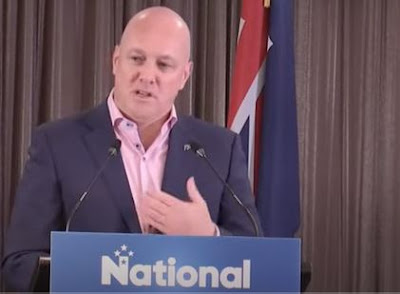
It’ll Take More Than Tax Cuts, Mr Luxon.

Something Old, Nothing New: In a week when smoke billowed over Kyiv and Wellington, what did National’s Christopher Luxon offer? Tax cuts.


IF EVER THERE WAS AN OPPORTUNITY for a conservative leader to seize the political initiative it was this past week. Seldom, in the post-war period, has there been such a confluence of disturbing and distressing events. War in Europe. Flames in Parliament Grounds. Covid-19 cases surging above 20,000 per day. Petrol prices topping $3.00 per litre.

A forceful demonstration of leadership by the Leader of the Opposition was required. A performance that not only addressed the hurt and confusion of New Zealanders, but also offered them reassurance and guidance.

On Sunday, 6 March 2022, the opportunity for a game-changing “State of the Nation” speech was right there in front of National’s Christopher Luxon.

Why didn’t he seize it? Why was his SOTN address such a limp and uninspiring effort? Political leaders worthy of the name possess an intuitive feel for what is on the voters’ minds. They don’t need a pollster to identify the main topics of conversation at the nation’s dinner-tables, office water-coolers, and public bars.

Given the week we have all lived through, Luxon’s speech should have been about security: what has happened to it, and how it might be restored. That is what the country wanted to hear, but that is not what the country got.

Luxon’s SOTN speech was straight out of National’s “Boiler Plate” file. Conventionally structured, rhetorically flat, and offering a policy package indistinguishable from all the other, equally undistinguished, SOTN speeches delivered over the past five years.

In a week when smoke billowed over Kyiv and Wellington: when New Zealanders had been frightened and angered by a series of shattering and bewildering events; what did National’s leader offer?

Tax cuts.

In a nation confronted with the enormous challenge of actually doing something meaningful about climate change – tax cuts. In a country where the restoration of social cohesion could hardly be more urgent – tax cuts. In a world where the red-lines of international conduct have been obliterated under the tracks of Russian tanks – tax cuts. (Although, to be fair, Luxon did address a few maudlin sentences to the people of Ukraine at the top of his address.)

This was not the speech of a serious – or even a very careful – politician. In his de rigueur castigation of Labour’s “socialism”, Luxon offered up the following anecdote:

“I remember sitting in a modest Moscow flat with a couple in their late 40s on a dark and snowy afternoon. It couldn’t have been clearer that socialism – in terms of Government control of everyday life and lack of rewards for hard work – had abjectly failed and actually created misery.”

Except that the Soviet Union blipped-off History’s screen in 1991 – when Luxon was still a university student. The earliest he is likely to have visited Moscow as an employee of Unilever was sometime after 1993. That would put his Moscow family squarely in the period of Neoliberal “Shock Therapy”. It was a time of accelerated social and economic collapse when millions of Russian workers lost their jobs, their homes, their pensions, and their hopes. The Yeltsin Years, when average Russian life expectancy actually fell.

If you’re going to sing the damnations of Soviet socialism, it helps to belong to a generation old enough to remember it!

The “Moscow Family” story is, however, illustrative of the “paint-by-numbers” approach of Luxon’s speechwriters. Clearly, the National Party possesses no one as talented as John F. Kennedy’s Ted Sorenson, or the US Republican Party’s Peggy Noonan and Pat Buchanan. Even more clearly, Luxon lacks the literary skills of a Barack Obama. The rhetorical genius of a Winston Churchill? … Sadly, no.

Does it matter?

Surely, the preponderance of recent poll data indicates that all Luxon has to do to win in 2023 is to sit still and not be Jacinda Ardern. If he can do that for the next 18 months, then all the smart money is on him becoming New Zealand’s next prime minister. Why draw attention to yourself with grandiose speeches about the state of your country and/or the state of the world? Surely, the offer of modest tax cuts is precisely the sort of small, but ideologically reassuring, gesture that will get National over the line?

Perhaps. If all the indicators pointed to New Zealand emerging from the worst of the Covid-19 Pandemic by the end of the third quarter of 2022, with life rapidly returning to normal by Christmas – well then, sitting still and saying as little as possible probably would be the best strategy. Especially if the fast-fading Covid Crisis throws into sharp relief all the unfinished and unstarted business of the Sixth Labour Government.

But is that any longer a particularly likely scenario? Is it not more probable that the Russo-Ukrainian War, internationally, and the ongoing breakdown of social cohesion, domestically, will foster a much starker, less forgiving, and more polarising kind of politics? A politics of daunting policy options and high-stakes gambles. A politics of fearless saviours and unforgiving avengers. Luxon might just pass muster as the hero of a fluffy Hollywood rom-com, but he hardly makes the cut as a Marvel super-hero.

Certainly, there is nothing in Luxon’s SOTN address to match the tone of Jacinda Ardern’s speech following the extraordinary events of 2 March 2022. This was not a “kind” speech. Indeed, it revealed the Prime Minister’s cold fury at what had transpired on Parliament Grounds. More importantly, it drew attention to the explosion of misinformation and disinformation that had fed the violence on Parliament’s front lawn, and which continues to eat away at the nation’s social cohesion. Something, she warned, that would have to be addressed.

Set forth in Ardern’s speech are the themes that will likely drive the political discourse of the next eighteen months. Perhaps the best way to encapsulate the Government’s new strategy is to cite the title of that greatest of trade union fighting songs: “Which Side Are You On?”

In its essence, it will ask the New Zealand electorate to choose between those who understand how radically the world has changed, and how much the country needs to change if it’s to keep up; and those who refuse to acknowledge that New Zealand is well beyond being restored to something approaching normality by a handful of modest tax cuts.

In the scathing words of Finance Minister Grant Robertson:

“National is still missing in action on a plan for the major issues that will define New Zealand’s future. The speech said nothing about how we will meet the challenge of climate change or seize the economic opportunities that come from a low carbon economy to provide higher wage jobs.”

Luxon will need to lift his game by a significant margin if he is not to find himself and his party positioned on the wrong side of history.

Recalling the first verse of “Which Side Are You On”:

They say in Harlan County
There are no neutrals there.
You’ll either be a union man
Or a thug for J. H. Blair.

If Luxon lets Labour manoeuvre him into the role of J.H. Blair, then he can kiss good-bye his chances of becoming Prime Minister.

To have a fighting chance, he’ll need a lot more than tax cuts.


This essay was originally posted on the Interest.co.nz website of Monday, 7 March 2022.

Friday, 4 March 2022

Beware the Backlash: The State Will Not Be Surprised A Second Time.

Right Back At Ya: In the minds of more and more New Zealanders it is now the defence of society itself that must take precedence over free speech. Increasingly, the defenders of free speech will come to be seen as the defenders of those who not only use their freedom of expression to cry “Fire!” in a crowded theatre, but then do all they can to persuade the audience to burn the theatre down.

THE FAR RIGHT ORGANISERS of the now suppressed occupation of Parliament Grounds will in no way consider themselves defeated. On the contrary, they will be celebrating their spectacular migration from the unnoticed ideological fringes to the glare of prime-time politics. In exactly the same way that a largely unknown provincial agitator was catapulted into the national German spotlight by his failed “Beer Hall Putsch” of 1923, the rioters of 2/3/22 have succeeded in seizing Middle New Zealand by the ear.

The Daily Blog’s editor, Martyn Bradbury, estimates that the dramatic events of 2/3/22 have recruited 100,000 followers for the Far-Right string-pullers behind the occupation and its cataclysmic finale. If he’s correct, then that is roughly enough voting power to crest the 5 percent MMP threshold and secure 6 seats in the House of Representatives – assuming, of course, that the Far-Right can arrive at an ideological consensus strong enough to permit the creation of a coherent political party.

There is, however, no evidence to suggest that such a coming together of the volatile elements on display in Parliament Grounds is imminent. Paradoxically, the same social media that brought the doings of the “Freedom Village” to around 30,000 people per day during the occupation all-too-easily emboldens those on the losing side of major debates to strike out on their own. Not only that, but it provides a public stage where the personal animosities of the major players can be played out for the edification of friends and foes alike.

In the absence of an Adolf Hitler-type figure with the requisite intellectual, ideological, rhetorical and political skills to transform the brawling and fissiparous Far-Right into an effective electoral force, the conclusions of the SIS’s Combined Threat Assessment Group (CTAG) are almost certainly correct. The locus for effective action on the Far-Right will shrink down to the level of the “Lone Wolf”. Those dangerously alienated individuals who see themselves as either the “saviours” of their race, or the “avengers” of those whose rights and freedoms have been stripped away by tyrannical blood-drinking paedophiles.

Under discussion here is terrorism – pure and simple. Across the national security community there will be many who, even as they witnessed the fire and smoke of the twenty-third day, were thinking of what a more organised and tactically aggressive leadership might have achieved on the first or second day of the protest, when the defences and defenders of Parliament were at their weakest.

Had 500 or 1,000 brawlers of the sort who hurled paving stones at the Police on 2/3/22 rushed up the steps of Parliament Buildings on 9/2/22 and forced their way through the doors – who could have stopped them? Would New Zealanders, like Americans, have been presented with live images of a crazed anti-vaxxer seated in the Speaker’s Chair? Would a noose-swinging lynch mob have made their way up the Beehive stairwells crying “Ja-cin-daaa!” And, having seen a dozen of their comrades shot down by the Prime Minister’s bodyguards, would they have set fire, not to pup-tents, but the Beehive itself?

There are senior “public servants” across Wellington brooding worriedly today upon what could so easily have happened because, exactly as the Royal Commission of Inquiry into the Christchurch Mosque Shootings warned, far too little attention has been paid, by those whose duty it is to protect the national security of New Zealand to, the Far-Right and its kindred subversives and terrorists.

Not the least worried of these public servants will be Police Commissioner Andrew Coster. He will be asking all manner of questions about why his own intelligence division failed to anticipate the scale of the crisis the foreign-inspired Far-Right promoters of Convoy 2022 were determined to provoke on the grounds of Parliament. One can only imagine the cold fury with which the Prime Minister directed the same questions at New Zealand’s chief law-enforcement officer.

With the events of 15 March 2019 – and now 2 March 2022 – etched upon her mind, Jacinda Ardern will be more determined than ever to curb the expression of hate speech. On her side of the House (and among a fair proportion of those seated on the opposite side) there will now be even less patience for those who attempt to keep the banner of free speech flying.

Among the public there will likely be a surge of support for the Government’s stance. In the minds of more and more New Zealanders it is now the defence of society itself that must take precedence. Increasingly, the defenders of free speech will come to be seen as the defenders of those who not only use their freedom of expression to cry “Fire!” in a crowded theatre, but then do all they can to persuade the audience to burn the theatre down.

That so many members of the Free Speech movement genuflect to the Right, rather than the Left, will only harden the resolve of those determined to silence the pedlars of arson and murder who – to borrow the Prime Minister’s expression – “desecrated” the holy precincts of New Zealand’s democracy.

Coming down hard on hate speech will only be the beginning. It is highly likely that the Law Commission will be tasked with reviewing the effectiveness of the legal weaponry currently available to a Government under siege. Geoffrey Palmer’s giddy 1980s bonfire of the repressive instruments of state power has taken on a less admirable lustre. Bonfires are no longer in vogue.

Finally, there is the formidable apparatus of New Zealand’s national security community, most particularly of the SIS and the GCSB. It should be presumed from here on out that those who blithely spout prejudice and hatred online will be simultaneously announcing themselves as “persons of interest” to all those who wield the swords of state protection.

To the stone-throwers and tent-burners out there, girding their loins for another crack at the lizard people and their lackeys, the most useful advice is simple and direct:

From now on, assume that you are not alone.


This essay was originally posted on The Daily Blog of Friday 4 March 2022.

Thursday, 3 March 2022

The Twenty-Third Day.

The Fire This Time: The Götterdämmerung the protest’s extremists had willed into existence over the preceding 22 days was finally upon them. Black smoke billowed-up from beneath the Pohutakawas, swirled around the statue of King Dick Seddon, and scudded over the nation’s Parliament on the wings of an early-autumn wind. New Zealand had never seen anything like it.

THE COUPLE sat in the middle of Molesworth Street sobbing. The young man turned his face away from the camera, shoulders heaving. The young woman stared directly at the camera lens, her face a pitiful picture of hurt and confusion. How had it come to this?

On Day 23 of the Occupation of Parliament Grounds, the Police’s patience ran out – as it was bound to, eventually.

Seldom has New Zealand witnessed a policing strategy which placed so much emphasis on “de-escalation”, or was so loathe to use violence to end what was, from the very beginning, an unlawful protest.

The restraint of Police Commissioner Andrew Coster offered a compelling historical contrast to that of Police Commissioner John Cullen, the man who called forth “Massey’s Cossacks” in 1913, and who in 1916 led the Police raid on Rua Kenana’s religious community at Maungapohatu. From the very beginning, Coster was determined to avoid the sort of violence for which Commissioner Bob Walton’s policing of the Springbok Tour is remembered. Coster was, after all, the senior police officer responsible for managing the Ihumatao occupation – the one that ended peacefully.

Unfortunately, it takes two to tango, and what passed for “the leadership” of the occupation steadfastly refused to dance. With the benefit of hindsight, it is clear that a peaceful resolution was never going to happen.

As the reports of the SIS’s Combined Threat Assessment Group (CTAG) released to the NZ Herald under the Official Information Act, make disturbingly clear, the “extremist elements” within the multi-faceted and “overwhelmingly peaceful” anti-vaccination and anti-vaccination-mandate movement, never had anything to gain from a peaceful resolution.

Coster, well aware of the CTAG assessments, gave every opportunity for the “overwhelmingly peaceful” elements encamped on Parliament Grounds to send him representatives with whom a meaningful dialogue about the character and duration of the occupation could be sustained. That this proved to be impossible indicates just how completely the residents of “Freedom Village” had allowed themselves to become enthralled to the ideas of its “extremist elements”.

Epitomised by that traumatised young couple in the middle of Molesworth Street, so many of the people participating in the occupation did not appear to grasp the reality of their situation. In spite of the fact that they had set their faces against the laws of the land. Heedless of the dangerous behaviour manifested by a growing number of their fellow occupiers. Regardless of the harm and inconvenience their actions were causing to others. The protesters continued to behave as if they were somehow immune to the likely consequences of their actions.

A pitiful picture of hurt and confusion. Two young protesters, Molesworth Street, Wellington. 2 March 2022.
Like the Native American “Ghost Dancers” of the late-nineteenth century, the protesters had convinced themselves that their powerful “medicine” would save them. The little world they had created on Parliament Grounds was stronger that “Jacinda’s” government; stronger than the journalists of the “evil media”; stronger than Andrew Coster and his “pigs”; stronger than anything the corrupt “system” could throw at them. Every attempt by that same system to engage with them and negotiate a peaceful resolution to their occupation was presented by the movement’s extremist guides as proof of their enemies’ diabolical cunning. All the more reason to “hold the line”.

The New Zealand government, and the New Zealand public, were prepared to let Coster give his de-escalation strategy a decent try. But, their patience was not endless. As the days turned into weeks, and the occupiers’ alternative reality kept smashing into the reality of everybody else, even Coster was forced to concede that his policy of reaching out and attempting to establish common ground had failed.

What’s more his intelligence reports began to align more and more alarmingly with the findings of CTAG. The peace, love and mung-beans crowd was thinning out, replaced by individuals eager to play the roles of “saviour” and “avenger” – by any means necessary.

It was time to wind it up.

And wind it up Coster and his highly-disciplined constables did. In scenes that will long be remembered, the Police in considerable numbers, and properly equipped (at last) with the riot gear needed to do the job, unleashed a torrent of pepper-spray on the protesters attempting to “hold the line” against the Police Commissioner’s encroaching army.

People reeled back in pain and shock. Eyes burning, skin burning, stumbling blindly, they were met by “medics” carrying 5 litre containers of milk to soothe the fire in the victims’ eyes. The skirmishers learned quickly to turn their backs to the Police, but that just offered the men and women with the riot shields increased surface area upon which to apply pressure. Remorselessly, the “line” was driven back.

And on this, the 23rd day, to the dismay of the protesters, the Police did not stop. Like the amplified messages on continuous loop telling the protesters that continued resistance would result in arrest, phalanxes of police officers just kept on coming. Soon, every corner of “Freedom Village” was under assault. In the manner of a garotte, the contracting police lines began, slowly but surely, to throttle the protest.

There was no perimeter to defend now, the blue tide was surging across Parliament Grounds, ripping out the occupiers’ tents, hurling them aside. Then the fires broke out. Tents and belongings burned. The protesters’ angry retreat became a rout. The Götterdämmerung the extremists had willed into existence over the preceding 22 days was finally upon them. Black smoke billowed-up from beneath the Pohutakawas, swirled around the statue of King Dick Seddon, and scudded over the nation’s Parliament on the wings of an early-autumn wind.

New Zealand had never seen anything like it.

In the dying days of World War II, as the British and Americans advanced deeper and deeper into western Germany, and the news of Adolf Hitler’s suicide spread, his people began to give up. His soldiers, too, started to surrender. One of these was photographed by Allied newsmen. Hans-Georg Henke was just sixteen, one of the boy-soldiers that had been Nazism’s last hope, and he was weeping openly before the cameras. His child’s face a pitiful picture of hurt and confusion.

Another Pitiful Picture: Sixteen-year-old Hans-Georg Henke surrenders. May 1945.
What had it all been for? How had the Fuhrer led Germany into this nightmare of death, destruction and defeat. Why had the German people allowed him to set their whole world on fire?

The look in the eyes of that young woman, as she clung tearfully to her young man in the middle of Molesworth Street on the 23rd day of the occupation; and the expression on the face of Hans-Georg Henke; were strikingly similar.


This essay was originally posted on The Daily Blog of Thursday, 3 March 2022.