
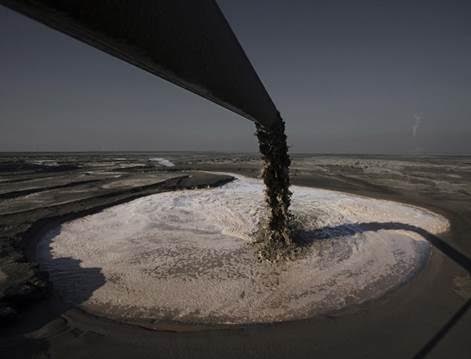
"The Gasping Pits And Poisonous Mounds Grew Hideously Clear." Toxic waste from the processing of rare earths pours into Lake Baotou in China's Inner Mongolia province. This is where 97 percent of the world's rare earths come from. Without them neither our smart phones nor our much vaunted "green technology" would work.
IT IS ONE of the most graphic passages in the whole of
J.R.R. Tolkien’s Lord of the Rings
trilogy. The description of the toxic desert on the outskirts of Mordor.
Inspired by the polluted landscapes surrounding Britain’s great industrial
cities in his youth, Tolkien employs the waste-dumps of Mordor as a metaphor
for the diseased and poisoned nature of the Dark Lord’s character. Just as the
ruined land is beyond all rehabilitation, so, too, is Sauron.
Here is Tolkien’s description of that terrible place:
“They had come to the desolation that lay before Mordor: the
lasting monument to the dark labour of its slaves that should endure when all
their purposes were made void; a land defiled, diseased beyond all healing –
unless the Great Sea should enter it and wash it with oblivion. ‘I feel sick,’
said Sam. Frodo did not speak.
For a while they stood there, like men on the edge of a
sleep where nightmare lurks, holding it off, though they know they can only
come to morning through shadows. The light broadened and hardened. The gasping
pits and poisonous mounds grew hideously clear. The sun was up, walking among
clouds and long flags of smoke, but even the sunlight was defiled. The hobbits
had no welcome for that light; unfriendly it seemed, revealing them in their
helplessness – little squeaking ghosts that wandered among the ash-heaps of the
Dark Lord.”
Throughout the fantasy, Tolkien takes great care to reassure
his readers that the “free peoples” of Middle Earth are at great pains to stand
aloof from Mordor and all its works. If, however, someone were to attempt to
describe the political economy of Middle Earth (at the end of the Third Age) it
would have to begin with the declining empire of Gondor and its vassal states,
Rohan and The Shire. A largely self-sufficient economic entity, such trade as
Gondor still engaged in was principally with the Dwarf kingdom located in the
Iron Hills, many hundreds of miles to the north. Tolkien hints that Gondor
might also have engaged in limited commerce with the kingdoms of the
“swertings” – the black-skinned peoples of the south – but only during the
period when the Dark Lord was believed to be dead.
There can be no doubt, however, that Mordor constituted the
economic powerhouse of Middle Earth. Like the ante-bellum South, Mordor boasted
vast plantations in which thousands of slaves produced the food and other
materials required for its sustenance. Any surplus was traded with the southern
kingdoms which had, since Sauron’s return, fallen steadily under Mordor’s sway.
Moreover, the Dark Lord’s military build-up, in preparation for his attack upon
Gondor, would have required the production of weapons on an industrial scale.
Mordor’s hunger for iron and other minerals must have been insatiable.
Deconstructing Tolkien’s great tale in this cold-eyed
economic fashion is, of course, anathema to LOTR
aficionados. The War of the Ring is supposed to be a battle between good and
evil, not an economic struggle between a rapidly industrialising, slave-owning
tyranny on the one hand, and an economically weak, largely agricultural,
kingdom without a king, on the other. Looked at in this fashion, it becomes
very clear, very quickly, that without the magical assistance rendered by
Gandalf and the Elves, Gondor would have been a gonner.
Cold-eyed and economically determined is, however, very
definitely the nature of the world in which we are required to live. A world
sadly lacking in magical beings dedicated to the protection of fading empires
and bucolic farming communities like the Shire. On Planet Earth, the rising
power of a tyrannical industrial powerhouse is unlikely to be checked by
anything remotely resembling wizards, elves or hobbits.
Where Tolkien’s fantasy and twenty-first century reality do
intersect, however, is in the environmental degradation attendant upon our
high-tech civilisation. The hideous pollution which Tolkien encountered in his
youth has, like the factories and mines that created it, largely disappeared
from England’s green and pleasant land. But this does not mean that Mordor-like
desolation is also a thing of the past. Mordor has merely shifted its location:
from the north of England and the midlands, to the seemingly limitless horizons
of Inner Mongolia and the horrors of Baotou.
Baotou is the global centre of rare earth production: the
place from which the minerals that make our post-modern, digitally-driven world
possible. Only in China is such an industrial complex possible, because the
inescapable environmental degradation attendant upon the extraction of Rare
Earths would never be tolerated in the democratic nations of the West.
Read how a team of BBC journalists and photographers
described their arrival at the man-made “lake” on the outskirts of Baotou. If
Mordor is anywhere in this world, then surely, it is here:
“We reached the shore, and looked across the lake. I’d seen
some photos before I left for Inner Mongolia, but nothing prepared me for the
sight. It’s a truly alien environment, dystopian and horrifying. The thought
that it is man-made depressed and terrified me, as did the realisation that
this was the by-product not just of the consumer electronics in my pocket, but
also green technologies like wind turbines and electric cars that we get so
smugly excited about in the West. Unsure of quite how to react, I take photos
and shoot video on my cerium polished iPhone.”
Baotou's Toxic Lake: "Nothing prepared me for the sight."
Tolkien’s great fantasy both reveals and conceals the true
nature of the world human-beings inhabit. The Ring of Power – symbol of the
ruthless instrumentalism through which humankind has subdued the planet – is
wonderfully conceived, but its ability to instruct the reader is fatally
weakened by Tolkien’s determination to make Good triumph over Evil.
The bitter truth, of course, is that all of us wear the Ring
of Power, all the time. And all of us are irredeemably engaged in the moral
self-destruction that use of the Ring inevitably entails. We New Zealanders may
be “sleepy hobbits”, dozing blissfully in our beautiful little Shire at the
world’s end, but that doesn’t stop us, when we’re awake, from using the
wondrous consumer goods Baotou’s rare earths make possible. Our ease, and the
bounteous lifestyle of which we are so proud (and of which the rest of the
world is so envious) only exists because somewhere, far, far away, in the
barren wilds of Inner Mongolia, giant pipes are continuously spewing their poisonous
brew into a lake so ruined, hideous and deadly, that Sauron, himself, would
blanche in horror.
This essay was
originally posted on The Daily Blog
of Saturday, 16 August 2015.
