Showing posts with label Lord of The Rings. Show all posts

Friday, 20 August 2021

The Men of the West’s Day Has Come – and Gone.

The Western Sun Sets: What nation, looking aghast at the chaos and confusion created by the United States precipitate withdrawal from Afghanistan, would consider putting its faith in American promises? What peoples, oppressed and abused though they may be by tyrannical regimes, will ever again look to the Western democracies for inspiration? What enemy of freedom and equality need any longer quail before the might of the West? The answers, tragically, are: “None.”

AS I WATCHED the big American helicopters circling the US Embassy in Kabul, I thought of Peter Jackson’s “Lord of the Rings”. As the smoke of burning files billowed out of the Embassy compound, I recalled Aragorn before the Black Gate of Mordor. As Sauron’s Orc legions marched towards the uncrowned King of Gondor’s vastly outnumbered army, he rallied his quailing knights with a speech that has always stuck in my memory:

“A day may come when the courage of men fails, when we forsake our friends and break all bonds of fellowship, but it is not this day. An hour of wolves and shattered shields, when the age of men comes crashing down! But it is not this day! This day we fight! By all that you hold dear on this good Earth, I bid you stand, Men of the West!”

In those stirring lines, Fran Walsh captures perfectly the chivalric Western ethos. The idea that an oath, once given, cannot be broken. That protection offered and accepted cannot be withdrawn unilaterally and arbitrarily. Most of all, that there is no greater sin than the betrayal and abandonment of the weak by the strong. Through all the blood and sweat and tears of our history. In spite of them being honoured more in the breach than in the execution – these have been the animating ideals of the “Men of the West”. The principles they strove to live by.

No more.

What nation, looking aghast at the chaos and confusion created by the United States precipitate withdrawal from Afghanistan, would consider putting its faith in American promises? What peoples, oppressed and abused though they may be by tyrannical regimes, will ever again look to the Western democracies for inspiration? What enemy of freedom and equality need any longer quail before the might of the West? The answers, tragically, are: “None.”

The true measure of the Afghanistan debacle will not be calculated in terms of the blood and treasure expended in that unhappy country. It will be calculated in terms of the loss of faith in the West’s word, and the West’s values, that the West’s betrayal and abandonment of the Afghan people – especially its women and girls – has provoked.

Henceforth, whenever anyone hears the “International Community” (a mealy-mouthed euphemism for the nations of North America, Europe and Australasia) warning some international miscreant against earning its displeasure, all that’s likely to be evoked is hollow laughter. It is difficult to imagine a more compelling miscreant than the Taliban, but it is equally difficult to imagine the Taliban losing too much sleep over what the “International Community” might do to it. After all, it’s been demonstrating its displeasure for twenty years with “Daisy Cutter” bombs, Cruise missiles, and “pinpoint” drone strikes, and all the “International Community” has achieved is the restoration of Taliban power.

And what about the nations not generally included in the “International Community”? What of the Russian Federation, the Islamic Republic of Iran, the Peoples Republic of China? What will they make of the West’s forsaking of its friends; its breaking of the bonds of fellowship?

What has happened, they will ask themselves, to the West that responded to Stalin’s provocations of 1948 with the Berlin Airlift? The West that met North Korea’s sudden southward thrust with a UN “Police Operation” that drove its forces back across the 38th Parallel, and which, thanks to the United States, has maintained a strong military presence in South Korea for nearly 70 years? The West that massed its armies against Saddam Hussein in 1990-91 and made good the promise of President George H.W. Bush that the Iraqi invasion of Kuwait “would not stand”. The West that, however imperfectly, and self-interestedly, kept its word?

Gone.

Writing for the Newsroom website earlier this week, Professor Robert Ayson, observed: “Kabul’s fall could be the last echo of a period when western governments believed their armed forces could knit together broken nations. Despite all of today’s talk about democratic values, the message is that we don’t really mind how you govern yourselves, or actually whether you govern yourselves, as long as you don’t harm us.”

But, cowering behind walls, while the rest of the world burns, is the policy of appeasers and defeatists. The Men of the West’s day has come – and they have not stood.


This essay was originally published in The Otago Daily Times and The Greymouth Star of Friday, 20 August 2021.

Wednesday, 5 October 2016

Sleepy Hobbits? Or, Something Worse?

At The Sign Of The Green Dragon: Have we really become “Sleepy Hobbits”? Or, something worse? The Scouring Of The Shire is, arguably, the most important chapter in J.R.R. Tolkien's Lord of the Rings trilogy. Far more than his thrilling depiction of the battles between Wizards, Orcs and Men, it shows how evil is born out of, and fed by, the fear and greed of ordinary, outwardly decent, individuals - even the Hobbits of the Shire.
 
ARE WE “SLEEPY HOBBITS” – or something worse? Certainly, it doesn’t sound very sinister. Martyn “Bomber” Bradbury’s description of the New Zealand electorate seems a lot more like gentle chiding than a full-blown assault. Kiwis are upbraided for their general failure to respond appropriately to the increasingly alarming news reaching their ears. Comparing them to the complacent patrons of Hobbiton’s Green Dragon, Martyn chastises New Zealanders for being much more interested in listening to gossip than hearing news.
 
Martyn’s characterisation acquires greater force, however, if his audience’s only reference point is Peter Jackson’s film version of Tolkien’s Lord of the Rings trilogy. Apparently, growing concerns about the project’s burgeoning length required Jackson to leave out what is, in many respects, the most powerful chapter of the entire trilogy – The Scouring of the Shire.
 
It is only when Frodo, Merry, Pippin and Sam return home that the universal impact of Sauron’s bid for absolute power strikes them. With a rising sense of outrage, and horror, they see that their beloved Shire has been transformed into what Tolkien clearly wants his readers to recognise as an industrial wasteland. Worse still, the Hobbits themselves are in the process of being industrialised. The sturdy peasants and artisans of the trilogy’s opening chapters, along with their aristocratic masters, are on the point of being turned into proletarians. They have been driven from their hobbit-holes and herded into barracks. Trees have been cut down. The old flour mill belches black smoke.
 
Not everyone, however, believes this to be a bad thing.
 
“This country wants waking up and setting to rights … and Sharkey’s going to do it; and make it hard, if you drive him to it. You need a bigger Boss. And you’ll get one before the year is out if there’s any more trouble. Then you’ll learn a thing or two, you little rat folk.”
 
Even some hobbits have succumbed to the new order. Ted Sandyman, the miller, scoffs at Sam’s anguish at the Shire’s obliterated beauty:
 
“Don’t ‘ee like it, Sam? … But you always was soft. I thought you’d gone off in one o’ them ships you used to prattle about, sailing, sailing. What d’you come back for? We’ve work to do in the Shire now.”
 
Given the way Jackson behaved when his “independent contractors” made a bid for better wages and conditions, it is, perhaps, unsurprising that he decided to keep The Scouring of the Shire out of his movie.
 
Tolkien makes it clear that tyranny warrants only one response from those it oppresses: rebellion and revolt. Led by the four veterans of the War of the Ring, the Hobbits rise up against “Sharkey”, the new “Boss”, and overthrow his new order. More importantly, they follow the disease to its source – the Wizard Saruman, whose magic, corrupted by Sauron, has wrought so much havoc, even in the Shire.
 
It is only in Jackson’s movie that the Hobbits (with the obvious exceptions of Bilbo, Frodo, Merry, Pippin and Sam) are portrayed as sleepy and complacent. The film version, similarly, misrepresents the Shire itself. According to Jackson, it is a happy (if utterly powerless) Utopia from which brave souls, very occasionally, venture out, but into which nothing untoward – excepting, briefly, Sauron’s Black Riders – ever venture in.
 
Tolkien’s fantasy is much more realistic. His Shire is not overthrown by rampaging Orcs, but by the fear and greed of its own inhabitants. As the steadfast Farmer Cotton explains to Frodo:
 
“It all began with Pimple, as we call him … and it began as soon as you’d gone off, Mr Frodo. He’d funny ideas, had Pimple. Seems he wanted to own everything himself, and then order other folk about. It soon came out that he already did own a sight more than was good for him; and he was always grabbing more, though where he got the money was a mystery: mills and malt-houses and inns, and farms, and leaf-plantations. He’d already bought Sandyman’s mill before he came to Bag End, seemingly.”
 
If that doesn’t remind New Zealanders of the fate of their own beautiful country, then Martyn’s right, we really have become “Sleepy Hobbits”! Or, maybe, something even worse. Could it be that we, too, have fallen victim to our own Pimples, our own Ted Sandymans? That far too many of us have allowed ourselves to be ordered around by the Shirrifs? The Boss? By Sharkey?
 
We must hope not. Because in our own case – in our own Shire – we cannot rely upon four returning heroes to put things right. “Raising the Shire” is something we will have to do on our own. Forging our own swords. Stringing our own bows. Summoning our own neighbours. Only when we have fashioned our own horns and bugles will we, like Tolkien’s Hobbits in revolt, be able to send their clarion blasts echoing across New Zealand’s fields, towns and cities:
 
Awake! Awake! Fear, Fire, Foes! Awake!
Fire, Foes! Awake!
 
This essay was originally posted on The Daily Blog of Tuesday, 4 October 2016.

Monday, 17 August 2015

The Desolation Of Mordor: Tolkien’s Fictional Wasteland Has Nothing On Baotou, The Worst Place On Earth.

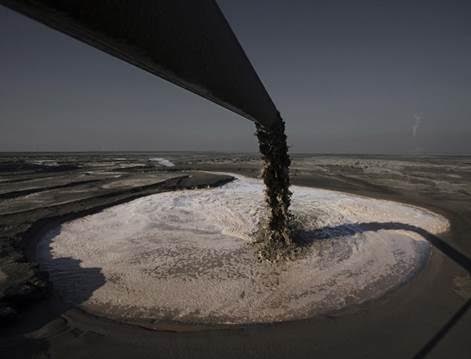
"The Gasping Pits And Poisonous Mounds Grew Hideously Clear." Toxic waste from the processing of rare earths pours into Lake Baotou in China's Inner Mongolia province. This is where 97 percent of the world's rare earths come from. Without them neither our smart phones nor our much vaunted "green technology" would work.
 
IT IS ONE of the most graphic passages in the whole of J.R.R. Tolkien’s Lord of the Rings trilogy. The description of the toxic desert on the outskirts of Mordor. Inspired by the polluted landscapes surrounding Britain’s great industrial cities in his youth, Tolkien employs the waste-dumps of Mordor as a metaphor for the diseased and poisoned nature of the Dark Lord’s character. Just as the ruined land is beyond all rehabilitation, so, too, is Sauron.
 
Here is Tolkien’s description of that terrible place:
 
“They had come to the desolation that lay before Mordor: the lasting monument to the dark labour of its slaves that should endure when all their purposes were made void; a land defiled, diseased beyond all healing – unless the Great Sea should enter it and wash it with oblivion. ‘I feel sick,’ said Sam. Frodo did not speak. 

For a while they stood there, like men on the edge of a sleep where nightmare lurks, holding it off, though they know they can only come to morning through shadows. The light broadened and hardened. The gasping pits and poisonous mounds grew hideously clear. The sun was up, walking among clouds and long flags of smoke, but even the sunlight was defiled. The hobbits had no welcome for that light; unfriendly it seemed, revealing them in their helplessness – little squeaking ghosts that wandered among the ash-heaps of the Dark Lord.”
 
Throughout the fantasy, Tolkien takes great care to reassure his readers that the “free peoples” of Middle Earth are at great pains to stand aloof from Mordor and all its works. If, however, someone were to attempt to describe the political economy of Middle Earth (at the end of the Third Age) it would have to begin with the declining empire of Gondor and its vassal states, Rohan and The Shire. A largely self-sufficient economic entity, such trade as Gondor still engaged in was principally with the Dwarf kingdom located in the Iron Hills, many hundreds of miles to the north. Tolkien hints that Gondor might also have engaged in limited commerce with the kingdoms of the “swertings” – the black-skinned peoples of the south – but only during the period when the Dark Lord was believed to be dead.
 
There can be no doubt, however, that Mordor constituted the economic powerhouse of Middle Earth. Like the ante-bellum South, Mordor boasted vast plantations in which thousands of slaves produced the food and other materials required for its sustenance. Any surplus was traded with the southern kingdoms which had, since Sauron’s return, fallen steadily under Mordor’s sway. Moreover, the Dark Lord’s military build-up, in preparation for his attack upon Gondor, would have required the production of weapons on an industrial scale. Mordor’s hunger for iron and other minerals must have been insatiable.
 
Deconstructing Tolkien’s great tale in this cold-eyed economic fashion is, of course, anathema to LOTR aficionados. The War of the Ring is supposed to be a battle between good and evil, not an economic struggle between a rapidly industrialising, slave-owning tyranny on the one hand, and an economically weak, largely agricultural, kingdom without a king, on the other. Looked at in this fashion, it becomes very clear, very quickly, that without the magical assistance rendered by Gandalf and the Elves, Gondor would have been a gonner.
 
Cold-eyed and economically determined is, however, very definitely the nature of the world in which we are required to live. A world sadly lacking in magical beings dedicated to the protection of fading empires and bucolic farming communities like the Shire. On Planet Earth, the rising power of a tyrannical industrial powerhouse is unlikely to be checked by anything remotely resembling wizards, elves or hobbits.
 
Where Tolkien’s fantasy and twenty-first century reality do intersect, however, is in the environmental degradation attendant upon our high-tech civilisation. The hideous pollution which Tolkien encountered in his youth has, like the factories and mines that created it, largely disappeared from England’s green and pleasant land. But this does not mean that Mordor-like desolation is also a thing of the past. Mordor has merely shifted its location: from the north of England and the midlands, to the seemingly limitless horizons of Inner Mongolia and the horrors of Baotou.
 
Baotou is the global centre of rare earth production: the place from which the minerals that make our post-modern, digitally-driven world possible. Only in China is such an industrial complex possible, because the inescapable environmental degradation attendant upon the extraction of Rare Earths would never be tolerated in the democratic nations of the West.
 
Read how a team of BBC journalists and photographers described their arrival at the man-made “lake” on the outskirts of Baotou. If Mordor is anywhere in this world, then surely, it is here:
 
“We reached the shore, and looked across the lake. I’d seen some photos before I left for Inner Mongolia, but nothing prepared me for the sight. It’s a truly alien environment, dystopian and horrifying. The thought that it is man-made depressed and terrified me, as did the realisation that this was the by-product not just of the consumer electronics in my pocket, but also green technologies like wind turbines and electric cars that we get so smugly excited about in the West. Unsure of quite how to react, I take photos and shoot video on my cerium polished iPhone.”
 
Baotou's Toxic Lake: "Nothing prepared me for the sight."
 
Tolkien’s great fantasy both reveals and conceals the true nature of the world human-beings inhabit. The Ring of Power – symbol of the ruthless instrumentalism through which humankind has subdued the planet – is wonderfully conceived, but its ability to instruct the reader is fatally weakened by Tolkien’s determination to make Good triumph over Evil.
 
The bitter truth, of course, is that all of us wear the Ring of Power, all the time. And all of us are irredeemably engaged in the moral self-destruction that use of the Ring inevitably entails. We New Zealanders may be “sleepy hobbits”, dozing blissfully in our beautiful little Shire at the world’s end, but that doesn’t stop us, when we’re awake, from using the wondrous consumer goods Baotou’s rare earths make possible. Our ease, and the bounteous lifestyle of which we are so proud (and of which the rest of the world is so envious) only exists because somewhere, far, far away, in the barren wilds of Inner Mongolia, giant pipes are continuously spewing their poisonous brew into a lake so ruined, hideous and deadly, that Sauron, himself, would blanche in horror.
 
This essay was originally posted on The Daily Blog of Saturday, 16 August 2015.